Search results
Search for "coordination" in Full Text gives 643 result(s) in Beilstein Journal of Organic Chemistry. Showing first 200.
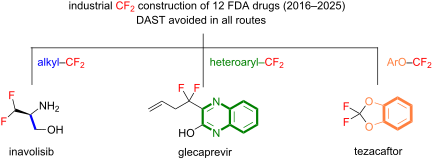
Construction of CF2 moieties in FDA-approved drugs (2016–2025): industrial routes, mechanisms, and scale-up considerations
Beilstein J. Org. Chem. 2026, 22, 1122–1150, doi:10.3762/bjoc.22.91


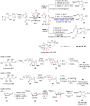




Rh(III)-catalyzed chelation-assisted C–H activation/annulation of 2-arylimidazolines with cyclic diazo-1,3-dicarbonyl compounds: a novel approach to tetracyclic annulated derivatives of 2,3-dihydroimidazo[2,1-a]isoquinoline
Beilstein J. Org. Chem. 2026, 22, 997–1003, doi:10.3762/bjoc.22.78
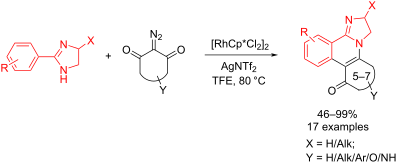
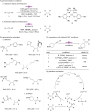
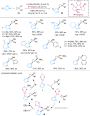
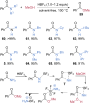
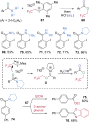
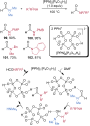
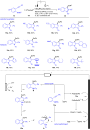
- intermediate B, followed by coordination of diazo compound 3 to give diazonium intermediate C. The latter transforms into a carbene complex D after nitrogen loss. The next intermediate E is a result of migratory insertion of the carbenoid into the C–Rh bond. The last step of the catalytic cycle is


Electrochemical reduction of unsaturated carbon–carbon bonds via 3d transition-metal catalysis
Beilstein J. Org. Chem. 2026, 22, 955–981, doi:10.3762/bjoc.22.75
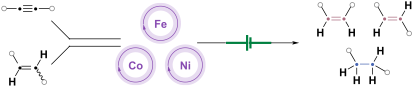
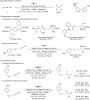
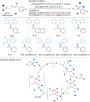
- stereoselective hydrogenation of alkynes under electrochemical and transition-metal-catalyzed conditions. The alkyne semihydrogenation generally benefits from the stronger coordination ability of the C–C triple bonds and the greater accessibility of metal-bound intermediates, thereby often enabling stereocontrol
- coordination to the low-valent iron species rather than proton-first pathways. In sharp contrast, stoichiometric experiments revealed that an independently prepared (P3P)Fe(II)–H species is largely unreactive toward internal alkynes (Scheme 1C, ii). Collectively, these findings strongly favor a hydride-free
- deuterium source (Scheme 5C) [102]. Cyclic voltammetry studies showed that, in the absence of dtbpy, only the Co(II)/Co(I) redox couple is accessible, whereas coordination of dtbpy enables electrochemical access to the Co(I)/Co(0) couple. Upon addition of AcOD, either alone or in combination with alkyne and








Recent advances in copper-catalyzed direct hydroamination of alkenes with (hetero)aromatic amines
Beilstein J. Org. Chem. 2026, 22, 925–947, doi:10.3762/bjoc.22.73
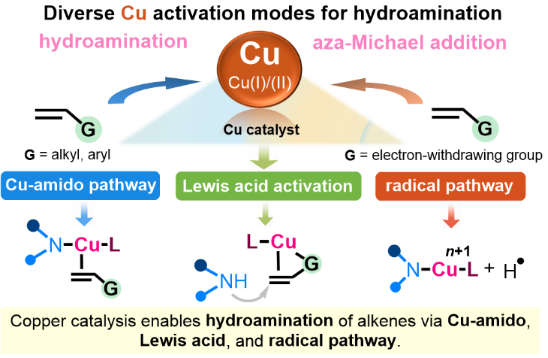
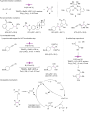
- coordination behavior of these substrates render such transformations inherently challenging. Recently, copper catalysis has emerged as a versatile and practical platform for addressing these limitations. Owing to its redox flexibility and ligand tunability, copper facilitates multiple activation modes
- aza-heterocycles often exhibit attenuated nucleophilicity, distinct acidity profiles, and potential coordination to metal centers, all of which can significantly influence catalytic reactivity and selectivity [20]. Therefore, the development of catalytic systems that can accommodate the unique
- –amido intermediate or aminocupration-type pathways, enabling efficient C–N bond formation under relatively mild conditions. Copper species may also operate in a Lewis acid-type capacity, where coordination to the alkene or copper-derived Brønsted acidity generated in situ increases alkene







Diastereodivergent electrophilic trapping of α-boryl lithium derivatives
Beilstein J. Org. Chem. 2026, 22, 882–887, doi:10.3762/bjoc.22.68
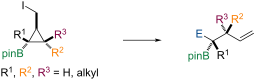
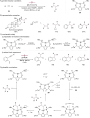
- results suggest that the stereochemical outcome is independent of the initial configuration at C2 and is instead dictated by conformational preferences of the α-boryl lithium intermediate. A simplified steric model is proposed in which lithium coordination induces a pseudo-chelated structure that controls
- task [25][26][27]. The electronic character of these intermediates, especially for boronic ester derivatives that allow coordination between oxygen atoms and the metal counterion, complicates predictable stereochemical outcome. Developing strategies to harness the exceptional nature of these carbanions
- revealed that the electrophile preferentially approaches from the face opposite the coordinating lithium cation, with the lowest-energy transition state stabilized by a lithium cation–vinyl interaction (see A in Scheme 1) [34]. Results and Discussion The intricate interplay of the coordination and steric




The trans-influence in gold chemistry from a catalytic perspective
Beilstein J. Org. Chem. 2026, 22, 838–856, doi:10.3762/bjoc.22.66
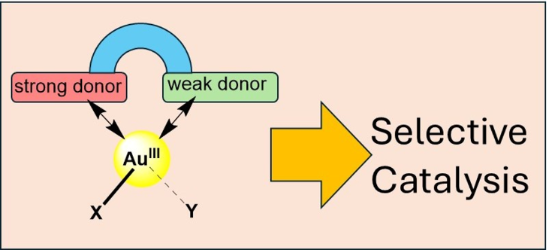
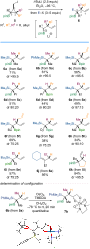
- occupied molecular orbitals (HOMO, HOMO−1, HOMO−2, HOMO−3). According to natural bond orbital analysis, the Au–CO coordination involves a single bond, with major contributions from the gold 6s, 6py, and 6dx²−y² molecular orbitals [12][30]. The Au–CO adduct is therefore best regarded as a σ-complex. These
- the range of dianionic C^C chelates to dicarboranyls highlights the effects of electronic characteristics. For example, while the removal of a trifluoroacetate ligand by B(C6F5)3 can usually be relied upon to quantitatively create a vacant coordination site [27][28][29], in the case of 7 this method
- of radicals. Also, the reaction was surprisingly accelerated by water. The findings are in agreement with another type of cooperative bimolecular mechanism, where the vacant coordination site required for alkyne binding is generated not by a radical initiator but apparently by the reductive


Knoevenagel condensation of 4,5- and 1,8-diazafluorenes
Beilstein J. Org. Chem. 2026, 22, 803–812, doi:10.3762/bjoc.22.62
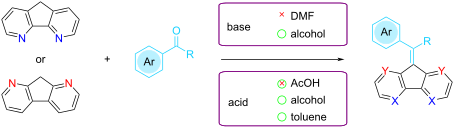
- products’ structure, physicochemical properties and coordination behavior (for 4,5-derivative). Both 4,5- and 1,8-diazafluorenes reacted with di(pyrid-2-yl)ketone forming di(pyridin-2-yl)methylene)-9H-4,5-diazafluorene (4,5-DPDAF) and 9-(di(pyridin-2-yl)methylene)-9H-1,8-diazafluorene (1,8-DPDAF) in 54
- molecules form stacks, while in the complex the dimers with Zn form a herringbone packing. The complex Zn–4,5-DPDAF represents a unique cyclic dimer structure and highlights a high potential of diazafluorenylidenes for coordination chemistry and materials science. Conclusion In summary, we elaborated




Synthesis of heterocycles based on azomethine ylides from α-amino acids (or amines) and carbonyl compounds
Beilstein J. Org. Chem. 2026, 22, 705–741, doi:10.3762/bjoc.22.55
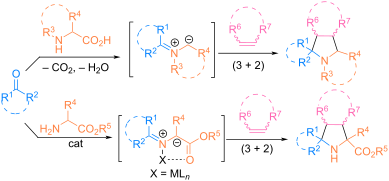
- hypothesized that when ligand L8 is utilized, throughout the entire catalytic cycle both the nitrogen and phosphorus atoms of the ligand maintain their coordination to copper. The final product 16 is formed as a consequence of electron redistribution within the metal-ligand assembly, coupled with steric
- absence of interaction between the metal and the electron-withdrawing group of the dipolarophile, and the coordination properties of the metal, for example, the possibility of changing the coordination sphere of copper(I) from bidentate to monodentate, which does not occur with the Ag(I) atom, which has
- derivatives 54 from readily available optically pure amino acids without any external chiral additives [4] (Scheme 24). Deprotonation and coordination of optically active imines 52, obtained from various natural or synthetic α-amino acids, such as ʟ-alanine, ʟ-tryptophan, ʟ-aspartic acid, ʟ-glutamic acid, ʟ


Hydrogen production from formic acid catalyzed by NHC–Cu complexes
Beilstein J. Org. Chem. 2026, 22, 620–627, doi:10.3762/bjoc.22.48
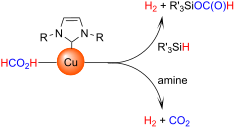
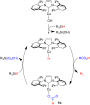
- deprotonation of the acid; indeed, their coordination to the copper center must also be taken into account [45]. Moreover, the reaction between FA and amines occurs in a more complex manner than a common acid–base equilibrium. In fact, calorimetric studies on the formation of FA/triethylamine adducts showed



Synthesis and uranyl(VI) extraction performance of a calix[4]pyrrole–tetrahydroxamic acid receptor
Beilstein J. Org. Chem. 2026, 22, 486–494, doi:10.3762/bjoc.22.36
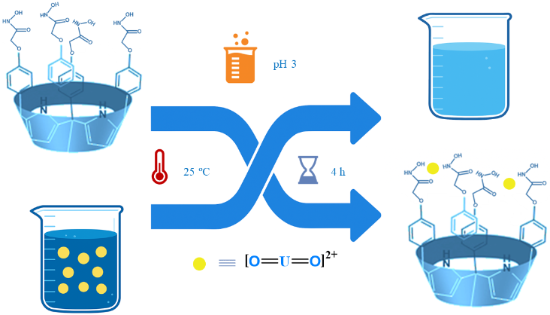
- , removing up to 95% of uranyl(VI) from aqueous solutions (1 mM) at acidic pH, likely due to the strong coordination provided by its hydroxamic acid groups. Further studies revealed that the extraction efficiency also depends on the ligand-to-metal molar ratio. These findings establish PCP HA as a promising
- and have found diverse applications across both biomedical and industrial fields [25][26]. Hydroxamic acids are also well known for their strong chelating ability toward uranyl, forming stable complexes through the synergistic coordination of the carbonyl and hydroxylamine groups [27]. Uranium is a
- deprotonation. The coordination of the hydroxamic acid groups to the uranyl cation stabilizes the deprotonated hydroxamate form, effectively lowering the apparent pKa and enabling strong binding even at low pH [33]. It is important to mention that the formation of the stable 5-membered chelate between the


Recent advances in the cleavage of non-activated amides
Beilstein J. Org. Chem. 2026, 22, 352–369, doi:10.3762/bjoc.22.23
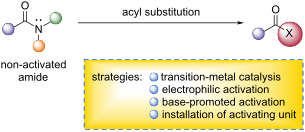
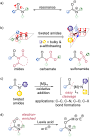
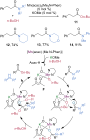
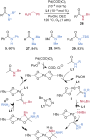
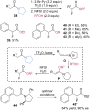
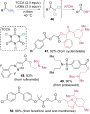
- employed as reliable tools to activate amide bonds through coordination with the amide oxygen lone pair [45]. Although the substrate scope of such methods remains limited, several successful examples with hindered amides have recently been reported. In 2019, Shimizu et al. reported the esterification of
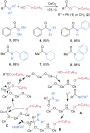
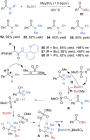
- restored after recalcination prior to reuse. Based on DFT calculations, the authors proposed that octanol is deprotonated and coordinated to Ce, while the amide substrate is simultaneously activated electrophilically through coordination to the Ce center (A). This dual activation enables the lattice oxygen
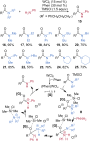
- that coordination of the amide oxygen to the Lewis-acidic sites of Nb activates the amide toward nucleophilic attack. Simultaneously, water is pre-adsorbed on the basic oxygen sites of Nb2O5, enabling nucleophilic attack on the activated carbonyl center (D). Following amine release from the resulting










Ring contraction and ring expansion reactions in terpenoid biosynthesis and their application to total synthesis
Beilstein J. Org. Chem. 2026, 22, 289–343, doi:10.3762/bjoc.22.21
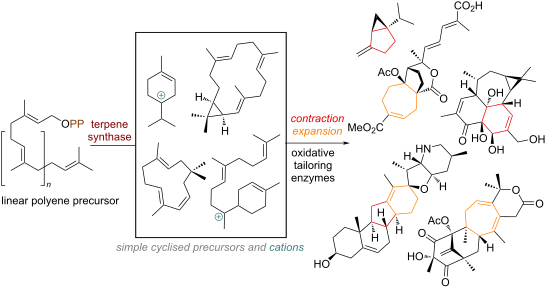
- included [48][49]. These enzymes exhibit distinctly different Fe-containing active sites, typically consisting of two histidines, a carboxylate ligand (e.g., aspartate) and, of course, the ketoglutarate which is bound both via the C-2 ketone and C-1 carboxylate to form 1 (Scheme 1C). Upon its coordination






Arene activation via π-bond localization: concepts and opportunities
Beilstein J. Org. Chem. 2026, 22, 257–273, doi:10.3762/bjoc.22.19
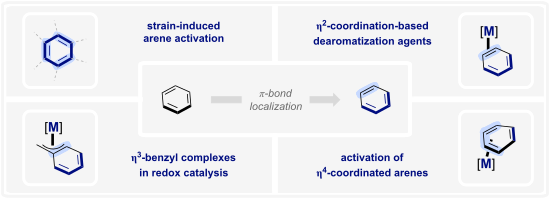
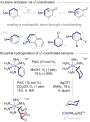
- as well as transition metal coordination to aromatic fragments in an η2-, η3-, and η4-fashion. The structural and reactivity consequences of these perturbations are analyzed in detail, and representative examples of stoichiometric and, where available, catalytic applications in synthesis are
- structure and reactivity. The following chapters introduce the broader mechanistic framework of transition metal coordination to a subset of the aromatic system, specifically η2-, η3-, and η4-coordination. These partial coordination modes effectively clamp the otherwise delocalized π-system, disrupting
- activation, such as the η6-coordination of arenes by π-Lewis acids, are specifically not included in this classification as the π-bonds remain fully delocalized and these modes have been extensively reviewed elsewhere [14][15]. Review Small-ring strain-induced arene activation Historical context The concept




Design and synthesis of an axially chiral platinum(II) complex and its CPL properties in PMMA matrix
Beilstein J. Org. Chem. 2026, 22, 143–150, doi:10.3762/bjoc.22.7
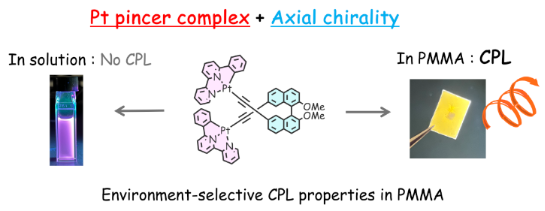
- chiral platinum(II) complex was synthesized via Sonogashira coupling and subsequent coordination of a pincer ligand to a precursor. The complex exhibited a broad absorption band ranging from 250 to 550 nm in the UV–vis spectrum, with TD-DFT calculations indicating mixed ligand-to-ligand charge transfer
- than the 80–100° range typically reported for the most stable conformation of binaphthyl groups [24]. In contrast, the dihedral angles between the binaphthyl unit and the coordination plane were 54° and 52°, respectively. The UV–vis spectral simulation based on electronic transition obtained from time
- ethynyl-linked coordination sites. Therefore, we prepared a PMMA polymer matrix containing 1 wt % of S/R-Pt to investigate the emission behavior under conditions where molecular motion was suppressed. The PMMA matrix was obtained by dissolving S/R-Pt and PMMA in chloroform under heating at 40 °C, casting


Highly electrophilic, gem- and spiro-activated trichloromethylnitrocyclopropanes: synthesis and structure
Beilstein J. Org. Chem. 2026, 22, 123–130, doi:10.3762/bjoc.22.5
- -crystal X-ray diffraction analysis. Experimental Physicochemical studies were performed using the equipment of the Center for Collective Use "Physicochemical methods for the study of nitro compounds, coordination, biologically active substances and nanostructured materials" of the Interdisciplinary


Total synthesis of natural products based on hydrogenation of aromatic rings
Beilstein J. Org. Chem. 2026, 22, 88–122, doi:10.3762/bjoc.22.4
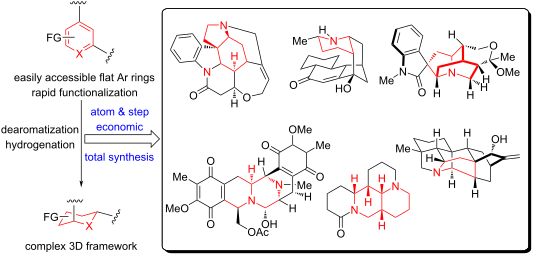
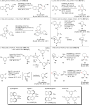
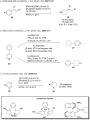
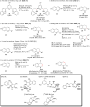
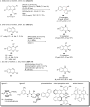
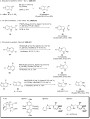
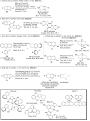
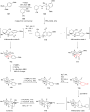
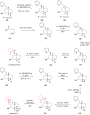
- the catalyst itself, a central scientific challenge is how to maintain high catalytic activity throughout the reaction, while preventing deactivation caused by coordination of heteroatoms that may be present in the reduced products. While the following subsections categorize hydrogenation strategies











Advances in Zr-mediated radical transformations and applications to total synthesis
Beilstein J. Org. Chem. 2026, 22, 71–87, doi:10.3762/bjoc.22.3
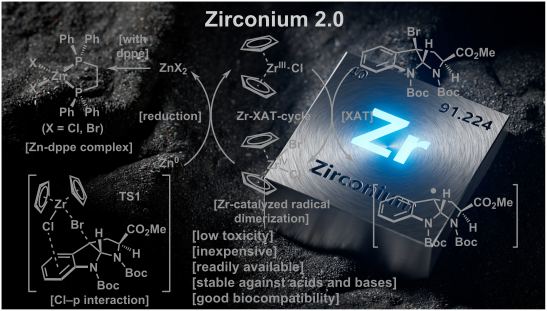
- experiments, coordination of thiourea 26 to the Zr center was suggested. This effect is considered to have tuned the reactivity of the Zr-catalyst, thereby having a positive effect on the reaction process. Finally, the regioselectivity of epoxide ring opening was compared between low-valent titanocene and








Palladium-catalyzed regioselective C1-selective nitration of carbazoles
Beilstein J. Org. Chem. 2025, 21, 2479–2488, doi:10.3762/bjoc.21.190
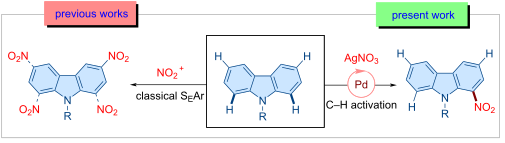
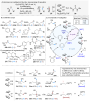
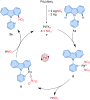
- ][78][79][80], a plausible catalytic cycle is proposed (Figure 2). The catalytic cycle commences with the formation of active palladium(II) species 7 in the presence of AgNO3. Coordination of the pyridyl group of 1a to Pd(NO₃)₂ is followed by irreversible C–H bond cleavage via cyclopalladation to form


Catalytic enantioselective synthesis of selenium-containing atropisomers via C–Se bond formations
Beilstein J. Org. Chem. 2025, 21, 2447–2455, doi:10.3762/bjoc.21.186
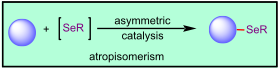
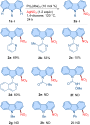
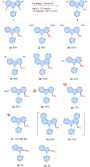
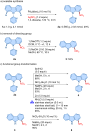
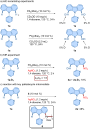
- has emerged as a powerful strategy for the rapid synthesis of functionally enriched axially chiral diaryl compounds. However, due to the potential strong coordination between organoselenium compounds and transition metals, the direct construction of C–Se bonds via metal-catalyzed C–H bond




Pathway economy in cyclization of 1,n-enynes
Beilstein J. Org. Chem. 2025, 21, 2260–2282, doi:10.3762/bjoc.21.173
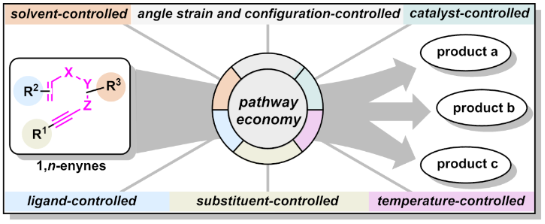
- under gold(I) catalysis through a substituent-controlled strategy (Scheme 8) [15]. Substrates with heteroaryl substituents underwent 6-endo-dig cyclization via gold-heteroatom coordination, furnishing the lactone-fused pyran scaffold 34 (Scheme 8, path a). Substrates with aryl substituents at the
- -substituted internal alkynes underwent exclusive 8-endo-dig cyclization, efficiently delivering the strained dibenzo[b,d]azocine 56 (Scheme 12, path b). Distinct activation modes governed the selectivity, where regioselective terminal gold coordination triggered 7-exo-dig cyclization in terminal alkynes
- of ortho-cyclized products 80, enabled by coordination to both the directing group and alkyne (Scheme 17, path a). However, the rigid electron-rich XPhos ligand (L2) promoted para-cyclization due to steric constraints and π–π stacking to yield dihydroquinoline derivatives 82 (Scheme 17, path b). This


Electrochemical cyclization of alkynes to construct five-membered nitrogen-heterocyclic rings
Beilstein J. Org. Chem. 2025, 21, 2173–2201, doi:10.3762/bjoc.21.166
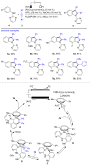
- five-membered rhodacycle B, which underwent alkyne coordination followed by nucleophilic cyclization with 20a to give the biindolyl–Rh species D. The reductive elimination of D produced the bisindole-ligated CpxRhI intermediate E, which performed anodic oxidation to finish 21a and regenerate A. Notably
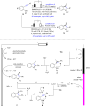
- ), Cu(OAc)2-H2O (0.0125 mmol) and N,N-dimethylacetamide (DMA, 4.0 mL), under electrolysis (RVC anode, Pt cathode, 6.0 mA) at 100 °C for 6 h. According to the experimental results, a proposed mechanism was outlined. Firstly, treatment of NaOPiv (0.25 mmol) with Cu(OAc)2-H2O formed Cu(OPiv)2. Coordination
- . Coordination of 29a with I− produced the iodonium species A, which was transformed to vinyl iodide B by intramolecular 5-exo-dig iodocyclization. The deprotonation/anodic oxidation of B gave the radical cation D via C. The second deprotonation/anodic oxidation produced F, which was transformed into stable









Asymmetric total synthesis of tricyclic prostaglandin D2 metabolite methyl ester via oxidative radical cyclization
Beilstein J. Org. Chem. 2025, 21, 1964–1972, doi:10.3762/bjoc.21.152
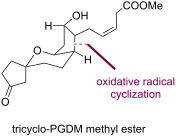
- intermediate 22 (see Supporting Information File 1 for the details). Reasoning that the preferential coordination of the palladium catalyst with the hydroxy group at C15 and the carbonyl group at C18 in compound 22 may have deactivated the palladium catalyst [34], we protected the hydroxy group. Compound 22

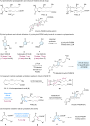


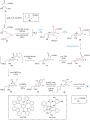
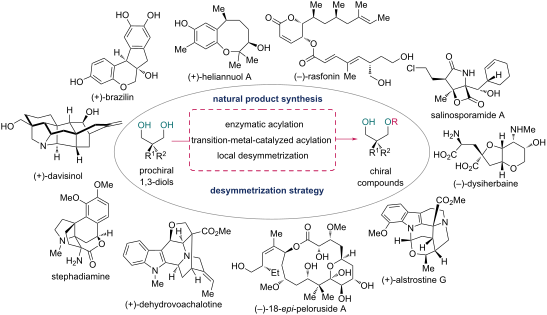
Enantioselective desymmetrization strategy of prochiral 1,3-diols in natural product synthesis
Beilstein J. Org. Chem. 2025, 21, 1932–1963, doi:10.3762/bjoc.21.151
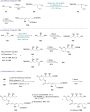
- enhanced the reaction performance. However, excessively bulky substituents at C4 and substitutions at both C4 and C5 hindered the coordination between substrate and catalyst, and led to reduced enantioselectivity. As to the structure of 128, the electronic effect of the bromo-substituted pyridine moiety
- favored complexation, while the phenyl substitution at C4 promoted a stable coordination-bond formation. Alternatively, (S)-130 could be furnished using Cu complex 129 in the desymmetrization step with comparable efficiency (98% yield and 91% ee), and was likewise transformed into 131 in four steps
- differential ability between two hydroxy groups, while bulky substituents hindered the formation of coordination bonds between the substrate and catalyst. As previously reported, with a suitable substituent at C4, an additional C5-substituent slightly enhanced the catalytic performance of the complex [62]. For










Photoswitches beyond azobenzene: a beginner’s guide
Beilstein J. Org. Chem. 2025, 21, 1808–1853, doi:10.3762/bjoc.21.143
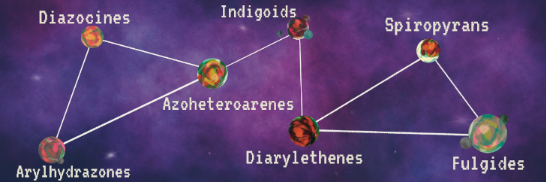
- picoseconds to several years. The presence of heteroatoms also introduces H-bond donors and acceptors and metal coordination sites [11]. Like azobenzenes, E–Z isomerisation of azoheteroarenes can be triggered by light irradiation, while Z–E isomerisation proceeds through irradiation with a different
- crystalline optical oscillators (Figure 8) [45]. The Herges group reported a photoinduced magnetic spin change of a Ni(II) porphyrine. The spin change was caused by the reversible coordination of azopyridine 33 to the Ni(II), which was only possible in the E-isomer (Scheme 8) [46]. The Han group reported a
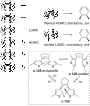
- stabilises one of the two isomers via the formation of a hydrogen bond (Scheme 30) [95]. This peculiarity makes this photoswitch class extremely susceptible to solvent polarity [96][97][98], pH [98][99][100][101], and metal coordination [102][103][104]. With such variability, predicting which is the most




Research progress on calixarene/pillararene-based controlled drug release systems
Beilstein J. Org. Chem. 2025, 21, 1757–1785, doi:10.3762/bjoc.21.139
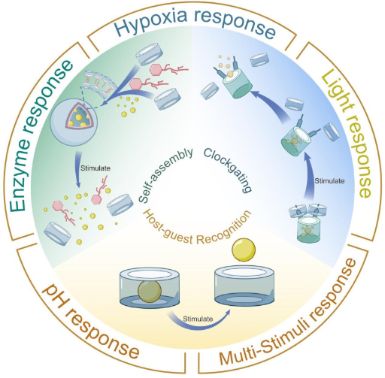
- processes. For example, supramolecular self-assembly technology enhances the targeting of chemotherapeutic drugs to tumor tissues, reducing systemic adverse reactions. (3) Macrocyclic aromatic supramolecular nano-valves have a pseudo-rotaxane structure with host–guest coordination and the kinetic properties