


Search results
Search for "cantilever" in Full Text gives 315 result(s) in Beilstein Journal of Nanotechnology. Showing first 200.
Stiffness calibration of qPlus sensors at low temperature through thermal noise measurements
Beilstein J. Nanotechnol. 2024, 15, 580–602, doi:10.3762/bjnano.15.50
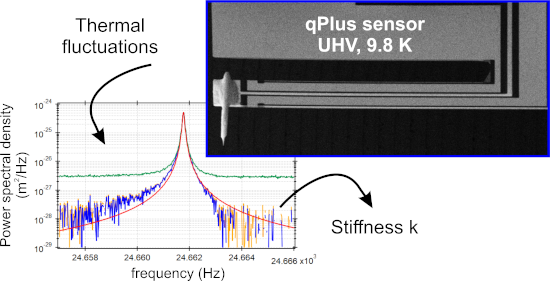
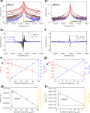
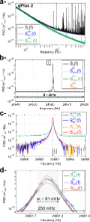
- little precision. An accurate stiffness calibration is therefore mandatory if accurate force measurements are targeted. In nc-AFM, the probe may either be a silicon cantilever, a quartz tuning fork (QTF), or a length extensional resonator (LER). When used in ultrahigh vacuum (UHV) and at low temperature
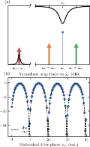
- Calibration Methods: A Brief Review This section reminds some salient results about stiffness calibration methods reported in the literature, which forms the context of the present study. In the following, unless specified otherwise, the word “probe” either means a silicon cantilever or the free prong of a
- Equation 5. As for Q2 and Q3, there are few results in the literature on how they are expected to vary in UHV. Usually, the quality factor decreases with n (cf. [87] and silicon cantilever P5 in [56]). We therefore have set arbitrary values following that trend. The simulated temperature is 9.8 K. We first

Design, fabrication, and characterization of kinetic-inductive force sensors for scanning probe applications
Beilstein J. Nanotechnol. 2024, 15, 242–255, doi:10.3762/bjnano.15.23
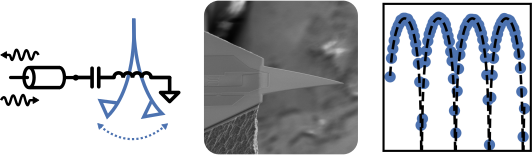
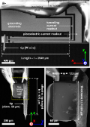
- microscopy based on electromechanical coupling due to a strain-dependent kinetic inductance of a superconducting nanowire. The force sensor is a bending triangular plate (cantilever) whose deflection is measured via a shift in the resonant frequency of a high-Q superconducting microwave resonator at 4.5 GHz
- the coupling to the transmission line used to measure the microwave resonance. A detailed description of our fabrication is presented, including information about the process parameters used for each layer. We also discuss the fabrication of sharp tips on the cantilever using focused electron beam
- , gravitational waves acting on a 40 kg mirror in LIGO [3], or atomic-scale tip–surface forces acting on a 40 pg cantilever in an atomic force microscope (AFM). For AFM cantilevers operating at room temperature close to their fundamental resonant frequency in the kilohertz-to-megahertz range, optical



Quantitative wear evaluation of tips based on sharp structures
Beilstein J. Nanotechnol. 2024, 15, 230–241, doi:10.3762/bjnano.15.22
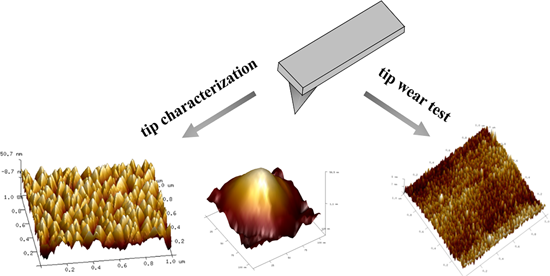
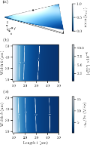
- , making it ideal for reverse imaging of the AFM probe tip to detect tip wear. AFM images were acquired using a Bruker Icon AFM system in tapping mode. The AFM probe used for AFM imaging was a Bruker FESPA-V2 probe. The cantilever was 225 µm long, 35 µm wide, and had a spring constant of 2.8 N/m. The
- working distance of 10–15 mm. Figure 7 presents an SEM image showcasing a probe tip with a rectangular cantilever and a triangular pyramid shape. The actual 3D morphology of the probe obtained using the 3D scanning results of the sample is shown in Figure 8. The analysis of the contour map of the probe
- scan images of the TipCheck sample. (a) 2D topography image and (b) 3D topography image. Extraction of scan line feature points. SEM images of AFM tips. (a) Image of tip and cantilever beam and (b) image of the tip; the dotted frame is a partially enlarged view of the tip. Reconstructed probe model. (a




Enhanced feedback performance in off-resonance AFM modes through pulse train sampling
Beilstein J. Nanotechnol. 2024, 15, 134–143, doi:10.3762/bjnano.15.13
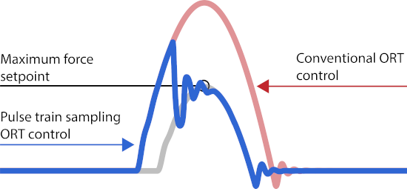
- at frequencies far away from the resonance frequency of the cantilever (off-resonance tapping (ORT) modes) can provide high-resolution imaging of a wide range of sample types, including biological samples, soft polymers, and hard materials. These modes offer precise and stable control of vertical
- reads the deflection of the cantilever and keeps the applied tip–sample vertical force at a fixed setpoint value by adjusting the voltage applied to a Z axis nano-positioner. While this AFM mode achieves high precision in controlling vertical forces, the high lateral forces applied while scanning limits
- the application of this AFM method when gentle and non-damaging imaging is required, for instance on soft biological materials [1]. In order to make the instrument technique suitable for imaging fragile samples, several dynamic modes that rely on the resonance characteristics of the cantilever have


Determination of the radii of coated and uncoated silicon AFM sharp tips using a height calibration standard grating and a nonlinear regression function
Beilstein J. Nanotechnol. 2023, 14, 1200–1207, doi:10.3762/bjnano.14.99
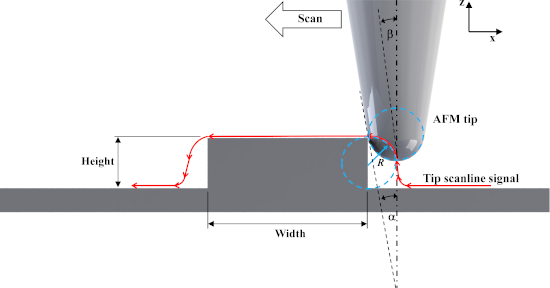
- strongly depend on the geometry of the AFM tip [7][8]. For example, the Pt-coated HQ:NSC18/Pt tip (for electrical force modulation AFM probes) and the Cr/Au-coated HQ:NSC16/Cr-Au tip (for tapping mode AFM probes with long AFM cantilever) produced by MikroMasch [9] have estimated nominal tip radii lower
- very sharp tips that can make a smaller difference in the scanned profile offset at the corners of the characterizer. A method for characterizing blunt tips was also demonstrated. Nanoindentation using four blunt tips on an AFM cantilever was performed in a normal loading process on a soft PVC sheet
- this measurement, the tip radius profile can be directly determined by the deflection and position signal of the AFM cantilever during contact between that edge surface and the tip end. Our point of interest for determining the tip radius using this standard grate is that the corner edge of the grate


Spatial variations of conductivity of self-assembled monolayers of dodecanethiol on Au/mica and Au/Si substrates
Beilstein J. Nanotechnol. 2023, 14, 1169–1177, doi:10.3762/bjnano.14.97
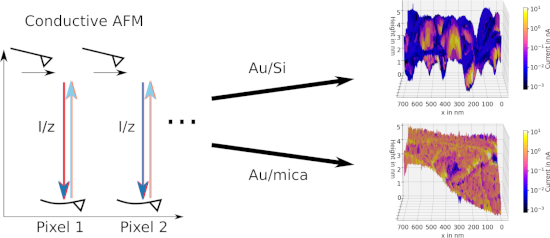
- . In this mode of CAFM operation, a force–distance curve is measured at every pixel of the image. The tip is approached until a certain bend of the cantilever is reached, corresponding to the force setpoint Fsetpoint. Plotting the z position at which the force setpoint is reached provides the


Dual-heterodyne Kelvin probe force microscopy
Beilstein J. Nanotechnol. 2023, 14, 1068–1084, doi:10.3762/bjnano.14.88
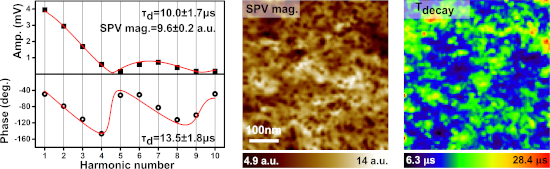
- time-periodic surface electrostatic potential generated under optical (or electrical) pumping with an atomic force microscope. The modulus and phase coefficients are probed by exploiting a double heterodyne frequency mixing effect between the mechanical oscillation of the cantilever, modulated
- components of the time-periodic electrostatic potential at harmonic frequencies of the pump, and an ac bias modulation signal. Each harmonic can be selectively transferred to the second cantilever eigenmode. We show how phase coherent sideband generation and signal demodulation at the second eigenmode can be
- with the application of a light pulse (i.e., a curve is recorded at each point of the surface along a 2D grid). Again, a differential SPV image can be reconstructed from the matrix of spectroscopic curves [5]. However, this approach is not free from artefacts, in particular the cantilever photothermal




Spatial mapping of photovoltage and light-induced displacement of on-chip coupled piezo/photodiodes by Kelvin probe force microscopy under modulated illumination
Beilstein J. Nanotechnol. 2023, 14, 1059–1067, doi:10.3762/bjnano.14.87
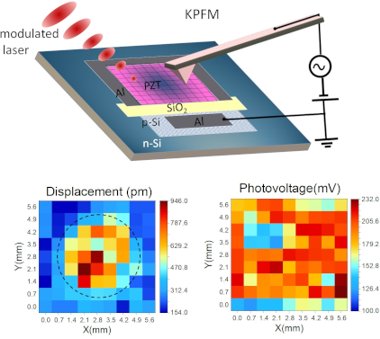
- KPFM shown in Figure 1a illustrates multiple lock-in amplifiers employed to excite the cantilever both mechanically and electrically at the same time, and to retrieve simultaneously the amplitude and phase of the movement of the cantilever at different frequencies. The cantilever is excited at its
- the cantilever resonance. Modulating the tip with VAC while the cantilever is oscillating near its resonance frequency leads to frequency mixing and intermodulation of the two frequencies (f0 ± fAC) [34]. The lock-in amplifiers 2 and 3 are fed with the vertical deflection signal of the cantilever to
- measure the sideband signals at f0 + fAC and f0 − fAC. Then, their average is used for the KPFM feedback to adjust the DC bias. If fAC is chosen to be small enough, such that the sideband peaks are close to f0, the amplitude of these peaks will be enhanced by the mechanical resonance of the cantilever


Exploring internal structures and properties of terpolymer fibers via real-space characterizations
Beilstein J. Nanotechnol. 2023, 14, 1004–1017, doi:10.3762/bjnano.14.83
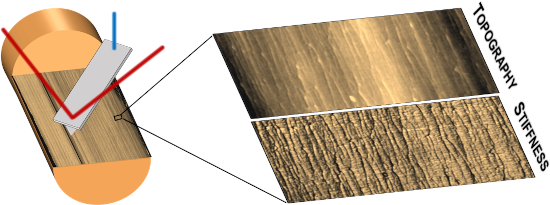
- N/m (nominal), k = 12–21 N/m (measured)) were used for AFM scans. By simultaneously exciting the AFM cantilever to its first and second resonance (f1 = 160–190 kHz and f2 = 900–1150 kHz, Figure 1c) and applying two distinct control conditions (amplitude modulation (AM) and frequency modulation (FM
- . Dashed line highlights a shear plane between the two notches. The fiber readily opens along this plane, exposing internal fiber surfaces for characterization. (c) Multifrequency AFM schematic. A cantilever is driven by a blue laser that simultaneously excites the cantilever at its first and second
- resonance frequencies (f1 and f2). The response of the cantilever as it scans across the exposed internal fiber surface provides information about the local fiber internal morphology and mechanical response (stiffness and transverse elastic modulus (ET)). Fiber-wide Technora® AFM maps. (a) Topography map






Cross-sectional Kelvin probe force microscopy on III–V epitaxial multilayer stacks: challenges and perspectives
Beilstein J. Nanotechnol. 2023, 14, 725–737, doi:10.3762/bjnano.14.59
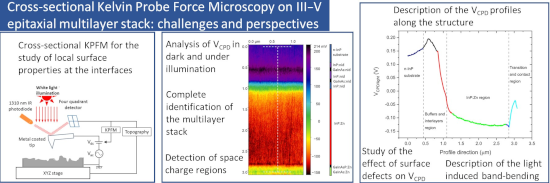
- the cantilever are reduced, as well as the effect of parasitic capacitances [16]. Additionally, in FM-KPFM, surface potential measurements are less dependent on the lift-height tip–sample distance than in AM-KPFM since this mode is less sensitive to static offsets induced by capacitive coupling or
- + dc potential is applied, the KPFM tip scans across a surface. The ac signal is sinusoidal with a frequency that equals the mechanical resonance of the cantilever. The four-quadrant detector gives feedback in order to minimize cantilever oscillation modifying the dc signal providing the sample surface


High–low Kelvin probe force spectroscopy for measuring the interface state density
Beilstein J. Nanotechnol. 2023, 14, 175–189, doi:10.3762/bjnano.14.18
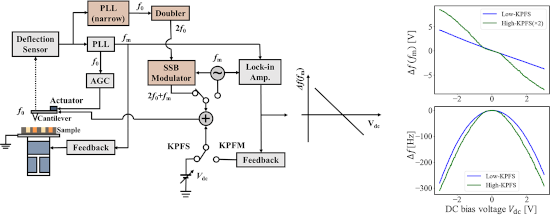
- advantages, namely high sensitivity to the electrostatic force gradient, high detection sensitivity using a cantilever with a weak spring constant at the first resonance, ease of implementation in adding FM-AFM, and no need to enhance the bandwidth of the cantilever deflection sensor. FM-KPFM is used to
- apply an AC bias voltage at frequencies lower than the cutoff frequency fc of carrier transport, and heterodyne FM-KPFM, based on the heterodyne effect (frequency conversion effect) between mechanical oscillation of the cantilever and electrostatic force oscillation, is used to apply an AC bias voltage
- vibrating cantilever are A and f0, respectively. The time-varying tip–sample distance is given by From this equation and the relationship Cg = ε0/z, we obtain the following expression: Because of frequency mixing between the electrostatic force due to the AC bias voltage cos 2πfmt and the cantilever



Intermodal coupling spectroscopy of mechanical modes in microcantilevers
Beilstein J. Nanotechnol. 2023, 14, 123–132, doi:10.3762/bjnano.14.13
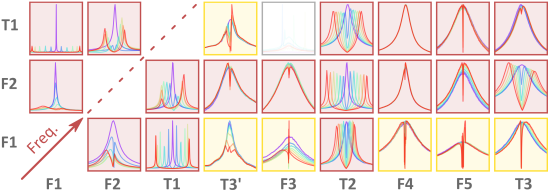
- opportunity to bring intermodal coupling techniques, derived from optomechanics, to AFM. It is easily accessible, with no hardware modifications and only requiring multifrequency excitation applied to the cantilever by either a piezoshaker or a modulated laser, found in many AFM setups. The field of
- excitation of the first mode of a cantilever with measurements being performed at its harmonics [37]. Another method involved clever designs such as T-shaped cantilevers [38] and inner-paddled cantilevers [39] aiming at reducing the noise impact on force reconstruction. Bimodal AFM is another addition to the
- field, where two eigenmodes are excited and read simultaneously [40]. Last, intermodulation products, created by two signals close to the fundamental cantilever mode, form a sea of evenly spaced tones to be measured [35][41][42]. All of these rely on the nonlinear tip–surface force to create these


Characterisation of a micrometer-scale active plasmonic element by means of complementary computational and experimental methods
Beilstein J. Nanotechnol. 2023, 14, 110–122, doi:10.3762/bjnano.14.12
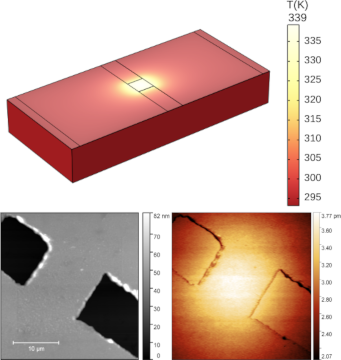
- plasmonic response. This heating also results in thermal expansion of the element. This expansion will result in deflection of an AFM cantilever scanning the surface. If a sinusoidal voltage is applied to an electrically conducting sample, such as the active plasmonic element discussed here, the resulting
- nanomechanical operations such as lithography and machining. The high spring constant of this cantilever has the advantage of minimising the unwanted deflection of the cantilever resulting from electrostatic interaction of the potential on the surface and the probe. The tip is constructed from wear-resistant
- Cypher AFM. This frequency is also well below the resonance frequency of the selected cantilever avoiding unwanted resonant oscillations in the cantilever as a result of the periodic force applied by the expanding surface when deflecting the cantilever. In principle, the drive frequency of the active




Frequency-dependent nanomechanical profiling for medical diagnosis
Beilstein J. Nanotechnol. 2022, 13, 1483–1489, doi:10.3762/bjnano.13.122
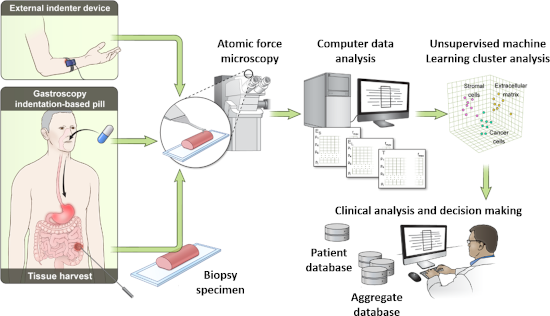
- optical imaging, the device could be equipped with one or more piezoelectrically excited membranes coupled with a sensing mechanism, such as an AFM cantilever or other type of mechanical sensor (similar stand-alone developments already exist [31][32]). The mechanical response of the membrane could be


Studies of probe tip materials by atomic force microscopy: a review
Beilstein J. Nanotechnol. 2022, 13, 1256–1267, doi:10.3762/bjnano.13.104
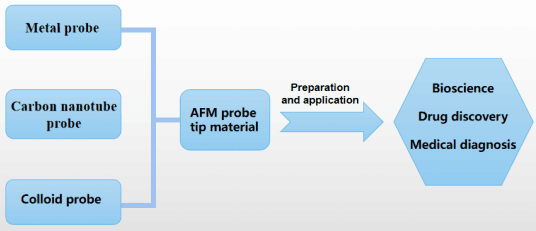
- . Applications range from mechanical and electrical sample characterization to measurements in liquids [1][2][3][4] and even in living cells [5][6][7][8]. The critical element of an AFM is the scanning probe itself, which is usually represented by a micro-cantilever beam equipped with a conical scanning tip. As
- the tip approaches the sample surface, an interaction force is generated that deflects (bends or stretches) the probe cantilever. As the AFM probe moves across the sample surface (in the X and Y directions), morphological information is obtained over the entire scan area. Its tip structure and the
- mechanical properties of the cantilever beam directly affect the performance, measurement resolution, and image quality of the AFM instrument. AFM probe tips [9][10] are generally fabricated with coatings, carbon nanotubes, magnetic nanoparticles, or even protein functionalization. A combination of probe
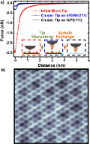
A cantilever-based, ultrahigh-vacuum, low-temperature scanning probe instrument for multidimensional scanning force microscopy
Beilstein J. Nanotechnol. 2022, 13, 1120–1140, doi:10.3762/bjnano.13.95
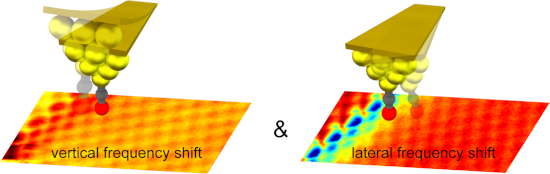
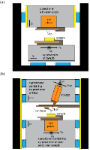
- Cantilever-based atomic force microscopy (AFM) performed under ambient conditions has become an important tool to characterize new material systems as well as devices. Current instruments permit robust scanning over large areas, atomic-scale lateral resolution, and the characterization of various sample
- tuning fork force sensor became increasingly popular. In comparison to microfabricated cantilevers, the more macroscopic tuning forks, however, lack sensitivity, which limits the measurement bandwidth. Moreover, multimodal and multifrequency techniques, such as those available in cantilever-based AFM
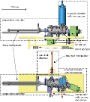
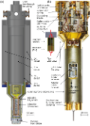
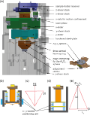
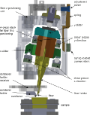
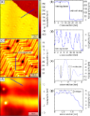
- carried out under ambient conditions, are challenging to implement. In this article, we describe a cantilever-based low-temperature UHV AFM setup that allows one to transfer the versatile AFM techniques developed for ambient conditions to UHV and low-temperature conditions. We demonstrate that such a





Comparing the performance of single and multifrequency Kelvin probe force microscopy techniques in air and water
Beilstein J. Nanotechnol. 2022, 13, 922–943, doi:10.3762/bjnano.13.82
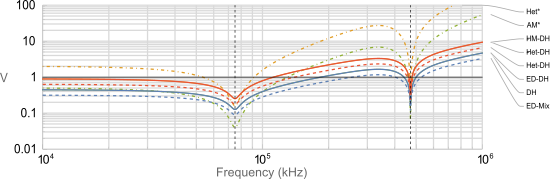
- first two eigenmodes of the cantilever. These comparisons allow the reader to quickly and quantitatively identify the parameters for the best performance for a given KPFM-based experiment in a given environment. Furthermore, we apply these performance metrics in the identification of KPFM-based modes
- forces in KPFM is generally expressed as the minimum detectable CPD [53], and is directly limited by the geometry of the interaction, thermal noise of the cantilever, and the detection noise limits of the AFM [36][54]. Cantilevers have a number of eigenmodes, ωn, where there is a mechanical enhancement
- to ωn where ∝ Qn/kn and there is a significant enhancement in the oscillation amplitude of the cantilever in response to the electrostatic force, thereby increasing the signal-to-noise ratio (SNR) [10]. In this paper we define the SNR as the ratio of the measured signal (oscillation amplitude of the
Temperature and chemical effects on the interfacial energy between a Ga–In–Sn eutectic liquid alloy and nanoscopic asperities
Beilstein J. Nanotechnol. 2022, 13, 817–827, doi:10.3762/bjnano.13.72
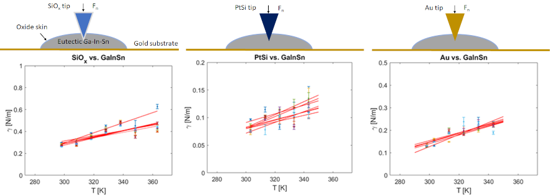
- force–distance curve with each cantilever on a quartz glass sample (manufactured by Goodfellow, United Kingdom) and extracting its slope in the range of repulsive forces. Subsequently, we determined the bending stiffness Cn of each cantilever by analyzing its thermal noise vibration [18]. After
- consisted of approaching a cantilever towards the sample surface at varying velocities dZ/dt = 0.1–25 µm/s (see Figure 1). We repeated force spectroscopy measurements at each approach/retraction velocity 15 times. We used the retraction part of the force–distance curves to determine the adhesion force Fad
- hysteresis for the normal force is not as straightforward to explain. In our experiments, we can exclude the effect of crosstalk due to misalignment of the cantilever since we mounted each cantilever on the same alignment chip on the cantilever holder. We consider it more likely that the hysteresis of the



Optimizing PMMA solutions to suppress contamination in the transfer of CVD graphene for batch production
Beilstein J. Nanotechnol. 2022, 13, 796–806, doi:10.3762/bjnano.13.70
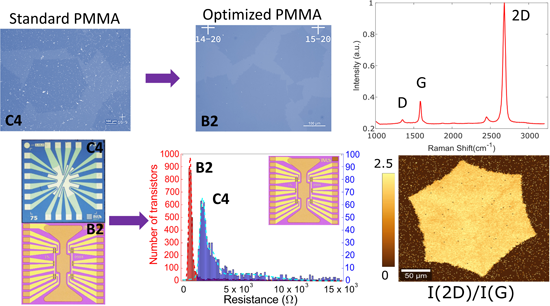
- frequency. The AFM measurement was carried out in tapping mode. A 633 nm laser light aimed at the back side of the cantilever tip was reflected toward a position-sensitive photodetector, which provides feedback signals to piezoelectric scanners that maintain the cantilever tip at constant height (force




Gelatin nanoparticles with tunable mechanical properties: effect of crosslinking time and loading
Beilstein J. Nanotechnol. 2022, 13, 778–787, doi:10.3762/bjnano.13.68
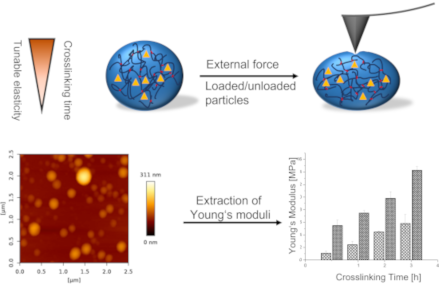
- same day. AFM measurements were carried out with a JPK NanoWizard® 3 AFM (JPK Instruments, Berlin, Germany) using the MLCT cantilever tip D (Bruker France Nano Surfaces, Wissembourg, France) with a nominal resonance frequency of 15 kHz and a spring constant of 0.03 N/m. Before each measurement, the
- actual sensitivity and the spring constant of the used cantilever were calibrated on a cleaned silica wafer by the thermal noise method by Hutter et al. [27] using a correction factor of 0.251. The data was acquired using the quantitative imaging mode (QI™) with image sizes of 5 × 5 µm and a resolution
- single nanoparticles. For the values of Young’s moduli, the respective curves were treated as follows: The determined spring constant and sensitivity must be applied to calibrate the cantilever deflection. To correct the vertical offset, a baseline subtraction is applied, and the contact point is


Direct measurement of surface photovoltage by AC bias Kelvin probe force microscopy
Beilstein J. Nanotechnol. 2022, 13, 712–720, doi:10.3762/bjnano.13.63
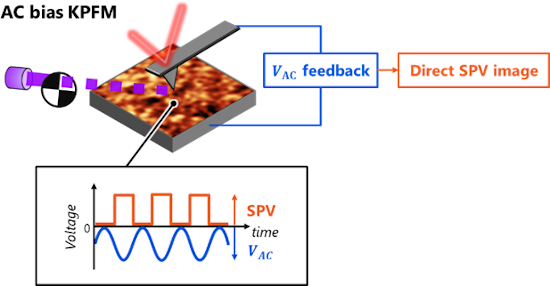
- force This signal is measured with a lock-in amplifier and compensated by VAC control, yielding the SPV value. To improve the sensitivity, ωm is usually tuned to the second (first) resonance frequency of the cantilever, while the first (second) resonance frequency is assigned to the AFM measurement [29
- -AFM was operated in the FM mode [32] with a constant oscillation amplitude A of 500 pm. The cantilever deflection was measured by an optical beam deflection (OBD) method [33]. AC-KPFM was carried out in the FM mode, in which the topography and SPV were measured simultaneously. An AC bias VAC with
- was arranged in front of a photodetector of the OBD system to suppress the influence of the UV light on the deflection sensor. We used a commercial Ir-coated Si cantilever (NANOSENSORS, SD-T7L100) with a resonant frequency f0 of 913 kHz, a spring constant k of 650 N/m, and a quality factor Q of 7748


Quantitative dynamic force microscopy with inclined tip oscillation
Beilstein J. Nanotechnol. 2022, 13, 610–619, doi:10.3762/bjnano.13.53
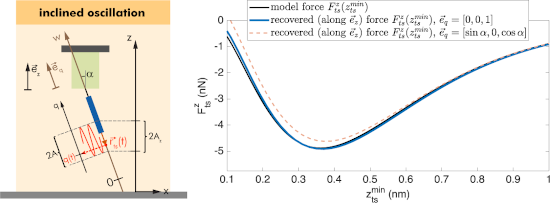
- measuring a heterogeneous atomic surface. We propose to measure the AFM observables along a path parallel to the oscillation direction in order to reliably recover the force along this direction. Keywords: atomic force microscopy; cantilever; quantitative force measurement; sampling path; Introduction
- for technical reasons. Consequences of this inclined AFM cantilever mount have been identified before, in particular for atomic force microscopy performed in static (“contact”) mode where an effective spring constant [6][7][8] has been introduced and a torque [9][10] as well as load [11] correction
- has been applied. Additionally, a tilted cantilever has been found to lead to a modification of the tip–sample convolution [12], to enhance the sensitivity of the measurement to the probe side [13], and to influence results of multifrequency AFM and Kelvin probe force microscopy [14]. In the presence


![[Graphic 38]](/bjnano/content/inline/2190-4286-13-53-i79.svg?max-width=637&scale=1.18182) and the axis w....
and the axis w....


Effects of substrate stiffness on the viscoelasticity and migration of prostate cancer cells examined by atomic force microscopy
Beilstein J. Nanotechnol. 2022, 13, 560–569, doi:10.3762/bjnano.13.47
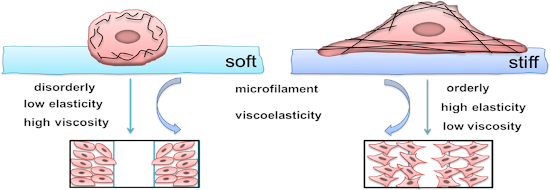
- Germany) for 2 h to prevent damage to the cells. Before the experiment, the thermal noise method was used to adjust the cantilever spring constant, and then the experiment was carried out in contact mode. The AFM probe (MLCT probe, Bruker, USA) slightly contacted the cell surface and a constant force was



Electrostatic pull-in application in flexible devices: A review
Beilstein J. Nanotechnol. 2022, 13, 390–403, doi:10.3762/bjnano.13.32
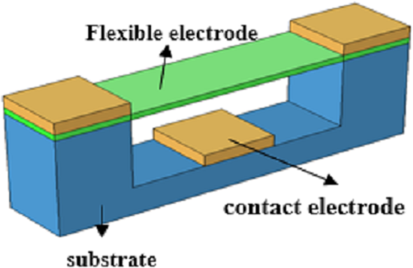
- the first time. They used single-walled carbon nanotubes (SWCNTs) to prepare a suspended cross bistable switch array. Table 1 summarizes the structures and the voltage of CNT-NEM switches described in the literature. In addition to bridge and cantilever structures, the vertical structure further
- the critical voltage is about 3.6 V. Abbasi et al. [2] prepared a bistable switch based on SWCNTs, with a pull-in voltage of 2.5–3 V, which is suitable for nonvolatile memory applications. Cantilever model: A typical cantilever structure is shown in Figure 2b. Lee et al. [22][23] prepared a three
- -terminal cantilever MWCNT NEM switch. The diameter of the CNTs is 50 nm, the length is 2 µm, and the gap is 150 nm. When Vds is 0.5 V, Vgs is in the range of 6–30 V. Loh et al. [24] prepared a cantilever SWCNT and diamond electrode structure with a pull-in voltage of 23.4 V. C–C bonds can greatly improve


Relationship between corrosion and nanoscale friction on a metallic glass
Beilstein J. Nanotechnol. 2022, 13, 236–244, doi:10.3762/bjnano.13.18
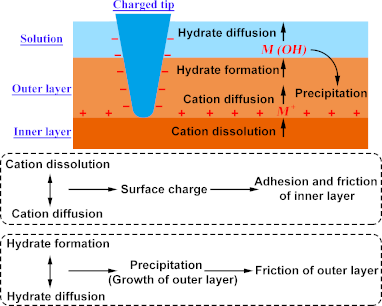
- corrosive solution was added. For these experiments, we used an electrochemical atomic force microscope (ECAFM, Agilent 5500) and the oxidized tip (radius of ca. 30 nm) of a single-crystalline Si cantilever (PPP-CONT, NanoSensors, Germany). We adopted the beam geometry method to calibrate the force
- constants of the cantilever [47]. The resonance frequency of the cantilever at the first normal oscillation mode measured in the air was used to calculate the thickness of the cantilever [47]. The AFM tip sliding velocity was 8.0 μm·s−1 and the scan field was 1.0 × 0.125 μm2. Sixteen cycles of repetitive





