


Search results
Search for "traps" in Full Text gives 96 result(s) in Beilstein Journal of Nanotechnology.
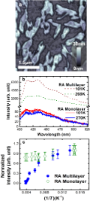
Absorption and photoconductivity spectra of amorphous multilayer structures
Beilstein J. Nanotechnol. 2020, 11, 1757–1763, doi:10.3762/bjnano.11.158
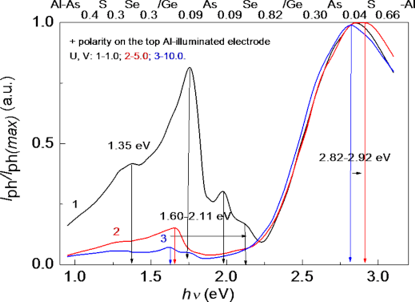
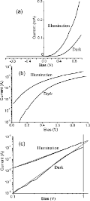
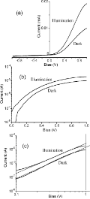
- , Nt is the concentration of traps, e is the electron charge, µ is the drift mobility, ε is the dielectric constant, t = Δ/(kBT) (Δ is the parameter of the trap distribution, kB is the Boltzmann constant, T is the absolute temperature), V is the applied voltage, and d is the sample thickness. The


Oxidation of Au/Ag films by oxygen plasma: phase separation and generation of nanoporosity
Beilstein J. Nanotechnol. 2020, 11, 1608–1614, doi:10.3762/bjnano.11.143
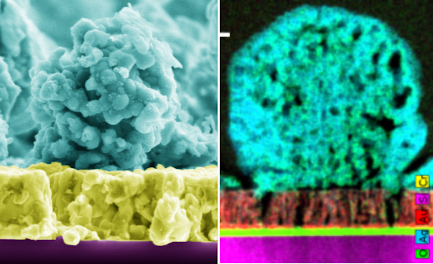
- 8). In the early stages of oxidation, silver diffuses toward the surface where it nucleates and forms clusters (Figure 8a). When Ag reaches the film surface the diffusion is expected to become limited due to two factors: (1) the presence of oxygen which traps Ag during the oxidation process


Effect of localized helium ion irradiation on the performance of synthetic monolayer MoS2 field-effect transistors
Beilstein J. Nanotechnol. 2020, 11, 1329–1335, doi:10.3762/bjnano.11.117
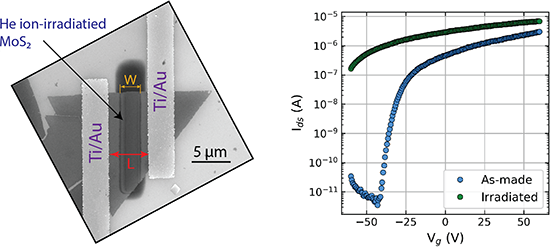
- -type channel functionality. This observed near-degenerate doping behavior is typical of an increased concentration of sulfur vacancies in defect-rich MoS2 [9][20][21]. We note here, that a recent high-energy irradiation study has also called for attention to charge traps generated in the underlying


Thermophoretic tweezers for single nanoparticle manipulation
Beilstein J. Nanotechnol. 2020, 11, 1126–1133, doi:10.3762/bjnano.11.97
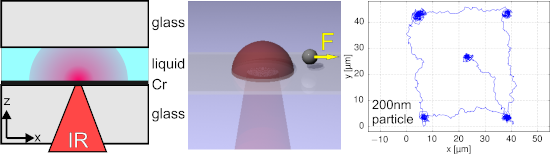
- modeling gives a quantitative prediction of the effect. Traps can be dynamically created and relocated, which we demonstrate by the controlled independent manipulation of two nanoparticles. Keywords: laser; microfluidics; nano-manipulation; thermophoresis; trapping; tweezers; Introduction In science and
- heating. While it is also possible to trap atoms and molecules in vacuum using electromagnetic traps, thermal noise is a governing factor when particles are under biological conditions, namely at room temperature in an aqueous medium. Laser tweezers [1][2][3], invented long ago and recognized with the
- dynamically created in parallel and relocated to an arbitrary position. The use of multiple thermo-optical traps enables a host of exciting applications, most prominently single-molecule chemistry. We demonstrate the thermophoretic tweezers by the trapping and parallel manipulation of individual particles


Band tail state related photoluminescence and photoresponse of ZnMgO solid solution nanostructured films
Beilstein J. Nanotechnol. 2020, 11, 899–910, doi:10.3762/bjnano.11.75
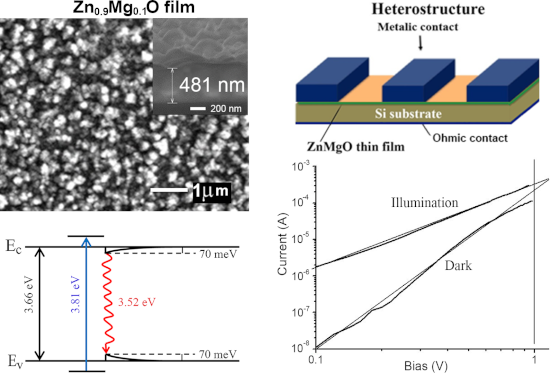
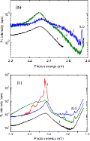
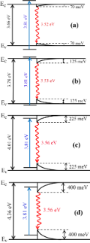
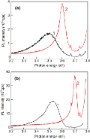
- dependence of the maximum PL emissions was explained in terms of exciton localization in potential traps induced by Mg compositional fluctuations. The fluctuations in the local arrangement of Mg and Zn atoms have been also recently investigated by means of cathodoluminescence (CL) and OA spectroscopy in c

Integrated photonics multi-waveguide devices for optical trapping and Raman spectroscopy: design, fabrication and performance demonstration
Beilstein J. Nanotechnol. 2020, 11, 829–842, doi:10.3762/bjnano.11.68
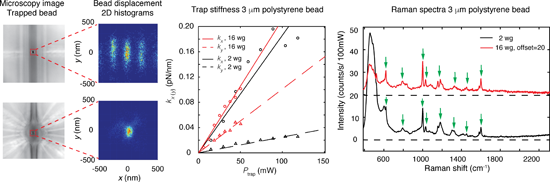
- enhancement around this center and thus counteract the effect of light concentration near the facets, which is a disadvantage of dual-waveguide traps. Thus, a trapping region is created around the center, where a single particle of a size in a wide range can be trapped and studied spectroscopically, free from
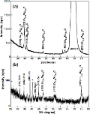
- focused Gaussian beam traps and are confirmed by our own simulations. The Raman spectra of the beads (in this work measured via an objective) show clear peaks that are characteristic of polystyrene. In the low-wavenumber range, the spectra have a background that most likely originates from the Si3N4
- device. The structure of the global hot region is magnified in the inset of Figure 4b, showing that the hottest spot has two strong side lobes. Further outwards the lobes become increasingly weaker. The individual local hot spots at and near the center serve as local traps for small particles (≤295 nm


Hexagonal boron nitride: a review of the emerging material platform for single-photon sources and the spin–photon interface
Beilstein J. Nanotechnol. 2020, 11, 740–769, doi:10.3762/bjnano.11.61




Comparison of fresh and aged lithium iron phosphate cathodes using a tailored electrochemical strain microscopy technique
Beilstein J. Nanotechnol. 2020, 11, 583–596, doi:10.3762/bjnano.11.46
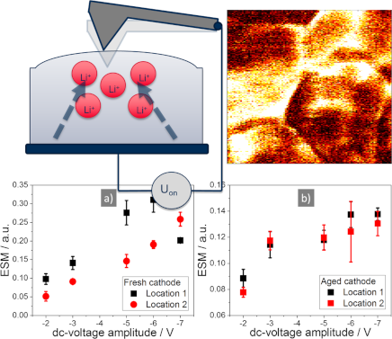
- inactive material traps Li-ions, which reduces the remaining capacity of the cell. Therefore, the presented ESM measurements visualize the reduction of the electrochemical activity and the loss of lithium inventory of the sample due to ageing on the nanometer scale. With that, ESM offers a higher



Implementation of data-cube pump–probe KPFM on organic solar cells
Beilstein J. Nanotechnol. 2020, 11, 323–337, doi:10.3762/bjnano.11.24
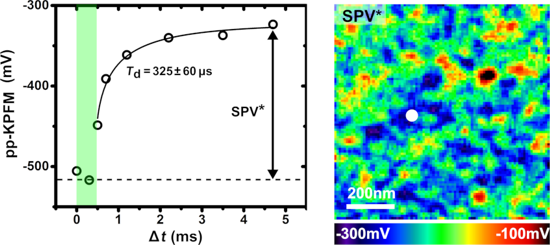
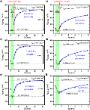
- exponents lower than 0.7 required for fitting of the spectroscopic curves (with the exception of the data in Figure 6f). These traps can be partially filled by applying a continuous white light background in addition to the pump pulse, which results in a significant reduction of the effective decay-time
- ) indicate that the effective carrier mobility strongly depends on the photocarrier concentration, which is inversely proportional to the optical power. Such a situation has been reported for different organic blends [33][34][35]. In some models, traps are the source of this concentration-dependent mobility




Recent progress in perovskite solar cells: the perovskite layer
Beilstein J. Nanotechnol. 2020, 11, 51–60, doi:10.3762/bjnano.11.5

- the bladed films and can even passivate charge traps to further improve the device performance. Finally, stabilized PCEs of 15.3% and 14.6% were reached for devices with active areas of 33.0 cm2 and 57.2 cm2 at a high coating speed of 180 m·h−1. More importantly, the surfactants could be a kind of


Nontoxic pyrite iron sulfide nanocrystals as second electron acceptor in PTB7:PC71BM-based organic photovoltaic cells
Beilstein J. Nanotechnol. 2019, 10, 2238–2250, doi:10.3762/bjnano.10.216
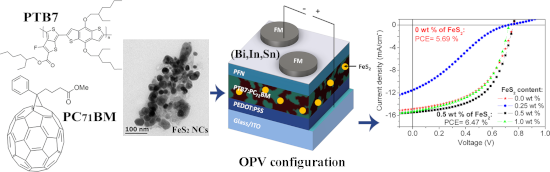
- ) AFM images of the OPVs with different concentrations of FeS2 recorded in the noncontact mode. The roughness of the OPV surface is increased gradually as the FeS2 concentration increases (Table 1 and Figure 7), such that traps for the charge carriers could occur and the leakage current could increase


Fabrication and characterization of Si1−xGex nanocrystals in as-grown and annealed structures: a comparative study
Beilstein J. Nanotechnol. 2019, 10, 1873–1882, doi:10.3762/bjnano.10.182
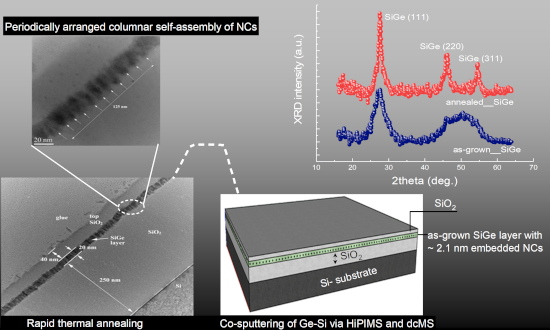
- interface traps (known as Pb-type defects). These interface traps produce scattering centers that can affect the mobility of charge carriers, thus altering the transport properties [11]. Moreover, sharp interfaces with an abrupt change in the dielectric constant or thermal expansion coefficients give rise


A highly efficient porous rod-like Ce-doped ZnO photocatalyst for the degradation of dye contaminants in water
Beilstein J. Nanotechnol. 2019, 10, 1157–1165, doi:10.3762/bjnano.10.115
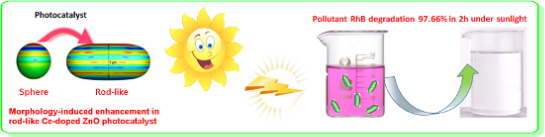
- levels serve as electron traps for photogenerated electrons. In this way, the recombination of photoinduced holes and electrons is suppressed, which accelerates the transfer of electrons to dissolve oxygen molecules and to produce more superoxide radicals to degrade probe dyes [9][22]. As a result, CZO-4


Advanced scanning probe lithography using anatase-to-rutile transition to create localized TiO2 nanorods
Beilstein J. Nanotechnol. 2019, 10, 412–418, doi:10.3762/bjnano.10.40
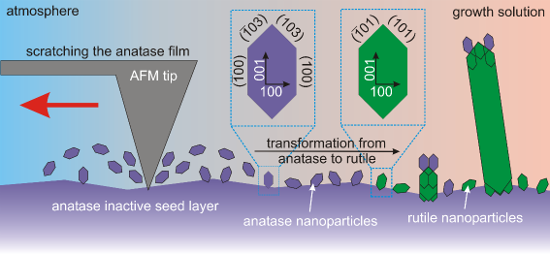
- charging by trapping of electrons from the electron beam in neutral traps such as OH groups [43]. However, this effect becomes significantly stronger with increasing beam intensity and remains for many days in a humid environment. Hence, it results more likely from electron-beam-induced surface smoothing


Wet chemistry route for the decoration of carbon nanotubes with iron oxide nanoparticles for gas sensing
Beilstein J. Nanotechnol. 2019, 10, 105–118, doi:10.3762/bjnano.10.10
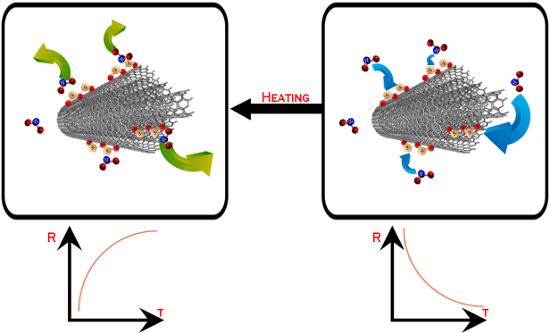
- with the active layer, the molecule traps electrons from the active layer, increasing its conductivity, because this increases the concentration of holes, which act as main charge carriers. Comparing the behavior of pristine and decorated CNTs, one can clearly see that the decoration process leads to




Surface plasmon resonance enhancement of photoluminescence intensity and bioimaging application of gold nanorod@CdSe/ZnS quantum dots
Beilstein J. Nanotechnol. 2019, 10, 22–31, doi:10.3762/bjnano.10.3
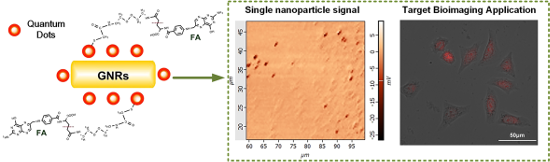
- nanomaterials are irradiated with light of a certain wavelength, the valence electrons transition back to the conduction band. Most of the conduction band electrons fall back into the deep electron traps and nonradiative transitions take the form of quenching. Semiconductor QDs with relatively shallow surface
- electron traps and holes can easily capture electrons to the conduction band. At the same time, the transition radiation returns to the valence band, emitting a photon. The PL characteristics are, therefore, better than in materials which have deep traps in the bulk semiconductor material. This finding


Impact of the anodization time on the photocatalytic activity of TiO2 nanotubes
Beilstein J. Nanotechnol. 2018, 9, 2628–2643, doi:10.3762/bjnano.9.244
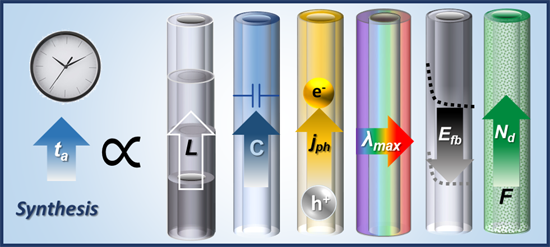
- concentration of surface hydroxy groups is generally observed in doped TiO2 nanostructures, and these are indicated through the asymmetry of the O 1s spectra [32][36]. Ti–OH groups act as electron traps that not only improve the separation efficiency for electron–hole pairs, but also improve the generation of
- . While such behavior is still related to the length of the nanostructures, it could also be associated with an increased number of electron traps since the potential is high enough to overcome recombination [65]. The differences observed in the interfacial PEC behavior suggest that a link between the


Exploring the photoleakage current and photoinduced negative bias instability in amorphous InGaZnO thin-film transistors with various active layer thicknesses
Beilstein J. Nanotechnol. 2018, 9, 2573–2580, doi:10.3762/bjnano.9.239
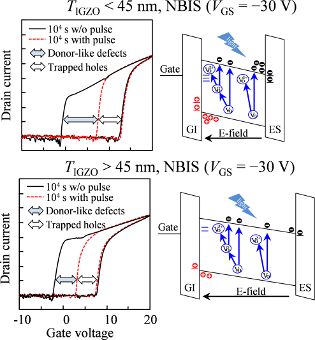
- bulk traps because of the identical a-IGZO/GI interfaces. Figure 2a–d shows the variation in the transfer characteristics of a-IGZO TFTs with various TIGZO under monochromatic light irradiation at the excitation wavelengths of 400, 430, 460, 490, and 530 nm. The transfer characteristics measured in the
- though the photon energy is smaller than the band gap of IGZO. In terms of the a-IGZO material, the high-density electron traps exist at (EC − E) of over 2.7 eV [9], which affect the photoleakage current of a-IGZO TFTs. The total amount of trapped electrons increase with an increase in the TIGZO. The
- oxygen-related defects, such as oxygen vacancies (VO), may be the origin of high-density electron traps near the EV in a-IGZO TFTs, which occupy the region near the valence band maximum with an energy width of ≈1.5 eV [26][27]. Figure 3a–d shows the variation in the transfer characteristics of a-IGZO


Lead-free hybrid perovskites for photovoltaics
Beilstein J. Nanotechnol. 2018, 9, 2209–2235, doi:10.3762/bjnano.9.207
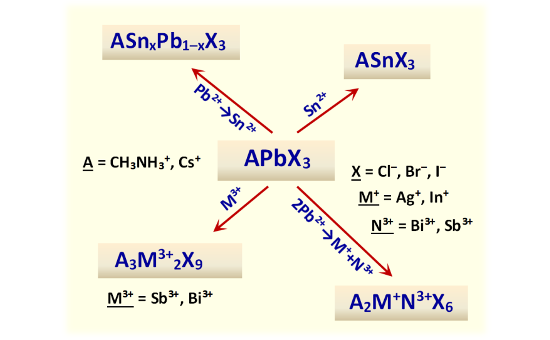
- suppressed lattice disorder of this HP results in a low density of traps and sub-bandgap states reflecting in a relatively small Eg–Voc loss of 0.45 eV [70]. The bandgap of alloyed FASnxPb1−xI3 HPs was found to vary in an unexpected way, that is, decreasing upon the introduction of Sn from ≈1.5 eV for MAPI
- ]. Calculations by the density functional theory (DFT) indicated that a partial substitution of Cs+ with Rb+ should considerably increase the stability of CsSnI3 [117]. To avoid a partial conversion of Sn2+ into Sn4+, the latter acting as charge carrier traps in ASnX3 HPs, it was suggested to deposit the


Spin-coated planar Sb2S3 hybrid solar cells approaching 5% efficiency
Beilstein J. Nanotechnol. 2018, 9, 2114–2124, doi:10.3762/bjnano.9.200
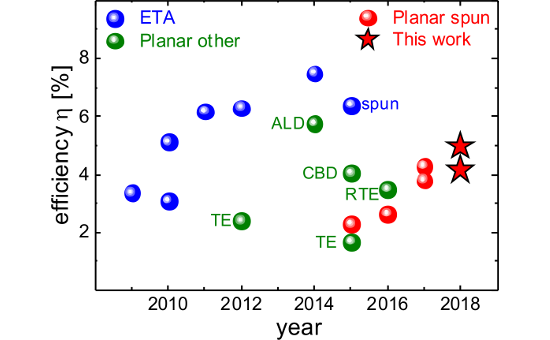
- formation a short air exposure was shown to increase device performance but longer exposure times deteriorated the solar cell [45]. In another study post-sulfurization reduced the Sb2O3 content and thereby the concentration of deep traps which improved solar cell performance [6]. As an alternative to CBD


Localized photodeposition of catalysts using nanophotonic resonances in silicon photocathodes
Beilstein J. Nanotechnol. 2018, 9, 2097–2105, doi:10.3762/bjnano.9.198
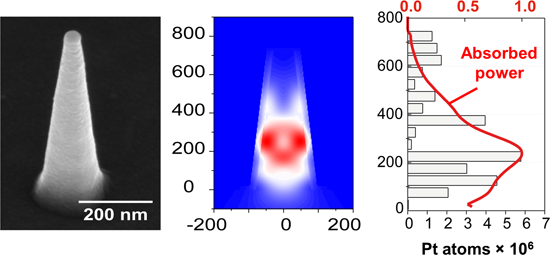
- with higher catalytic activity, leading to preferential deposition, or traps that capture carriers preventing deposition. Conclusion We show that the optical modes of silicon nanostructures can be used for lithography-free patterning of catalytic nanoparticles. Tuning of the photo-electrochemical


Numerical analysis of single-point spectroscopy curves used in photo-carrier dynamics measurements by Kelvin probe force microscopy under frequency-modulated excitation
Beilstein J. Nanotechnol. 2018, 9, 1834–1843, doi:10.3762/bjnano.9.175
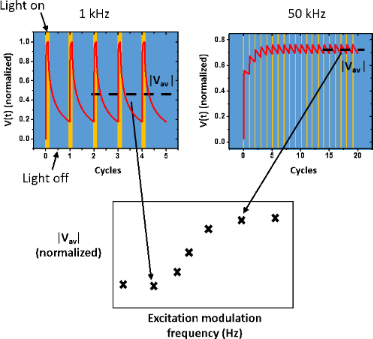
- the effective time needed for exciton generation, dissociation and carrier separation. On the other hand, in the case of some organic photovoltaic (OPV) samples, the SPV built-up time can be attributed to the effective time needed to fill lower energy states (traps). In a more general way, it can be
- dynamics are governing the SPV behavior of the sample, as it is the case for instance for OPV samples exhibiting a high density of low-energy states (traps). Nonetheless, we stress that even if the calculated photo-carrier lifetime values do not fully agree with those reported in [4], the ratio between the


Multimodal noncontact atomic force microscopy and Kelvin probe force microscopy investigations of organolead tribromide perovskite single crystals
Beilstein J. Nanotechnol. 2018, 9, 1695–1704, doi:10.3762/bjnano.9.161
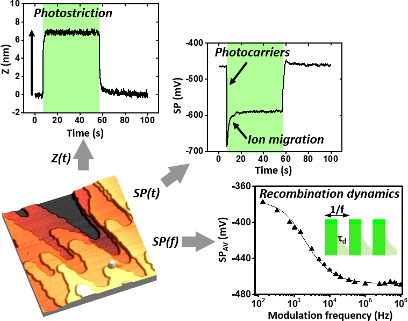
- the surface potential probed by KPFM. It is now clear that a complex interplay exists between the charge carrier populations, traps, and mobile ions. Despite all the progress made, interpreting the surface potential (SP) and surface photovoltage (SPV) contrasts recorded by KPFM on polycrystalline lead


Electro-optical interfacial effects on a graphene/π-conjugated organic semiconductor hybrid system
Beilstein J. Nanotechnol. 2018, 9, 963–974, doi:10.3762/bjnano.9.90
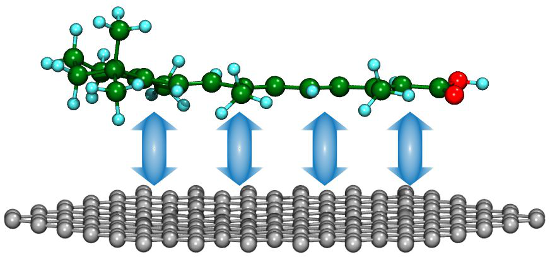
- migration [28]. At low temperatures, the volume probed by an exciton is reduced, which reduces the interaction probability with nonradiative traps or defects, reflecting an increase in the emission efficiency of the organic compound [29]. Moreover, the increase in emission efficiency with decreasing




Noble metal-modified titania with visible-light activity for the decomposition of microorganisms
Beilstein J. Nanotechnol. 2018, 9, 829–841, doi:10.3762/bjnano.9.77
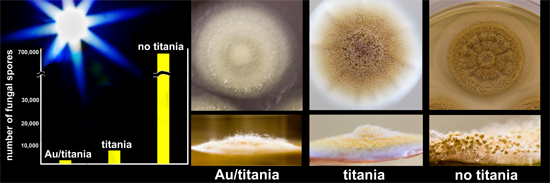
- clusters were preferentially deposited on surface defects of the support [55]. Therefore, fine titania with a high number of defects (electron traps, ETs) induced the formation of fine and well-dispersed NMNPs on titania surface, as shown in Figure 1 (top). In contrast, titania with large crystals (low





