


Search results
Search for "calculations" in Full Text gives 787 result(s) in Beilstein Journal of Nanotechnology. Showing first 200.
Synthesis of silver–palladium Janus nanoparticles using co-sputtering of independent sources: experimental and theorical study
Beilstein J. Nanotechnol. 2024, 15, 808–816, doi:10.3762/bjnano.15.67
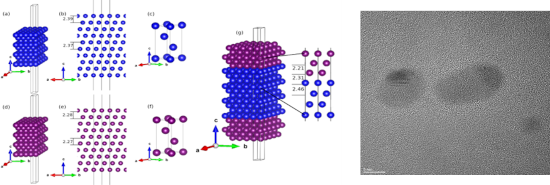
- condensación en gas inerte”, Universidad Autónoma de Nuevo León, 2019). The authors acknowledge the support from Alvaro Mayoral from UNIZAR for the TEM observations. Calculations were performed in the DGCTIC-UNAM Supercomputing Center, under the projects LANCADUNAM-DGTIC-368 and LANCAD-UNAM-DGTIC-382. Funding




Electron-induced ligand loss from iron tetracarbonyl methyl acrylate
Beilstein J. Nanotechnol. 2024, 15, 797–807, doi:10.3762/bjnano.15.66
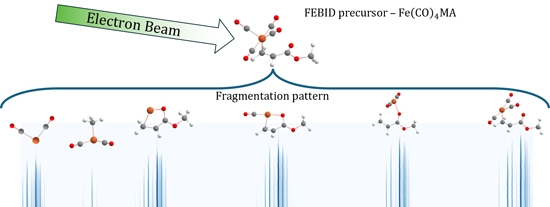
- and support the interpretation of data by quantum chemical calculations. This way, both the dissociative ionization and dissociative electron attachment fragmentation channels are characterized. Considerable differences in the degree of precursor fragmentation in these two channels are observed
- experimental setups are combined with quantum chemical calculations to provide information about ligand loss pathways. The results are brought into context with the deposition experiments of Boeckers and coworkers [8]. Methods Synthesis of Fe(CO)4(C4H6O2) General considerations All reactions were carried out
- set to around 100 (M/ΔM). DFT calculations DFT-based structure optimization calculations have been performed using Gaussian 16 software [30]. All calculations were conducted using the commonly employed hybrid functional B3LYP [31] with a 6-31++G(d,p) [32][33] basis set and included the GD3 empirical



Level set simulation of focused ion beam sputtering of a multilayer substrate
Beilstein J. Nanotechnol. 2024, 15, 733–742, doi:10.3762/bjnano.15.61
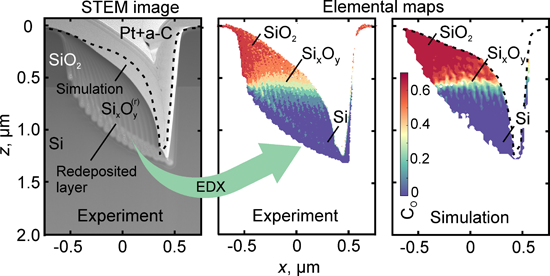
- sputtering of a multilayer substrate under FIB irradiation. The results of the calculations for narrow trenches and rectangular boxes with varying aspect ratios were compared with cross-sectional scanning transmission electron microscopy (STEM) images of experimental test structures fabricated in the silicon
- on evaluating the shape of milled dot and line structures with different depths. Numerical calculations Equation 1 was solved numerically on a primary three-dimensional regular rectangular computational grid with a cell (voxel) size equal to 0.3σ1 to find the function . The function S(x, y, t) was
- computational grid. The experimental angular dependences of the sputtering yield [24] and YSi(θ) [34] were used for the calculations of Fsp,i with μi values of 0.15 for SiO2 (i =1) [24] and 0.3 for Si (i = 2) [35]. The function at t=0 was specified by the structure of the Si substrate covered by a SiO2 layer

![[Graphic 55]](/bjnano/content/inline/2190-4286-15-61-i68.svg?max-width=637&scale=1.18182)


Elastic modulus of β-Ga2O3 nanowires measured by resonance and three-point bending techniques
Beilstein J. Nanotechnol. 2024, 15, 704–712, doi:10.3762/bjnano.15.58
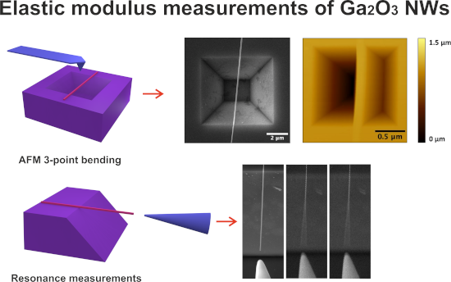
- frequency calculations), inaccuracies in measuring these dimensions can cause a scattering effect on the elastic modulus [28]. In this work, this effect is further complicated by the fact that β-Ga2O3 NW cross-sections tend to deviate from the rectangular geometry (e.g., trapezoid), giving an additional
- error to the calculations which should be minimised via a thorough study of each individual nanostructure geometry [29]. The magnitude of the geometrical measurement error typically increases significantly for smaller NWs, since the relative measurement error is becoming comparable to the absolute value


Laser synthesis of nanoparticles in organic solvents – products, reactions, and perspectives
Beilstein J. Nanotechnol. 2024, 15, 638–663, doi:10.3762/bjnano.15.54





Directed growth of quinacridone chains on the vicinal Ag(35 1 1) surface
Beilstein J. Nanotechnol. 2024, 15, 556–568, doi:10.3762/bjnano.15.48
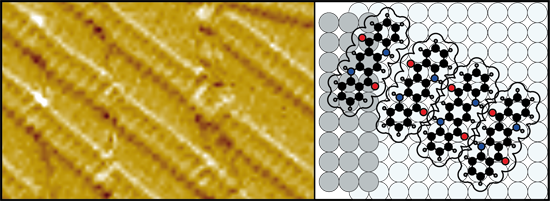
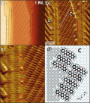
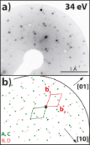
- the azimuthal orientations of the chains relative to the step edges [37]. The chains of NDCA grow along the [10] direction of the substrate and are, thus, orthogonal to the direction of the step edges, which are oriented along the [01] direction. Density functional theory calculations have shown that


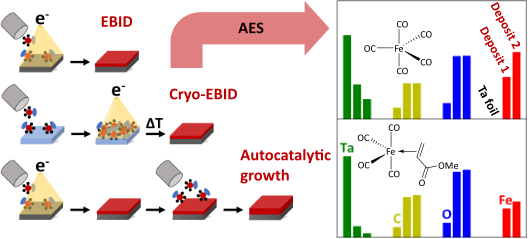
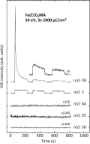
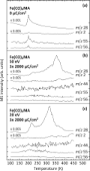
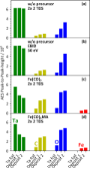
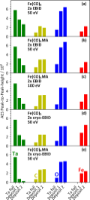
Electron-induced deposition using Fe(CO)4MA and Fe(CO)5 – effect of MA ligand and process conditions
Beilstein J. Nanotechnol. 2024, 15, 500–516, doi:10.3762/bjnano.15.45

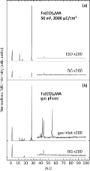


Potential of a deep eutectic solvent in silver nanoparticle fabrication for antibiotic residue detection
Beilstein J. Nanotechnol. 2024, 15, 426–434, doi:10.3762/bjnano.15.38
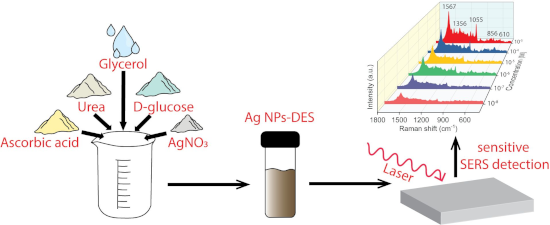
- located at 390 nm, which is suitable for SERS applications with 532 nm laser excitation. Besides, the shape of the UV–vis spectrum is in accordance with Mie scattering theory calculations, as reported in [39], proving the existence of Ag NPs in the solution. Moreover, the XRD pattern of the thin film


Unveiling the nature of atomic defects in graphene on a metal surface
Beilstein J. Nanotechnol. 2024, 15, 416–425, doi:10.3762/bjnano.15.37
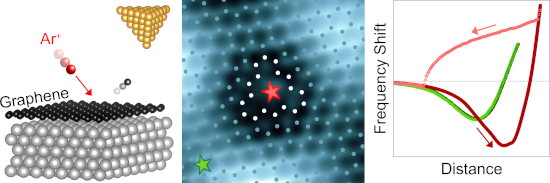
- missing C atoms, that is, defect 1 is compatible with a tetravacancy that was previously put forward by calculations accompanying an STM experiment [24]. The boundary of the tetravacancy is most likely lowered toward the metal surface allowing hybridization of the unsaturated C dangling bonds with


Modulated critical currents of spin-transfer torque-induced resistance changes in NiCu/Cu multilayered nanowires
Beilstein J. Nanotechnol. 2024, 15, 360–366, doi:10.3762/bjnano.15.32
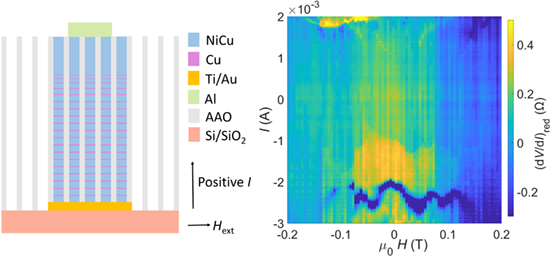
- number of contacted nanowires can be estimated to be around six in the present case; for detailed calculations see Supporting Information File 1. The maximal dV/dI is achieved at µ0H ≈ −21 mT/21 mT in the downsweep/upsweep of the magnetic field, respectively. The gradual changes in the dV/dI hysteresis


Comparative electron microscopy particle sizing of TiO2 pigments: sample preparation and measurement
Beilstein J. Nanotechnol. 2024, 15, 317–332, doi:10.3762/bjnano.15.29
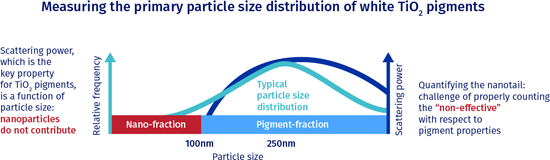
- calculations An initial estimate of the particle size range of the pigments under investigation was calculated by assuming a log-normal PSD around a median (μ*) of 100 nm and a distribution width (σ*) of 1.65 nm. In this “worst case” estimate, 99% of the particles have diameters in the range between 22 and 445
- particle size is the SSA, which is a good measure for non-porous, untreated, and nearly spherical TiO2 particles, independent of sample dispersion. However, we advise against using average ECD or MinFeret values for such calculations. To obtain reliable and accurate results over a wide range of particle
- , calculations, and graphics were performed using the R software [24], the fitdistrplus package, [25] and the graphical package ggplot2 [26]. Comparison of cumulative distribution curves measured by three different manufacturers using three different methods (M1: cross section, M2: dry, and M3: sonicated


Investigating structural and electronic properties of neutral zinc clusters: a G0W0 and G0W0Г0(1) benchmark
Beilstein J. Nanotechnol. 2024, 15, 310–316, doi:10.3762/bjnano.15.28
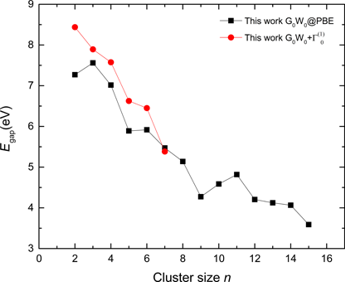
- literature to study the stability of these structures. We further assess the electronic properties, including the ionization potential, using the all-electron FHI-aims code employing G0W0 calculations, and the G0W0Г0(1) correction for a few smaller clusters, which provides a better estimation of the
- functional theory (DFT) calculations at different levels of theory to study the transition states (vdW to semiconductor-like states) in Zn clusters. In addition, the approaches used to study the electronic properties, such as ionization potentials (IPs) of zinc, are based on the ∆-SCF methods; for some
- clusters have been reported in the literature. Our G0W0 calculations will provide a benchmark to help accelerate the research on clusters and creating materials with high stability that can be used for advanced energy storage applications [17][18][19]. In this work, we have employed the generalized


![[Graphic 14]](/bjnano/content/inline/2190-4286-15-28-i15.svg?max-width=637&scale=1.18182)
Exploring the relationships between physiochemical properties of nanoparticles and cell damage to combat cancer growth using simple periodic table-based descriptors
Beilstein J. Nanotechnol. 2024, 15, 297–309, doi:10.3762/bjnano.15.27
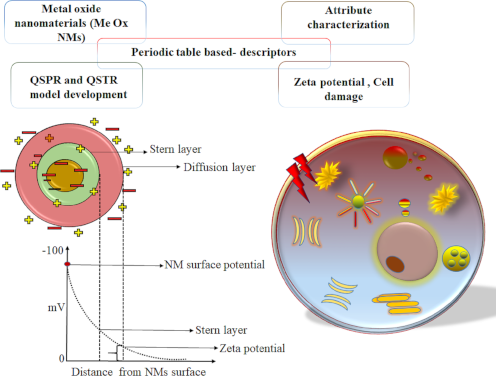
- shows the number of compounds used in the training and test sets represented by Ntrain and Ntest, respectively. Additionally, R2 and , the determination coefficient and leave-one-out (LOO) cross-validation coefficient, were employed. Furthermore, external data prediction calculations were made using


Quantitative wear evaluation of tips based on sharp structures
Beilstein J. Nanotechnol. 2024, 15, 230–241, doi:10.3762/bjnano.15.22
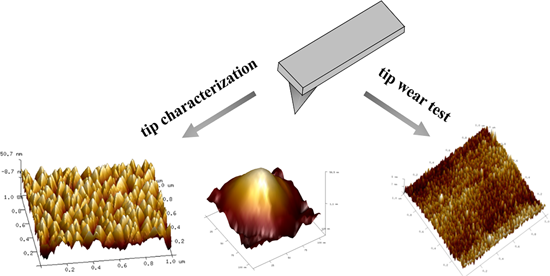
- computation. Conversely, if the surrounding data points exceed the value of the feature point, the point is deemed invalid and should be excluded from subsequent calculations. This process is iterative and requires that the next potential feature point is continually identified. The column feature points can




Multiscale modelling of biomolecular corona formation on metallic surfaces
Beilstein J. Nanotechnol. 2024, 15, 215–229, doi:10.3762/bjnano.15.21
- nm−2) and mass abundance (represented as a percentage of the total adsorbed mass). These calculations were performed utilizing the most recent KMC method modifications, including an alternative mode in which the acceptance–rejection criteria for incoming adsorbates are altered to allow replacement of
- concentration (per nm2) and mass abundance obtained from KMC simulations with NPs of radius 80 nm. These calculations have been done using the KMC method with displacements. Supporting Information Table S1: Adsorption free energies for each SCA on Al surfaces; Figure S1: Water density profiles for aluminum




Exploring disorder correlations in superconducting systems: spectroscopic insights and matrix element effects
Beilstein J. Nanotechnol. 2024, 15, 199–206, doi:10.3762/bjnano.15.19
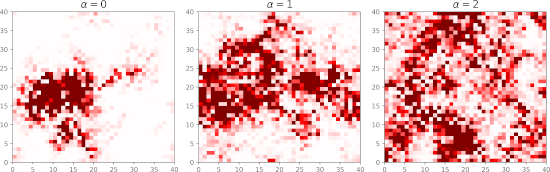
- construction, the resulting disorder correlation function has a power-law character. Moreover, it is Gaussian and stationary. Without loss of generality, we normalize the power-law series so that it has zero mean and the standard deviation as required by Equation 6. Numerical parameters In the calculations, we
- take N = 50, which our calculations show is sufficiently large to mitigate finite-size effects. BdG equations (Equation 2) are solved together with the self-consistency conditions (Equation 3) in the usual way until the order parameter and the Hartree potential reach a predefined accuracy threshold [63
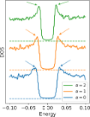
- ][64]. Additionally, we determine the chemical potential μ from the condition that the average electron density ne is fixed. In the calculations, we choose ne = 0.875. This is quite far from the half-filling condition ne = 1, at which a singular van Hove singularity appears in the DOS in the middle of


Graphene removal by water-assisted focused electron-beam-induced etching – unveiling the dose and dwell time impact on the etch profile and topographical changes in SiO2 substrates
Beilstein J. Nanotechnol. 2024, 15, 190–198, doi:10.3762/bjnano.15.18
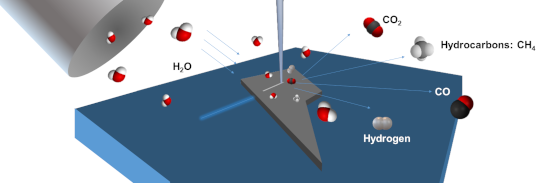
- of the etching procedure, we performed careful data treatment and detailed calculations of the AFM measurements of the etched profile width and depth as well as central deposit/protrusion width and height (see Figure 3C for a visual explanation). The meaningful parameters are presented in Figure 3C


Ferromagnetic resonance spectra of linear magnetosome chains
Beilstein J. Nanotechnol. 2024, 15, 157–167, doi:10.3762/bjnano.15.15
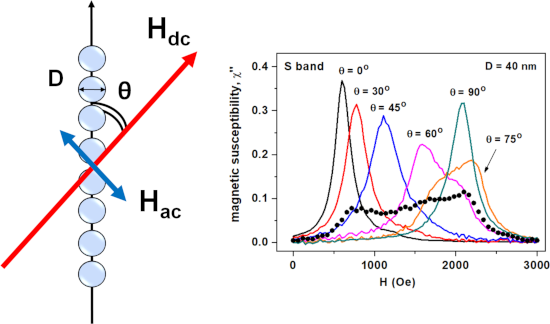
- nanoparticles are scarce [40]. Because of the well-known perfection of the crystal structure and shape of magnetosomes, in this paper most of the calculations are carried out for the case of moderate damping, κ = 0.05–0.1; however, the case of high damping, κ = 0.3, 0.5, is also briefly considered. Note that it
- observed at a larger magnetizing field. As Figure 1d shows, with an increase in the number of particles in the chain from 5 to 20, the position of the FMR resonance peak shifts to lower fields; however, for Np > 20 the position and shape of the FMR resonance peak remain practically unchanged. Calculations
- = 20–25. Therefore, in this work most of the calculations were carried out for magnetosome chains with Np = 20. As noted above, the experimental data on the value of the magnetic damping constant in assemblies of magnetic nanoparticles are scarce. Since magnetosomes grow inside a bacterium under strict


Determination of the radii of coated and uncoated silicon AFM sharp tips using a height calibration standard grating and a nonlinear regression function
Beilstein J. Nanotechnol. 2023, 14, 1200–1207, doi:10.3762/bjnano.14.99
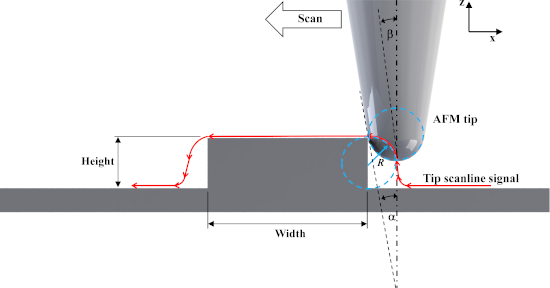
- higher frequency with low PSD value than sharp tips [8]. However, the aforementioned measurements are theoretical approaches lacking consideration of the measured point-to-point data of the scanline profile in an (x, y) coordinate system for calculations of the exact tip radius after the scan. In


A combined gas-phase dissociative ionization, dissociative electron attachment and deposition study on the potential FEBID precursor [Au(CH3)2Cl]2
Beilstein J. Nanotechnol. 2023, 14, 1178–1199, doi:10.3762/bjnano.14.98
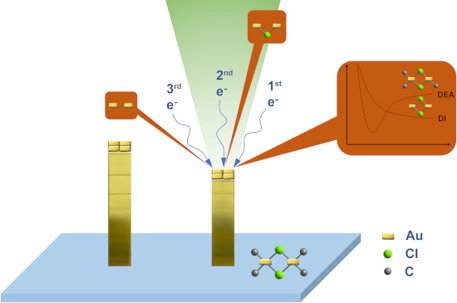
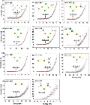
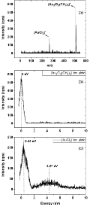
- gas-phase experiments under single-collision conditions and quantum mechanical calculations for data interpretation, in combination with FEBID in an UHV setup. The results of this study demonstrated that at 5 keV electron energy, FEBID deposits with 31–34 atom % Au content were attainable with this
- by the quantum chemical calculations. However, in one specific channel in the DI gas-phase study, a significant retention of the phosphorous at the gold precursor was found indicating significant surface effects. In the current study, we extended this approach to investigate the deposition of Au
- using [Au(CH3)2Cl]2 as a potential FEBID precursor. The FEBID in an UHV setup was conducted, in conjunction with a gas-phase study on the electron energy dependence of the fragmentation of this compound through DI and DEA. Moreover, quantum chemical calculations were used to determine the dominating



A bifunctional superconducting cell as flux qubit and neuron
Beilstein J. Nanotechnol. 2023, 14, 1116–1126, doi:10.3762/bjnano.14.92
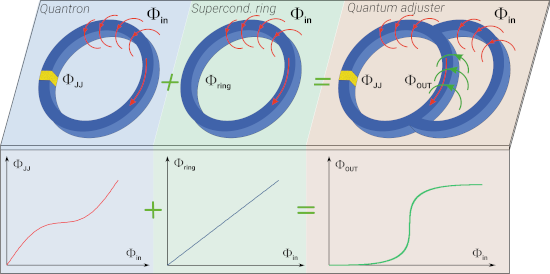
- -to-output transformation function (sigma-neuron). Preliminary calculations have shown that under certain conditions, such a neuron can operate successfully in both classical and quantum modes [24][26][28][30]. The energy of the system in the Hamiltonian formalism can be expressed as follows: where
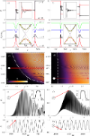
- adiabatic energy levels at anticrossing τLZ. The estimates obtained in the framework of the two-level model are in good agreement with the numerical calculations (solid lines in Figure 2a,b) of the Schrödinger time-dependent equation by the Crank–Nicolson method [46] based on the Magnus decomposition for
- correspond to the rise/fall rates of the applied flux and the normalised inductance of the cell, respectively. The calculations show that as the inductance of the parametron l and the performance of it increases, the requirements for system temperature control also increase, necessitating increasingly lower



Density functional theory study of Au-fcc/Ge and Au-hcp/Ge interfaces
Beilstein J. Nanotechnol. 2023, 14, 1093–1105, doi:10.3762/bjnano.14.90
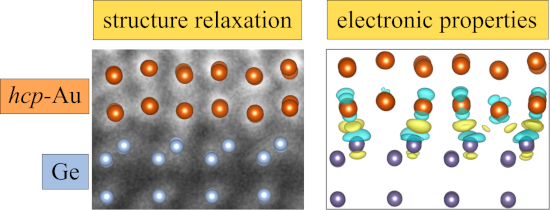
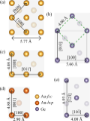
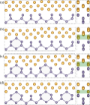
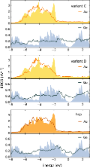
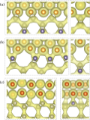
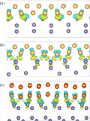
- . Our DFT calculations for the Au-fcc(011)/Ge(001) junction show how the presence of defects in the interface layer can help to stabilize the atomic pattern, consistent with microscopic images. Although the Au-hcp/Ge interface is characterized by a similar interface energy, it reveals large atomic
- power, the atomic structure and specific properties of various interfaces have been successfully studied using first principle calculations [8][9][10][11][12][13]. Up to very high pressures, gold crystallizes in the fcc phase [14] with the ABC repeating pattern of hexagonal planes in the [111] direction
- principles calculations of the cohesive energy and elastic constants as well as phonon dispersion relations show stability of both hcp and dhcp polytypes of gold [24]. Ab initio studies indicate higher stability of the fcc phase and a tendency towards hcp → fcc phase transformation. However, the calculated





Spatial mapping of photovoltage and light-induced displacement of on-chip coupled piezo/photodiodes by Kelvin probe force microscopy under modulated illumination
Beilstein J. Nanotechnol. 2023, 14, 1059–1067, doi:10.3762/bjnano.14.87
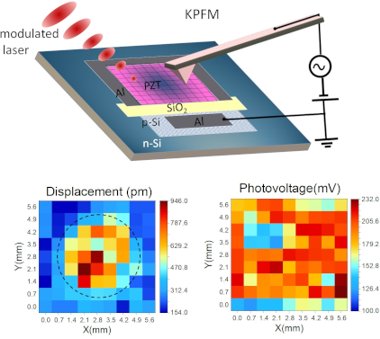
- devices. Solid mechanics and electrostatics modules were coupled to facilitate the piezoelectricity calculations. As shown in Figure 2, the symmetry condition is used to reduce the computation cost of the simulations. Analogous to our AFM and KPFM experiments, the sample edges are fixed. Additionally, the


Experimental investigation of usage of POE lubricants with Al2O3, graphene or CNT nanoparticles in a refrigeration compressor
Beilstein J. Nanotechnol. 2023, 14, 1041–1058, doi:10.3762/bjnano.14.86
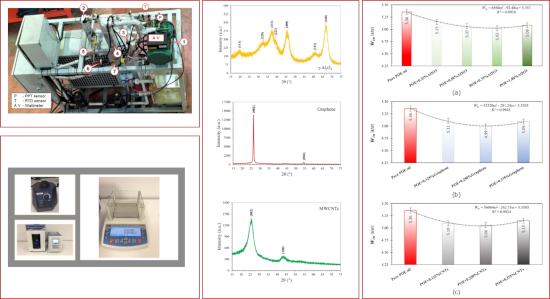
- kinematic viscosity expression given in Equation 1 was adapted according to the uncertainty analysis relation given in Equation 2, and the uncertainty amounts for the kinematic viscosity calculations within the scope of this study were calculated with the help of Equation 3. The maximum uncertainty amount





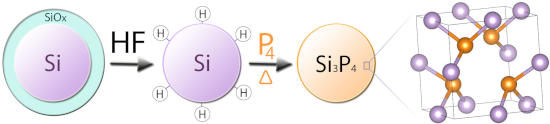
Isolation of cubic Si3P4 in the form of nanocrystals
Beilstein J. Nanotechnol. 2023, 14, 971–979, doi:10.3762/bjnano.14.80
- calculations; semiconductor nanocrystals; silicon phosphide; Introduction Advancements in electronics and related fields are calling for new ways of synthesizing compounds. Subsequently, recognizing and utilizing the special properties of nanoparticles (NPs) of new materials using emerging methods offers a
- calculations in the GGA approximation, a pseudocubic defective zinc blende Si3P4 phase was predicted to possess lattice constants a = 5.038 Å and c = 5.038 Å consistent with our experimental results [11]. Given that the values of the parameters a and c cannot be experimentally discerned, the lattice was
- analysis for the Si3P4 unit cell yields Γoptic = A1 + E + 2T1 + 3T2, Raman active vibrations of the representations A1, as well as E and T2, totaling five prior to splitting. DFT calculations were used to tentatively assign symmetries to the observed Raman modes (Table 2). The resultant structural





