


Search results
Search for "film" in Full Text gives 1174 result(s) in Beilstein Journal of Nanotechnology. Showing first 200.
Superconducting spin valve effect in Co/Pb/Co heterostructures with insulating interlayers
Beilstein J. Nanotechnol. 2024, 15, 457–464, doi:10.3762/bjnano.15.41
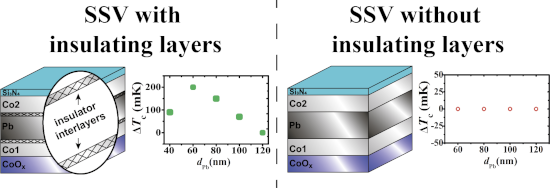
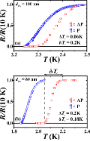
- to the literature, the formation of an oxide on the surface of the Pb film requires significantly higher temperatures and pressures, and much longer exposition times [45][46][47]. Finally, all samples were covered with a protective Si3N4 layer. The deposition rates were as follows: 0.5 Å/s for Co1



![[Graphic 6]](/bjnano/content/inline/2190-4286-15-41-i6.svg?max-width=637&scale=1.18182)
Heat-induced morphological changes in silver nanowires deposited on a patterned silicon substrate
Beilstein J. Nanotechnol. 2024, 15, 435–446, doi:10.3762/bjnano.15.39
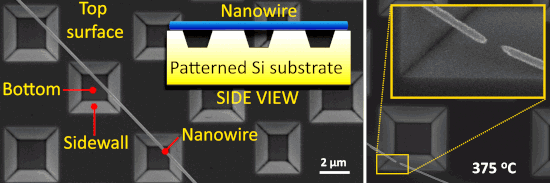
- NW networks is in highly flexible transparent film heaters [15]. In recent years, Ag NWs have garnered attention as a key element in neuromorphic computing devices [16]. In the context of the applications mentioned, Ag NWs are subjected to elevated temperatures caused by Joule heating [17]. Moreover


Potential of a deep eutectic solvent in silver nanoparticle fabrication for antibiotic residue detection
Beilstein J. Nanotechnol. 2024, 15, 426–434, doi:10.3762/bjnano.15.38
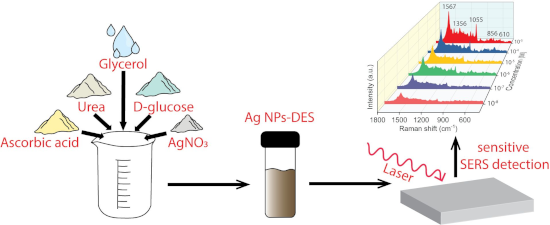
- located at 390 nm, which is suitable for SERS applications with 532 nm laser excitation. Besides, the shape of the UV–vis spectrum is in accordance with Mie scattering theory calculations, as reported in [39], proving the existence of Ag NPs in the solution. Moreover, the XRD pattern of the thin film
- thin film (Figure 3B). The uniform distribution of silver shows the uniformity of Ag NPs-DES thin film on the glass substrate, which is crucial for the applicability of this material. NFT detection The most fundamental component of a SERS-based biosensor is its SERS substrate. It directly affects the
- SERS performance of the biosensor [6]. Herein, the Ag NPs-DES thin film with the superiorly uniform Ag NPs-DES coating can be used as a SERS substrate for the analysis of antibiotics. First, residue tracing of nitrofurantoin (NFT) has been conducted in the range from 10−3 M down to 10−8 M (Figure 4A


Unveiling the nature of atomic defects in graphene on a metal surface
Beilstein J. Nanotechnol. 2024, 15, 416–425, doi:10.3762/bjnano.15.37
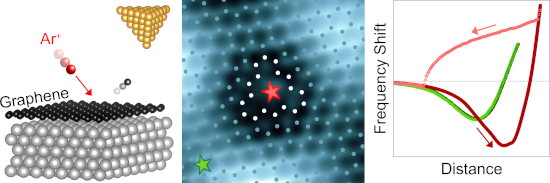
- and, presumably, coated with a Au film. The tip shape was further sharpened by single-atom transfers from the tip to the sample surface [31][32][33][34][35][36]. Topographic STM data were recorded in constant-current as well as constant-height modes with the bias voltage applied to the sample


On the mechanism of piezoresistance in nanocrystalline graphite
Beilstein J. Nanotechnol. 2024, 15, 376–384, doi:10.3762/bjnano.15.34
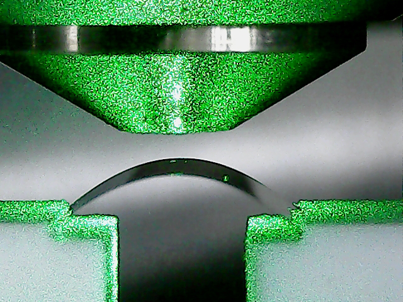
- , which was constructed in-house and automated using Python. Then, sheet resistance measurements under externally applied strain are discussed. Raman spectroscopy of the NCG under strain is studied, which gives insights into the distribution of strain in the film. Utilizing electrical and optical
- ; subsequently, it was transferred onto a 100 μm thick PET substrate. For more details please see the Experimental section. Measured piezoresistance curves (with forward and reverse sweep) for a 5 nm thick patterned NCG film on the PET substrate are shown in Figure 2a. Sheet resistance values are plotted against
- flexibility, the NCG film was grown on both sides of the glass substrate. There are three reasons for that. First, the negative thermal expansion coefficient of NCG prevents the release of stress initially present in the glass [25]. Second, the film protects the glass from any corrosion from water if the


Modulated critical currents of spin-transfer torque-induced resistance changes in NiCu/Cu multilayered nanowires
Beilstein J. Nanotechnol. 2024, 15, 360–366, doi:10.3762/bjnano.15.32
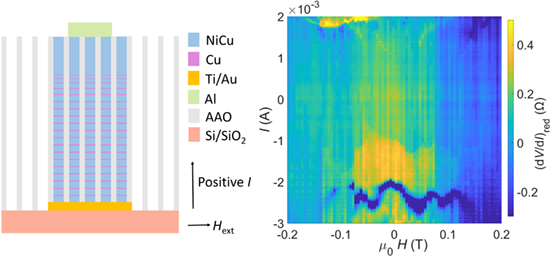
- Discussion The AAO template was fabricated by directly anodizing a ca. 1 µm thick aluminum (Al) film on a silicon (Si) substrate covered with 200 nm SiO2 and patterned Ti/Au (5/50 nm) bottom electrodes. It has pores with a diameter of around 35 nm, an interpore distance of around 50 nm, and a height of
- the surface area of the AAO template (or Si substrate) is isolated from the bottom electrodes and the magnetic nanowires, thereby largely improving the flexibility for the design of the top electrodes. After removing the overgrowth by a thin blade or milling in argon plasma, a thick Al film of 180 nm
- was patterned to build the top electrode by thermal evaporation at a large deposition rate (>3 Å/s) to ensure quick and continuous film formation and, thus, to efficiently avoid Al to be deposited into the pores. Therefore, only the nanowires the top of which have reached the upper surface of the AAO


Controllable physicochemical properties of WOx thin films grown under glancing angle
Beilstein J. Nanotechnol. 2024, 15, 350–359, doi:10.3762/bjnano.15.31
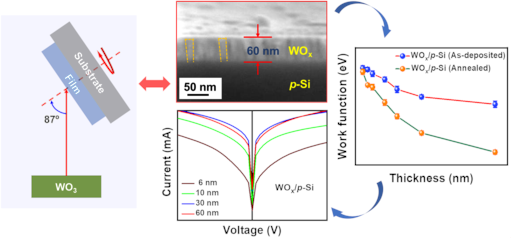
- , bandgap, and electrical conductivity, to a large extent by controlling the cationic oxidation state and the film stoichiometry [2]. As a matter of fact, adjustments in the film stoichiometry and microstructure are experimentally viable by the choice of a suitable growth technique [9][10][11]. As a result
- , film crystallinity and compositional variations in such films can also be adjusted as a function of the growth angle [27][28], making GLAD a promising approach to yield nanostructured (NS) films [29][30][31]. Electronic devices consisting of multilayers often require information on surface
- −7 mbar). The thickness of the films was measured using a surface profilometer (Ambios, XP 200). The surface morphology of the as-deposited and the annealed films was acquired using tapping mode AFM (Asylum Research). AFM images were recorded at different places on each sample to confirm the film


Determining by Raman spectroscopy the average thickness and N-layer-specific surface coverages of MoS2 thin films with domains much smaller than the laser spot size
Beilstein J. Nanotechnol. 2024, 15, 279–296, doi:10.3762/bjnano.15.26
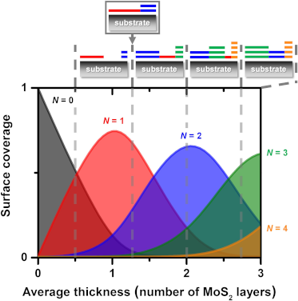
- modes is proposed to evaluate the surface coverage for each N (i.e., the ratio between the surface covered by exactly N layers and the total surface) in DLI-PP-CVD MoS2 samples. Keywords: molybdenum disulfide; number of layers; Raman spectroscopy; thin film; transition metal dichalcogenides
- . However, atomic force microscopy revealed that they are constituted of nanoflakes (with a lateral size of typically 50 nm) with possibly a distribution of thicknesses. Furthermore, depending on the synthesis conditions, the MoS2 surface coverage can be incomplete, and the thin film average thickness can
- contaminations or deposition of others species would have a different impact on the Raman intensity coming from MoS2 in the film and on the one coming from the Si substrate underneath the deposited thin film. It is, thus, expected that the measurements on contaminated or highly defective MoS2 thin films will


Ultrasensitive and ultrastretchable metal crack strain sensor based on helical polydimethylsiloxane
Beilstein J. Nanotechnol. 2024, 15, 270–278, doi:10.3762/bjnano.15.25
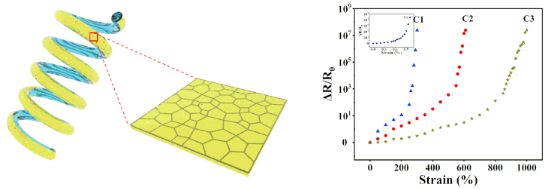
- metal crack sensors that exhibit exceptional performance in terms of ultrahigh sensitivity and ultrahigh stretchability. This is achieved by incorporating a helical structure into the substrate through a modeling process and, subsequently, depositing a thin film of gold onto the polydimethylsiloxane
- substrate via sputter deposition. The metal thin film is then pre-stretched to generate microcracks. The sensor demonstrates a remarkable stretchability of 300%, an exceptional sensitivity with a maximum gauge factor reaching 107, a rapid response time of 158 ms, minimal hysteresis, and outstanding
- film deposited on a microstructured polydimethylsiloxane (PDMS) substrate [21]. The sensor exhibits exceptional strain sensitivity, allowing for stretching of up to 20% strain. Liu et al. have successfully developed a strain sensor that exhibits high-performance characteristics [22]. A fish-scale-like


Design, fabrication, and characterization of kinetic-inductive force sensors for scanning probe applications
Beilstein J. Nanotechnol. 2024, 15, 242–255, doi:10.3762/bjnano.15.23
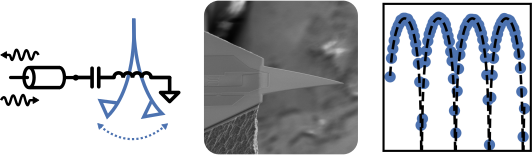
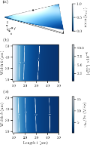
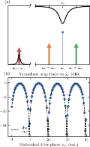
- L and capacitance C. The relatively small size available from the cantilever dimensions motivates the use of kinetic inductance to achieve a compact lumped-element inductor with negligible stray capacitance. Mattis–Bardeen theory [30] relates the kinetic inductance of a film with thickness t much
- less than the London penetration depth to the normal-state sheet resistance R□ and the superconducting energy gap Δ0. For a conductor of length ℓ and width w, the kinetic inductance is where Lk,□ is the kinetic inductance per square. From Equation 4, we require a superconducting film with large normal
- through the inductor is limited by the critical current Ic, also set by material choice and physical dimensions. From Equation 5, we can increase nc for a given material by, again, making the nanowire longer or narrower, or by increasing Lk,□ through a thinner film. However, longer and narrower nanowires



Quantitative wear evaluation of tips based on sharp structures
Beilstein J. Nanotechnol. 2024, 15, 230–241, doi:10.3762/bjnano.15.22
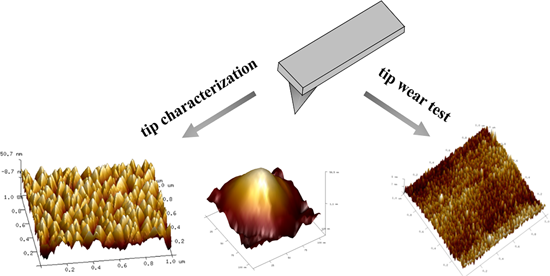
- analyze the shape of the tip, we use a probe to scan a TipCheck calibration sample and characterize its morphology. The TipCheck sample, provided by BudgetSensors, consists of a silicon chip sample with a wear-resistant thin film coating. The thin film coating exhibits granular and sharp nanostructures




Nanocarrier systems loaded with IR780, iron oxide nanoparticles and chlorambucil for cancer theragnostics
Beilstein J. Nanotechnol. 2024, 15, 180–189, doi:10.3762/bjnano.15.17
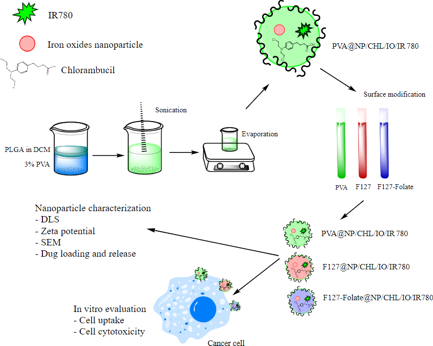
- film for 1 min, and water was allowed to evaporate. Then, the NPs were coated with titanium and SEM images were acquired using a FE-SEM S4800 HITACHI, Japan. Loading capacity Entrapment and release of CHL and IR780 in the NPs were measured by the absorbance of CHL at 256 nm and IR780 at 780 nm using


Modification of graphene oxide and its effect on properties of natural rubber/graphene oxide nanocomposites
Beilstein J. Nanotechnol. 2024, 15, 168–179, doi:10.3762/bjnano.15.16
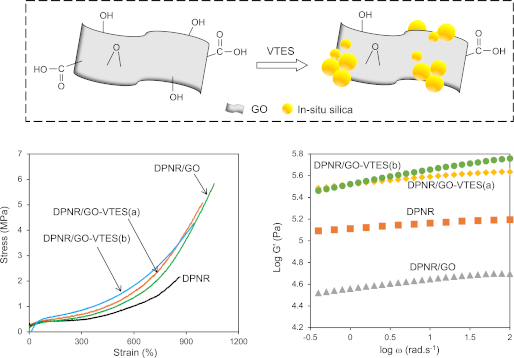
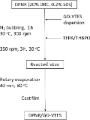
- under N2 atmosphere at 30 °C. The reacted latex was subjected to rotary evaporation for 40 min to remove impurities. The resulting latex was cast on a petri dish and dried in an oven at 50 °C, then in a vacuum to obtain a DPNR/GO-VTES composite film. A similar procedure was carried out with 0.2 g of GO






CdSe/ZnS quantum dots as a booster in the active layer of distributed ternary organic photovoltaics
Beilstein J. Nanotechnol. 2024, 15, 144–156, doi:10.3762/bjnano.15.14
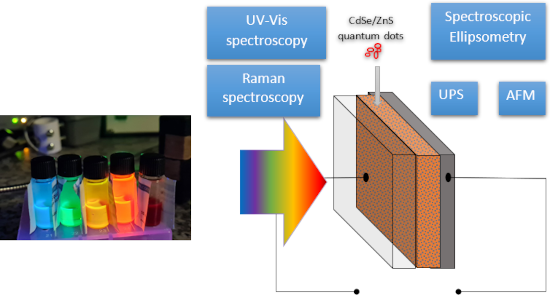
- ultrasonicated for 20 s and then applied to the substrate according to the test method. The angular velocity of the spin coater was also determined by the specific test method and its required film thickness. To keep the typical ratio of the donor and acceptor equal to 1:1 and simultaneously highlight the QD
- spectra of a solid were studied as a thin film deposited on quartz, and measurements in solution were obtained in chloroform. The wavelength ranged from 250 to 1000 nm. A Woolam M-2000 ellipsometer was used for spectroscopic ellipsometry analysis. The measurement range was 350–1650 nm. The measurement was
- (point by point). The layer under consideration was first pure quantum dots and then a ternary system with PC71BM and P3HT. The refractive index (n) of the quantum dots thin film and the extinction coefficient (k) were estimated using the Lorentz model modified by Tauc. The complex dielectric function is




In situ optical sub-wavelength thickness control of porous anodic aluminum oxide
Beilstein J. Nanotechnol. 2024, 15, 126–133, doi:10.3762/bjnano.15.12
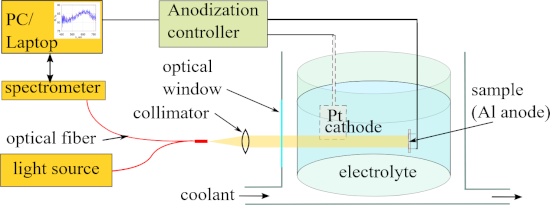
- layer, several samples were mapped via SE. Instead of a single-layer alumina with effective RI neff, the model for SE measurements (Figure 1c) consisted of a barrier layer (phase 1) and a porous alumina layer (phase 2). As can be seen in Figure 4a–e, the thickness variation of the total alumina film was
- presented method to other anodization protocols and film growth in a broader context, an important assumption for using the TM model is that the pore diameters (or other inhomogeneities in general) are much smaller than the wavelength of light and the film can be characterized by an effective medium


Development and characterization of potential larvicidal nanoemulsions against Aedes aegypti
Beilstein J. Nanotechnol. 2024, 15, 104–114, doi:10.3762/bjnano.15.10
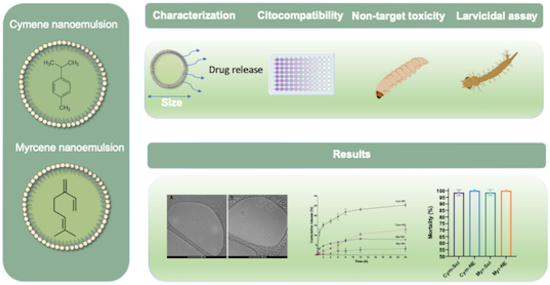
- enhances the properties of the interfacial film, leading to improved adsorption between the oil and water phases and enhancing the stability of nanoemulsions [29]. Previous studies have reported similar findings regarding NEs containing terpenes. Polydispersity index values comparable to those observed in
- deviation. Cryogenic transmission electron microscopy The nanoemulsions were mounted onto a copper grid with lacy carbon film (300 mesh). The acquisition was carried out with a MET Talos Arctica G2 apparatus. In vitro terpene release profile The in vitro release assays were conducted assuring sink


Influence of conductive carbon and MnCo2O4 on morphological and electrical properties of hydrogels for electrochemical energy conversion
Beilstein J. Nanotechnol. 2024, 15, 57–70, doi:10.3762/bjnano.15.6
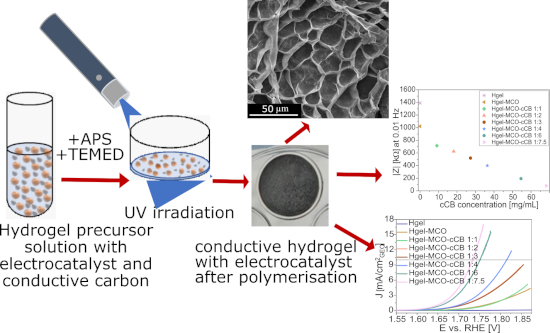
- , the results indicate that microporosity, and thus the electroactive surface area of the electrode, increases with a higher content of cCB in the hydrogel-MCO film. A slightly different trend can be observed for the charge transfer resistance Rct at the solution–film interface. The highest Rct is


Curcumin-loaded nanostructured systems for treatment of leishmaniasis: a review
Beilstein J. Nanotechnol. 2024, 15, 37–50, doi:10.3762/bjnano.15.4

- nanoliposomes promoting increased antiparasitic activity. Recently, Bafghi and collaborators produced nanoliposomes for curc delivery as a new alternative for leishmaniasis treatment [89]. Briefly, the nanoliposomes were prepared by thin-film hydration, resulting in spherical vesicles with 176.5 nm of diameter


Measurements of dichroic bow-tie antenna arrays with integrated cold-electron bolometers using YBCO oscillators
Beilstein J. Nanotechnol. 2024, 15, 26–36, doi:10.3762/bjnano.15.3
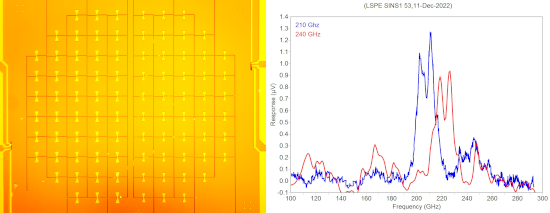
- based on high-temperature YBCO Josephson junctions [27][28][29]. Long junctions based on YBCO thin films were fabricated by the preliminary topology mask method [30][31]. Specifically, YBCO film was deposited on a 24° [001]-tilt Zr1−xYxO2 bicrystal substrate by magnetron sputtering with preliminary


TEM sample preparation of lithographically patterned permalloy nanostructures on silicon nitride membranes
Beilstein J. Nanotechnol. 2024, 15, 1–12, doi:10.3762/bjnano.15.1
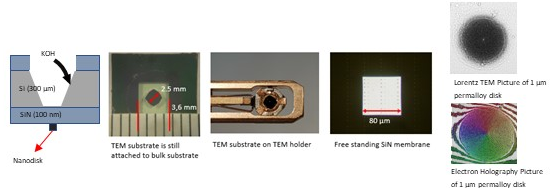
- method to form an undercut structure that guarantees a clean lift-off procedure. The second approach used dry etching with an Ar beam to etch a thin Py film, while an electron-beam-patterned negative resist mask kept the desired structure. In the third process, nanostencils (shadow masks) with
- mode to avoid melting of the PMMA resist. The second approach involved etching a thin Py film with an ion beam while preserving the intended structure with an electron-beam-patterned negative resist mask. Redeposition of etched material was found to construct fences at the edges of the structures
- target–substrate distance of around 8 cm. The sputtered film was investigated under HRTEM. It was revealed that the film is polycrystalline with a lattice spacing of 0.36 nm (Figure 4), which correlates to the lattice constant of Py. The lift-off technique allows for the fabrication of arrays of 220 nm


Fluorescent bioinspired albumin/polydopamine nanoparticles and their interactions with Escherichia coli cells
Beilstein J. Nanotechnol. 2023, 14, 1208–1224, doi:10.3762/bjnano.14.100
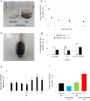
- mixtures of BSA and DA in Tris buffer inhibited the deposition of a PDA film on the wall of the reaction beakers (Figure 3a). This suggested that BSA/PDA aggregates formed and that almost all the free DA molecules were consumed in these aggregates, as already mentioned by Bergtold and co-workers [13]. A
- progressive inhibition of the deposition of a PDA film on the wall of the reaction beaker, which was mentioned above and observed above a certain amount of BSA (Figure 3a). This allowed us to assume that BSA molecules below a critical amount cannot surround all DA molecules (some DA molecules thus form a thin
- film of PDA on the beaker’s wall), whereas they stabilize PDA NPs above this amount. The suspension stability was maintained when BSA/PDA NPs were in suspension in H2O or 150 mM NaCl solution. However, the mean hydrodynamic diameter varied with the solvent, with an increase by up to 50% for a BSA/DA



Spatial variations of conductivity of self-assembled monolayers of dodecanethiol on Au/mica and Au/Si substrates
Beilstein J. Nanotechnol. 2023, 14, 1169–1177, doi:10.3762/bjnano.14.97
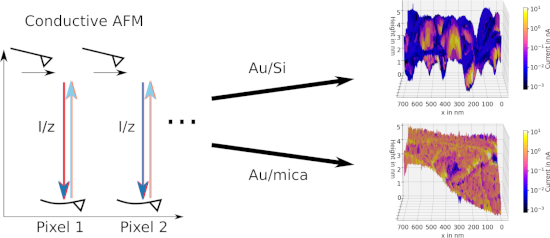
- S2a). In contrast to the Au/mica surface, the Au/Si substrate exhibits a rougher surface, as seen in Figure 2c, in agreement with the difference in growth mode of Au films on the two substrates. For mica, epitaxial growth is obtained [16][17], while Au on Si/SiO2 forms a granular film [18]. Although


Hierarchically patterned polyurethane microgrooves featuring nanopillars or nanoholes for neurite elongation and alignment
Beilstein J. Nanotechnol. 2023, 14, 1157–1168, doi:10.3762/bjnano.14.96
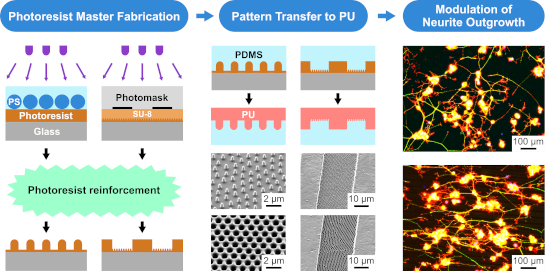
- nanopillar array on an SU-8 film (Figure 1A(i) and (ii)). SU-8 generates a strong acid in UV-exposed areas, which, in turn, undergo acid-initiated crosslinking during the post-exposure baking step [18]. However, we found that the subsequent formation of a polydimethylsiloxane (PDMS) inverse mold from the SU
- further crosslinking the SU-8 (Figure 1A(iv)). This enabled the release of the PDMS film without breakage of the nanopillars (Supporting Information File 1, Figure S1D). Application of NLL on the positive photoresist AZ1518 allowed for the formation of a nanohole array (Figure 1A(v)). AZ1518 contains a
- photolithography step following NLL (Figure 3A(i) and (ii)). The starting samples for photolithography were a hard-baked SU-8 film, SU-8 nanopillars (not hard-baked), and SU-8 nanoholes for the creation of plain microgrooves (“microgroove”), nanopillars on microgrooves (“pillar–groove”), and nanoholes on


A multi-resistance wide-range calibration sample for conductive probe atomic force microscopy measurements
Beilstein J. Nanotechnol. 2023, 14, 1141–1148, doi:10.3762/bjnano.14.94
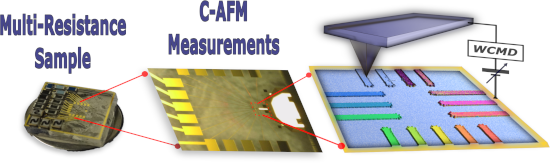
- . Subsequently, a lift-off process in acetone was employed to reveal the gold pattern. Finally, square samples were cut to match the dimensions of the measurement setup. We hand-soldered thick-film surface-mounted-device (SMD) resistors onto the connection gold pads on the surface using small soldering paste
- in Figure 3. The resistance values for the electrode arms i = 3, 4, and 5 (i.e., 10 kΩ, 100 kΩ, and 1 MΩ, respectively) were corrected by accounting for the tip resistance, which was measured on a copper film at Rtip = 6591 Ω with a relative uncertainty of 1% (conservative value). It is worth noting


Properties of tin oxide films grown by atomic layer deposition from tin tetraiodide and ozone
Beilstein J. Nanotechnol. 2023, 14, 1085–1092, doi:10.3762/bjnano.14.89
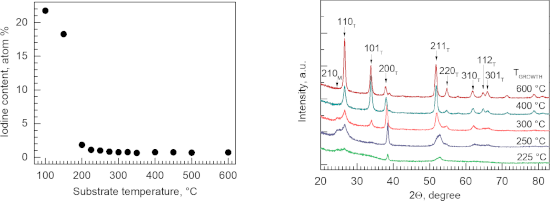
- investigating the dependence of different film properties on the deposition temperature. Other experiments were carried out at 300 °C since the highest GPC, which was 0.27 nm/cycle, was obtained at this temperature. In order to visualize the stepwise film growth and, at the same time, determine the optimum
- pulse length for the iodide precursor, the SnI4–O3 process was, at first, examined in situ using a quartz crystal microbalance (QCM) [17]. The QCM data were acquired with a Q-pod quartz crystal monitor (Inficon) at a stabilized reactor temperature of 300 °C. For the film growth for ex situ measurements
- ZSX Version 5.55 was used to measure the elemental composition of films. A spectroscopic ellipsometer, model GES5-E, was used for the measurements of film thicknesses and refractive indices. Ellipsometric data was modelled using the Cauchy dispersion model. The crystal structure was evaluated by





