Search results
Search for "nanostructure" in Full Text gives 366 result(s) in Beilstein Journal of Nanotechnology. Showing first 200.
Surface plasmon resonance enhancement of photoluminescence intensity and bioimaging application of gold nanorod@CdSe/ZnS quantum dots
Beilstein J. Nanotechnol. 2019, 10, 22–31, doi:10.3762/bjnano.10.3
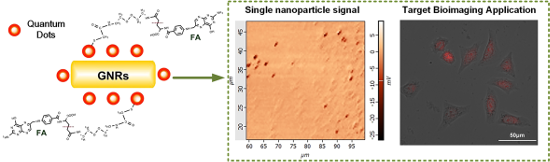
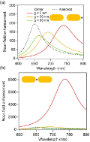
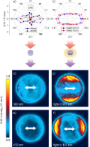
- biological application and therapy of human diseases [26][27]. In this work, we demonstrated a novel GNR@CdSe/ZnS multimodal nanostructure in aqueous phase. We chose CdSe/ZnS QDs as a PL contributor due to its high degree of brightness, excellent photostability, and good spectral overlap with GNRs. We then


A new bioinspired method for pressure and flow sensing based on the underwater air-retaining surface of the backswimmer Notonecta
Beilstein J. Nanotechnol. 2018, 9, 3039–3047, doi:10.3762/bjnano.9.282
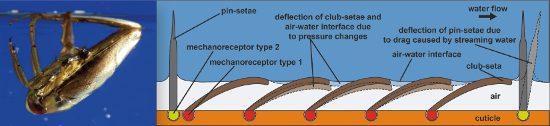
- Notonecta use to maintain this air layer while submerged, Ditsche-Kuru et al. [12] investigated the micro- and nanostructure of the hemelytra of Notonecta glauca. They found that the upper side of the hemelytra is hierarchically structured by two types of setae and many microtrichia. One type of setae is


Size limits of magnetic-domain engineering in continuous in-plane exchange-bias prototype films
Beilstein J. Nanotechnol. 2018, 9, 2968–2979, doi:10.3762/bjnano.9.276
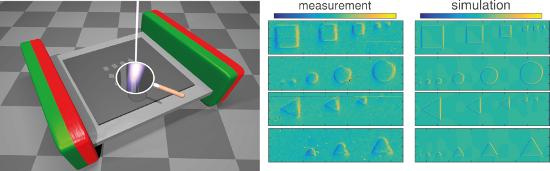
- Interdisciplinary Nanostructure Science and Technology (CINSaT), University of Kassel, 34132 Kassel, Germany Faculty of Physics, Physics of supramolecular Systems and Surfaces, University of Bielefeld, 33501 Bielefeld, Germany PT-DESY, Deutsches Elektronen-Synchrotron DESY, 22607 Hamburg, Germany Peter Grünberg
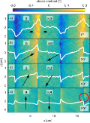


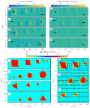


![[Graphic 63]](/bjnano/content/inline/2190-4286-9-276-i63.svg?max-width=637&scale=1.18182) .
. ![[Graphic 64]](/bjnano/content/inline/2190-4286-9-276-i64.svg?max-width=637&scale=1.18182) is the angle between the domain wall (DW) normal vector
is the angle between the domain wall (DW) normal vector ![[Graphic 65]](/bjnano/content/inline/2190-4286-9-276-i65.svg?max-width=637&scale=1.18182) and the local unidirectio...
and the local unidirectio...
Charged particle single nanometre manufacturing
Beilstein J. Nanotechnol. 2018, 9, 2855–2882, doi:10.3762/bjnano.9.266
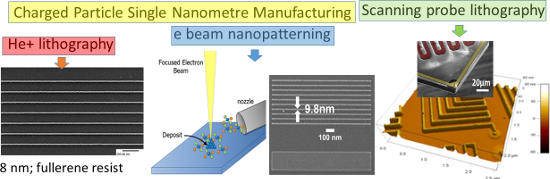
- read-out of the cantilever bending. The STM uses the tunneling current between a tip and the surface to obtain information about the sample surface [106][107]. Scanning probe nanolithography uses the interaction of such a tip with the sample to nanostructure its surface. For the purpose of this review


Nanostructure-induced performance degradation of WO3·nH2O for energy conversion and storage devices
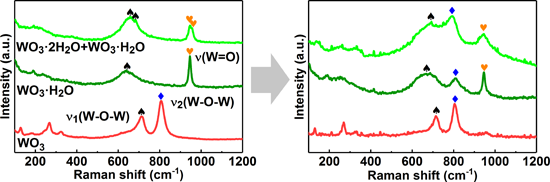
Beilstein J. Nanotechnol. 2018, 9, 2845–2854, doi:10.3762/bjnano.9.265


Graphene-enhanced metal oxide gas sensors at room temperature: a review
Beilstein J. Nanotechnol. 2018, 9, 2832–2844, doi:10.3762/bjnano.9.264
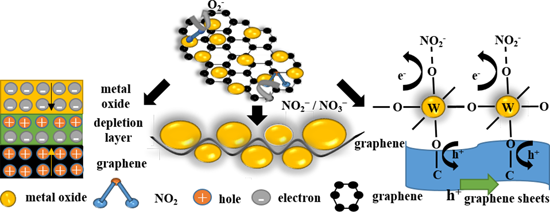
- . In a pioneering work, Lin et al. [78] demonstrated that SnO2–graphene (GN) hybrids fabricated via hydrothermal synthesis using GO and SnCl2 as precursors exhibited a 3D nanostructure with high specific surface area (94.9 m2/g). During the hydrothermal process, GO served as a template to promote the



Silencing the second harmonic generation from plasmonic nanodimers: A comprehensive discussion
Beilstein J. Nanotechnol. 2018, 9, 2674–2683, doi:10.3762/bjnano.9.250
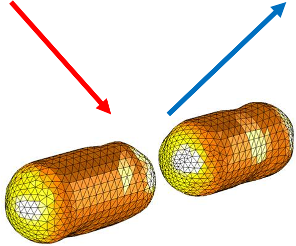
- concentrate light into subwavelength regions [1][2]. The collective oscillations of these electrons in a given plasmonic nanostructure are called localized surface plasmon resonances (LSPRs) [3][4][5]. The high electric field enhancement associated with the optical excitation of such a resonance has been
- ][29]. The SH surface currents are obtained by solving the surface integral equation formulation taking into account the nonlinear polarization and enforcing the boundary conditions at the nanostructure surfaces [30]. As the linear surface currents, the SH surface currents are expanded on Rao–Wilton
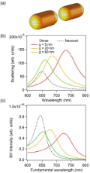
- function of the fundamental wavelength for gold dimers with gaps of 5 nm, 20 nm, and 60 nm and a single nanorod. For each nanostructure, a maximum of the second harmonic scattering is observed when the fundamental wavelength is close to the resonant wavelength of the bonding dipolar mode. This effect is


Characterization of the microscopic tribological properties of sandfish (Scincus scincus) scales by atomic force microscopy
Beilstein J. Nanotechnol. 2018, 9, 2618–2627, doi:10.3762/bjnano.9.243

- nanostructure of the sandfish is found only on dorsal scales and is missing on ventral scales. Moreover, both types feature a similar friction coefficient. Finally, such a comb-like structure can be found on many reptiles even on those that do not sand-swim or live in a different environment [15]. Consequently


Pattern generation for direct-write three-dimensional nanoscale structures via focused electron beam induced deposition
Beilstein J. Nanotechnol. 2018, 9, 2581–2598, doi:10.3762/bjnano.9.240
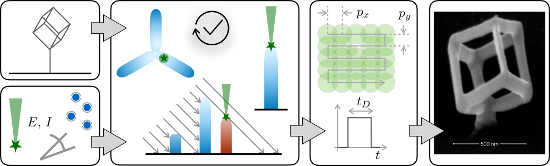
- eventually leads to the growth of the desired 3D nanostructure. Ideally, this pattern-definition file should be generated quasi-automatically from a simple geometrical description of the target 3D structure. A simulation-guided generation of pattern-definition files may well prove to be superior for some




ZnO-nanostructure-based electrochemical sensor: Effect of nanostructure morphology on the sensing of heavy metal ions
Beilstein J. Nanotechnol. 2018, 9, 2421–2431, doi:10.3762/bjnano.9.227
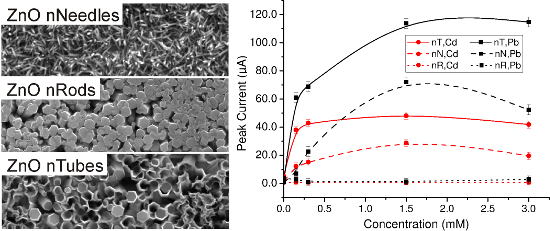
- were carried out using these nanostructured ZnO coatings on the working electrodes using aqueous solutions of Pb(NO3)2 and Cd(NO3)2 as analytes with different concentrations. Experimental Design and fabrication of the ZnO nanostructure-based electrochemical sensor Three morphologies of well-aligned one
- , which limits the flow of liquid around the sample and reduces the probability of grown particles to enter covered areas, providing the necessary selectivity of nanostructure growth only on the electrodes. In the second step a temporary extra rubber sealing mask was applied and Cr electrodes were coated
- series of DPV measurements in Pb(NO3)2 aqueous solution at concentrations of 1.5 μM, 3 μM, 15 μM, 30 μM, 150 μM, and 300 μM were performed. The same configuration of the cell was used in the measurements. Results and Discussion Characterization of the ZnO nanostructure-modified electrodes SEM images show


High-throughput micro-nanostructuring by microdroplet inkjet printing
Beilstein J. Nanotechnol. 2018, 9, 2372–2380, doi:10.3762/bjnano.9.222
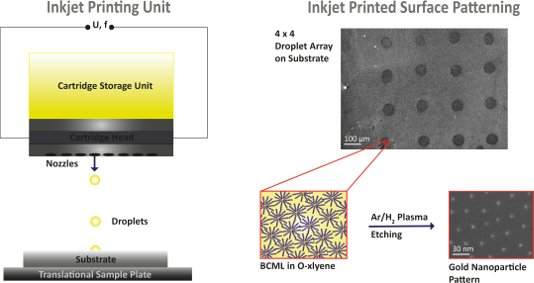
- generated on different types of silicon and nickel–titanium (NiTi) materials, thus providing a novel method to micro-nanostructure and functionalize materials, which are relevant in biomaterial and biosensor applications. Results and Discussion Inkjet printing for generating micelle solution droplets The
- nanostructure inside the printed circles is strongly distorted, and nanostructured patches are formed. Our method can easily be extended to further nanoparticle systems and also to complex printing patterns. Hence, it is relevant in all applications where nanoparticle separation distances and densities need to


Block copolymers for designing nanostructured porous coatings
Beilstein J. Nanotechnol. 2018, 9, 2332–2344, doi:10.3762/bjnano.9.218
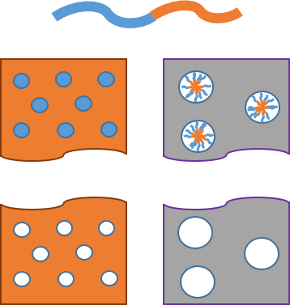
- nanostructure. AFM images reported in this study show that after thermal treatment, a mesoporous titania coating is obtained where the spherical pore systems correspond to the PS spherical domains in the hybrid film before calcination. Depending on the formulation parameters and following the same procedure
- methods, the principal critical step is the removal of the porogen without losing the designed nanostructure organization [4]. In general, this procedure is a very complex route that requires either strong acids/bases or selective organic solvent washing (not easy to handle or environmentally friendly


Metal–dielectric hybrid nanoantennas for efficient frequency conversion at the anapole mode
Beilstein J. Nanotechnol. 2018, 9, 2306–2314, doi:10.3762/bjnano.9.215
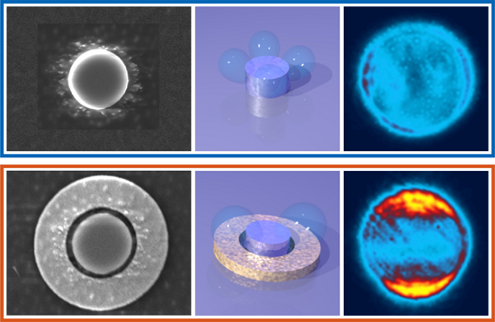
- in placing a metal nanostructure in the proximity of the dielectric nanoantenna to manipulate the in- and out-coupling of light [34][35]. This hybrid integration was exploited to significantly boost the nonlinear conversion efficiency of nanosystems [32][36][37]. In particular, Maier and co-workers
- wavelength, surrounded by an Au ring designed to improve light coupling to the nanostructure anapole. This enables the improvement of both the second- and third-order nonlinear efficiencies, with measured enhancement factors of about 30 and 15 for the SHG and THG processes, respectively. The analysis of both




Nanoscale characterization of the temporary adhesive of the sea urchin Paracentrotus lividus
Beilstein J. Nanotechnol. 2018, 9, 2277–2286, doi:10.3762/bjnano.9.212
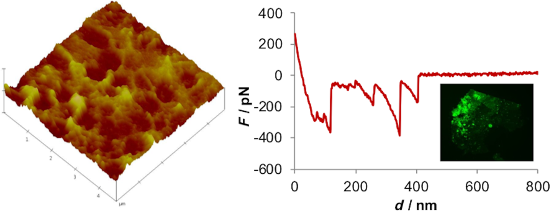
- curves and positive thioflavin-T labelling. Conclusion: Our results confirm that like other temporary adhesives, the sea urchin adhesive footprint nanostructure consists of a meshwork of entangled globular nanostructures. Under native conditions, the adhesive footprints of the sea urchin behaved like a
- adhesives, most studies have focused on permanent adhesives like those of mussels, barnacles and tubeworms, whereas the so-called nonpermanent, temporary or reversible adhesives have received much less attention. To our knowledge, the nanostructure of temporary adhesives has only been examined in a few
- disc epidermis [15]. The two secretions mix when extruded, producing adhesive footprints composed of proteins, neutral and amino sugars and uronic acid [16]. The adhesive nanostructure of sea stars was studied in two species, Asterias rubens [7] and Marthasterias glacialis [8]. AFM was employed to show


Electrospun one-dimensional nanostructures: a new horizon for gas sensing materials
Beilstein J. Nanotechnol. 2018, 9, 2128–2170, doi:10.3762/bjnano.9.202
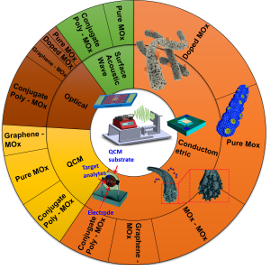
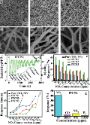
- electrospinning practices [58][59][60][61][62]. 3 Nanostructure morphologies generated by electrospinning Recently, a great deal of attention and research effort has been devoted to the development of electrospun fibers incorporated with functional nanoparticles (NPs) [39][40]. This practice significantly
- (e.g., polypyrrole (PPy), polyaniline (PANI), polythiophene (PTh) and their derivatives) [32][87][88][90], MOx nanofibers surface functionalized by metal nanoparticles [75] and graphene sheets incorporated with MOx nanofibers [89]. 4.1 Conductometric gas sensors Nanostructure-based conductometric






Localized photodeposition of catalysts using nanophotonic resonances in silicon photocathodes
Beilstein J. Nanotechnol. 2018, 9, 2097–2105, doi:10.3762/bjnano.9.198
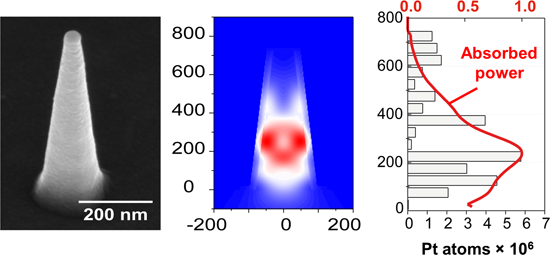
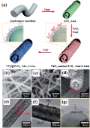
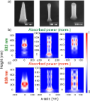
- nanostructure. Silicon nanocones confine light mostly at the top of the structure at 532 nm (Figure 2b) in contrast to an excitation at 638 nm, where most of the light is absorbed at the bottom of the cone (Figure 2c). In the case of inverted nanocones, light is concentrated primarily at the bottom for both
- follows: First, preliminary chronoamperometric experiments were conducted to indicate the conditions in which we could easily identify the location of the platinum particles on each nanostructure without the total overgrowth of the latter. A total amount of around 1 mC was needed to obtain well separated
- optimization of the photo-electrodeposition process is necessary for the fabrication of efficient photocatalytic samples. For each Si nanostructure morphology, overlays of secondary-electron and backscattered-electron (collected with an in-lens mirror detector) SEM images were acquired. This overlay method


A scanning probe microscopy study of nanostructured TiO2/poly(3-hexylthiophene) hybrid heterojunctions for photovoltaic applications
Beilstein J. Nanotechnol. 2018, 9, 2087–2096, doi:10.3762/bjnano.9.197
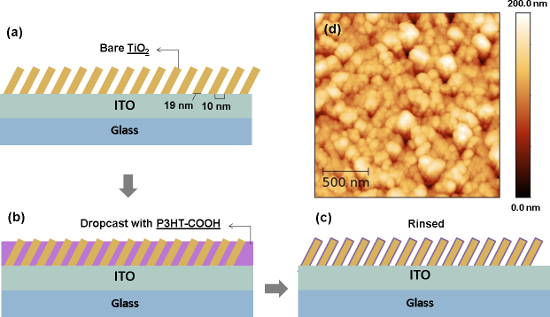
- the electron acceptor materials commonly used for DSSC and HBHJ, titanium dioxide (TiO2) is a well-known metal oxide semiconductor [6][7][8]. Depending on its nanostructure and its crystalline phase, its conductivity varies from 10−4 Ω−1·cm−1 to 10−11 Ω−1·cm−1 [9][10]. TiO2 is very valuable because it


Metal-free catalysis based on nitrogen-doped carbon nanomaterials: a photoelectron spectroscopy point of view
Beilstein J. Nanotechnol. 2018, 9, 2015–2031, doi:10.3762/bjnano.9.191
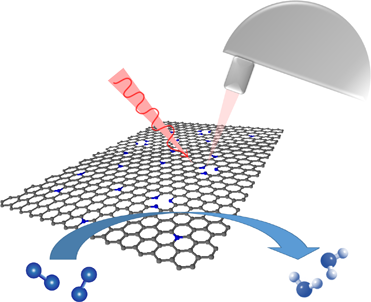
- nanostructure. The creation of active sites for interaction is a key step for obtaining an optimal working catalyst as well as for sensing foreign species [29][30][31]. These sites enable the dissociation of molecules and the formation of bonds with the products, for example in the molecular adsorption of
- ]: Niwa et al. [105] described carbon nanostructure alloys (a precursor of graphene), Nagaiah and co-workers studied nitrogen-doped CNTs [106], and Parvez et al. used N-graphene [107]. In the first report, correlating X-ray absorption spectroscopy (XAS) and ORR activity, the study was focused on the




Recent highlights in nanoscale and mesoscale friction
Beilstein J. Nanotechnol. 2018, 9, 1995–2014, doi:10.3762/bjnano.9.190
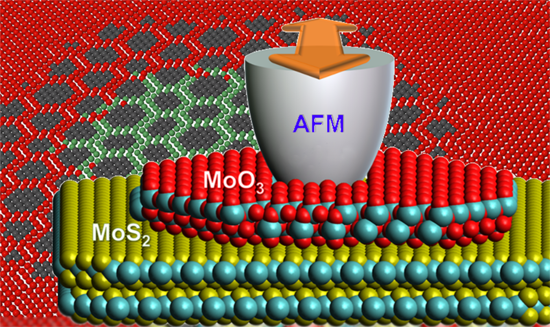
- force component originating from the interface between nanostructure and substrate [43]. Only for very small structures, dynamic NC-AFM techniques are required in which the interfacial friction can be quantified based on the frequency shift induced by the resistance of the structure against movement [55
- particles can be of importance. This was demonstrated by MD simulations for gold clusters on HOPG, where a significant reduction of static friction was found by simply increasing the cluster thickness. As a result, the nanostructure becomes elastically stiffer, which goes along with a reduced tendency to


Numerical analysis of single-point spectroscopy curves used in photo-carrier dynamics measurements by Kelvin probe force microscopy under frequency-modulated excitation
Beilstein J. Nanotechnol. 2018, 9, 1834–1843, doi:10.3762/bjnano.9.175
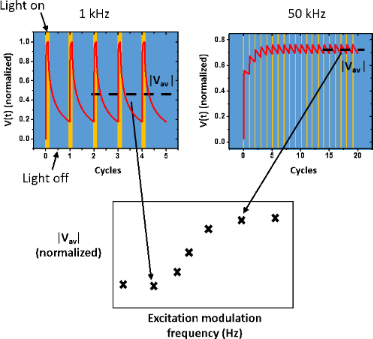
- nanostructure and photo-transport mechanisms has become of crucial importance for the development of many emerging photovoltaic technologies. In this context, Kelvin probe force microscopy under frequency-modulated excitation has emerged as a useful technique for probing photo-carrier dynamics and gaining


Controllable one-pot synthesis of uniform colloidal TiO2 particles in a mixed solvent solution for photocatalysis
Beilstein J. Nanotechnol. 2018, 9, 1715–1727, doi:10.3762/bjnano.9.163
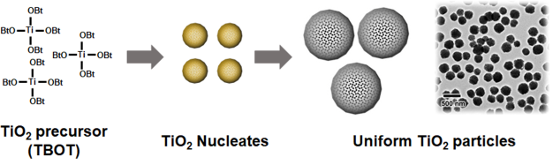
- synthesize TiO2 photocatalysts with controlled crystallinity while maintaining a high surface area. Since many photocatalysis reactions are a liquid phase reaction, a well-dispersible colloidal TiO2 nanostructure should be one of the most ideal forms. In order to maximize the active surface area as well as




Light extraction efficiency enhancement of flip-chip blue light-emitting diodes by anodic aluminum oxide
Beilstein J. Nanotechnol. 2018, 9, 1602–1612, doi:10.3762/bjnano.9.152
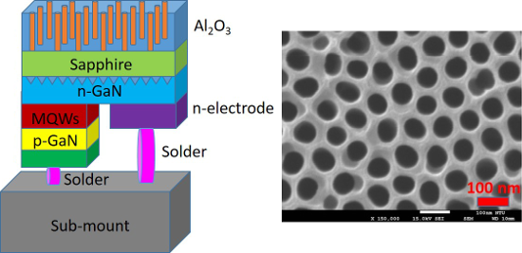
- high-luminance flip-chip blue LEDs (FC-BLEDs) to enhance the LEE [26][27]. This enhancement may occur through two mechanisms [28][29][30][31][32][33][34]. The nanostructure on the LED can decrease the total light reflectivity, thereby decreasing the critical angle of total reflectivity and enhancing
- LEE [12][16][35][36]. Whether the nanostructure, which possesses special metallic features, is influenced by the surface plasmon wave and enhances LEE has also been studied [37][38][39][40]. Results and Discussion Scanning electron microscopy and atomic force microscopy measurements The scanning
- a predominantly regular periodic nanostructure. The nanopore diameters of the three samples are approximately 73–75 nm, 77–79 nm, and 80–85 nm, and the distance between pores is approximately 15, 13, and 10 nm ± 2 nm. Figure 1a shows a relatively complete surface periodic structure; Figure 1b shows


Interaction-tailored organization of large-area colloidal assemblies
Beilstein J. Nanotechnol. 2018, 9, 1582–1593, doi:10.3762/bjnano.9.150
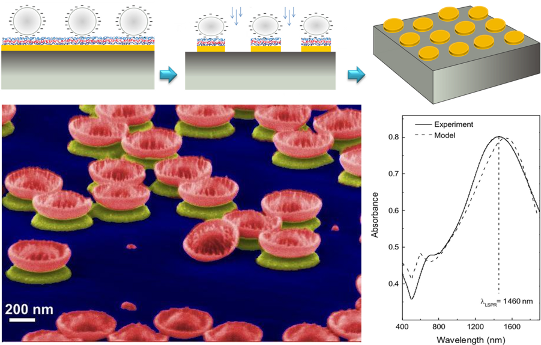
- different sizes and materials. Keywords: colloidal lithography; electrostatic interactions; large-area nanostructure patterning; localized surface plasmon resonance; spherical nanoparticles; Introduction In recent years, ordered nanostructured arrays have attracted great interest because of their
- -area nanostructure arrays with controlled size and shape for application in localized surface plasmon resonance (LSPR) sensing and magnonics. Experimental Materials Glass substrates (3.5 × 2.5 cm2) were obtained from Electro Optical Technologies. Polystyrene spheres with diameter of 80 ± 7 nm (sulfate
- on the whole surface considered. The optical absorbance of the fabricated nanostructure was characterized by a Cary500 UV–visible spectrophotometer. All the spectra were taken in the vis–NIR spectral range at room temperature and compared with expected theoretical results obtained through numerical


Sheet-on-belt branched TiO2(B)/rGO powders with enhanced photocatalytic activity
Beilstein J. Nanotechnol. 2018, 9, 1550–1557, doi:10.3762/bjnano.9.146
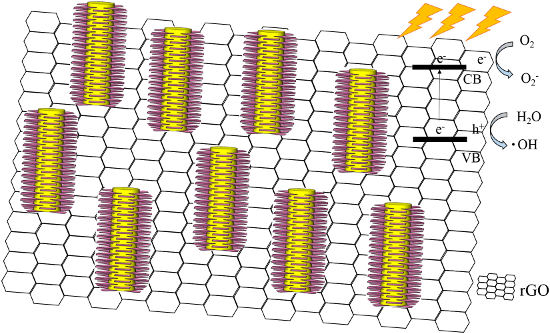
- assist the photodegradation of phenol in water under UV light illumination. The enhanced photocatalytic activity can be attributed to the significantly increased surface area and enhanced charge separation. Keywords: branched nanostructure; photocatalysis; reduced graphene oxide; TiO2(B); Introduction
- harvesting efficiency, which also contributes to increased photocatalytic activity [22][27]. Herein, we report a novel approach to synthesize branched TiO2(B) nanobelts incorporated at the same time with reduced graphene oxide (rGO). The unique sheet-on-belt nanostructure demonstrates a high specific surface
- surface area of the pristine TiO2 nanobelt. The further increased surface area of the branched nanostructure can be explained by the thinner thickness (≈2 nm, Figure 2d) and thus higher specific surface area of the nanosheet branches compared with the nanobelt trunks (≈5 nm in thickness, Figure 2a and


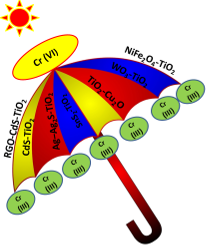
Cr(VI) remediation from aqueous environment through modified-TiO2-mediated photocatalytic reduction
Beilstein J. Nanotechnol. 2018, 9, 1448–1470, doi:10.3762/bjnano.9.137