


Search results
Search for "sputtering" in Full Text gives 398 result(s) in Beilstein Journal of Nanotechnology. Showing first 200.
Site-controlled formation of single Si nanocrystals in a buried SiO2 matrix using ion beam mixing
Beilstein J. Nanotechnol. 2018, 9, 2883–2892, doi:10.3762/bjnano.9.267
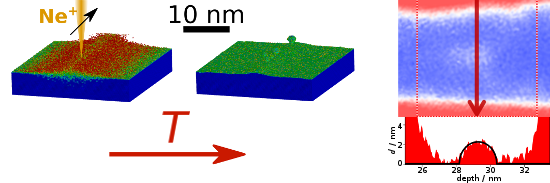
- -oxide-semiconductor (CMOS) technology and thus have yet to be integrated into a cost-efficient Si-based technology. Multiple methods have been proposed and optimized for Si NC fabrication, including plasma-enhanced chemical vapor deposition (PECVD) [4][10], magnetron sputtering [11][12], laser-induced
- fluence over 10000 Ne+/nm2 in order to achieve a sufficient Si enrichment in the SiO2 layer. Two effects prevent NC self-assembly by point irradiation. First, the sputtering of the top silicon layer becomes significant. Second, Ne bubble formation [34][35] occurred below the SiO2 layer resulting in a
- position of the focused beam irradiation and has a diameter of 2.2 nm. Further minimization of the mixed volume by point-like irradiation with the focused Ne+ ion beam is prohibited by excessive sputtering and Ne bubble formation due to the high fluences required to achieve sufficient mixing. However, the


Charged particle single nanometre manufacturing
Beilstein J. Nanotechnol. 2018, 9, 2855–2882, doi:10.3762/bjnano.9.266
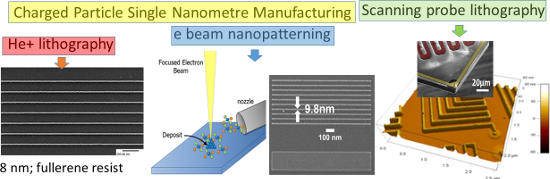
- the resist through sputtering and loss of substrate crystallinity. The situation for Ga+ ions is further complicated by the property of Ga+ as a p-type dopant of silicon. Scattering and range can be calculated using Monte Carlo simulation codes with typical results as shown in Figure 3 [30]. The
- , complementary to EBID in that it is top-down, with a significant advantage over ion milling due to the absence of sputtering. It therefore has wide applications, including use on samples that cannot withstand ion exposure, e.g., due to damage susceptibility. The first report of EBIE to our knowledge was in 1979


Controlling surface morphology and sensitivity of granular and porous silver films for surface-enhanced Raman scattering, SERS
Beilstein J. Nanotechnol. 2018, 9, 2813–2831, doi:10.3762/bjnano.9.263
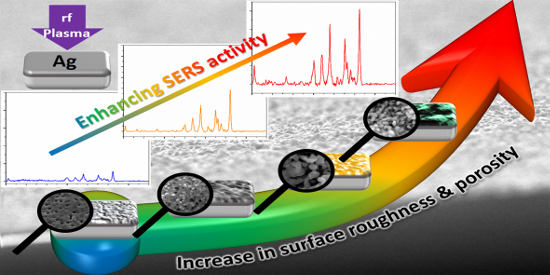
- treatment; silver; sputtering; surface-enhanced Raman spectroscopy (SERS); surface roughening; Introduction The great enhancement of Raman signals obtained from molecules when they are in close vicinity to a rough noble-metal surface (e.g., gold, silver and copper) has attracted a great deal of interest in
- Electronics) scanning Auger nanoprobe operated at an acceleration voltage of 20 keV and a current of 10 nA. Sputtering was carried out under ultra-high vacuum (5 × 10⁻⁹ Torr), with an argon gun operated at 250 eV and 500 nA. The UV–vis spectra of the silver films on glass substrate were recorded by a Thermo
- are observed due island formation during sputtering (Figure 1c,d) [77]. The granular morphology could be advantageous for the formation of hot spots resulting in an efficient SERS activity of the silver film. For the 200 nm thick silver film the coalescence of the adjacent silver clusters formed in






Variation of the photoluminescence spectrum of InAs/GaAs heterostructures grown by ion-beam deposition
Beilstein J. Nanotechnol. 2018, 9, 2794–2801, doi:10.3762/bjnano.9.261
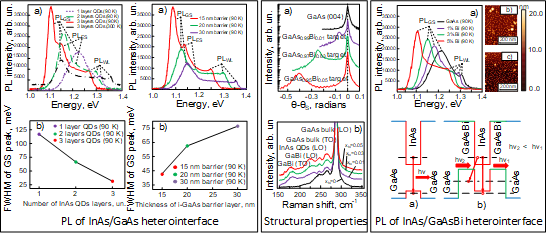
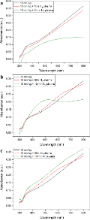
- photoluminescence spectrum of the heterostructures. The heterostructures were synthesized by using an IBD system [21]. The deposition experiments were performed on GaAs(100) substrates. The deposition of the material was carried out by sputtering the target with an Ar+ ion beam. Calibration dependencies of InAs and
- GaAs sputtering yields on the beam energy, the slope angle and the flux density were obtained earlier [21][49][50]. Two types of samples were grown for the research of vertically stacked QDs. The first type of samples (ST#1) contained one to three QD layers separated by 15 nm GaAs layers. The second
- sputtering yield of the target, which affects the kinetics of the surface processes on the substrate. The influence of the thickness of the i-GaAs barrier layer (ST#2 samples) on the photoluminescence properties of the InAs/GaAs heterostructures is shown in Figure 2. It is seen that a decrease in the i-GaAs


Optimization of Mo/Cr bilayer back contacts for thin-film solar cells
Beilstein J. Nanotechnol. 2018, 9, 2700–2707, doi:10.3762/bjnano.9.252
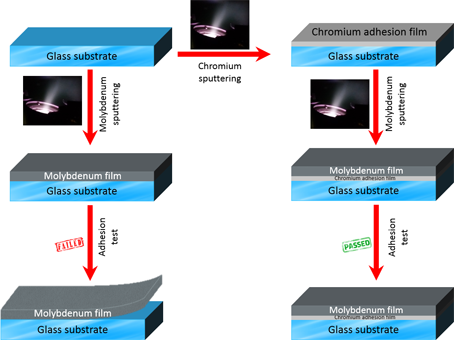
- chromium (Cr) adhesion layer is used as the back contact for a copper zinc tin sulfide (CZTS) thin-film solar cell on a SLG substrate. DC magnetron sputtering is used for deposition of Mo and Cr films. The conductivity of Mo/Cr bilayer films, their microstructure and surface morphology are studied at
- ; bilayer; chromium; DC sputtering; molybdenum; optical reflectance; Introduction Molybdenum (Mo) thin films are widely used as a back contact for photovoltaic devices such as Cu(In1−xGax)S2 (CIGS) and Cu2ZnSnS4 (CZTS) thin-film solar cells. The back contact is the first layer to be deposited and its
- a functions of the sputtering power and pressure [8][9]. The most successful approach suggested so far to improve the adhesion of Mo back contact layer to the glass substrate (while retaining its conductivity and optical reflectance) is through the deposition of a Mo bilayer rather than a single


Au–Si plasmonic platforms: synthesis, structure and FDTD simulations
Beilstein J. Nanotechnol. 2018, 9, 2599–2608, doi:10.3762/bjnano.9.241
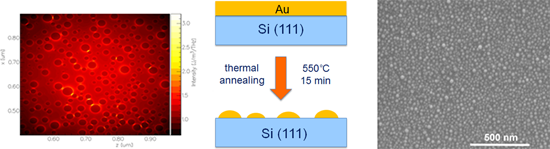
- . Experimental Au nanostructures were prepared on Si(111) as a substrate. The substrates (1 × 1 cm2 of area) were cleaned with acetylacetone and then rinsed in ethanol. Thin Au films (with thicknesses in a range of 1.7–5.0 nm) were deposited using a table-top dc magnetron sputtering coater (EM SCD 500, Leica



Pattern generation for direct-write three-dimensional nanoscale structures via focused electron beam induced deposition
Beilstein J. Nanotechnol. 2018, 9, 2581–2598, doi:10.3762/bjnano.9.240
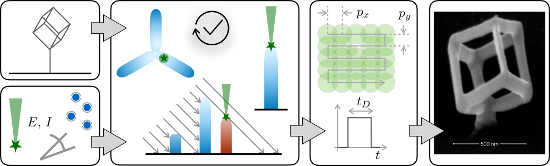
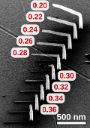
- sputtering to a thickness of 30 nm and 3 nm, respectively. The patterning was done by UV lithography using allresist AR-U 4040 and lift-off. In section 3.5 we state some of the execution times for the generation of the pattern files used for deposit fabrication as presented next. 3.1 Edge-angle-dependent




Exploring the photoleakage current and photoinduced negative bias instability in amorphous InGaZnO thin-film transistors with various active layer thicknesses
Beilstein J. Nanotechnol. 2018, 9, 2573–2580, doi:10.3762/bjnano.9.239
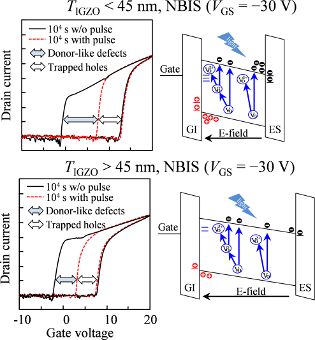
- thicknesses were prepared by magnetron sputtering. The initial electrical properties and the photoleakage current of a-IGZO TFTs with various active layer thicknesses were investigated. The subthreshold value slightly increased while the threshold voltage (Vth) and mobility (μ) decreased with increasing TIGZO
- at 160 °C from a sintered IGZO ceramic target by DC magnetron sputtering with a mixed gas of Ar/O2 = 29.4/0.6 sccm at a deposition pressure of 1 Pa. After patterning of the IGZO films as the active channel, a SiOx etch-stopper (200 nm), source and drain electrodes, and a 200 nm-thick SiOx passivation


High-temperature magnetism and microstructure of a semiconducting ferromagnetic (GaSb)1−x(MnSb)x alloy
Beilstein J. Nanotechnol. 2018, 9, 2457–2465, doi:10.3762/bjnano.9.230
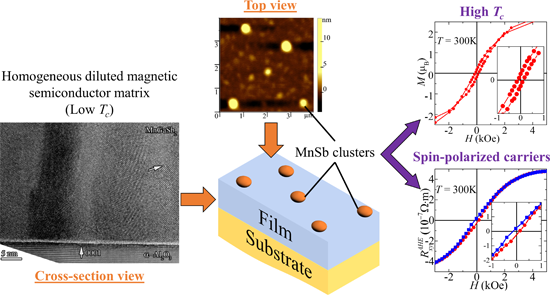
- , Russian Federation 10.3762/bjnano.9.230 Abstract We have studied the properties of relatively thick (about 120 nm) magnetic composite films grown by pulsed laser deposition using the eutectic compound (GaSb)0.59(MnSb)0.41 as target for sputtering. For the studied films we have observed ferromagnetism and
- , using a GaSb–MnSb eutectic composition as a target for sputtering allowed us to avoid the formation of MnGa inclusions, which were observed earlier in samples obtained by laser deposition from Mn and GaSb targets, without taking the stoichiometry into account [28]. However, due to unevenness of the film



Thickness-dependent photoelectrochemical properties of a semitransparent Co3O4 photocathode
Beilstein J. Nanotechnol. 2018, 9, 2432–2442, doi:10.3762/bjnano.9.228
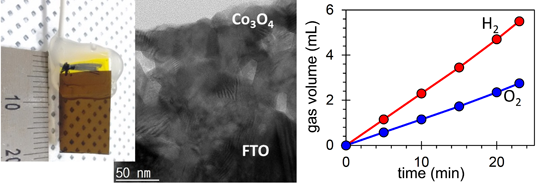
- favourable HER properties [20]. We also developed compact Co3O4 films by a reactive sputtering method, in which sputtered Co particles were converted into a compact Co3O4 film by controlling the flowing O2 gas, to offer a self-powered ultraviolet photodetector [17] and semitransparent photovoltaics [39]. It
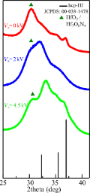
- thickness were deposited using large-area (4 inch diameter) sputtering on glass and FTO/glass substrates. Identical rapid thermal processing (RTP) oxidation was applied to these Co films to allow the formation of Co3O4 films of varying thickness and porosity. Figure 1b shows the XRD pattern of two prepared
- Co3O4 film are primarily due to its enhanced porosity and optical absorption. We also studied the thickness dependent optical and electrical properties of Co3O4 film grown by reactive sputtering [17]. In fact, we can see the systematic variation of Mott–Schottky characteristics, and so of the VFB and NA




ZnO-nanostructure-based electrochemical sensor: Effect of nanostructure morphology on the sensing of heavy metal ions
Beilstein J. Nanotechnol. 2018, 9, 2421–2431, doi:10.3762/bjnano.9.227
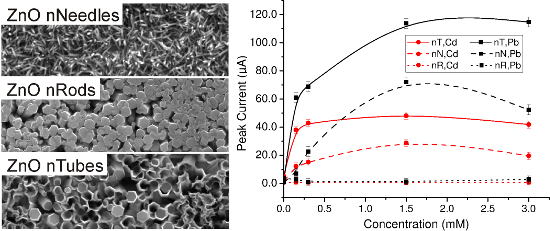
- carried out with the LAB18 thin film deposition system (Kurt J. Lesker, USA) in DC magnetron sputtering mode. As a result, a set of electrodes consisted of four mutually separated planar elements, as illustrated in Figure 1. All of the manipulations described below were carried out using a metal mask


Magnetism and magnetoresistance of single Ni–Cu alloy nanowires
Beilstein J. Nanotechnol. 2018, 9, 2345–2355, doi:10.3762/bjnano.9.219
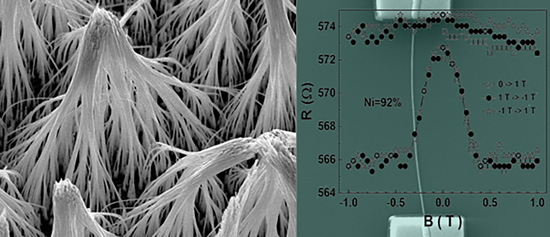
- 620 equipment situated into a cleanroom class 100 (ISO EN 14644) with RF magnetron sputtering and thermal vacuum evaporation (using TECTRA equipment). Thus, to contact single Ni–Cu alloy nanowires using a typical EBL process (Zeiss Merlin Compact field-emission scanning electron microscope combined
- , the deposition of Ti and Au contacts (100/200 nm) by RF magnetron sputtering and thermal vacuum evaporation, respectively, was performed. Individual contacted Ni–Cu alloy nanowires are thus obtained. The main steps of the EBL process are shown in Figure 8. The morphological and compositional


Influence of the thickness of an antiferromagnetic IrMn layer on the static and dynamic magnetization of weakly coupled CoFeB/IrMn/CoFeB trilayers
Beilstein J. Nanotechnol. 2018, 9, 2198–2208, doi:10.3762/bjnano.9.206
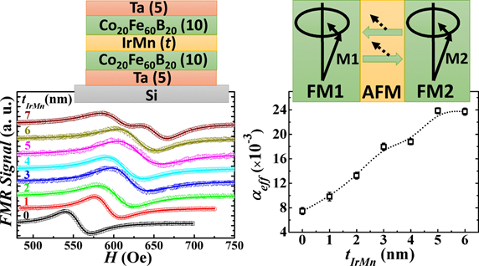
- (10 nm) were deposited at room temperature using pulsed-DC magnetron sputtering on naturally oxidized Si wafers with Ta (5 nm) seed and cap layers. The base pressure and working pressure of deposition were 2·10−7 and 4·10−3 Torr, respectively. The thickness tIrMn was systematically varied in 1 nm


Electrospun one-dimensional nanostructures: a new horizon for gas sensing materials
Beilstein J. Nanotechnol. 2018, 9, 2128–2170, doi:10.3762/bjnano.9.202
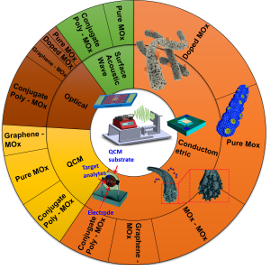
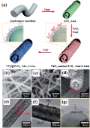
- fabrication strategy for synthesis of SnO2 NFs with a branch-on-stem morphology using electrospinning, oxygen plasma etching, sputtering and annealing. Electrospun PVP NFs were first etched with oxygen plasma to make a hierarchical template. Afterwards, a SnO2 film is deposited by sputtering and the PVP
- template is removed by annealing. The morphology of the NFs is dependent on sputtering time, resulting in uniformly distributed branches all over stem. Jun et al. [77] developed polypyrrole (PPy)-coated SnO2 tube-in-tube structures using single-nozzle electrospinning with a phase separation solvent method






A scanning probe microscopy study of nanostructured TiO2/poly(3-hexylthiophene) hybrid heterojunctions for photovoltaic applications
Beilstein J. Nanotechnol. 2018, 9, 2087–2096, doi:10.3762/bjnano.9.197
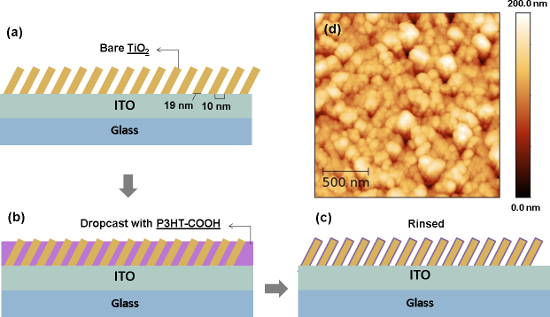
- knowledge, this joint KPFM/PC-AFM study of such a nanostructured array of TiO2 columns sensitized with functionalized P3HT-COOH constitutes a novel result of interest from both a theoretical and material design perspectives. Materials and Methods The TiO2 layers were synthesized by magnetron sputtering in


High-throughput synthesis of modified Fresnel zone plate arrays via ion beam lithography
Beilstein J. Nanotechnol. 2018, 9, 2049–2056, doi:10.3762/bjnano.9.194
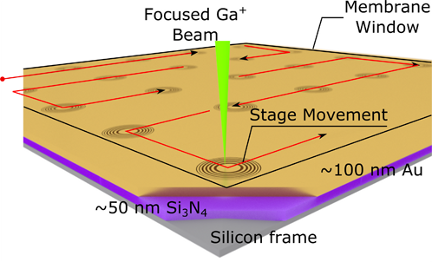
- sputtering processes. The idea here is, if the desired depth of an open zone can be reached before destroying the adjacent zones, it becomes possible to write very dense structures, very quickly. To achieve this goal, the ion beam dosage, which is now determined by the 1D beam overlap (i.e., the step size in


Metal-free catalysis based on nitrogen-doped carbon nanomaterials: a photoelectron spectroscopy point of view
Beilstein J. Nanotechnol. 2018, 9, 2015–2031, doi:10.3762/bjnano.9.191
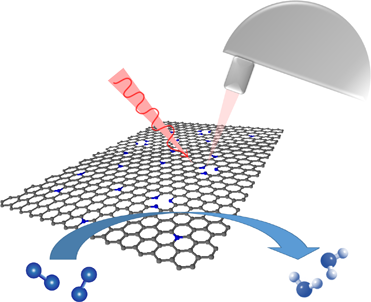
- kinetic energies from hundreds of electronvolts to few kiloelectronvolts does not lead to a damage or the sputtering of the material [37][57][84][85]. This effect was explained with different dissipation of the ion energy in the nanostructured material compared to the bulk. In the former, many ions
- traverse the nanostructures without inelastic scattering, while for bulk materials or graphene supported on heavy metallic substrates, the energy of the incident ion species is dissipated at the surface generating a backscattering cascade leading to the sputtering of the sample surface (Figure 5). Using




Electromigrated electrical optical antennas for transducing electrons and photons at the nanoscale
Beilstein J. Nanotechnol. 2018, 9, 1964–1976, doi:10.3762/bjnano.9.187
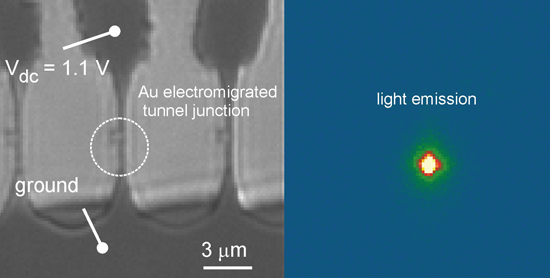
- . Electron imaging is made possible by sputtering a thin conductive Au layer. Different information can be deduced from the image. To begin with, the tunneling gap is not situated at the location of the constriction, but is displaced towards the source electrode as already reported in the past [37]. There
- electromigration. Voids resulting from Au migration are also observed on the source electrode. The image is obtained by sputtering a thin conductive Au layer on the post mortem device. (a) Current density JT plotted versus applied bias Vdc. The black circles are experimental data points and the solid red line is


![[Graphic 32]](/bjnano/content/inline/2190-4286-9-187-i38.svg?max-width=637&scale=1.18182) and
and ![[Graphic 33]](/bjnano/content/inline/2190-4286-9-187-i39.svg?max-width=637&scale=1.18182) are...
are...


Defect formation in multiwalled carbon nanotubes under low-energy He and Ne ion irradiation
Beilstein J. Nanotechnol. 2018, 9, 1951–1963, doi:10.3762/bjnano.9.186
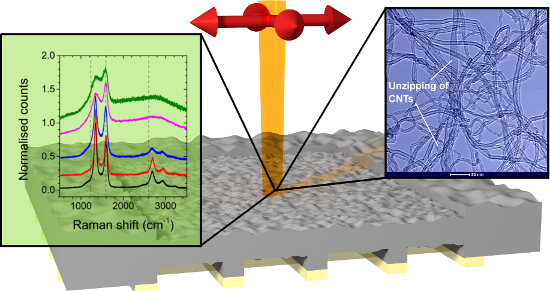
- carbon support of typical TEM grids, a new methodology involving Raman inactive Au TEM grids was developed. The experimental results have been compared to SDTRIMSP simulations. Due to the small thickness of the MWCNTs, sputtering has been observed for the top and bottom side of the samples. Depending on
- sputtering of targets with a cylindrical geometry [49], however, as we are going to irradiate a slab of MWCNTs we prefer to use a solid slab representing the whole sample. A study by Hobler et al. showed that BCA-based simulations can be used to study backward and forward sputtering of membranes or targets
- the extent of damage observed by TEM in Figure 3B,E is consistent with the ratio of intensities of D to G band shown in Figure 2b. This agrees also with the simulation results discussed later which indicate a higher sputtering yield and a higher displacement due to Ne+ irradiation in comparison to He



Synthesis of hafnium nanoparticles and hafnium nanoparticle films by gas condensation and energetic deposition
Beilstein J. Nanotechnol. 2018, 9, 1868–1880, doi:10.3762/bjnano.9.179
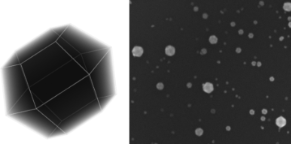
- study the fabrication and characterization of hafnium nanoparticles and hafnium nanoparticle thin films. Hafnium nanoparticles were grown in vacuum by magnetron-sputtering inert-gas condensation. The as deposited nanoparticles have a hexagonal close-packed crystal structure, they possess truncated
- produced by inert-gas condensation. In order to avoid contaminants the base pressure prior to deposition was ca. 9·10−7 mbar, a high-purity (99.95%) sputtering Hf target was utilized, and thorough target presputtering was performed prior to deposition. All depositions were performed at room temperature
- , the argon (Ar) flow rate was in all cases kept at 60 sccm and the sputtering power at 32 W. During deposition in the soft-landing regime, no substrate bias voltage was applied (Vs = 0 kV). Thus, the kinetic energy of the nanoparticles was mainly defined by the pressure difference between the






Preparation of micro/nanopatterned gelatins crosslinked with genipin for biocompatible dental implants
Beilstein J. Nanotechnol. 2018, 9, 1735–1754, doi:10.3762/bjnano.9.165








Friction force microscopy of tribochemistry and interfacial ageing for the SiOx/Si/Au system
Beilstein J. Nanotechnol. 2018, 9, 1647–1658, doi:10.3762/bjnano.9.157
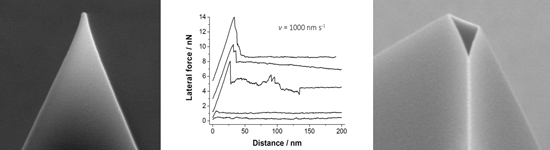
- cantilevers before use. A Au(111) single crystal (MaTeck GmbH, Jülich, Germany) was prepared by repeating a sputter–heating cycle (20 min Ar sputtering at 25 μA/1 keV followed by 1 h annealing at 850 °C) until a sharp (111) pattern was observed by low-energy electron diffraction (LEED). The n-Si(100) sample
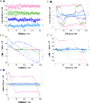
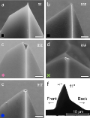
- ). Prolonged stationary contact with Au(111) after sputtering resulted in activation of a Au/Si tip. After sliding this tip for 260 mm on Au(111), the tip was worn by 370 nm (Figure 6e). The largest wear was measured for tips that had been sliding against reactive Si(100); the Au/Si tip was worn by 530 nm




Interaction-tailored organization of large-area colloidal assemblies
Beilstein J. Nanotechnol. 2018, 9, 1582–1593, doi:10.3762/bjnano.9.150
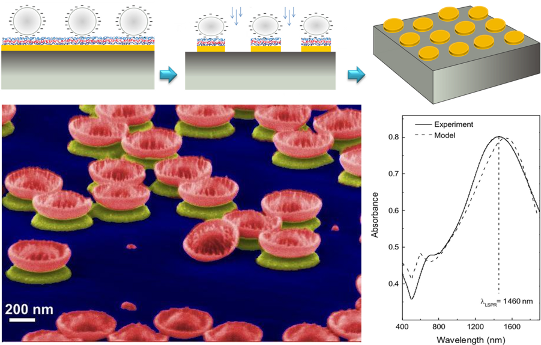
- thick metal layers (gold films deposited by thermal evaporation and cobalt films deposited by magnetron sputtering) and successively removing the metal-capped spherical, nanoscale materials (termed “nanospheres” throughout the remainder of this article) by careful tape stripping with carbon tape in


Photoluminescence of CdSe/ZnS quantum dots in nematic liquid crystals in electric fields
Beilstein J. Nanotechnol. 2018, 9, 1544–1549, doi:10.3762/bjnano.9.145
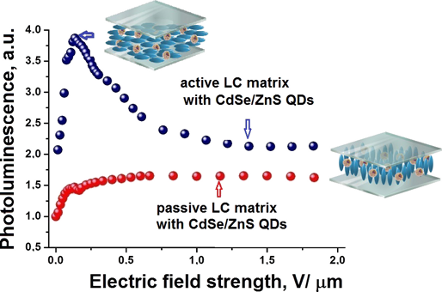
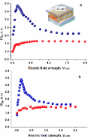
- of two quartz substrates with a fixed gap of about 33 μm. Both substrates were coated by cathode sputtering with transparent conductive electrodes based on indium tin oxide. Orienting layers of rubbed polyimide and chromolane were used to obtain a planar or vertical orientation of the LC molecules


Nanoporous silicon nitride-based membranes of controlled pore size, shape and areal density: Fabrication as well as electrophoretic and molecular filtering characterization
Beilstein J. Nanotechnol. 2018, 9, 1390–1398, doi:10.3762/bjnano.9.131
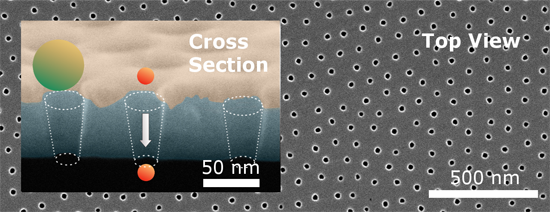
- pillars are removed by grazing incidence sputtering with Ar ions. (f) Subsequent RIE results in nanopores. (g) Optional removal of the residual Cr layer with a liquid etchant. (h) Experiment: SEM micrograph of the cross-section of membrane A (cf. text) with nanopores. HRSEM micrographs of nanoporous





