Search results
Search for "olefin" in Full Text gives 466 result(s) in Beilstein Journal of Organic Chemistry. Showing first 200.
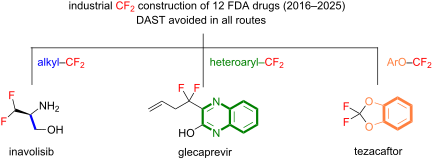
Construction of CF2 moieties in FDA-approved drugs (2016–2025): industrial routes, mechanisms, and scale-up considerations
Beilstein J. Org. Chem. 2026, 22, 1122–1150, doi:10.3762/bjoc.22.91
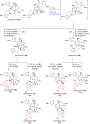
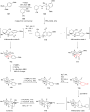
- ]. The Corey–Chaykovsky cyclopropanation is a powerful method for constructing cyclopropane rings. Given the stereochemistry of 18, the key to this method lies in the construction of the E-olefin 26. However, in route c, the first step, a Horner–Wadsworth–Emmons reaction, tends to give the Z-olefin as
- the product, which is unfavorable for the subsequent cyclopropane ring formation. Attempts to use chiral auxiliaries used to promote E-olefin formation gave extremely low yields in the synthesis of 26. In route d, during the Knoevenagel condensation in the first step, due to the exceptionally


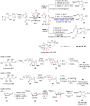




Z-Selective semihydrogenation of alkynes via Ni/Lewis acid synergistic catalyzed system using DMF as hydrogen source and solvent
Beilstein J. Org. Chem. 2026, 22, 1004–1012, doi:10.3762/bjoc.22.79
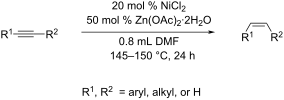
- the generated alkene products under the relatively high reaction temperature of 150 °C, which partially consumes the target olefin products and reduces the final isolated yields. In a preliminary experiment, we tested 1-phenyl-1-propyne (5a) and 5-decyne (7a) as substrates under the established

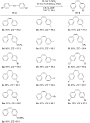


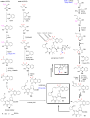
Electrochemical reduction of unsaturated carbon–carbon bonds via 3d transition-metal catalysis
Beilstein J. Org. Chem. 2026, 22, 955–981, doi:10.3762/bjoc.22.75
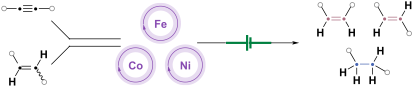
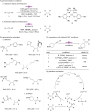
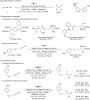
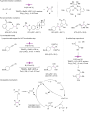
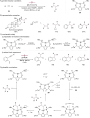
- , alkynes bearing alkene moieties underwent selective reduction of the alkyne unit without perturbing the olefin, thereby demonstrating the high level of chemoselectivity of the reaction. Notably, the electrocatalytic HAT platform exhibits a markedly expanded substrate scope, tolerating functionalities such








Recent advances in copper-catalyzed direct hydroamination of alkenes with (hetero)aromatic amines
Beilstein J. Org. Chem. 2026, 22, 925–947, doi:10.3762/bjoc.22.73
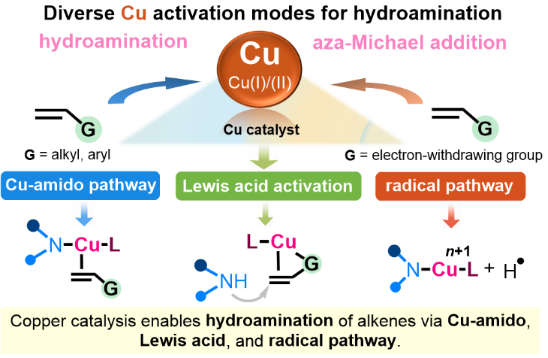
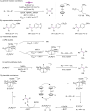
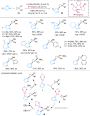
- activated olefin, followed by aminocupration across the C=C bond to form the alkylcopper intermediate IV, which subsequently underwent proton transfer with aniline to furnish the β-amino product 1 while regenerating the copper–amido species II. Alternatively, path B proceeded through the direct nucleophilic
- addition of copper–amido complex II to the electron-deficient olefin. In this pathway, the nucleophilic attack of the copper–amido species on the activated alkene generated zwitterionic intermediate VI, followed by proton transfer to afford product 1. Control experiments revealed that simple copper salts
- , particularly for ester-substituted alkenes. Mechanistic insights obtained from the DFT calculations suggested that the reaction proceeded via a copper–amido catalytic cycle involving metal-assisted olefin activation and the aminocupration pathway. In the initial step, deprotonation of the amine by KOt-Bu







The trans-influence in gold chemistry from a catalytic perspective
Beilstein J. Org. Chem. 2026, 22, 838–856, doi:10.3762/bjoc.22.66
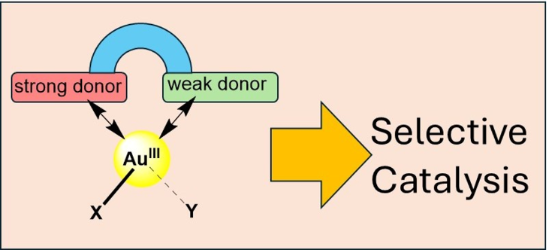
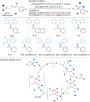
- (II) congener, K[PtCl3(ethylene)] [28], as well as the first examples of gold(III) alkyne [29], CO [30], hydride [31] and σ-complexes [32] (Scheme 3). The olefin complexes were isolated as microcrystalline powders which as dry solids are fairly stable in air at room temperature. The olefin bonding is
- pathway [97]. Attack on the coordinated olefin by a triflate anion, followed by aryl–alkyl reductive elimination, generates an alkyl triflate as the primary organic product. Kinetic measurements showed that this occurs before the formation of any olefinic end-products. In a second, separate H+-catalysed


Synthesis of heterocycles based on azomethine ylides from α-amino acids (or amines) and carbonyl compounds
Beilstein J. Org. Chem. 2026, 22, 705–741, doi:10.3762/bjoc.22.55
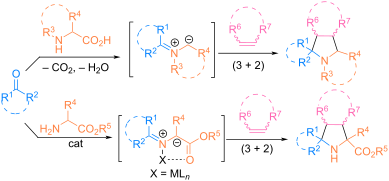
- -dipolar cycloaddition of iminoesters 1 and 1,3-enynes 36 is described, which provides a series of chiral polysubstituted pyrrolidines 37 with high regio-, diastereo-, and enantioselectivities (Scheme 18). It is noted that the presence of a conjugated triple bond leads to weak activation of the olefin


Synthesis of depressin, cryptomeridiol and 4-epi-cryptomeridiol enabled by a terpenoid chiral pool-producing platform
Beilstein J. Org. Chem. 2026, 22, 683–690, doi:10.3762/bjoc.22.53
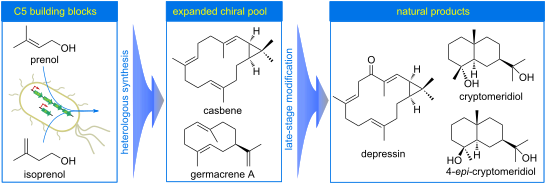
- efficient macrocyclization methods, including tetracarbonylnickel-promoted cyclization of allylic dibromide [17][18], copper-mediated intramolecular carbene–olefin cyclization [19], titanium-induced intramolecular carbonyl coupling [20], and organozinc carbenoid-mediated intramolecular cyclopropanation [21


Kinetic resolution of racemic planar-chiral vinylcymantrenes by molybdenum-catalyzed asymmetric metathesis dimerization
Beilstein J. Org. Chem. 2026, 22, 568–574, doi:10.3762/bjoc.22.42
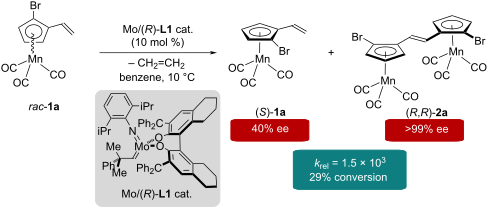
- resolution; molybdenum; olefin metathesis; planar chirality; Introduction The development of the well-defined molybdenum- [1][2] or ruthenium-alkylidene [3][4][5] catalysts has proven the olefin metathesis reaction to be a powerful tool in organic synthesis. Asymmetric extension is a recent trend in
- metathesis chemistry, and various chiral metal-alkylidene catalysts have been prepared over the past two decades [6][7][8][9]. Since 2002, our group and others have been interested in utilizing the olefin metathesis reaction for the modulation of various transition-metal complexes [10][11][12][13] thanks to
- the excellent tolerance of the Mo-/Ru-metathesis catalysts toward the organometallic substrates. The olefin metathesis protocols could be extended to the asymmetric synthesis of diverse planar-chiral transition metal complexes either by the kinetic resolution of the racemic substrates [14][15][16] or


Modern synthetic pathways towards eribulin and its subunits
Beilstein J. Org. Chem. 2026, 22, 495–526, doi:10.3762/bjoc.22.37
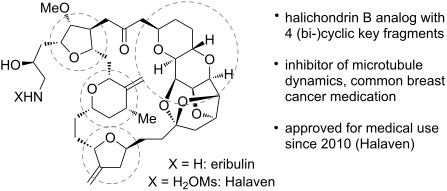
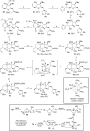
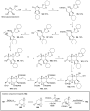
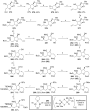
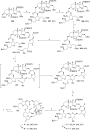
- filtrate during this process and isolated as a diastereomeric mixture of 2.6:1. At first, the benzyl moieties of 66 were cleaved off and the diol was reprotected as acetonide to afford 67. The remaining secondary alcohol was PMB-protected and the olefin was oxidatively cleaved, before addition of a
- lithiated furanyl unit took place. The so-obtained 1:1 diastereomeric mixture of 68 was treated with (PhO)3PMeI in dimethylacetamide and formed an intermediate trans-olefin, which subsequently underwent an asymmetric Sharpless dihydroxylation. The acetonide was cleaved with AcOH and the addition of NBS
- using acetic anhydride. Oxidative cleavage of olefin 73, followed by treatment with ʟ-proline led to an intermediate β-aldehyde with inverted stereochemistry at the β-C (4:1 dr). Subsequent reduction with NaBH4 yielded alcohol 74. Piv-protection of the primary alcohol, reductive deprotection of the Bn








Recent advances in the stereoselective synthesis of distal biaxially chiral molecules
Beilstein J. Org. Chem. 2026, 22, 461–479, doi:10.3762/bjoc.22.34
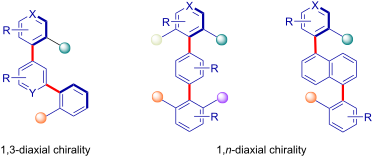
- reaction may find application as novel S-olefin ligands. In 2023, Amatore and co-workers developed an NHC-catalyzed method to acquire previously unknown axially chiral N-arylphthalimides 79 (Scheme 22) [61]. This system adopted a (4 + 2) oxidative annulation strategy. The products are generated through the


Ring contraction and ring expansion reactions in terpenoid biosynthesis and their application to total synthesis
Beilstein J. Org. Chem. 2026, 22, 289–343, doi:10.3762/bjoc.22.21
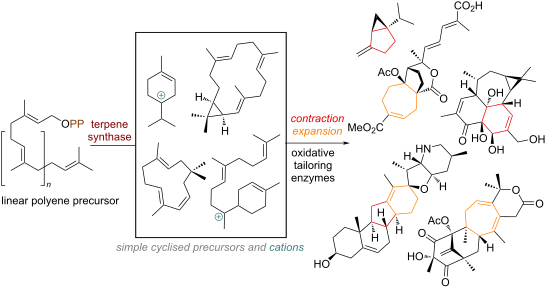
- the activation of the diphosphate group and ionisation) [25][37] and Class II (ionisation by olefin or epoxide protonation via a carboxylic acid in the active site) [26][38][39] and their reactions thus are mediated by carbocations and olefins, through careful preorganisation of the linear substrate
- framework and ring contraction (10b). From here, follow up oxidations and olefin isomerisation afford β-vetivone B (11), a constituent of aromatic vetiver oil. Finally, in the biosynthesis of the antibiotic pleuromutilin (13) [61][62][63] a similar ring contraction takes place (see Scheme 2C). Cyclisation
- is initiated via protonation of geranylgeranyl pyrophosphate (GGPP, 12) at the terminal olefin with CpPS (= Clitopilus passeckeranis pleuromutilin synthase), forming the decalin system 12a. A cascade of 1,2-shifts delivers the carbocation 12b which undergoes ring contraction and elimination to give






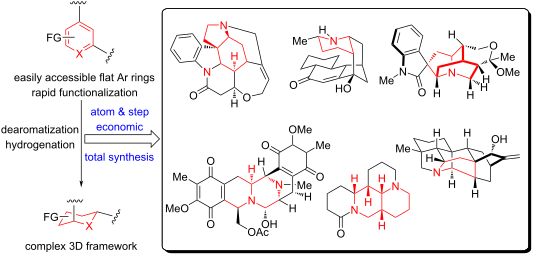
Total synthesis of natural products based on hydrogenation of aromatic rings
Beilstein J. Org. Chem. 2026, 22, 88–122, doi:10.3762/bjoc.22.4
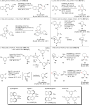
- , olefin hydrogenation, and DMP oxidation, provided diketone 125. The two carbonyl groups in 125 were then chemoselectively and stereoselectively reduced using rhodium as a catalyst to yield hydroxylated ketone 126. A further three-step transformation provided the catalytic hydrogenation precursor 127
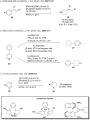
- another synthesis work to revise the structure of huperzine N. Similar to their previous study, the synthesis started with a 1,3-dicarbonyl compound 154 to synthesize the hydrogenation precursor 155. A three-step process, including hydrogenation of the olefin, hydride reduction and methylation, afforded
- -type alkaloids [98]. That same year, Sherburn and co-workers described a complementary synthesis employing an aza-Diels–Alder cycloaddition followed by olefin hydrogenation [99]. Starting from pyridine and glutaryl chloride, tetracyclic intermediate 192 was efficiently generated in a single step











Advances in Zr-mediated radical transformations and applications to total synthesis
Beilstein J. Org. Chem. 2026, 22, 71–87, doi:10.3762/bjoc.22.3
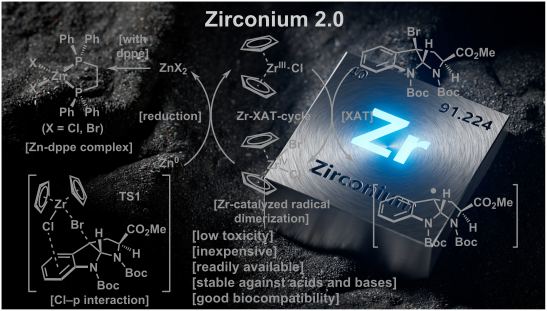
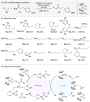
- Schwartz’s reagent (Scheme 1) [7][8]. When compound 2, bearing an alkyl halide and an olefin moiety, was treated with triethylborane and Schwartz’s reagent in tetrahydrofuran, a halogen atom transfer (XAT) occurred at the alkyl halide, generating alkyl radical 3. This radical subsequently underwent
- intramolecular addition to the olefin, affording the cyclized acetal product 4. The reaction proceeded efficiently across a range of substrates bearing various substituents at R¹–R⁴, delivering the desired cyclized products 4a–f in good yields. The proposed mechanism is illustrated in Scheme 1C. Initially
- , Schwartz’s reagent reacts with triethylborane to generate a low-valent zirconium complex 5. This complex abstracts the halogen atom from the alkyl halide, forming alkyl radical 8. The radical then cyclizes onto the olefin, and the resulting radical intermediate undergoes hydrogen atom transfer (HAT) from








Synthesis and applications of alkenyl chlorides (vinyl chlorides): a review
Beilstein J. Org. Chem. 2026, 22, 1–63, doi:10.3762/bjoc.22.1
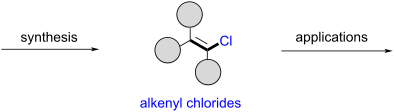
- stereocontrolled olefin metathesis with molybdenum catalysts to access trisubstituted alkenes including alkenyl chlorides (Figure 3H) [39]. Two recent reviews by Lu [40] and Nishiwaki [41] provide overviews of current developments in the hydrochlorination of alkynes, highlighting emerging catalytic strategies
- chlorides (not shown) [185][186]. 1.8 Alkenyl chloride synthesis via olefin metathesis Johnson and co-workers investigated complex 287, which forms as a product of an initial metathesis cycle in the cross-metathesis (CM) with alkenyl chlorides (Scheme 55) [187][188]. The authors observed that complex 287























Total synthesis of asperdinones B, C, D, E and terezine D
Beilstein J. Org. Chem. 2025, 21, 2730–2738, doi:10.3762/bjoc.21.210
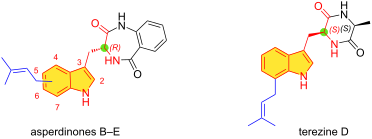
- product 11 in 37% yield (Scheme 2). Despite the modest yield, product 11 was transformed to the corresponding tertiary alcohol 12. Removal of the N-Piv group and dehydration with the Burgess reagent [35] led to an inseparable mixture of olefins slightly in favor of the exo-olefin isomer. Dehydration in
- -substituted indoles as well as to the corresponding allylindoles. In the latter case, a Grubbs olefin cross-metathesis reaction with 2-butene would indirectly introduce the prenyl appendage [43][44][45]. The synthesis of 7-prenylindole from 2-iodoaniline in 4 steps was reported in 1996 [46][47]. Subsequently


Recent advancements in the synthesis of Veratrum alkaloids
Beilstein J. Org. Chem. 2025, 21, 2657–2693, doi:10.3762/bjoc.21.206
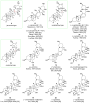
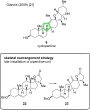
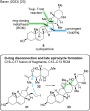
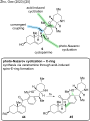
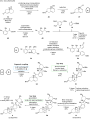
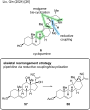
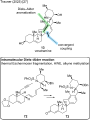
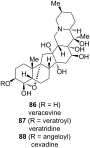
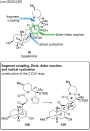
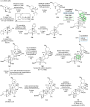
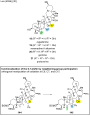
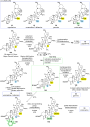
- sequence of redox manipulations and acetylation, olefin 90 was transformed into 3,18-diacetate 92. The degradation of the superfluous side chain was realized by acidic cleavage of the spiroketal moiety, followed by redox manipulations. A seven-step sequence afforded methyl ketone 93 [20]. The F-ring was
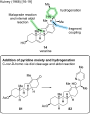
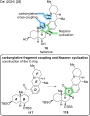
- afford cyclization of the E-ring. The obtained pyridinium species was directly reduced to reveal the piperidine moiety. The observed selectivity for hydrogenation from the α-side was attributed to the steric hindrance of the C20 axial tertiary TMS ether. The survival of the olefin in the D-ring was
















Chemoenzymatic synthesis of the cardenolide rhodexin A and its aglycone sarmentogenin
Beilstein J. Org. Chem. 2025, 21, 2637–2644, doi:10.3762/bjoc.21.204
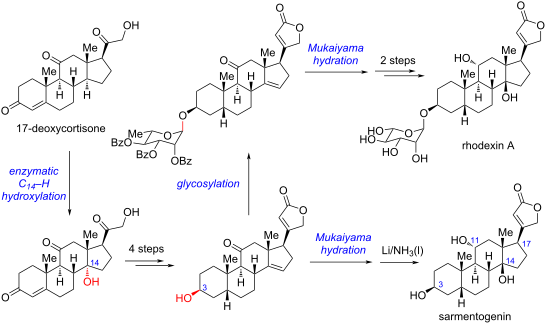
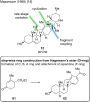
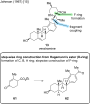
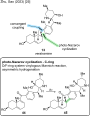
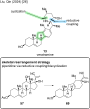
- donor, through a late-stage glycosylation. The aglycon 2 can be derived from the Δ14 olefin intermediate 3 via Mukaiyama hydration and several functional group transformations. In turn, 3 would be generated from the key C14α-hydroxylated intermediate 4 via an elimination process. For the synthesis of 4
- reagent [20], the key intermediate 8 bearing a butenolide motif was obtained in 76% yield. Next, with the aid of the strong Lewis acid Bi(OTf)3, the regioselective elimination of 8 was achieved to produce the Δ14 olefin intermediate 9 in 86% yield. Afterwards, we evaluated the reactivity of 9 towards



Recent advances in total synthesis of illisimonin A
Beilstein J. Org. Chem. 2025, 21, 2571–2583, doi:10.3762/bjoc.21.199
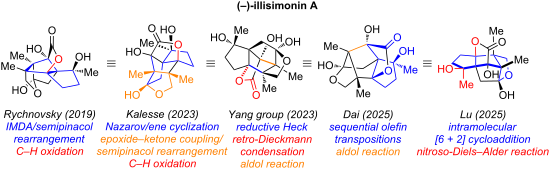
- hydroxy group could be responsible for this reversal in selectivity. Dai’s asymmetric synthesis of (−)-illisimonin A In 2025, Dai and co-workers accomplished an asymmetric total synthesis of (−)-illisimonin A in 16 steps from (S)-carvone (67) using a pattern-recognition strategy and five sequential olefin
- the same pot to give 72. Isomerization of the allylic methyl ether to an enol methyl ether was achieved using Crabtree’s catalyst in refluxing THF. Subsequent ketalization with the primary alcohol yielded the bridged ketal 73. A Schenck ene reaction on 73 induced the second olefin isomerization
- , generating an allylic alcohol that was acetylated in situ to provide 74. An Ireland–Claisen rearrangement facilitated the third olefin transposition, concurrently forming an all-carbon quaternary center at C9 and affording carboxylic acid 75. The fourth olefin transposition was achieved via a palladium






Total syntheses of highly oxidative Ryania diterpenoids facilitated by innovations in synthetic strategies
Beilstein J. Org. Chem. 2025, 21, 2553–2570, doi:10.3762/bjoc.21.198
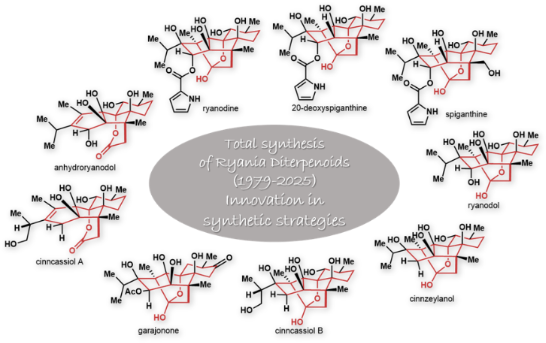
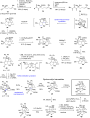
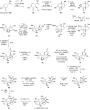
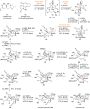
- -ryanodol, cinnzeylanol, and cinncassiols A,B In 2014, the Inoue group at the University of Tokyo reported a synthetic strategy for ryanodol (4) that leveraged substrate symmetry design, employing intramolecular radical coupling and olefin metathesis as key steps [46] (Scheme 4). Recognizing an embedded
- the simultaneous construction of four quaternary carbon centers (C1, C4, C5, and C12) and the core AB bicyclic skeleton, markedly improving synthetic efficiency. Subsequent oxidative desymmetrization of the C14–C15 olefin in (±)-33 established the sterically hindered C11 quaternary carbon center. An α
- successfully accomplished via an epoxide ring-opening/tandem lactonization/olefin hydration sequence. In total, 12 consecutive redox manipulations (7 oxidations and 5 reductions) established all stereocenters, with subsequent functional group transformations completing the total synthesis of garajonone (8







Rapid access to the core of malayamycin A by intramolecular dipolar cycloaddition
Beilstein J. Org. Chem. 2025, 21, 2542–2547, doi:10.3762/bjoc.21.196
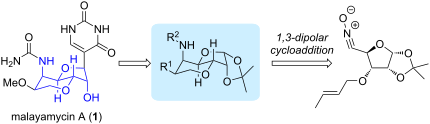
- , several conditions to cleave the N–O bond in 11 or 12 had not yielded any successful outcome. Therefore, we turned to adjust the synthetic sequence to switch the oxidation states at C2 and C3 (Scheme 4). It should be noted that compound 16 [38] was obtained as a stereoisomeric mixture of olefin, resulting




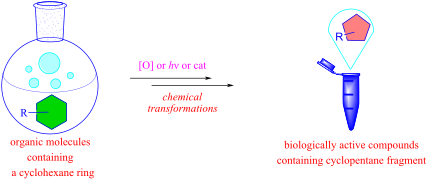
Transformation of the cyclohexane ring to the cyclopentane fragment of biologically active compounds
Beilstein J. Org. Chem. 2025, 21, 2416–2446, doi:10.3762/bjoc.21.185
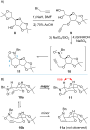
- ] described the first total syntheses of racemic meroterpenes (±)-andrastin D (106), (±)-preterrenoid (107), (±)-terrenoid (108), and (±)-terretonin L (109) using a Co-catalyzed homoallyl-type rearrangement/hydrogen atom transfer (HAT) as ring contraction strategy. Radical hydrochlorination of olefin 110 [57
- (±)-terretonin L (109) as the main product with a yield of 46%. Radical hydrochlorination of olefin 110 under more powerful oxidizing conditions (Co(II) catalyst 113, N-fluoropyridinium salt (F+) 114), resulted in the formation of cyclopentenone derivative 112 with a yield of 90%. Demethylation of the latter led
- form three possible products: ketone 191, olefin 192, and cyclopentane 193 (Scheme 33). At the first stage, the epoxy ring was opened to form intermediate A. According to the authors [87], there are three possible ways of carbocation stabilization. The 1,2-shift of a proton at C3 to C4 led to the


Synthetic study toward vibralactone
Beilstein J. Org. Chem. 2025, 21, 2376–2382, doi:10.3762/bjoc.21.182

- -lactone with an all-carbon quaternary center and two trisubstituted olefin moieties. It is therefore not surprising that this compound has attracted considerable interest from both the chemical biology and synthetic chemistry communities. Sieber and co-workers disclosed that vibralactone can target ClpP1


Rotaxanes with integrated photoswitches: design principles, functional behavior, and emerging applications
Beilstein J. Org. Chem. 2025, 21, 2345–2366, doi:10.3762/bjoc.21.179

- in-situ generation of toxic 1O2. Fumaramide Fumaramide is a bisamide photoswitch with a thermally stable trans-olefin, which, upon UV light irradiation, undergoes trans-to-cis isomerization, affording the corresponding maleamide (Figure 2). These photoswitches are distinct due to their ability to
- -counterfeiting applications. Stilbene and stiff-stilbene Stilbene photoswitches consist of a central olefin with a phenyl group at each end. Upon light irradiation, they undergo trans-to-cis isomerization, with the reverse isomerization triggered photochemically at a different wavelength or thermally (Figure 2


Comparative analysis of complanadine A total syntheses
Beilstein J. Org. Chem. 2025, 21, 2334–2344, doi:10.3762/bjoc.21.178
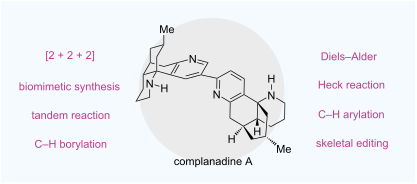
- Scheme 5, the Dai synthesis starts with compound 58 which can be prepared from (+)-pulegone in three steps or via an organocatalyzed tandem sequence in one step. The terminal olefin of 58 was then converted to a primary azide via an anti-Markovnikov hydroazidation reaction with a combination of 59 and
- TMSN3 recently developed by Xu and co-workers [34]. Mukaiyama conjugate addition between 60 and 61 promoted by Tf2NH followed by a one-pot enol ether hydrolysis gave 62 as a mixture of inconsequential stereoisomers. Subsequent oxidative cleavage of the terminal olefin of 62 using ozonolysis followed by



Recent advances in Norrish–Yang cyclization and dicarbonyl photoredox reactions for natural product synthesis
Beilstein J. Org. Chem. 2025, 21, 2315–2333, doi:10.3762/bjoc.21.177
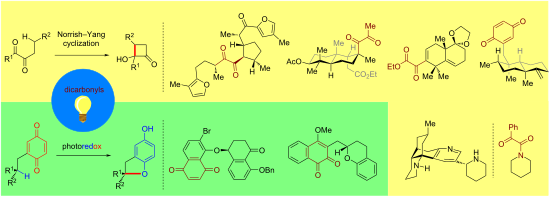
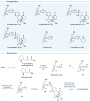
- , followed by diastereoselective α-alkylation, produced 38. A Wittig reaction and subsequent deketalization converted the ketone in 38 to the terminal alkene 39, allowing for subsequent sequential chemoselective hydrogenations: first, hydrogenation of the exo-olefin using Wilkinson’s catalyst proceeded with
- moderate diastereoselectivity; this was followed by Mn(III)-catalyzed metal-hydride hydrogen atom (MHAT) transfer to reduce the endocyclic olefin, forming 41 as a single diastereomer. Subsequent transformations – including a Wittig reaction, demethylation, and oxidation of the resulting phenol to a p