


Search results
Search for "organic chemistry" in Full Text gives 1184 result(s) in Beilstein Journal of Organic Chemistry. Showing first 200.
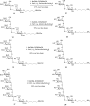
Electrochemical reduction of unsaturated carbon–carbon bonds via 3d transition-metal catalysis
Beilstein J. Org. Chem. 2026, 22, 955–981, doi:10.3762/bjoc.22.75
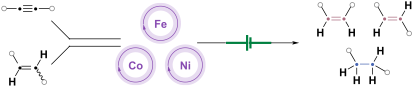
- the use of stoichiometric reagents. In this context, when electrochemistry is employed as a synthetic tool in organic chemistry, several critical parameters must be taken into account, including (a) electrode, (b) electrolysis mode, and (c) cell configuration (Figure 1). Among these, the choice of








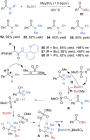
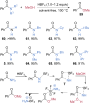
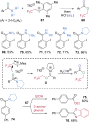
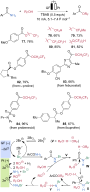
Synthesis of sterically shielded piperidine nitroxides via acid-catalyzed heterocyclization of β-aminoketone derivatives with ketones
Beilstein J. Org. Chem. 2026, 22, 948–954, doi:10.3762/bjoc.22.74
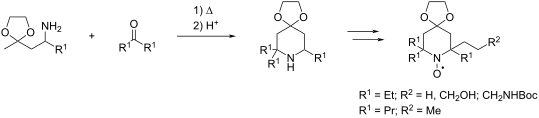
- Mark M. Gulman Yurii I. Glazachev Sergey A. Dobrynin N. N. Vorozhtsov Novosibirsk Institute of Organic Chemistry, Siberian Branch of the Russian Academy of Sciences, Novosibirsk, 630090, Russia Novosibirsk State University, Pirogova Str. 2, Novosibirsk, 630090, Russia Voevodsky Institute of


Unsymmetrical sulfoxides with sterically hindered catechol fragment: synthesis, structure, electrochemical properties, and antiradical activity
Beilstein J. Org. Chem. 2026, 22, 828–837, doi:10.3762/bjoc.22.65
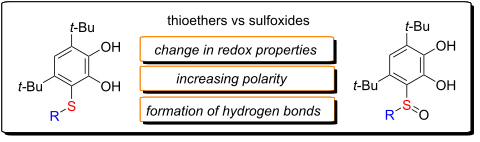
- chemoselective oxidation of the thioether group to the sulfoxide, without overoxidation to the sulfone, remains a current challenge in organic chemistry. Peroxide compounds – such as hydrogen peroxide [33], organic hydroperoxides [34][35], peracids [36], ozone, and the peroxymonosulfate anion (the active


Total synthesis of the capsular polysaccharide repeating unit towards the development of a glycoconjugate vaccine against Klebsiella pneumoniae ST512
Beilstein J. Org. Chem. 2026, 22, 821–827, doi:10.3762/bjoc.22.64
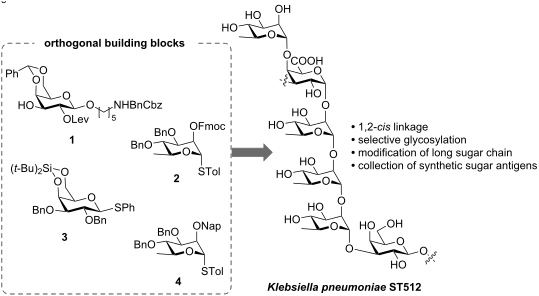
- : Department of Chemistry, Dalian University of Technology, No. 2 Linggong Road, 116024 Dalian, China Institute of Organic Chemistry and Biochemistry of the Czech Academy of Sciences, Flemingovo náměstí 542/2, 160 00 Praha 6, Czech Republic 10.3762/bjoc.22.64 Abstract Klebsiella pneumoniae ST512 is an


Synthesis and structural elucidation of a novel bis-spirooxindole from isatin and ethylenediamine
Beilstein J. Org. Chem. 2026, 22, 813–820, doi:10.3762/bjoc.22.63
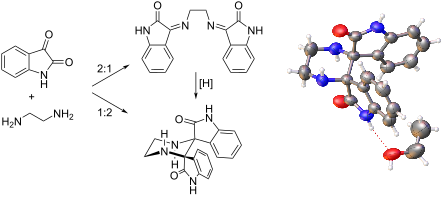
- Irene Moreno-Gutierrez Josefa L. Lopez-Martinez Sonia Berenguel-Gomez Irene Torres-Garcia Duane Choquesillo-Lazarte Manuel Munoz-Dorado Miriam Alvarez-Corral Ignacio Rodriguez-Garcia Organic Chemistry, University of Almería, CIAIMBITAL, 04120 Almería, Spain Laboratorio de Estudios Cristalográficos


Knoevenagel condensation of 4,5- and 1,8-diazafluorenes
Beilstein J. Org. Chem. 2026, 22, 803–812, doi:10.3762/bjoc.22.62
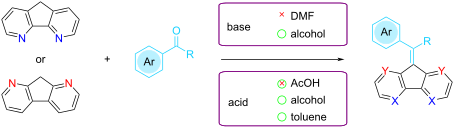
- Darya S. Cheshkina Christina S. Becker Alina A. Sonina Maxim S. Kazantsev N.N. Vorozhtsov Novosibirsk Institute of Organic Chemistry SB RAS, Lavrentieva 9, 630090 Novosibirsk, Russia 10.3762/bjoc.22.62 Abstract Diazafluorenylidenes are potential antitumor agents, ligands, and functional materials


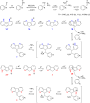


Halogenated azobenzene acrylates: from efficient solution photoswitching to stable solid-state photochromic materials
Beilstein J. Org. Chem. 2026, 22, 782–794, doi:10.3762/bjoc.22.60
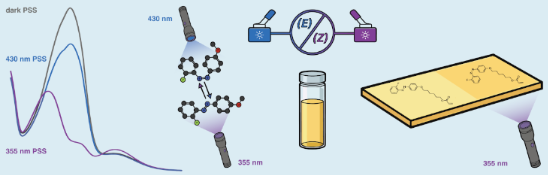
- . Neumanna 1316, Pardubice, 53002, Czech Republic Institute of Organic Chemistry and Technology, Faculty of Chemical Technology, University of Pardubice, Studentská 573, Pardubice, 53210, Czech Republic 10.3762/bjoc.22.60 Abstract The design, synthesis, and comprehensive characterization of six novel


Harnessing light energy with molecules
Beilstein J. Org. Chem. 2026, 22, 680–682, doi:10.3762/bjoc.22.52
- Grace G. D. Han Mogens Brondsted Nielsen Hermann A. Wegner Department of Chemistry and Biochemistry, University of California, Santa Barbara, CA 93016, USA Department of Chemistry, University of Copenhagen, Universitetsparken 5, 2100 Copenhagen, Denmark Institute of Organic Chemistry, Justus
Photoorganocatalytic trifluoromethylation of (het)arenes in green conditions
Beilstein J. Org. Chem. 2026, 22, 662–671, doi:10.3762/bjoc.22.50
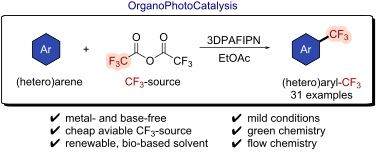
- Egor N. Boronin Svetlana E. Kaurkina Milena M. Svetlakova Anton S. Bolshakov Maxim V. Arsenyev Vasilii F. Otvagin Alexey Yu. Fedorov Timothy Noel Alexander V. Nyuchev Department of Organic Chemistry, N.I. Lobachevsky State University of Nizhny Novgorod, Gagarina Av. 23, 603950 Nizhny Novgorod




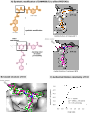
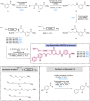
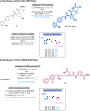
Towards the targeted protein degradation of CK2: design and synthesis of CAM4066-based PROTACs
Beilstein J. Org. Chem. 2026, 22, 611–619, doi:10.3762/bjoc.22.47
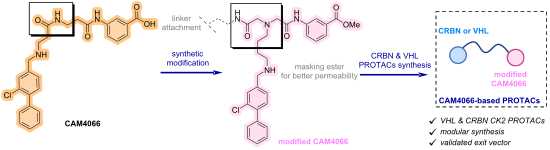
- Sophie Day-Riley Sona Krajcovicova Aryaman Raj Sokhal Jan L. Venne Paul Brear Marko Hyvonen Benjamin C. Whitehurst Jason S. Carroll David R. Spring Yusuf Hamied Department of Chemistry, University of Cambridge, Lensfield Road, CB2 1EW, Cambridge, United Kingdom Department of Organic Chemistry

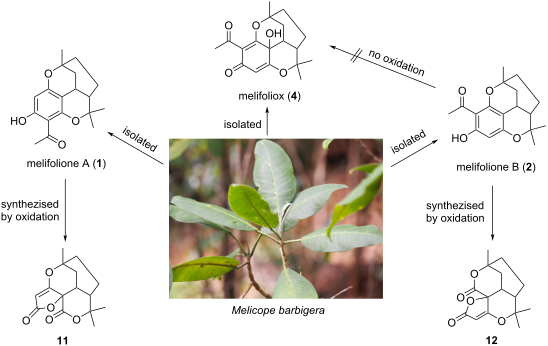
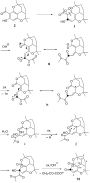
Melifoliox B, a novel phloroglucin derivative isolated from Melicope barbigera (Rutaceae) and synthesis of new oxidation products from melifoliones A and B
Beilstein J. Org. Chem. 2026, 22, 535–546, doi:10.3762/bjoc.22.39
- Biotechnology, Heinrich-Heine-University Duesseldorf, 40225 Duesseldorf, Germany Institute of Organic Chemistry and Macromolecular Chemistry, Heinrich-Heine-University Duesseldorf, 40225, Duesseldorf, Germany Institute of Inorganic Chemistry and Structural Chemistry, Heinrich-Heine-University Duesseldorf, 40225



Recent advances in the stereoselective synthesis of distal biaxially chiral molecules
Beilstein J. Org. Chem. 2026, 22, 461–479, doi:10.3762/bjoc.22.34
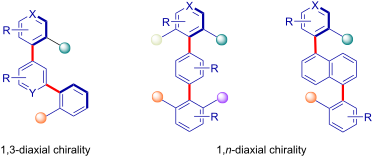
- chiral scaffolds, which arise from hindered rotation between two planes connected by a single bond, have attracted increasing attention due to their widespread applications in chiral ligands, organocatalysts [1], and functional materials [2], making them highly valuable molecular frameworks in organic
- chemistry [3][4][5][6][7][8][9][10][11][12][13][14][15][16][17][18][19][20][21][22][23][24]. Axially chiral molecules form stable spatial configurations due to restricted rotation, providing a well-defined chiral environment that is advantageous in molecular recognition [25], stereochemical induction and


Dialkylaminoalkylation of β-ketosulfones via ring-opening of 3-sulfonylpyrrolidines
Beilstein J. Org. Chem. 2026, 22, 383–389, doi:10.3762/bjoc.22.26
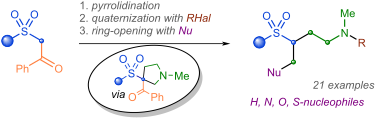
- obtained products with LiAlH4 leads to a substitution of the attached nucleophilic moiety with hydrogen in good yields. Keywords: aminoalkylation; aminosulfones; ketosulfones; pyrrolidines; Introduction Sulfones and sulfonic acids are valuable structural motifs in organic chemistry, notable for their




Electrosynthetic access to unsymmetrical oxaza[8]helicenes with high chiral stability and strong circularly polarized luminescence (CPL)
Beilstein J. Org. Chem. 2026, 22, 372–382, doi:10.3762/bjoc.22.25
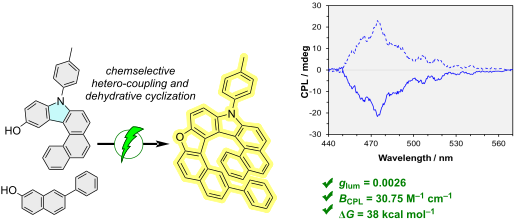
- Yamada-oka, Suita, Osaka 565-0871, Japan Graduate School of Science and Engineering, Kindai University, 3-4-1 Kowakae, Higashi-Osaka, Osaka 577-8502, Japan Pharmaceutical Organic Chemistry Department, Faculty of Pharmacy, Suez Canal University, Ismailia 8366004, Egypt 10.3762/bjoc.22.25 Abstract




Non-central chirality in organic chemistry
Beilstein J. Org. Chem. 2026, 22, 370–371, doi:10.3762/bjoc.22.24
- ; chiroptical properties; molecular chirality; Chirality is a foundational concept in organic chemistry, traditionally framed around tetrahedral carbon stereocenters. Over the past decades, however, it has become increasingly clear that molecular handedness is not confined to localized points in space. Axes
- complementary roles played by non-central chiral molecules in contemporary organic chemistry. First, they continue to serve as demanding benchmarks for asymmetric synthesis, probing how far stereochemical information can be transmitted and controlled when the stereogenic element is spatially or conceptually
- the shared concept of chirality beyond central chirality. The open and inclusive scope of the Beilstein Journal of Organic Chemistry provide a particularly suitable platform for such a concept-driven collection, allowing broad connections across subfields of organic chemistry to be explored without
Recent advances in the cleavage of non-activated amides
Beilstein J. Org. Chem. 2026, 22, 352–369, doi:10.3762/bjoc.22.23
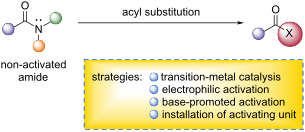
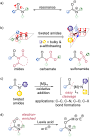
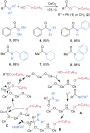
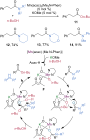
- Eun-Sol Choi Hyo-Jun Lee Department of Chemistry, Kunsan National University, Gunsan 54150, Republic of Korea 10.3762/bjoc.22.23 Abstract The amide bond is one of the most fundamental and widely utilized functional groups in organic chemistry, central to the structures of pharmaceuticals
- . Keywords: amide; amide activation; esterification; non-activated amide; transamidation; Introduction Serving as a cornerstone in organic chemistry, the amide bond is a fundamental and extensively utilized functional group, playing a central role in natural products, biomolecules, and functional materials





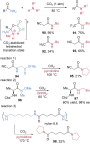
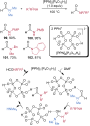


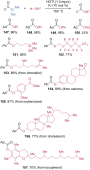

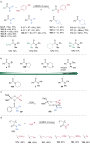


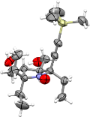
Synthesis of tricyclic fused pyrrolidine nitroxides from 2-alkynylpyrrolidine-1-oxyls
Beilstein J. Org. Chem. 2026, 22, 344–351, doi:10.3762/bjoc.22.22

- Mark M. Gulman Yuliya F. Polienko Sofia Yu. Trakhininа Yuri V. Gatilov Tatyana V. Rybalova Sergey A. Dobrynin Igor A. Kirilyuk N. N. Vorozhtsov Novosibirsk Institute of Organic Chemistry SB RAS, Lavrentiev Ave. 9, Novosibirsk, 630090, Russia Novosibirsk State University, Pirogova Str. 2




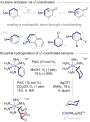
Arene activation via π-bond localization: concepts and opportunities
Beilstein J. Org. Chem. 2026, 22, 257–273, doi:10.3762/bjoc.22.19
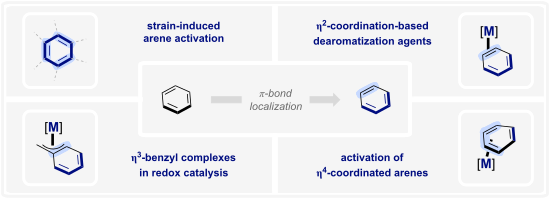
- palladium to aryl halides serving as a prominent example [41]. In addition to such fleeting intermediates, recent decades have seen the emergence of numerous well-defined metal–arene complexes, sufficiently stable to enable systematic exploration of their rich and versatile organic chemistry. η2
- . Substrate-dependent ortho- and para-selective dearomatization of naphthyl chlorides and leveraging three-component strategies to access η3-benzyl intermediates. Acknowledgements We gratefully acknowledge support from the Institute of Organic Chemistry at Heidelberg University, and we would also like to




A mild and atom-efficient four-component cascade strategy for the construction of biologically relevant 4-hydroxyquinolin-2(1H)-one derivatives
Beilstein J. Org. Chem. 2026, 22, 244–256, doi:10.3762/bjoc.22.18
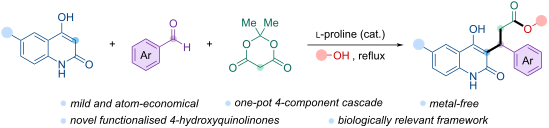
- ; Introduction Contemporary organic chemistry focuses on the development of universal, efficient, and environmentally benign synthetic methods that address the challenges of constructing complex molecular architectures [1][2][3]. Among these, multicomponent reactions (MCRs) have emerged as powerful tools


Base-promoted deacylation of 2-acetyl-2,5-dihydrothiophenes and their oxygen-mediated hydroxylation
Beilstein J. Org. Chem. 2026, 22, 192–204, doi:10.3762/bjoc.22.13
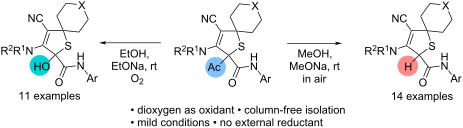
- Vladimir G. Ilkin Margarita Likhacheva Igor V. Trushkov Tetyana V. Beryozkina Vera S. Berseneva Vladimir T. Abaev Wim Dehaen Vasiliy A. Bakulev TOS Department, Ural Federal University, 19 Mira str., Yekaterinburg 620002, Russia N.D. Zelinsky Institute of Organic Chemistry, Russian Academy of


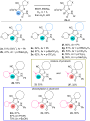


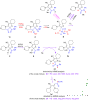
A new synthesis of Tyrian purple (6,6’-dibromoindigo) and its corresponding sulfonate salts
Beilstein J. Org. Chem. 2026, 22, 167–174, doi:10.3762/bjoc.22.10
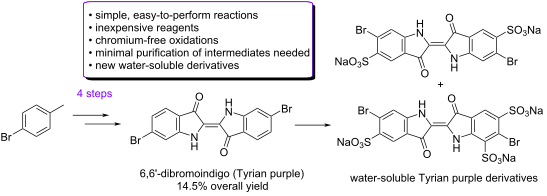
- authors wish to thank the University of Notre Dame and Dr. William Bogges for his assistance in obtaining high-resolution mass spectra of synthesized compounds. Moreover, the authors want to thank the 2024 and 2025 Organic Chemistry II classes at North Central College, whose preliminary work served as


Circumventing Mukaiyama oxidation: selective S–O bond formation via sulfenamide–alcohol coupling
Beilstein J. Org. Chem. 2026, 22, 158–166, doi:10.3762/bjoc.22.9
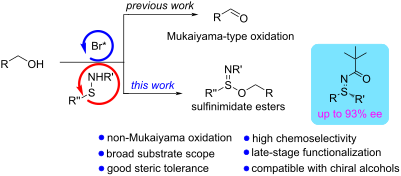
- versatile intermediates for enantioselective S–C bond formation under mild and metal-free conditions. Keywords: asymmetric synthesis; late-stage functionalization; selective oxidation; sulfenamides; sulfinimidate esters; Introduction Sulfur is a privileged heteroatom in organic chemistry, celebrated for


Highly electrophilic, gem- and spiro-activated trichloromethylnitrocyclopropanes: synthesis and structure
Beilstein J. Org. Chem. 2026, 22, 123–130, doi:10.3762/bjoc.22.5
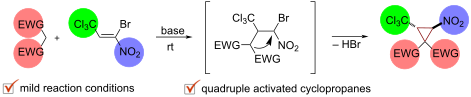
- Ilia A. Pilipenko Mikhail V. Grigoriev Olga Yu. Ozerova Igor A. Litvinov Darya V. Spiridonova Aleksander V. Vasilyev Sergey V. Makarenko Department of Chemistry, Saint-Petersburg State Forest Technical University, Saint-Petersburg 194021, Russia Department of Organic Chemistry, Herzen State
- Pedagogical University of Russia, Saint-Petersburg 191186, Russia A. E. Arbuzov Institute of Organic and Physical Chemistry, FRC Kazan Scientific Center of the Russian Academy of Sciences, Kazan 420088, Russia Department of Organic Chemistry, Institute of Chemistry, Saint-Petersburg State University, Saint


Total synthesis of natural products based on hydrogenation of aromatic rings
Beilstein J. Org. Chem. 2026, 22, 88–122, doi:10.3762/bjoc.22.4
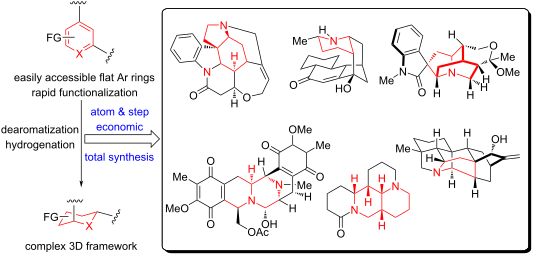
- Haoxiang Wu Xiangbing Qi National Institute of Biological Sciences, Beijing. No. 7, Science Park Road, Zhongguancun Life Science Park, Changping District, 102206 Beijing, China 10.3762/bjoc.22.4 Abstract Arenes and heteroarenes are easily available building blocks in organic chemistry, and
- highlights representative examples that illustrate recent synthetic advances [35][36]. Hydrogenation of monocyclic aromatic rings Hydrogenation of heterocyclic aromatic rings: Despite the widespread application of six-membered aromatic heterocycles in various fields of organic chemistry, reports on their











Reactivity umpolung of the cycloheptatriene core in hexa(methoxycarbonyl)cycloheptatriene
Beilstein J. Org. Chem. 2026, 22, 64–70, doi:10.3762/bjoc.22.2
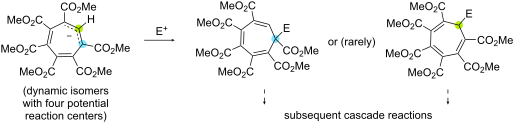
- Dmitry N. Platonov Alexander Yu. Belyy Rinat F. Salikov Kirill S. Erokhin Yury V. Tomilov N. D. Zelinsky Institute of Organic Chemistry, Russian Academy of Sciences, 47 Leninsky prosp., 119991 Moscow, Russian Federation Higher School of Economics National Research University, 101000 Moscow
- , include the formation of norcaradienes, dihydroindazoles, a tetracyclodecene and a hydrazonocycloheptatriene derivative. Keywords: azo shift; cascade reactions; cycloheptatriene; relief of antiaromaticity; umpolung; Introduction Reactivity umpolung [1] is a synthetic concept in organic chemistry that





