Search results
Search for "sterically-hindered" in Full Text gives 297 result(s) in Beilstein Journal of Organic Chemistry. Showing first 200.
Synthesis of sterically shielded piperidine nitroxides via acid-catalyzed heterocyclization of β-aminoketone derivatives with ketones
Beilstein J. Org. Chem. 2026, 22, 948–954, doi:10.3762/bjoc.22.74
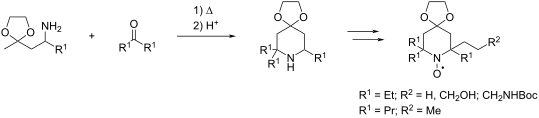
- tetraethyl structures and do not allow the introduction of functional groups into position 2. We propose an alternative approach that allows for the variation of substituents adjacent to the nitroxyl group, which significantly expands the potential of sterically hindered nitroxides for promising applications
- of nitroxides and increases their lifetimes in biological systems [12], which makes these radicals promising MRI contrast agents [13], spin probes for in vivo EPRI [14][15] and antioxidant tissue protectors [16]. Existing methods for the synthesis of such sterically hindered piperidine nitroxide
- of sterically hindered piperidine nitroxyl radicals. Six-membered cyclic nitrones – 2,2,6-trialkyl-substituted 2,3,4,5-tetrahydropyridine-1-oxides were prepared via the acid-catalyzed reaction of 2-(2-aminoalkyl)-2-methyl-1,3-dioxolanes with ketones in analogy to literature procedures [25][26][27][28


Recent advances in copper-catalyzed direct hydroamination of alkenes with (hetero)aromatic amines
Beilstein J. Org. Chem. 2026, 22, 925–947, doi:10.3762/bjoc.22.73
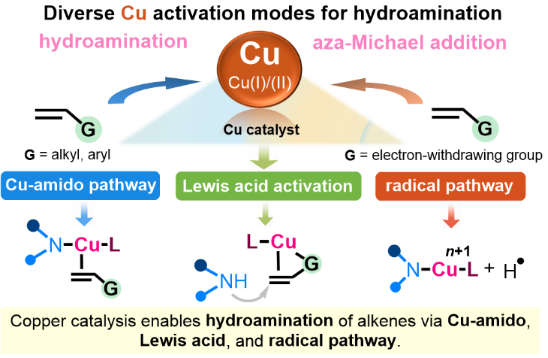
- , exhibiting remarkable nitrogen regioselectivity and favoring a more sterically hindered N2 position (N2/N1 > 20:1). Furthermore, various substituted cyclopropenes were well tolerated, yielding the corresponding hydroamination products in good yield with high enantioselectivity. Mechanistic studies suggested
- system development have further expanded the scope and efficiency of copper-catalyzed hydroamination. Despite these achievements, extending these methods to electron-neutral and sterically hindered unactivated alkenes, such as simple aliphatic terminal alkenes and internal alkenes, as well as achieving







Unsymmetrical sulfoxides with sterically hindered catechol fragment: synthesis, structure, electrochemical properties, and antiradical activity
Beilstein J. Org. Chem. 2026, 22, 828–837, doi:10.3762/bjoc.22.65
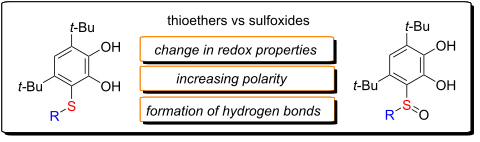
- 10.3762/bjoc.22.65 Abstract New unsymmetrical sulfoxides containing a redox-active sterically hindered catechol fragment and a nonpolar hydrocarbon substituent at the sulfoxide group were synthesized via the oxidation of the corresponding catechol thioethers with hydrogen peroxide. The yield of the
- ]. We have previously shown that hybrid molecules based on sterically hindered catechol thioethers, bearing various polar and hydrocarbon groups, exhibit pronounced chelating [15][16], antiradical, and cryoprotective activity [17][18][19][20]. The ability of the sulfur atom to exist in various oxidation
- sterically hindered o-benzoquinones. The obtained data differ from the spectral pattern characteristic of o-benzoquinone thioethers (λmax = 490–505 nm) [23][51][52][53] and indicate the absence of intramolecular charge transfer between the thioether group and the o-benzoquinone fragment. Based on


Rongalite addition to dienones: diastereoselectivity in cyclic sulfone synthesis; stereochemical rationalization and prospects as a general conjugate nucleophile
Beilstein J. Org. Chem. 2026, 22, 742–752, doi:10.3762/bjoc.22.56

- stereochemistry by i) sulfide oxidation and ii) derivatization. Reactions of sterically hindered substrates. Initial reactivity comparison with p-toluenesulfinate. Preparation of anticipated products in competition experiments with Rongalite and other sulfinates. Exchange experiment. Double intermolecular




Computational prediction of C–H hydricities and their use in predicting the regioselectivity of electron-rich C–H functionalisation reactions
Beilstein J. Org. Chem. 2026, 22, 603–610, doi:10.3762/bjoc.22.46
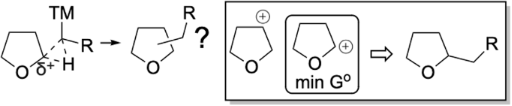
- is less sterically hindered (%Vbur = 62.3%). For comparison, the site with the lowest BDE has an intermediate value for %Vbur of 65.4%. Compounds 5 and 6 Allen and Lambert [42] reported the tropylium ion-mediated α-cyanation of amines, including compounds 5 and 6. In the case of compound 5, the


![[Graphic 6]](/bjoc/content/inline/1860-5397-22-46-i8.svg?max-width=637&scale=1.18182)


Continuous-flow carbonyl hydrogenation under subatmospheric to atmospheric hydrogen pressure enabled by robust heterogeneous Pt–Fe catalysts
Beilstein J. Org. Chem. 2026, 22, 575–582, doi:10.3762/bjoc.22.43
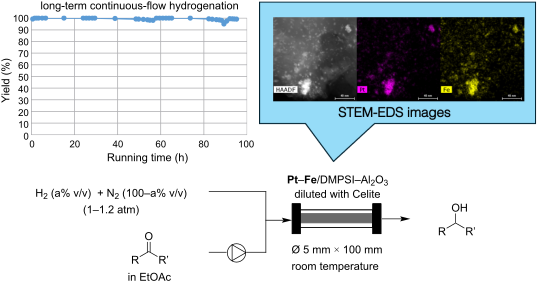
- bimetallic Pt–Fe nanoparticle catalyst immobilized on a composite support of dimethylpolysilane and alumina. Both ketones and aldehydes, including highly bulky and sterically hindered substrates, were smoothly hydrogenated using the newly developed catalysts under continuous-flow conditions at room
- bulky and sterically hindered substrates, were smoothly hydrogenated at room temperature under subatmospheric to atmospheric hydrogen pressure with a wide substrate scope. The high durability of the heterogeneous catalyst was confirmed by a long-term continuous-flow reaction, and the catalytic activity


Synthesis and uranyl(VI) extraction performance of a calix[4]pyrrole–tetrahydroxamic acid receptor
Beilstein J. Org. Chem. 2026, 22, 486–494, doi:10.3762/bjoc.22.36
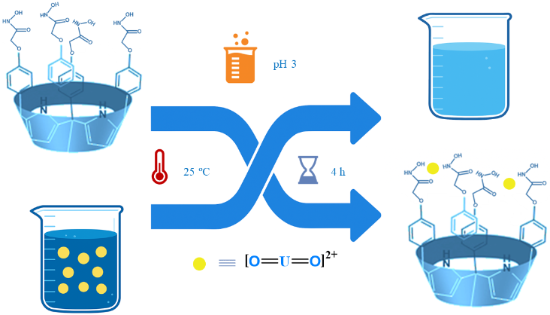
- , particularly when the starting compounds are sterically hindered [50]. In this regard, a methanolic solution of PCP ester was allowed to react with a large excess of methanolic hydroxylamine in the presence of DBU for one night. At this stage, the formation of precipitated PCP hydroxamic acids was verified


Cone p-aminocalix[4]arenes enriched with ‘clickable’ alkyne or azide functionalities
Beilstein J. Org. Chem. 2026, 22, 399–415, doi:10.3762/bjoc.22.28
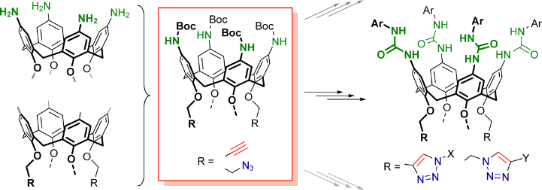
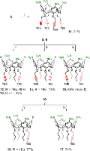
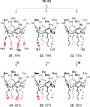
- conditions. In line with this, compounds 8–10 having less sterically hindered narrow-rim substitution patterns were found to be more resistant to side reactions during wide-rim nitration as well as to the target exhaustive nitration itself. These reactions required a higher nitric acid concentration of ≈2.5
- -temperature preparation of the tetrapropargyl ether 24 from its silylated precursor 21. Surprisingly, attempts to apply these conditions to a complete removal of TBS groups in the less sterically hindered propargyl ethers 22 and 23 failed, and large amounts of the starting materials (as well as the partially


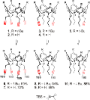




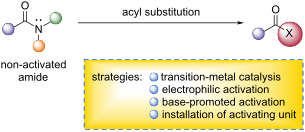
Recent advances in the cleavage of non-activated amides
Beilstein J. Org. Chem. 2026, 22, 352–369, doi:10.3762/bjoc.22.23
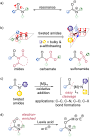
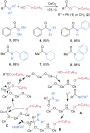
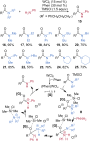
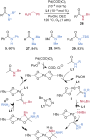
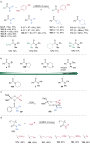
- in good to high yields, and the results were highly dependent on the steric congestion of the substrate. With increased lengths of the alkyl substituent on the nitrogen, the yield was slightly decreased. Sterically hindered N-methyl-N-tert-butylamide 22 produced the corresponding anilide in only 53
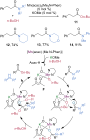
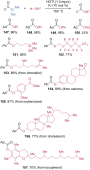
- , and secondary amines all furnished the corresponding amides 135–143 in high yields, though the sterically hindered 1-adamantylamine afforded the corresponding amide 142 in a moderate 56% yield. Notably, the tertiary amide moiety was cleaved with excellent chemoselectivity even in the presence of other
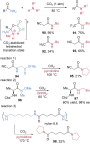
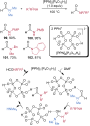
- unactivated tertiary amides under transition-metal-free conditions [73]. Lithium hexamethyldisilazide (LiHMDS) was used to activate the amide, enabling smooth cleavage of the C–N bond even in sterically hindered substrates (Scheme 22a). Using p-methylaniline as a nucleophile in the presence of three










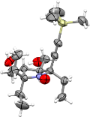
Synthesis of tricyclic fused pyrrolidine nitroxides from 2-alkynylpyrrolidine-1-oxyls
Beilstein J. Org. Chem. 2026, 22, 344–351, doi:10.3762/bjoc.22.22

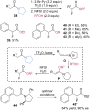
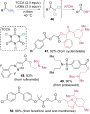
- rotation of the radical separately from the framework is impossible could be particularly promising. Rigid polycyclic fused systems with incorporated nitroxide moieties could be one of the possible ways to achieve the above feature. We recently found that the reaction of sterically hindered 3-hydroxymethyl




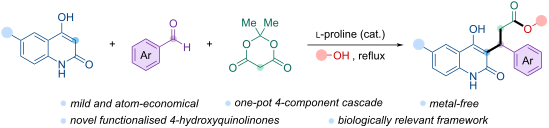
A mild and atom-efficient four-component cascade strategy for the construction of biologically relevant 4-hydroxyquinolin-2(1H)-one derivatives
Beilstein J. Org. Chem. 2026, 22, 244–256, doi:10.3762/bjoc.22.18
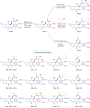
- cyclohexanol in refluxing dichloromethane. Moreover, Steglich esterification (using DCC and DMAP in dichloromethane), known for its mild conditions and compatibility with sterically hindered substrates, also produced the cyclic pyranoquinoline 14 rather than the expected ester. During preparative


Conformational analysis of difluoromethylornithine: factors influencing its gas-phase and bioactive conformations
Beilstein J. Org. Chem. 2026, 22, 237–243, doi:10.3762/bjoc.22.17
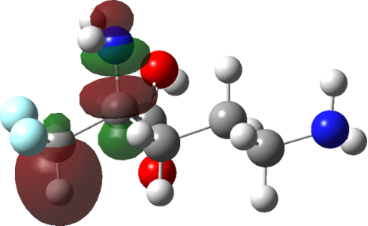
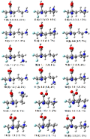
- hyperconjugation, but the former experiences weaker steric repulsion. Conversely, conformer 18 is both the least stabilized by hyperconjugation and one of the most sterically hindered. The gas-phase preferences can be contrasted with the bioconformation of (S)-DFMO. Although PDB entry 9FOS is reported as ornithine




Circumventing Mukaiyama oxidation: selective S–O bond formation via sulfenamide–alcohol coupling
Beilstein J. Org. Chem. 2026, 22, 158–166, doi:10.3762/bjoc.22.9
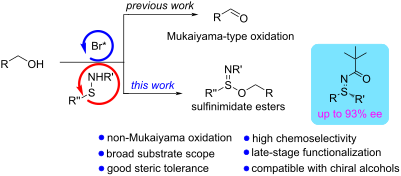
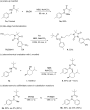
- good to excellent yields (up to 99%), suggesting broad functional group compatibility. The protocol also demonstrated excellent compatibility with structurally and electronically distinct amide substrates. The sterically hindered 2-naphthylamide-derived sulfenamide afforded the desired product 3h’ in
- efficiently even with secondary hydroxy groups. The method also accommodated sterically hindered and functionalized alcohols. tert-Butylmethanol in which the hydroxy group is attached to a methylene adjacent to a bulky tert-butyl group, gave the desired product 3v’ in 91% yield, while a halogenated alcohol
- with alcohols to access sulfinimidate esters. The method uses inexpensive and readily available reagents and features a broad substrate scope, high chemoselectivity, and excellent tolerance toward sterically hindered and functionalized alcohols. It avoids typical Mukaiyama-type oxidation pathways and


Highly electrophilic, gem- and spiro-activated trichloromethylnitrocyclopropanes: synthesis and structure
Beilstein J. Org. Chem. 2026, 22, 123–130, doi:10.3762/bjoc.22.5
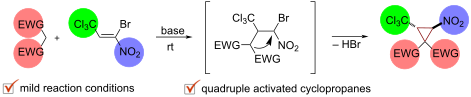
- cyclopropane ring is probably a consequence of the formation of a sterically hindered carbanion II in a conformation with an anti-periplanar position of the bulky substituents – bromine and a trichloromethyl group (Scheme 6). Due to the steric reasons, the anion in this conformation is selectively protonated


Reactivity umpolung of the cycloheptatriene core in hexa(methoxycarbonyl)cycloheptatriene
Beilstein J. Org. Chem. 2026, 22, 64–70, doi:10.3762/bjoc.22.2
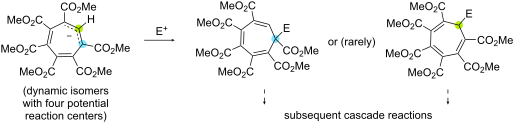
- (methoxycarbonyl)cycloheptatriene 3 (pKa(DMSO) = 8.65) [20][21] with potassium tert-butoxide and subjected to reactions with electrophilic reagents. The reactions gave two primary products 4 and 5 (Scheme 1) through an attack to either the most available i-position or the most nucleophilic but sterically hindered
- sterically hindered 2-(methoxycarbonyl)phenyldiazonium ion afforded only one isomer of dihydroindazole 8k which indicates the influence of the steric factor on the azocyclopropane rearrangement. However, the reaction additionally gave the product of an i-substitution with subsequent proton migration to form
- with the formation of 4a,b, as well as the formation of hydrazone product 10k exclusively in the case of the most sterically hindered diazonium electrophile leads to the conclusion that the direct electrophilic attack onto the i-position could take place in all these cases. To clarify this, we analyzed


Synthesis and applications of alkenyl chlorides (vinyl chlorides): a review
Beilstein J. Org. Chem. 2026, 22, 1–63, doi:10.3762/bjoc.22.1
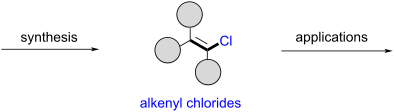
- products 28–35, 38 and 39 [56]). The yields varied considerably depending on the substrate, leading to the following conclusions: (a) unhindered ketones lacking functional groups generally react in high yields; (b) sterically hindered ketones provide products 33, 36, and 39 with low yields; (c) electron
- alkenyl chloride 156 was isolated only in trace amounts, alongside isomerized alkene 157 and dichloride 158. Notably, only the sterically hindered tert-butyl-substituted alkyne afforded the desired product 155 in high yields, whereas hydrochlorination of 4-octyne proved inefficient to deliver compound 159























Tandem hydrothiocyanation/cyclization of CF3-iminopropargyl alcohols with NaSCN in the presence of AcOH
Beilstein J. Org. Chem. 2025, 21, 2694–2702, doi:10.3762/bjoc.21.207
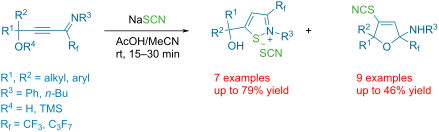
- , providing products 2b,c and 3b,c with similar yields (Table 2, entries 1 and 2). The slightly decreased yield observed for product 3c obtained from iminopropargyl alcohol having a cyclohexyl substituent, is probably due to the steric effect (Table 2, entry 2). The more sterically hindered CF3-iminopropargyl



Efficient solid-phase synthesis and structural characterization of segetalins A–H, J and K
Beilstein J. Org. Chem. 2025, 21, 2612–2617, doi:10.3762/bjoc.21.202
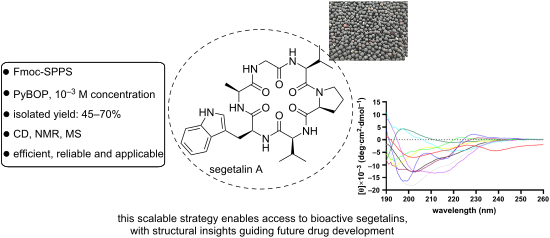
- from the high cost of the specialized resin and large solvent volumes required for dilution, coupled with DPPA's poor efficiency in forming sterically hindered peptide bonds involving residues like Val or Ile. Dahiya and Kaur synthesized segetalin C (3) via a solution-phase fragment coupling strategy


Total syntheses of highly oxidative Ryania diterpenoids facilitated by innovations in synthetic strategies
Beilstein J. Org. Chem. 2025, 21, 2553–2570, doi:10.3762/bjoc.21.198
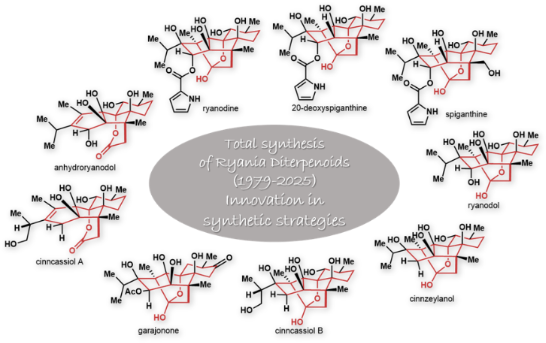
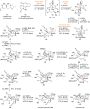
- the simultaneous construction of four quaternary carbon centers (C1, C4, C5, and C12) and the core AB bicyclic skeleton, markedly improving synthetic efficiency. Subsequent oxidative desymmetrization of the C14–C15 olefin in (±)-33 established the sterically hindered C11 quaternary carbon center. An α
- , (+)-ryanodol (4), indicates that the pyrrole-2-carboxylate unit at the C3 position is critical for receptor binding, as established by structure–activity relationship (SAR) studies [28]. However, the direct and selective modification of the highly sterically hindered C3 hydroxy group within this







Synthetic study toward vibralactone
Beilstein J. Org. Chem. 2025, 21, 2376–2382, doi:10.3762/bjoc.21.182

- not proceed to form the all-carbon quaternary center and only decomposition of 21 was observed. The failure is likely due to the sterically hindered environment of the substituted β-lactone ring which precludes the C–H insertion or deprotonation of the β-lactone and interrupted the generation of the


Recent advances in Norrish–Yang cyclization and dicarbonyl photoredox reactions for natural product synthesis
Beilstein J. Org. Chem. 2025, 21, 2315–2333, doi:10.3762/bjoc.21.177
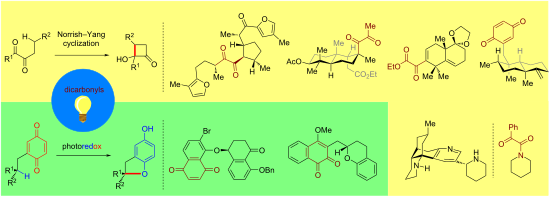
- natural product synthesis. This review summarizes the latest advancements in these reactions for constructing terpenoids, alkaloids, and antibiotics. Through Norrish–Yang cyclization, dicarbonyls (e.g., 1,2-diketones and α-keto amides) can efficiently construct sterically hindered ring structures, which
- , enabling the construction of diverse architectures including sterically hindered cyclobutanes, spiroketals, and fused polycycles. However, the potential of dicarbonyls in photoreactions warrants further exploration. Future research could investigate a broader range of dicarbonyl substrates to uncover new




Pd-catalyzed dehydrogenative arylation of arylhydrazines to access non-symmetric azobenzenes, including tetra-ortho derivatives
Beilstein J. Org. Chem. 2025, 21, 2234–2242, doi:10.3762/bjoc.21.170
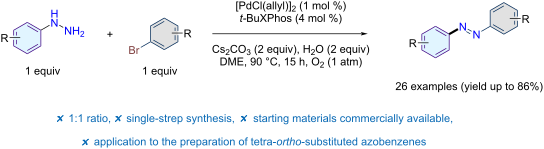
- efficiency, as the reaction proceeds smoothly even when both coupling partners possess sterically hindered substituents at the 2,6-positions. For example, the coupling of 2,6-difluorophenylhydrazine with 1-bromo-2,6-dimethoxybenzene yielded tetra-ortho-substituted azobenzene 5a in a notable yield of 63


C2 to C6 biobased carbonyl platforms for fine chemistry
Beilstein J. Org. Chem. 2025, 21, 2103–2172, doi:10.3762/bjoc.21.165


The application of desymmetric enantioselective reduction of cyclic 1,3-dicarbonyl compounds in the total synthesis of terpenoid and alkaloid natural products
Beilstein J. Org. Chem. 2025, 21, 2085–2102, doi:10.3762/bjoc.21.164
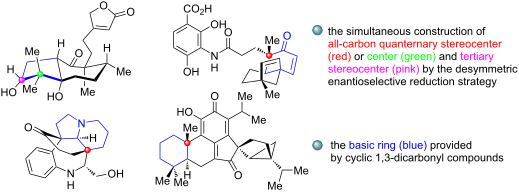
- ], the enzyme-catalyzed desymmetric enantioselective reduction of 28, afforded hydroxyketone 54 in 65% yield with >99% ee and 8–9:1 dr on multigram scale [34]. Functional group transformations of 54 in four steps produced sterically hindered allyl triflate 55. By employing the palladacycle catalyst 45
- -catalyzed Suzuki cross-coupling reaction of sterically hindered substrates developed by Han [35][36][37], the coupled product 57 was obtained in a satisfactory yield (72%) from 55 and pinacol boronate 56, along with trace amounts of the double bond migrated side product 58 (57:58 = ca. 15:1). Demethylation







α-Ketoglutaric acid in Ugi reactions and Ugi/aza-Wittig tandem reactions
Beilstein J. Org. Chem. 2025, 21, 2021–2029, doi:10.3762/bjoc.21.157
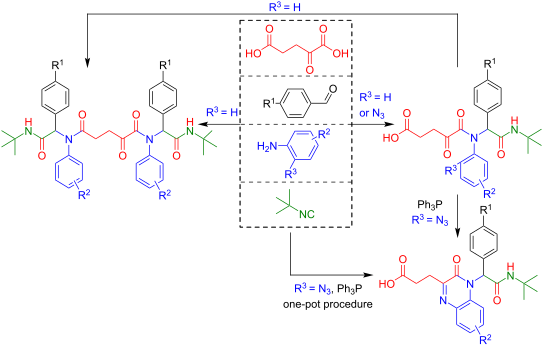
- compared to compounds 5, which can be clearly seen in the spectrum of compound 8h with both substituted ortho-positions of the amine moiety. In our opinion, this indicates the presence of rotamerism [59][60] caused by the restricted rotation of the sterically hindered amide group. The 1H NMR spectra of