Search results
Search for "cis/trans isomerization" in Full Text gives 41 result(s) in Beilstein Journal of Organic Chemistry.
Are boat transition states likely to occur in Cope rearrangements? A DFT study of the biogenesis of germacranes
Beilstein J. Org. Chem. 2017, 13, 1969–1976, doi:10.3762/bjoc.13.192
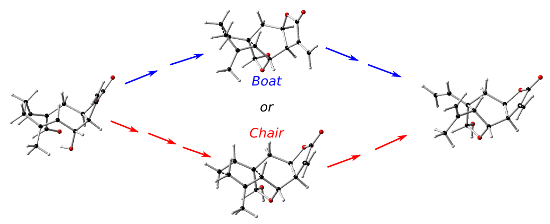
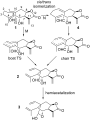
- [64]. The stability of the wave functions of all the transition states was checked. An unrestricted wave function was used to calculate the activation energy of the cis/trans isomerization of the (Z,E)-germacranolide. All energies were reported with zero-point energy corrections and all TS geometries
- predict the conformation of a germacrene. Interestingly, the (Z,E)-germacranes are significantly more stable than (E,E)-germacranes. Then, cis/trans isomerization can only happen in one way, (E,E)-germacranes → (Z,E)-germacranes. Moreover, this isomerization cannot be thermally activated because of the



Benzothiadiazole oligoene fatty acids: fluorescent dyes with large Stokes shifts
Beilstein J. Org. Chem. 2016, 12, 2739–2747, doi:10.3762/bjoc.12.270
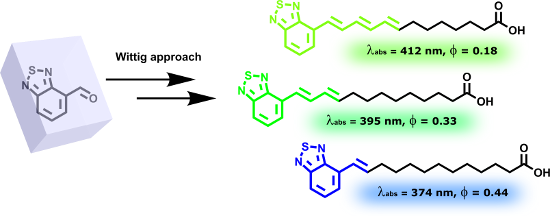
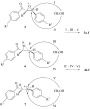
- isomerization has to take place. To access the benzothiadiazole (BTD) fatty acid 3 with just one conjugated double bond we made use of the Wittig reaction starting with commercially available aldehyde 1. As expected, the (Z)-isomer was the major product; thus, we performed a subsequent cis–trans isomerization
- presence of a Lewis acid and DIBAL at low temperatures. MnO2-mediated oxidation afforded the respective aldehyde that was immediately transformed by Wittig reaction. Iodine-catalyzed cis–trans isomerization yielded the desired fatty acid 7 in 35% over three steps (Scheme 2). The analogue with three


Tuning of tetrathiafulvalene properties: versatile synthesis of N-arylated monopyrrolotetrathiafulvalenes via Ullmann-type coupling reactions
Beilstein J. Org. Chem. 2015, 11, 860–868, doi:10.3762/bjoc.11.96
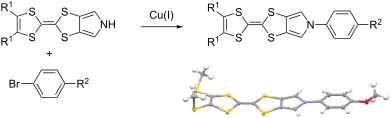
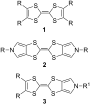
- regioselective functionalization of TTF, however, remains problematic due to the presence of four identical attachment sites. Incorporation of the TTF moiety in macrocycles usually leads to poorly separable mixtures of cis/trans isomers [7][8][9]. Even if separation is possible, TTFs are prone to cis/trans
- isomerization, which can be induced by light [10] or traces of acid [11]. These problems are aggravated by the fact that each reversible oxidation–reduction cycle of the TTF moiety always leads to formation of cis/trans isomer mixtures. Bis-pyrrolotetrathiafulvalenes 2 and monopyrrolotetrathiafulvalenes (MPTTFs



cis–trans Isomerization of silybins A and B
Beilstein J. Org. Chem. 2014, 10, 1047–1063, doi:10.3762/bjoc.10.105
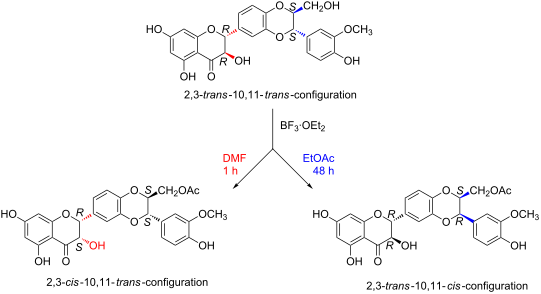
- optically pure compounds was determined by using NMR and comparing their electronic circular dichroism data with model compounds of known absolute configurations. Mechanisms for cis–trans-isomerization of silybin are proposed and supported by quantum mechanical calculations. Keywords: 2,3-cis-silybin
- propose a mechanism for the cis–trans-isomerization processes. Results and Discussion Chemistry In our previous work on the enzymatic kinetic resolution of silybin [4][5], BF3∙OEt2 in EtOAc was found to catalyze the transesterification of silybin to yield not only 23-O-acetylsilybin (2, ca. 90%), but two
- NMR coupling constants and a comparison of their ECD spectra with model compounds with well-defined absolute configurations. Moreover, the absolute configuration of these novel 2,3-cis- and 10,11-cis-isomers of silybin enabled us to propose mechanisms for the cis–trans isomerization of silybin


An investigation of the observed, but counter-intuitive, stereoselectivity noted during chiral amine synthesis via N-chiral-ketimines
Beilstein J. Org. Chem. 2013, 9, 2103–2112, doi:10.3762/bjoc.9.247
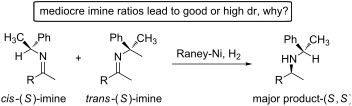
- ensuing experimental and computational (DFT) results favor the former, pre-existing, explanation. Keywords: chiral amines; cis/trans isomerization; imine isomerization; imine reduction; reductive amination; Introduction A class of chiral compounds drawing ever more attention is α-chiral amines (chiral
- reference [51].) Reduction of this imine, regardless of the starting cis/trans ratio, resulted in the same amine product dr. It was then proposed that this occurred because of in situ cis/trans isomerization but no further evidence was offered, here we follow up on this point. Harada also noted that protic


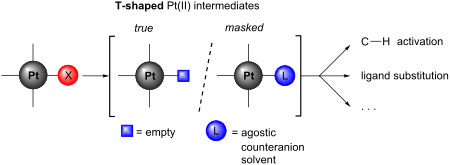
True and masked three-coordinate T-shaped platinum(II) intermediates
Beilstein J. Org. Chem. 2013, 9, 1352–1382, doi:10.3762/bjoc.9.153

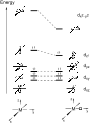


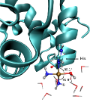


Spin state switching in iron coordination compounds
Beilstein J. Org. Chem. 2013, 9, 342–391, doi:10.3762/bjoc.9.39
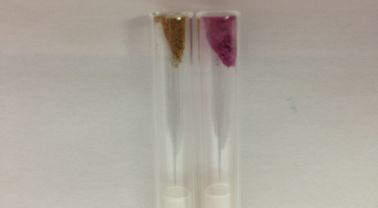
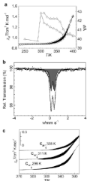
- primary step of LD-LISC is a photochemical reaction on the ligand molecules, for instance a photo-induced cis/trans-isomerization on 4-styrylpyridine (stpy) as a ligand, e.g., in [Fe(II)(stpy)4(NCS)2], which modulates the ligand field strength at the metal center and eventually leads to spin state


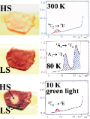
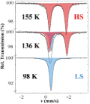


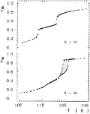

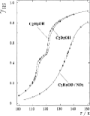


![[Graphic 1]](/bjoc/content/inline/1860-5397-9-39-i3.png?max-width=637&scale=1.18182) ) modes versus the anion volu...
) modes versus the anion volu...






Amino-substituted diazocines as pincer-type photochromic switches
Beilstein J. Org. Chem. 2013, 9, 1–7, doi:10.3762/bjoc.9.1
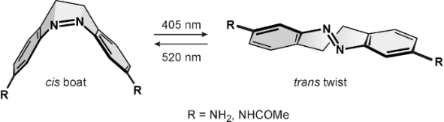
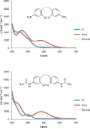
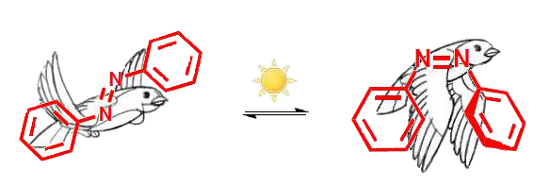
- as directed motion at the molecular level [2][3], the geometry change and the force induced during cis–trans isomerization has to be coupled to the environment. In the macroscopic world, therefore, machines are made from stiff materials. Azobenzene, however, is a rather floppy molecule. Both phenyl




Partial thioamide scan on the lipopeptaibiotic trichogin GA IV. Effects on folding and bioactivity
Beilstein J. Org. Chem. 2012, 8, 1161–1171, doi:10.3762/bjoc.8.129
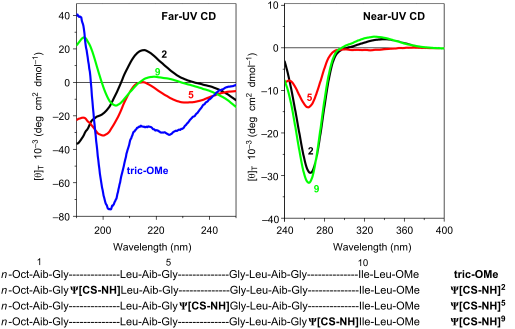
- /trans isomerization can be phototriggered by irradiation at about 260 nm [absorption maximum of the -C(=S)NH- π→π* electronic transition]. (iii) It may act as a minimalist, effective quencher for any type of protein and nonprotein fluorophores. Recently, based on the aforementioned characteristics of
- ][20][21][22][23][24][25][26][27][28][29][30][31][32][33][34][35][36][37][38][39][40][41][42][43][44]. Among these properties, we highlight the following: (i) The thioamide NH group is more acidic than that of its oxygenated counterpart and consequently it is a stronger H-bonding donor. (ii) Its cis


Control over molecular motion using the cis–trans photoisomerization of the azo group
Beilstein J. Org. Chem. 2012, 8, 1071–1090, doi:10.3762/bjoc.8.119
- and S2←S0 excitations and cis–trans isomerization by exciting into the S1 or S2 state [21]. The sum of the quantum yields is different to unity, which indicates multiple pathways for isomerization. In stilbene, the isomerization occurs exclusively by rotation and the quantum yield equals unity [22
- does not affect cell survival, and similarly irradiation of incubated cells with LAMs not containing CPT, did not lead to cell death, thus confirming the biocompatibility of the LAMs with the cells. Molecular lift The individual molecular motion of azobenzene in the cis–trans isomerization process can


Diarylethene-modified nucleotides for switching optical properties in DNA
Beilstein J. Org. Chem. 2012, 8, 905–914, doi:10.3762/bjoc.8.103
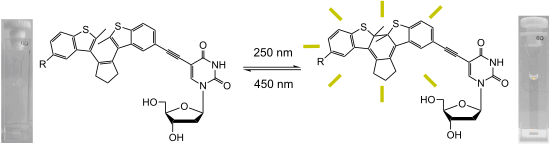
- photoswitchable components in nucleic acids and are suitable for the control of a variety of different biological functions. The photoinduced cis–trans isomerization of azobenzene nucleosides can reversibly switch between the formation and dissociation of DNA duplexes [14][15][16][17], photoregulate DNA
- polymerase reaction [18], photocontrol DNA triplex formation [19], and drive photon-fueled DNA-based nanomachines [20][21]. Concerning the extent of structural change, the cis–trans isomerization of azobenzenes behaves much simpler than the ring opening of spiropyrans to merocyanines. In the latter case not




Photochemical and thermal intramolecular 1,3-dipolar cycloaddition reactions of new o-stilbene-methylene-3-sydnones and their synthesis
Beilstein J. Org. Chem. 2011, 7, 1663–1670, doi:10.3762/bjoc.7.196
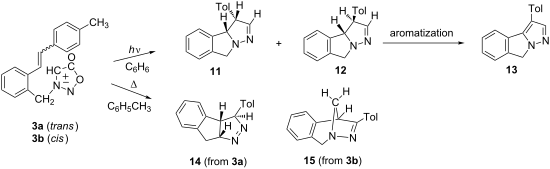
- , where the sydnone moiety is part of a heterostilbene system, cis–trans isomerization was the main process, and no intramolecular cycloadducts were found owing to the unfavourable conformation of the formed intermediate in the trans configuration. The existence of the nitrile imine intermediate as a
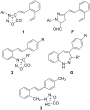
- , namely, trans–cis and cis–trans isomerization of the stilbene moiety, and photolysis of the sydnone ring resulting in the formation of the nitrile imine intermediate. The nitrile imine species is, in intramolecular dipolar [3 + 2] cycloaddition, trapped by the cis- or trans-double bond of the stilbene




The arene–alkene photocycloaddition
Beilstein J. Org. Chem. 2011, 7, 525–542, doi:10.3762/bjoc.7.61
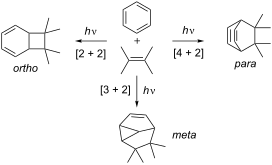
- that the meta photocycloaddition occurs from the singlet excited-state; they observed that 6-phenyl-2-hexene undergoes cis–trans isomerization upon sensitizing with acetone and benzophenone, whereas the photocycloaddition to the meta product could only be triggered via direct irradiation [23]. Mode


Exceptionally small supramolecular hydrogelators based on aromatic–aromatic interactions
Beilstein J. Org. Chem. 2011, 7, 167–172, doi:10.3762/bjoc.7.23
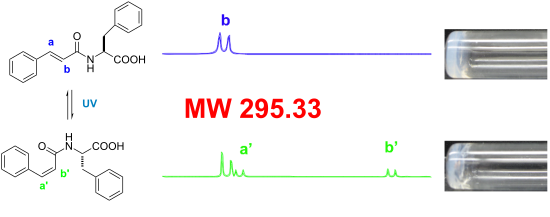
- properties. Notably, compound 6 can undergo cis/trans-isomerization upon UV irradiation. Keywords: aromatic–aromatic interaction; cinnamoyl; hydrogel; hydrogelator; supramolecular; Introduction Gels formed by three-dimensional, elastic networks to encapsulate a liquid [1], have many useful properties (e.g
- reversible cis/trans-isomerization provides an additional pathway for rearranging the supramolecular structures and achieving ordered supramolecular structures to produce well-dispersed nanofibers as the matrices of the hydrogels. The fact that compound 6 has the lowest molecular weight amongst the peptide
- and molecular structure, but also offers a small molecular building block for the development of enzyme based molecular self-assembly. Furthermore, cis/trans-isomerization offers a novel pathway for achieving well-dispersed nanofibers, which could be used in drug separation, drug release and other




Mechanistic aspects of the isomerization of Z-vinylic tellurides double bonds in the synthesis of potassium Z-vinyltrifluoroborate salts
Beilstein J. Org. Chem. 2008, 4, No. 9, doi:10.1186/1860-5397-4-9
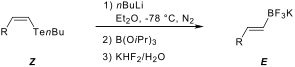
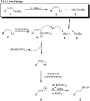
- ), generates nBu•, which is responsible for the cis-trans isomerization. The butyl radical attack occurs at the boronic “ate” complex 4 (Scheme 1) [16], yielding the nBuBF3K salt as a final product. In order to verify the presence of radical species in the reaction mixture, we performed EPR spin trapping


Photosonochemical catalytic ring opening of α-epoxyketones
Beilstein J. Org. Chem. 2007, 3, No. 2, doi:10.1186/1860-5397-3-2
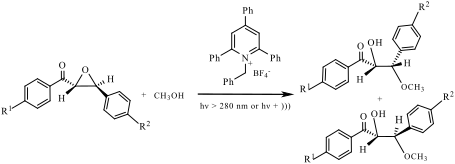
- trioxolane derivatives [32][33][34] or by dipolarophiles to form various tetrahydrofurans and dihydrofurans. [41] In the absence of appropriate dipolarophiles, cis/trans isomerization of the epoxide ring has been observed. [42] The cleavage of Cα-O or Cβ-O bonds has been confirmed either by rearrangement to