Search results
Search for "acylation" in Full Text gives 355 result(s) in Beilstein Journal of Organic Chemistry. Showing first 200.
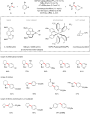
Ferrocenoyl-adenines: substituent effects on regioselective acylation
Beilstein J. Org. Chem. 2022, 18, 1270–1277, doi:10.3762/bjoc.18.133
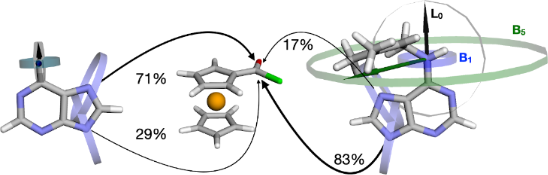
- the acylation of purines from a regioselective to a regiospecific mode. Keywords: DFT; ferrocene; nucleophilicity; purine; steric effect; Introduction Nucleosides in which the sugar part is replaced with an organometallic moiety have attracted remarkable interest [1][2][3]. One important class are
- kinetic and thermodynamic control of the acylation reaction. Results and Discussion It was shown that the reaction between the pyrimidine anion (uracil, thymine, or 5-fluorouracil) and FcCOCl in N,N-dimethylformamide (DMF) proceeded in a full regiospecific mode [19]. In the purine series, however, the
- both isomers is, therefore, a competitive process. This confirms that the adenine anion behaves as an ambident nucleophile with two competing reaction centers at the N7- and N9-position [26]. It is known that acylation [25] or alkylation [27][28][29] of adenine is rarely regiospecific, and mixtures of



From amines to (form)amides: a simple and successful mechanochemical approach
Beilstein J. Org. Chem. 2022, 18, 1210–1216, doi:10.3762/bjoc.18.126
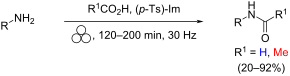
- was successfully converted into the corresponding formamide 19 as was the poorly nucleophilic diphenylamine (Scheme 2, amide 20). Lastly, we aimed to apply the procedure to the acylation of a series of amines. To our delight, we successfully extended the methodology to the mechanosynthesis of amides
- -formylation reaction of several aromatic amines. On the other side, p-Ts-Im, activated by the acid reagent, proved an efficient activating agent under mild mechanochemical conditions for the formylation and acylation of those amines with less marked or limited (see protonated aliphatic amines) reactivity
First example of organocatalysis by cathodic N-heterocyclic carbene generation and accumulation using a divided electrochemical flow cell
Beilstein J. Org. Chem. 2022, 18, 979–990, doi:10.3762/bjoc.18.98
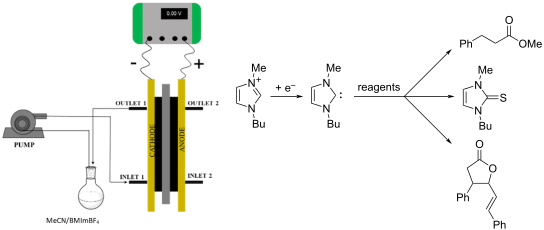
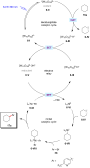
- as ligands in organometallic catalysts [9] and as versatile organocatalysts [10] in a very wide range of organic reactions such as classical benzoin condensation, transesterification, acylation, Knoevenagel reaction, Claisen condensation etc. The electrochemical generation of carbenes from ILs avoids


Introducing a new 7-ring fused diindenone-dithieno[3,2-b:2',3'-d]thiophene unit as a promising component for organic semiconductor materials
Beilstein J. Org. Chem. 2022, 18, 944–955, doi:10.3762/bjoc.18.94
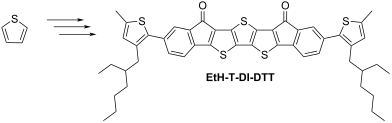
- using polyphosphoric acid [16] and sulfuric acid failed [42], therefore we tried Friedel–Crafts acylation. For that, 27 was hydrolysed to the corresponding diacid 28 with lithium hydroxide [15]. In a manner similar to [24], firstly, a ‘cold’ Friedel–Crafts acylation in dichloromethane was attempted, in
- the ring closure proceeded on one side of the molecule. It was assumed that this species precipitated, preventing further reaction. We thus turned to a ‘hot’ Friedel–Crafts acylation, in which the reaction mixture was refluxed after the addition of oxalyl chloride, followed by removal of the volatiles
- . Since the ring-closure with a ‘hot’ Friedel–Crafts acylation [43] led to an insoluble material, we wanted to synthesise a soluble derivative by attaching 4-(2-ethylhexyl)-2-methylthiophene groups. This was done by reacting intermediate 27 with compound 32, which was prepared as shown in Scheme 3. In a


First series of N-alkylamino peptoid homooligomers: solution phase synthesis and conformational investigation
Beilstein J. Org. Chem. 2022, 18, 845–854, doi:10.3762/bjoc.18.85
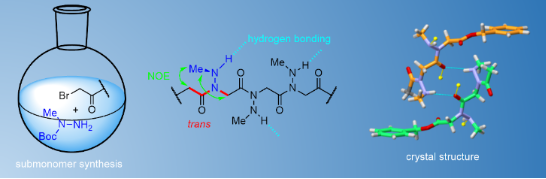
- acylation conditions in solution (Scheme 1) allowed us to reach the pentamer length with good yields for each substitution–acylation submonomer cycle (from 56 to 76% yield, Supporting Information File 1, Scheme S1). All compounds were acetylated at the N-terminus followed by removal of the Boc protecting


Synthesis of odorants in flow and their applications in perfumery
Beilstein J. Org. Chem. 2022, 18, 754–768, doi:10.3762/bjoc.18.76
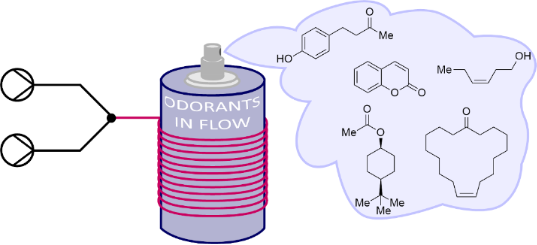
- min. The authors propose that the reaction does not follow the mechanism of the Perkin process but proceeds via acylation of salicylaldehyde (44) to intermediate 45, which forms coumarin (46) in an intramolecular aldol cyclization. Therefore, O-acylation of salicylaldehyde (44) is completed at 150 °C
- 240 °C in one tube reactor, the reaction gives incomplete conversion and the yield of coumarin (46) drops to 21%. The authors proposed that under these conditions the reaction proceeds via the Perkin process, which is significantly slower than the O-acylation/aldol sequence [42]. An odorant that is


An isoxazole strategy for the synthesis of 4-oxo-1,4-dihydropyridine-3-carboxylates
Beilstein J. Org. Chem. 2022, 18, 738–745, doi:10.3762/bjoc.18.74
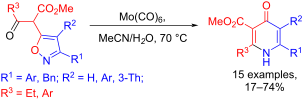
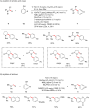
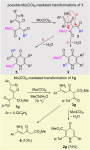
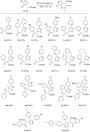
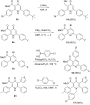
- synthesized in 44–98% yield by acylation of isoxazoles 11, 12 and 13 with acyl chlorides in the presence of NaH (Scheme 4). For the preparation of isoxazole 1a propionic anhydride was used. Further, isoxazoles 1 were reacted with Mo(CO)6/H2O/MeCN under the optimal conditions to give pyridones 2 (Scheme 5




Heteroleptic metallosupramolecular aggregates/complexation for supramolecular catalysis
Beilstein J. Org. Chem. 2022, 18, 597–630, doi:10.3762/bjoc.18.62


BINOL as a chiral element in mechanically interlocked molecules
Beilstein J. Org. Chem. 2022, 18, 508–523, doi:10.3762/bjoc.18.53
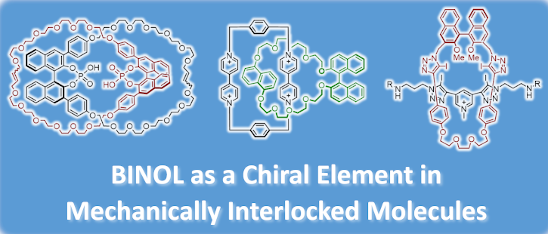
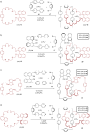
- the axle, placing it away from the polymer backbone. By N-acylation of the ammonium group, a shuttling of the macrocycle towards the ester moiety is achieved, placing the chiral information of the macrocycle in closer proximity to the polymer backbone (polymers 33). The influence of the chiral BINOL




The asymmetric Henry reaction as synthetic tool for the preparation of the drugs linezolid and rivaroxaban
Beilstein J. Org. Chem. 2022, 18, 438–445, doi:10.3762/bjoc.18.46
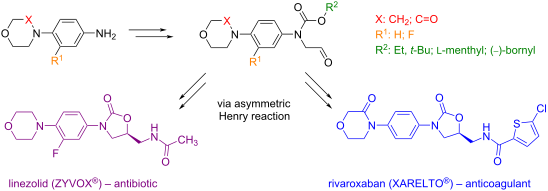
- 26 were chosen. The reduction of the nitro groups in 24 and 26 via the hydrogenation procedure proceeded smoothly with almost quantitative yields; the amine intermediates were immediately used in the next step. Hence, the N-acylation reactions were performed by the action of the corresponding


Cs2CO3-Promoted reaction of tertiary bromopropargylic alcohols and phenols in DMF: a novel approach to α-phenoxyketones
Beilstein J. Org. Chem. 2022, 18, 420–428, doi:10.3762/bjoc.18.44
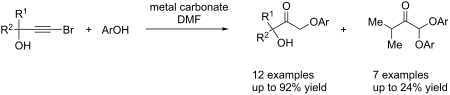
- highly selective hydration/acylation of tertiary bromopropargylic alcohols with carboxylic acids promoted by alkali metal carbonates [24]. The reaction proceeds via the ring-opening of 1,3-dioxolan-2-one intermediates formed with hydroxy and alkynyl groups of bromopropargylic alcohol and alkali metal


Menadione: a platform and a target to valuable compounds synthesis
Beilstein J. Org. Chem. 2022, 18, 381–419, doi:10.3762/bjoc.18.43
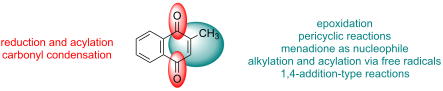
- source was made after preliminary studies demonstrated the occurrence of reactions with benzoquinones using the compact fluorescent lamp (Scheme 18). Reduction and acylation reactions Menadione reduction reactions are one of the most important types of reactions and are directly related to some of its
- strategy applying Lewis acids can be used. Among the options, bismuth triflate is a catalyst, with the additional advantages of low-cost and easy preparation from commercially available bismuth oxide and triflic acid. Quinone acylation reactions took place under mild conditions using acetic anhydride and 2
- 24–75% yields (Scheme 28). Alkylation and acylation by free radicals One of the largest groups of reactions that use menadione (10) as substrate comprises free radical alkylation and acylation reactions. The most useful alkylation approach is the Kochi–Anderson method [76] or (Jacobsen–Torssell


Amamistatins isolated from Nocardia altamirensis
Beilstein J. Org. Chem. 2022, 18, 360–367, doi:10.3762/bjoc.18.40
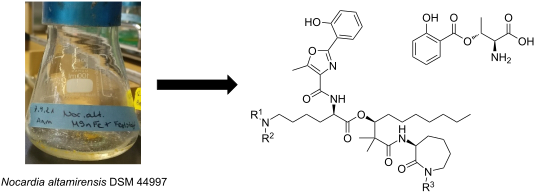
- the end product of the pathway in N. altamirensis DSM 44997. Previous studies have demonstrated that, in nature, hydroxamates arise from the oxidation of terminal amino groups in amino acid side chains, followed by formylation or acylation of the resulting hydroxylamines. While the oxidations are
- catalyzed by flavin-dependent monooxygenases [12][13][14][15][16], the carbon transfer is mediated either by tetrahydrofolate-dependent formyl [17] or by acyl-CoA-dependent acyl transferases [13][15][16]. It is widely assumed that the oxidation precedes the formylation or acylation [17][18][19][20][21][22


Regioselectivity of the SEAr-based cyclizations and SEAr-terminated annulations of 3,5-unsubstituted, 4-substituted indoles
Beilstein J. Org. Chem. 2022, 18, 293–302, doi:10.3762/bjoc.18.33
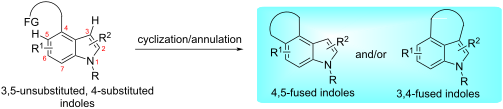
- in their studies on the intramolecular Friedel−Crafts (FC) acylation of 4-substituted indoles [20]. Specifically, N-Ns/Ts-indolyl Meldrum's acid derivatives 28a–f delivered 4,5-fused indoles 29a–f under BF3·OEt2 or Yb(OTf)3 catalysis (Scheme 10A). It should be noted that the authors could not extend
- this methodology to related substrates with free indolyl NH as such reactions resulted into a complex mixture (not shown here), possibly due to the decomposition of the substrates. Nevertheless, the same regioselectivity was observed when the FC-acylation of N-protected 3-(4-indolyl)propanoic acids 28g
- preference for cyclization onto the C5 position is more dominating than the higher nucleophilicity of the C3 position, making the CAr–C bond formation completely regioselective at the C5 position. Subsequently in 2017, Li and co-workers also applied the intramolecular Friedel–Crafts acylation strategy to get


Tenacibactins K–M, cytotoxic siderophores from a coral-associated gliding bacterium of the genus Tenacibaculum
Beilstein J. Org. Chem. 2022, 18, 110–119, doi:10.3762/bjoc.18.12
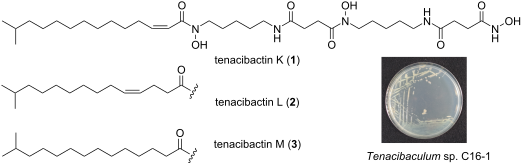
- [30], terminal blocking by acylation [29][31][32], formation of sugar ester [33], imine oxide [34], oxime [35], or functional group transformation into a hydroxy [33] or nitro group [35]. To the best of our knowledge, compounds 1–3 are the first to have a hydroxamic acid terminus. Similar to the


Chemical and chemoenzymatic routes to bridged homoarabinofuranosylpyrimidines: Bicyclic AZT analogues
Beilstein J. Org. Chem. 2022, 18, 95–101, doi:10.3762/bjoc.18.10
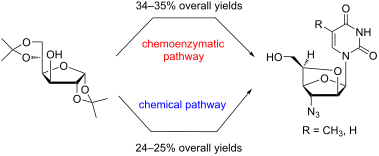
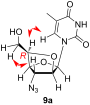
- group present in 3′-O-benzyl-β-ᴅ-glucofuranosylpyrimidines [27]. In this article, regioselective acylation at the primary hydroxy group of 3′-azido-3′-deoxy-β-ᴅ-allofuranosylpyrimidines was carried out with the different biocatalyst Lipozyme TL IM using the same acylating agent, i.e., vinyl acetate but



Chemoselective N-acylation of indoles using thioesters as acyl source
Beilstein J. Org. Chem. 2022, 18, 89–94, doi:10.3762/bjoc.18.9
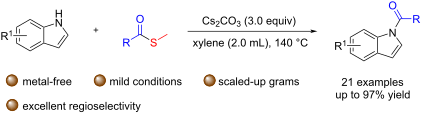
- Tianri Du Xiangmu Wei Honghong Xu Xin Zhang Ruiru Fang Zheng Yuan Zhi Liang Yahui Li Key Laboratory of Agri-Food Safety of Anhui Province, School of Resources and Environment, Anhui Agricultural University, Hefei 230036, China 10.3762/bjoc.18.9 Abstract The selective acylation of indoles often
- requires sensitive and reactive acyl chloride derivatives. Here, we report a mild, efficient, functional group tolerant, and highly chemoselective N-acylation of indoles using thioesters as a stable acyl source. A series of indoleamides have been obtained with moderate to good yields. In addition
- , heterocycles, such as carbazole, can also be used as nucleophiles in this reaction. Keywords: indole; N-acylation; nucleophilic substitution; thioesters; Introduction Molecules containing N-acylindoles have attracted wide attention in the synthetic polymers and pharmaceutical industry because of their unique


1,2-Naphthoquinone-4-sulfonic acid salts in organic synthesis
Beilstein J. Org. Chem. 2022, 18, 53–69, doi:10.3762/bjoc.18.5
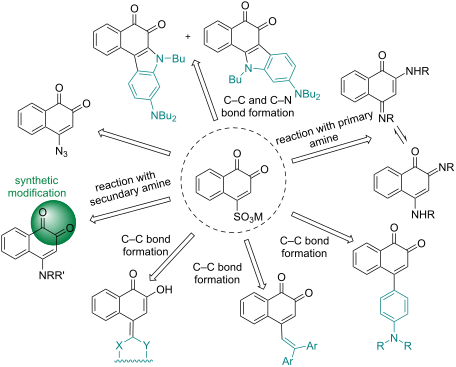
- transformations. Organometallics are the most commonly used catalysts to promote C–C bond formation. In addition, other so-called classical reactions are also widely used, such as Friedel–Crafts alkylation and acylation, Wittig and Horner–Emmons reactions, carbonyl addition/substitution, α-alkylation, aldol


Unsaturated fatty acids and a prenylated tryptophan derivative from a rare actinomycete of the genus Couchioplanes
Beilstein J. Org. Chem. 2021, 17, 2939–2949, doi:10.3762/bjoc.17.203
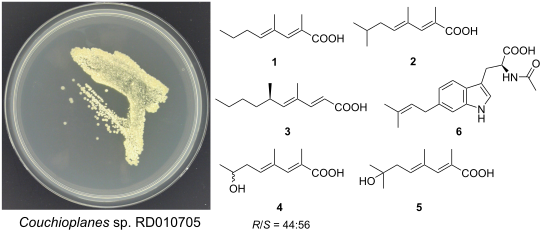
- -diazomethane and the resulting methyl ester 4' was acylated with (R)- or (S)-α-methoxyphenylacetic acid (MPA). To our surprise, however, 1H NMR spectra of both the acylation products were substantially the same but contained several duplicated signals with contrasting peak intensities, indicating 4 to be an
- enantiomeric mixture of unequal quantities (Figure 3). Indeed, two 1H resonance sets with slightly different chemical shifts were obtained, which were assigned to be a pair of MPA-acylated diastereomers (4'a and 4'b; 4'c and 4'd) by careful interpretation of a COSY spectrum of the (R)-MPA acylation product
- previously [36]. The MIC of the reference antibiotic kanamycin was 0.31 μg/mL (against K. rhizophila). Structures of 1–6. COSY, key HMBC and NOESY correlations of 1–5. 1H NMR spectra and partial chemical shift assignments for MPA esters 4'a–4'd. Upper: (R)-MPA acylation products, Lower: (S)-MPA acylation


The PIFA-initiated oxidative cyclization of 2-(3-butenyl)quinazolin-4(3H)-ones – an efficient approach to 1-(hydroxymethyl)-2,3-dihydropyrrolo[1,2-a]quinazolin-5(1H)-ones
Beilstein J. Org. Chem. 2021, 17, 2787–2794, doi:10.3762/bjoc.17.189
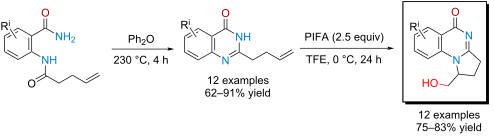
- unsaturated moieties. The known literature exceptions included synthesis of 2-alkynylquinazolines via acylation of anthranilamides with alkynylcarboxylic acids and further cyclocondensation under alkaline conditions [36], as well as formation of 2-alkenyl counterparts by a one-pot Yb(OTf)3-catalyzed microwave
- - or ultrasound-assisted reaction of 2-aminobenzonitrile and alkenoyl chlorides [56]. We have found that substrates 7 can be obtained efficiently by a two-step reaction sequence commencing from acylation of anthranilamides 8 with α-allylacetyl chloride 9 leading to benzamides 10. These intermediates


Synthetic strategies toward 1,3-oxathiolane nucleoside analogues
Beilstein J. Org. Chem. 2021, 17, 2680–2715, doi:10.3762/bjoc.17.182
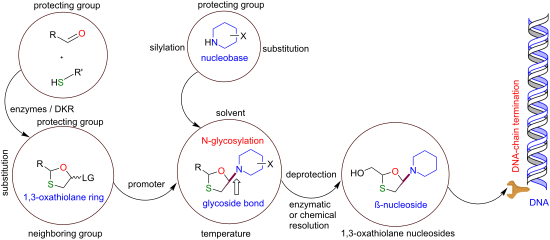
- methoxide. Further, selective recrystallization in an appropriate solvent (toluene/hexanes) resulted in a single isomer (50:1 dr) in solution. The oxathiolane derivative 52 has the opposite configuration of that required for 3TC (1) synthesis. This acylation reaction was accomplished using pivaloyl chloride
- was devised for targeting specific receptors on the leukocytes membrane. The crucial N-glycosylation reaction between 1,3-oxathiolane precursor 45 and silylated cytosine was carried out using TiCl4 as a catalyst. The N-acylation of compound 92a was performed for flash chromatography, and further


Synthesis of highly substituted fluorenones via metal-free TBHP-promoted oxidative cyclization of 2-(aminomethyl)biphenyls. Application to the total synthesis of nobilone
Beilstein J. Org. Chem. 2021, 17, 2668–2679, doi:10.3762/bjoc.17.181
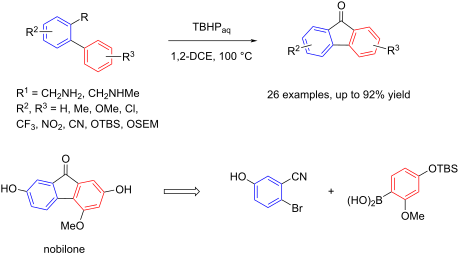
- activated derivatives (intramolecular Friedel–Crafts acylation) [29][30][31] found wide application here. In a different approach, a total synthesis of dengibsin (1a) was accomplished by Wang and Snieckus in 15 steps by means of a directed remote metalation [32], using a benzamide residue as the directing


AlBr3-Promoted stereoselective anti-hydroarylation of the acetylene bond in 3-arylpropynenitriles by electron-rich arenes: synthesis of 3,3-diarylpropenenitriles
Beilstein J. Org. Chem. 2021, 17, 2663–2667, doi:10.3762/bjoc.17.180
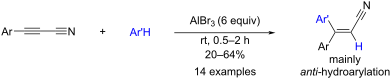
- ) through the regioselective hydroarylation of the carbon–carbon double bond. In TfOH, the reactions proceed further to 3-arylindanones, as products of the intramolecular aromatic acylation of the 3,3-diarylpropanenitriles by the electrophilically activated nitrile group [16][17]. Based on this study and


Halides as versatile anions in asymmetric anion-binding organocatalysis
Beilstein J. Org. Chem. 2021, 17, 2270–2286, doi:10.3762/bjoc.17.145
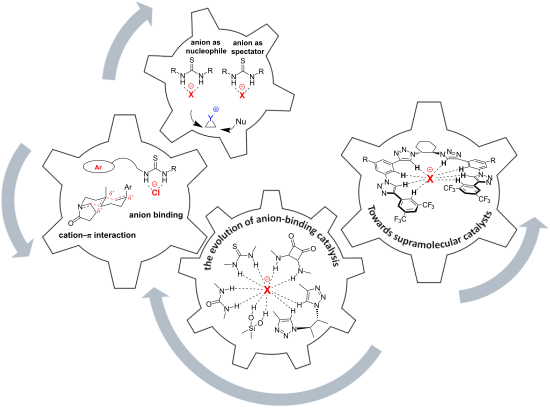
- ) [35]. During this early period, the group of Jacobsen also reported an asymmetric thiourea-catalyzed Reissert reaction of isoquinolines 21 (Scheme 5a) [36]. The mechanism proceeds by initial activation of the isoquinoline via N-acylation and subsequent dearomatization by a nucleophilic attack in the



Photoredox catalysis in nickel-catalyzed C–H functionalization
Beilstein J. Org. Chem. 2021, 17, 2209–2259, doi:10.3762/bjoc.17.143
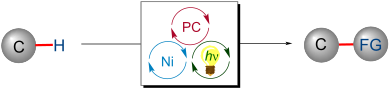
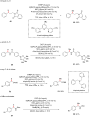
- under slightly modified reaction conditions with exclusion of the nickel catalyst (Scheme 36) [113]. Acylation The ketone motif is an important functional group in pharmaceuticals, agrochemicals, and functional materials [114][115][116][117]. Hence continuous efforts devoted to developing a convenient
- method to introduce keto functional groups onto complex organic molecules. During the last decade, the acylation of hydrocarbons through direct C–H activation has been achieved by means of transition-metal catalysis using various acyl precursors [118][119]. The renaissance of metallaphotoredox catalysis
- has improved further the C–H acylation procedures by working under mild reaction conditions. Thus, Doyle and Joe reported a mild C–H acylation protocol for the direct functionalization of α-amino C(sp3)–H bonds of N-arylamines 1 with acyl electrophiles such as anhydrides 72 and 2-pyridyl thioester 73