


Search results
Search for "chiral ligand" in Full Text gives 83 result(s) in Beilstein Journal of Organic Chemistry.
Recent developments in gold-catalyzed cycloaddition reactions
Beilstein J. Org. Chem. 2011, 7, 1075–1094, doi:10.3762/bjoc.7.124
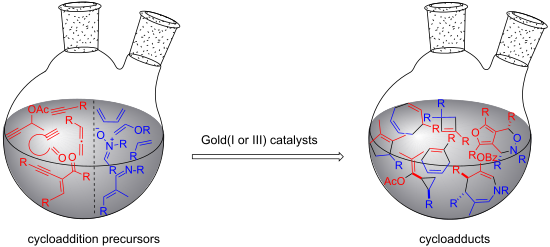
- also studied enantioselective variants of this cycloaddition using gold complexes derived from this highly versatile type of chiral ligand. We found that it was possible to obtain excellent enantioselectivities with gold complexes derived from bulky phosphoramidites with anthracenyl substituents at 3


Chiral gold(I) vs chiral silver complexes as catalysts for the enantioselective synthesis of the second generation GSK-hepatitis C virus inhibitor
Beilstein J. Org. Chem. 2011, 7, 988–996, doi:10.3762/bjoc.7.111
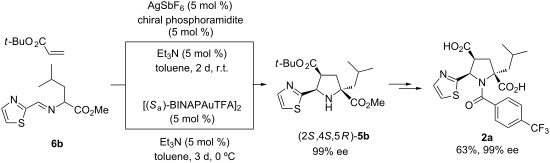
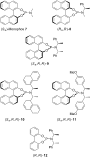
- chiral ligand (Ra,R)-8 the enantioselectivities were low or moderate in the examples concerning AgClO4 and AgTFA (TFA = trifluoroacetate anion), respectively (Table 1, entries 5 and 7). Surprisingly, the reaction involving this chiral ligand 8 combined with AgSbF6 afforded a good yield of the
- complex (Ra,R)-8/AuTFA did not give the expected reaction product (Table 1, entry 9). The employment of this matched combination with (Ra,R)-8 was justified by the low enantioselectivity achieved through the use of (Ra,S)-8 in the same transformation (not shown in Table 1). The widely used chiral ligand
- represented in Scheme 2. The chiral ligand (Sa)-BINAP (13) was also tested in the standard reaction to access key molecule endo-5b (Scheme 3). AgClO4 was found to be the most appropriate silver salt to achieve the highest enantioselectivity (88% ee) compared to the results obtained when other silver salts




Recent advances in the gold-catalyzed additions to C–C multiple bonds
Beilstein J. Org. Chem. 2011, 7, 897–936, doi:10.3762/bjoc.7.103
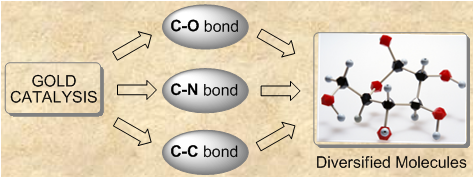
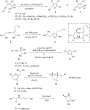
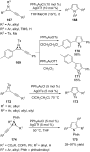
- (Scheme 59) [174]. The first step is supposed to be an intramolecular addition of the hydroxy group to the internal carbon of the triple bond, which is similar to the mechanism mentioned above [161][163]. 6 Gold-catalyzed asymmetric addition reactions The chiral ligand used for the transition metal








Asymmetric synthesis of tertiary thiols and thioethers
Beilstein J. Org. Chem. 2011, 7, 582–595, doi:10.3762/bjoc.7.68
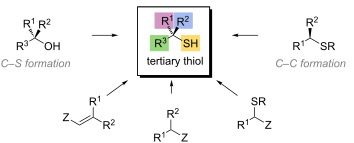
- secondary thiol derivatives. These were prepared by diastereoselective electrophilic additions in proline-derived systems [71][72] and asymmetric alkylation of thiocarbamates in the presence of a chiral ligand [73][74]. Stereospecific functionalisation of configurationally stable lithiated thiocarbamates








Gelation or molecular recognition; is the bis-(α,β-dihydroxy ester)s motif an omnigelator?
Beilstein J. Org. Chem. 2010, 6, 1079–1088, doi:10.3762/bjoc.6.123
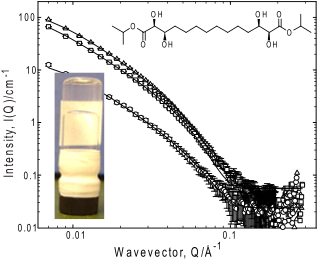
- (1) and two equivalents of isopropyl acrylate 2, which routinely delivered 80–85% yields of the bisenoate 3, exclusively as the (E,E)-isomer shown (Scheme 1), followed by an AD-mix double bishydroxylation with (DHQD)2PHAL as the chiral ligand [54]. The deuterated analogue 6, Scheme 2, was prepared by




Bis(oxazolines) based on glycopyranosides – steric, configurational and conformational influences on stereoselectivity
Beilstein J. Org. Chem. 2010, 6, No. 23, doi:10.3762/bjoc.6.23
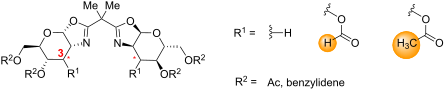
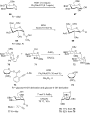
- ligands for metal catalysed transformations is of crucial importance for stereoselective synthesis and is therefore an active field of research. In this context, carbohydrates are interesting, even if comparatively rarely used as starting materials for the preparation of new chiral ligand structures



Iridium-catalyzed asymmetric ring-opening reactions of oxabicyclic alkenes with secondary amine nucleophiles
Beilstein J. Org. Chem. 2009, 5, No. 53, doi:10.3762/bjoc.5.53
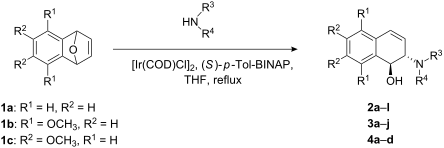
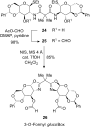
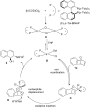
- , and 4a-d. ORTEP plot for 3f. Identification of optimal chiral ligand for iridium-catalyzed asymmetric ring-opening of oxabenzonorbornadiene 1a with N-methylaniline. Proposed mechanism for the ARO of oxabenzonorbornadiene 1a with secondary amine nucleophiles. Screening conditions for iridium-catalyzed


DBFOX- Ph/metal complexes: Evaluation as catalysts for enantioselective fluorination of 3-(2-arylacetyl)-2-thiazolidinones
Beilstein J. Org. Chem. 2008, 4, No. 16, doi:10.3762/bjoc.4.16
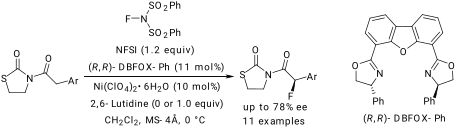
- reactions. Stoichiometric approaches based on cinchona alkaloid/Selectfluor® combinations [18][19][20][21][22][23][24][25][26][27][28][29][30][31][32], chiral ligand/metal-catalyzed [33][34][35][36][37][38][39][40][41][42][43][44][45][46][47][48][49][50][51][52][53][54][55][56][57] or organocatalytic [58


Other Beilstein-Institut Open Science Activities



