


Search results
Search for "flow chemistry" in Full Text gives 129 result(s) in Beilstein Journal of Organic Chemistry.
Continuous-flow synthesis of primary amines: Metal-free reduction of aliphatic and aromatic nitro derivatives with trichlorosilane
Beilstein J. Org. Chem. 2016, 12, 2614–2619, doi:10.3762/bjoc.12.257
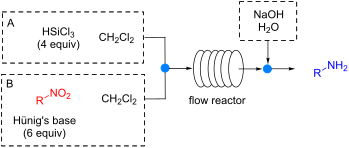
- . Flow chemistry has recently emerged as a powerful technology in synthetic chemistry [12] as it can reduce risks associated to the use of hazardous chemicals and favors reaction scale-up [13][14][15][16][17]. The possibility to efficiently perform nitro reduction in continuo would make the


Development of a continuous process for α-thio-β-chloroacrylamide synthesis with enhanced control of a cascade transformation
Beilstein J. Org. Chem. 2016, 12, 2511–2522, doi:10.3762/bjoc.12.246
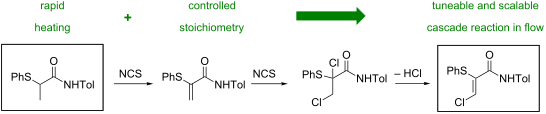
- -chloroacrylamides; cascade reactions; flow chemistry; Introduction Since the efficient and highly stereoselective transformation of α-thioamides to the corresponding α-thio-β-chloroacrylamides derivatives was first reported [1][2], the considerable synthetic utility of these heavily functionalized acrylamide
- facilitate significant ease of scale-up. The reaction control afforded by use of high surface-area-to-volume ratio tubular reactors, specifically with respect to dissipation of heat, offers a safety profile unique to flow chemistry. Continuous processing also provides the capacity to continuously generate
- ′-methylphenyl-(Z)-3-chloro-2-(phenylthio)propenamide (Z-3) as the target product. This optimized process would utilise flow chemistry as a key enabling technology to overcome the aforementioned challenges. Results and Discussion Preparation of α-chloroamide The synthesis of α-chloroamide 1 is highly exothermic




A flow reactor setup for photochemistry of biphasic gas/liquid reactions
Beilstein J. Org. Chem. 2016, 12, 1798–1811, doi:10.3762/bjoc.12.170
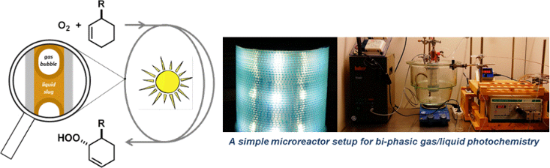
- operation of various other reactions at light/liquid/gas interfaces in student, research, and industrial laboratories. Keywords: biphasic reactions; flow chemistry; gas phase; microreactor; oxygen; photochemistry; Introduction The recent developments of microreactor technologies have significantly


Catalytic Chan–Lam coupling using a ‘tube-in-tube’ reactor to deliver molecular oxygen as an oxidant
Beilstein J. Org. Chem. 2016, 12, 1598–1607, doi:10.3762/bjoc.12.156
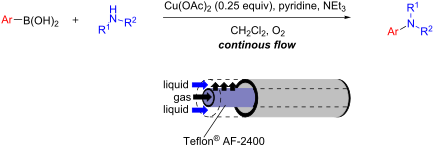
- oxygen accelerating the optimisation phase and allowing easy access to elevated pressures. A small exemplification library of heteroaromatic products has been prepared and the process has been shown to be robust over extended reaction times. Keywords: Chan–Lam coupling; flow chemistry; gases in flow
- modification can reliably deliver 0.216 g h−1 of 19 at 81% isolated yield. Conclusion The use of flow chemistry for the C–N coupling through a catalytic Chan–Lam reaction has allowed for a safe and efficient introduction of oxygen through a reverse “tube-in-tube” reactor. Optimisation of the reaction


Flow carbonylation of sterically hindered ortho-substituted iodoarenes
Beilstein J. Org. Chem. 2016, 12, 1503–1511, doi:10.3762/bjoc.12.147
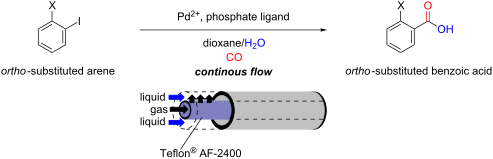
- via a reverse “tube-in-tube” flow reactor at elevated pressures to give yields of carboxylated products that are much higher than those obtained under normal batch conditions. Keywords: carbon monoxide; carbonylation of ortho-substituted substrates; flow chemistry; gases in flow; “tube-in-tube
- monoxide concentration and temperature is critical to obtaining a good yield of carbonylated ortho-substituted products. Results and Discussion The application of flow chemistry [19][20] has been shown to be beneficial for many reactions that involve gases [21][22][23][24][25][26][27][28][29]. The
- h−1 of 20 in 85% isolated yield. Conclusion We have successfully demonstrated how flow chemistry can be used to enhance difficult transformations such as the palladium-catalysed hydroxy-carbonylation of ortho-substituted iodoarenes. The optimised conditions were also demonstrated to work on a number


Continuous formation of N-chloro-N,N-dialkylamine solutions in well-mixed meso-scale flow reactors
Beilstein J. Org. Chem. 2015, 11, 2408–2417, doi:10.3762/bjoc.11.262
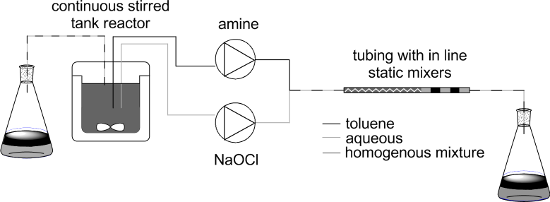
- solutions of N,N-dialkyl-N-chloramines produced continuously will enable their use in tandem flow reactions with a range of nucleophilic substrates. Keywords: amine; biphasic; chloramine; chlorination; continuous flow chemistry; CSTR; static mixer; sodium hypochlorite; tube reactor; Introduction N


The synthesis of active pharmaceutical ingredients (APIs) using continuous flow chemistry
Beilstein J. Org. Chem. 2015, 11, 1194–1219, doi:10.3762/bjoc.11.134
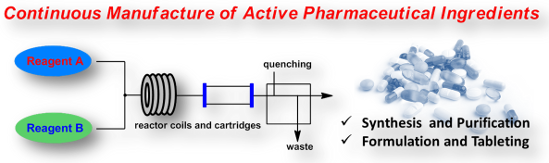
- synthetic capabilities. As a result many new preparative routes have been designed towards commercially relevant drug compounds achieving more efficient and reproducible manufacture. This review article aims to illustrate the holistic systems approach and diverse applications of flow chemistry to the
- selected syntheses using micro or meso-scaled flow reactors will be exemplified for key transformations and process control. It is hoped that the reader will gain an appreciation of the innovative technology and transformational nature that flow chemistry can leverage to an overall process. Keywords
- . Arguably one of the most widely amenable of the enabling technologies is flow chemistry, which accommodates small foot-print reactors in which streams of substrates and reagents can be united to react in a highly controlled and reproducible environment [7][8][9][10][11][12][13][14][15]. Importantly


Photocatalytic nucleophilic addition of alcohols to styrenes in Markovnikov and anti-Markovnikov orientation
Beilstein J. Org. Chem. 2015, 11, 568–575, doi:10.3762/bjoc.11.62
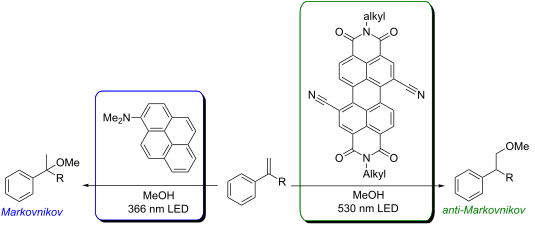
- at 530 nm and 59% when irradiated at 470 nm. These irradiations were performed with the corresponding LEDs and yields were identical with conversions. Finally, the nucleophilic addition of methanol to 1 using PDI as photocatalyst was representatively executed in two mesoflow reactors, since flow
- chemistry has significant advantages over batch chemistry, such as easier temperature control, larger surface-to-volume ratio and more efficient photoirradiation. Two setups were used to transfer the reaction to continuous-flow systems. The first mesoflow reactor was equipped with four 250 mW high-power


Integration of enabling methods for the automated flow preparation of piperazine-2-carboxamide
Beilstein J. Org. Chem. 2014, 10, 641–652, doi:10.3762/bjoc.10.56
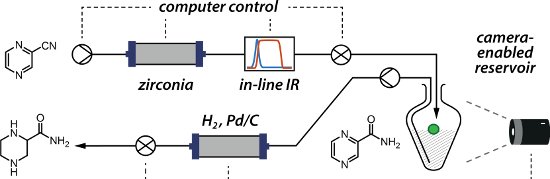
- Abstract Here we describe the use of a new open-source software package and a Raspberry Pi® computer for the simultaneous control of multiple flow chemistry devices and its application to a machine-assisted, multi-step flow preparation of pyrazine-2-carboxamide – a component of Rifater®, used in the
- treatment of tuberculosis – and its reduced derivative piperazine-2-carboxamide. Keywords: automation; flow chemistry; hydration; hydrogenation; sustainable processing; Introduction Enabling synthesis technologies such as flow chemistry are becoming commonplace in modern laboratories (for recent reviews
- of flow chemistry in synthesis see [1] and [2]). As more groups start to use this technology, there is an increasing demand to expand the capabilities of laboratory apparatus, in particular for the seamless integration of different types of apparatus from different manufacturers so that they can be




Continuous flow nitration in miniaturized devices
Beilstein J. Org. Chem. 2014, 10, 405–424, doi:10.3762/bjoc.10.38
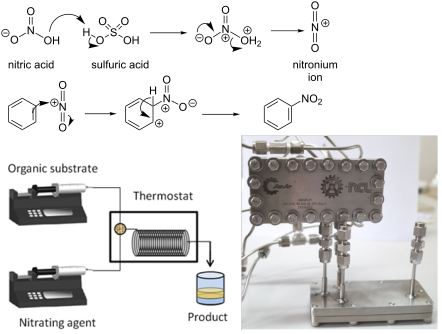
- presented herein and discussed in view of their advantages, limitations and applicability of the information towards scale-up. Selected recent patents that disclose scale-up methodologies for continuous flow nitration are also briefly reviewed. Keywords: continuous flow; flow chemistry; nitration; nitric


Continuous-flow Heck synthesis of 4-methoxybiphenyl and methyl 4-methoxycinnamate in supercritical carbon dioxide expanded solvent solutions
Beilstein J. Org. Chem. 2013, 9, 2886–2897, doi:10.3762/bjoc.9.325
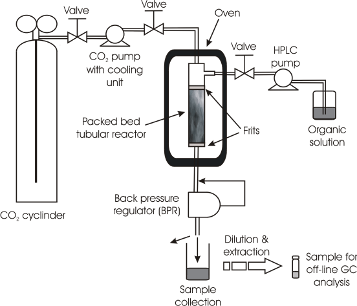
- ; flow chemistry; Heck; palladium; supercritical carbon dioxide; Introduction The use of cross-coupling reactions between organometallic reagents and organic halides as a straightforward method of carbon–carbon bond formation has gained much popularity over the past three decades. The development of
- system over homogeneously catalysed reactions using complexes with elaborate ligand design, it would also make purification simpler. Results and Discussion Two reactions were studied using continuous flow chemistry as shown in Scheme 1. In both cases 4-iodoanisole was used as the aryl halide. The alkene


Flow microreactor synthesis in organo-fluorine chemistry
Beilstein J. Org. Chem. 2013, 9, 2793–2802, doi:10.3762/bjoc.9.314
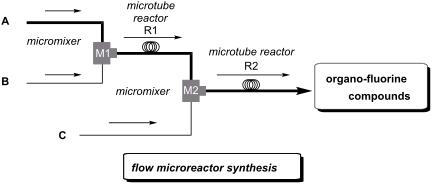
- inert plastic flow tubes provided flexibility, scale-up production, and improved safety of operation. Using flow chemistry, the conversion of alcohols to fluorides was achieved by Seeberger and Ley, independently (Scheme 2) [44][45][46][47]. Usually, gem-difluorination of ketones by DAST is known to be
- that can be well-controlled and accelerated using flow microreactor systems The success of continuous flow chemistry in organic synthesis has enlarged rapidly last decade. There have been numerous examples using flow microreactors with improvement of chemical conversions and selectivities compared to


Investigating the continuous synthesis of a nicotinonitrile precursor to nevirapine
Beilstein J. Org. Chem. 2013, 9, 2570–2578, doi:10.3762/bjoc.9.292
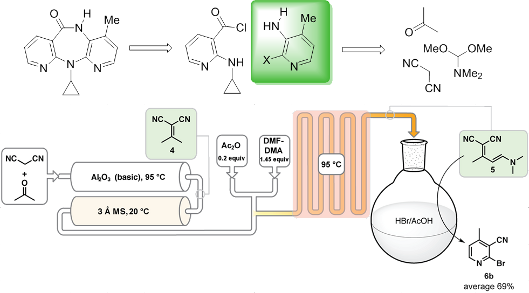
- other value added structures that contain complex pyridines. The route terminates in a batch crystallization yielding high purity CAPIC. This outcome is expected to facilitate regulatory implementation of the overall process. Keywords: continuous; flow chemistry; HIV; Knoevenagel; nevirapine
- , flow chemistry allows chemists to expand their window of process operability by working at elevated temperatures and pressures to increase reaction rates and decrease catalyst loadings [30][31][32][33]. Unlike scaling-up batch reactions, which requires additional optimization, scaling-up flow processes


A combined continuous microflow photochemistry and asymmetric organocatalysis approach for the enantioselective synthesis of tetrahydroquinolines
Beilstein J. Org. Chem. 2013, 9, 2457–2462, doi:10.3762/bjoc.9.284
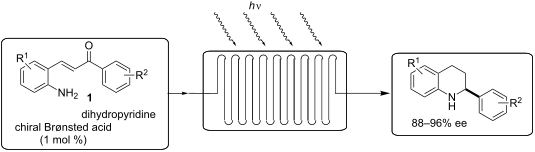
- dihydropyridine as hydrogen source providing the desired products in good yields and with excellent enantioselectivities. Keywords: asymmetric transfer hydrogenation; binolphosphate; continuous-flow reactors; flow chemistry; microreactors; organocatalysis; photochemistry; Introduction Tetrahydroquinolines [1][2
- ][11][12][13][14][15][16][17]. In the past years, continuous-flow chemistry has received considerable attention and microstructured continuous-flow devices have emerged as useful devices for different chemical reactions [18][19][20][21][22]. Microreactor technology offers numerous practical advantages


Synthesis of homo- and heteromultivalent carbohydrate-functionalized oligo(amidoamines) using novel glyco-building blocks
Beilstein J. Org. Chem. 2013, 9, 2395–2403, doi:10.3762/bjoc.9.276
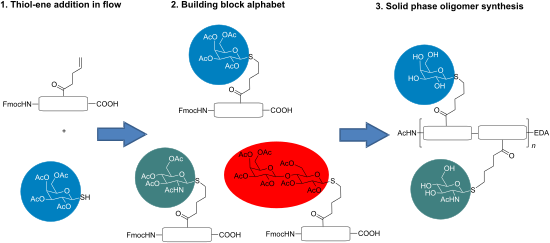
- heteromultivalent glycosylation patterns by combining building blocks presenting different mono- and disaccharides. Keywords: continuous flow; flow chemistry: flow synthesis; glycoligands; multivalency; photochemistry; solid-phase synthesis; thiol–ene; thioglycosides; Introduction Multivalent carbohydrate ligand



Micro-flow synthesis and structural analysis of sterically crowded diimine ligands with five aryl rings
Beilstein J. Org. Chem. 2013, 9, 2336–2343, doi:10.3762/bjoc.9.268
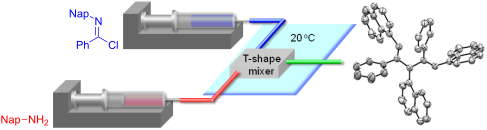
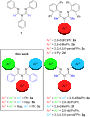
- ligands exerted high polymerization activity in the ethylene homopolymerization and copolymerization of ethylene with polar monomers. Keywords: amidine formation; diimine; flow chemistry; polymerization; Introduction The design of a ligand is a key step in the development of new catalysts because the



Flow synthesis of phenylserine using threonine aldolase immobilized on Eupergit support
Beilstein J. Org. Chem. 2013, 9, 2168–2179, doi:10.3762/bjoc.9.254
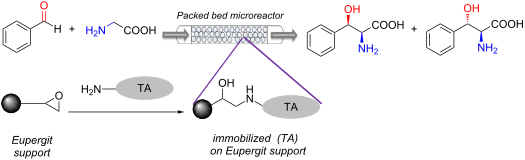
- Jagdish D. Tibhe Hui Fu Timothy Noel Qi Wang Jan Meuldijk Volker Hessel Micro Flow Chemistry and Process Technology, Department of Chemical Engineering and Chemistry, Eindhoven University of Technology, P.O. Box 513, 5600 MB Eindhoven, the Netherlands 10.3762/bjoc.9.254 Abstract Threonine
- was achieved at 20 minute residence time. Finally, the productivity of the reactor was calculated, extrapolated to parallel run units, and compared with data collected previously. Keywords: Eupergit; flow chemistry; immobilized enzyme; threonine aldolase; Introduction Enzymes are bio-based catalysts


Temperature measurements with two different IR sensors in a continuous-flow microwave heated system
Beilstein J. Org. Chem. 2013, 9, 2079–2087, doi:10.3762/bjoc.9.244
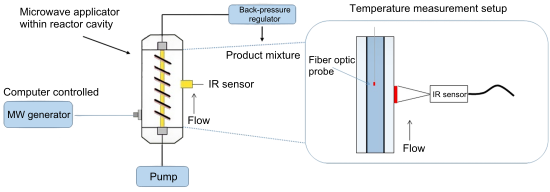
- chemistry applications. Keywords: continuous-flow; flow chemistry; heating; microwave; organic synthesis; temperature; Introduction In organic synthesis, being able to accurately determine the reaction temperature is often of utmost importance [1][2][3]. When using conventional heating the reaction


Flow synthesis of a versatile fructosamine mimic and quenching studies of a fructose transport probe
Beilstein J. Org. Chem. 2013, 9, 2022–2027, doi:10.3762/bjoc.9.238
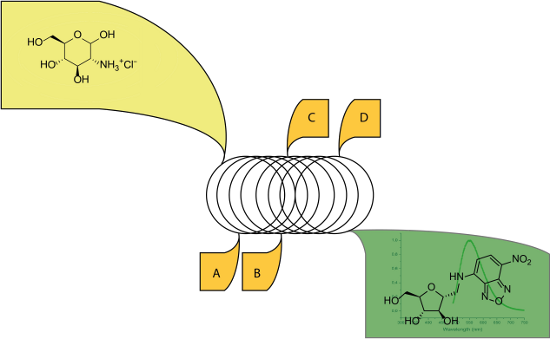
- NBDM, enabling us to measure key photophysical properties that will facilitate future uptake studies. Keywords: flow chemistry; fructose mimic; gluts; NBDM; Introduction The impact of dietary fructose on human health is not well-understood. A growing body of work suggests that those eating diets high
- flow chemistry challenge. The output from the oxime step contains excess hydroxylamine and salts carried from the first step that poisoned the packed-bed catalyst we screened. In theory, continuous purification could remove these materials but existing strategies do not enable removal of water soluble


Microflow photochemistry: UVC-induced [2 + 2]-photoadditions to furanone in a microcapillary reactor
Beilstein J. Org. Chem. 2013, 9, 2015–2021, doi:10.3762/bjoc.9.237
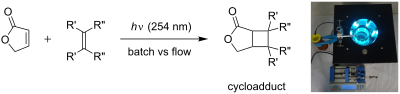
- chemistry; furanone; microflow chemistry; photochemistry; Introduction Continuous-flow chemistry has recently emerged as a new methodology in organic chemistry [1][2][3][4]. The combination of microstructured dimensions and flow operations has also proven advantageous for photochemical applications [5][6
- test tube. The microcapillary unit had a 9-times larger surface-to-volume ratio, which resulted in a more efficient harvest of the available light. The results contribute to the growing field of ‘microflow photochemistry’ [5][6][7][8][9] and ‘green flow chemistry’ [42][43][44][45]. It is hoped that
- photoreactor equipped with low wattage UVC-lamps. Conversion rates and isolated yields were compared to analogue batch reactions in a quartz test tube. In all cases examined, the microcapillary reactor furnished faster conversions and improved product qualities. Keywords: cycloaddition; cyclobutane; flow


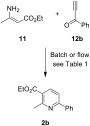
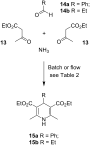
One-step synthesis of pyridines and dihydropyridines in a continuous flow microwave reactor
Beilstein J. Org. Chem. 2013, 9, 1957–1968, doi:10.3762/bjoc.9.232
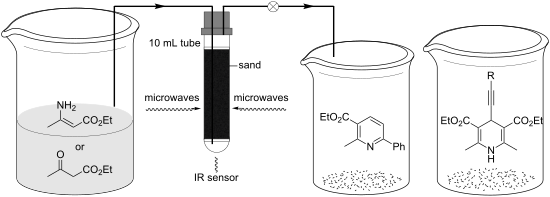
- -substituted propargyl aldehydes undergo Hantzsch dihydropyridine synthesis in preference to Bohlmann–Rahtz reaction in a very high yielding process that is readily transferred to continuous flow processing. Keywords: Bohlmann–Rahtz; continuous flow processing; ethynyl ketones; flow chemistry; Hantzsch
- microwave-assisted transformations under flow processing have greatly expanded the range of chemistries scaled up and evaluated using this technology [1][9][16][33][34][35][36][37][38][39][40][41][42]. With all of these developments, it is becoming increasingly clear that flow chemistry, and to some degree
- microwave flow chemistry, is realizing its potential towards the next evolutionary step in synthetic chemistry [43]. In 2005 we described a new continuous flow reactor design for microwave-assisted synthesis that operates in the optimum standing-wave cavity of a proprietary instrument [44]. The principal




Continuous flow photocyclization of stilbenes – scalable synthesis of functionalized phenanthrenes and helicenes
Beilstein J. Org. Chem. 2013, 9, 1883–1890, doi:10.3762/bjoc.9.221
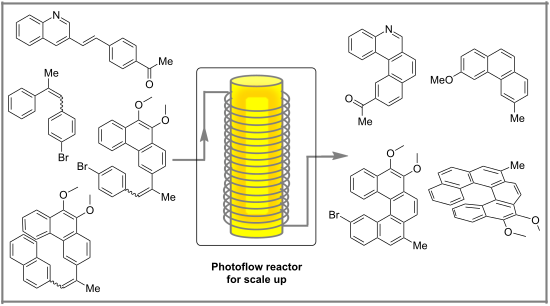
- backbone functionalized phenanthrenes and helicenes of various sizes in good yields. Keywords: continuous-flow reactor; flow chemistry; helicenes; light-driven cyclization reaction; photocyclization; stilbenes; Introduction Phenanthrenes are versatile intermediates toward polycyclic aromatic hydrocarbons




Raman spectroscopy as a tool for monitoring mesoscale continuous-flow organic synthesis: Equipment interface and assessment in four medicinally-relevant reactions
Beilstein J. Org. Chem. 2013, 9, 1843–1852, doi:10.3762/bjoc.9.215
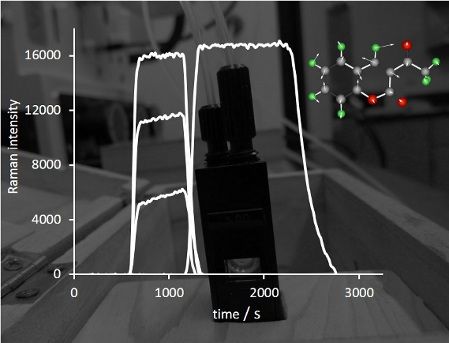
- industry on production scales. In a research and development setting, there has been increasing interest in using flow chemistry on smaller scales. To this end, a wide range of companies now produce equipment for both micro- and mesofluidic flow chemistry [1][2]. Some of the advantages of these devices are
- increased experimental safety, easy scale-up and thorough mixing of reagents [3][4][5][6][7]. It is not surprising, therefore, that a wide range of synthetic chemistry transformations have been reported using this equipment [8][9]. When it comes to evaluating the outcome of reactions performed using flow
- chemistry and optimizing reaction conditions, one option is to use inline product analysis. This opens the avenue for fast, reliable assay in comparison with the traditional approach in which performance is evaluated based on offline product analysis. When interfaced with microreactors, inline analysis has




Integrating reaction and analysis: investigation of higher-order reactions by cryogenic trapping
Beilstein J. Org. Chem. 2013, 9, 1837–1842, doi:10.3762/bjoc.9.214
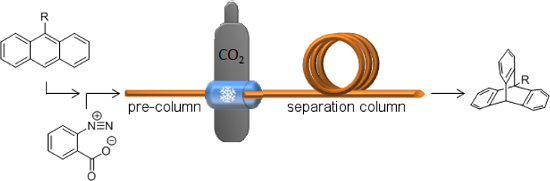
- ; cycloaddition; Diels–Alder reaction; flow chemistry; gas chromatography; on-column reaction gas chromatography; Introduction The combination of synthesis and analysis in a single experiment offers many advantages. Time-consuming steps, i.e. work-up and separation of the reaction products, can be minimized, and


Ethyl diazoacetate synthesis in flow
Beilstein J. Org. Chem. 2013, 9, 1813–1818, doi:10.3762/bjoc.9.211

- ); flow chemistry; microreactor technology; Introduction Diazo compounds are frequently used versatile building blocks in organic chemistry [1][2]. From this class of compounds diazomethane and ethyl diazoacetate (1, EDA) are arguably the synthetically most useful ones. Due to the potentially explosive





