


Search results
Search for "asymmetric catalysis" in Full Text gives 156 result(s) in Beilstein Journal of Organic Chemistry.
Cupreines and cupreidines: an established class of bifunctional cinchona organocatalysts
Beilstein J. Org. Chem. 2016, 12, 429–443, doi:10.3762/bjoc.12.46
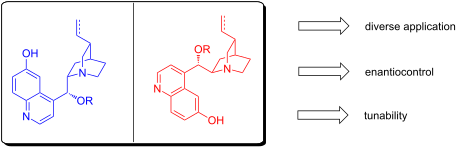
- . Keywords: bifunctional; cupreidine; cinchona; cupreine; organocatalysis; Introduction The cinchona alkaloids, comprising quinine (QN), quinidine (QD), cinchonidine (CD), cinchonine (CN, Figure 1), and their derivatives have revolutionized asymmetric catalysis owing to their privileged structures. The


Organocatalytic asymmetric Henry reaction of 1H-pyrrole-2,3-diones with bifunctional amine-thiourea catalysts bearing multiple hydrogen-bond donors
Beilstein J. Org. Chem. 2016, 12, 295–300, doi:10.3762/bjoc.12.31
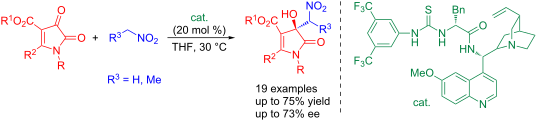
- -pyrrol-2(3H)-ones bearing quaternary stereocenters were obtained in acceptable yield (up to 75%) and enantioselectivity (up to 73% ee). Keywords: asymmetric catalysis; bifunctional catalysts; Henry reaction; organocatalysis; 1H-pyrrole-2,3-diones; Introduction Asymmetric organocatalysis has been


Spiro-fused carbohydrate oxazoline ligands: Synthesis and application as enantio-discrimination agents in asymmetric allylic alkylation
Beilstein J. Org. Chem. 2016, 12, 166–171, doi:10.3762/bjoc.12.18
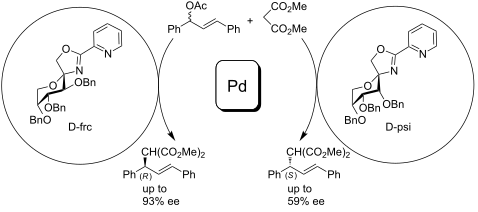
- present work, we describe a convenient synthesis of spiro-fused D-fructo- and D-psico-configurated oxazoline ligands and their application in asymmetric catalysis. The ligands were synthesized from readily available 3,4,5-tri-O-benzyl-1,2-O-isopropylidene-β-D-fructopyranose and 3,4,5-tri-O-benzyl-1,2-O
- chiral ligands in palladium-catalyzed allylic alkylation of 1,3-diphenylallyl acetate with dimethyl malonate. The D-fructo-PyOx ligand provided mainly the (R)-enantiomer while the D-psico-configurated ligand gave the (S)-enantiomer with a lower enantiomeric excess. Keywords: asymmetric catalysis
- metal complexes that enable asymmetric catalysis over the past decades, and an array of highly efficient privileged ligands for metal-catalyzed enantioselective syntheses have been derived from carbohydrates so far [1][2][3][4][5][6]. However, the enantioselective construction of C–C bonds, especially




Recent advances in copper-catalyzed asymmetric coupling reactions
Beilstein J. Org. Chem. 2015, 11, 2600–2615, doi:10.3762/bjoc.11.280
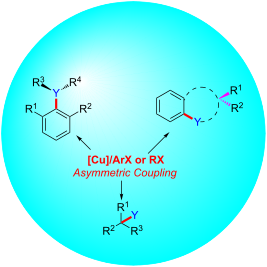
- -catalyzed or -mediated enantioselective carbon–carbon or carbon–heteroatom coupling reactions have been one of the most challenging areas in asymmetric catalysis in recent years. The asymmetric copper-catalyzed C(Aryl)–C(Aryl) bond formation through the incorporation of a chiral ester group as auxiliary


Organocatalytic and enantioselective Michael reaction between α-nitroesters and nitroalkenes. Syn/anti-selectivity control using catalysts with the same absolute backbone chirality
Beilstein J. Org. Chem. 2015, 11, 2577–2583, doi:10.3762/bjoc.11.277
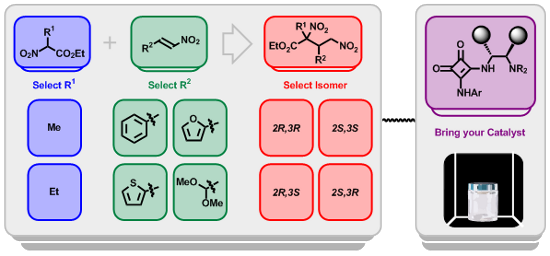
- biological systems [1]. As a consequence, the last decades have witnessed an enormous progress directed toward the development of synthetic methodology for the preparation of chiral molecules as single enantiomers with a well-defined three-dimensional arrangement. In this scenario, asymmetric catalysis


Copper-catalysed asymmetric allylic alkylation of alkylzirconocenes to racemic 3,6-dihydro-2H-pyrans
Beilstein J. Org. Chem. 2015, 11, 2435–2443, doi:10.3762/bjoc.11.264
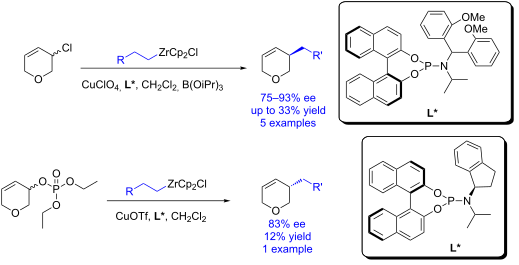
- assistance of a design of experiments statistical approach (83% ee, 12% yield). 1H NMR spectroscopy was used to gain insight into the reaction mechanisms. Keywords: allylic alkylation; asymmetric catalysis; copper; design of experiments; dynamic kinetic asymmetric transformation; heterocycles; Schwartz




Copper-catalyzed asymmetric conjugate addition of organometallic reagents to extended Michael acceptors
Beilstein J. Org. Chem. 2015, 11, 2418–2434, doi:10.3762/bjoc.11.263
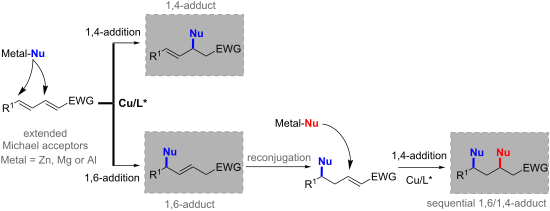
- catalytic applications [22][23]. Amongst the myriad of available NHC ligands, chiral unsymmetrical NHC ligands appeared as particularly potent in asymmetric catalysis, and were investigated in copper-catalyzed conjugate additions [24]. Recently, a multicomponent synthesis enabled the facile access to a wide


A new approach to ferrocene derived alkenes via copper-catalyzed olefination
Beilstein J. Org. Chem. 2015, 11, 2072–2078, doi:10.3762/bjoc.11.223
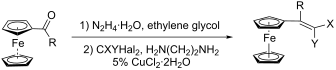
- drugs containing a ferrocene fragment in their structures (Scheme 1) [5]. The ferrocene core is also a very popular scaffold for ligand design, particularly, in asymmetric catalysis (Scheme 1). Probably, the most challenging application of ferrocenes is the production of ferrocene-containing polymers [6


Chiral Cu(II)-catalyzed enantioselective β-borylation of α,β-unsaturated nitriles in water
Beilstein J. Org. Chem. 2015, 11, 2007–2011, doi:10.3762/bjoc.11.217
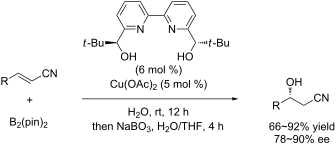
- -unsaturated nitriles in water. The catalyst system, which consisted of Cu(OAc)2 and a chiral 2,2′-bipyridine ligand, enabled β-borylation and chiral induction in water. Subsequent protonation, which was accelerated in aqueous medium, led to high activity of this asymmetric catalysis. Both solid and liquid


New palladium–oxazoline complexes: Synthesis and evaluation of the optical properties and the catalytic power during the oxidation of textile dyes
Beilstein J. Org. Chem. 2015, 11, 1175–1186, doi:10.3762/bjoc.11.132
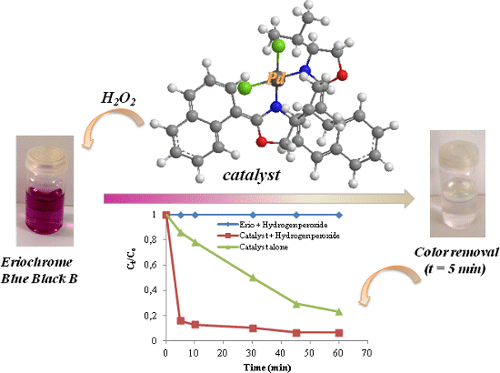
- used for the total synthesis of natural products and nanocompounds [5]. It is only since 1986 that oxazoline-based ligands have been utilized in asymmetric catalysis. This initiated considerable research activity in this field and triggered the synthesis of numerous chiral ligands containing at least


Chemoselective O-acylation of hydroxyamino acids and amino alcohols under acidic reaction conditions: History, scope and applications
Beilstein J. Org. Chem. 2015, 11, 446–468, doi:10.3762/bjoc.11.51
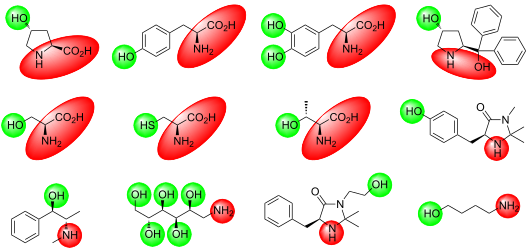
- recognized procedure for large-scale preparation of many useful side-chain derivatives of hydroxyamino acids and related compounds. Such derivatives are useful in peptide chemistry and drug development, as amino acid amphiphiles for asymmetric catalysis, and as amino acid acrylic precursors for preparation


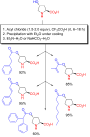


Chiral phosphines in nucleophilic organocatalysis
Beilstein J. Org. Chem. 2014, 10, 2089–2121, doi:10.3762/bjoc.10.218
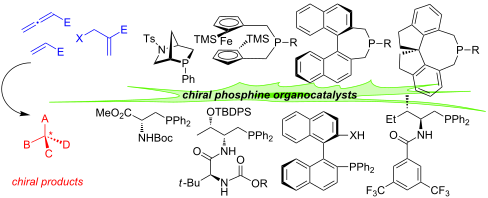
- carbonates, Michael additions, γ-umpolung additions, and acylations of alcohols. Keywords: asymmetric catalysis; chiral phosphine; nucleophilic; organocatalysis; organophosphorus; synthesis; Introduction During the past two decades, tertiary phosphine catalysts have been applied extensively in a wide range


Organophosphorus chemistry
Beilstein J. Org. Chem. 2014, 10, 2087–2088, doi:10.3762/bjoc.10.217
- molecule therapeutic agents and pro-drugs substantiates their role in modern synthetic chemistry and chemical biology. Moreover, their central use as ligands and effectors in asymmetric catalysis, as well as key functional groups for the development of new synthetic methods, has taken the field to new
- heights. This Thematic Series highlights and details some of the novel methods that are advancing the field of organophosphorus chemistry. The Thematic Series covers topics that range from new synthetic methods and phosphorus-based ligands in asymmetric catalysis to bisphosphonates as promising enzyme
- phosphinoyl-indoles and phosphinoyl-isocoumarins and new chemistries of H-phosphonates. The Thematic Series also details work on new metathesis-based reactions of vinyl phosphonates and phosphate tethers, novel phosphorus-based ligands in asymmetric catalysis, novel rasta resin–triphenylphosphine oxides and
Rational design of cyclopropane-based chiral PHOX ligands for intermolecular asymmetric Heck reaction
Beilstein J. Org. Chem. 2014, 10, 1536–1548, doi:10.3762/bjoc.10.158
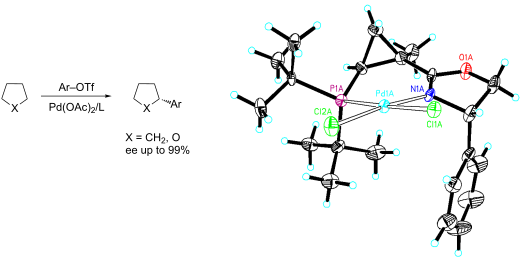
- the isomerization were identified. It was shown that the nature of this isomerization is different from that demonstrated previously using chiral diphosphine ligands. Keywords: asymmetric catalysis; chiral phosphine ligands; cyclopropane; Heck reaction; organophosphorus; transition metal catalysis


Synthesis of 1-[bis(trifluoromethyl)phosphine]-1’-oxazolinylferrocene ligands and their application in regio- and enantioselective Pd-catalyzed allylic alkylation of monosubstituted allyl substrates
Beilstein J. Org. Chem. 2014, 10, 1261–1266, doi:10.3762/bjoc.10.126
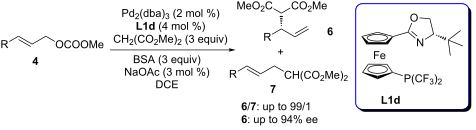
- monosubstituted allyl carbonates. Further studies on the synthesis of 1-[bis(perfluoroalkyl)phosphine]-1’-oxazolinylferrocene ligands and their applications in asymmetric catalysis are ongoing in our lab. Representative ligands developed for the regio- and enantioselective Pd-catalyzed allylic alkylation


Preparation of phosphines through C–P bond formation
Beilstein J. Org. Chem. 2014, 10, 1064–1096, doi:10.3762/bjoc.10.106
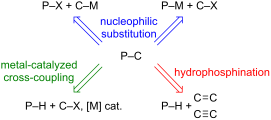
- P-nucleophile or the C-electrophile. Chiral phosphines have attracted more and more interest since they are employed as ligands in transition metal complexes to perform asymmetric catalysis [117]. Enantiopure phosphines have mostly been prepared by starting from enantiopure products or by resolution


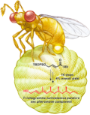
Asymmetric total synthesis of a putative sex pheromone component from the parasitoid wasp Trichogramma turkestanica
Beilstein J. Org. Chem. 2014, 10, 761–766, doi:10.3762/bjoc.10.71
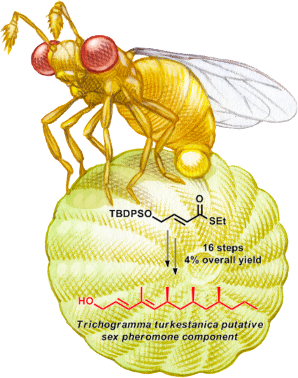
- of 4.4%. Keywords: asymmetric catalysis; copper; deoxypropionates; natural products; sex pheromone; Trichogramma turkestanica; Introduction Communication by means of pheromones is common in many animal species. For instance, many insects secrete air-borne volatiles to attract a mate for generating


Group-assisted purification (GAP) chemistry for the synthesis of Velcade via asymmetric borylation of N-phosphinylimines
Beilstein J. Org. Chem. 2014, 10, 746–751, doi:10.3762/bjoc.10.69
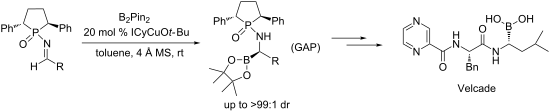
- biological research [1][2][3][4][5][6][7][8]. In the past several years, asymmetric catalysis and auxiliary-directed asymmetric synthesis has been conducted for assembling adjacent chiral centers of boronic aicds [9][10][11][12][13], but only a few methods for generating chiral α-aminoboronic acids have been


Organocatalytic asymmetric fluorination of α-chloroaldehydes involving kinetic resolution
Beilstein J. Org. Chem. 2014, 10, 323–331, doi:10.3762/bjoc.10.30
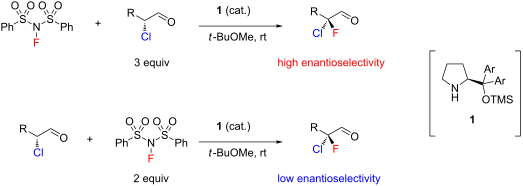
- determination of the absolute stereochemistry of a resulting α-chloro-α-fluoroaldehyde. Some information about the substrate scope and a possible reaction mechanism are also described which shed more light on the nature of this asymmetric fluorination reaction. Keywords: α-branched aldehyde; asymmetric
- catalysis; chlorination; fluorination; organocatalyst; organo-fluorine; Introduction Fluorinated organic molecules are of considerable interest in pharmaceutical and agricultural chemistry owing to the unique properties of the fluorine atom [1][2]. These compounds, especially with one or more fluorinated


Novel supramolecular affinity materials based on (−)-isosteviol as molecular templates
Beilstein J. Org. Chem. 2013, 9, 2821–2833, doi:10.3762/bjoc.9.317
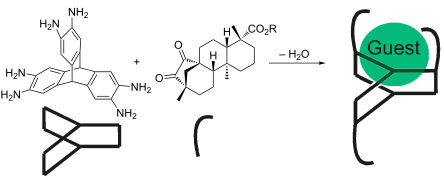
- ][6][7][8][9][10]. Particular interest was given to C3-symmetric structures, serving e.g. as templates in asymmetric catalysis or molecular recognition [11][12][13][14]. A specific but potent subclass of such C3-symmetric architectures is represented by triphenylene ketals [15]. They have found


Stereodivergent synthesis of jaspine B and its isomers using a carbohydrate-derived alkoxyallene as C3-building block
Beilstein J. Org. Chem. 2013, 9, 2564–2569, doi:10.3762/bjoc.9.291
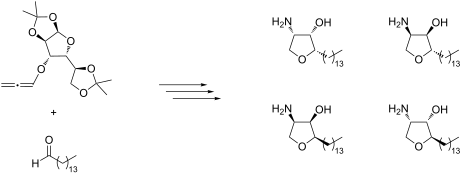
- than 30 published syntheses up to now. Most frequently they are based on transformations of starting materials available from the ”chiral pool”, e.g. L-serine [7][8][9][10][11][12][13][14][15][16][17][18], or by asymmetric catalysis [19][20][21][22][23][24][25]. Several publications also focused on the


Synthetic scope and DFT analysis of the chiral binap–gold(I) complex-catalyzed 1,3-dipolar cycloaddition of azlactones with alkenes
Beilstein J. Org. Chem. 2013, 9, 2422–2433, doi:10.3762/bjoc.9.280
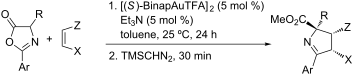
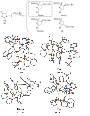
- : asymmetric catalysis; DFT; 1,3-dipolar cycloaddition; gold catalysis; NICS; NTR; oxazolones; prolines; Introduction The synthesis of α-amino acids employing an α-amino carbonyl template constitutes the most straightforward route to introduce the α-side chain [1]. As a valid example, oxazol-5-(4H)-ones
- efficient in asymmetric catalysis [23][24]. The high amount of gold per mole of catalyst and the chiral ligand itself make these processes somehow expensive. The relative lower cost of chiral privileged ligand Binap (versus Cy-Segphos) and the good results obtained in the 1,3-DC of α-imino esters and




Gold(I)-catalyzed enantioselective cycloaddition reactions
Beilstein J. Org. Chem. 2013, 9, 2250–2264, doi:10.3762/bjoc.9.264
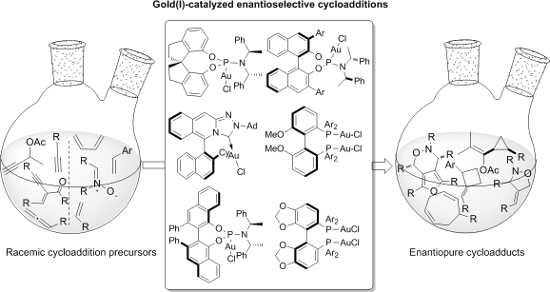
- processes. Keywords: alkyne; allene; asymmetric catalysis; cycloaddition; enantioselective; gold; gold catalysis; Introduction In the past decade, there have been extraordinary advances in the development of novel stereoselective gold(I)-catalyzed transformations [1][2][3][4][5][6][7][8][9][10]. In this


Synthesis of axially chiral gold complexes and their applications in asymmetric catalyses
Beilstein J. Org. Chem. 2013, 9, 2224–2232, doi:10.3762/bjoc.9.261
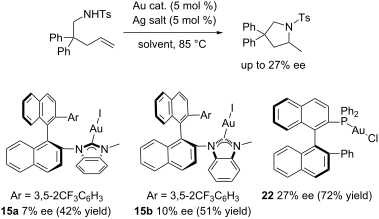
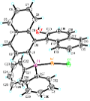
- has not been reported yet. We therefore applied our Au complexes to the asymmetric catalysis of the intramolecular hydroamination of olefin 24 tethered with a NHTs functional group. Treatment of olefin 24 with the axially chiral gold complex (S)-22 and AgOTf (5 mol %) in toluene at 85 oC for 36 h



Enantioselective synthesis of planar chiral ferrocenes via palladium-catalyzed annulation with diarylethynes
Beilstein J. Org. Chem. 2013, 9, 1891–1896, doi:10.3762/bjoc.9.222
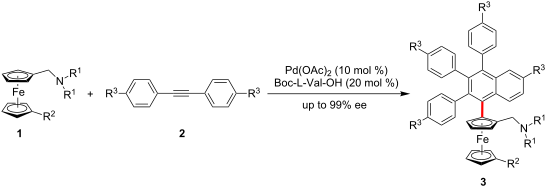
- enantioselectivity (up to 99% ee). Keywords: annulation; asymmetric catalysis; C–H activation; ferrocene; palladium; planar chirality; Introduction Chiral ferrocene derivatives have been widely applied to asymmetric catalysis, materials science, biomedical research, etc. [1][2][3][4]. Particularly, ferrocenes with
- planar chirality are applied as efficient ligands or catalysts in asymmetric catalysis [5][6][7][8][9][10][11][12][13][14][15]. However, the typical method for introduction of planar chirality in the ferrrocene backbone is still utilizing the chiral auxiliaries strategy [16][17][18][19][20][21]. Snieckus





