Search results
Search for "hydration" in Full Text gives 141 result(s) in Beilstein Journal of Organic Chemistry.
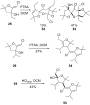
Copper-promoted hydration and annulation of 2-fluorophenylacetylene derivatives: from alkynes to benzo[b]furans and benzo[b]thiophenes
Beilstein J. Org. Chem. 2014, 10, 2886–2891, doi:10.3762/bjoc.10.305
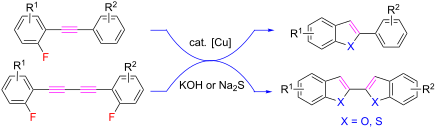
- Yibiao Li Liang Cheng Xiaohang Liu Bin Li Ning Sun School of Chemical & Environmental Engineering, Wuyi University, Jiangmen, Guangdong Province, 529090, China BASF Catalyst, 23800 Mercantile Road, Beachwood, Ohio 44124, USA 10.3762/bjoc.10.305 Abstract An efficient copper-promoted hydration
- reaction and its application in the synthesis of benzo[b]furan and benzo[b]thiophene derivatives is presented starting from readily available 2-fluorophenylacetylene derivatives. The key annulation step involves the hydration of the C–F bond of 2-fluorophenylacetylene derivatives followed by an
- product (Table 1, entry 1). The usage of CuCl and 1,10-phenanthroline (1,10-phen) as a ligand in CH3CN at 80 °C showed that 2a could be isolated in 35% yield (Table 1, entry 2). The screening of the various solvents revealed that the solvent played an important role in this hydration and annulation


Binding mode and free energy prediction of fisetin/β-cyclodextrin inclusion complexes
Beilstein J. Org. Chem. 2014, 10, 2789–2799, doi:10.3762/bjoc.10.296
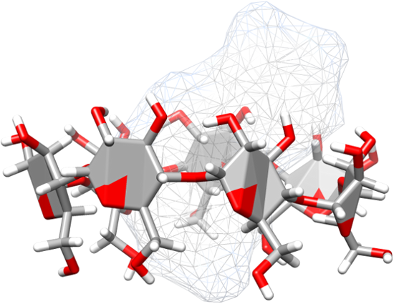
- . From the atom–atom interaction RDF analysis, among all six oxygen atoms of fisetin in three complexes, no peak appeared within ~3 Å of the O1 atom, suggesting that this atom on the chromone ring has a relatively low water accessibility or very weak hydration interaction. Along the simulation this atom
- always seems to stay inside the hydrophobic cavity. Differentially, the other oxygen atoms show the first sharp peak centered at ~2.8 Å corresponding to a highly possible hydration and the first minimum at ~4 Å accounting for the time when a water molecule remains on the first solvation shell. On the
- -CD through the B-ring fitting at the narrow rim (complexes II–III), only the O7 atom on the A-ring was significantly higher solvated. The further discussion on the hydration of fisetin in complexation with β-CD is summarized as follows. Low hydration on the O3 atom (I–III: ~1.5, ~0.8 and ~0.6) was


Anomalous diffusion of Ibuprofen in cyclodextrin nanosponge hydrogels: an HRMAS NMR study
Beilstein J. Org. Chem. 2014, 10, 2715–2723, doi:10.3762/bjoc.10.286
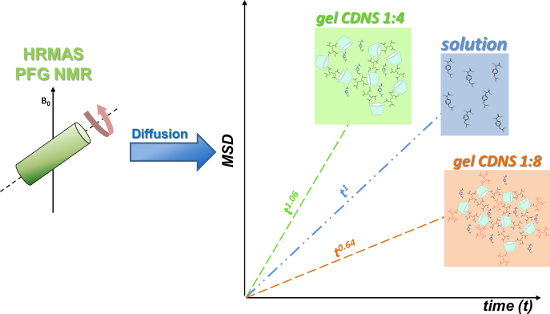
- , such as the chemical compositions of the nanosponge (e.g., CDNSPMA, CDNSEDTA are swellable, CDNSDPC are not) and the cross-linker to CD mole ratio n [17]. Recently, we demonstrated that the CDNS hydrogels undergo phase transitions by changing the hydration level h = m(H2O)/mCDNS by a complex interplay


Phosphinocyclodextrins as confining units for catalytic metal centres. Applications to carbon–carbon bond forming reactions
Beilstein J. Org. Chem. 2014, 10, 2388–2405, doi:10.3762/bjoc.10.249
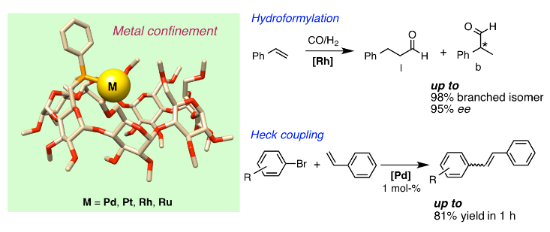
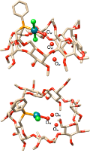
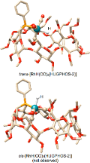
- , 2JC,P = 22.8 Hz, CO) ppm; 31P{1H} NMR (161.9 MHz, CDCl3, 25 °C) δ 40.5 (d, 1JP,Rh = 172 Hz) ppm; IR: 2086 (vs, CO), 2026 (vs, CO), 2004 (s, CO) cm−1; We do not provide microanalytical data for this compound because of strong hydration; MS (ESI–TOF): m/z (%): 1799.44 (70) [M – Cl]+, 1857.40 (100) [M






Pyrrolidine nucleotide analogs with a tunable conformation
Beilstein J. Org. Chem. 2014, 10, 1967–1980, doi:10.3762/bjoc.10.205
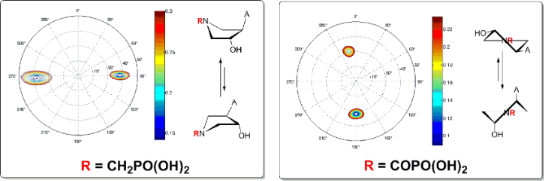
- alternate between A, B and Z forms depending on the hydration and the type and concentration of metal ions, which is also reflected in the conformation of the sugar part. Finally, the conformation of ribose or its mimics also significantly predetermines the binding of a nucleoside, nucleotide or an analog


Synthesis of trifluoromethyl-substituted pyrazolo[4,3-c]pyridines – sequential versus multicomponent reaction approach
Beilstein J. Org. Chem. 2014, 10, 1759–1764, doi:10.3762/bjoc.10.183

- the corresponding ketones. The hydration of C–C triple bonds under the influence of various catalytic systems, including also Pd-based catalysts, is a well-known reaction [21][22]. It should be emphasized that NMR investigations with compounds 8a,c unambiguously revealed the methylene group adjacent


The search for new amphiphiles: synthesis of a modular, high-throughput library
Beilstein J. Org. Chem. 2014, 10, 1578–1588, doi:10.3762/bjoc.10.163
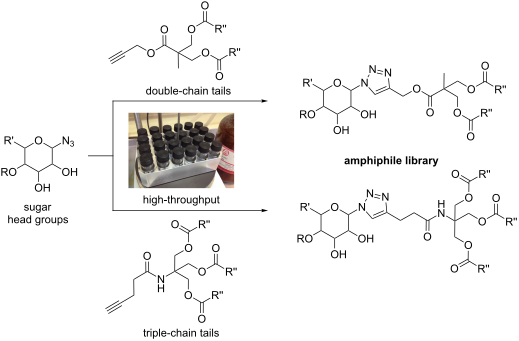
- layer of amphiphile prior to hydration of the material. The microscope slide was placed into a Linkam PE94 hot stage (Linkam Scientific Instruments Ltd.; Surrey, England) and a water drop added at the side of the cover slip to flood the sample and create a concentration gradient as water was absorbed


Molecular recognition of surface-immobilized carbohydrates by a synthetic lectin
Beilstein J. Org. Chem. 2014, 10, 1354–1364, doi:10.3762/bjoc.10.138
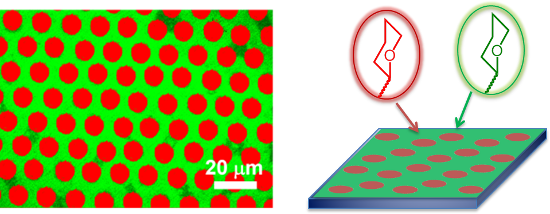
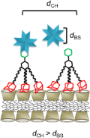
- as drugs in various therapies and as recognition units in diagnostics and sensing. However, the development of synthetic lectins poses a phenomenal challenge for supramolecular chemistry [37] because a carbohydrate receptor in order to be useful must not only compete with the strong hydration of


Staudinger ligation towards cyclodextrin dimers in aqueous/organic media. Synthesis, conformations and guest-encapsulation ability
Beilstein J. Org. Chem. 2014, 10, 774–783, doi:10.3762/bjoc.10.73
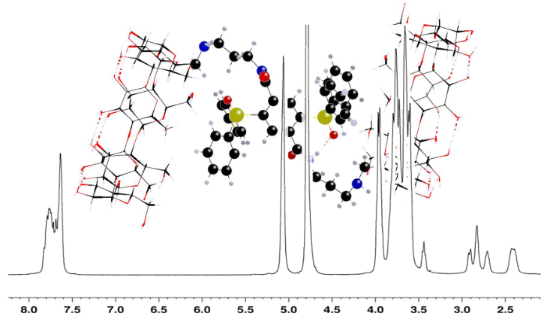
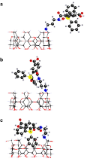
- both β-CD cavities (Figure 3d) are the least stable by PM3(COSMO) (in the presence of water), although highly favorable by PM3 (in the absence of solvent). This was attributed to insufficient hydration of the primary hydroxy groups due to steric crowding around the primary sides of the two β-CD tori



Integration of enabling methods for the automated flow preparation of piperazine-2-carboxamide
Beilstein J. Org. Chem. 2014, 10, 641–652, doi:10.3762/bjoc.10.56
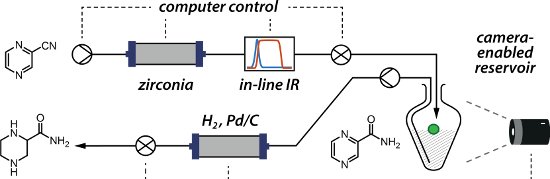
- treatment of tuberculosis – and its reduced derivative piperazine-2-carboxamide. Keywords: automation; flow chemistry; hydration; hydrogenation; sustainable processing; Introduction Enabling synthesis technologies such as flow chemistry are becoming commonplace in modern laboratories (for recent reviews
- explored the possibility of developing a machine-automated synthesis of this compound which might later be extended to analogous structures. For the facile machine-assisted synthesis of 1 we devised and optimised the fully continuous sequential hydration of nitrile 3 to amide 2 and hydrogenation of
- pyrazine 2 to piperazine 1 (Figure 2b). Both of these steps involve flowing through heterogeneous catalysts, a metal oxide for the hydration of the nitrile and a supported precious metal for the hydrogenation of the heteroaromatic ring. Furthermore, both steps involve the addition of a volatile small




Silver and gold-catalyzed multicomponent reactions
Beilstein J. Org. Chem. 2014, 10, 481–513, doi:10.3762/bjoc.10.46


Ambient gold-catalyzed O-vinylation of cyclic 1,3-diketone: A vinyl ether synthesis
Beilstein J. Org. Chem. 2013, 9, 2537–2543, doi:10.3762/bjoc.9.288
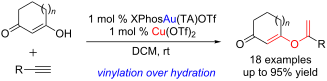
- as essential tools in organic synthesis. Generally with the unique reactivity and mild reaction conditions, this type of transformation has found widespread applications in complex molecule synthesis [10][11]. Among those reactions, the gold-catalyzed hydration of alkynes is regarded as one of the
- signature reactions in the field (known as Teles hydration) [12]. This reaction usually utilized the combination of methanol and water, wherein methanol served as the nucleophile to attack the triple bond, forming the vinyl ether intermediate. This vinyl ether then collapsed to give a ketone as the final
- 1,3-diketones with unactivated alkynes at ambient temperature. Results and Discussion As indicated in Scheme 1, the main challenge for the intermolecular O-nucleophile addition to alkynes is the competitive hydration side reaction. Although, theoretically, strictly anhydrous conditions shall prevent


Recent advances in transition metal-catalyzed Csp2-monofluoro-, difluoro-, perfluoromethylation and trifluoromethylthiolation
Beilstein J. Org. Chem. 2013, 9, 2476–2536, doi:10.3762/bjoc.9.287
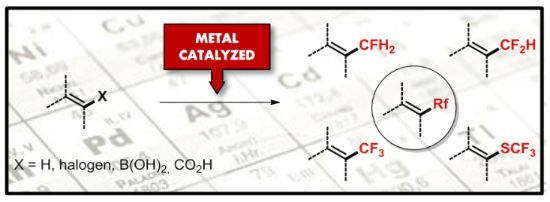
- fluorine, its hydration and thus reduced nucleophilicity [21]. The importance of this developing research field is reflected by the various review articles which have been published dealing with transition metal mediated or catalyzed fluorination [22][23][24], difluoromethylation [24], and


The chemistry of isoindole natural products
Beilstein J. Org. Chem. 2013, 9, 2048–2078, doi:10.3762/bjoc.9.243
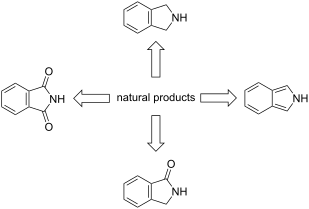
- condensation of primary amines with o-diacylbenzene 19 (Scheme 2) [13]. After initial formation of 20, isomerization to 21 and 22 can occur through a sequential dehydration–hydration process. Dimerization of 21 and 22 generates 23, the substrate for a formal retro-Aldol reaction. Loss of formaldehyde gives 24












A concise enantioselective synthesis of the guaiane sesquiterpene (−)-oxyphyllol
Beilstein J. Org. Chem. 2013, 9, 2028–2032, doi:10.3762/bjoc.9.239
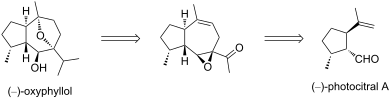
- the total synthesis of the anticancer guaiane (−)-englerin A. A regio- and diastereoselective Co(II)-catalyzed hydration of the olefin and a transannular epoxide opening were used as the key reactions. Keywords: asymmetric synthesis; hydration; natural products; terpenes; transannular epoxide opening
- completion of the synthesis of (−)-oxyphyllol (1) from 4. To our delight, a direct regio- and diastereoselective Co(II)-catalyzed hydration [12] of the olefin in 4 succeeded to give the required α-stereoisomer 3 in 58% isolated yield after chromatographic separation of the minor β-alcohol. Compared to the


Synthesis of enantiomerically pure (2S,3S)-5,5,5-trifluoroisoleucine and (2R,3S)-5,5,5-trifluoro-allo-isoleucine
Beilstein J. Org. Chem. 2013, 9, 2009–2014, doi:10.3762/bjoc.9.236
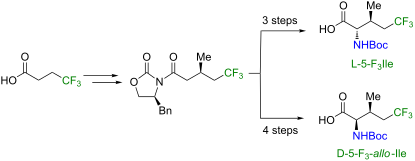
- stereoisomers of Ile are less hydrophobic than Aha. F6Leu is similar to Aha in hydrophobicity, while exhibiting a much larger volume. In a free energy perturbation study, the hydration energy of F6Leu was shown to be 1.1 kcal/mol higher than that of leucine [29]. This, together with our previous and new
- findings, suggests that there are two factors determining the overall hydrophobicity of fluorinated amino acids [26]. On one hand, substitutions of hydrogen by fluorine increase the solvent accessible surface area and thus lead to an increase in hydration energy. On the other hand, the C–F bond is more


A practical synthesis of long-chain iso-fatty acids (iso-C12–C19) and related natural products
Beilstein J. Org. Chem. 2013, 9, 1807–1812, doi:10.3762/bjoc.9.210
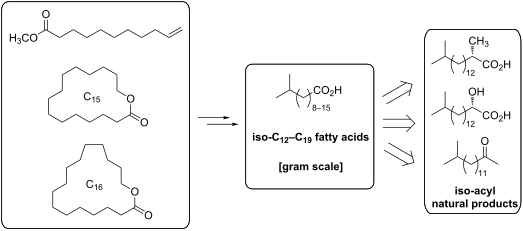
- triethylsilane and BF3·Et2O [53], affording 11. Oxidative cleavage of 11 with KMnO4/Bu4NBr [54] afforded iso-C12 acid 1. Alternatively, anti-Markovnikov hydration of 11, using I2/NaBH4 then hydrogen peroxide [55], afforded the alcohol 12, and oxidation of 12 with KMnO4/Bu4NBr afforded iso-C13 acid 2


Gold(I)-catalyzed formation of furans from γ-acyloxyalkynyl ketones
Beilstein J. Org. Chem. 2013, 9, 1774–1780, doi:10.3762/bjoc.9.206
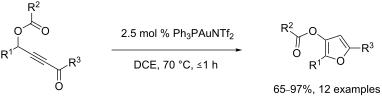
- formation of the hydration product 3 (Table 1, entries 2 and 3 versus entry 1). We found out that running the reaction at 70 °C instead of at room temperature completely prevented the byproduct formation. At this temperature good to quantitative yields of furans 2a were achieved in less than 30 min, and 5
- °C, no trace of furan 2a could be detected by 1H NMR analysis. Interestingly, decreasing the catalytic loading from 5 to 1 mol % still provided the furan in less than 1 h and in high yields (Table 1, entries 6 and 7 versus entry 5). However, hydration started to compete again at low loading, as
- hydration product, the reaction took 6 h to reach almost full conversion. Beside the expected furan 2d, its corresponding regioisomer 2d’ arising from 1,3-migration of the pivaloyl group is formed in this reaction and both products were obtained in a combined yield of 68% (Table 2, entry 4). We next varied


Aerobic radical multifunctionalization of alkenes using tert-butyl nitrite and water
Beilstein J. Org. Chem. 2013, 9, 1713–1717, doi:10.3762/bjoc.9.196

- hydroxy group arising from hydration of the olefin (entry 6). Functionalization reactions involving oxygenation of methylene C–H bonds of alkenes 11–13 also proceeded to afford secondary nitrate compounds 21–23, though no diastereoselectivity was observed (Table 2, entries 7–9). Unfortunately, no tertiary


Anionic cascade reactions. One-pot assembly of (Z)-chloro-exo-methylenetetrahydrofurans from β-hydroxyketones
Beilstein J. Org. Chem. 2013, 9, 1319–1325, doi:10.3762/bjoc.9.148

- 13 was treated with aqueous hydrochloric acid, in the hope of generating the corresponding dihydrofuran carbaldehyde 33. Instead, the diol 34 was obtained in 52% yield as a 1:1 mixture of diastereoisomers. It thus transpires that protonation and hydration of the exo-methylene double bond of 13
- of two new dimers. Formation of (Z)-chloro-exo-methyleneketals. Mechanism of formation of (Z)-chloro-exo-methylenetetrahydrofurans. Stepwise formation of (Z)-chloro-exo-methylenetetrahydrofurans. Optimized protocols to form (Z)-chloro-exo-methylenetetrahydrofurans. Hydration of (Z)-chloro-exo





A computational study of base-catalyzed reactions of cyclic 1,2-diones: cyclobutane-1,2-dione
Beilstein J. Org. Chem. 2013, 9, 594–601, doi:10.3762/bjoc.9.64
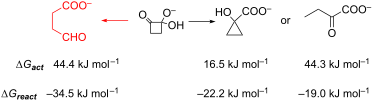
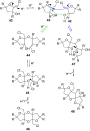
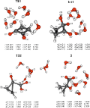
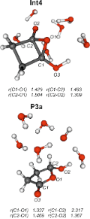
- transition states, intermediates and products shown in Scheme 3, hydration by six water molecules is implied. Relative Gibbs free energies with respect to the separated reactants 1·(H2O)2 + [OH(H2O)4]– including bulk aqueous solvation energies (SMD solvation model [21]) obtained by various computational





Alkyne hydroarylation with Au N-heterocyclic carbene catalysts
Beilstein J. Org. Chem. 2013, 9, 246–253, doi:10.3762/bjoc.9.29

- selectivity compared to the previously published complex AuCl(PPh3). Preliminary results on intramolecular hydroarylations using this catalytic system indicate, however, that alkyne hydration by traces of water may become a serious competing reaction. Keywords: alkyne; C–H functionalization; cyclisation
- VI moderate to very good conversions of the substrates were obtained, but the main reaction product was invariably the product of hydration of the triple bond 8, whereas the 6-endo-dig cyclisation product 7 was present in minor amounts. Gold(I) NHC complexes such as VI are known to be extremely
- efficient catalysts for alkyne hydration [61], hence it can be expected that alkyne hydration by traces of water may become a serious competitive reaction despite the low concentration of water in the reaction mixture. On the basis of the above, it can be hypothesised that in order to steer the reaction


Presence or absence of a novel charge-transfer complex in the base-catalyzed hydrolysis of N-ethylbenzamide or ethyl benzoate
Beilstein J. Org. Chem. 2013, 9, 185–196, doi:10.3762/bjoc.9.22
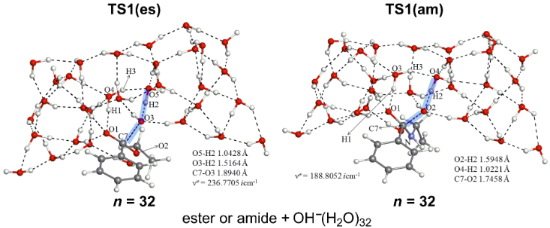
- water molecules in the first hydration shell of an alanine molecule was found to be seven [44]. Thus, more than seven water molecules would be required to examine the reaction paths of hydrolyses reliably. However, less than six water molecules are included in the precedent computational studies [26][27
- TS1(es) is enlarged appreciably (= +17.87 kcal/mol) in spite of the positional assumption (ii) in Figure 7. Thus, the counter ion works unfavorably on the rate-determining step TS1(es). The Na+ ion has a very large hydration energy (= −97 kcal/mol), and the cation needs to be surrounded by many water
- molecules in the hydration shell far from the reaction region. Figure 8 shows energy changes for the amide hydrolysis of Figure 5. Those of Na+-containing paths in the system, Ph–C(=O)–NH–Et + NaOH(H2O)16 in Figure S4 (Supporting Information File 1), are also shown in green. In energies of the Na+-free




Antifreeze glycopeptide diastereomers
Beilstein J. Org. Chem. 2012, 8, 1657–1667, doi:10.3762/bjoc.8.190
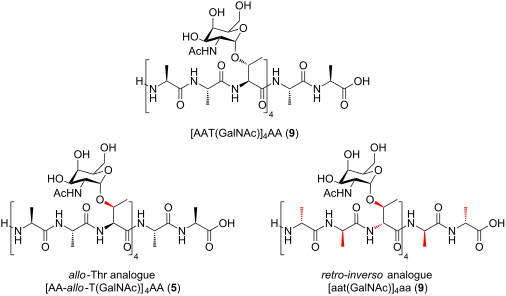
- position for adsorption to the ice surface; a similar situation applies to the retro-inverso peptide 7. Moreover, these conformational changes may possibly also alter the water hydration shell around the peptide, which has been suggested to be essential for the antifreeze activity of AFGPs and AFGP
- backbone as well as on the hydration shell around the peptide. Experimental All chemicals were acquired from Sigma Aldrich (Hamburg, Germany), Acros (Geel, Belgium), Alfa Aesar (Ward Hill, USA) and VWR (Darmstadt, Germany) and were employed without additional purification. Moisture- and air-sensitive


Mannose-decorated cyclodextrin vesicles: The interplay of multivalency and surface density in lectin–carbohydrate recognition
Beilstein J. Org. Chem. 2012, 8, 1543–1551, doi:10.3762/bjoc.8.175
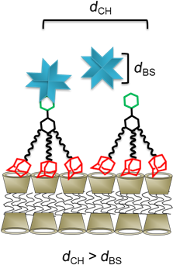
- functionalized by self-assembly [27]. To this end, cyclodextrins are modified with long alkyl chains (“tails”) and short oligo(ethylene glycol) head groups. These macrocyclic amphiphiles form unilamellar bilayer vesicles in aqueous solution upon hydration of a thin film cast by evaporation from organic solution