


Search results
Search for "primary amine" in Full Text gives 171 result(s) in Beilstein Journal of Organic Chemistry.
Catalytic asymmetric synthesis of biologically important 3-hydroxyoxindoles: an update
Beilstein J. Org. Chem. 2016, 12, 1000–1039, doi:10.3762/bjoc.12.98
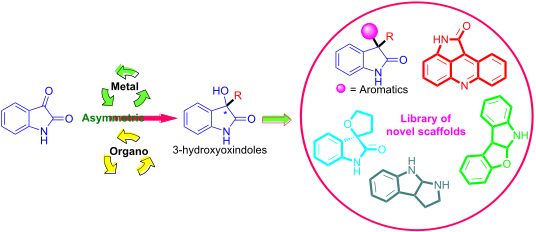
- -derived primary amine catalysts (cat. 15 and 16) and achieved the asymmetric aldol reaction of 1,1-dimethoxyacetone with isatins (Scheme 30) [46]. The reactions were carried out at room temperature using 10% catalyst loading and trichloroacetic acid (TCA) as the additive, affording the corresponding 3
- -hydroxyoxindoles in excellent yields (up to 96% yield) and with high enantioselectivies (up to 97% ee), even for N-unsubstituted isatin derivatives. Besides, this protocol showed a broad substrate scope and good tolerance toward different functional groups. TCA promoted the formation of an enamine from the primary
- amine of the catalyst and ketone substrate and protonation of the tertiary amino group. The protonated amine then served as hydrogen bond donor to activate the carbonyl group of isatin substrates, thereby facilitating the aldol addition. Interestingly, the authors obtained the R-/S-enantiomer by using




A robust synthesis of 7,8-didemethyl-8-hydroxy-5-deazariboflavin
Beilstein J. Org. Chem. 2016, 12, 912–917, doi:10.3762/bjoc.12.89
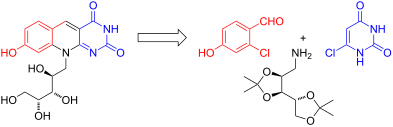
- deprotection with iodine instead of mercury compounds) we have improved the synthesis of aldehyde 9. The latter compound was then transformed to the protected ribitylamine 10 via the oxime, which was reduced with LiAlH4. Primary amine 10 was then converted with chlorouracil 3, which was actually the key


Synthesis of 2,1-benzisoxazole-3(1H)-ones by base-mediated photochemical N–O bond-forming cyclization of 2-azidobenzoic acids
Beilstein J. Org. Chem. 2016, 12, 874–881, doi:10.3762/bjoc.12.86
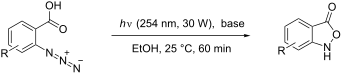
- the reaction mixture [30] and obtained a maximum yield of 20% and 50%, respectively, at a water content of 50%. Under these conditions, no formation of the primary amine 4 (a product of the typical triplet nitrene reaction (Scheme 1, intermediate D)) was detected. The replacement of the aprotic
- presence of isoprene as a triplet nitrene quencher. The addition of isoprene lead to a significantly increased yield of 3-amino-6-nitro-2,1-benzisoxazole and an insignificant decrease of the primary amine yield. Thus it was demonstrated that the formation of 3-amino-6-nitro-2,1-benzisoxazole goes through


(Thio)urea-mediated synthesis of functionalized six-membered rings with multiple chiral centers
Beilstein J. Org. Chem. 2016, 12, 462–495, doi:10.3762/bjoc.12.48
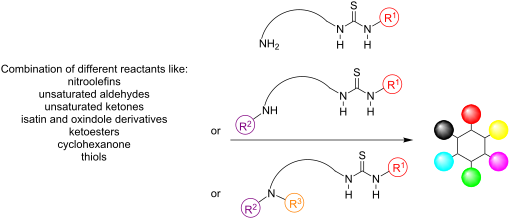
- will be summarized. Initially, the use of primary amine-thioureas as organocatalysts for the above transformation is being discussed, followed by the examples employing secondary amine-thioureas. Finally, the use of tertiary amine-thioureas and miscellaneous examples are presented. Keywords: multiple
- organocatalysts. Review Primary amine-thioureas as organocatalysts promoting asymmetric transformations that lead to a six-membered ring As discussed earlier, except from the activation of the substrates with the formation of the corresponding enamines or iminium ions, the synthesis of enantiopure products can be
- of a bifunctional catalyst. The first family of these bifunctional catalysts, that are going to be discussed, are the "primary amine-thioureas". Initially, catalyst 4 was studied as an organocatalyst in the addition of isobutyraldehyde (1) to (E)-methyl 2-oxo-4-phenylbut-3-enoate (2) for the


Cupreines and cupreidines: an established class of bifunctional cinchona organocatalysts
Beilstein J. Org. Chem. 2016, 12, 429–443, doi:10.3762/bjoc.12.46
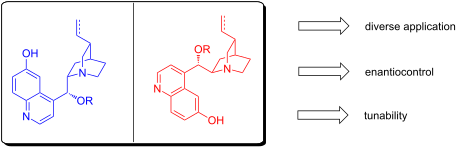
- co-workers who developed an organocatalytic transamination process using the cupreine catalyst CPN-81, which is substituted with n-butyl at the 9-OH position [59]. In this report, the α-ketoester 79 was reacted with the primary amine o-ClC6H4CH2NH2 80 in the presence of the catalyst. Once again, the


Highly stable and reusable immobilized formate dehydrogenases: Promising biocatalysts for in situ regeneration of NADH
Beilstein J. Org. Chem. 2016, 12, 271–277, doi:10.3762/bjoc.12.29
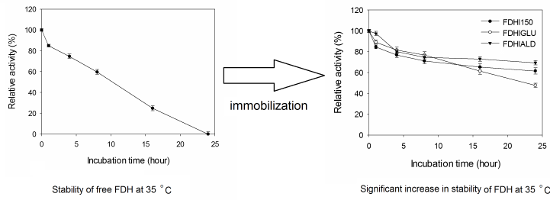
- different nucleophiles highly abundant in the protein surface such as primary amine, sulfhydryl and carboxylic groups [21]. In this study, Immobead 150 was used as epoxy group containing supports for the immobilization of C. methylica FDH (Figure 1a). The amount of bound protein was determined as 85% of the


A novel and practical asymmetric synthesis of dapoxetine hydrochloride
Beilstein J. Org. Chem. 2015, 11, 2641–2645, doi:10.3762/bjoc.11.283
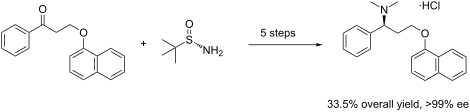
- temperature and dissociated with NaHCO3 to give the primary amine 6 in 90.0% yield. The reductive amination of 6 under Eschweiler–Clarke conditions furnished (S)-dapoxetine 7 with excellent enantiopurity (99.3% ee) in 74.7% yield. After salt formation and recrystallization, the target compound 1 was obtained


Synthesis of bi- and bis-1,2,3-triazoles by copper-catalyzed Huisgen cycloaddition: A family of valuable products by click chemistry
Beilstein J. Org. Chem. 2015, 11, 2557–2576, doi:10.3762/bjoc.11.276
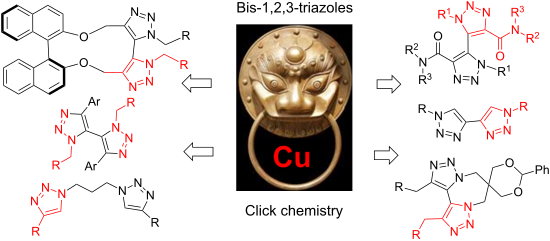
- low yield when the alkynes or azides were linked directly with a hindered group or an aromatic moiety. In 2012, Xu and co-workers disclosed that both the secondary and primary amine-functionalized polysiloxanes were good ligands for the copper-catalyzed Huisgen reaction of organic azides and alkynes




Synthesis of D-fructose-derived spirocyclic 2-substituted-2-oxazoline ribosides
Beilstein J. Org. Chem. 2015, 11, 2289–2296, doi:10.3762/bjoc.11.249
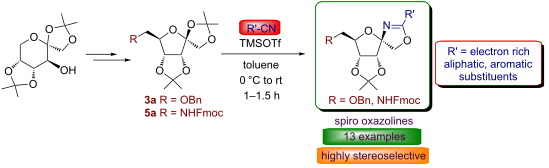
- rotation values of 2a and 4a are in accordance with the previously reported data [42][47][48]. In the next step, hydrogenation of the azide with 10% Pd/C in EtOAc afforded the primary amine, which was protected using Fmoc-OSu/NaHCO3 in THF/H2O to afford 5a. Finally, the C6–OBn- and C6–NHFmoc-protected


Beyond catalyst deactivation: cross-metathesis involving olefins containing N-heteroaromatics
Beilstein J. Org. Chem. 2015, 11, 2223–2241, doi:10.3762/bjoc.11.241
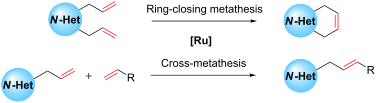
- NMR experiments [45]. The steric hindrance of the amine appeared to be a critical parameter. The non-bulky primary amine n-butylamine (a) induced a fast decomposition of the methylidene 2 (Table 1, entry 1) whereas secondary amines such as pyrrolidine (b) and morpholine (c) are less detrimental to the
- those obtained with GII were obtained. In the presence of a non-bulky primary amine such as n-butylamine, the bis-aminobenzylidene 17 was formed and complete decomposition was noticed after 12 h at rt yielding ruthenium complex 18 and amine 10. In the presence of secondary amines b and c and sp2 amine d


Cross metathesis of unsaturated epoxides for the synthesis of polyfunctional building blocks
Beilstein J. Org. Chem. 2015, 11, 1876–1880, doi:10.3762/bjoc.11.201
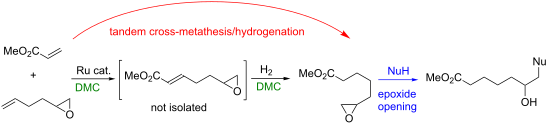
- electron- deficient olefin cross metathesis partner has received attention for the synthesis of polymer precursors. For instance, we have reported the reduction of the nitrile functional group into primary amine [22] and the reduction of the formyl group into alcohol [23][24]. Herein, we focused on the
- by intramolecular trans-esterification from 6, 7 and 8, as well as cyclic amines by intramolecular cyclization involving primary amine resulting from hydrogenation of the nitrile functionality in 5. All these aspects will be further developed in our group. Cross metathesis of 1 with methyl acrylate


An efficient synthesis of N-substituted 3-nitrothiophen-2-amines
Beilstein J. Org. Chem. 2015, 11, 1707–1712, doi:10.3762/bjoc.11.185
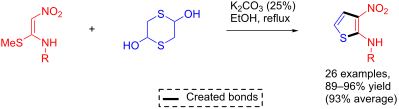
- transformation was investigated by examining the reaction between a variety of α-nitroketene N,S-anilinoacetals 1 with 1,4-dithiane-2,5-diol (2, Scheme 3 and Table 2). The starting materials 1 were readily available by refluxing in ethanol the suitable primary amine and 1,1-bis(methylthio)-2-nitroethylene



Chemoselective O-acylation of hydroxyamino acids and amino alcohols under acidic reaction conditions: History, scope and applications
Beilstein J. Org. Chem. 2015, 11, 446–468, doi:10.3762/bjoc.11.51




Detonation nanodiamonds biofunctionalization and immobilization to titanium alloy surfaces as first steps towards medical application
Beilstein J. Org. Chem. 2014, 10, 2765–2773, doi:10.3762/bjoc.10.293
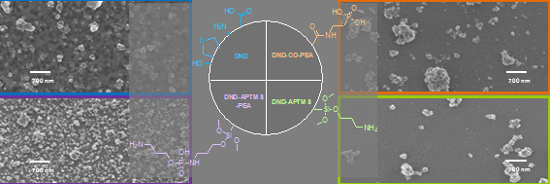
- as control to verify the interaction of amino groups and the titanium based alloy. Furthermore, products 3 and 6 can be seen as ‘inversely modified’ DND with a terminal phosphate and a secondary amide 3 or with a primary amine and a secondary phosphoroamidate 6. This might help to assess the



A green approach to the synthesis of novel phytosphingolipidyl β-cyclodextrin designed to interact with membranes
Beilstein J. Org. Chem. 2014, 10, 2654–2657, doi:10.3762/bjoc.10.278
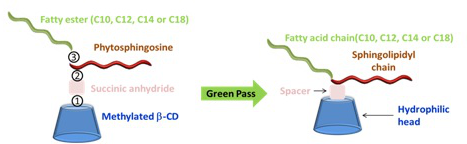
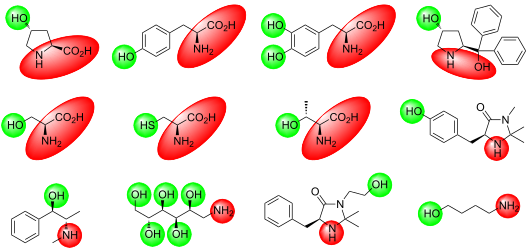
- hydrophobic compound bearing one primary amine, one primary alcohol and two secondary alcohols has attracted our interest (See Figure 1 ). Its amino group can be used to couple with 6-amidosuccinyl-6-desoxy-permethylated-β-CD, and thereafter, the primary alcohol can be used for the enzymatically catalyzed


Efficient CO2 capture by tertiary amine-functionalized ionic liquids through Li+-stabilized zwitterionic adduct formation
Beilstein J. Org. Chem. 2014, 10, 1959–1966, doi:10.3762/bjoc.10.204
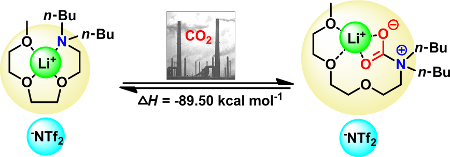
- ] showed a poor CO2 sorption capacity, implying that only physical interactions with CO2 were present (Table 1, entries 1–3). The primary amine-functionalized IL [PEG150MeNH2Li][NTf2] gave rise to CO2 uptake approaching 1:2 stoichiometry (Table 1, entry 4) as expected from the proposed mechanism for the




Influence of cyclodextrin on the UCST- and LCST-behavior of poly(2-methacrylamido-caprolactam)-co-(N,N-dimethylacrylamide)
Beilstein J. Org. Chem. 2014, 10, 1951–1958, doi:10.3762/bjoc.10.203
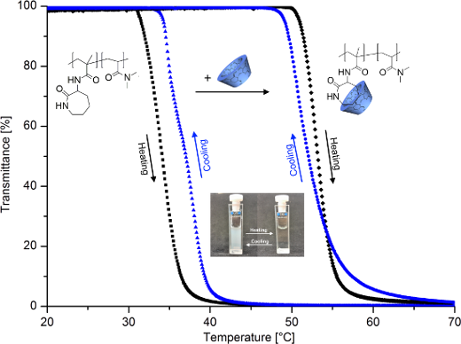
- -amino-ε-caprolactam (2) was obtained according to literature via cyclocondensation of L-lysine (1) [15]. Through amidation of the primary amine (2) with methacryloyl chloride (3) the polymerizable 2-methacrylamido-caprolactam (4) was obtained (Scheme 1) [14]. Free radical copolymerization of 4 in


Synthesis of a bifunctional cytidine derivative and its conjugation to RNA for in vitro selection of a cytidine deaminase ribozyme
Beilstein J. Org. Chem. 2014, 10, 1906–1913, doi:10.3762/bjoc.10.198
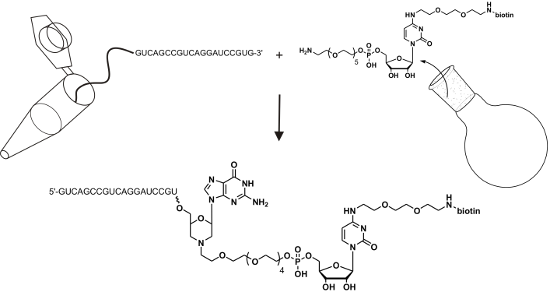
- bifunctionalized cytidine derivative and its successful conjugation to RNA. Results and Discussion Synthesis of the bifunctional cytidine derivative 1 started from uridine making use of four synthons: a protected hexaethylene glycol linker phosphoramidite 2 bearing a primary amine to be used later for RNA
- . In terms of synthesis efficiency, we first tried to simultaneously deprotect the amino functionality at the nucleobase and the sugar 5'-hydroxy group to generate derivative 12. Thereafter, the greater nucleophilicity of the primary amine over the alcohol should be used for selective amide bond


Photoswitchable precision glycooligomers and their lectin binding
Beilstein J. Org. Chem. 2014, 10, 1603–1612, doi:10.3762/bjoc.10.166
- carefully washing the resin with DMF. Capping of N-teminal site: The free primary amine, obtained after final Fmoc cleavage, was capped with an acetyl group by the addition of 2.5 mL acetic anhydride. After shaking the mixture for 15 min, the resin was washed with DMF and DCM. Cleavage from solid phase: 30
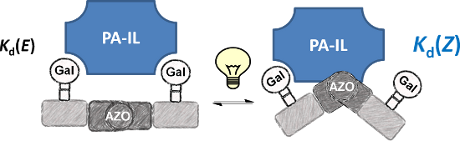
- )-3: This structure was synthesized by applying the general coupling protocol three times with building blocks in the sequence TDS, AZO, TDS. After capping the primary amine, two galactose units were conjugated to the scaffold according to the general CuAAC protocol. The product was cleaved from the
- the primary amine, three galactose units were conjugated to the scaffold according to the general CuAAC protocol. The product was cleaved from the resin as final step giving 18 mg (yield: 68%). 1H NMR (400 MHz, D2O) δ 7.73–7.45 (m, 12H), 7.34 (br. s, 3H), 4.48–4.31 (m, 9H), 4.25–4.08 (m, 8H), 3.78


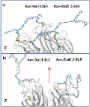
Design, automated synthesis and immunological evaluation of NOD2-ligand–antigen conjugates
Beilstein J. Org. Chem. 2014, 10, 1445–1453, doi:10.3762/bjoc.10.148
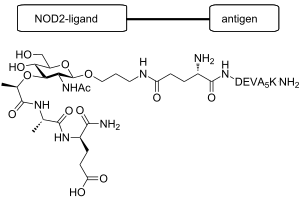
- with the reduction of the azide in compound 14 with PMe3 and subsequently the primary amine and Fmoc protected glutamic acid allyl ester were condensed under influence of HATU and DiPEA to give the orthogonally protected compound 15 in 57% yield. To make 15 suitable for SPPS, the allyl protective group


Asymmetric Ugi 3CR on isatin-derived ketimine: synthesis of chiral 3,3-disubstituted 3-aminooxindole derivatives
Beilstein J. Org. Chem. 2014, 10, 1383–1389, doi:10.3762/bjoc.10.141
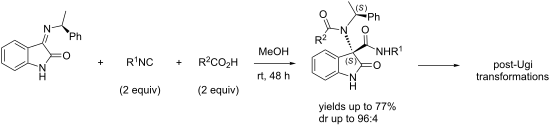
- , selected post-Ugi transformations were investigated in order to better evaluate the synthetic versatility of the Ugi adducts. Compound 10a was easily converted to the primary amide 16 and then to the known amino amide 17 [16], thus establishing the possible subsequent functionalization of both the primary
- amine and the isonitrile-derived primary carboxamide functional groups (Scheme 1). Also, this chemical correlation of the major diastereoisomer 10a allowed us to further confirm the prevailing S-configuration at the tetrasubstituted stereocenter C3 of the Ugi products. Compound 15a was submitted to a


Molecular recognition of surface-immobilized carbohydrates by a synthetic lectin
Beilstein J. Org. Chem. 2014, 10, 1354–1364, doi:10.3762/bjoc.10.138
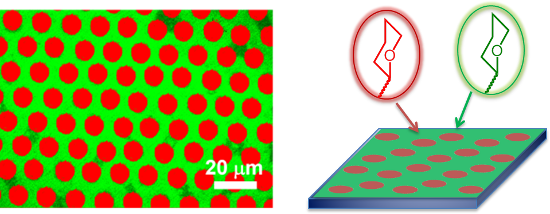
- ), respectively. In order to flexibly attach the carbohydrates on the substrate and to ensure unhindered carbohydrate–lectin interactions, oligo(ethylene glycol) spacers were introduced. Oligo(ethylene glycol) chains are flexible, water-soluble and do not interact with lectins [46]. A nucleophilic primary amine


Atherton–Todd reaction: mechanism, scope and applications
Beilstein J. Org. Chem. 2014, 10, 1166–1196, doi:10.3762/bjoc.10.117

- Atherton–Todd (AT) reaction was applied for the synthesis of phosphoramidates by reacting dialkyl phosphite with a primary amine in the presence of carbon tetrachloride. These reaction conditions were subsequently modified with the aim to optimize them and the reaction was extended to different
- nature of the intermediate species: i) the addition of the phosphorinane and trialkylamine was achieved at 0 °C (this should favor the formation of the kinetic product). ii) Phosphorinane and trialkylamine were added dropwise on the primary amine (this is the best condition to have an excess of the
- also a few reports on AT reactions in water–organic solvent mixtures when reactive nucleophilic species were used (primary amine) and under biphasic conditions with a phase-transfer agent as shown in Scheme 10 [38]. In this study, water and CCl4 were used to produce the biphasic system. NaOH is the




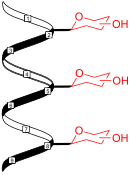
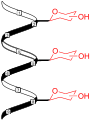
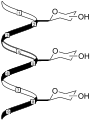
Molecular architecture with carbohydrate functionalized β-peptides adopting 314-helical conformation
Beilstein J. Org. Chem. 2014, 10, 948–955, doi:10.3762/bjoc.10.93
- ]. Formation of compound 10c is in accordance with the Felkin–Anh model. In case of compound 9c, the TS 2 (Figure 4) is favourable with the attack of ammonia to the C=C double bond from the si-face affording compound 10c as the only product. Ester hydrolysis with lithium hydroxide followed by primary amine


Primary-tertiary diamine-catalyzed Michael addition of ketones to isatylidenemalononitrile derivatives
Beilstein J. Org. Chem. 2014, 10, 929–935, doi:10.3762/bjoc.10.91
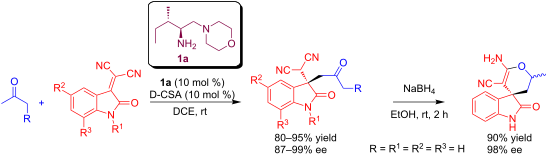
- serve as important precursors to procure various structurally diverse spirooxindoles [23][24]. Over the years, many chiral organocatalysts have been developed and explored for Michael reactions [1][2][3][4][5][6][7][8]. Recently, aminocatalysts – in particular those bearing a primary amine moiety – have
- been found to catalyze a variety of carbon–carbon bond-forming reactions [25][26][27][28][29][30]. Small peptides derived from acyclic amino acids, primary-secondary diamines, Cinchona-based primary amines, and thioureas with a primary amine functionality etc., have found many successful applications
- 86% yield and 88% ee (Table 5, entry 9). A recently reported similar reaction catalyzed by Cinchona alkaloid-based primary amine catalyst requires high catalyst loading and is only suitable for N-unprotected isatylidenemalononitrile derivatives [5]. In contrast, our methodology is suitable for both N





