


Search results
Search for "scale-up" in Full Text gives 215 result(s) in Beilstein Journal of Organic Chemistry. Showing first 200.
Mechanochemical synthesis of hyper-crosslinked polymers: influences on their pore structure and adsorption behaviour for organic vapors
Beilstein J. Org. Chem. 2019, 15, 1154–1161, doi:10.3762/bjoc.15.112
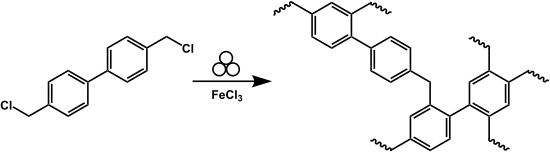
- that even small amounts of the monomer (3.2 mmol) lead to a swift and rise in vessel pressure exceeding 12 bar (Figure 3A) caused by the released HCl in the course of the reaction. This behaviour can be handled under laboratory conditions but is hampering the potential scale up of the process. In the


An improved synthesis of adefovir and related analogues
Beilstein J. Org. Chem. 2019, 15, 801–810, doi:10.3762/bjoc.15.77
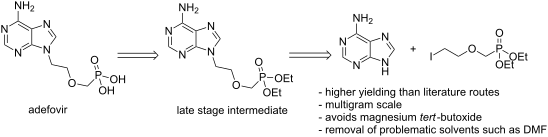
- a sticky resin on exposure to atmospheric moisture. This resin hinders the isolation of phosphonate 6 and stymies scale-up. Finally, several byproducts, including the ethyl ether of 4 and the hemi-dealkylated ester of 6, are produced during this reaction, further reducing the atom economy of this


An efficient and concise access to 2-amino-4H-benzothiopyran-4-one derivatives
Beilstein J. Org. Chem. 2019, 15, 703–709, doi:10.3762/bjoc.15.65
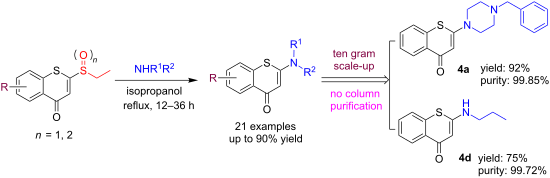
- and the substrate scope in terms of electronic properties of the substituents of the benzothiopyranone is broad. The ten grams scale-up synthesis of the representative compounds 4a and 4d was implemented to show the practical application of this reaction, which afforded the corresponding compounds in
- good yields and excellent chemical purity without requiring column chromatographical purification. Keywords: 2-amino-4H-benzothiopyran-4-ones; addition–elimination; scale-up synthesis; sulfinyl group; Introduction Benzothiopyranones are a class of molecules displaying biological activities in part
- chromatographical purification that was employed in the milligram-scale synthesis. Overall, this synthetic route is efficient and applicable to scale-up. Conclusion In summary, we have developed a facile and efficient strategy for the synthesis of 2-aminobenzothiopyranones through a conjugated addition–elimination


Low-budget 3D-printed equipment for continuous flow reactions
Beilstein J. Org. Chem. 2019, 15, 558–566, doi:10.3762/bjoc.15.50
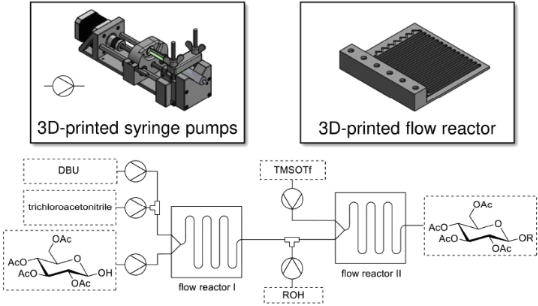
- like better mixing, more efficient heat transfer, and less scale-up problems [1]. For these reasons the number of publications in this field is rapidly increasing over the last decades. Another benefit of flow syntheses is the opportunity to perform multistep reactions with several reactors in a single


Asymmetric synthesis of a high added value chiral amine using immobilized ω-transaminases
Beilstein J. Org. Chem. 2019, 15, 60–66, doi:10.3762/bjoc.15.6
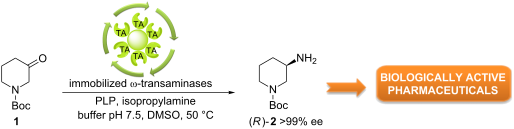
- on the substrate 1, no relevant changes in activity and selectivity were obtained. In order to optimize the reaction, some scale-up tests were performed using 200 mg of ATA-025-IMB and a substrate concentration of 40 g/L. Compared to the reactions carried out with smaller amounts of substrate, the


Assembly of fully substituted triazolochromenes via a novel multicomponent reaction or mechanochemical synthesis
Beilstein J. Org. Chem. 2018, 14, 2689–2697, doi:10.3762/bjoc.14.246
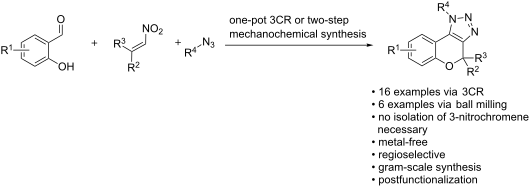
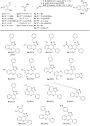
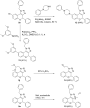
- triazolochromene 5a and obtained oxidized side product 6. Reaction pathways leading to the different regioisomers. Synthesis of bis-chromenotriazole 5p. Scale-up of the one-pot three-component reaction and two-step ball milling procedure. Postfunctional transformations of triazolochromenes. Supporting Information




Quinolines from the cyclocondensation of isatoic anhydride with ethyl acetoacetate: preparation of ethyl 4-hydroxy-2-methylquinoline-3-carboxylate and derivatives
Beilstein J. Org. Chem. 2018, 14, 2529–2536, doi:10.3762/bjoc.14.229

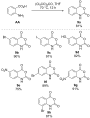
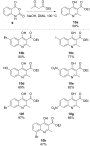
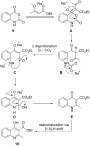
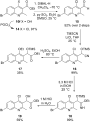
- the benzene ring of the quinolone [13]. The known synthesis of quinoline core 8 has been published in a one-pot, two-step reaction from 4-bromoaniline (7) and diethyl acetylsuccinate in 36% yield (Scheme 2) [14][15]. However, our attempts to repeat and scale-up this procedure beyond a few hundred
- hydroxide [19][20]. The use of sodium hydride is of particular concern upon reaction scale-up due to limited solubility in organic solvents and the production of flammable hydrogen gas [21][22]. Sodium hydroxide avoids the off-gassing of hydrogen and produces water instead, thereby avoiding the use of any




A general and atom-efficient continuous-flow approach to prepare amines, amides and imines via reactive N-chloramines
Beilstein J. Org. Chem. 2018, 14, 2220–2228, doi:10.3762/bjoc.14.196
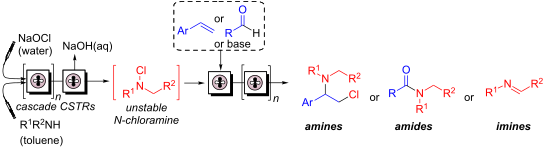
- upon scale-up makes this a useful reaction to translate to flow. Likewise, imines are an important class of compounds and are increasingly used as precursors to optically active amines [35][36][37][38][39]. Whilst normally prepared via a corresponding carbonyl compound, final dehydration can be


β-Hydroxy sulfides and their syntheses
Beilstein J. Org. Chem. 2018, 14, 1668–1692, doi:10.3762/bjoc.14.143
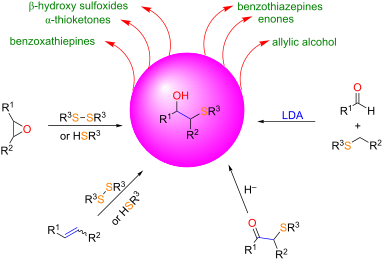
- . The arylthiols bearing chloro and fluoro substituents gave the expected β-hydroxy sulfides in moderate yields while the much deactivated nitro-thiophenol did not lead to any product formation. The protocol allowed easy scale-up to gram quantities. The results strongly supported a free radical


Anomeric modification of carbohydrates using the Mitsunobu reaction
Beilstein J. Org. Chem. 2018, 14, 1619–1636, doi:10.3762/bjoc.14.138
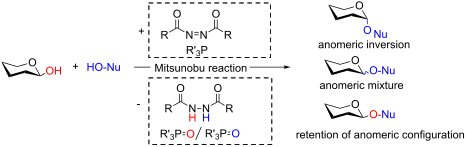
- text books claim. Unfortunately, the Mitsunobu reaction is uneasy to scale up and this is probably one of the biggest obstacles for a broad and also technical use of this reaction. Nevertheless, this review proves that in the glycosciences, the Mitsunobu reaction must not be overlooked as it is an


Direct electrochemical generation of organic carbonates by dehydrogenative coupling
Beilstein J. Org. Chem. 2018, 14, 1578–1582, doi:10.3762/bjoc.14.135
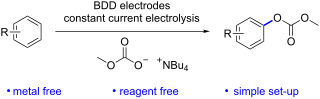
- within scale-up, when a significant effect of the electrode distance occurred (Figure 2). To generate a sufficient amount of material for work-up studies, we conducted conversions in 25 mL beaker-type cells. However, neither product formation nor conversion were observed. Since all parameters were


An efficient and facile access to highly functionalized pyrrole derivatives
Beilstein J. Org. Chem. 2018, 14, 884–890, doi:10.3762/bjoc.14.75
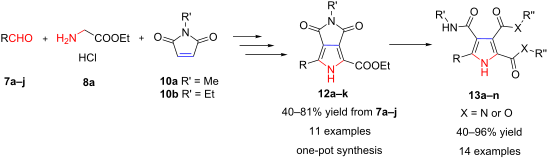
- another simple dipolarophile was also examined; the target product 12k was prepared smoothly in high yield (74%). This concise and efficient protocol displays the potentiality for scale-up synthesis of pyrrolo[3,4-c]pyrrole-1,3-diones. Having the pyrrolo[3,4-c]pyrrole-1,3-diones with diversified


Continuous-flow retro-Diels–Alder reaction: an efficient method for the preparation of pyrimidinone derivatives
Beilstein J. Org. Chem. 2018, 14, 318–324, doi:10.3762/bjoc.14.20
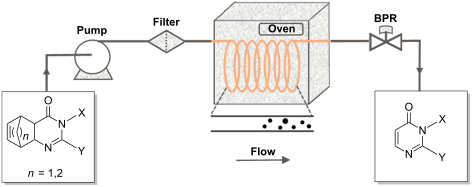
- optimization, acceleration [6], and easy scale-up with a wide and growing range of chemical transformations in combination with an inherently safe and green nature [7][8][9][10][11][12]. Advantageously, safety issues are complied with excellent mixing and heat transfer [7][8][9][10][11][12][13][14]. These


Halogen-containing thiazole orange analogues – new fluorogenic DNA stains
Beilstein J. Org. Chem. 2017, 13, 2902–2914, doi:10.3762/bjoc.13.283
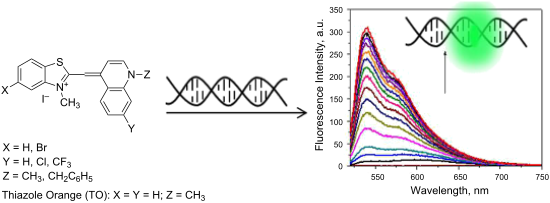
- -condensation of the resulting quaternary products. Carrying out the reaction in bulk without solvents allows scale-up of the quaternary salt synthesis and prevents possible environmental pollution. The known synthetic procedure [50][51] for the target dyes (Scheme 3) was modified to obtain the model compound
- solvents in organic synthesis. The reaction in water as a solvent provided moderate yields (procedures B1 and B2), but the subsequent scale-up of these reactions could be favorable on using intermediates with better water solubility. The best reaction yields for TO-7Cl were obtained on using procedure C1




The synthesis of the 2,3-difluorobutan-1,4-diol diastereomers
Beilstein J. Org. Chem. 2017, 13, 2883–2887, doi:10.3762/bjoc.13.280
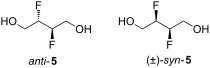
- protecting group resulted in a significant increase in mass, and therefore, chromatographic purification of the protected intermediates upon scale-up was inconvenient. As previously reported [17], epoxide opening of cis-2 with Olah’s reagent (HF·py) led to an 80% yield of the fluorohydrin after just three
- , on scale-up this proved inconvenient due to the large volumes of solvent required, and so these impurities were precipitated out the reaction mixture by cooling to 0 °C and collected by filtration through Celite. After work-up, the obtained epoxide was of high purity and no additional chromatographic
- ppm) [17]. Upon scale-up of the reaction to 10 g of (±)-trans-2, a similarly high yield of 90% (crude) was obtained, which again could be used directly in the next step without purification. Conversion of fluorohydrin (±)-anti-3 to difluoride (±)-syn-4 under the same conditions as shown in Scheme 2


A concise flow synthesis of indole-3-carboxylic ester and its derivatisation to an auxin mimic
Beilstein J. Org. Chem. 2017, 13, 2549–2560, doi:10.3762/bjoc.13.251
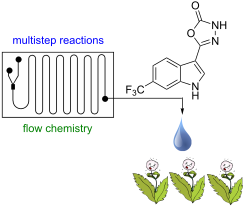
- Marcus Baumann Ian R. Baxendale Fabien Deplante Department of Chemistry, University of Durham, South Road, Durham, Durham, DH1 3LE, UK 10.3762/bjoc.13.251 Abstract An assembled suite of flow-based transformations have been used to rapidly scale-up the production of a novel auxin mimic-based


New bio-nanocomposites based on iron oxides and polysaccharides applied to oxidation and alkylation reactions
Beilstein J. Org. Chem. 2017, 13, 1982–1993, doi:10.3762/bjoc.13.194
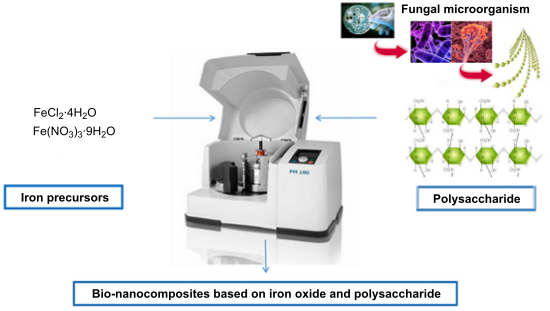
- both oxidation and acid catalyzed processes. Among all the known oxidative transformations, the oxidation of alcohols to ketones and aldehydes have gained a lot of attention for the research community due to its broad range of industrial applications [38][39]. Nonetheless, the scale up of the oxidation


Mechanochemical synthesis of small organic molecules
Beilstein J. Org. Chem. 2017, 13, 1907–1931, doi:10.3762/bjoc.13.186
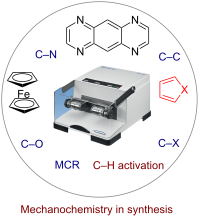
- Aleksanyan and co-workers reported the first gram-scale synthesis of a PdII organometallic pincer complex under mechanomilling via C–H bond activation. After successful isolation of the PdII pincer complex by grinding of bis(thiocarbamate) and PdCl2(NCPh)2 they could scale up the reaction up to 1.76 mmol


Influence of the milling parameters on the nucleophilic substitution reaction of activated β-cyclodextrins
Beilstein J. Org. Chem. 2017, 13, 1893–1899, doi:10.3762/bjoc.13.184
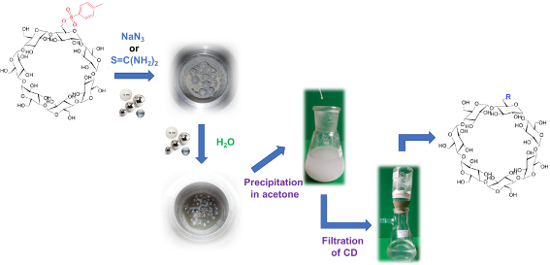
- materials, ball number and size, ball-to-powder mass ratio, the fraction of reactor volume occupied by balls and the reactor volume itself. Results and Discussion We previously reported [13] a successful scale-up monoazidation reaction of Ts-β-CD (the reaction scale was 6.5 g, 5 mmol) in a ball-mill


Accessing simply-substituted 4-hydroxytetrahydroisoquinolines via Pomeranz–Fritsch–Bobbitt reaction with non-activated and moderately-activated systems
Beilstein J. Org. Chem. 2017, 13, 1871–1878, doi:10.3762/bjoc.13.182
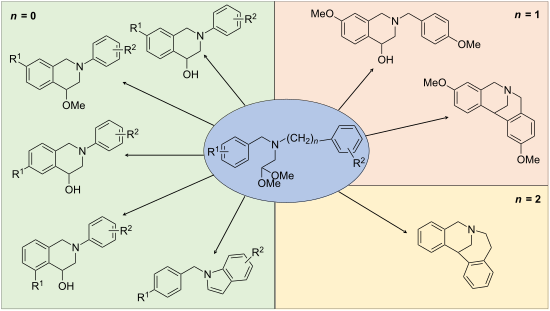
- catalyze the cyclization of 2-MeO compound 9n, rendering the target THIQ 10n inaccessible by this approach. In certain cases, during scale-up of the reaction to a gram scale, a minor product became clearly identifiable and could sometimes be isolated. Whenever the cyclization was possible in both the para


Solvent-free sonochemistry: Sonochemical organic synthesis in the absence of a liquid medium
Beilstein J. Org. Chem. 2017, 13, 1850–1856, doi:10.3762/bjoc.13.179
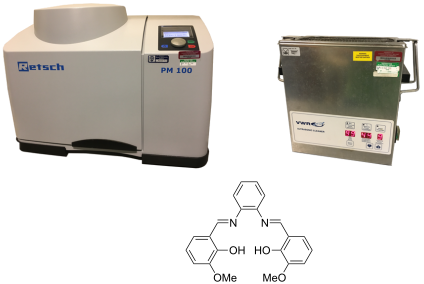
- ’) in the vial was required to accommodate this increase in pressure. A larger vial (25 mL) was then employed, which was able to sustain the pressure of the water vapour produced in the system, and with that there was a 5-fold scale-up of the reaction mixture from ca. 0.2 g to ca. 1.0 g. After 60
- carried out (where grinding results in degradation of the material). Finally, as with ball milling, there is potential for the scale-up of sonochemical reactions, therefore aiding in the drive towards sustainable chemistry. Typical laboratory employed planetary ball mill and ultrasonic bath. o-Vanillin in


Oxidative dehydrogenation of C–C and C–N bonds: A convenient approach to access diverse (dihydro)heteroaromatic compounds
Beilstein J. Org. Chem. 2017, 13, 1670–1692, doi:10.3762/bjoc.13.162
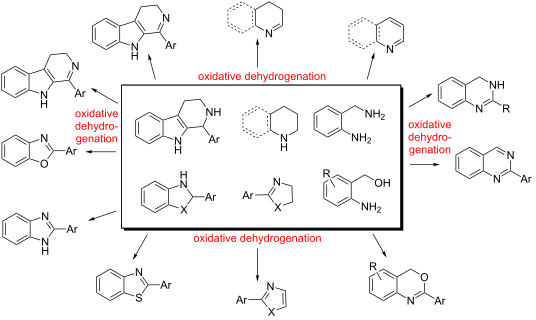
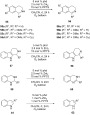
- benzoxazinoindolines 85 to benzoxazinoindoles 86 (found in elbasvir (87), a component of zepatier®, a combination therapeutic drug approved by FDA for curing Hepatitis C, Scheme 30). The robustness of the strategy is exemplified by demonstrating a successful scale-up reaction of 86 in 0.5 kg scale. The putative
- other chronic and acute neurogenerative diseases [99]. This molecule reached the clinical development phase, consequently a safe, robust and economic scale-up process was investigated by the researcher as the original process was incompatible towards scale-up. The investigation indeed provided a better
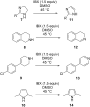
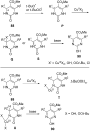
- scale-up process, where the key reaction, a Zeigler coupling, of an early trifluoromethylimidazole intermediate 100 with commercially available 2-chloro-5-fluoropyrimidine afforded 101 (a compound with partially saturated pyrimidine framework). An aerobic oxidative dehydrogenation of 101 in the presence








Synthesis of oligonucleotides on a soluble support
Beilstein J. Org. Chem. 2017, 13, 1368–1387, doi:10.3762/bjoc.13.134
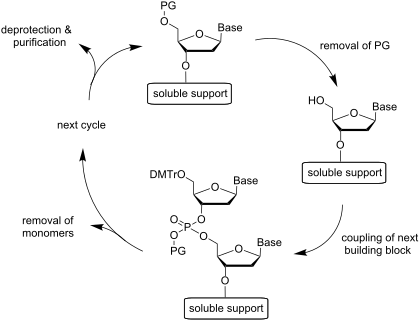
- blocks, (ii) the scale up procedure would be more straightforward and (iii) expensive solid support material is not needed. In addition, the possibility to characterize the growing chain by mass or NMR spectroscopy after each coupling is an attractive feature, although not possible with all soluble






G-Protein coupled receptors: answers from simulations
Beilstein J. Org. Chem. 2017, 13, 1071–1078, doi:10.3762/bjoc.13.106
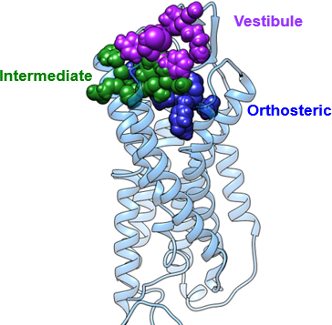
- specialized hardware such as Anton [25] but are less effective on more conventional massively parallel supercomputers because the simulations only scale up to a relatively limited number of CPUs or GPUs [35]. Luckily, of the many enhanced-sampling techniques [35], modern variations of metadynamics [27] can


A concise and practical stereoselective synthesis of ipragliflozin L-proline
Beilstein J. Org. Chem. 2017, 13, 1064–1070, doi:10.3762/bjoc.13.105
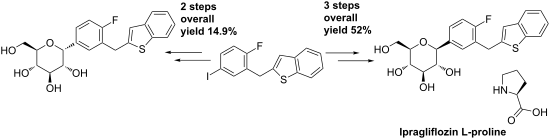
- prepare dapagliflozin and canagliflozin. However, these approaches might be difficult to scale up because of the involvements of complex synthetic procedures, chromatographic purification or expensive catalysts and ligands. Gong et al. [15] reported an approach to synthesise C-aryl glycosides based on a





