Search for "alkene" in Full Text gives 553 result(s) in Beilstein Journal of Organic Chemistry. Showing first 200.
Beilstein J. Org. Chem. 2022, 18, 926–934, doi:10.3762/bjoc.18.92
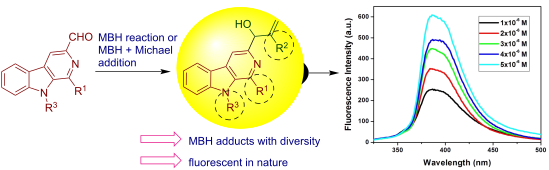
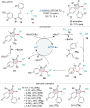
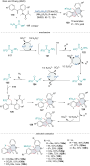
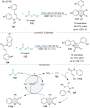
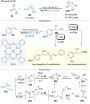
Graphical Abstract
Figure 1: Few examples of β-carboline-based drugs and bioactive natural products.
Figure 2: 1/3-Formyl-9H-β-carboline: new synthons for the synthesis of β-carboline-fused and substituted fram...
Figure 3: A summary of previous reports toward exploration of 3-formyl-9H-β-carbolines.
Scheme 1: Synthesis of 3-formyl-9H-pyrido[3,4-b]indole derivatives.
Scheme 2: Synthesis of C-3 substituted pyrido[3,4-b]indole MBH derivatives (7 and 8).
Scheme 3: Synthesis of C-3 substituted pyrido[3,4-b]indole MBH derivatives 10.
Figure 4: Library of C-3-substituted pyrido[3,4-b]indole MBH derivatives 7, 8 and 10.
Figure 5: Results of optimization for fluorescence studies: a) contact time; b) concentration; c) solvent.
Figure 6: Pictorial representation of structure–fluorescence activity relationship of C-3 substituted pyrido[...
Beilstein J. Org. Chem. 2022, 18, 889–915, doi:10.3762/bjoc.18.90
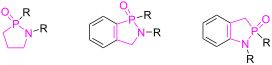
Graphical Abstract
Figure 1: Biologically active 1,2-azaphospholine 2-oxide derivatives.
Figure 2: Diverse synthetic strategies for the preparation of 1,2-azaphospholidine and 1,2-azaphospholine 2-o...
Scheme 1: Synthesis of 1-phenyl-2-phenylamino-γ-phosphonolactam (2) from N,N’-diphenyl 3-chloropropylphosphon...
Scheme 2: Synthesis of 2-ethoxy-1-methyl-γ-phosphonolactam (6) from ethyl N-methyl-(3-bromopropyl)phosphonami...
Scheme 3: Synthesis of 2-aryl-1-methyl-2,3-dihydrobenzo[c][1,2]azaphosphole 1-oxides 13 from N-aryl-2-chlorom...
Scheme 4: Synthesis of 2,3-dihydrobenzo[c][1,2]azaphosphole 1-oxides from alkylarylphosphinyl or diarylphosph...
Scheme 5: Synthesis of 3-arylmethylidene-2,3-dihydrobenzo[c][1,2]azaphosphole 1-oxides via the TBAF-mediated ...
Scheme 6: Synthesis of 2-hydrobenzo[c][1,2]azaphosphol-3-one 1-oxides via the metal-free intramolecular oxida...
Scheme 7: Synthesis of 1,3-dihydrobenzo[d][1,2]azaphosphole 2-oxides 42 and 44 from ethyl/benzyl 2-bromobenzy...
Scheme 8: Synthesis of azaphospholidine 2-oxides/sulfide from 1,2-oxaphospholane 2-oxides/sulfides and 1,2-th...
Scheme 9: Synthesis of 1,3-dihydrobenzo[d][1,2]azaphosphole 2-oxides/sulfides from 2-aminobenzyl(phenyl)phosp...
Scheme 10: Synthesis of 1,3-dihydrobenzo[d][1,2]azaphosphole 2-sulfide (59) from zwitterionic 2-aminobenzyl(ph...
Scheme 11: Synthesis of 1,3-dihydrobenzo[d][1,2]azaphosphole 2-oxides from 2-aminobenzyl(methyl/phenyl)phosphi...
Scheme 12: Synthesis of ethyl 2-methyl-1,2-azaphospholidine-5-carboxylate 2-oxide 69 from 2-amino-4-(hydroxy(m...
Scheme 13: Synthesis of 2-methoxy-1,3-dihydrobenzo[d][1,2]azaphosphole 2-oxide 71 from dimethyl 2-(methylamino...
Scheme 14: Synthesis of tricyclic γ-phosphonolactams via formation of the P–C bond.
Scheme 15: Synthesis of γ-phosphonolactams 85 from ethyl 2-(3-chloropropyl)aminoalkanoates with diethyl chloro...
Scheme 16: Synthesis of N-phosphoryl- and N-thiophosphoryl-1,2-azaphospholidine 2-oxides 90/2-sulfides 91 from...
Scheme 17: Synthesis of 1-methyl-1,3-dihydrobenzo[d][1,2]azaphosphole 2-oxides 56a and 93 from P-(chloromethyl...
Scheme 18: Synthesis of 2-allylamino-1,5-dihydro-1,2-azaphosphole 2-oxides from N,N’-diallyl-vinylphosphonodia...
Scheme 19: Diastereoselective synthesis of 2-allylamino-1,5-dihydro-1,2-azaphosphole 2-oxides from N,N’-dially...
Scheme 20: Synthesis of 1-alkyl-3-benzoyl-2-ethoxy-1,3-dihydrobenzo[d][1,2]azaphosphole 2-oxides 106 from ethy...
Scheme 21: Synthesis of cyclohexadiene-fused γ-phosphinolactams from diphenyl-N-benzyl-N-methylphosphinamide (...
Scheme 22: Synthesis of cyclohexadiene-fused γ-phosphinolactams from diphenyl-N-alkyl-N-benzylphosphinamides.
Scheme 23: Synthesis of cyclohexadiene-fused γ-phosphinolactams from diphenyl-N-methyl-N-(1-phenylethyl)phosph...
Scheme 24: Synthesis of benzocyclohexadiene-fused γ-phosphinolactams from dinaphth-1-yl-N-alkyl-N-benzylphosph...
Scheme 25: Synthesis of benzocyclohexadiene-fused γ-phosphinolactams from dinaphth-1-yl-N-benzyl-N-methylphosp...
Scheme 26: Synthesis of carbonyl-containing benzocyclohexadiene-fused γ-phosphinolactams from dinaphth-1-yl-N-...
Scheme 27: Synthesis of benzocyclohexadiene-fused γ-phosphinolactams from dinaphthyl-N-benzyl-N-methylphosphin...
Scheme 28: Synthesis of cyclohexadiene-fused 1-(N-benzyl-N-methyl)amino-γ-phosphinolactams from aryl-N,N’-dibe...
Scheme 29: Synthesis of bis(cyclohexadiene-fused γ-phosphinolactam)s from bis(diphenyl-N-benzylphosphinamide)s....
Scheme 30: Synthesis of bis(hydroxymethyl-derived cyclohexadiene-fused γ-phosphinolactam)s from tetramethylene...
Scheme 31: Synthesis of 2-aryl/dimethylamino-1-ethoxy-2-hydrobenzo[c][1,2]azaphosphol-3-one 1-oxides from ethy...
Scheme 32: Synthesis of ethyl 2-ethoxy-1,2-azaphospholidine-4-carboxylate 2-oxides from ethyl 2-((chloro(ethox...
Scheme 33: Synthesis of (1S,3R)-2-(tert-butyldiphenylsilyl)-3-methyl-1-phenyl-2,3-dihydrobenzo[c][1,2]azaphosp...
Scheme 34: Synthesis of 2,3,3a,9a-tetrahydro-4H-1,2-azaphospholo[5,4-b]chromen-4-one (215) from 3-(phenylamino...
Scheme 35: Synthesis of quinoline-fused 1,2-azaphospholine 2-oxides from 2-azidoquinoline-3-carbaldehydes and ...
Scheme 36: Synthesis of 1-hydro-1,2-azaphosphol-5-one 2-oxide from cyanoacetohydrazide with phosphonic acid an...
Scheme 37: Synthesis of chromene-fused 5-oxo-1,2-azaphospolidine 2-oxides.
Scheme 38: Synthesis of (R)-1-phenyl-2-((R)-1-phenylethyl)-2-hydrobenzo[c][1,2]azaphosphol-3-one 1-oxide (239)...
Scheme 39: Synthesis of dihydro[1,2]azaphosphole 1-oxides from aryl/vinyl-N-phenylphosphonamidates and aryl-N-...
Scheme 40: Synthesis of 1,3-dihydro-[1,2]azaphospholo[5,4-b]pyridine 2-oxides.
Beilstein J. Org. Chem. 2022, 18, 769–780, doi:10.3762/bjoc.18.77
Graphical Abstract
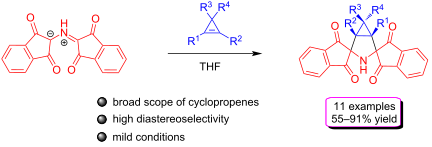
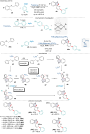
Scheme 1: Early studies concerning cyclopropene cycloadditions to azomethine ylides and cycloaddition reactio...
Scheme 2: The pilot experiment aimed at studying the cycloaddition reaction between the protonated form of Ru...
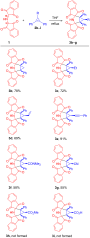
Scheme 3: Synthesis of meso-3'-azadispiro[indene-2,2'-bicyclo[3.1.0]hexane-4',2''-indene] derivatives 3b–g vi...
Figure 1: ORTEP representation of the molecular structure of 3e.
Scheme 4: The reaction of protonated Ruhemann's purple (1) with 3-methyl-3-phenylcyclopropene (2j).
Scheme 5: Attempts to carry out the cycloaddition reactions between 3,3-disubstituted cyclopropenes 2k,l and ...
Scheme 6: The reactions of protonated Ruhemann's purple (1) with unstable cyclopropenes 2m–p.
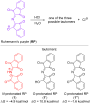
Scheme 7: The acid–base reaction of Ruhemann's purple with hydrochloric acid and relative Gibbs free energy c...
Scheme 8: Plausible mechanism of the 1,3-DC reaction of protonated Ruhemann's purple (1) with 3-methyl-3-phen...
Scheme 9: Plausible mechanism of the 1,3-DC reaction of protonated Ruhemann's purple (1) with 1-chloro-2-phen...
Beilstein J. Org. Chem. 2022, 18, 754–768, doi:10.3762/bjoc.18.76
Graphical Abstract
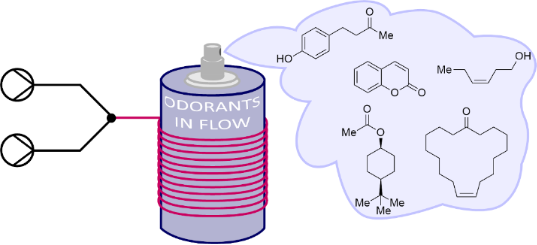
Figure 1: The olfactory spectrum wheel ordering different types of odorants from fruity to musky.
Figure 2: Classification of odorants as “top note”, “middle note” and “base note” depending on their substant...
Scheme 1: Synthesis of raspberry ketone (5) and raspberry ketone methyl ether (6) in two steps in flow.
Scheme 2: Autoxidation of (+)-valencene (7) to (+)-nootkatone (8) under catalyst and solvent-free conditions ...
Scheme 3: Enzyme-catalyzed acetylation of isoamyl alcohol (9) in a biphasic n-heptane/water mixture utilizing...
Scheme 4: Esterification of alcohols by transesterification, catalyzed by immobilized acyltransferase in a pa...
Scheme 5: Synthesis of homologated alcohols 20 by iterative homologation of terpenyl boronate esters 17 follo...
Scheme 6: Sequential three-step synthesis of (S)-α-phellandrene (30) from (R)-carvone (25) via selective hydr...
Scheme 7: Selective hydrogenation of alkyne 31 to “leaf alcohol” 32 employing a solid-supported palladium cat...
Scheme 8: A) Synthesis of jasmonal (35) by crossed aldol condensation of benzaldehyde (33) and heptanal (34) ...
Scheme 9: Synthesis of thymol (41) from m-cresol (39) and isopropyl alcohol via Fries-type rearrangement of e...
Scheme 10: Preparation of coumarin (46) by reaction of salicylaldehyde (44) with potassium acetate, acetic aci...
Scheme 11: Synthesis of phthalide (50) by photoinduced decatungstate catalysis.
Scheme 12: Synthesis of woody acetate (54) by reduction of cyclohexanone 51 and subsequent acetylation; ADH200...
Scheme 13: Synthesis of juniper lactone (56) by pyrolysis of triperoxide 55 generated by oxidation of cyclohex...
Scheme 14: Synthesis of macrocyclic olefine 60 by ring-closing metathesis of diene 58 in a continuously stirre...
Scheme 15: Synthesis of macrocycles 65 and 66 by ring-closing metathesis of dienes 62 or 63, respectively, in ...
Scheme 16: Z-Selective synthesis of civetone (69) enabled by metathesis catalyst 68 in a tube-in-tube reactor.
Scheme 17: Synthesis of macrocyclic olefine 72 by ring-closing metathesis of diene 70.
Beilstein J. Org. Chem. 2022, 18, 746–753, doi:10.3762/bjoc.18.75
Graphical Abstract
Figure 1: Highly reactive dienophiles.
Figure 2: Dibromide substrates and product 12.
Scheme 1: Mechanochemical reaction of 10 with anthracene.
Figure 3: Scope of the Zn/Cu reaction with dibromide 10 (dienes are colored in red).
Scheme 2: Mechanochemical reaction of 11 with furan.
Scheme 3: Reactivity of bicyclo[2.2.2] dibromide 42 with dienes.
Beilstein J. Org. Chem. 2022, 18, 381–419, doi:10.3762/bjoc.18.43
Graphical Abstract
Figure 1: Natural bioactive naphthoquinones.
Figure 2: Chemical structures of vitamins K.
Figure 3: Redox cycle of menadione.
Scheme 1: Selected approaches for menadione synthesis using silver(I) as a catalyst.
Scheme 2: Methylation approaches for the preparation of menadione from 1,4-naphthoquinone using tert-butyl hy...
Scheme 3: Methylation approach of 1,4-naphthoquinone using i) rhodium complexes/methylboronic acid and ii) bi...
Scheme 4: Synthesis of menadione (10) from itaconic acid.
Scheme 5: Menadione synthesis via Diels–Alder reaction.
Scheme 6: Synthesis of menadione (10) using p-cresol as a synthetic precursor.
Scheme 7: Synthesis of menadione (10) via demethoxycarbonylating annulation of methyl methacrylate.
Scheme 8: Furan 34 used as a diene in a Diels–Alder reaction for the synthesis of menadione (10).
Scheme 9: o-Toluidine as a dienophile in a Diels–Alder reaction for the synthesis of menadione (10).
Scheme 10: Representation of electrochemical synthesis of menadione.
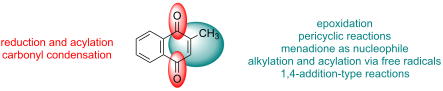
Figure 4: Reaction sites and reaction types of menadione as substrate.
Scheme 11: DBU-catalyzed epoxidation of menadione (10).
Scheme 12: Phase-transfer catalysis for the epoxidation of menadione.
Scheme 13: Menadione epoxidation using a hydroperoxide derived from (+)-norcamphor.
Scheme 14: Enantioselective Diels–Alder reaction for the synthesis of asymmetric quinone 50 catalyzed by a chi...
Scheme 15: Optimized reaction conditions for the synthesis of anthra[9,1-bc]pyranone.
Scheme 16: Synthesis of anthra[9,1-bc]furanone, anthra[9,1-bc]pyridine, and anthra[9,1-bc]pyrrole derivatives.
Scheme 17: Synthesis of derivatives employing protected trienes.
Scheme 18: Synthesis of cyclobutene derivatives of menadione.
Scheme 19: Menadione reduction reactions using sodium hydrosulfite.
Scheme 20: Green methodology for menadiol synthesis and pegylation.
Scheme 21: Menadione reduction by 5,6-O-isopropylidene-ʟ-ascorbic acid under UV light irradiation.
Scheme 22: Selected approaches of menadione hydroacetylation to diacetylated menadiol.
Scheme 23: Thiele–Winter reaction catalyzed by Bi(OTf)3.
Scheme 24: Carbonyl condensation of menadione using resorcinol and a hydrazone derivative.
Scheme 25: Condensation reaction of menadione with thiosemicarbazide.
Scheme 26: Condensation reaction of menadione with acylhydrazides.
Scheme 27: Menadione derivatives functionalized with organochalcogens.
Scheme 28: Synthesis of selenium-menadione conjugates derived from chloromethylated menadione 84.
Scheme 29: Menadione alkylation by the Kochi–Anderson method.
Scheme 30: Menadione alkylation by diacids.
Scheme 31: Menadione alkylation by heterocycles-substituted carboxylic acids.
Scheme 32: Menadione alkylation by bromoalkyl-substituted carboxylic acids.
Scheme 33: Menadione alkylation by complex carboxylic acids.
Scheme 34: Kochi–Anderson method variations for the menadione alkylation via oxidative decarboxylation of carb...
Scheme 35: Copper-catalyzed menadione alkylation via free radicals.
Scheme 36: Nickel-catalyzed menadione cyanoalkylation.
Scheme 37: Iron-catalyzed alkylation of menadione.
Scheme 38: Selected approaches to menadione alkylation.
Scheme 39: Menadione acylation by photo-Friedel–Crafts acylation reported by Waske and co-workers.
Scheme 40: Menadione acylation by Westwood procedure.
Scheme 41: Synthesis of 3-benzoylmenadione via metal-free TBAI/TBHP system.
Scheme 42: Michael-type addition of amines to menadione reported by Kallmayer.
Scheme 43: Synthesis of amino-menadione derivatives using polyalkylamines.
Scheme 44: Selected examples for the synthesis of different amino-substituted menadione derivatives.
Scheme 45: Selected examples of Michael-type addition of complex amines to menadione (10).
Scheme 46: Addition of different natural α-amino acids to menadione.
Scheme 47: Michael-type addition of amines to menadione using silica-supported perchloric acid.
Scheme 48: Indolylnaphthoquinone or indolylnaphthalene-1,4-diol synthesis reported by Yadav et al.
Scheme 49: Indolylnaphthoquinone synthesis reported by Tanoue and co-workers.
Scheme 50: Indolylnaphthoquinone synthesis from menadione by Escobeto-González and co-workers.
Scheme 51: Synthesis of menadione analogues functionalized with thiols.
Scheme 52: Synthesis of menadione-derived symmetrical derivatives through reaction with dithiols.
Scheme 53: Mercaptoalkyl acids as nucleophiles in Michael-type addition reaction to menadione.
Scheme 54: Reactions of menadione (10) with cysteine derivatives for the synthesis of quinoproteins.
Scheme 55: Synthesis of menadione-glutathione conjugate 152 by Michael-type addition.
Beilstein J. Org. Chem. 2022, 18, 337–349, doi:10.3762/bjoc.18.38
Graphical Abstract
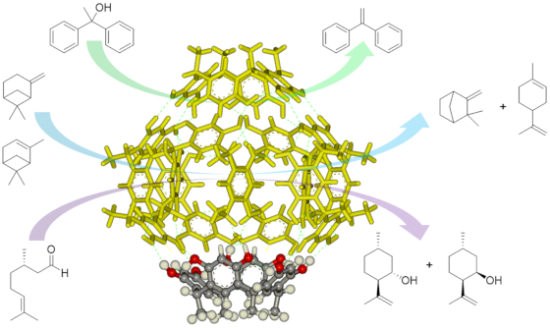
Scheme 1: Resorcin[4]arene 1 forming the corresponding hexameric capsule 16 and the species used for control ...
Scheme 2: Carbonyl–ene intramolecular cyclization of (S)-citronellal to the corresponding diastereoisomeric c...
Figure 1: 1H NMR spectra in water-saturated CDCl3 except for G. A: [16] (7.5 mM); B: citronellal; C: citronel...
Scheme 3: Dehydration reaction of 1,1-diphenylethanol to 1,1-diphenylethylene.
Figure 2: 1H NMR spectra in water-saturated CDCl3 except for G. A: [16] (7.5 mM); B: 1,1-diphenylethanol; C: ...
Scheme 4: Possible isomerization products from β-pinene and α-pinene.
Figure 3: 1H NMR spectra in water-saturated CDCl3 except for G. A: [16] (7.5 mM); B: α-pinene; C: α-pinene (7...
Figure 4: 1H NMR spectra in water-saturated CDCl3 except for G. A: [16] (7.5 mM); B: β-pinene; C: β-pinene (7...
Figure 5: 1H NMR spectra in water-saturated CDCl3, except for E. A: [16] (7.5 mM); B: β-pinene; C: β-pinene (...
Beilstein J. Org. Chem. 2022, 18, 309–324, doi:10.3762/bjoc.18.35
Graphical Abstract
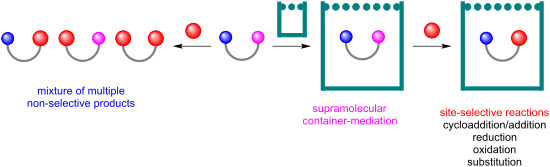
Figure 1: Site-selective Diels–Alder reaction of anthracene and phthalimide mediated by aqueous organopalladi...
Figure 2: Site-selective Diels–Alder and [2 + 2]-photoaddition reactions between naphthalene and phthalimide ...
Figure 3: Cage host A-mediated selective 1,4-radical addition of o-quinone 10.
Figure 4: Cyclodextrin-mediated site-selective reductions.
Figure 5: Selective reduction of an α,ω-diazide compound mediated by water-soluble cavitand D.
Figure 6: Selective radical reduction of α,ω-dihalides mediated by water-soluble cavitands E and F.
Figure 7: Site-selective hydrogenation of polyenols mediated by supramolecular encapsulated rhodium catalyst.
Figure 8: Site-selective oxidation of steroids using cyclodextrin as the anchoring template.
Figure 9: Site-selective oxidations of linear diterpenoids with the help of cage host A.
Figure 10: Site-selective monoepoxidation of α,ω-dienes mediated by the water-soluble cavitand host E.
Figure 11: Site-selective ring-opening reaction of epoxides mediated by cavitand I with an inwardly directed c...
Figure 12: Site-selective nucleophilic substitution reaction of allylic chlorides mediated by cage host J.
Figure 13: Site-selective monohydrolysis of α,ω-difunctional compounds using deep water-soluble cavitands.
Beilstein J. Org. Chem. 2022, 18, 251–261, doi:10.3762/bjoc.18.30
Graphical Abstract
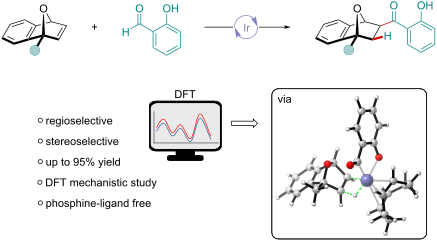
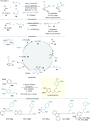
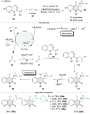
Scheme 1: Previously reported metal-catalyzed reactions of heterobicyclic alkenes and applications towards th...
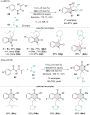
Scheme 2: Iridium-catalyzed hydroacylation of C1-substituted OBDs 13a–k with salicylaldehyde 14.
Scheme 3: Competition reaction of different C1-substituted OBDs.
Figure 1: Potential energy profile of the PCM solvation model for the hydrometalation/reductive elimination p...
Figure 2: Potential energy profile of the PCM solvation model for the carbometalation/reductive elimination p...
Figure 3: Potential energy profile of the PCM solvation model for the endo hydrometalation/reductive eliminat...
Figure 4: Potential energy profile of the PCM solvation model for the Ir/diene-catalyzed hydroacylation of Me...
Beilstein J. Org. Chem. 2022, 18, 232–239, doi:10.3762/bjoc.18.27
Graphical Abstract
Scheme 1: Methods for accessing 1,3,4-oxadiazoles.
Scheme 2: Synthesis of acyl hydrazones 1a–j.
Scheme 3: Iodine-mediated cyclisation of hydrazones 1a–j yielding oxadiazoles 2a–j. Reaction conditions: 1a–j...
Scheme 4: Synthesis of complex oxadiazoles.
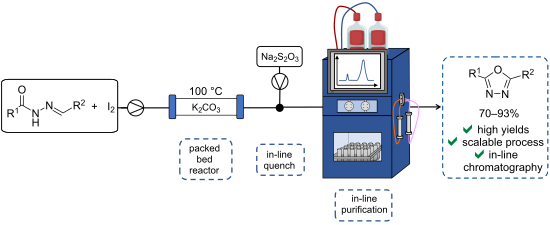
Scheme 5: Continuous flow scale-up reaction with in-line quench and extraction.
Scheme 6: Continuous flow setup equipped with in-line extraction and purification.
Beilstein J. Org. Chem. 2022, 18, 120–132, doi:10.3762/bjoc.18.13
Graphical Abstract
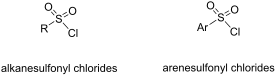
Scheme 1: Organic reactions where the breaking of a C–X bond involves the formation of a high energy ion-pair...
Scheme 2: The chemical structures for the 1-adamantyl substrate, 2-adamantyl substrate, and the S-methyldiben...
Figure 1: The SN2 reaction plot of log (k/ko) vs (1.26 NT + 0.65 YCl) for the solvolyses of benzesulfonyl chl...
Figure 2: The SN2 reaction plot of log (k/ko) vs (1.35 NT + 0.70 YCl) for the solvolyses of 2-thiophenesulfon...
Beilstein J. Org. Chem. 2022, 18, 86–88, doi:10.3762/bjoc.18.8
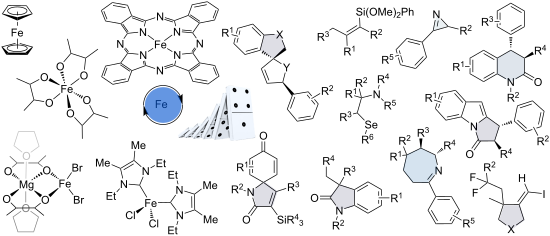
Beilstein J. Org. Chem. 2021, 17, 2848–2893, doi:10.3762/bjoc.17.196
Graphical Abstract
Figure 1: Price comparison among iron and other transition metals used in catalysis.
Scheme 1: Typical modes of C–C bond formation.
Scheme 2: The components of an iron-catalyzed domino reaction.
Scheme 3: Iron-catalyzed tandem cyclization and cross-coupling reactions of iodoalkanes 1 with aryl Grignard ...
Scheme 4: Three component iron-catalyzed dicarbofunctionalization of vinyl cyclopropanes 14.
Scheme 5: Three-component iron-catalyzed dicarbofunctionalization of alkenes 21.
Scheme 6: Double carbomagnesiation of internal alkynes 31 with alkyl Grignard reagents 32.
Scheme 7: Iron-catalyzed cycloisomerization/cross-coupling of enyne derivatives 35 with alkyl Grignard reagen...
Scheme 8: Iron-catalyzed spirocyclization/cross-coupling cascade.
Scheme 9: Iron-catalyzed alkenylboration of alkenes 50.
Scheme 10: N-Alkyl–N-aryl acrylamide 60 CDC cyclization with C(sp3)–H bonds adjacent to a heteroatom.
Scheme 11: 1,2-Carboacylation of activated alkenes 60 with aldehydes 65 and alcohols 67.
Scheme 12: Iron-catalyzed dicarbonylation of activated alkenes 68 with alcohols 67.
Scheme 13: Iron-catalyzed cyanoalkylation/radical dearomatization of acrylamides 75.
Scheme 14: Synergistic photoredox/iron-catalyzed 1,2-dialkylation of alkenes 82 with common alkanes 83 and 1,3...
Scheme 15: Iron-catalyzed oxidative coupling/cyclization of phenol derivatives 86 and alkenes 87.
Scheme 16: Iron-catalyzed carbosulfonylation of activated alkenes 60.
Scheme 17: Iron-catalyzed oxidative spirocyclization of N-arylpropiolamides 91 with silanes 92 and tert-butyl ...
Scheme 18: Iron-catalyzed free radical cascade difunctionalization of unsaturated benzamides 94 with silanes 92...
Scheme 19: Iron-catalyzed cyclization of olefinic dicarbonyl compounds 97 and 100 with C(sp3)–H bonds.
Scheme 20: Radical difunctionalization of o-vinylanilides 102 with ketones and esters 103.
Scheme 21: Dehydrogenative 1,2-carboamination of alkenes 82 with alkyl nitriles 76 and amines 105.
Scheme 22: Iron-catalyzed intermolecular 1,2-difunctionalization of conjugated alkenes 107 with silanes 92 and...
Scheme 23: Four-component radical difunctionalization of chemically distinct alkenes 114/115 with aldehydes 65...
Scheme 24: Iron-catalyzed carbocarbonylation of activated alkenes 60 with carbazates 117.
Scheme 25: Iron-catalyzed radical 6-endo cyclization of dienes 119 with carbazates 117.
Scheme 26: Iron-catalyzed decarboxylative synthesis of functionalized oxindoles 130 with tert-butyl peresters ...
Scheme 27: Iron‑catalyzed decarboxylative alkylation/cyclization of cinnamamides 131/134.
Scheme 28: Iron-catalyzed carbochloromethylation of activated alkenes 60.
Scheme 29: Iron-catalyzed trifluoromethylation of dienes 142.
Scheme 30: Iron-catalyzed, silver-mediated arylalkylation of conjugated alkenes 115.
Scheme 31: Iron-catalyzed three-component carboazidation of conjugated alkenes 115 with alkanes 101/139b and t...
Scheme 32: Iron-catalyzed carboazidation of alkenes 82 and alkynes 160 with iodoalkanes 20 and trimethylsilyl ...
Scheme 33: Iron-catalyzed asymmetric carboazidation of styrene derivatives 115.
Scheme 34: Iron-catalyzed carboamination of conjugated alkenes 115 with alkyl diacyl peroxides 163 and acetoni...
Scheme 35: Iron-catalyzed carboamination using oxime esters 165 and arenes 166.
Scheme 36: Iron-catalyzed iminyl radical-triggered [5 + 2] and [5 + 1] annulation reactions with oxime esters ...
Scheme 37: Iron-catalyzed decarboxylative alkyl etherification of alkenes 108 with alcohols 67 and aliphatic a...
Scheme 38: Iron-catalyzed inter-/intramolecular alkylative cyclization of carboxylic acid and alcohol-tethered...
Scheme 39: Iron-catalyzed intermolecular trifluoromethyl-acyloxylation of styrene derivatives 115.
Scheme 40: Iron-catalyzed carboiodination of terminal alkenes and alkynes 180.
Scheme 41: Copper/iron-cocatalyzed cascade perfluoroalkylation/cyclization of 1,6-enynes 183/185.
Scheme 42: Iron-catalyzed stereoselective carbosilylation of internal alkynes 187.
Scheme 43: Synergistic photoredox/iron catalyzed difluoroalkylation–thiolation of alkenes 82.
Scheme 44: Iron-catalyzed three-component aminoazidation of alkenes 82.
Scheme 45: Iron-catalyzed intra-/intermolecular aminoazidation of alkenes 194.
Scheme 46: Stereoselective iron-catalyzed oxyazidation of enamides 196 using hypervalent iodine reagents 197.
Scheme 47: Iron-catalyzed aminooxygenation for the synthesis of unprotected amino alcohols 200.
Scheme 48: Iron-catalyzed intramolecular aminofluorination of alkenes 209.
Scheme 49: Iron-catalyzed intramolecular aminochlorination and aminobromination of alkenes 209.
Scheme 50: Iron-catalyzed intermolecular aminofluorination of alkenes 82.
Scheme 51: Iron-catalyzed aminochlorination of alkenes 82.
Scheme 52: Iron-catalyzed phosphinoylazidation of alkenes 108.
Scheme 53: Synergistic photoredox/iron-catalyzed three-component aminoselenation of trisubstituted alkenes 82.
Beilstein J. Org. Chem. 2021, 17, 2729–2764, doi:10.3762/bjoc.17.185
Graphical Abstract
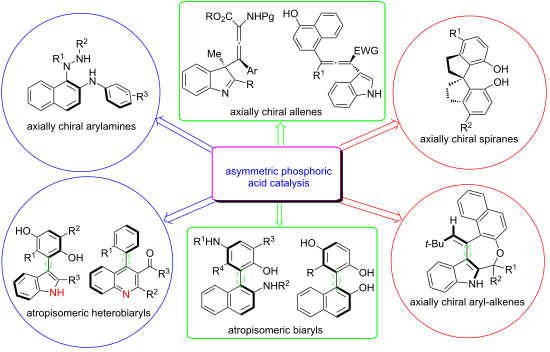
Figure 1: Representative examples of axially chiral biaryls, heterobiaryls, spiranes and allenes as ligands a...
Figure 2: Selected examples of axially chiral drugs and bioactive molecules.
Figure 3: Axially chiral functional materials and supramolecules.
Figure 4: Important chiral phosphoric acid scaffolds used in this review.
Scheme 1: Atroposelective aryl–aryl-bond formation by employing a facile [3,3]-sigmatropic rearrangement.
Scheme 2: Atroposelective synthesis of axially chiral biaryl amino alcohols 5.
Scheme 3: The enantioselective reaction of quinone and 2-naphthol derivatives.
Scheme 4: Enantioselective synthesis of multisubstituted biaryls.
Scheme 5: Enantioselective synthesis of axially chiral quinoline-derived biaryl atropisomers mediated by chir...
Scheme 6: Pd-Catalyzed atroposelective C–H olefination of biarylamines.
Scheme 7: Palladium-catalyzed directed atroposelective C–H allylation.
Scheme 8: Enantioselective synthesis of axially chiral (a) aryl indoles and (b) biaryldiols.
Scheme 9: Asymmetric arylation of indoles enabled by azo groups.
Scheme 10: Proposed mechanism for the asymmetric arylation of indoles.
Scheme 11: Enantioselective synthesis of axially chiral N-arylindoles [38].
Scheme 12: Enantioselective [3 + 2] formal cycloaddition and central-to-axial chirality conversion.
Scheme 13: Organocatalytic atroposelective arene functionalization of nitrosonaphthalene with indoles.
Scheme 14: Proposed reaction mechanism for the atroposelective arene functionalization of nitrosonaphthalenes.
Scheme 15: Asymmetric construction of axially chiral naphthylindoles [65].
Scheme 16: Enantioselective synthesis of axially chiral 3,3’-bisindoles [66].
Scheme 17: Atroposelective synthesis of 3,3’-bisiindoles bearing axial and central chirality.
Scheme 18: Enantioselective synthesis of axially chiral 3,3’-bisindoles bearing single axial chirality.
Scheme 19: Enantioselective reaction of azonaphthalenes with various pyrazolones.
Scheme 20: Enantioselective and atroposelective synthesis of axially chiral N-arylcarbazoles [73].
Scheme 21: Atroposelective cyclodehydration reaction.
Scheme 22: Atroposelective construction of axially chiral N-arylbenzimidazoles [78].
Scheme 23: Proposed reaction mechanism for the atroposelective synthesis of axially chiral N-arylbenzimidazole...
Scheme 24: Atroposelective synthesis of axially chiral arylpyrroles [21].
Scheme 25: Synthesis of axially chiral arylquinazolinones and its reaction pathway [35].
Scheme 26: Synthesis of axially chiral aryquinoline by Friedländer heteroannulation reaction and its proposed...
Scheme 27: Povarov cycloaddition–oxidative chirality conversion process.
Scheme 28: Atroposelective synthesis of oxindole-based axially chiral styrenes via kinetic resolution.
Scheme 29: Synthesis of axially chiral alkene-indole frame works [45].
Scheme 30: Proposed reaction mechanism for axially chiral alkene-indoles.
Scheme 31: Atroposelective C–H aminations of N-aryl-2-naphthylamines with azodicarboxylates.
Scheme 32: Synthesis of brominated atropisomeric N-arylquinoids.
Scheme 33: The enantioselective syntheses of axially chiral SPINOL derivatives.
Scheme 34: γ-Addition reaction of various 2,3-disubstituted indoles to β,γ-alkynyl-α-imino esters.
Scheme 35: Regio- and stereoselective γ-addition reactions of isoxazol-5(4H)-ones to β,γ-alkynyl-α-imino ester...
Scheme 36: Synthesis of chiral tetrasubstituted allenes and naphthopyrans.
Scheme 37: Asymmetric remote 1,8-conjugate additions of thiazolones and azlactones to propargyl alcohols.
Scheme 38: Synthesis of chiral allenes from 1-substituted 2-naphthols [107].
Beilstein J. Org. Chem. 2021, 17, 2680–2715, doi:10.3762/bjoc.17.182
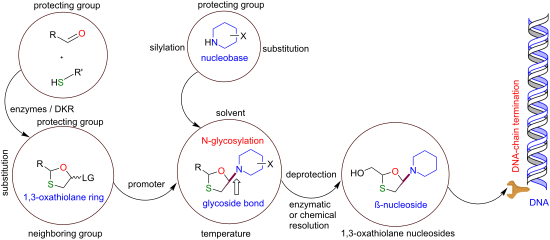
Graphical Abstract
Figure 1: Representative modified 1,3-oxathiolane nucleoside analogues.
Figure 2: Mechanism of antiviral action of 1,3-oxathiolane nucleosides, 3TC (1) and FTC (2), as chain termina...
Figure 3: Synthetic strategies for the construction of the 1,3-oxathiolane sugar ring.
Scheme 1: Synthesis of 4 from benzoyloxyacetaldehyde (3a) and 2-mercapto-substituted dimethyl acetal 3na.
Scheme 2: Synthesis of 8 from protected glycolic aldehyde 3b and 2-mercaptoacetic acid (3o).
Scheme 3: Synthesis of 20 from ᴅ-mannose (3c).
Scheme 4: Synthesis of 20 from 1,6-thioanhydro-ᴅ-galactose (3d).
Scheme 5: Synthesis of 8 from 2-(tert-butyldiphenylsilyloxy)methyl-5-oxo-1,2-oxathiolane (3m).
Scheme 6: Synthesis of 20a from ʟ-gulose derivative 3f.
Scheme 7: Synthesis of 31 from (+)-thiolactic acid 3p and 2-benzoyloxyacetaldehyde (3a).
Scheme 8: Synthesis of 35a from 1,4-dithiane-2,5-diol (3q) and glyoxylic acid (3g) hydrate.
Scheme 9: Synthetic routes toward 41 through Pummerer reaction from methyl 2-mercaptoacetate (3j) and bromoac...
Scheme 10: Strategy for the synthesis of 2,5-substituted 1,3-oxathiolane 41a using 4-nitrobenzyl glyoxylate an...
Scheme 11: Synthesis of 44 by a resolution method using Mucor miehei lipase.
Scheme 12: Synthesis of 45 from benzoyloxyacetaldehyde (3a) and 2-mercaptoacetaldehyde bis(2-methoxyethyl) ace...
Scheme 13: Synthesis of 46 from 2-mercaptoacetaldehyde bis(2-methoxyethyl) acetal (3nc) and diethyl 3-phosphon...
Scheme 14: Synthesis of 48 from 1,3-dihydroxyacetone dimer 3l.
Scheme 15: Approach toward 52 from protected alkene 3rb and lactic acid derivative 51 developed by Snead et al....
Scheme 16: Recent approach toward 56a developed by Kashinath et al.
Scheme 17: Synthesis of 56a from ʟ-menthyl glyoxylate (3h) hydrate by DKR.
Scheme 18: Possible mechanism with catalytic TEA for rapid interconversion of isomers.
Scheme 19: Synthesis of 35a by a classical resolution method through norephedrine salt 58 formation.
Scheme 20: Synthesis of 63 via [1,2]-Brook rearrangement from silyl glyoxylate 61 and thiol 3nb.
Scheme 21: Combined use of STS and CAL-B as catalysts to synthesize an enantiopure oxathiolane precursor 65.
Scheme 22: Synthesis of 1 and 1a from glycolaldehyde dimer 64 and 1,4-dithiane-2,5-diol (3q) using STS and CAL...
Scheme 23: Synthesis of 68 by using Klebsiella oxytoca.
Scheme 24: Synthesis of 71 and 72 using Trichosporon taibachii lipase and kinetic resolution.
Scheme 25: Synthesis of 1,3-oxathiolan-5-ones 77 and 78 via dynamic covalent kinetic resolution.
Figure 4: Pathway for glycosidic bond formation.
Scheme 26: First synthesis of (±)-BCH-189 (1c) by Belleau et al.
Scheme 27: Enantioselective synthesis of 3TC (1).
Scheme 28: Synthesis of cis-diastereomer 3TC (1) from oxathiolane propionate 44.
Scheme 29: Synthesis of (±)-BCH-189 (1c) via SnCl4-mediated N-glycosylation of 8.
Scheme 30: Synthesis of (+)-BCH-189 (1a) via TMSOTf-mediated N-glycosylation of 20.
Scheme 31: Synthesis of 3TC (1) from oxathiolane precursor 20a.
Scheme 32: Synthesis of 83 via N-glycosylation of 20 with pyrimidine bases.
Scheme 33: Synthesis of 85 via N-glycosylation of 20 with purine bases.
Scheme 34: Synthesis of 86 and 87 via N-glycosylation using TMSOTf and pyrimidines.
Scheme 35: Synthesis of 90 and 91 via N-glycosylation using TMSOTf and purines.
Scheme 36: Synthesis of 3TC (1) via TMSI-mediated N-glycosylation.
Scheme 37: Stereoselective N-glycosylation for the synthesis of 1 by anchimeric assistance of a chiral auxilia...
Scheme 38: Whitehead and co-workers’ approach for the synthesis of 1 via direct N-glycosylation without an act...
Scheme 39: ZrCl4-mediated stereoselective N-glycosylation.
Scheme 40: Plausible reaction mechanism for stereoselective N-glycosylation using ZrCl4.
Scheme 41: Synthesis of enantiomerically pure oxathiolane nucleosides 1 and 2.
Scheme 42: Synthesis of tetrazole analogues of 1,3-oxathiolane nucleosides 97.
Scheme 43: Synthetic approach toward 99 from 1,3-oxathiolane 45 by Camplo et al.
Scheme 44: Synthesis of 100 from oxathiolane phosphonate analogue 46.
Scheme 45: Synthetic approach toward 102 and the corresponding cyclic thianucleoside monophosphate 102a by Cha...
Scheme 46: Synthesis of emtricitabine (2) from 1,4-dithiane-2,5-diol (3q) and glyoxylic acid (3g).
Scheme 47: Synthesis of 1 and 2, respectively, from 56a–d using iodine-mediated N-glycosylation.
Scheme 48: Plausible mechanism for silane- and I2-mediated N-glycosylation.
Scheme 49: Pyridinium triflate-mediated N-glycosylation of 35a.
Scheme 50: Possible pathway for stereoselective N-glycosylation via in situ chelation with a metal ligand.
Scheme 51: Synthesis of novel 1,3-oxathiolane nucleoside 108 from oxathiolane precursor 8 and 3-benzyloxy-2-me...
Scheme 52: Synthesis of 110 using T-705 as a nucleobase and 1,3-oxathiolane derivative 8 via N-glycosylation.
Scheme 53: Synthesis of 1 using an asymmetric leaving group and N-glycosylation with bromine and mesitylene.
Scheme 54: Cytidine deaminase for enzymatic separation of 1c.
Scheme 55: Enzymatic resolution of the monophosphate derivative 116 for the synthesis of (−)-BCH-189 (1) and (...
Scheme 56: Enantioselective resolution by PLE-mediated hydrolysis to obtain FTC (2).
Scheme 57: (+)-Menthyl chloroformate as a resolving agent to separate a racemic mixture 120.
Scheme 58: Separation of racemic mixture 1c by cocrystal 123 formation with (S)-(−)-BINOL.
Beilstein J. Org. Chem. 2021, 17, 2642–2649, doi:10.3762/bjoc.17.177
Graphical Abstract
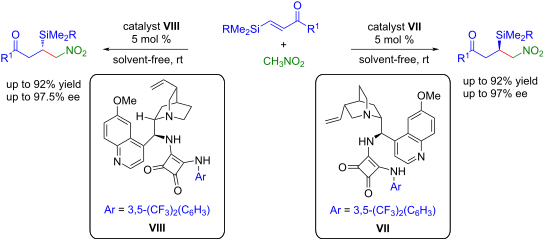
Scheme 1: Selected methods for the synthesis of enantioenriched β-silyl nitroalkanes, synthesis of chiral org...
Scheme 2: Scope of substrates. Reaction conditions: 1 (0.2 mmol), 2 (0.5 mmol), catalyst VII (0.01 mmol, 5 mo...
Scheme 3: Synthesis of ent-3. Reaction conditions: 1 (0.2 mmol), 2 (0.5 mmol), catalyst VIII (0.01 mmol, 5 mo...
Scheme 4: Organocatalytic 1,4-conjuagte addition of nitromethane (2) to enone 3o.
Figure 1: Single crystal X-ray structure of ent-3k (CCDC 2097263).
Scheme 5: Preparative scale synthesis of 3c and ent-3d.
Beilstein J. Org. Chem. 2021, 17, 2570–2584, doi:10.3762/bjoc.17.172
Graphical Abstract
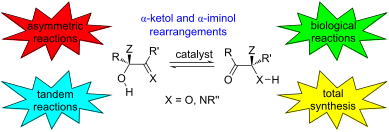
Figure 1: Generalized α-ketol or α-iminol rearrangement.
Figure 2: Nickel(II)-catalyzed enantioselective rearrangement of ketol 3 to form the ring-expanded and chiral...
Figure 3: Enantioselective ring expansion of β-hydroxy-α-dicarbonyl 6 catalyzed by a chiral copper-bisoxazoli...
Figure 4: Enantioselective rearrangement of ketols 9 and 12 and hydroxyaldimine 14 catalyzed by Al(III) or Sc...
Figure 5: Asymmetric rearrangement of α,α-dialkyl-α-siloxyaldehydes 16 to α-siloxyketones 17 catalyzed by chi...
Figure 6: BF3-promoted diastereospecific rearrangement of α-ketol 21 to difluoroalkoxyborane 22.
Figure 7: In the presence of a gold catalyst and water in 1,4-dioxane, 1-alkynylbutanol derivatives undergo t...
Figure 8: The diastereospecific α-ketol rearrangement of 32 to 33, part of the total synthesis of periconiano...
Figure 9: Two α-ketol rearrangements, one catalyzed by silica gel on 38 and the other by NaOMe on both 38 and ...
Figure 10: α-Ketol rearrangement of triumphalone (41) to isotriumphalone (42) via ring contraction.
Figure 11: Tandem reaction of strophasterol A synthetic intermediate 43 to 44 through a vinylogous α-ketol rea...
Figure 12: Tandem reaction consisting of a Diels–Alder cycloaddition followed by an α-ketol rearrangement, par...
Figure 13: Single-pot reaction consisting of Claisen and α-ketol rearrangements, part of the total synthesis o...
Figure 14: Enzyme-catalyzed α-ketol rearrangements. a) Ketol-acid reductoisomerase (KAR) catalyzes the rearran...
Figure 15: The conversion of asperfloroid (73) to asperflotone (72), featuring the ring-expanding α-ketol rear...
Figure 16: Hypothetical interconversion of natural products prekinamycin (76) and isoprekinamycin (77) and che...
Figure 17: Proposed biosynthetic pathway converting acylphloroglucinol (87) to isolated elodeoidins A–H 92–96....
Figure 18: α-Iminol rearrangements catalyzed by VANOL Zr (99). The rearrangement can be conducted with preform...
Figure 19: α-Iminol rearrangements catalyzed by silica gel and montmorillonite K 10. a) For 102a (102 with R =...
Figure 20: Synthesis of tryptamines 110 via a ring-contracting α‑iminol rearrangement. A mechanism for the fin...
Figure 21: Tandem synthesis of functionalized α-amino cyclopentanones 119 from heteroarenes 115 and cyclobutan...
Figure 22: Four eburnane-type alkaloid natural products 122–125 were synthesized from common intermediate 127,...
Beilstein J. Org. Chem. 2021, 17, 2520–2542, doi:10.3762/bjoc.17.169
Graphical Abstract
Scheme 1: Photoredox catalysis mechanism of [Ru(bpy)3]2+.
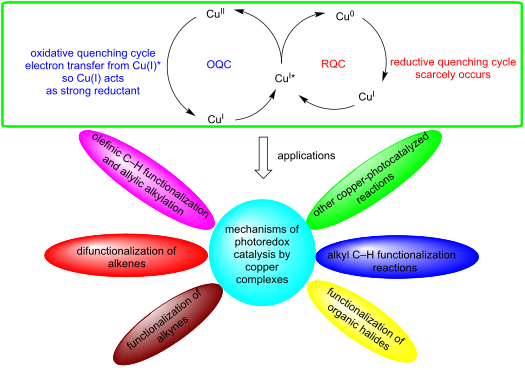
Scheme 2: Photoredox catalysis mechanism of CuI.
Scheme 3: Ligands and CuI complexes.
Scheme 4: Mechanism of CuI-based photocatalysis.
Scheme 5: Mechanisms of CuI–substrate complexes.
Scheme 6: Mechanism of CuII-base photocatalysis.
Scheme 7: Olefinic C–H functionalization and allylic alkylation.
Scheme 8: Cross-coupling of unactivated alkenes and CF3SO2Cl.
Scheme 9: Chlorosulfonylation/cyanofluoroalkylation of alkenes.
Scheme 10: Hydroamination of alkenes.
Scheme 11: Cross-coupling reaction of alkenes, alkyl halides with nucleophiles.
Scheme 12: Cross-coupling of alkenes with oxime esters.
Scheme 13: Oxo-azidation of vinyl arenes.
Scheme 14: Azidation/difunctionalization of vinyl arenes.
Scheme 15: Photoinitiated copper-catalyzed Sonogashira reaction.
Scheme 16: Alkyne functionalization reactions.
Scheme 17: Alkynylation of dihydroquinoxalin-2-ones with terminal alkynes.
Scheme 18: Decarboxylative alkynylation of redox-active esters.
Scheme 19: Aerobic oxidative C(sp)–S coupling reaction.
Scheme 20: Copper-catalyzed alkylation of carbazoles with alkyl halides.
Scheme 21: C–N coupling of organic halides with amides and aliphatic amines.
Scheme 22: Copper-catalyzed C–X (N, S, O) bond formation reactions.
Scheme 23: Arylation of C(sp2)–H bonds of azoles.
Scheme 24: C–C cross-coupling of aryl halides and heteroarenes.
Scheme 25: Benzylic or α-amino C–H functionalization.
Scheme 26: α-Amino C–H functionalization of aromatic amines.
Scheme 27: C–H functionalization of aromatic amines.
Scheme 28: α-Amino-C–H and alkyl C–H functionalization reactions.
Scheme 29: Other copper-photocatalyzed reactions.
Scheme 30: Cross-coupling of oxime esters with phenols or amines.
Scheme 31: Alkylation of heteroarene N-oxides.
Beilstein J. Org. Chem. 2021, 17, 2385–2389, doi:10.3762/bjoc.17.155
Graphical Abstract
Scheme 1: Dimerisation of α-lithio epoxides or aziridines [3-5].
Scheme 2: Proposed eliminative cross-coupling of carbenoids to allylic alcohols (X = O) or allylic amines (X ...
Scheme 3: Allylic alcohol 6 by one-carbon homologation from epoxide 5.
Scheme 4: Internal allylic alcohols from epoxides and stannane 7.
Scheme 5: Cyclopropylidene synthesis from epoxide 5.
Scheme 6: Synthesis of vinylsilane 14.
Scheme 7: Allylic alcohol 8 from epoxide 5 and sulfone 15.
Scheme 8: Allylic amines from aziridine 17.
Scheme 9: Cyclopropylidene synthesis from aziridine 20.
Scheme 10: Cinnamylamine 23 synthesis from aziridine 17.
Scheme 11: Cinnamylamine 23 synthesis from isopropyl or neopentyl benzylic ethers 26 and 27.
Beilstein J. Org. Chem. 2021, 17, 2348–2376, doi:10.3762/bjoc.17.153
Graphical Abstract
Scheme 1: Schematic representation of Hg(II)-mediated addition to an unsaturated bond.
Scheme 2: First report of Hg(II)-mediated synthesis of 2,5-dioxane derivatives from allyl alcohol.
Scheme 3: Stepwise synthesis of 2,6-distubstituted dioxane derivatives.
Scheme 4: Cyclization of carbohydrate alkene precursor.
Scheme 5: Hg(II)-mediated synthesis of C-glucopyranosyl derivatives.
Scheme 6: Synthesis of C-glycosyl amino acid derivative using Hg(TFA)2.
Scheme 7: Hg(OAc)2-mediated synthesis of α-ᴅ-ribose derivative.
Scheme 8: Synthesis of β-ᴅ-arabinose derivative 18.
Scheme 9: Hg(OAc)2-mediated synthesis of tetrahydrofuran derivatives.
Scheme 10: Synthesis of Hg(TFA)2-mediated bicyclic nucleoside derivative.
Scheme 11: Synthesis of pyrrolidine and piperidine derivatives.
Scheme 12: HgCl2-mediated synthesis of diastereomeric pyrrolidine derivatives.
Scheme 13: HgCl2-mediated cyclization of alkenyl α-aminophosphonates.
Scheme 14: Cyclization of 4-cycloocten-1-ol with Hg(OAc)2 forming fused bicyclic products.
Scheme 15: trans-Amino alcohol formation through Hg(II)-salt-mediated cyclization.
Scheme 16: Hg(OAc)2-mediated 2-aza- or 2-oxa-bicyclic ring formations.
Scheme 17: Hg(II)-salt-induced cyclic peroxide formation.
Scheme 18: Hg(OAc)2-mediated formation of 1,2,4-trioxanes.
Scheme 19: Endocyclic enol ether derivative formation through Hg(II) salts.
Scheme 20: Synthesis of optically active cyclic alanine derivatives.
Scheme 21: Hg(II)-salt-mediated formation of tetrahydropyrimidin-4(1H)-one derivatives.
Scheme 22: Cyclization of ether derivatives to form stereoselective oxazolidine derivatives.
Scheme 23: Cyclization of amide derivatives induced by Hg(OAc)2.
Scheme 24: Hg(OAc)2/Hg(TFA)2-promoted cyclization of salicylamide-derived amidal auxiliary derivatives.
Scheme 25: Hg(II)-salt-mediated cyclization to form dihydrobenzopyrans.
Scheme 26: HgCl2-induced cyclization of acetylenic silyl enol ether derivatives.
Scheme 27: Synthesis of exocyclic and endocyclic enol ether derivatives.
Scheme 28: Cyclization of trans-acetylenic alcohol by treatment with HgCl2.
Scheme 29: Synthesis of benzofuran derivatives in presence of HgCl2.
Scheme 30: a) Hg(II)-salt-mediated cyclization of 4-hydroxy-2-alkyn-1-ones to furan derivatives and b) its mec...
Scheme 31: Cyclization of arylacetylenes to synthesize carbocyclic and heterocyclic derivatives.
Scheme 32: Hg(II)-salt-promoted cyclization–rearrangement to form heterocyclic compounds.
Scheme 33: a) HgCl2-mediated cyclization reaction of tethered alkyne dithioacetals; and b) proposed mechanism.
Scheme 34: Cyclization of aryl allenic ethers on treatment with Hg(OTf)2.
Scheme 35: Hg(TFA)2-mediated cyclization of allene.
Scheme 36: Hg(II)-catalyzed intramolecular trans-etherification reaction of 2-hydroxy-1-(γ-methoxyallyl)tetrah...
Scheme 37: a) Cyclization of alkene derivatives by catalytic Hg(OTf)2 salts and b) mechanism of cyclization.
Scheme 38: a) Synthesis of 1,4-dihydroquinoline derivatives by Hg(OTf)2 and b) plausible mechanism of formatio...
Scheme 39: Synthesis of Hg(II)-salt-catalyzed heteroaromatic derivatives.
Scheme 40: Hg(II)-salt-catalyzed synthesis of dihydropyranone derivatives.
Scheme 41: Hg(II)-salt-catalyzed cyclization of alkynoic acids.
Scheme 42: Hg(II)-salt-mediated cyclization of alkyne carboxylic acids and alcohol to furan, pyran, and spiroc...
Scheme 43: Hg(II)-salt-mediated cyclization of 1,4-dihydroxy-5-alkyne derivatives.
Scheme 44: Six-membered morpholine derivative formation by catalytic Hg(II)-salt-induced cyclization.
Scheme 45: Hg(OTf)2-catalyzed hydroxylative carbocyclization of 1,6-enyne.
Scheme 46: a) Hg(OTf)2-catalyzed hydroxylative carbocyclization of 1,6-enyne. b) Proposed mechanism.
Scheme 47: a) Synthesis of carbocyclic derivatives using a catalytic amount of Hg(II) salt. b) Proposed mechan...
Scheme 48: Cyclization of 1-alkyn-5-ones to 2-methylfuran derivatives.
Scheme 49: Hg(NO3)2-catalyzed synthesis of 2-methylenepiperidine.
Scheme 50: a) Preparation of indole derivatives through cycloisomerization of 2-ethynylaniline and b) its mech...
Scheme 51: a) Hg(OTf)2-catalyzed synthesis of 3-indolinones and 3-coumaranones and b) simplified mechanism.
Scheme 52: a) Hg(OTf)2-catalyzed one pot cyclization of nitroalkyne and b) its plausible mechanism.
Scheme 53: Synthesis of tricyclic heterocyclic scaffolds.
Scheme 54: HgCl2-mediated cyclization of 2-alkynylphenyl alkyl sulfoxide.
Scheme 55: a) Hg(OTf)2-catalyzed cyclization of allenes and alkynes. b) Proposed mechanism of cyclization.
Scheme 56: Stereoselective synthesis of tetrahydropyran derivatives.
Scheme 57: a) Hg(ClO4)2-catalyzed cyclization of α-allenol derivatives. b) Simplified mechanism.
Scheme 58: Hg(TFA)2-promoted cyclization of a γ-hydroxy alkene derivative.
Scheme 59: Synthesis Hg(II)-salt-mediated cyclization of allyl alcohol for the construction of ventiloquinone ...
Scheme 60: Hg(OAc)2-mediated cyclization as a key step for the synthesis of hongconin.
Scheme 61: Examples of Hg(II)-salt-mediated cyclized ring formation in the syntheses of (±)-fastigilin C and (...
Scheme 62: Formal synthesis of (±)-thallusin.
Scheme 63: Total synthesis of hippuristanol and its analog.
Scheme 64: Total synthesis of solanoeclepin A.
Scheme 65: a) Synthesis of Hg(OTf)2-catalyzed azaspiro structure for the formation of natural products. b) Pro...
Beilstein J. Org. Chem. 2021, 17, 2209–2259, doi:10.3762/bjoc.17.143
Graphical Abstract
Scheme 1: Nickel-catalyzed cross-coupling versus C‒H activation.
Figure 1: Oxidative and reductive quenching cycles of a photocatalyst. [PC] = photocatalyst, A = acceptor, D ...
Scheme 2: Photoredox nickel-catalyzed C(sp3)–H arylation of dimethylaniline (1a).
Scheme 3: Photoredox nickel-catalyzed arylation of α-amino, α-oxy and benzylic C(sp3)‒H bonds with aryl bromi...
Figure 2: Proposed catalytic cycle for the photoredox-mediated HAT and nickel catalysis enabled C(sp3)‒H aryl...
Scheme 4: Photoredox arylation of α-amino C(sp3)‒H bonds with aryl iodides.
Figure 3: Proposed mechanism for photoredox nickel-catalyzed α-amino C‒H arylation with aryl iodides.
Scheme 5: Nickel-catalyzed α-oxy C(sp3)−H arylation of cyclic and acyclic ethers.
Figure 4: Proposed catalytic cycle for the C(sp3)−H arylation of cyclic and acyclic ethers.
Scheme 6: Photochemical nickel-catalyzed C–H arylation of ethers.
Figure 5: Proposed catalytic cycle for the nickel-catalyzed arylation of ethers with aryl bromides.
Scheme 7: Nickel-catalyzed α-amino C(sp3)‒H arylation with aryl tosylates.
Scheme 8: Arylation of α-amino C(sp3)‒H bonds by in situ generated aryl tosylates from phenols.
Scheme 9: Formylation of aryl chlorides through redox-neutral 2-functionalization of 1,3-dioxolane (13).
Scheme 10: Photochemical C(sp3)–H arylation via a dual polyoxometalate HAT and nickel catalytic manifold.
Figure 6: Proposed mechanism for C(sp3)–H arylation through dual polyoxometalate HAT and nickel catalytic man...
Scheme 11: Photochemical nickel-catalyzed α-hydroxy C‒H arylation.
Scheme 12: Photochemical synthesis of fluoxetine (21).
Scheme 13: Photochemical nickel-catalyzed allylic C(sp3)‒H arylation with aryl bromides.
Figure 7: Proposed mechanism for the photochemical nickel-catalyzed allylic C(sp3)‒H arylation with aryl brom...
Scheme 14: Photochemical C(sp3)‒H arylation by the synergy of ketone HAT catalysis and nickel catalysis.
Figure 8: Proposed mechanism for photochemical C(sp3)‒H arylation by the synergy of ketone HAT catalysis and ...
Scheme 15: Benzophenone- and nickel-catalyzed photoredox benzylic C–H arylation.
Scheme 16: Benzaldehyde- and nickel-catalyzed photoredox C(sp3)–H arylation.
Scheme 17: Photoredox and nickel-catalyzed enantioselective benzylic C–H arylation.
Figure 9: Proposed mechanism for the photoredox and nickel-catalyzed enantioselective benzylic C–H arylation.
Scheme 18: Photoredox nickel-catalyzed α-(sp3)‒H arylation of secondary benzamides with aryl bromides.
Scheme 19: Enantioselective sp3 α-arylation of benzamides.
Scheme 20: Nickel-catalyzed decarboxylative vinylation/C‒H arylation of cyclic oxalates.
Figure 10: Proposed mechanism for the nickel-catalyzed decarboxylative vinylation/C‒H arylation of cyclic oxal...
Scheme 21: C(sp3)−H arylation of bioactive molecules using mpg-CN photocatalysis and nickel catalysis.
Figure 11: Proposed mechanism for the mpg-CN/nickel photocatalytic C(sp3)–H arylation.
Scheme 22: Nickel-catalyzed synthesis of 1,1-diarylalkanes from alkyl bromides and aryl bromides.
Figure 12: Proposed mechanism for photoredox nickel-catalyzed C(sp3)–H alkylation via polarity-matched HAT.
Scheme 23: Photoredox nickel-catalyzed C(sp3)‒H alkylation via polarity-matched HAT.
Scheme 24: Benzaldehyde- and nickel-catalyzed photoredox C(sp3)‒H alkylation of ethers.
Scheme 25: Benzaldehyde- and nickel-catalyzed photoredox C(sp3)‒H alkylation of amides and thioethers.
Scheme 26: Photoredox and nickel-catalyzed C(sp3)‒H alkylation of benzamides with alkyl bromides.
Scheme 27: CzIPN and nickel-catalyzed C(sp3)‒H alkylation of ethers with alkyl bromides.
Figure 13: Proposed mechanism for the CzIPN and nickel-catalyzed C(sp3)‒H alkylation of ethers.
Scheme 28: Nickel/photoredox-catalyzed methylation of (hetero)aryl chlorides and acid chlorides using trimethy...
Figure 14: Proposed catalytic cycle for the nickel/photoredox-catalyzed methylation of (hetero)aryl chlorides ...
Scheme 29: Photochemical nickel-catalyzed C(sp3)–H methylations.
Scheme 30: Photoredox nickel catalysis-enabled alkylation of unactivated C(sp3)–H bonds with alkyl bromides.
Scheme 31: Photochemical C(sp3)–H alkenylation with alkenyl tosylates.
Scheme 32: Photoredox nickel-catalyzed hydroalkylation of internal alkynes.
Figure 15: Proposed mechanism for the photoredox nickel-catalyzed hydroalkylation of internal alkynes.
Scheme 33: Photoredox nickel-catalyzed hydroalkylation of activated alkynes with C(sp3)−H bonds.
Scheme 34: Allylation of unactivated C(sp3)−H bonds with allylic chlorides.
Scheme 35: Photochemical nickel-catalyzed α-amino C(sp3)–H allylation of secondary amides with trifluoromethyl...
Scheme 36: Photoredox δ C(sp3)‒H allylation of secondary amides with trifluoromethylated alkenes.
Scheme 37: Photoredox nickel-catalyzed acylation of α-amino C(sp3)‒H bonds of N-arylamines.
Figure 16: Proposed mechanism for the photoredox nickel-catalyzed acylation of α-amino C(sp3)–H bonds of N-ary...
Scheme 38: Photocatalytic α‑acylation of ethers with acid chlorides.
Figure 17: Proposed mechanism for the photocatalytic α‑acylation of ethers with acid chlorides.
Scheme 39: Photoredox and nickel-catalyzed C(sp3)‒H esterification with chloroformates.
Scheme 40: Photoredox nickel-catalyzed dehydrogenative coupling of benzylic and aldehydic C–H bonds.
Figure 18: Proposed reaction pathway for the photoredox nickel-catalyzed dehydrogenative coupling of benzylic ...
Scheme 41: Photoredox nickel-catalyzed enantioselective acylation of α-amino C(sp3)–H bonds with carboxylic ac...
Scheme 42: Nickel-catalyzed C(sp3)‒H acylation with N-acylsuccinimides.
Figure 19: Proposed mechanism for the nickel-catalyzed C(sp3)–H acylation with N-acylsuccinimides.
Scheme 43: Nickel-catalyzed benzylic C–H functionalization with acid chlorides 45.
Scheme 44: Photoredox nickel-catalyzed benzylic C–H acylation with N-acylsuccinimides 84.
Scheme 45: Photoredox nickel-catalyzed acylation of indoles 86 with α-oxoacids 87.
Scheme 46: Nickel-catalyzed aldehyde C–H functionalization.
Figure 20: Proposed catalytic cycle for the photoredox nickel-catalyzed aldehyde C–H functionalization.
Scheme 47: Photoredox carboxylation of methylbenzenes with CO2.
Figure 21: Proposed mechanism for the photoredox carboxylation of methylbenzenes with CO2.
Scheme 48: Decatungstate photo-HAT and nickel catalysis enabled alkene difunctionalization.
Figure 22: Proposed catalytic cycle for the decatungstate photo-HAT and nickel catalysis enabled alkene difunc...
Scheme 49: Diaryl ketone HAT catalysis and nickel catalysis enabled dicarbofunctionalization of alkenes.
Figure 23: Proposed catalytic mechanism for the diaryl ketone HAT catalysis and nickel catalysis enabled dicar...
Scheme 50: Overview of photoredox nickel-catalyzed C–H functionalizations.
Beilstein J. Org. Chem. 2021, 17, 2203–2208, doi:10.3762/bjoc.17.142
Graphical Abstract
Scheme 1: Synthesis of 4a: (i) phenol, K2CO3, DMF, reflux, 2 h, 91%; (ii) PhMgBr, dry THF, 0 °C, 2 h, 86%; (i...
Figure 1: Scope of substrates for intramolecular FCA by activation of 4a–l and their isolated yields. aCondit...
Scheme 2: Plausible reaction mechanism for the cyclization reaction of alkene 4a.
Beilstein J. Org. Chem. 2021, 17, 2186–2193, doi:10.3762/bjoc.17.140
Graphical Abstract
Scheme 1: Literature-reported approaches to synthesise indene from MBH adducts [10-14].
Scheme 2: Proposed model for the intramolecular Friedel–Crafts cyclization.
Scheme 3: Reactions of azomethine imine 7a with 2-substituted 1H-indenes 6a and 6b.
Beilstein J. Org. Chem. 2021, 17, 2051–2066, doi:10.3762/bjoc.17.132
Graphical Abstract
Figure 1: Some commercial Ru-based catalysts used in the current work.
Figure 2: Synthesis of divinylated cyclopentane-fused isoxazolines [41].
Figure 3: Various fluorine-containing olefins used in the current work.
Scheme 1: Cross-metathesis of divinylated isoxazoline (±)-4 with 1,1,1,3,3,3-hexafluoropropan-2-yl acrylate (...
Scheme 2: Cross-metathesis of divinylated isoxazoline (±)-4 with 2,2,3,3,4,4,4-heptafluorobutyl acrylate (7d)....
Scheme 3: Cross-metathesis of divinylated isoxazoline (±)-4 with 2,2,2-trifluoroethyl acrylate (7e).
Scheme 4: Cross-metathesis of divinylated isoxazoline (±)-4 with 1,1,1-trifluoro-2-(trifluoromethyl)pent-4-en...
Scheme 5: Cross-metathesis of divinylated isoxazoline (±)-4 with 8-(allyloxy)-1,1,1,2,2,3,3,4,4,5,5,6,6-tride...
Scheme 6: Cross-metathesis of divinylated isoxazoline (±)-4 with 4-fluorostyrene (7h).
Scheme 7: Selective CM of divinylated isoxazoline (±)-5 with 1,1,1,3,3,3-hexafluoropropan-2-yl acrylate (7c).
Scheme 8: Cross-metathesis of divinylated isoxazoline (±)-5 with 2,2,3,3,4,4,4-heptafluorobutyl acrylate (7d)....
Scheme 9: Cross-metathesis of divinylated isoxazoline (±)-5 with 2,2,2-trifluoroethyl acrylate (7e).
Scheme 10: Cross-metathesis of divinylated isoxazoline (±)-5 with 1,1,1-trifluoro-2-(trifluoromethyl)pent-4-en...
Scheme 11: Cross-metathesis of divinylated isoxazoline (±)-5 with 8-(allyloxy)-1,1,1,2,2,3,3,4,4,5,5,6,6-tride...
Scheme 12: Cross-metathesis of divinylated isoxazoline (±)-5 with 4-fluorostyrene (7h).
Scheme 13: Cross-metathesis of divinylated isoxazoline (±)-6 with 1,1,1,3,3,3-hexafluoropropan-2-yl acrylate (...
Scheme 14: Cross-metathesis of divinylated isoxazoline (±)-6 with 2,2,3,3,4,4,4-heptafluorobutyl acrylate (7d)....
Scheme 15: Cross-metathesis of divinylated isoxazoline (±)-6 with 2,2,2-trifluoroethyl acrylate (7e).
Scheme 16: Cross-metathesis of divinylated isoxazoline (±)-6 with 1,1,1-trifluoro-2-(trifluoromethyl)pent-4-en...
Scheme 17: Cross-metathesis of divinylated isoxazoline (±)-6 with 8-(allyloxy)-1,1,1,2,2,3,3,4,4,5,5,6,6-tride...
Scheme 18: Cross-metathesis of divinylated isoxazoline (±)-6 with 4-fluorostyrene (7h).
Figure 4: Chemoselective CM reaction due to steric hindrance.
Beilstein J. Org. Chem. 2021, 17, 2028–2050, doi:10.3762/bjoc.17.131
Graphical Abstract
Figure 1: Examples of anthracene derivatives and their applications.
Scheme 1: Rhodium-catalyzed oxidative coupling reactions of arylboronic acids with internal alkynes.
Scheme 2: Rhodium-catalyzed oxidative benzannulation reactions of 1-adamantoyl-1-naphthylamines with internal...
Scheme 3: Gold/bismuth-catalyzed cyclization of o-alkynyldiarylmethanes.
Scheme 4: [2 + 2 + 2] Cyclotrimerization reactions with alkynes/nitriles in the presence of nickel and cobalt...
Scheme 5: Cobalt-catalyzed [2 + 2 + 2] cyclotrimerization reactions with bis(trimethylsilyl)acetylene (23).
Scheme 6: [2 + 2 + 2] Alkyne-cyclotrimerization reactions catalyzed by a CoCl2·6H2O/Zn reagent.
Scheme 7: Pd(II)-catalyzed sp3 C–H alkenylation of diphenyl carboxylic acids with acrylates.

Scheme 8: Pd(II)-catalyzed sp3 C–H arylation with o-tolualdehydes and aryl iodides.
Scheme 9: Alkylation of arenes with aromatic aldehydes in the presence of acetyl bromide and ZnBr2/SiO2.
Scheme 10: BF3·H2O-catalyzed hydroxyalkylation of arenes with aromatic dialdehyde 44.
Scheme 11: Bi(OTf)3-promoted Friedel–Crafts alkylation of triarylmethanes and aromatic acylals and of arenes a...
Scheme 12: Reduction of anthraquinones by using Zn/pyridine or Zn/NaOH reductive methods.
Scheme 13: Two-step route to novel substituted Indenoanthracenes.
Scheme 14: Synthesis of 1,8-diarylanthracenes through Suzuki–Miyaura coupling reaction in the presence of Pd-P...
Scheme 15: Synthesis of five new substituted anthracenes by using LAH as reducing agent.
Scheme 16: One-pot procedure to synthesize substituted 9,10-dicyanoanthracenes.
Scheme 17: Reduction of bromoanthraquinones with NaBH4 in alkaline medium.
Scheme 18: In(III)-catalyzed reductive-dehydration intramolecular cycloaromatization of 2-benzylic aromatic al...
Scheme 19: Acid-catalyzed cyclization of new O-protected ortho-acetal diarylmethanols.
Scheme 20: Lewis acid-mediated regioselective cyclization of asymmetric diarylmethine dipivalates and diarylme...
Scheme 21: BF3·OEt2/CF3SO3H-mediated cyclodehydration reactions of 2-(arylmethyl)benzaldehydes and 2-(arylmeth...
Scheme 22: Synthesis of 2,3,6,7-anthracenetetracarbonitrile (90) by double Wittig reaction followed by deprote...
Scheme 23: Homo-elongation protocol for the synthesis of substituted acene diesters/dinitriles.
Scheme 24: Synthesis of two new parental BN anthracenes via borylative cyclization.
Scheme 25: Synthesis of substituted anthracenes from a bifunctional organomagnesium alkoxide.
Scheme 26: Palladium-catalyzed tandem C–H activation/bis-cyclization of propargylic carbonates.
Scheme 27: Ruthenium-catalyzed C–H arylation of acetophenone derivatives with arenediboronates.
Scheme 28: Pd-catalyzed intramolecular cyclization of (Z,Z)-p-styrylstilbene derivatives.
Scheme 29: AuCl-catalyzed double cyclization of diiodoethynylterphenyl compounds.
Scheme 30: Iodonium-induced electrophilic cyclization of terphenyl derivatives.
Scheme 31: Oxidative photocyclization of 1,3-distyrylbenzene derivatives.
Scheme 32: Oxidative cyclization of 2,3-diphenylnaphthalenes.
Scheme 33: Suzuki-Miyaura/isomerization/ring closing metathesis strategy to synthesize benz[a]anthracenes.
Scheme 34: Green synthesis of oxa-aza-benzo[a]anthracene and oxa-aza-phenanthrene derivatives.
Scheme 35: Triple benzannulation of substituted naphtalene via a 1,3,6-naphthotriyne synthetic equivalent.
Scheme 36: Zinc iodide-catalyzed Diels–Alder reactions with 1,3-dienes and aroyl propiolates followed by intra...
Scheme 37: H3PO4-promoted intramolecular cyclization of substituted benzoic acids.
Scheme 38: Palladium-catalyzed intermolecular direct acylation of aromatic aldehydes and o-iodoesters.
Scheme 39: Cycloaddition/oxidative aromatization of quinone and β-enamino esters.
Scheme 40: ʟ-Proline-catalyzed [4 + 2] cycloaddition reaction of naphthoquinones and α,β-unsaturated aldehydes....
Scheme 41: Iridium-catalyzed [2 + 2 + 2] cycloaddition of a 1,2-bis(propiolyl)benzene derivative with alkynes.
Scheme 42: Synthesis of several anthraquinone derivatives by using InCl3 and molecular iodine.
Scheme 43: Indium-catalyzed multicomponent reactions employing 2-hydroxy-1,4-naphthoquinone (186), β-naphthol (...
Scheme 44: Synthesis of substituted anthraquinones catalyzed by an AlCl3/MeSO3H system.
Scheme 45: Palladium(II)-catalyzed/visible light-mediated synthesis of anthraquinones.
Scheme 46: [4 + 2] Anionic annulation reaction for the synthesis of substituted anthraquinones.