


Search results
Search for "diketone" in Full Text gives 142 result(s) in Beilstein Journal of Organic Chemistry.
A racemic formal total synthesis of clavukerin A using gold(I)-catalyzed cycloisomerization of 3-methoxy-1,6-enynes as the key strategy
Beilstein J. Org. Chem. 2011, 7, 740–743, doi:10.3762/bjoc.7.84
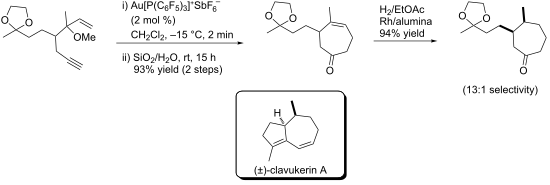
- in the formal synthesis of clavukerin A was explored. We first investigated the cyclization–hydrogenation strategy (path A in Scheme 4). Deprotection of 4 and the aldol condensation of the resulting diketone under basic conditions proceeded smoothly to give the enone 2 in good yield. However


Construction of cyclic enones via gold-catalyzed oxygen transfer reactions
Beilstein J. Org. Chem. 2011, 7, 606–614, doi:10.3762/bjoc.7.71
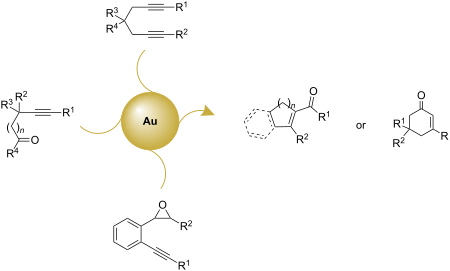
- might exist. One of the key intermediates in the catalytic cycle is the hydrolyzed product – the alkynyl ketone from hydrolysis of one triple bond – which is the same as the substrate that was employed by Yamamoto and co-workers. Thus, a similar diketone intermediate 6' could also have been formed




An overview of the key routes to the best selling 5-membered ring heterocyclic pharmaceuticals
Beilstein J. Org. Chem. 2011, 7, 442–495, doi:10.3762/bjoc.7.57
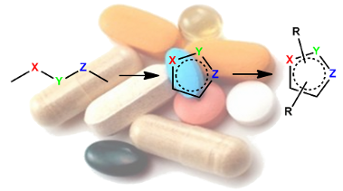
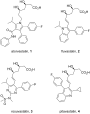
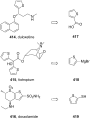
- synthetic approach was based on the classical Paal–Knorr cyclocondensation of a highly substituted 1,4-diketone with a primary amine bearing a masked aldehyde functionality. The 1,4-diketone component, which can be accessed via a 3-step sequence [5] starting from aniline, was refluxed with 3
- acceptor obtained from an initial Knoevenagel condensation (Scheme 5). In order to improve the overall yield as well as the convergency, the industrial route [7] introduced the fully elaborated side chain 34 by condensation with the previously described 1,4-diketone 31 (Scheme 5 and Scheme 6). The desired





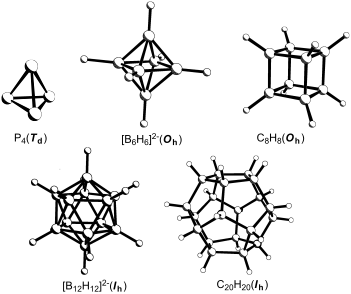
Reciprocal polyhedra and the Euler relationship: cage hydrocarbons, CnHn and closo-boranes [BxHx]2−
Beilstein J. Org. Chem. 2011, 7, 222–233, doi:10.3762/bjoc.7.30
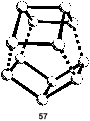
- the mono-protected diketone 28, itself available via photolysis of 27, the mono-ketal of the Diels–Alder dimer of 2-bromocyclopentadienone. At this point, the bishomocubanedione system is exquisitely poised to undergo successive Favorskii reactions to yield eventually the carboxylic acid 29, which
- reaction to prepare the C14 diketone 60 (Scheme 11). In principle, one could incorporate bridgehead halogens as in 61 with the aim of carrying out two Favorskii ring contractions to generate the octahedrane skeleton, viz. the dicarboxylic acid 62, which ultimately would then require to be decarboxylated to
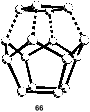
- diketone 65 [36]. We await further elaboration of this fascinating system. Decahedrane, C16H16, 14 Formally, 14 should be available by capping [4]peristylane with a four-membered ring system, as in 66 (Figure 6). However, to translate this concept into a preparatively realistic protocol is a different






Photocycloaddition of aromatic and aliphatic aldehydes to isoxazoles: Cycloaddition reactivity and stability studies
Beilstein J. Org. Chem. 2011, 7, 127–134, doi:10.3762/bjoc.7.18
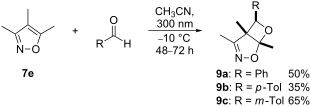
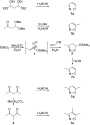
- of aci-nitroethane 1 (Scheme 1). The reaction of acetylacetaldehyde with hydroxylamine gave 7b, exclusively. 3,5-Diphenylisoxazole (7f) was prepared from acetophenone and methyl benzoate, followed by cyclization of the resulting diketone 4 with hydroxylamine. 5-Methoxy-3-phenylisoxazole (7g) and 5



Syntheses and properties of thienyl-substituted dithienophenazines
Beilstein J. Org. Chem. 2010, 6, 1180–1187, doi:10.3762/bjoc.6.135
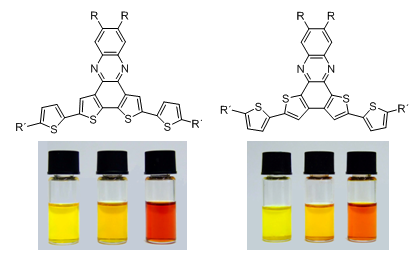
- quantitative yield [21][22]. The respective regio isomer 8 was synthesized starting from commercially available 3-bromothiophene 1 and boronic acid 5 in three steps (Scheme 2). By Suzuki–Miyaura coupling we obtained 3,3’-bithiophene in good yields. The red diketone 7 was prepared by two-fold acylation with


Miniemulsion polymerization as a versatile tool for the synthesis of functionalized polymers
Beilstein J. Org. Chem. 2010, 6, 1132–1148, doi:10.3762/bjoc.6.130
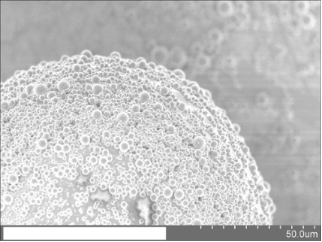
- solution polymerization was demonstrated by Qi et al. who were able to polymerize styrene with horseradish peroxidase, hydrogen peroxide, and a β-diketone in aqueous direct miniemulsion [92]. Normally, only hydrophilic monomers can be polymerized with this initiating system in water or a co-solvent, e.g





Synthesis of oxa-bridged derivatives from Diels–Alder bis-adducts of butadiene and 1,2,3,4-tetrahalo-5,5-dimethoxycyclopentadiene
Beilstein J. Org. Chem. 2010, 6, No. 64, doi:10.3762/bjoc.6.64
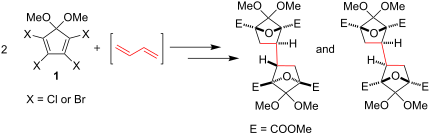
- yield. Ruthenium catalyzed oxidation of the bis-adducts followed by a one-pot transformation of the resulting α-diketone furnished oxa-bridged compounds. Unambiguous stereochemical assignments of both diastereomeric series are reported. Keywords: Diels–Alder reactions; diketones; oxa-bridged
- analysis (Figure 1) [20]. Working backwards, the structures of the adduct 5, the bis-diketone 7 were confirmed unequivocally. We next turned our attention to the bromo analogue 1b in order to see if the overall yield of the bis-oxa-bridged derivatives 8 and 10 could be improved. We were also interested to
- chloro-analogue furnished mono-adduct 11 (endo:exo = 91:9) and bis-adducts 12 and 13 (Scheme 4). The bis-adducts 12 and 13 were separated by preparative HPLC. The bis-adducts 12 and 13 were converted in excellent yields to the corresponding bis-α-diketones 14 and 15 (Scheme 5). Bis-diketone 14 was


Synthesis of spiroannulated and 3-arylated 1,2,4-trioxanes from mesitylol and methyl 4-hydroxytiglate by photooxygenation and peroxyacetalization
Beilstein J. Org. Chem. 2010, 6, No. 61, doi:10.3762/bjoc.6.61
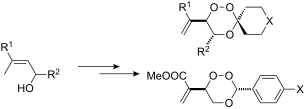
- our work on bis-peroxide synthesis from bifunctional ketones [22], we have also studied the peroxyacetalization of the allylic hydroperoxide 7 with the bifunctional cyclohexane-1,4-dione (CHD, Scheme 2). In this case, one equivalent of the diketone gave the monoadduct 9c in 20% yield. The products


An expedient and new synthesis of pyrrolo[1,2-b]pyridazine derivatives
Beilstein J. Org. Chem. 2009, 5, No. 66, doi:10.3762/bjoc.5.66
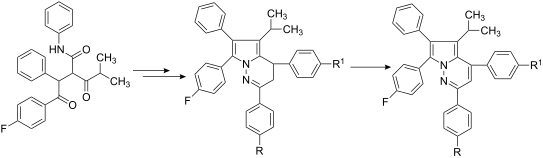
- -methyl-3-oxo-pentanoic acid phenylamide with tertiary butyl carbazate and subsequent condensation of the resulting carbamate derivative with a chalcone provided a facile new approach to pyrrolo[1,2-b]pyridazine derivatives. Keywords: 1,4-diketone; migration and cyclization; pyrrolo[1,2-b]pyridazine


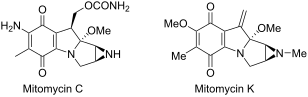
Mitomycins syntheses: a recent update
Beilstein J. Org. Chem. 2009, 5, No. 33, doi:10.3762/bjoc.5.33






Diastereoselective and enantioselective reduction of tetralin- 1,4-dione
Beilstein J. Org. Chem. 2008, 4, No. 37, doi:10.3762/bjoc.4.37
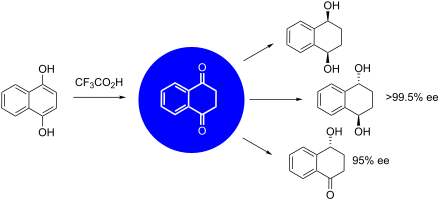
- accessible and offers interesting opportunities for synthesis. Results The title reactions were explored. L-Selectride reduced the diketone to give preferentially the cis-diol (d.r. 84 : 16). Red-Al gave preferentially the trans-diol (d.r. 13 : 87). NaBH4, LiAlH4, and BH3 gave lower diastereoselectivities
- ; Introduction In this article, we briefly review synthetic approaches to 2,3-dihydro-1,4-naphthoquinone, more simply named tetralin-1,4-dione (2). This symmetric diketone is the stable tautomer of 1,4-dihydroxynaphthalene (1). Although known for many years, it has never been used in synthesis. The reactions of
- . Using the tautomerization of 1 in trifluoroacetic acid to generate 2 [4], we found that upon solvent evaporation the tautomer obtained was dihydroxynaphthalene 1, rather than diketone 2. During evaporation, the lower solubility of 1 led to its precipitation and this shifted the equilibrium back. This


End game strategies towards the total synthesis of vibsanin E, 3-hydroxyvibsanin E, furanovibsanin A, and 3-O-methylfuranovibsanin A
Beilstein J. Org. Chem. 2008, 4, No. 34, doi:10.3762/bjoc.4.34
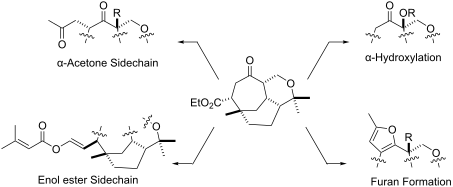
- diketone dehydration (i.e. phosphorus pentaoxide [23]). For Padwa’s protocol the TMS enol ether 33 was required, which was obtained in 75% from sequential treatment of 30 with LDA and TMSCl. Subsequent reaction of 33 with Padwa’s electrophile 34 [24] and silver tetrafluoroborate gave a complex mixture with
- diketone 40, which could be accessed from 43 (and 44) via a Wacker oxidation (64%), also failed to yield furan functionality using classical conditions (i.e. phosphorus pentaoxide and amberlyst resin) (Scheme 6). Enol ester sidechain construction: although Davies [16] has reported the construction of the
- directed towards bis-epi-3-hydroxyvibsanin E 51. This manoeuvre was further justified by the fact that diketone 40 was readily available via the allylation/Wacker protocol as described in Scheme 6. Considering the knowledge gained in Scheme 8, it was perceived best not to perform tricarbonyl reduction then


Sordarin, an antifungal agent with a unique mode of action
Beilstein J. Org. Chem. 2008, 4, No. 31, doi:10.3762/bjoc.4.31
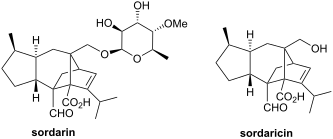
- acrylonitrile (88), obtained in turn from 2-alkylcyclopentanedione 89. Diketone 90 was advanced to vinylogous ester 91, the enolate of which was acylated with the Mander reagent to furnish 92 (Scheme 16). The subsequent Michael addition of 92 to acrolein proceeded in quantitative yield under the catalytic
- sordaricin analog 98. In summary, diketone 98 was obtained from starting compound 90 in an overall yield of 19% over 7 steps. The sordarin analogs shown in Scheme 16 exhibit a bridgehead methoxy instead of a carboxy group. Efforts to adapt the general strategy delineated above to the preparation of


Perhalogenated pyrimidine scaffolds. Reactions of 5-chloro- 2,4,6-trifluoropyrimidine with nitrogen centred nucleophiles
Beilstein J. Org. Chem. 2008, 4, No. 22, doi:10.3762/bjoc.4.22
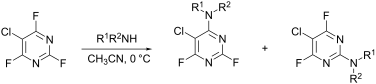
- , many pyrimidine derivatives have been used for various medicinal applications (Figure 1) [1][2][3]. Synthesis of pyrimidine rings most commonly involves cyclocondensation reactions of amidine, guanidine or thiourea derivatives with either 1,3-diketone or 1,3-diester systems [4][5]. However, many of


Multiple hydride reduction pathways in isoflavonoids
Beilstein J. Org. Chem. 2006, 2, No. 16, doi:10.1186/1860-5397-2-16
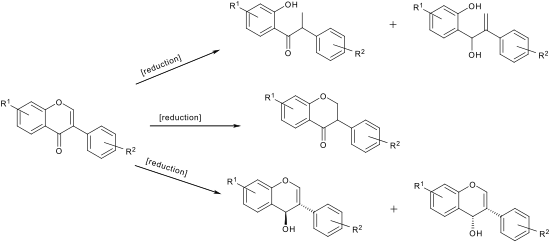
- , DIBAH) occurs normally by 1,2-attack, this being a key step in the well known "carbonyl transposition" of 1,3-diketone enol ethers into enones (R3O-CR=CR1-COR2 → R-CO-CR1=CHR2). [11][12][13][14][15] Prior to our work there were no reports on the reduction of isoflavones containing free hydroxy groups


A convenient synthesis of γ-functionalized cyclopentenones
Beilstein J. Org. Chem. 2005, 1, No. 11, doi:10.1186/1860-5397-1-11
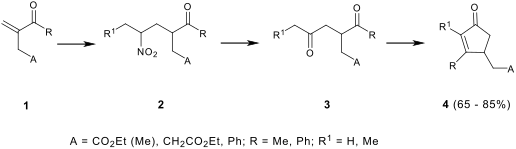
- conjugate addition of nitroalkanes to α,β-unsaturated ketones 1 leading to the nitroalkanes derivatives 2 which may be converted into their γ-diketone homologues 3 using Nef reaction. The intramolecular cyclization of 1,4-diketones 3 led to the corresponding cyclopentenones 4. Results and discussion As
- C9H14O4: 186.0892. Found: 186.0877. Preparation of γ-functionalized cyclopentenones (4): General procedure To a solution of 1,4-diketone 3 (5 mmol) in MeOH (10 mL) was added 1 equivalent of K2CO3, the mixture was bring to reflux during one hour. After workup, the product 4 was purified by column





