


Search results
Search for "mercury" in Full Text gives 192 result(s) in Beilstein Journal of Organic Chemistry.
Second generation silver(I)-mediated imidazole base pairs
Beilstein J. Org. Chem. 2014, 10, 2139–2144, doi:10.3762/bjoc.10.221
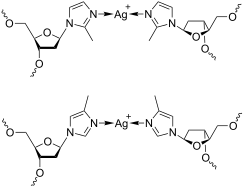
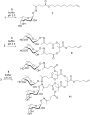
- (Figure 1). This contrasts the situation in a duplex with thyminate–Hg(II)–thyminate base pairs (Scheme 1, bottom) [31][32]. As a result of the keto groups on the thymine residues, the mercury(II) ions included in this type of metal-mediated base pair are clearly shielded from outside access [31]. In an


Photo, thermal and chemical degradation of riboflavin
Beilstein J. Org. Chem. 2014, 10, 1999–2012, doi:10.3762/bjoc.10.208
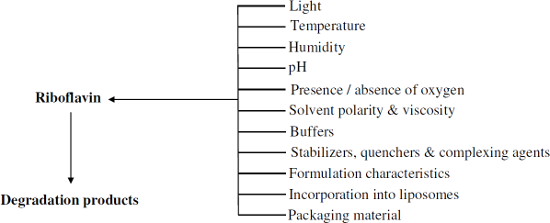
- (medium pressure mercury vapor lamp, 125 W), i.e., 2.19 ± 0.12 × 10¹⁸ quanta s−1 as compared to the visible sources (high pressure mercury vapor fluorescent lamp, 125 W and tungsten lamp, 150 W), i.e., 1.14 ± 0.10 × 10¹⁷ and 1.06 ± 0.11 × 10¹⁶ quanta s−1, respectively [24][26]. Previously it was reported
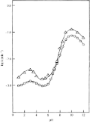
- photodegradation of RF in aqueous solution. log k–pH profiles for the photolysis of RF in aqueous solution using UV light (∆) and visible light (○). UV lamp emission at 313 and 366 nm (125 W medium pressure mercury vapor lamp, 2.19 ± 0.12 × 10¹⁸ quanta s−1), Visible lamp emission at 405 and 435 nm (Philips HPL N
- 125 W high pressure mercury vapor fluorescent lamp, 1.14 ± 0.10 × 10¹⁷ quanta s−1). Reproduced with permission from [24]. Copyright 2004 Elsevier. log k–pH profiles for the photolysis of FMF (10−4 M) in alkaline solution under aerobic (○) and anaerobic (∆) conditions irradiated for 1 h at 25 ± 1 °C




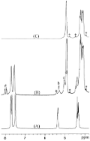
Copolymerization and terpolymerization of carbon dioxide/propylene oxide/phthalic anhydride using a (salen)Co(III) complex tethering four quaternary ammonium salts
Beilstein J. Org. Chem. 2014, 10, 1787–1795, doi:10.3762/bjoc.10.187
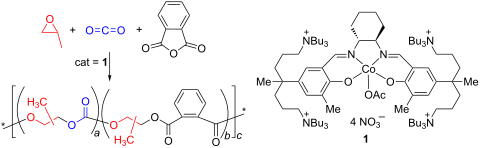
- over CaH2 and then vacuum-transferred to a reservoir. PA was purchased from Aldrich and purified by recrystallization in ethyl acetate. 1H NMR (400 MHz) and 13C NMR (100 MHz) spectra were recorded on a Varian Mercury Plus 400 instrument. Gel permeation chromatography (GPC) was performed in THF at 40 °C




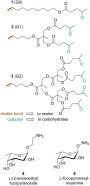
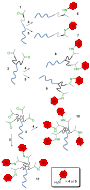
Bifunctional dendrons for multiple carbohydrate presentation via carbonyl chemistry
Beilstein J. Org. Chem. 2014, 10, 1686–1691, doi:10.3762/bjoc.10.177
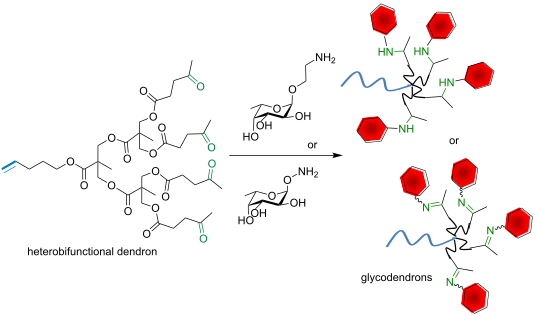
- performed on silica gel 230–400 mesh (Merck). Routine 1H and 13C NMR spectra were recorded on a Varian Mercury instrument at 400 MHz (1H) and 100.57 MHz (13C). Chemical shifts are reported in parts per million downfield from TMS as an internal standard, J values are given in Hz. Mass spectra were recorded



An experimental and theoretical NMR study of NH-benzimidazoles in solution and in the solid state: proton transfer and tautomerism
Beilstein J. Org. Chem. 2014, 10, 1620–1629, doi:10.3762/bjoc.10.168
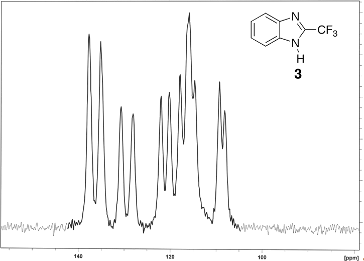
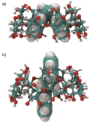
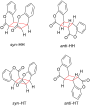
- of programs. The five studied compounds. Trimers A (left) and B (right) of 1. The tautomerism of 1H-benzimidazole. The 13C CPMAS NMR spectrum of 3. The two independent molecules of 3 drawn with the Mercury program [26]. The evolution of the spectrum of 1 with temperature in HMPA-d18. Calculated and


Molecular recognition of surface-immobilized carbohydrates by a synthetic lectin
Beilstein J. Org. Chem. 2014, 10, 1354–1364, doi:10.3762/bjoc.10.138
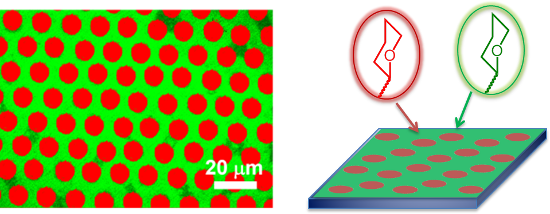
- inverted research microscope CKX41 (Olympus, Shinjuku, Tokyo/Japan) equipped with a mercury burner U-RFL-T as light source and a DX 20 L-FW camera (Kappa opto-electronics GmbH, Gleichen/Germany) for image acquisition. The camera was controlled by the program Kappa CameraControl (version 2.7.5.7032). All


Nonanebis(peroxoic acid): a stable peracid for oxidative bromination of aminoanthracene-9,10-dione
Beilstein J. Org. Chem. 2014, 10, 921–928, doi:10.3762/bjoc.10.90
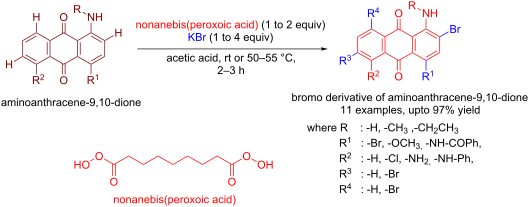
- (Universal V4.5A TA Instrument), ramp 10.00 °C/min to 300.00 °C, flow rate: 50.0 mL/min. Procedure for the preparation of nonanebis(peroxoic acid): In 250 mL round bottomed flask equipped with a mercury sealed stirrer, 10 g of nonanedioic acid (0.0531 mol) was dissolved in 95% sulfuric acid (25 g, 0.255 mol
- product (9.2 g, 78% yield). The active oxygen content of the final product was determined by iodometric titration. (Reported: 14.5%; Obtained: 14.2–14.4%.) General procedure for oxidative bromination of aminoanthracene-9,10-dione: In a 100 mL round bottomed flask equipped with a mercury sealed stirrer, 5


Deoxygenative gem-difluoroolefination of carbonyl compounds with (chlorodifluoromethyl)trimethylsilane and triphenylphosphine
Beilstein J. Org. Chem. 2014, 10, 344–351, doi:10.3762/bjoc.10.32
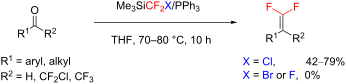
- examples include using bis(trifluoromethyl)mercury (Hg(CF3)2) under the promotion of NaI (Scheme 1, reaction 3) [24] and using methyl 2,2-difluoro-2-(fluorosulfonyl)acetate (MDFA) under the promotion of KI (Scheme 1, reaction 4) [25]. Our group has focused on the development and application of new


The regioselective synthesis of spirooxindolo pyrrolidines and pyrrolizidines via three-component reactions of acrylamides and aroylacrylic acids with isatins and α-amino acids
Beilstein J. Org. Chem. 2014, 10, 117–126, doi:10.3762/bjoc.10.8
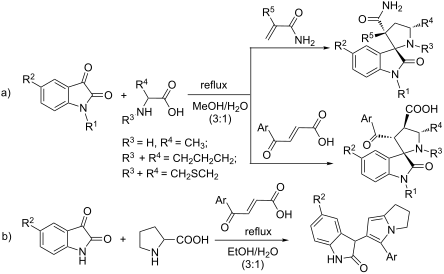
- spectra were recorded on Varian Mercury VX-200 (200 MHz) and Bruker Avance DRX-500 (500 MHz) instruments in DMSO-d6 with TMS as an internal standard. The 13C NMR spectra were recorded on a Bruker Avance DRX-500 (125 MHz) and Bruker AM-300 (75 MHz) instruments in DMSO-d6 with TMS as an internal standard




Synthesis of five- and six-membered cyclic organic peroxides: Key transformations into peroxide ring-retaining products
Beilstein J. Org. Chem. 2014, 10, 34–114, doi:10.3762/bjoc.10.6
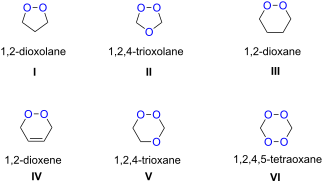
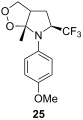
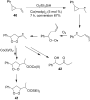
- )) with Et2NH in CF3CH2OH. However, these attempts failed. Spiroperoxide 241 was prepared in satisfactory yield by reaction of 240 with the use of mercury (II) acetate (Scheme 68) [331]. The intermediate mercury-containing peroxide produced by the cyclization of bis(hydroperoxide) 240 was reduced with






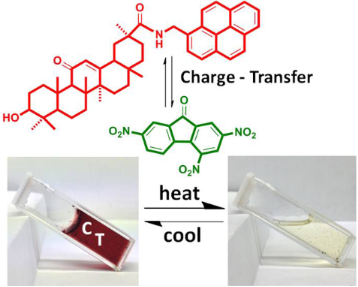
Charge-transfer interaction mediated organogels from 18β-glycyrrhetinic acid appended pyrene
Beilstein J. Org. Chem. 2013, 9, 2877–2885, doi:10.3762/bjoc.9.324
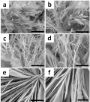
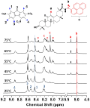
- used. UV–vis spectra were measured on an Agilent Technologies 95-03 spectrometer; fluorescence spectra were measured on a Varian Cary Eclipse spectrometer; NMR spectra were recorded on Varian Mercury 300/400 spectrometers in CDCl3 and DMSO-d6; mass spectrometry was measured on a Micromass QTOF and




New syntheses of 5,6- and 7,8-diaminoquinolines
Beilstein J. Org. Chem. 2013, 9, 2669–2674, doi:10.3762/bjoc.9.302
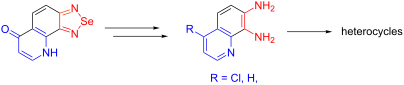
- [Normasil 60 (43–60 μm)]. Melting points were measured on a Koffler block and are uncorrected. 1H NMR and 13C NMR spectra were recorded on a Varian Mercury 300 MHz spectrometer at 25 °C. The operating frequencies were 300 MHz for 1H and 75.5 MHz for 13C nuclei. Chemical shifts (δ) are reported in ppm and


A combined continuous microflow photochemistry and asymmetric organocatalysis approach for the enantioselective synthesis of tetrahydroquinolines
Beilstein J. Org. Chem. 2013, 9, 2457–2462, doi:10.3762/bjoc.9.284
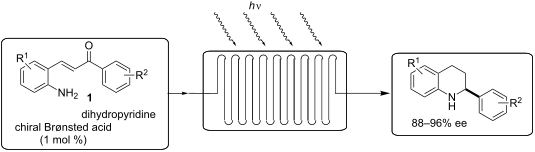
- placed in a water bath [39]. The light required to perform the reaction is supplied from a high-pressure mercury lamp located outside of the reactor. The lamp consists of a double-jacketed water-cooled pyrex immersion well. The reagents were degassed and introduced into the microreactor using a


Temperature measurements with two different IR sensors in a continuous-flow microwave heated system
Beilstein J. Org. Chem. 2013, 9, 2079–2087, doi:10.3762/bjoc.9.244
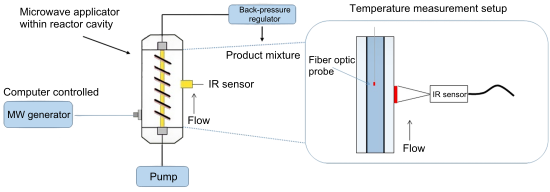
- than the walls [8]. Unfortunately, under microwave radiation the usual methods to directly measure the internal liquid temperature of a reaction mixture such as thermocouples or mercury thermometers are affected by the electromagnetic field and will thus not be possible to use in the radiated zone [14


Continuous flow photocyclization of stilbenes – scalable synthesis of functionalized phenanthrenes and helicenes
Beilstein J. Org. Chem. 2013, 9, 1883–1890, doi:10.3762/bjoc.9.221
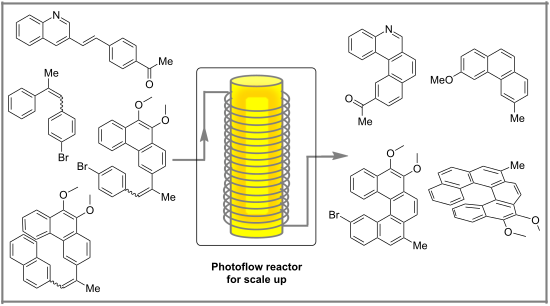
- tightly wrapped around the water-cooling unit (Duran glass) of a high-pressure mercury lamp (TQ 150, UV-Consulting Peschl). Further optimization and scope was performed with a similar setup using a bigger capillary (FEP, outer/inner diameter 4/2 mm, total volume 24 mL). For the sake of safety and to




Topochemical control of the photodimerization of aromatic compounds by γ-cyclodextrin thioethers in aqueous solution
Beilstein J. Org. Chem. 2013, 9, 1858–1866, doi:10.3762/bjoc.9.217
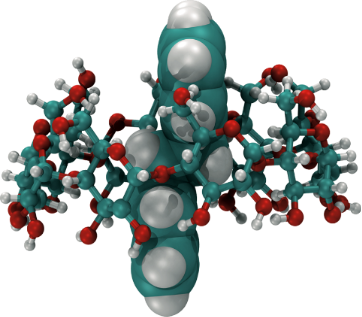
- inclusion complexes were transferred into 50 mL quartz round-bottomed flasks and bubbled with nitrogen gas for 20 min with stirring before photo-irradiation. Photodimerization of the samples was carried out using a medium-pressure mercury lamp (166.5 W, Heraeus Noblelight GmbH, UVB) as a light source. After



[3 + 2]-Cycloadditions of nitrile ylides after photoactivation of vinyl azides under flow conditions
Beilstein J. Org. Chem. 2013, 9, 1745–1750, doi:10.3762/bjoc.9.201
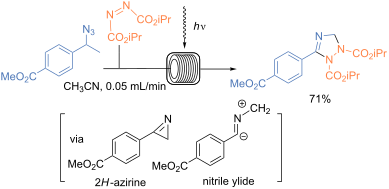
- water-cooled quartz immersion well (type UV-RS-1, Heraeus) equipped with a medium-pressure mercury lamp (type TQ 150, λ = 190–600 nm). The reaction mixture was fed into the tubing by using a pump and collected in a flask after having passed through the reactor. In essence 2H-azirines can be prepared


A reductive coupling strategy towards ripostatin A
Beilstein J. Org. Chem. 2013, 9, 1533–1550, doi:10.3762/bjoc.9.175
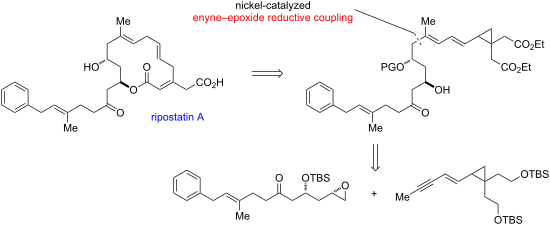
- alternative promoters were investigated to avoid the use of mercury(II) salts in the ketal deprotection (including MeI, H2O2, AgClO4/I2); however, these generally led to concomitant removal of the TBS groups. Ketone 19 was converted to the α,β-unsaturated ester 20 using the Peterson olefination [32


α-Bromodiazoacetamides – a new class of diazo compounds for catalyst-free, ambient temperature intramolecular C–H insertion reactions
Beilstein J. Org. Chem. 2013, 9, 1407–1413, doi:10.3762/bjoc.9.157

- ][27][28][29][30], as well as carbon, e.g., in aldol reactions with aldehydes [31][32], ketones [33][34] and imines [35][36]. The first syntheses of α-halodiazoacetic esters, reported in the late 1960s, employed electrophilic diazoalkane substitution; the mercury or silver salts of ethyl diazoacetate
- reflux: a reaction that plausibly occurs with a free halocarbonylcarbene or a mercury carbenoid as intermediate [45][55][56]. In the case of the α-bromo-β-lactam 5b, the authors reported an exo-diastereoselectivity of 5.25:1. In order to compare the reactivity of other halides in the α-position, we


Metal-free aerobic oxidations mediated by N-hydroxyphthalimide. A concise review
Beilstein J. Org. Chem. 2013, 9, 1296–1310, doi:10.3762/bjoc.9.146
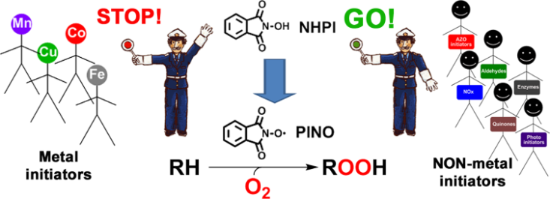
- /1. These results are objects of two patent applications [60][61]. Light-induced activation The first example of light-induced in situ generation of PINO radical was reported in 2007 by Lucarini and co-workers [62]. Irradiation of N-alkoxyphthalimides with filtered light (λ > 300 nm) from a mercury


Interplay of ortho- with spiro-cyclisation during iminyl radical closures onto arenes and heteroarenes
Beilstein J. Org. Chem. 2013, 9, 1083–1092, doi:10.3762/bjoc.9.120
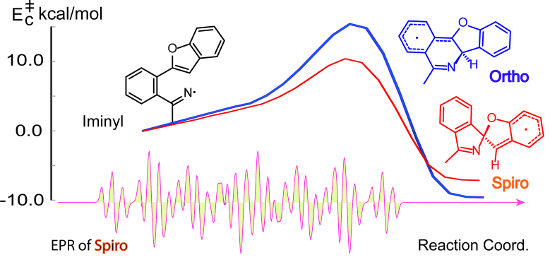
- Manchester. Oxime carbonates (2 to 15 mg) and MAP (1 equiv wt/wt) in t-BuPh or benzene (0.5 mL) were prepared in quartz tubes and deaerated by bubbling with nitrogen for 15 min. Photolysis in the resonant cavity was by unfiltered light from a 500 W super-pressure mercury arc lamp or, in the Manchester




Spectroscopic characterization of photoaccumulated radical anions: a litmus test to evaluate the efficiency of photoinduced electron transfer (PET) processes
Beilstein J. Org. Chem. 2013, 9, 800–808, doi:10.3762/bjoc.9.91
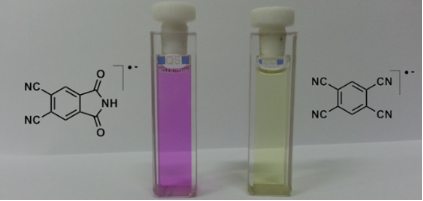
- deoxygenated solutions, except where otherwise noted. The examined solutions were irradiated on an optical bench equipped with a 150 W high-pressure mercury lamp, (λIRR = 313 nm). The electrochemical properties of TCB [8][9], DCN [8][9], DCA [8][9], DCP [10], DCP-ME [10], ME [45], PME [28], Et3N [60], iPr3N


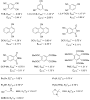


High-spin intermediates of the photolysis of 2,4,6-triazido-3-chloro-5-fluoropyridine
Beilstein J. Org. Chem. 2013, 9, 733–742, doi:10.3762/bjoc.9.83
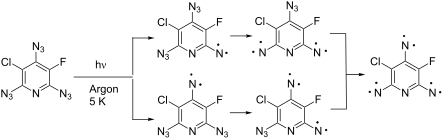
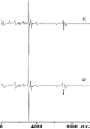
- were irradiated with a high-pressure mercury lamp, by using a filter passing the light at λ = 260–320 nm, and spectra were recorded at various irradiation times. The computer simulations of EPR spectra were performed by using the EasySpin program package (version 4.0.0) [38]. The simulations were




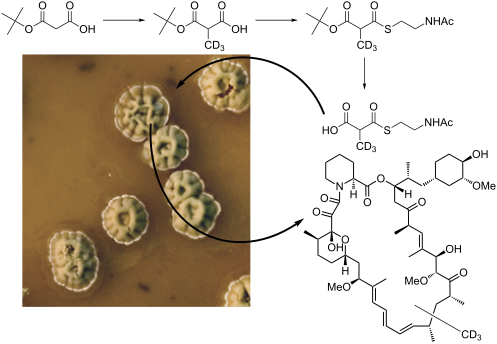
Quantification of N-acetylcysteamine activated methylmalonate incorporation into polyketide biosynthesis
Beilstein J. Org. Chem. 2013, 9, 664–674, doi:10.3762/bjoc.9.75
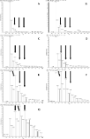
- 5% aqueous NaOH in 500 mL H2O) and subsequent heat treatment. NMR spectra were recorded by using a Varian Mercury 400 (400 MHz, 1H; 100 MHz, 13C) spectrometer and calibrated using residual undeuterated solvent as an internal reference. High-resolution mass spectra were recorded at LTQ Orbitrap with



Synthesis and stability study of a new major metabolite of γ-hydroxybutyric acid
Beilstein J. Org. Chem. 2013, 9, 641–646, doi:10.3762/bjoc.9.72

- . Thin-layer chromatography (TLC) was carried out on commercially available precoated aluminium sheets (Merck 60 F254). The quoted Rf values are rounded to the nearest 0.05. 1H and 13C NMR was run on a Varian Mercury 300 MHz, a Varian Gemini 300 MHz and a Bruker 500 MHz Avance III Fourier transform NMR





