


Search results
Search for "pyridinium" in Full Text gives 194 result(s) in Beilstein Journal of Organic Chemistry.
The preparation of several 1,2,3,4,5-functionalized cyclopentane derivatives
Beilstein J. Org. Chem. 2013, 9, 1705–1712, doi:10.3762/bjoc.9.195
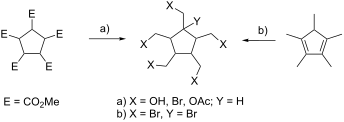
- acetylenedicarboxylate (22) with dimethyl malonate (23) under the catalytic influence of pyridinium acetate, the fully substituted cycloheptadienes 24 and 25 (Scheme 5) were produced; both authors also proposed reaction mechanisms for this complex transformation that can be considered as reasonable even today; for the



Synthesis of the calcilytic ligand NPS 2143
Beilstein J. Org. Chem. 2013, 9, 1383–1387, doi:10.3762/bjoc.9.154
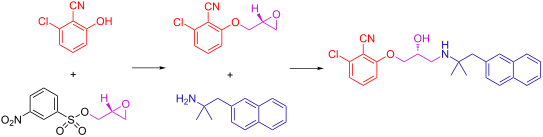
- (Scheme 2). Reduction of 7 was easily achieved on multigram scale by using LiAlH4 to provide amine 8 in excellent yield and purity after work-up. According to the method of Katritzky et al. [16] amine 8 was activated as the corresponding pyridinium salt 10 upon treatment with triphenylpyrylium salt 9 in
- ethanol under reflux. Subsequently, the crude pyridinium salt 10 was exposed to the sodium salt of 2-nitropropane (11) to give nitro compound 12. Reduction of the nitro group in 12 by catalytic hydrogenation at atmospheric pressure to produce amine 6 has previously been described by Kamal and Chouhan [17


Efficient regio- and stereoselective access to novel fluorinated β-aminocyclohexanecarboxylates
Beilstein J. Org. Chem. 2013, 9, 1164–1169, doi:10.3762/bjoc.9.130
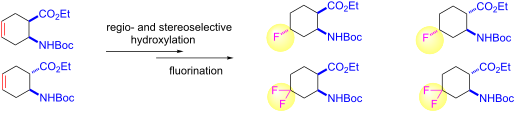
- position 4 was efficiently synthesized. Oxidation of the hydroxy group of amino ester 5 with pyridinium chlorochromate (PCC) in CH2Cl2 yielded the corresponding oxo-group-containing amino ester 8, which was then converted with Deoxo-Fluor in CH2Cl2 at 0 °C to the corresponding geminal difluoro amino ester


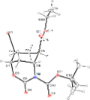


Tandem dinucleophilic cyclization of cyclohexane-1,3-diones with pyridinium salts
Beilstein J. Org. Chem. 2013, 9, 1119–1126, doi:10.3762/bjoc.9.124
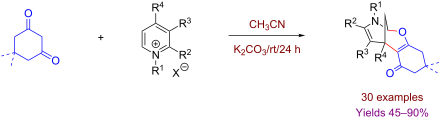
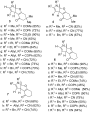
- Katalyse e.V. an der Universität Rostock, Albert-Einstein-Straße 29a, D-18059 Rostock, Germany 10.3762/bjoc.9.124 Abstract The cyclization of cyclohexane-1,3-diones with various substituted pyridinium salts afforded functionalized 8-oxa-10-aza-tricyclo[7.3.1.02,7]trideca-2(7),11-dienes. The reaction
- proceeds by regioselective attack of the central carbon atom of the 1,3-dicarbonyl unit to 4-position of the pyridinium salt and subsequent cyclization by base-assisted proton migration and nucleophilic addition of the oxygen atom to the 2-position, as was elucidated by DFT computations. Fairly extensive
- screening of bases and additives revealed that the presence of potassium cations is essential for formation of the product. Keywords: cyclization; density functional calculations; heterocycles; nucleophilic addition; pyridinium salt; Introduction The nucleophilic addition to pyridinium salts has recently




Synthesis of guanidinium–sulfonimide ion pairs: towards novel ionic liquid crystals
Beilstein J. Org. Chem. 2013, 9, 1093–1101, doi:10.3762/bjoc.9.121
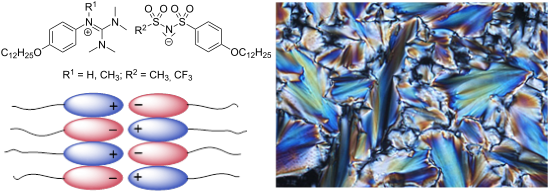
- ]. Although Heintz was the pioneer, who observed in 1854 melting and clearing transitions upon heating of magnesium myristate [9][10], he did not recognize this as liquid-crystalline behavior. The first regular pyridinium ILCs were reported in 1938 by Knight and Shaw [11][12], followed by seminal findings by


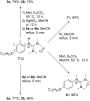


Facile synthesis of functionalized spiro[indoline-3,2'-oxiran]-2-ones by Darzens reaction
Beilstein J. Org. Chem. 2013, 9, 918–924, doi:10.3762/bjoc.9.105
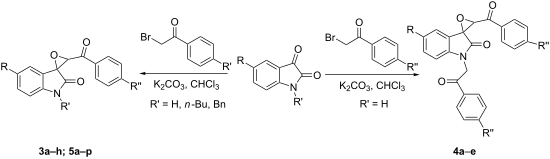
- phenacyl bromides and report the facile synthesis of versatile spiro[indoline-3,2'-oxiran]-2-ones. Results and Discussion In recent years we have found that pyridinium salts react with versatile reactive methylene compounds to give different kinds of products, including functionalized cyclopropanes, 2,3
- -dihydrofurans, polysubstituted pyridines, pyrido[1,2-a]benzimidazoles and charge-separated zwitterionic salts [26][27][28][29][30][31]. We envisaged that in situ generated pyridinium ylide might react with the reactive carbonyl group of isatins to afford spiro epoxyoxindoles (Scheme 1). To test this feasibility
- , the reactions of various substituted isatins with pyridinium salt in the presence of base were examined under different conditions. We were disappointed that the reactions produced much complicated mixtures and no acceptable results were obtained. Thus, our attention was turned toward the development


Reductions of aldehydes and ketones with a readily available N-heterocyclic carbene borane and acetic acid
Beilstein J. Org. Chem. 2013, 9, 675–680, doi:10.3762/bjoc.9.76
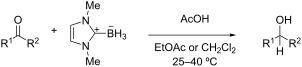
- ethyl acetate (EtOAc) was complete in 30 min and gave 3-phenylpropanol (3) in 86% yield after evaporation and flash chromatography (Scheme 2). Other acids including pyridinium p-toluenesulfonate, benzohydroxamic acid, and 2,2-dimethyl-1,3-dioxane-4,6-dione (Meldrum’s acid) also promoted this reduction


Asymmetric Diels–Alder reaction with >C=P– functionality of the 2-phosphaindolizine-η1-P-aluminium(O-menthoxy) dichloride complex: experimental and theoretical results
Beilstein J. Org. Chem. 2013, 9, 392–400, doi:10.3762/bjoc.9.40
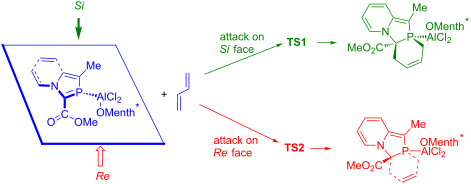
- theoretically as well as experimentally [16]. In this context, we found that 1,3-bis(alkoxycarbonyl)-2-phosphaindolizines (1a, Z = CO2R1) prepared through 1,5-electrocyclization of in situ generated bis(pyridinium ylidyl)phosphenium chlorides [17] lead to successful DA reaction [18][19], but 3-alkoxycarbonyl-2


Glycosylation efficiencies on different solid supports using a hydrogenolysis-labile linker
Beilstein J. Org. Chem. 2013, 9, 97–105, doi:10.3762/bjoc.9.13
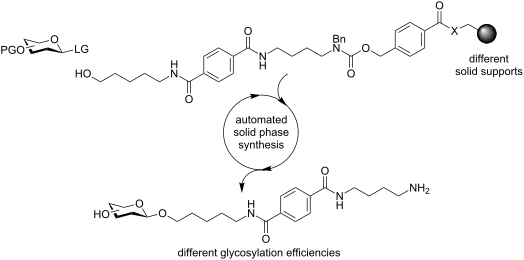
- resins, an additional Zemplén cleavage site for fast LC–MS analysis is introduced. Synthesis of linker 1. Reactions and conditions: (a) NEt3, DCM, rt, 84%; (b) DHP, pyridinium p-toluenesulfonate, DCM, rt, quant.; (c) 2 M aq NaOH, THF, rt, 91%; (d) DSC, NEt3, CH3CN, 0 °C to rt; (e) NEt3, DCM, rt, 80% over


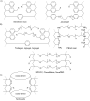


Supramolecular hydrogels formed from poly(viologen) cross-linked with cyclodextrin dimers and their physical properties
Beilstein J. Org. Chem. 2012, 8, 1594–1600, doi:10.3762/bjoc.8.182
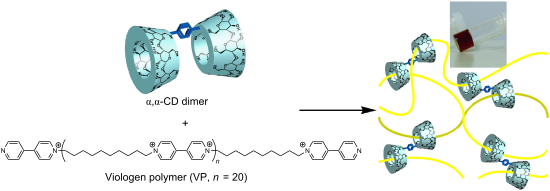
- range of the 1H NMR time scale due to the slow equilibrium [19][20]. Cationic groups, such as pyridinium and pyridylpyridinium terminal groups, inhibit the decomposition of polyrotaxane and stabilize the complexes between α-CD and cationic alkanediyl compounds [21][22][23]. Herein, to study the


Cation affinity numbers of Lewis bases
Beilstein J. Org. Chem. 2012, 8, 1406–1442, doi:10.3762/bjoc.8.163
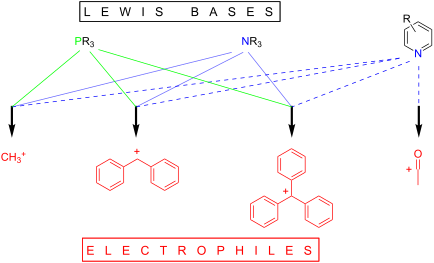
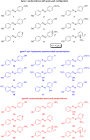
- -position are significantly more effective than aryl substituents in stabilizing the pyridinium ions formed through acetyl cation addition. Photo-switchable 3,4-diaminopyridines including a diazo moiety are potentially useful as special-purpose catalysts. The azobenzene substituent itself is electron


Stereoselective synthesis of trans-fused iridoid lactones and their identification in the parasitoid wasp Alloxysta victrix, Part I: Dihydronepetalactones
Beilstein J. Org. Chem. 2012, 8, 1246–1255, doi:10.3762/bjoc.8.140
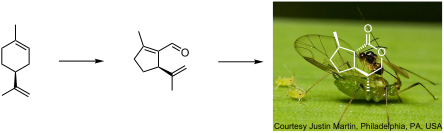
- intermediate 16 was transformed to the aldehyde 23. In the course of this short sequence, the free hydroxy group of 16 was protected as the TBDMS ether to yield 21 which afforded the mono-protected diol 22 after treatment with KOH in methanol. Subsequently, 22 was oxidized with pyridinium dichromate to give


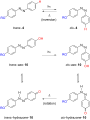
Control over molecular motion using the cis–trans photoisomerization of the azo group
Beilstein J. Org. Chem. 2012, 8, 1071–1090, doi:10.3762/bjoc.8.119
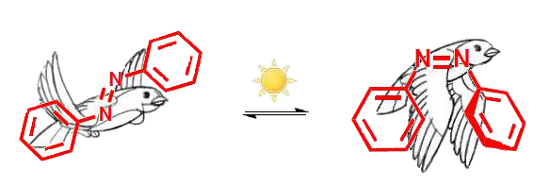
- fluorescence emitted by the pyridinium salt free cyclophane. The azobenzene trans-10 is conveniently replaced with electron donor units, so that when it is associated, as azo-10∙11, the fluorescence is completely inhibited by charge-transfer interactions. The photoexcitation carried out by irradiation with


Recent advances towards azobenzene-based light-driven real-time information-transmitting materials
Beilstein J. Org. Chem. 2012, 8, 1003–1017, doi:10.3762/bjoc.8.113
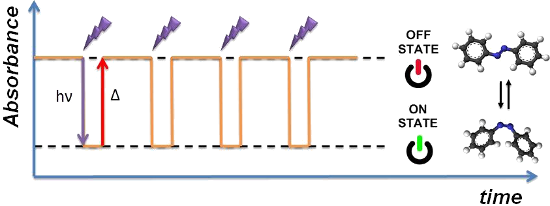
- -azobenzene derivatives. This notable red-shift of the absorption wavelength arises from the strong charge transfer from the alkoxy group to the positively-charged nitrogen atom of the pyridinium salt. Figure 8 shows the transient absorption generated upon pulsed laser irradiation of ethanol solutions of azo
- electron transfer from the alkoxy group to the pyridinium salt produces a partial breaking of the double N–N bond of the azo moiety, thereby facilitating the rotation around this bond to recover the more stable initial trans configuration in a quick fashion [56]. Type-II azoderivatives: photochromic
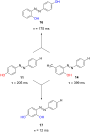
- azoderivatives [63]. This section collects different families of azoderivatives that combine the two strategies aforementioned: the presence of powerful electron-withdrawing groups, like nitro or pyridinium salts, and the existence of a phenol function in the convenient positions (2’ and 4’) of the azobenzene







Hybrid super electron donors – preparation and reactivity
Beilstein J. Org. Chem. 2012, 8, 994–1002, doi:10.3762/bjoc.8.112
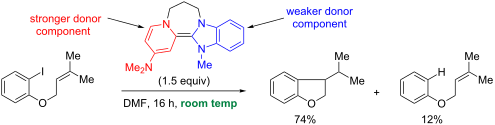
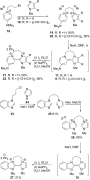
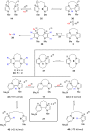
- studies on deprotonation of pyridinium salts [21]. However, 38 is a dication, and, to attain neutrality, could lose two protons. Compound 3 could be a strong base (in support of this, we have witnessed complete conversion of the analogous donor 2 to form 40 by rapid exchange in CD3CN as solvent; see
- protonation, then it should undergo easy fragmentation to 45, featuring a pyridinium salt and an imidazolylidene, and in these circumstances, it would be difficult to understand why this electron-donor system works well. However, if isomeric compound 44 is the product of protonation, then its fragmentation to






Volatile organic compounds produced by the phytopathogenic bacterium Xanthomonas campestris pv. vesicatoria 85-10
Beilstein J. Org. Chem. 2012, 8, 579–596, doi:10.3762/bjoc.8.65
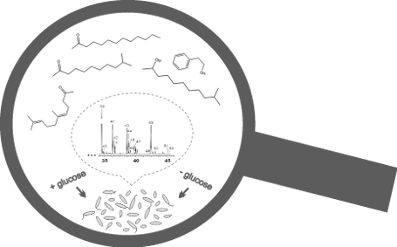
- available (Aldrich) 1-bromo-5-methylhexane (B) according to the standard procedure [72]. The resulting 2-benzyloxy-10-methylundec-4-yne (C) was hydrogenated over 10% Pd/C-catalyst at 1 atm. The crude secondary alcohol was oxidized with pyridinium dichromate [73][74] to yield the corresponding ketone
- the solvent was removed in vacuo. To a solution of 950 mg (5.1 mmol) of the crude 9-methylundecane-2-ol in 50 mL dichloromethane was added 2.3 g (1.2 equiv) pyridinium dichromate, and the mixture was vigorously stirred for 12 h at RT. As a gas-chromatographic control revealed the reaction to be
- incomplete, another 1.2 equiv of pyridinium dichromate was added, and the mixture was heated under reflux for 6 h. After filtration over silica and concentration in vacuo, the crude ketone was purified by column chromatography on silica with cyclohexane/diethyl ether 20:1. A final Kugelrohr distillation of





Syntheses and applications of furanyl-functionalised 2,2’:6’,2’’-terpyridines
Beilstein J. Org. Chem. 2012, 8, 379–389, doi:10.3762/bjoc.8.41
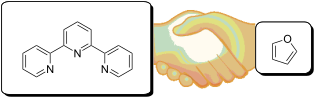
- these with pyridinium salt 8 afforded 1,5-diketo-derivatives 9–11 through Michael addition. These derivatives are generally not isolated, but undergo in situ ring closure performed in the presence of an ammonia source, such as ammonium acetate, leading to terpyridines 12–14 (Scheme 1) [4][15]. In the
- sodium hydroxide without solvent, thus yielding 1,5-diketo-derivatives. Ring closure was then carried out in methanol in the presence of ammonium acetate, according to Scheme 2. In addition to reducing the amount of solvent , this one-pot two-steps procedure avoids preparation of pyridinium salt 8
- synthesis starts with 6-carboxy-2-acetylpyridine (20), which is reacted with furfural (1), thus providing chalcone 21. This is then reacted with di-pyridinium salt 22 in the presence of ammonium acetate to afford quinquepyridine 23 (Scheme 4). Another possibility to access the key intermediate “1,5-diketone


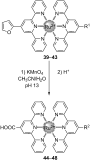


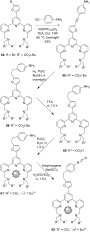
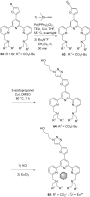

Organic synthesis using (diacetoxyiodo)benzene (DIB): Unexpected and novel oxidation of 3-oxo-butanamides to 2,2-dihalo-N-phenylacetamides
Beilstein J. Org. Chem. 2012, 8, 344–348, doi:10.3762/bjoc.8.38
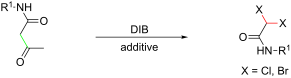
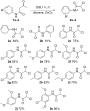
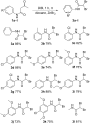
- (Scheme 2). To the best of our knowledge, there are several reports on chlorination and bromination reactions with PhI(OAc)2 and a halogen source such as TMSBr, lithium halide or pyridinium halide [32][33][34]. Also, there are several reports on the synthesis of difunctionalized acetamide derivatives [35




Fifty years of oxacalix[3]arenes: A review
Beilstein J. Org. Chem. 2012, 8, 201–226, doi:10.3762/bjoc.8.22
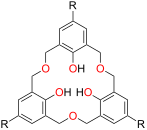
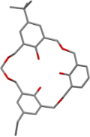
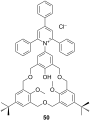
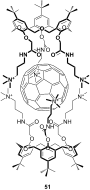
- M−1, but when Ga3+ was present this dropped to 2833 M−1, suggesting that the macrocyclic cavity, while preorganized for the smaller cations, was too rigid for the extended ammonium cation. One of the more unusual derivatives to have been prepared, 50, incorporates an N-pyridinium dye on one of the












Imidazole as a parent π-conjugated backbone in charge-transfer chromophores
Beilstein J. Org. Chem. 2012, 8, 25–49, doi:10.3762/bjoc.8.4
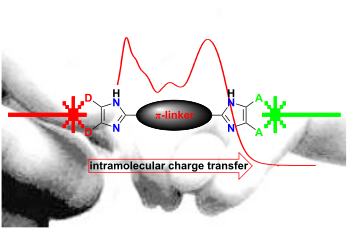
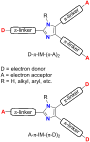
- theoretically. Abe et al. studied pyridinium betaines of general formula 72 consisting of negatively charged benzimidazolate and a positively charged pyridinium ion (Figure 13; [79]). Moreover, the π-conjugated system was systematically enlarged and either donor- or acceptor-substituted in order to generate D-π
- systems 35–43 [25][62][63][64][65][66]. Structure of benzimidazoles (44–47), imidazophenanthrolines (48–57), imidazophenanthrenes (58–60), fluorophores 61, 62, and TCAQ-imidazo-TTF (63) chromophores [23][24][67][68][69][70][71]. General structures of bis(benzimidazole) chromophores 67–71 and pyridinium




Highly efficient cyclosarin degradation mediated by a β-cyclodextrin derivative containing an oxime-derived substituent
Beilstein J. Org. Chem. 2011, 7, 1543–1554, doi:10.3762/bjoc.7.182
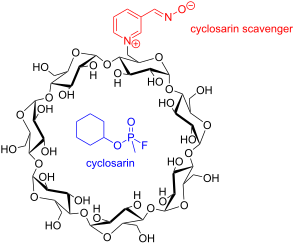
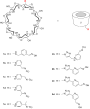
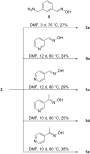
- corresponding pyridine aldoximes or ketoximes (Scheme 4) all of which are easily accessible from the commercially available aldehydes or ketones by reaction with hydroxylamine [32]. Attempts to also prepare the analogous derivative with the oxime group in the 2-position of the pyridinium ring, by reaction of 3
- of a binary solvent mixture, acetonitrile/0.025% aqueous ammonia. All products were thus obtained in analytically pure form, which is necessary to ensure that the subsequent evaluation of activity yields reliable results. Elemental analyses and NMR spectroscopy indicated that the pyridinium
- , indicates that the activity of these cyclodextrin derivatives depends sensitively on the structural parameters of the substituents in combination with the electronic properties. The generally larger activity of the pyridinium derivatives such as 1b–e and 2a with respect to compounds containing a neutral





A new phenylethyl alkyl amide from the Ambrostoma quadriimpressum Motschulsky
Beilstein J. Org. Chem. 2011, 7, 1342–1346, doi:10.3762/bjoc.7.158
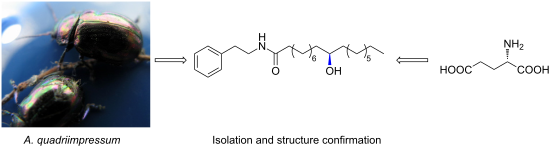
- -heptylidenetriphenylphosphonium bromide in the presence of n-BuLi gave adduct 11 as an (E/Z)-mixture (E/Z = 1:5) in 75% yield. Selective removal of the TBS group with pyridinium tosylate gave 12 in 98% yield [21]. With the alcohol 12 in hand, our next step was to synthesize the phosphonium salt 15 [22][23] (Scheme 4). Therefore


Functionalization of anthracene: A selective route to brominated 1,4-anthraquinones
Beilstein J. Org. Chem. 2011, 7, 1036–1045, doi:10.3762/bjoc.7.118

- -tribromoanthracene-1,4-dione (28) To a solution of pyridinium chlorochromate (300 mg, 1.08 mmol) in methylene chloride (30 mL) was added a solution of 2,9,10-tribromo-1,4-dihydroanthracene-1,4-diol (27) (222 mg, 0.504 mmol) in methylene chloride (25 mL). The mixture was stirred at ambient temperature for 3 d


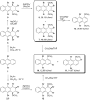


Oxidative allylic rearrangement of cycloalkenols: Formal total synthesis of enantiomerically pure trisporic acid B
Beilstein J. Org. Chem. 2011, 7, 421–425, doi:10.3762/bjoc.7.54
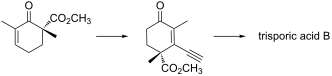
- the synthesis of natural occurring terpenes, i. a., trisporic acid and its derivatives. An advanced building block has been synthesized in a short reaction sequence, which involves an oxidative allylic rearrangement initiated by pyridinium dichromate (PDC) as the key step. Keywords: enzymatic


Molecular rearrangements of superelectrophiles
Beilstein J. Org. Chem. 2011, 7, 346–363, doi:10.3762/bjoc.7.45
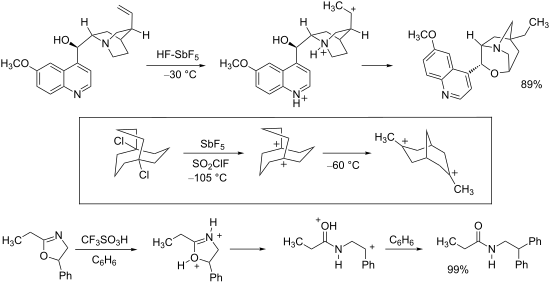
- nitrogen atom. In the case of α-isomer 108, the developing azonium cation may be stabilized by resonance interaction with the phenyl group of 111. However, with the β-isomer 109 the developing azonium cation is located next to the pyridinium ring 116. Evidently, structure 116 is destabilized by the





