Search results
Search for "small molecule" in Full Text gives 226 result(s) in Beilstein Journal of Organic Chemistry. Showing first 200.
My maize and blue brick road to physical organic chemistry in materials
Beilstein J. Org. Chem. 2016, 12, 229–238, doi:10.3762/bjoc.12.24
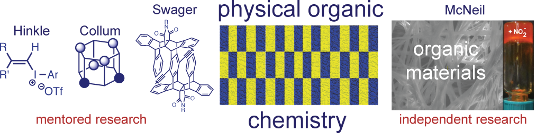
- field of supramolecular chemistry, specifically, and organic materials, broadly. My research group’s efforts toward designing new sensors based on small molecule gelators are described. In particular, I highlight how our design strategy has evolved as we learn more about molecular gelators. This


A journey in bioinspired supramolecular chemistry: from molecular tweezers to small molecules that target myotonic dystrophy
Beilstein J. Org. Chem. 2016, 12, 125–138, doi:10.3762/bjoc.12.14
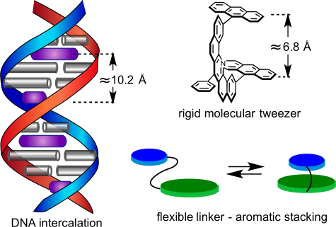
- early career efforts in molecular recognition, especially molecular tweezers. Although designed to complex DNA, these hosts proved more applicable to the field of host–guest chemistry. This early experience and interest in intercalation ultimately led to the current efforts to develop small molecule
- understood even today, my idea as a graduate student was to make a bisintercalator that was so rigid it could not form the mono-intercalated complex in Figure 2d. The ultimate goal was to develop a small molecule ligand that might intercalate at sites that lack a conventional neighboring intercalation site
- , students were not so interested in this area of research, perhaps because I had little training in DNA/small molecule recognition. Whatever the reason, we temporarily suspended this research effort. Fortunately, others were more persevering and pushed the concept forward in important new directions


Learning from the unexpected in life and DNA self-assembly
Beilstein J. Org. Chem. 2015, 11, 2713–2720, doi:10.3762/bjoc.11.292
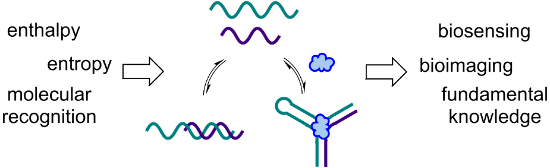
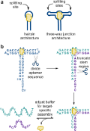
- presence of a small-molecule or protein target [5][6]. Thus, they combine my two favorite themes, as they use molecular recognition to drive self-assembly. At the point that we began our research program, all of the reported work on split aptamers had focused on detecting non-covalent assembly for systems
- demonstrated that we could use our split aptamer ligation method to measure the concentration of a small-molecule target, but doing so required analysis via gel electrophoresis. Thus, we sought to create an assay that would be capable of the high throughput needed for clinical diagnostics applications, and we
- binding events to be “remembered” through covalent trapping of the assembled split aptamer. Thus, the ability to generate target-dependent signal is preserved even if target binding is lost in the washing steps. At this point, we were excited by our successes in the development of small-molecule detection




Inclusion complexes of 2-methoxyestradiol with dimethylated and permethylated β-cyclodextrins: models for cyclodextrin–steroid interaction
Beilstein J. Org. Chem. 2015, 11, 2616–2630, doi:10.3762/bjoc.11.281
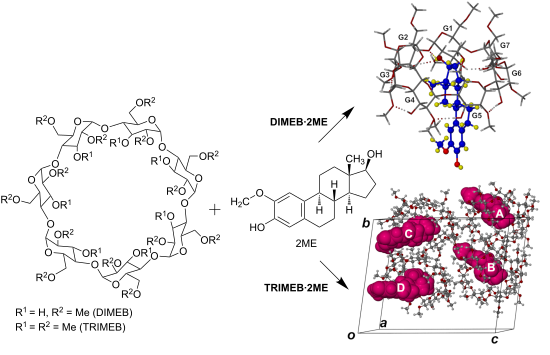
- feature, while commonly observed in protein–ligand recognition and selection, is rare for small molecule structures [1]. In addition to the solid-state results detailed below, we report original data on the use of CDs to enhance the aqeous solubility of 2ME. The title steroid, originally identified as an





Smart molecules for imaging, sensing and health (SMITH)
Beilstein J. Org. Chem. 2015, 11, 2540–2548, doi:10.3762/bjoc.11.274
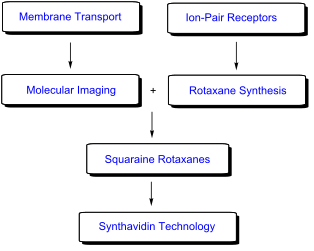
- . This vision merges classical supramolecular chemistry with materials self-assembly. The projects will be technically challenging, as they will require nanoscale characterization methods that are not familiar to most small molecule chemists. Thus, collaboration is likely to be a key element for this


Recent developments in copper-catalyzed radical alkylations of electron-rich π-systems
Beilstein J. Org. Chem. 2015, 11, 2278–2288, doi:10.3762/bjoc.11.248
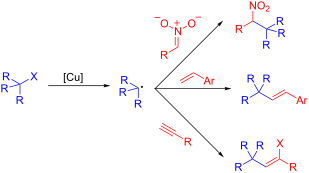
- used extensively in polymer chemistry because of the ability of alkyl radicals to participate in chain reactions [2][3][4]. They have also been used extensively in small molecule synthesis, particularly in an intramolecular cyclization setting [5][6][7][8][9]. However, while the ability of alkyl


Nitro-Grela-type complexes containing iodides – robust and selective catalysts for olefin metathesis under challenging conditions
Beilstein J. Org. Chem. 2015, 11, 1823–1832, doi:10.3762/bjoc.11.198
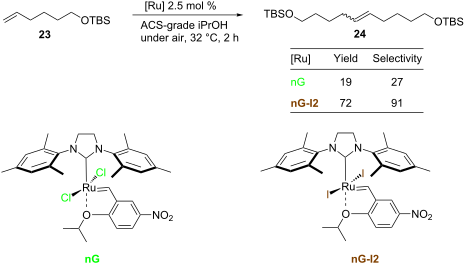
- small molecule of ethylene is coordinated to the ruthenium generating highly active methylidene species. Macrocyclization reactions As model substrates for macrocyclization we choose esters 17 and 18 which are metathesized to the 16- and 14- membered lactones. The RCM was run in toluene, at 70 °C and at


Azobenzene-based inhibitors of human carbonic anhydrase II
Beilstein J. Org. Chem. 2015, 11, 1129–1135, doi:10.3762/bjoc.11.127
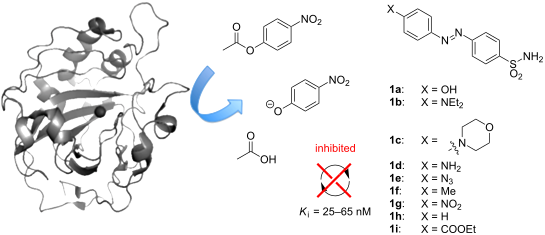
- as well as Eric P. Trautman and Martin Maier for excellent synthetic assistance. Author Contributions D.T. supervised the research. J.B. and D.T. conceived and designed the study. J.B. and L.S.R. performed chemical, biological and small molecule crystallization experiments. J.B. performed protein


DNA display of glycoconjugates to emulate oligomeric interactions of glycans
Beilstein J. Org. Chem. 2015, 11, 707–719, doi:10.3762/bjoc.11.81
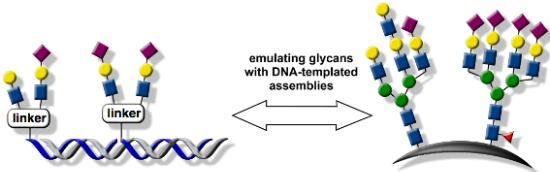
- surface glycans are important actors in cellular recognition and have been implicated in numerous events such as fertilization, embryonic development, lymphocyte trafficking and cancer metastasis [1][2][3][4]. In contrast to many small molecule ligands where a functional output is often the product of a
- used to display glycans with a synergy between the interactions of the individual ligands binding with a target. Progress in this area has paralleled similar developments with small molecule conjugates [48][54][55][56][57][58][59][60][61][62][63]. Technological developments in conjugation chemistry and


Synthesis and biological evaluation of a novel MUC1 glycopeptide conjugate vaccine candidate comprising a 4’-deoxy-4’-fluoro-Thomsen–Friedenreich epitope
Beilstein J. Org. Chem. 2015, 11, 155–161, doi:10.3762/bjoc.11.15
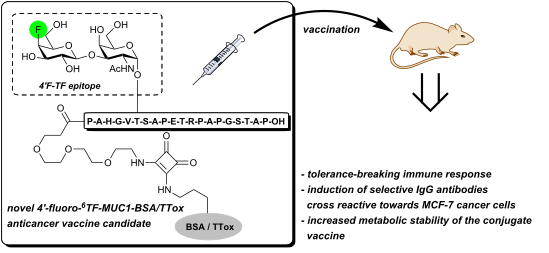
- , the search for novel anticancer therapies is of high current interest. For instance, promising approaches such as targeted therapy with small molecule tyrosine kinase inhibitors [1][2] and active cancer immune therapy have emerged [3][4] with the latter one being particularly attractive in terms of




Organic chemistry on surfaces: Direct cyclopropanation by dihalocarbene addition to vinyl terminated self-assembled monolayers (SAMs)
Beilstein J. Org. Chem. 2014, 10, 2897–2902, doi:10.3762/bjoc.10.307
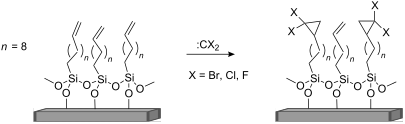
- -difluorocyclopropane-terminated SAMs by generating difluorocarbene, following the procedure of Wang et al. [22] for small molecule transformations. This involved stirring a solution of NaI (0.2 equiv) and TMSCF3 in THF (2 mL), and then immersing the silicon wafers (1 cm × 1.5 cm) into the reaction mixture at 65 °C for


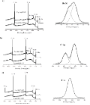


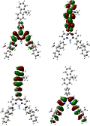
Synthesis and properties of novel star-shaped oligofluorene conjugated systems with BODIPY cores
Beilstein J. Org. Chem. 2014, 10, 2704–2714, doi:10.3762/bjoc.10.285
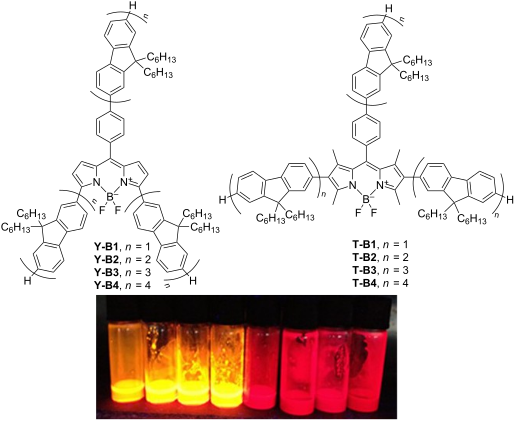
- have found numerous applications as laser dyes [5][6][7], labels for biological imaging [8][9][10] and low band-gap polymers [11][12][13]. Being efficient emitters in solution, small molecule BODIPY compounds often show signs of aggregation at high concentration and in solid films [14][15], which



Solution processable diketopyrrolopyrrole (DPP) cored small molecules with BODIPY end groups as novel donors for organic solar cells
Beilstein J. Org. Chem. 2014, 10, 2683–2695, doi:10.3762/bjoc.10.283
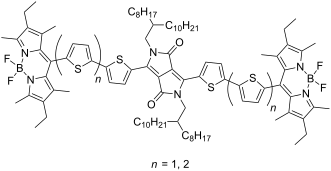
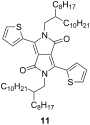
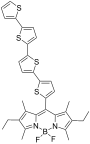
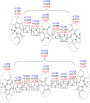
- -diaza-s-indacene (BODIPY) units attached by thiophene rings have been synthesised having high molar extinction coefficients. These triads were characterised and used as donor materials in small molecule, solution processable organic solar cells. Both triads were blended with PC71BM as an acceptor in
- processing during device fabrication. The difference in power conversion efficiencies (PCEs) between polymer and small-molecule based OPVs is decreasing and PCEs over 7% have been realised in the case of the latter [18][19]. Small molecules used in OPVs are most commonly based on oligothiophenes and their
- results [26][27][28]. A PCE greater than 4% was achieved in combination with phenyl-C71-butyric acid methyl ester (PC71BM) [29]. Interestingly, a small molecule based on a DPP core substituted with electron-withdrawing units was also used as an acceptor in OPVs as a substitute for fullerene with PCEs of 1




A small azide-modified thiazole-based reporter molecule for fluorescence and mass spectrometric detection
Beilstein J. Org. Chem. 2014, 10, 2470–2479, doi:10.3762/bjoc.10.258
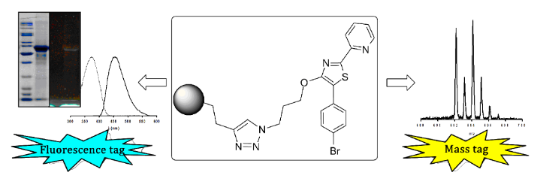
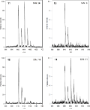
- electrospray ionization MS runs by monitoring for its characteristic isotope signature. We demonstrate the universal utility of the reporter for the detection of an alkyne-modified small molecule by LC–MS and for the visualization of a model protein by in-gel fluorescence. The novel probe advantageously



Molecular recognition of AT-DNA sequences by the induced CD pattern of dibenzotetraaza[14]annulene (DBTAA)–adenine derivatives
Beilstein J. Org. Chem. 2014, 10, 2175–2185, doi:10.3762/bjoc.10.225
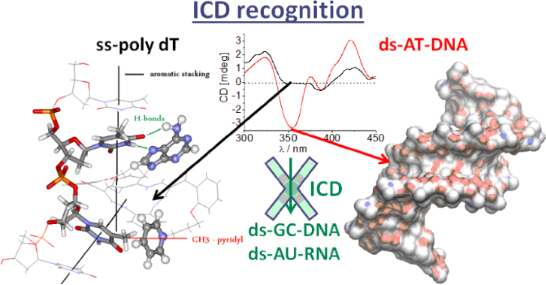
- recognition; circular dichroism; DBTAA-adenine conjugate; ds-DNA/RNA; minor groove binding; nucleic acids; Introduction The majority of natural and artificial applications involving small molecule-DNA/RNA recognition depend on several non-covalent binding modes. Typical examples are double-stranded (ds) DNA
- /RNA sites [2][3], frequently relying upon new knowledge gained from supramolecular chemistry [4]. Among the large number of DNA/RNA sequences of biochemical interest, long homogeneous AT tracts have attracted significant attention as small molecule targets. An illustrative natural example can be found
- advantage of nucleobase incorporation in small molecule structures for the recognition of complementary nucleotides/polynucleotides [8][9][10]. Recent studies of the novel DBTAA-adenine conjugates AP3 and AP6 (Scheme 1) showed a highly selective binding of only AP3 to poly dT among all other ss-DNA/RNA, as


Chiral phosphines in nucleophilic organocatalysis
Beilstein J. Org. Chem. 2014, 10, 2089–2121, doi:10.3762/bjoc.10.218
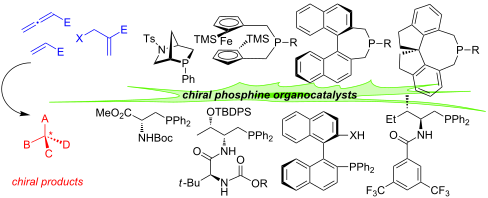
- have excellent catalytic activities and enantioselectivities, only a few acyclic phosphines were effective. In this context, inspired by polyfunctional chiral small-molecule catalysts, particularly amino acid and thiourea-based systems [31][32], multifunctional chiral phosphines were constructed by


Organophosphorus chemistry
Beilstein J. Org. Chem. 2014, 10, 2087–2088, doi:10.3762/bjoc.10.217

- number of important fields. Among the more prominent features that elevate their status as a unique and versatile class of compounds, include variable oxidation states, multivalency, asymmetry and metal-binding properties. Their presence in bioactive natural products, endogenous biomolecules, small
- molecule therapeutic agents and pro-drugs substantiates their role in modern synthetic chemistry and chemical biology. Moreover, their central use as ligands and effectors in asymmetric catalysis, as well as key functional groups for the development of new synthetic methods, has taken the field to new
Supercritical carbon dioxide: a solvent like no other
Beilstein J. Org. Chem. 2014, 10, 1878–1895, doi:10.3762/bjoc.10.196
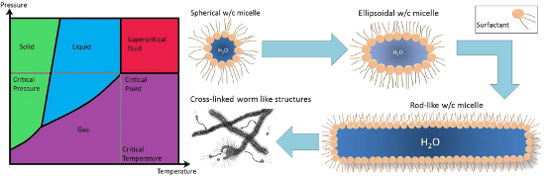
- small molecule surfactants have reapplied during the design of CO2-philic polymers. The structures of polymers discussed in this review can be seen in Table 2. Fluorinated polymers: One of the first polymers reported to be solubilised in CO2 was Krytox 16350 (Table 2, compound 16), a perfluoropolyether


Multicomponent reactions in nucleoside chemistry
Beilstein J. Org. Chem. 2014, 10, 1706–1732, doi:10.3762/bjoc.10.179
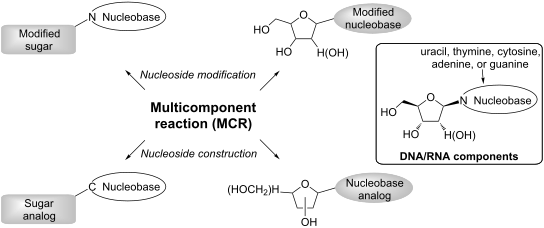
- ) represent an excellent tool for the generation of libraries of small-molecule compounds, for instance they are indispensable for the structure–activity relationship (SAR) studies. Many excellent comprehensive reviews on MCRs have been published. The reviews have covered the significant topics in this field


Aryl substitution of pentacenes
Beilstein J. Org. Chem. 2014, 10, 1692–1705, doi:10.3762/bjoc.10.178
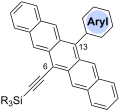
- ], and specifically 6,13-(triisopropylsilylethynyl)pentacene (TIPSPc) [13][14]. The latter was synthesized by Anthony over a decade ago [16], but it is still a leading focus of the scientific community. Substituted pentacenes can offer several advantages to other small molecule semiconductors, including




An experimental and theoretical NMR study of NH-benzimidazoles in solution and in the solid state: proton transfer and tautomerism
Beilstein J. Org. Chem. 2014, 10, 1620–1629, doi:10.3762/bjoc.10.168
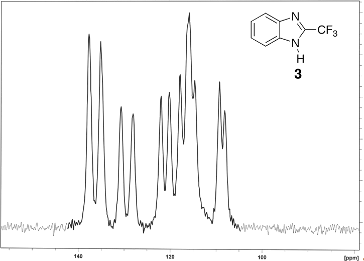
- heterocycles it can be said that they have relevant biological and medicinal chemistry properties, because, for instance, over 80% of top small molecule drugs by US retail sales in 2010 contain at least one heterocyclic fragment in their structures [1]. Benzimidazoles besides being the skeleton of many


Syntheses of fluorooxindole and 2-fluoro-2-arylacetic acid derivatives from diethyl 2-fluoromalonate ester
Beilstein J. Org. Chem. 2014, 10, 1213–1219, doi:10.3762/bjoc.10.119
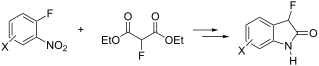
- –fluorine bonds are ‘man-made’. Syntheses rely either on the construction of carbon–fluorine bonds using a fluorinating agent (‘late-stage’ fluorination) or the application of polyfunctional fluorine-containing small molecule building blocks (‘early stage’ fluorination) which may be employed in further


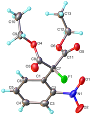

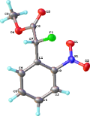


Automated solid-phase peptide synthesis to obtain therapeutic peptides
Beilstein J. Org. Chem. 2014, 10, 1197–1212, doi:10.3762/bjoc.10.118
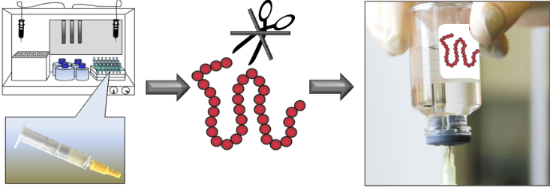
- interesting target on the pharmaceutical market. In terms of molecular weight, peptides bridge the gap between small molecule drugs (<500 Da) and protein-based pharmaceuticals (>5,000 Da) and enable a possible medication of incurable pathologies [3]. Diseases such as cancer, diabetes, obesity but also


Rapid pseudo five-component synthesis of intensively blue luminescent 2,5-di(hetero)arylfurans via a Sonogashira–Glaser cyclization sequence
Beilstein J. Org. Chem. 2014, 10, 672–679, doi:10.3762/bjoc.10.60
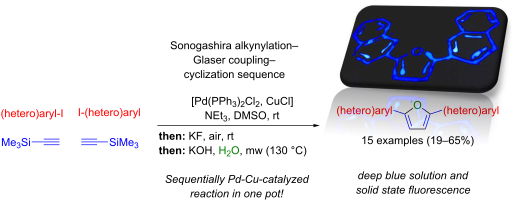
- structurally related to small molecule inhibitors of p53-HDM-2 [21][22][23]. Electronic properties and computational studies All title compounds 2 display strong fluorescence in solution and in the solid state upon UV excitation (Figure 1). Therefore, the absorption and emission spectra of all compounds 2 were




Integration of enabling methods for the automated flow preparation of piperazine-2-carboxamide
Beilstein J. Org. Chem. 2014, 10, 641–652, doi:10.3762/bjoc.10.56
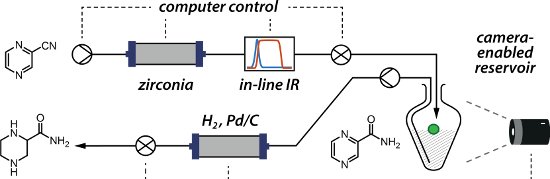
- pyrazine 2 to piperazine 1 (Figure 2b). Both of these steps involve flowing through heterogeneous catalysts, a metal oxide for the hydration of the nitrile and a supported precious metal for the hydrogenation of the heteroaromatic ring. Furthermore, both steps involve the addition of a volatile small
- molecule to the substrate with no byproducts: the addition of water for the nitrile hydration, and the addition of hydrogen to the heteroarene for the reduction. Thus, this sequence is ideal for a fully continuous multi-step process. Results and Discussion Nitrile hydration Primary amides can be prepared