


Search results
Search for "stereoisomers" in Full Text gives 242 result(s) in Beilstein Journal of Organic Chemistry. Showing first 200.
Aluminacyclopentanes in the synthesis of 3-substituted phospholanes and α,ω-bisphospholanes
Beilstein J. Org. Chem. 2016, 12, 406–412, doi:10.3762/bjoc.12.43
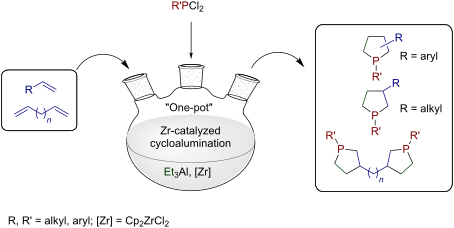
- BuPCl2, the reaction with 3-benzyl-1-ethylaluminacyclopentane 1f affords the corresponding phospholanes 2g,h with one of the isomers predominating (Table 1). In the case of 3-cyclohexyl- and 3-(сyclohex-3-en-1-yl)-1-phenylphospholanes (2d and 2e), the number of stereoisomers increases owing to the
- /methanol = 5:3:1) and characterized in a separate fraction (Scheme 4). It should be noted that the phosphorus signals of major intensity of 2-aryl phospholane oxides 8a, 8b, 8d, 8e, 8f, corresponding to one of the stereoisomers, are shifted upfield by ca. 5–7 ppm with respect to those of 3-aryl-substituted
- the proximate asymmetric centres at C-3 and С-3′. Ratios of stereoisomers were determined by HPLC method as 2:1 (see Supporting Information File 2, Figure S1). Organophosphorus compounds, including cyclic ones, are known to readily form complexes with transition metals, which are extensively studied


Diastereoselective synthesis of new O-alkylated and C-branched inositols and their corresponding fluoro analogues
Beilstein J. Org. Chem. 2016, 12, 353–361, doi:10.3762/bjoc.12.39
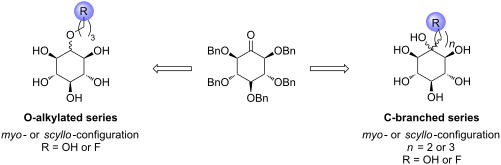
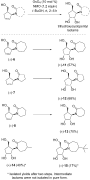
- ; Introduction Inositol is a trivial name used to describe cyclohexanehexol compounds. Nine stereoisomers exist differing in the relative orientation of the hydroxy groups, the most naturally abounding and biologically important is myo-inositol [1][2]. The chemistry of inositols has been the theme of several


Interactions of cyclodextrins and their derivatives with toxic organophosphorus compounds
Beilstein J. Org. Chem. 2016, 12, 204–228, doi:10.3762/bjoc.12.23
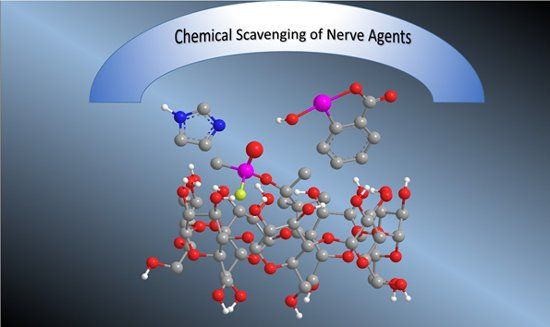
- organophosphates is to be considered important insofar as the individual stereoisomers of a neurotoxic agent do not share the same level of toxicity [20]. Sarin (compounds 14a and 14b, Figure 5), cyclosarin (compounds 15a and 15b, Figure 5) and tabun (compounds 16a and 16b, Figure 5) consist of a mixture of two
- enantiomers. Due to the presence of two chiral centers (the phosphorus atom and the carbon atom of the 1,2,2-trimethylpropyloxy group), soman presents four stereoisomers: C(S)P(S), C(R)P(S), C(S)P(R) and C(R)P(R) (compounds 17a–d, Figure 5). CDs can tune a reaction mechanism in two ways: (a) by creating a
- agent stereoisomers’ absolute configuration of the phosphorus atom was not firmly established. Thus, the van Hooidonk and Breebaart’s work dating from 1970, it is highly probable that they did not attributed the correct absolute configurations to the enantiomers of sarin, which means that the (S






Hydroquinone–pyrrole dyads with varied linkers
Beilstein J. Org. Chem. 2016, 12, 89–96, doi:10.3762/bjoc.12.10
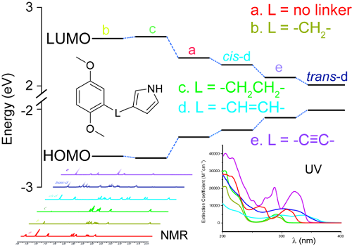
- % yield after 3 h. When the reaction was performed at room temperature, only 20% yield was obtained after 48 h. Close to equal quantities of cis-4c and trans-4c were formed in this reaction, and were separated chromatographically. Having access to both isomers was desirable, since the stereoisomers are


Organocatalytic and enantioselective Michael reaction between α-nitroesters and nitroalkenes. Syn/anti-selectivity control using catalysts with the same absolute backbone chirality
Beilstein J. Org. Chem. 2015, 11, 2577–2583, doi:10.3762/bjoc.11.277
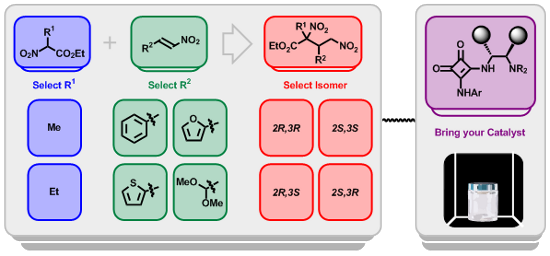
- despite the advances made in the field, an important challenge arises when a molecule containing multiple stereocentres has to be prepared because the access to all possible stereoisomers is not usually straightforward. While obtaining one or other mirror image of the target molecule can also be easily


[2.2]Paracyclophane derivatives containing tetrathiafulvalene moieties
Beilstein J. Org. Chem. 2015, 11, 1917–1921, doi:10.3762/bjoc.11.207
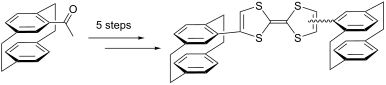
- -dithiolium salts; [2.2]paracyclophane; regioselective bromination; stereoisomers; tetrathiafulvalenes; Introduction Tetrathiafulvalene (TTF) and its derivatives have been extensively studied with respect to their applications as organic metals and superconductors [1][2]. These properties are a consequence
- a mixture of inseparable isomeric tetrathiafulvalenes 7 in 17% yield. Since compound 6 already exhibits planar chirality (racemate Rp/Sp), the theoretical number of stereoisomers of the tetrathiafulvalene 7 should be six as follows: cis-(Sp,Sp) with cis-(Rp,Rp) and trans-(Sp,Sp) with trans-(Rp,Rp


Cross metathesis of unsaturated epoxides for the synthesis of polyfunctional building blocks
Beilstein J. Org. Chem. 2015, 11, 1876–1880, doi:10.3762/bjoc.11.201
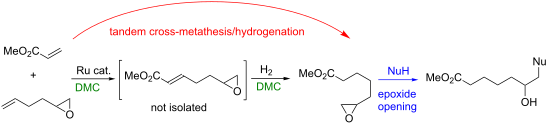
- performances (Table 1, entries 7 and 8). Similarly, the cross metathesis of 1 with acrylonitrile was conducted to furnish the bifunctional derivative 3 in 71% yield as a mixture of stereoisomers. In that case, high conversions and yields could only be obtained by means of slow addition of the catalyst and high
- dilution (Scheme 2) [13]. As we already observed, [13][14][22] together with other groups, [35][36] in various cross metathesis reactions involving acrylonitrile, the cross metathesis product 3 was obtained as a mixture of E (minor) and Z (major) stereoisomers. With these two compounds in hands, we turned


Mechanism, kinetics and selectivity of selenocyclization of 5-alkenylhydantoins: an experimental and computational study
Beilstein J. Org. Chem. 2015, 11, 1865–1875, doi:10.3762/bjoc.11.200
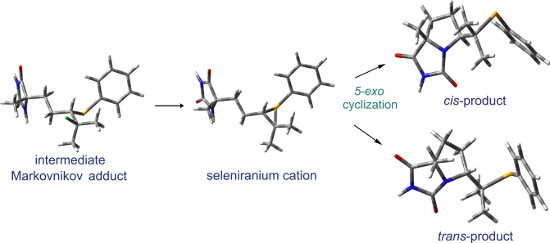
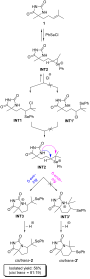
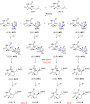
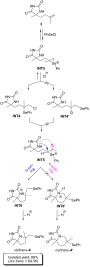
- addition of PhSeCl to the double bond, is presented in Scheme 1, while the 5-exo pathway with all stereoisomers is presented in Scheme 2. The first step of the proposed mechanism producing the seleniranium cation, followed by anti-attack of the external nucleophile (Cl−) to the double bond [35] of 5





Preparative semiconductor photoredox catalysis: An emerging theme in organic synthesis
Beilstein J. Org. Chem. 2015, 11, 1570–1582, doi:10.3762/bjoc.11.173
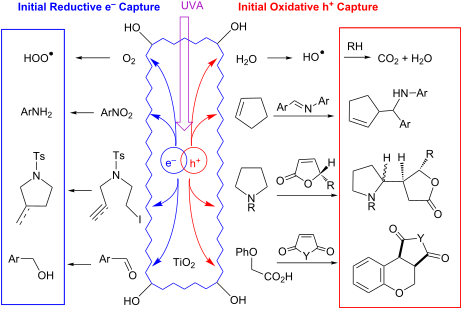
- yield of 75%. Phenyl- and 2-thienylacetic acids afforded adducts accompanied by the dimers bibenzyl (18%) and 1,2-di(thiophen-2-yl)ethane (27%), respectively. Significantly, Boc-protected α-amino acids also proved amenable and yielded adducts as 1:1 mixtures of stereoisomers. Chirality was not preserved







Cathodic hydrodimerization of nitroolefins
Beilstein J. Org. Chem. 2015, 11, 1163–1174, doi:10.3762/bjoc.11.131
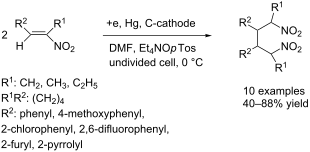
- the Marple electrode and converted to SCE. Hydrodimerization of nitroalkene 14 and 15. (a) Intramolecular hydrocoupling of dinitrodiene 16 and (b) hydrodimerization of 1-nitrocyclohexene (17). Possible stereoisomers and their mirror images for the hydrodimers 2 and 18–23; R and S are the


Advances in the synthesis of functionalised pyrrolotetrathiafulvalenes
Beilstein J. Org. Chem. 2015, 11, 1112–1122, doi:10.3762/bjoc.11.125
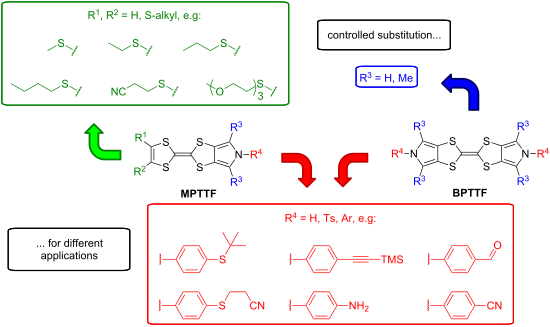
- complication encountered with such functionalised TTFs is the existence of cis and trans stereoisomers. The investigation of the properties of a single isomer is challenging, not only due to difficulties in the separation of the isomers, but also because it is possible for the isomers to interconvert in the


Synthesis of novel N-cyclopentenyl-lactams using the Aubé reaction
Beilstein J. Org. Chem. 2015, 11, 1060–1067, doi:10.3762/bjoc.11.119

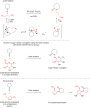
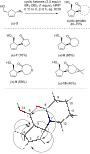
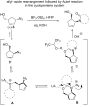
- Carell et al. in 2007 [40]. The work of Aubé on AAC (azide–alkyne cycloaddition) chemistry also gives a good indication that equilibrating allylic azide stereoisomers can selectively participate in reactions [37][38][39][40][41][42][43][44][45]. In 2000, Aubé et al. proposed a mechanism for the




Discrete multiporphyrin pseudorotaxane assemblies from di- and tetravalent porphyrin building blocks
Beilstein J. Org. Chem. 2015, 11, 748–762, doi:10.3762/bjoc.11.85
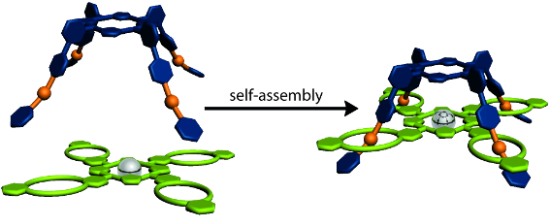
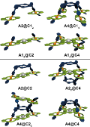
- ethers on its corresponding axle are possible. One can therefore expect a mixture of stereoisomers to form. In the simplest case, A2@C2, two enantiomers and one meso-form are expected to exist, which should result in two overlapping sets of signals. For the other three complexes, the situation is even
- . The formation of unspecific complexes as well as fragmentation upon ionization have been found to be quite limited so that the picture obtained from the mass spectra can be expected to provide realistic insights into the composition of the complexes present in solution. As all stereoisomers have the
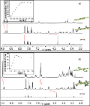
- broaden significantly, which is in agreement with the assumption that upon complexation the number of signals increases because the methylene protons become diasterotopic and different supramolecular stereoisomers can form. However, based on the present NMR spectroscopy data (Figure 7 and Figure 8) one





Synthesis of carbohydrate-scaffolded thymine glycoconjugates to organize multivalency
Beilstein J. Org. Chem. 2015, 11, 668–674, doi:10.3762/bjoc.11.75
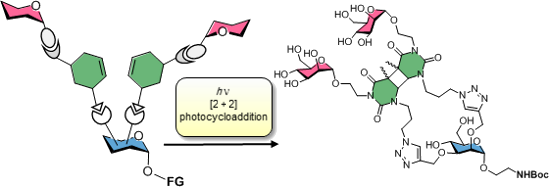
- products (cf. Supporting Information File 1). Both regioisomers can consist of four different stereoisomers, two cis and two trans isomers according to the relative steric orientation of the thymine methyl groups. It can be assumed that the irradiation of 7 in diluted solution favors the syn



Novel stereocontrolled syntheses of tashiromine and epitashiromine
Beilstein J. Org. Chem. 2015, 11, 596–603, doi:10.3762/bjoc.11.66

- stereoisomers (determined on the basis of 1H NMR data) failed, but the mixture could be applied in the next ring-opening oxidation step, since it gave only one open-chain diformyl intermediate I2. Similarly to the cis isomer, this unstable dialdehyde intermediate was subjected without isolation to catalytic


Enhancing the reactivity of 1,2-diphospholes in cycloaddition reactions
Beilstein J. Org. Chem. 2015, 11, 169–173, doi:10.3762/bjoc.11.17
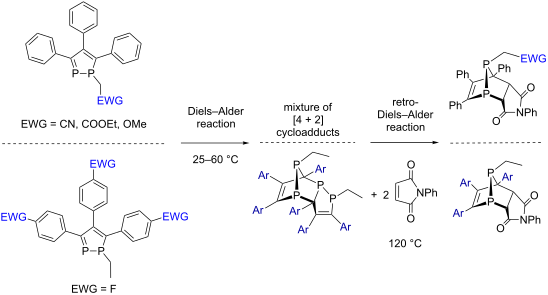
- would be assumed that similar [4 + 2] cycloadducts are formed according to the range of signals in the 31P NMR spectra. However, in this case, several stereoisomers are formed due to the high reactivity of the 1,2-diphospholes containing EWGs on the phosphorus atom. It should be noted that this is the


First chemoenzymatic stereodivergent synthesis of both enantiomers of promethazine and ethopropazine
Beilstein J. Org. Chem. 2014, 10, 3038–3055, doi:10.3762/bjoc.10.322
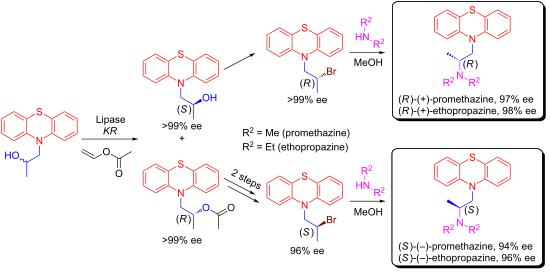
- derivatives by means of PBr3, and subsequently reacted with appropriate amine providing desired pharmacologically valuable (R)- and (S)-stereoisomers of title drugs in an ee range of 84–98%, respectively. The modular amination procedure is based on a solvent-dependent stereodivergent transformation of the
- profiles of its stereoisomers, obtaining both enantiomers in more than analytical quantities is particularly desirable. Moreover, the racemic mixture of this pharmaceutical is commercially available, however it is sold at high price, as its production by standard synthetic procedures is time-consuming and




(2R,1'S,2'R)- and (2S,1'S,2'R)-3-[2-Mono(di,tri)fluoromethylcyclopropyl]alanines and their incorporation into hormaomycin analogues
Beilstein J. Org. Chem. 2014, 10, 2844–2857, doi:10.3762/bjoc.10.302
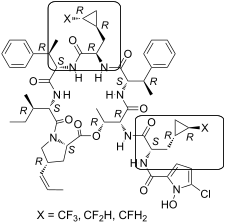
- with alkyl halides virtually yield single stereoisomers, in which the configuration of the newly formed stereogenic center at C-2 of the amino acid moiety is the same as that in the proline moiety of the chiral auxiliary in the starting material. In reactions of the enolate of this chiral glycine
- triflates of threonine stereoisomers [47], the chiral auxiliary approach [48][49][50][51] and enantioselective hydrogenation over a chiral catalyst [52][53]. All these approaches ought to be applicable to prepare unsubstituted β-methylphenylalanine, but most if not all of them have severe drawbacks. Among
- the chiral auxiliary approaches to β-branched arylalanines, including all four stereoisomers of β-methylphenylalanine, the one employing the "Evans amide" method with a 4-benzyl- or 4-phenyl-2-oxazolidinone moiety, has been used most frequently. Along this route, which requires eight procedural steps




Preparation of neuroprotective condensed 1,4-benzoxazepines by regio- and diastereoselective domino Knoevenagel–[1,5]-hydride shift cyclization reaction
Beilstein J. Org. Chem. 2014, 10, 2594–2602, doi:10.3762/bjoc.10.272
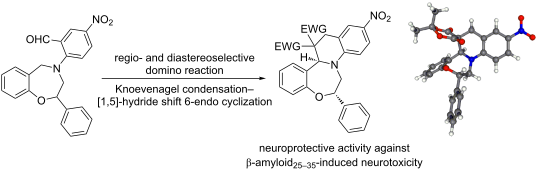
- ). TDDFT-ECD calculation was proved an efficient method to determine the absolute configuration of separated stereoisomers of bioactive synthetic [19] and natural derivatives [20][21] on the basis of their HPLC-ECD spectra. For the configurational assignment of the separated enantiomers, TDDFT-ECD


Phosphinocyclodextrins as confining units for catalytic metal centres. Applications to carbon–carbon bond forming reactions
Beilstein J. Org. Chem. 2014, 10, 2388–2405, doi:10.3762/bjoc.10.249
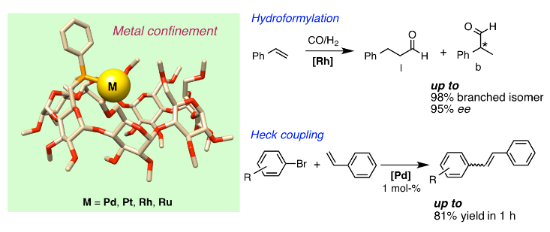
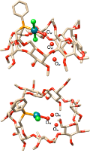
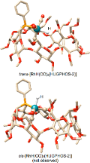
- trans (strong CO IR band at 1985 cm−1 [55][56]) configured. Remarkably, the same ratio of stereoisomers was obtained when rhodium complex 13 (see Scheme 6) was treated with LiCl under CO (1 atm). When the reaction between HUGPHOS-2 and [RhCl(CO)2]2 was repeated, but applying a 1:1 instead of 1:0.5






N–O Cleavage reactions of heterobicycloalkene-fused 2-isoxazolines
Beilstein J. Org. Chem. 2014, 10, 2200–2205, doi:10.3762/bjoc.10.227
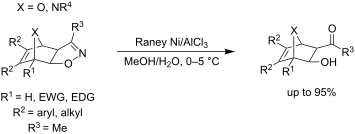
- cleavage of carbobicycle-fused 2-isoxazolines converts both exo- and endo stereoisomers of 8 into the corresponding single isomer of cyclopentene 9 (Table 1) [20]. Since then, we have been interested in the outcomes of cleavage reactions of 2-isoxazolines fused to heterobicyclic compounds 10 or 11, which


Building complex carbon skeletons with ethynyl[2.2]paracyclophanes
Beilstein J. Org. Chem. 2014, 10, 2013–2020, doi:10.3762/bjoc.10.209

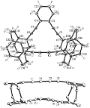
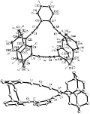
- diastereomers are generated (as expected) by the oxidative dimerization of the mono ethynyl derivative [9], but assignment of the various spectra to specific stereoisomers remains an open question, and will only be possible after the resolution of the 4-ethynyl[2.2]paracyclophane, determination of its absolute




Synthesis of rigid p-terphenyl-linked carbohydrate mimetics
Beilstein J. Org. Chem. 2014, 10, 1749–1758, doi:10.3762/bjoc.10.182
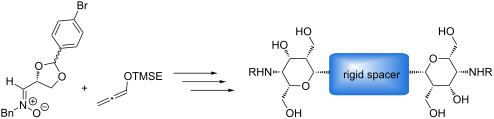
- dioxolane C-2 (ratios close to 1:1). The preparation of syn-1,2-oxazine 4 was achieved in good yields ranging from 67–77% by stereocontrolled addition of lithiated (trimethylsilyl)ethoxyallene 9 to (Z)-nitrone 6 at −78 °C (Scheme 3). Although the formation of four stereoisomers is possible only two were


Multicomponent reactions in nucleoside chemistry
Beilstein J. Org. Chem. 2014, 10, 1706–1732, doi:10.3762/bjoc.10.179
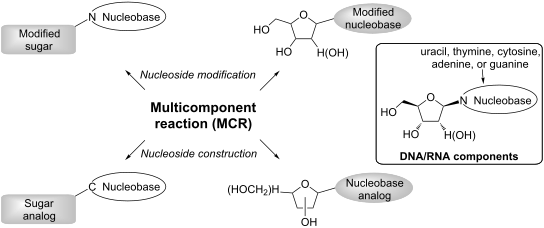
- , the uridine example is shown) [114]. The coupling products 98 were obtained as (Z)-stereoisomers for studies related to the drug discovery against the hepatitis C virus. The methodology shown in Scheme 40 [114] was further elaborated on reactions of polyfunctional iodide 99 with four equivalents of


cis–trans Isomerization of silybins A and B
Beilstein J. Org. Chem. 2014, 10, 1047–1063, doi:10.3762/bjoc.10.105
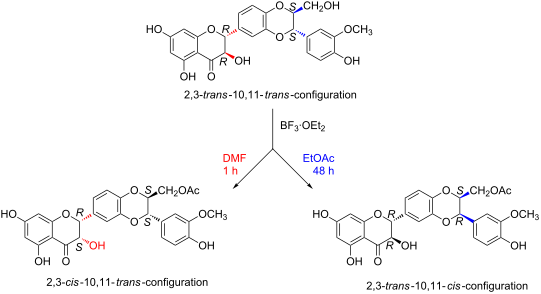
- ; 10,11-cis-silybin; isomerization; silibinin; silybin; silymarin; Introduction The flavonolignan silybin (alternative name silibinin), occurring in the fruits of Silybum marianum (milk thistle), consists of two stereoisomers – silybin A (1a) and B (1b) – in a ca. 1:1 ratio (Figure 1). Their absolute
- (or 10 from 1b) on silica gel was not feasible, analogous to the preparative separation of silybin stereoisomers 1a and 1b (Figure 1), which was a challenge for several decades. It was accomplished as the separation of the respective silybin glycosides for the first time [13][14], later by HPLC [3
- -glucopyranoside 6''-gallate, Figure 6) was subjected to both, basic and acidic hydrolysis during its structure elucidation. However, under these conditions four stereoisomers of the original aglycon (2R,3R)-taxifolin were formed. Base-catalyzed isomerization of another taxifolin glycoside, (2R,3R)-2,3





