


Search results
Search for "substitution pattern" in Full Text gives 230 result(s) in Beilstein Journal of Organic Chemistry. Showing first 200.
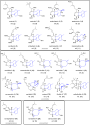
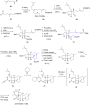
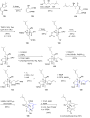
Synthesis of Xenia diterpenoids and related metabolites isolated from marine organisms
Beilstein J. Org. Chem. 2015, 11, 2521–2539, doi:10.3762/bjoc.11.273
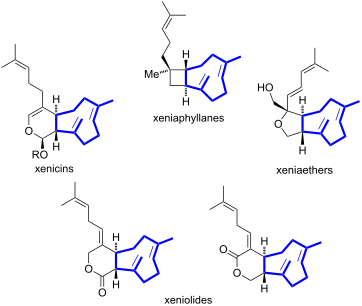
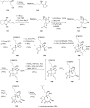
- coupling) and ring contracting reactions. The choice of tactic is dependent on the individual substitution pattern of the target compound. However, many of the presented strategies rely on long synthetic sequences that cannot provide large amounts of synthetic material which is required for further







Synthesis of constrained analogues of tryptophan
Beilstein J. Org. Chem. 2015, 11, 1997–2006, doi:10.3762/bjoc.11.216
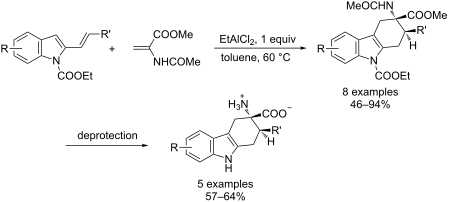
- the substitution pattern of starting materials (substituted arylhydrazines and cyclohexanones) and is therefore useful mainly for the synthesis of symmetrically or unsubstituted derivatives [16][17]. Recently, our research group described the synthesis of tetrahydrocarbazole derivatives by Diels–Alder
- of these compounds. In particular, the dependence upon the substitution pattern at nitrogen and at the outer-ring double bond, highlighted the need to select the appropriate promoter for each desired transformation. Examples of drugs embodying unnatural amino acids. Examples of biologically active


Synthesis of quinoline-3-carboxylates by a Rh(II)-catalyzed cyclopropanation-ring expansion reaction of indoles with halodiazoacetates
Beilstein J. Org. Chem. 2015, 11, 1944–1949, doi:10.3762/bjoc.11.210
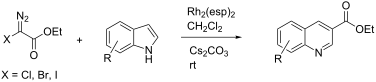
- [15]. The substitution pattern of the indole substrate can have a significant effect on chemo- and regioselectivity. Electron-rich indoles typically give selective alkylation at the C3 position in the absence of a preexisting C3-substituent. In the presence of a C3-substituent, the alkylation is
- substitution pattern of an indole substrate, particularly in the 2- and 3-position, can have a significant effect on the reactivity and selectivity. The reaction gave a good yield (70%) of the 4-substituted quinoline carboxylate, demonstrating that a substituent in indole’s 3-position was tolerated well. The


[2.2]Paracyclophane derivatives containing tetrathiafulvalene moieties
Beilstein J. Org. Chem. 2015, 11, 1917–1921, doi:10.3762/bjoc.11.207
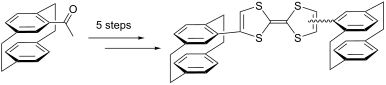
- recent report has appeared concerning the synthesis of a [2.2]paracyclophane doubly substituted by a dimeric tetrathiafulvalene in a pseudo-ortho substitution pattern [10]. This compound exhibited novel chiroptical properties. Prompted by these observations, we decided to investigate the synthesis of a


Preparative semiconductor photoredox catalysis: An emerging theme in organic synthesis
Beilstein J. Org. Chem. 2015, 11, 1570–1582, doi:10.3762/bjoc.11.173
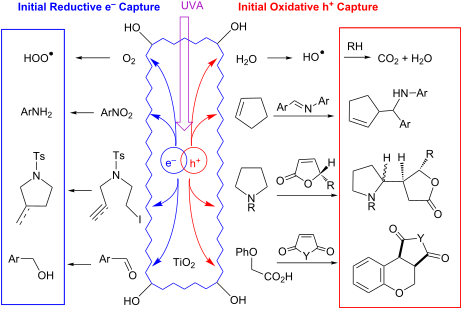
- popularity of homogeneous PRCs is due to their ease of synthesis and stability as well as their excellent photoredox properties. Furthermore, they can be activated by visible light, precluding the requirement for specialized irradiation setups, and their reactivity can be tuned by altering the substitution
- pattern on the ligands and by changing the metal. In the case of the prototypical PRC, Ru(bpy)32+, absorption of a photon generates the long lived triplet species *Ru(bpy)32+ that can act both as a reductant and an oxidant. Electron transfer to an acceptor molecule A generates the A–• radical anion







Latent ruthenium–indenylidene catalysts bearing a N-heterocyclic carbene and a bidentate picolinate ligand
Beilstein J. Org. Chem. 2015, 11, 1541–1546, doi:10.3762/bjoc.11.169
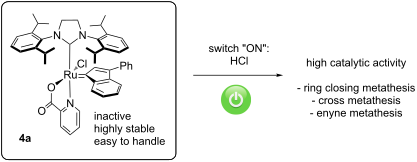
- , under these modified conditions the desired complex 4a could be prepared in a clean manner with an improved 62% isolated yield. Given the importance of the substitution pattern of the chelating [N–O] ligand, X-ray diffraction analysis unambiguously confirmed the structure of complex 4a, which displayed


An intramolecular C–N cross-coupling of β-enaminones: a simple and efficient way to precursors of some alkaloids of Galipea officinalis
Beilstein J. Org. Chem. 2015, 11, 884–892, doi:10.3762/bjoc.11.99

- -Diketones 4 were obtained using tert-butoxide or tert-pentoxide mediated Claisen condensation of esters 5 with the appropriate acetophenones 6a–d (Scheme 5, step c). The substitution pattern on compounds 6 was chosen so that the final products 1 are the precursors for the synthesis of galipinine, galipeine


Further exploration of the heterocyclic diversity accessible from the allylation chemistry of indigo
Beilstein J. Org. Chem. 2015, 11, 481–492, doi:10.3762/bjoc.11.54
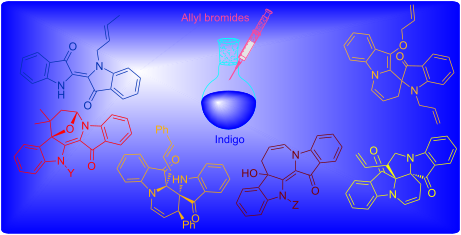
- summary, a bulky terminal substitution pattern in the allylic bromide reactant is thus an important factor in determining the eventual main product outcomes after N-monoallylation. Mechanistic discussions The short reaction times suggest the initial formation of monoallylated products followed by a second




Conjugates of methylated cyclodextrin derivatives and hydroxyethyl starch (HES): Synthesis, cytotoxicity and inclusion of anaesthetic actives
Beilstein J. Org. Chem. 2014, 10, 3087–3096, doi:10.3762/bjoc.10.325
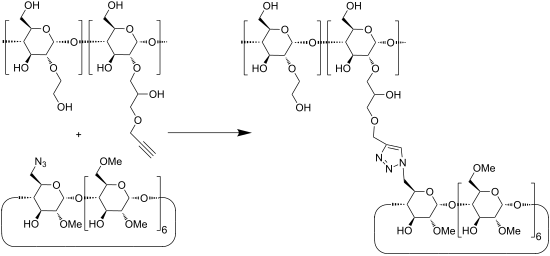
- ]. Toxicity of β-CD can be minimized by derivatisation [11][12]. Both, hydroxypropyl-β-CD (HP-β-CD) and sulfobutyl-β-CD are less toxic than β-CD, but they are less defined due to a statistical substitution pattern [13]. HP-β-CD often shows a reduced binding potential compared to β-CD [2][14]. On the other




A one-pot multistep cyclization yielding thiadiazoloimidazole derivatives
Beilstein J. Org. Chem. 2014, 10, 2989–2996, doi:10.3762/bjoc.10.317
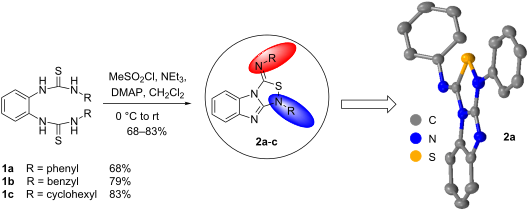
- found that the product was produced in slightly lower yields of 42% and 55%, respectively. Using the optimized conditions (Table 1, entry 3), we prepared both benzyl (2b, 79%) and cyclohexyl (2c, 83%) substituted 1,2,4-thiadiazoles as representatives for a substitution pattern with various alkyl
- carbodiimide and thiourea units under in situ conditions. The product structure was confirmed by single crystal X-ray analysis in the solid state. The substitution pattern (aryl, benzyl, sec-alkyl) may be varied easily to achieve potentially biologically active compounds with interesting properties. The free


Synthesis of uniform cyclodextrin thioethers to transport hydrophobic drugs
Beilstein J. Org. Chem. 2014, 10, 2920–2927, doi:10.3762/bjoc.10.310
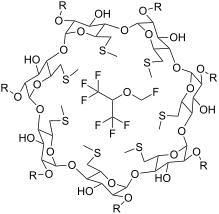
- anaesthesia. Keywords: active pharmaceutical ingredient; binding constant; cyclodextrin; derivatization; gas chromatography; sevoflurane; substitution pattern; Introduction Cyclodextrins (CDs) are cyclic oligomers of α-1,4-linked glucose units. Those CDs consisting of 6, 7, and 8 glucose units are called α
- (Figure 1) showed a rather broad molecular weight distribution typical for CD derivatives with statistical substitution pattern. On the other hand, nearly uniform CD derivatives were synthesized by regioselective deprotonation of all 2-OH positions with NaH in DMF solution according to Tian and D’Souza
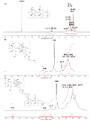
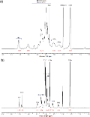
- MS of 3b1 (Figure 1) showed a significantly lower polydispersity than 2b1. Also the 1H NMR spectrum of 3b1 was much better resolved than the one of the statistical derivative 2b1 due to its homogenous substitution pattern and uniform lengths of the oligoethylene oxide groups (Figure 2). All β-CD




Self-assembled monolayers of shape-persistent macrocycles on graphite: interior design and conformational polymorphism
Beilstein J. Org. Chem. 2014, 10, 2774–2782, doi:10.3762/bjoc.10.294
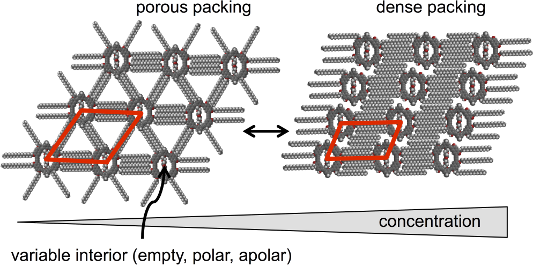
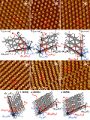
- the role of intraannular substituents on the 2D supramolecular surface patterns of macrocyclic compounds. Therefore, in addition to the concentration-driven conformational polymorphism that is yet attributed to a distinct extraannular substitution pattern as discussed above, we evaluate the role of



Synthesis and properties of novel star-shaped oligofluorene conjugated systems with BODIPY cores
Beilstein J. Org. Chem. 2014, 10, 2704–2714, doi:10.3762/bjoc.10.285
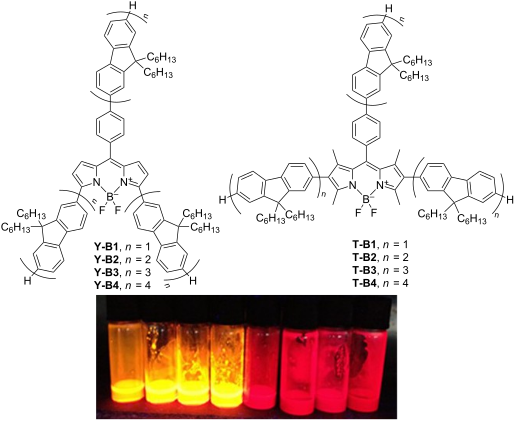
- under ambient conditions and UV-illumination is presented in Figure 2. The effect of the substitution pattern of the BODIPY core with fluorene arms (either at the α- or β-positions) on the optical properties of the materials can be observed with the naked eye. The compounds of the Y-Bn (n = 1–4) series



Facile synthesis of 1H-imidazo[1,2-b]pyrazoles via a sequential one-pot synthetic approach
Beilstein J. Org. Chem. 2014, 10, 2338–2344, doi:10.3762/bjoc.10.243
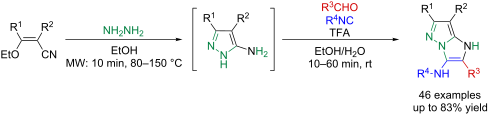
- imidazo[1,2-b]pyrazole core is definitely an attractive synthetic target, in view of its noteworthy pharmacological potential, which is strongly affected by the ring substitution pattern and the level of ring saturation. Among others, anti-inflammatory [37][38], antiviral [28][39] and antidiabetic [40
- simple, green access to highly substituted 1H-imidazo[1,2-b]pyrazoles with easily variable substitution pattern and does not require complex purification techniques. The conventional GBB-3CR. Plausible products 6A–H. Synthesis of 6 via the sequential one-pot method. Solvent and catalyst screen of the GBB


Visible light photoredox-catalyzed deoxygenation of alcohols
Beilstein J. Org. Chem. 2014, 10, 2157–2165, doi:10.3762/bjoc.10.223
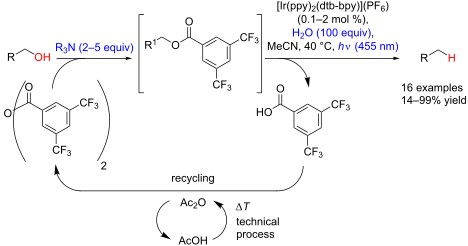
- substitution pattern of benzoates we intended to shift the electrochemical reduction potentials of the substances into a region that could be accessed by common visible light photocatalysts. The substituents should be as inert as possible in order not to interfere with the photochemical reaction itself


Aryl substitution of pentacenes
Beilstein J. Org. Chem. 2014, 10, 1692–1705, doi:10.3762/bjoc.10.178
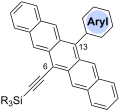
- , unfortunately, no clear trend observed for the oxidation potentials based on the substitution pattern of the aryl moieties, although both oxidations appear somewhat easier for pentacene 3f as a result of the two electron-donating methoxy groups attached to the pendent phenyl ring. Aryl-substituted pentacenes 3a
- –k each show one reversible reduction event in a rather narrow range of −1.59 to −1.68 V. Similar to that observed for the oxidation potentials, there is no obvious trend that can be identified in the reduction potentials based on substitution pattern, aside from the observation that the silyl
- change the electronic properties of the pentacene skeleton itself. Aryl-substitution pattern does however, have a considerable effect on solid-state arrangement of the molecules, and X-ray crystallographic analysis afforded insight on the packing arrangements of the synthesized pentacenes. In spite of




Chemistry of polyhalogenated nitrobutadienes, 14: Efficient synthesis of functionalized (Z)-2-allylidenethiazolidin-4-ones
Beilstein J. Org. Chem. 2014, 10, 1638–1644, doi:10.3762/bjoc.10.170
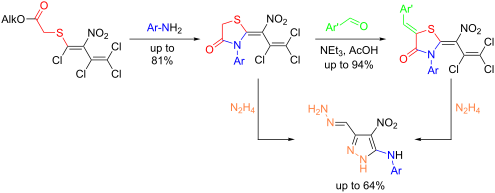
- molecules were incorporated into the final product, whereas two additional equivalents were consumed capturing hydrochloric acid. In this way, the 1H-pyrazole 27 with an exceptional substitution pattern was obtained in 64% yield. The same reaction was applied to 5-arylmethylidene-thiazolidin-4-one 25 which


Triazol-substituted titanocenes by strain-driven 1,3-dipolar cycloadditions
Beilstein J. Org. Chem. 2014, 10, 1630–1637, doi:10.3762/bjoc.10.169

- started our investigation with the preparation of azide-substituted cationic titanocenes. To this end, the titanocene carboxylates 1–3 shown in Figure 1 were employed as substrates because their substitution pattern should allow a first simple assessment of structure–activity relationships. The compounds
- through 1,3-dipolar cycloaddition markedly changes the activity of our titanocenes as a function of the substitution pattern. The most active complexes are highlighted in Figure 3. Gratifyingly, 18, together with a ketone-substituted titanocene, displays the highest activity against the BJAB cell line of


A promising cellulose-based polyzwitterion with pH-sensitive charges
Beilstein J. Org. Chem. 2014, 10, 1549–1556, doi:10.3762/bjoc.10.159
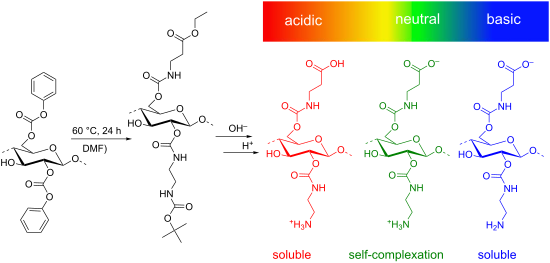
- . While polyzwitterions based on N-functionalized chitosan [14][15] or 6-desoxy-6-aminocelluloses [16] are composed like synthetic polybetaines, a few cellulose-based zwitterions are described where the isoelectric point and the properties in solution could be tuned by varying the substitution pattern [17


Stereoselective synthesis of carbocyclic analogues of the nucleoside Q precursor (PreQ0)
Beilstein J. Org. Chem. 2014, 10, 1333–1338, doi:10.3762/bjoc.10.135
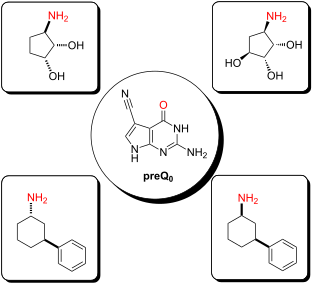
- -substituted analogues with interesting three-dimensional character, including chiral cyclopentane-1,2-diol and -1,2,3-triol derivatives. This unusual substitution pattern provides a useful starting point for the discovery of novel bioactive molecules. Keywords: diol synthesis; nucleoside; PreQ0




Cyclization–endoperoxidation cascade reactions of dienes mediated by a pyrylium photoredox catalyst
Beilstein J. Org. Chem. 2014, 10, 1272–1281, doi:10.3762/bjoc.10.128
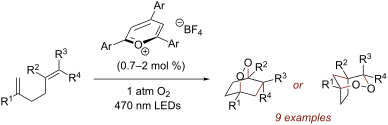
- , attempts to move away from 2b to less electron-rich dienes such as 2c, 2d and 2e (Table 1, entries 2–4), failed to produce any of the desired endoperoxide products and mainly oxidative cleavage adducts were observed. Given the lack of reactivity of this alkene substitution pattern, we turned our attention


Dimerisation, rhodium complex formation and rearrangements of N-heterocyclic carbenes of indazoles
Beilstein J. Org. Chem. 2014, 10, 832–840, doi:10.3762/bjoc.10.79
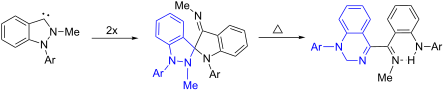
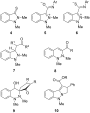
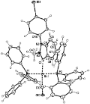
- depends on the choice of potential reaction partners, but also on its substitution pattern and the reaction conditions. As examples, when N1 is substituted with a methyl group, the carbene can be trapped by elemental sulfur, isocyanates, and isothiocyanates which form indazolethione 4, indazolium-3






Towards allosteric receptors – synthesis of β-cyclodextrin-functionalised 2,2’-bipyridines and their metal complexes
Beilstein J. Org. Chem. 2014, 10, 814–824, doi:10.3762/bjoc.10.77
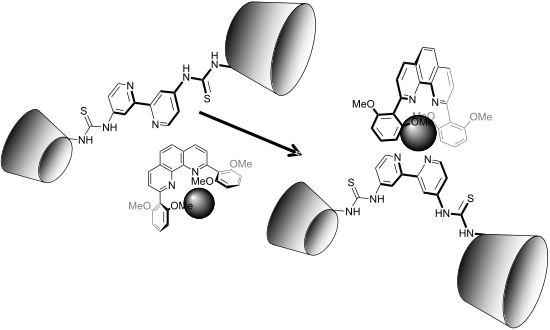
- ]. Depending on the substitution pattern for the central 2,2’-bipyridines, three conceptually different types of allosteric receptors can be obtained: 4,4’- or 6,6’-substitution, both leading to positive allosteric receptors, meaning that they adopt an open anti-conformation in the free state where the two
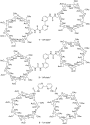
- on-state in the absence of the effector and changes its conformation to the open off-state upon binding of it. In this article we present the synthesis of three new cyclodextrin-functionalised 2,2’-bipyridines 1–3 differing in the bipyridine’s substitution pattern (Scheme 2) and their metal complexes
- well defined [Zn(1)2] complexes which, together with the NMR data, proof that zinc(II) ions are suitable to act as an effector for 1. Changing the substitution pattern to 6,6’ like in ligand 2, however, makes it impossible to form a 1:2 complex due to the steric crowding around the metal binding site




Additive-assisted regioselective 1,3-dipolar cycloaddition of azomethine ylides with benzylideneacetone
Beilstein J. Org. Chem. 2014, 10, 352–360, doi:10.3762/bjoc.10.33
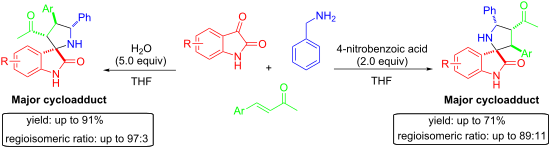
- to prepare the spirooxindoles with this novel substitution pattern. Thus, the acid additives were examined and the optimization results are listed in Table 2. To our delight, the addition of 4-nitrobenzoic acid reversed the regioselectivity of this reaction, and the ratio of 5a/4a was increased from




New hydrogen-bonding organocatalysts: Chiral cyclophosphazanes and phosphorus amides as catalysts for asymmetric Michael additions
Beilstein J. Org. Chem. 2014, 10, 224–236, doi:10.3762/bjoc.10.18
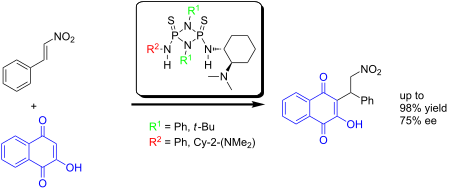
- -selective fashion, as the cis-isomers are generally thermodynamically favored even with large R-groups on the exo-nitrogen substituents [39][40][41]. The situation is less clear for N(ring)-aryl-cyclodiphosphazanes, in which, dependent on the substitution pattern either cis or trans-isomers are favored [42
- yields but a lower enantioselectivity. Chlorine and fluorine in meta-position also lead to diminished yields and lower enantioselectivities (Table 3). Concerning the substitution pattern a clear trend that correlates the increasing electron-withdrawing properties of substituents on the phenyl ring with





