Search results
Search for "transition states" in Full Text gives 224 result(s) in Beilstein Journal of Organic Chemistry. Showing first 200.
Surprisingly facile CO2 insertion into cobalt alkoxide bonds: A theoretical investigation
Beilstein J. Org. Chem. 2015, 11, 1340–1351, doi:10.3762/bjoc.11.144
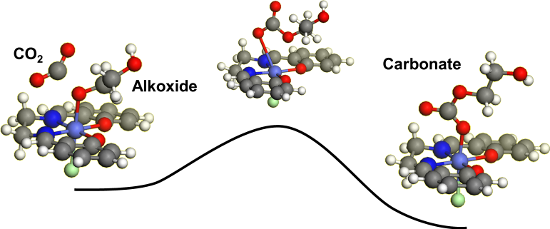
- the precursor and product states as the anchor points, the transition states were located for each L. All determined transition states were geometrically similar, depicting a cyclic arrangement around the cobalt(III) atom, an oxygen and carbon atom of CO2 and the oxygen atom of the original Co–O
- alkoxide bond (Figure 4). These configurations were identical to the arrangement of the reactive atoms in the transition states of the reaction between [Ni(OH)(pincer ligand)] complexes and CO2 [50]. Since the configurations of the reactive atoms are essentially identical in the reactant, precursor
- normal mode frequency analysis. The synchronous-transit method was applied to localize possible transition states [60]. These states were further optimized by following eigenvectors to gain the best predicted configuration of the transition state. Transition states were analysed by a normal mode


Cathodic hydrodimerization of nitroolefins
Beilstein J. Org. Chem. 2015, 11, 1163–1174, doi:10.3762/bjoc.11.131
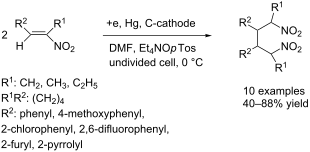
- caused by the NH groups of the pyrroles. Their hydrogen bonds could influence the relative energies of the transition states leading to the diastereomers. One of the two meso-configurations can be assigned to isomer 22a because of the missing coupling between the benzylic methine protons. The 1H NMR data


Mechanical stability of bivalent transition metal complexes analyzed by single-molecule force spectroscopy
Beilstein J. Org. Chem. 2015, 11, 817–827, doi:10.3762/bjoc.11.91
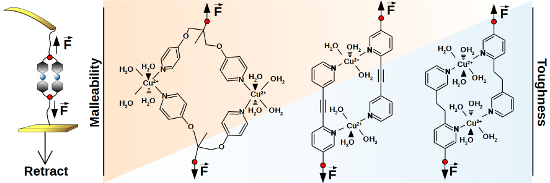
- inverse rupture length rb and the x-intercept a measure of koff. Two linear regimes denote a change in two dominant transition states [45], a non-linear behavior may be due to a more complex PED [46]. A drawback of this method is the reduction of all measured rupture forces to one most-probable force




On the strong difference in reactivity of acyclic and cyclic diazodiketones with thioketones: experimental results and quantum-chemical interpretation
Beilstein J. Org. Chem. 2015, 11, 504–513, doi:10.3762/bjoc.11.57
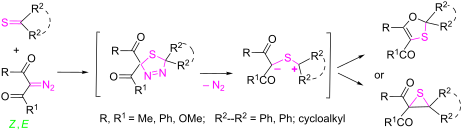
- relative energy of the reagents, reaction intermediates, transition states, and reaction products on the potential energy surfaces were carried out. The results of the performed study are summarized and discussed in the present publication. Results and Discussion The subjects of the quantum-chemical
- transition states) on the potential energy surface of the reaction of the diazo compounds 1a–f with thiobenzophenone (2a) were located. The optimized structures of reagents, intermediates, and products were found to be characterized by the absence of the imaginary part of the frequency, and transition states
- through the single minimum energy transition state, TS1. This observation implies that the cycloaddition reaction proceeds via a concerted mechanism. In the case of an alternative, stepwise mechanism, one would expect the appearance of at least two transition states [29], which was not observed. In


Azirinium ylides from α-diazoketones and 2H-azirines on the route to 2H-1,4-oxazines: three-membered ring opening vs 1,5-cyclization
Beilstein J. Org. Chem. 2015, 11, 302–312, doi:10.3762/bjoc.11.35
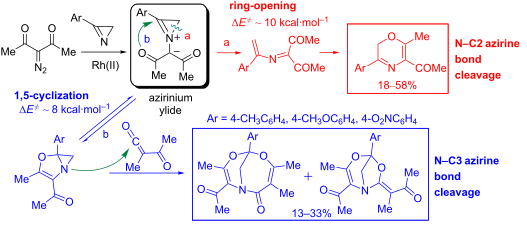
- ] adduct 6j, because the transition state TS9 leading to betaine 14′j, a precursor of [4.3.1] adduct 7j, has a higher energy than the transition state TS5 for the competitive pathway. In spite of the fact that the transition states TS3 and TS8 for alternative betaine 14j formation pathways are very close


Synthesis of dinucleoside acylphosphonites by phosphonodiamidite chemistry and investigation of phosphorus epimerization
Beilstein J. Org. Chem. 2015, 11, 184–191, doi:10.3762/bjoc.11.19
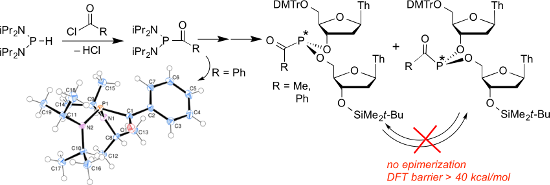
- on the conformations about the P–O bonds, the energies are comparable (separated by less than 1 kcal/mol) and do not have a significant impact on the inversion barriers. Transition states were located using routines implemented in Gaussian (see Supporting Information File 1 for details), and in all


Microsolvation and sp2-stereoinversion of monomeric α-(2,6-di-tert-butylphenyl)vinyllithium as measured by NMR
Beilstein J. Org. Chem. 2014, 10, 2521–2530, doi:10.3762/bjoc.10.263
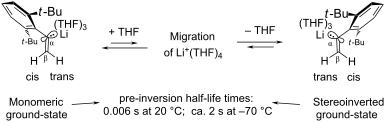
- migration across the β-unsubstituted H2C= region in 13 might be sterically much more comfortable than across the bulky β,β-di-tert-alkyl substituents in the transition states deriving from 1 or 2, this opportunity is apparently disdained in 13: The stereoinversion is not facilitated for 4, since the ΔGψ




Chiral phosphines in nucleophilic organocatalysis
Beilstein J. Org. Chem. 2014, 10, 2089–2121, doi:10.3762/bjoc.10.218
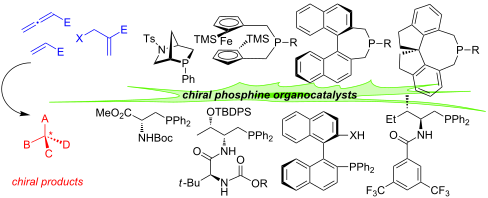
- of yield, ee, or both. Based on previous literature, Zhao and co-workers speculated two possible transition states; in both cases, the dienolate adopts a conformation, featuring hydrogen bonding and O–P electrostatic attraction, that favors re-face attack of the imine (Scheme 44). 2.8 [4 + 2


Isoxazolium N-ylides and 1-oxa-5-azahexa-1,3,5-trienes on the way from isoxazoles to 2H-1,3-oxazines
Beilstein J. Org. Chem. 2014, 10, 1896–1905, doi:10.3762/bjoc.10.197
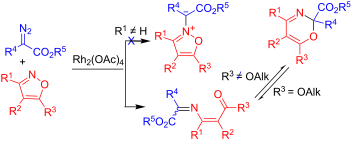
- B3LYP/6-31G(d) level [34][35][36] by using the Gaussian 09 suite of quantum chemical programs [37] at the Resource center ‘Computer center of Saint Petersburg State University’. Geometry optimizations of intermediates, transition states, reactants and products in benzene were performed by means of a PCM
- model. Intrinsic reaction coordinates were calculated to authenticate all transition states. Energy profiles for the transformations of ylides C, (3Z)-1-oxa-5-azahexa-1,3,5-triene D and oxazines E derived from methoxycarbonylcarbene and isoxazole A. Relative free energies [kcal/mol, 298 K, CH2Cl2 (PCM
- compounds, 1H and 13C NMR spectra for all new compounds, and computational details (energies of molecules, transition states, and the Cartesian coordinates of atoms). Acknowledgements We gratefully acknowledge the financial support from the Russian Foundation for Basic Research (Grant No. 14-03-00187) and


Theoretical study of the adsorption of benzene on coinage metals
Beilstein J. Org. Chem. 2014, 10, 1775–1784, doi:10.3762/bjoc.10.185
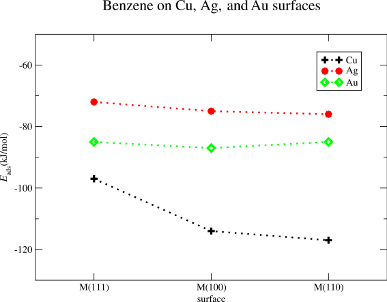
- adsorption sites for each surface. Other adsorption sites are higher in energy by 2 to 15 kJ/mol. This points to a relatively high mobility of benzene on the surfaces assuming that the corresponding activation barriers are of similar magnitude. We did not calculate the transition states because this was not


Proton transfers in the Strecker reaction revealed by DFT calculations
Beilstein J. Org. Chem. 2014, 10, 1765–1774, doi:10.3762/bjoc.10.184
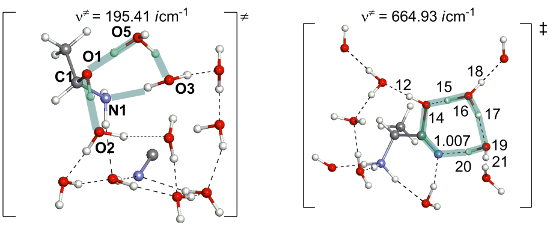
- competitive TS8/18 has an energy barrier of 32.0 kcal/mol. Geometries along the unfavorable routes pathway II and pathway IB, are shown in Figures S4 and S5, Supporting Information File 1, respectively. The relative stability of these two transition states were checked with extended models TS10/11-ext and TS8
- kcal/mol and the large value corresponds to the high temperature conditions in Scheme 1(b). Geometries of transition states along the reaction from acetaldehyde (1) to the aminonitrile 8. Distances are in Å. TS1/2 means, for instance, a transition state for the step 1 → 2. Energy changes along
- elementary processes from acetaldehyde to aminonitrile. Bold numbers are defined in Scheme 5. Two transition states (A and B) of the nucleophilic addition of (S)-α-phenylethylamine to acetaldehyde. (H2O)10 is also included, and the molecular formula of the reaction system is C11H36N2O11. Energy changes along


The chemoenzymatic synthesis of clofarabine and related 2′-deoxyfluoroarabinosyl nucleosides: the electronic and stereochemical factors determining substrate recognition by E. coli nucleoside phosphorylases
Beilstein J. Org. Chem. 2014, 10, 1657–1669, doi:10.3762/bjoc.10.173
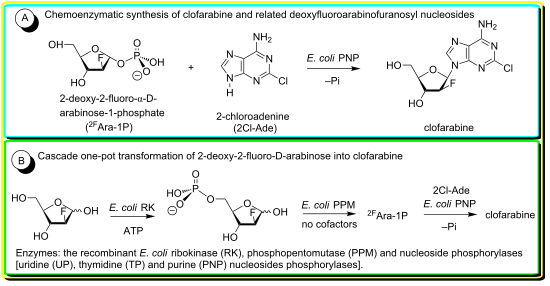
- that the phosphate 12a is incapable to adopt a pentofuranose-ring conformation at the catalytic sites of E. coli UP and TP, which would be compatible with the coupling to pyrimidine bases. There are convincing arguments that the transition states of the phosphorolysis of pyrimidine [37] and purine [38


Dimerisation, rhodium complex formation and rearrangements of N-heterocyclic carbenes of indazoles
Beilstein J. Org. Chem. 2014, 10, 832–840, doi:10.3762/bjoc.10.79
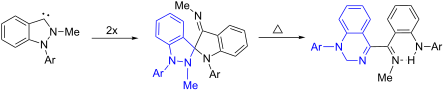
- to be true minima by the absence of imaginary frequencies or transition states by the occurrence of one negative frequency. Plots were obtained using Maestro 9.1.207, the graphical interface of Jaguar. Inversion barriers have been calculated fully relaxed, fixating one torsion angle around the




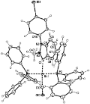


Domino reactions of 2H-azirines with acylketenes from furan-2,3-diones: Competition between the formation of ortho-fused and bridged heterocyclic systems
Beilstein J. Org. Chem. 2014, 10, 784–793, doi:10.3762/bjoc.10.74

- Supporting Information File 1). No intermediate structure was located on the way to the most stable conformation of trans-isomer 5a with the piperazine ring in a boat conformation. The free energies of the highest transition states on the pathways from 12a to cis-isomer 4a and trans-isomer 5a are practically
- , transition states, reactants, and products in benzene were performed using the PCM model. Intrinsic reaction coordinates were calculated to authenticate all transition states. Molecular structures of compounds 3а, 4b. Energy profiles for the reactions of azirines 2a,c and acylketene 6a, as well as acylketene
- experimental procedures including characterization data for all synthesized compounds, 1H and 13C NMR spectra for all new compounds. Computational details: energies of molecules, transition states and their Cartesian coordinates of atoms. Supporting Information File 191: Detailed experimental procedures and


Chromatographically separable rotamers of an unhindered amide
Beilstein J. Org. Chem. 2014, 10, 701–706, doi:10.3762/bjoc.10.63
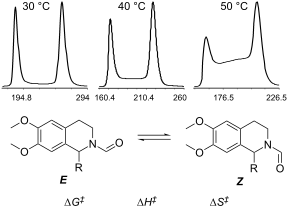
- ° and = 290°. The geometries of both minima were used as starting geometries for a geometry optimization followed by the calculation of the thermochemical data at 298 K. The coordinates of the maxima were used as starting points for the search for the transition states. After locating the transition
- - and Z-isomer of 4 is predicted to be 3.2 kJ/mol in hexane and 5.8 kJ/mol in vacuo, respectively. The transition states are located at 108.8 kJ/mol (TS1) and 105.5 kJ/mol (TS2) above the Z-isomer of 4 for hexane solvation as well as at 107.3 k/mol (TS1) and 102.1 kJ/mol (TS2) in the gas phase
- , respectively. The geometries of the E- and Z-ground states of 4 and both transition states (TS1 and TS2) are shown in Figure 6 together with the dihedral angle O–C–N–C1 () and the C–N bond length. Both transition states show a single imaginary frequency (−280.8 cm−1 (TS1) and −364.5 cm−1 (TS2) in hexane and at


![[Graphic 2]](/bjoc/content/inline/1860-5397-10-63-i3.png?max-width=637&scale=1.18182) ) in 4 (BP-D3/def2-SVP).
) in 4 (BP-D3/def2-SVP).

Substrate dependent reaction channels of the Wolff–Kishner reduction reaction: A theoretical study
Beilstein J. Org. Chem. 2014, 10, 259–270, doi:10.3762/bjoc.10.21
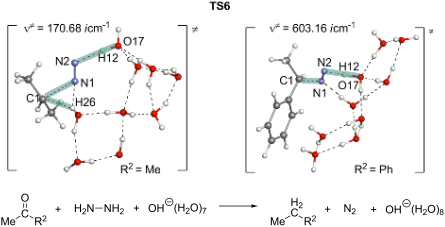
- product. For both ketone substrates, the diimines undergoing E2 reactions were found to be key intermediates. Keywords: acetone; acetophenone; DFT calculations; diimine intermediate; reduction reaction; transition states; Wolff–Kishner; Introduction The Wolff–Kishner (W-K) reduction is an organic
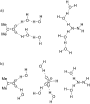
- process includes high-energy transition states, TS5 with +42.72 kcal/mol, TS7a with +53.81 kcal/mol and TS7b with +50.20 kcal/mol. The conversion of the acetone hydrazone to propane without the base catalyst is clearly improbable. A base-promoted reaction of acetone. The reaction model adopted here is
- effect was considered by the polarizable continuum model (PCM) [40][41][42]. Geometries of transition states (TSs) were determined by the input data consisting of two steps. For the first step, the initial geometry containing average and assumed distances between covalent and intermolecular interactions









New hydrogen-bonding organocatalysts: Chiral cyclophosphazanes and phosphorus amides as catalysts for asymmetric Michael additions
Beilstein J. Org. Chem. 2014, 10, 224–236, doi:10.3762/bjoc.10.18
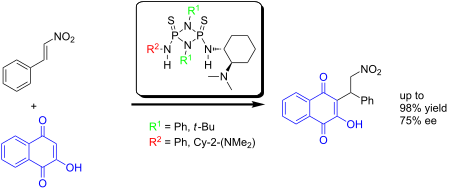
- calculation of binding energies (Table 1) we considered different conformational binding patterns of the nitroolefin to the diamide moiety with either any one or both oxygen atoms participating in hydrogen bonding. This results in potentially twelve different transition states, some of which present the same
- stationary point on the potential energy surface resulting in 9 (see Supporting Information File 1 for all TS) competing transition states. Relative energies in Figure 9 suggest that TS-(pro-S)-14a is the most favored by 1.1 kcal/mol compared to the lowest competing TS in pro-R-configuration TS-(pro-R)-14a
- Hitachi together with the chiral column Chiralcel OJ-H in 25 cm length. The enantiomers of the product were determined by reference spectra. Crystal data, NMR spectra and coordinates of stationary points/transition states as well as experimental procedures for the preparation of catalysts 1–7f can be


Synthesis of the B-seco limonoid core scaffold
Beilstein J. Org. Chem. 2014, 10, 194–208, doi:10.3762/bjoc.10.15
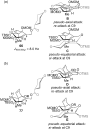
- ). This might be explained by the rigidity of the bicyclic system, such that transition states B and C can compete without preference for a conformation that clearly favours axial attack. Underscored by MM2 conformational calculations, it is furthermore plausible that the C11 oxygen can form an H-bond to
- transition states D and E seem to compete without any preference for a conformation that clearly favours axial attack (Figure 3b). Presumably because of the absence of electrostatic interactions in the pseudo-axial attack of the silyl ketene acetal (compare transition state B in Figure 3a: electrostatic
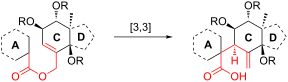
- precursor 30 and possible transition state involved in the Ireland–Claisen rearrangement. Conformations of rearrangement precursors 66 and 77 and possible transition states involved in the Ireland–Claisen rearrangements. R = MOM. Retrosynthetic analysis of the B-seco limonoid framework employing a [3,3




Recent applications of the divinylcyclopropane–cycloheptadiene rearrangement in organic synthesis
Beilstein J. Org. Chem. 2014, 10, 163–193, doi:10.3762/bjoc.10.14
- the Cope rearrangement, it has to be noted that the preference of transition states (chair/boat) is opposite. Whereas the Cope rearrangement of hexa-1,5-diene 12 usually proceeds through chair-like transition state 12' (see Scheme 2) and not through the energetically disfavoured boat-transition state
- 12'' [15], the DVCPR only proceeds via boat-like transition state 9nn' where both vinyl-moieties are in the endo-orientation reagarding the cyclopropane [16]. The other transition states (9xx'/9xn') would result in a cycloheptadiene with at least one E-configured double bond (13/14) after a
- characterization of cis-divinylcyclopropane by Brown. Transition states for the Cope rearrangement and the related DVCPR. Ts = transition state. Two possible mechanisms of trans-cis isomerizations of divinylcyclopropanes. Proposed biosynthesic pathway to ectocarpene (21), an inactive degradation product of a




Less reactive dipoles of diazodicarbonyl compounds in reaction with cycloaliphatic thioketones – First evidence for the 1,3-oxathiole–thiocarbonyl ylide interconversion
Beilstein J. Org. Chem. 2013, 9, 2751–2761, doi:10.3762/bjoc.9.309

- , below −5 °C) the reaction was essentially ‘frozen’. According to the computational analysis, the transition states for the formation of 1,3,4-thiadiazoline 10a via the concerted cycloaddition of the corresponding reagents as well as for its decomposition to thiocarbonyl ylide 6a' and N2 display
- , Table S1). According to the computations, the transition states for the electrocyclizations of the initially formed thiocarbonyl ylide 6e' to 1,3-oxathiole 3e and to thiirane 8e' display activation barriers (ΔG#) of 8.6 and 15.2 kcal·mol−1, while the Gibbs free energy changes (ΔG) for the same processes
- are 15.2 and 26.6 kcal·mol−1, respectively (see Supporting Information File 1, Table S1). Based on these data domination of 1,5-electrocyclization of C=S-ylide 6e' at room temperature can be apparently explained by the rather high difference (6.6 kcal·mol−1) between transition states energy levels TS1




Advancements in the mechanistic understanding of the copper-catalyzed azide–alkyne cycloaddition
Beilstein J. Org. Chem. 2013, 9, 2715–2750, doi:10.3762/bjoc.9.308
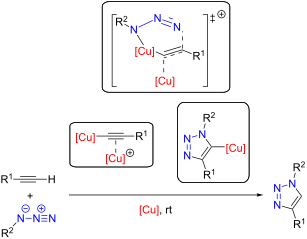
- ) complexes as calculated in a DFT study by Ahlquist and Fokin [125] (transition states with Cu–Cu distances of 2.54 Å for L = X = chloride and 2.64 Å for L = acetylide). They tested copper(I) acetate in the CuAAC model reaction of benzyl azide with phenylacetylene and reported an excellent performance of




Diastereoselectivity in the Staudinger reaction of pentafluorosulfanylaldimines and ketimines
Beilstein J. Org. Chem. 2013, 9, 2675–2680, doi:10.3762/bjoc.9.303

- highly charged transition states such as B. In both structures, consistent with the opposing dipole geometry of the Cornforth transition state, the N–C–C–S torsional angles remain near 170° (169° and 167° for 7a and 7c respectively). The 1,2-lk,ul ring closure product may be formed in the reaction of 5c


Garner’s aldehyde as a versatile intermediate in the synthesis of enantiopure natural products
Beilstein J. Org. Chem. 2013, 9, 2641–2659, doi:10.3762/bjoc.9.300
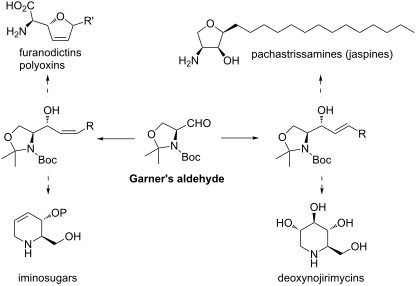
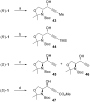
- detected, instead the syn-adduct 30 was obtained as the sole stereoisomer. By lowering the temperature to −40 °C and keeping the amount of reagents the same, the selectivity was inverted! Only the anti-adduct 29 was isolated. This change in selectivity was explained with two different transition states. At




Bidirectional cross metathesis and ring-closing metathesis/ring opening of a C2-symmetric building block: a strategy for the synthesis of decanolide natural products
Beilstein J. Org. Chem. 2013, 9, 2544–2555, doi:10.3762/bjoc.9.289
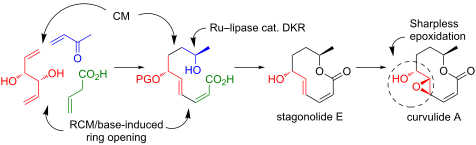
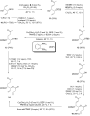
- 8) and to 67% for the 6,9-disubstituted compound 38 (Scheme 9). The presence of substituents and their relative configuration may have severe conformational effects on transition states, activation barriers and product stability [61][62]. An example for which a dramatically increased yield was






Synthetic scope and DFT analysis of the chiral binap–gold(I) complex-catalyzed 1,3-dipolar cycloaddition of azlactones with alkenes
Beilstein J. Org. Chem. 2013, 9, 2422–2433, doi:10.3762/bjoc.9.280
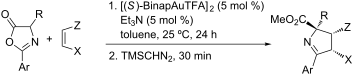
- ball and stick and wireframe models, respectively. Blue surface represents the solvent-accessible surface with a probe radius of 1.9 Å. Main geometrical features and relative Gibbs free energies (in kcal mol−1) of the less energetic transition states associated with the 1,3-DC of 5aa and NPM catalyzed
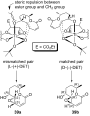
- wireframe models, respectively. Blue surface represents the solvent-accessible surface with a probe radius of 1.9 Å. Main geometrical features and relative Gibbs free energies (in kcal mol−1) of the less energetic transition states associated with the 1,3-DC of 10 and tert-butyl acrylate catalyzed by (Sa