Search results
Search for "conformer" in Full Text gives 201 result(s) in Beilstein Journal of Organic Chemistry. Showing first 200.
Computational evidence for intramolecular hydrogen bonding and nonbonding X···O interactions in 2'-haloflavonols
Beilstein J. Org. Chem. 2012, 8, 112–117, doi:10.3762/bjoc.8.12
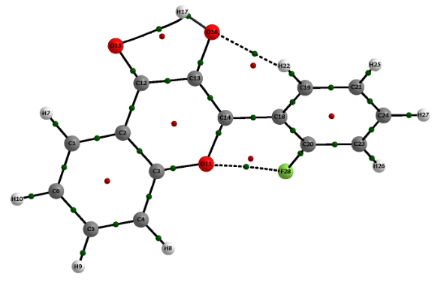
- 10.3762/bjoc.8.12 Abstract The conformational isomerism and stereoelectronic interactions present in 2'-haloflavonols were computationally analyzed. On the basis of the quantum theory of atoms in molecules (QTAIM) and natural bond orbital (NBO) analysis, the conformer stabilities of 2'-haloflavonols were
- carbonyl oxygen (conformer A), establishing an intramolecular HB as the stabilizing interaction of this conformation, in agreement with the crystal structure of 2'-methoxyflavonol [19] and with the bioactive conformation of fisetin [20] and quercetin [21]. Moreover, a weak (H)O···H–C HB also takes place in
- and a nonbonding F…O interaction. The formation of the nonbonding F…O interaction in conformer A, having fluorine as electron acceptor, is supposed to be due to the partial negative atomic charge on the ether oxygen and a less negative atomic charge on the fluorine atom (the QTAIM atomic charges are


Binding of group 15 and group 16 oxides by a concave host containing an isophthalamide unit
Beilstein J. Org. Chem. 2012, 8, 11–17, doi:10.3762/bjoc.8.2
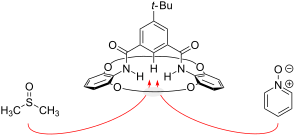
- anion transport. Rotation along the amide–aryl bonds leads to syn/anti, syn/syn and anti/anti conformers (syn and anti defined with respect to the relative orientation of the NH atoms), and only the syn/syn conformer of an isophthalamide is capable of simultaneously binding an anion by both NH groups


(How) does 1,3,5-triethylbenzene scaffolding work? Analyzing the abilities of 1,3,5-triethylbenzene- and 1,3,5-trimethylbenzene-based scaffolds to preorganize the binding elements of supramolecular hosts and to improve binding of targets
Beilstein J. Org. Chem. 2012, 8, 1–10, doi:10.3762/bjoc.8.1
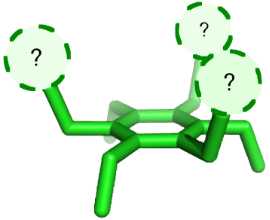
- were studied and reported here. The results of the calculation in the gas phase were in good agreement with the values reported by Mislow (Table 4). The ududud conformer adopted the most stable conformation and the energy level of this conformation was 4.3 kcal/mol lower than the second most stable
- conformer, namely uddudd. One can expect a significant effect of the nature of the recognition elements on conformational energies. Many recognition elements that vary in shape, functionality, charge, and chirality have been reported. We picked pyrazole-derived hosts 4 (used for cation binding) [17] and
- calculations. The conformers ududud and uddudd, are almost of the same energy and the next two most stable conformers, ududdd and udduud, lie only 0.3 and 0.4 kcal/mol above the ududud conformer. When the solvent condition is changed to water the trend of the results is much closer to those of hexaethylbenzene


Structural conditions required for the bridge lithiation and substitution of a basic calix[4]arene
Beilstein J. Org. Chem. 2011, 7, 1602–1608, doi:10.3762/bjoc.7.188
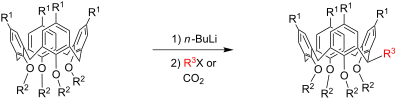
- methine proton. In contrast, after addition of the fixatives to a CDCl3 solution of 14, a more complex signal pattern indicates the presence of at least two fixed conformations. One can be related to the expected resonances of the cone conformer, while the resonances of the second species fit best to a
- , transferring the 1,2-alternate to the cone conformer, is impossible, since it would ultimately lead to an axial orientation of the COOH group, which is strictly avoided for steric reasons [4][10]. Crystal structure of compound 12 Crystallization of the mixed calixarene ether 12 from ethanol yielded colourless


Synthesis of enantiomerically enriched (R)-13C-labelled 2-aminoisobutyric acid (Aib) by conformational memory in the alkylation of a derivative of L-alanine
Beilstein J. Org. Chem. 2011, 7, 1304–1309, doi:10.3762/bjoc.7.152
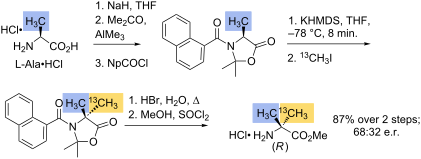
- less hindered conformer of 3. Alkylated 5 was freed from its protecting group and the naphthamide “aide-mémoire” by heating to reflux in 47% hydrobromic acid, followed by esterification with methanol and thionyl chloride, which returned the labelled Aib as its methyl ester hydrochloride salt 6* in 93


NMR studies of anion-induced conformational changes in diindolylureas and diindolylthioureas
Beilstein J. Org. Chem. 2011, 7, 1205–1214, doi:10.3762/bjoc.7.140
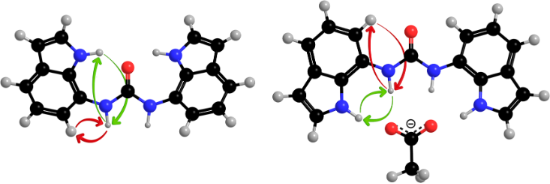
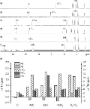
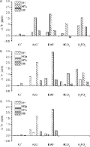
- mechanics calculations. NOE experiments showed that the anti–anti conformer along the C7–N7α bonds was predominant in DMSO-d6 solution in the absence of anions. Anion-induced changes in the 1H and 15N chemical shifts confirm the weak binding of chloride anions with negligible conformational changes. Strong
- along the C7–N7α bonds and the syn–syn conformer was preferred for anion–receptor complexes. The conformational changes upon anion binding are in good agreement with energetic preferences established by ab initio calculations. Keywords: anion recognition; conformation analysis; host–guest systems; NMR
- major, energetically preferred, conformers are likely to be observed (Figure 3). The syn–syn conformer, where NH protons form a convergent hydrogen-bonding array, is expected to be adopted in the presence of bound anionic guests, based on the previous solid-state studies. On the other hand, this






Toward an integrated route to the vernonia allenes and related sesquiterpenoids
Beilstein J. Org. Chem. 2011, 7, 937–943, doi:10.3762/bjoc.7.104
- -decalin system. Low energy conformers were identified for these species [59]. The lowest energy conformer gave the greatest torsion angles (~175°) for both the alcohol V and the alkoxide VI, and these approach 180°. For comparison purposes, the cis-hydrindane derivative in entry 3 was also studied [38


Intraannular photoreactions in pseudo-geminally substituted [2.2]paracyclophanes
Beilstein J. Org. Chem. 2011, 7, 658–667, doi:10.3762/bjoc.7.78

- -conformation, which has been shown to be present as a conformer in the solid state by X-ray structural analysis does not photocyclize to 8. Moreover, syn,syn-7 is evidently too sterically hindered (by repulsion of the relevant hydrogen atoms as shown in Scheme 3) to be part of the conformational equilibrium


Accuracy in determining interproton distances using Nuclear Overhauser Effect data from a flexible molecule
Beilstein J. Org. Chem. 2011, 7, 145–150, doi:10.3762/bjoc.7.20
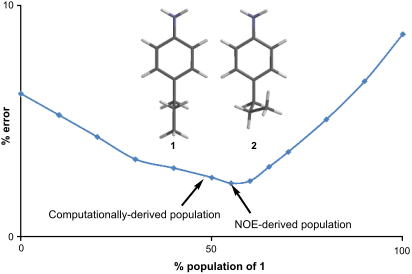
- multi-conformer, flexible small molecules was investigated with the model compound 4-propylaniline. The low accuracy assumed for semi-quantitative NOE distance restraints is typically taken to suggest that large numbers of constraints need to be used in the dynamical analysis of flexible molecules, and
- obtained in a rigid organic molecule, it seems sensible to examine whether this approach can be extended more generally to multi-conformational systems with similar accuracy. Further, it is likely that the accurate interproton distance-assessments from NOE will allow accurate modelling of conformer
- ensemble-averaging of the observed NOEs for each corresponding interproton distance in each contributing conformer. One approach to analysing such ensemble-averaged NOEs is to assume the molecule will occupy a number of distinct low-energy conformations with particular populations in solution. The ensemble


Synthesis of Ru alkylidene complexes
Beilstein J. Org. Chem. 2011, 7, 104–110, doi:10.3762/bjoc.7.14
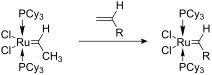
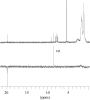
- with the resonances of the residual protons H5 (8.12, d, J = 8.2 Hz), H6 (7.50, t, J = 7.0 Hz) and H7/H8 (7.67-7.75, m). Strong NOE enhancement of H1 upon saturation of the carbene proton at 19.75 ppm (see Figure 2) is consistent with preferred conformer 1g in which the naphthyl moiety is directed away
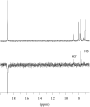
- resonances of both isomers 1e and 1e’. Saturation of the carbene proton at 18.9 ppm led to strong NOE enhancement of the singlet at 7.68 ppm (Figure 3) and allowed the assignment of this signal to the H3 proton of the thienyl moiety and was consistent with the s-trans isomer 1e being the preferred conformer
- (see Scheme 5). The EXSY effect made it possible to assign the signal at 8.80 ppm to H3’ of the minor s-cis conformer. Enhancement of the signal at 6.99 ppm (Figure 4) by saturation of the signal at 8.07 ppm and EXSY inversion of the resonance at 7.79 ppm allowed the assignment of the signals for H5




Intramolecular hydroxycarbene C–H-insertion: The curious case of (o-methoxyphenyl)hydroxycarbene
Beilstein J. Org. Chem. 2010, 6, 1061–1069, doi:10.3762/bjoc.6.121
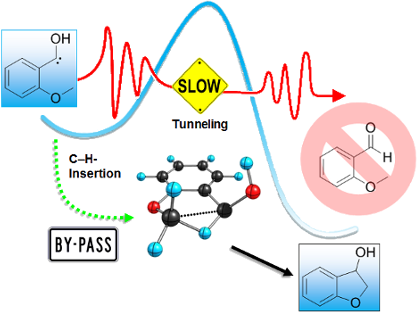
- thermodynamic preference for either 7 or 8. The thermal barrier for the reaction of 5 via conformer 5i leading to 8 is lower (18 kcal mol–1, via TS3) than that leading to 7 (27 kcal mol–1, via TS1). These results help rationalize the observed reactivity under HVFP conditions. The thermal barrier for the
- +•). Attempted generation of 12 and the actual pyrolysis product 11. Unanticipated reaction of 6 upon heating in xylenes. Potential energy hypersurface of (o-methoxyphenyl)hydroxycarbene (5) (not drawn to scale; ZPVE included); legend: 5c: carbene, cis conformation; 5t: carbene, trans conformation; 5i: conformer


Catalysis: transition-state molecular recognition?
Beilstein J. Org. Chem. 2010, 6, 1026–1034, doi:10.3762/bjoc.6.117
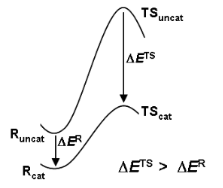
- course of 30 ps trajectories, even in the presence of propionate and propionic acid moieties to mimic Glu78 and Glu172 [23]. In contrast, analogous MD simulations for the 4C1 conformer of the reactant complex of phenyl β-xylobioside with BCX showed spontaneous transformation to the 2,5B conformer (Figure
- , revealed a decrease in free energy of activation of about 40 kJ mol−1 due to the presence of the single OY atom in BCX (Figure 6). Fluctuations in the hydrogen-bond distances HY…Oring (red) and HY…Onuc (blue) to the boat conformer of RC, TS and glycosyl-enzyme COV intermediate in the active site of BCX, as
- reorganisation of the electrostatic environment to go from RC to TS than is needed in aqueous solution, thereby achieving selective stabilisation of TS. The boat conformer of a xyloside substrate is favoured over the chair in the active site of BCX owing to a hydrogen bond from Tyr69 to Oring of xylose, but





Synthesis and crystallographic analysis of meso-2,3-difluoro-1,4-butanediol and meso-1,4-dibenzyloxy-2,3-difluorobutane
Beilstein J. Org. Chem. 2010, 6, No. 62, doi:10.3762/bjoc.6.62

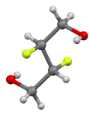
- disparity in the amounts of each conformer present gives rise to the disorder observed in the crystal structure. The vicinal difluoro group adopts an anti conformation with the F–C–C–F dihedral angle exactly 180°, which manifests itself in the crystallographic inversion centre. Nevertheless, each benzyloxy



The C–F bond as a conformational tool in organic and biological chemistry
Beilstein J. Org. Chem. 2010, 6, No. 38, doi:10.3762/bjoc.6.38
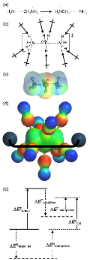
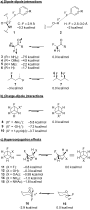
- in these systems. Hyperconjugation effects Consider the well-studied molecule 1,2-difluoroethane (11, Figure 1c). There are two possible staggered conformers, with the fluorine atoms either gauche or anti. NMR and molecular modelling studies have shown that the gauche conformer is lower in energy
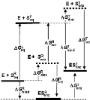
- , which is perhaps a surprising result since the fluorine atoms might reasonably be expected to repel each other. What effect overrides the difluoro repulsion and stabilises the gauche conformer? There is a vacant low-energy σ* antibonding orbital associated with each C–F bond (Figure 1c). In the gauche
- conformer of 11, both σ*CF orbitals are aligned with adjacent C–H bonds, which can donate electron density into the σ*CF orbitals in a process known as hyperconjugation [1][2]. Feeding electron density into an antibonding orbital in this way is equivalent to partially breaking the bond, so when









Molecular recognition of organic ammonium ions in solution using synthetic receptors
Beilstein J. Org. Chem. 2010, 6, No. 32, doi:10.3762/bjoc.6.32












































Bis(oxazolines) based on glycopyranosides – steric, configurational and conformational influences on stereoselectivity
Beilstein J. Org. Chem. 2010, 6, No. 23, doi:10.3762/bjoc.6.23
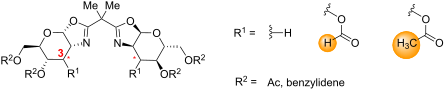
- conformation of the pyranose scaffold – a twist conformation for ligands 2a–c without 4,6-O-benzylidene protection (Scheme 1, conformer A) and a partially chair-like conformation for ligands 3a–f (Scheme 1, conformer B) fixed by the annulated 4,6-O-benzylidene group – has a direct impact on the



Synthesis and properties of calix[4]arene telluropodant ethers as Ag+ selective sensors and Ag+, Hg2+ extractants
Beilstein J. Org. Chem. 2009, 5, No. 59, doi:10.3762/bjoc.5.59
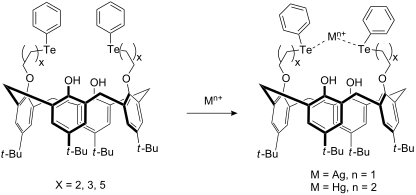
- , Tianjin 300071, P.R. China 10.3762/bjoc.5.59 Abstract Three novel phenyltelluroalkoxyl functionalized tweezer-like calix[4]arenes 6–8 and two monophenyltelluropropoxyl functionalized calix[4]arenes 10 (cone conformer) and 12 (partial cone conformer) were synthesized and characterized. They are good Ag
- the receptors showed very weak extraction ability towards Li+, Na+, K+, Ca2+, which meant that these ionophores had weak affinity for these main Group cations. It was noteworthy that the soft Ag+ and Hg2+ ions were almost quantitatively extracted by calix[4]arenes 6–8. The cone conformer 10 exhibited
- strong extraction ability towards Hg2+ and moderate extraction ability towards Ag+. However, the partial cone conformer 12 just gave moderate extraction ability towards Hg2+ and weak extraction ability towards Ag+. Thus, the extraction ability of the receptor 6–8, 10 and 12 towards Ag+ and Hg2+ was given


Chiral amplification in a cyanobiphenyl nematic liquid crystal doped with helicene-like derivatives
Beilstein J. Org. Chem. 2009, 5, No. 50, doi:10.3762/bjoc.5.50
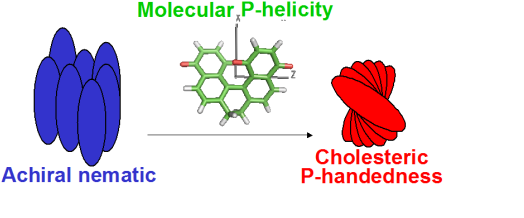
- conformer of 5, the molecular surface has negative helicity along the x axis, whereas the helicity is positive along the y and z axes. This is in agreement with the P helical stereochemical descriptor of the chiral dopants under investigation, which is defined with respect to the helix axis (y). In the case
- under investigation. We can see even more substantial differences between Qii components, with particularly low values predicted for the 5-I conformer. As a result of the surface chirality and the orientational behavior, induction of right-handed cholesterics is predicted for our dopants. The trend of




Preparation and Diels–Alder/cross coupling reactions of a 2-diethanolaminoboron- substituted 1,3-diene
Beilstein J. Org. Chem. 2009, 5, No. 45, doi:10.3762/bjoc.5.45
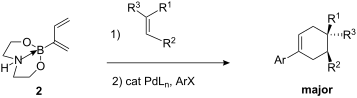
- earlier work [10] and those cobaloxime dienes consistently favored the s-cis conformation in the solid state. Diene 2 is in the s-trans conformation in the solid state (Figure 1) but in this case we suspect that the preference for the s-trans conformer is due to intermolecular hydrogen bonding between the
- N–H and one of the adjacent molecule’s boronate oxygen atoms. This hydrogen bonding would make a C(2)–C(3) dihedral angle of 50–60° (on the order of those we observed in cobaloxime diene solid state structures) unfavorable. At 25 °C in CDCl3, we saw no evidence for the s-cis conformer by NOESY. In


Synthesis of rigidified flavin–guanidinium ion conjugates and investigation of their photocatalytic properties
Beilstein J. Org. Chem. 2009, 5, No. 26, doi:10.3762/bjoc.5.26
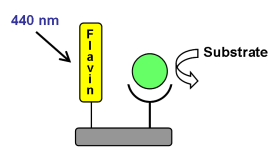
- spectra of compounds 1 and 2 revealed several NOE contacts, but the flexibility of the molecule did not allow the determination of preferred conformations. The most stable conformer of compound 1 in the gas phase was determined by computational methods (semi-empirical AM1, Spartan program package, Figure




Synthesis of deep- cavity fluorous calix[4]arenes as molecular recognition scaffolds
Beilstein J. Org. Chem. 2008, 4, No. 36, doi:10.3762/bjoc.4.36
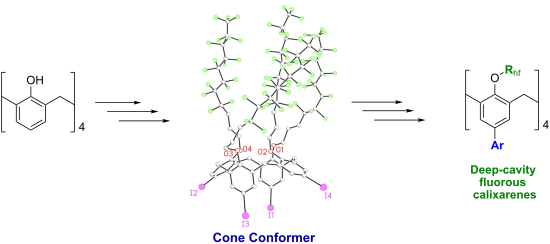
- enhance the formation of a single conformer [12]. Of the four possible conformations, the cone is the most desirable for molecular recognition and sensing applications because it has the largest available surface area for host-guest interactions [10]. With appropriate functionality and conformation, the
- ]arene [27] 2. Using NaH/DMF, conditions known to favor reaction in the cone conformation [12], 2 was alkylated with 3-(perfluorohexyl)propyl iodide to give cone conformer 3a as the dominant tetraalkylated product in 61% yield after recrystallization (Scheme 1). However, 3a did not exhibit the desired


Single and double stereoselective fluorination of (E)-allylsilanes
Beilstein J. Org. Chem. 2007, 3, No. 34, doi:10.1186/1860-5397-3-34

- other than "F+", an anti approach with respect to the silyl group prevails with preferential formation of the syn (E) isomer. [18][19][20][21] This stereochemical outcome suggests that the major reaction pathway involves the reactive conformer I leading, after addition of the electrophile, to a


Reactions of glycidyl derivatives with ambident nucleophiles; part 2: amino acid derivatives
Beilstein J. Org. Chem. 2007, 3, No. 28, doi:10.1186/1860-5397-3-28
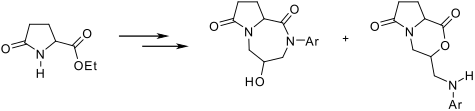
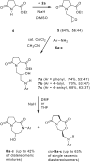
- from a weak intramolecular hydrogen bond. According to ab initio calculations for cis-9a, (B3LYP, 6-31G*, zero point energy included) this structure is indeed 1.9 kcal/mol more stable than its exo-oriented conformer and 2.2 kcal/mol more stable than its trans-stereoisomer. Conclusion In summary, we




Photosonochemical catalytic ring opening of α-epoxyketones
Beilstein J. Org. Chem. 2007, 3, No. 2, doi:10.1186/1860-5397-3-2
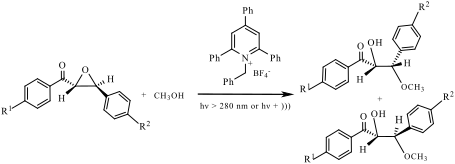
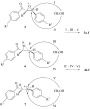
- more stable conformer of the intermediate 7 can be formed through interaction of oxygen lone pair of carbonyl group with carbocation center (Scheme 4, intermediate 8). This leads to the preferred nucleophilic attack of methanol to the carbon atom at the less hindered site (VII) to form the cis-isomers




The vicinal difluoro motif: The synthesis and conformation of erythro- and threo- diastereoisomers of 1,2-difluorodiphenylethanes, 2,3-difluorosuccinic acids and their derivatives
Beilstein J. Org. Chem. 2006, 2, No. 19, doi:10.1186/1860-5397-2-19
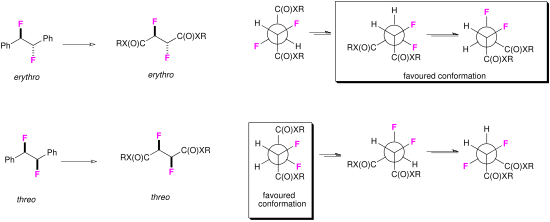
- Information File 2). Of the three staggered conformers of the erythro-13 isomer two are enantiomeric and have identical energies thus analysis of erythro-13 is reduced to a comparison of the energies of conformers a and b. Conformer a emerges as the more stable in the gas phase, with this stability
- originating predominantly from entropy and zero-point energy corrections (1.06 kcal/mol). This is also the conformer that most closely represents the X-ray structure (Figure 1). The solvent correction (which takes into account free energy differences associated with the solvent cavity, but does not allow for
- and appears to be dominated by solvation of the trans relationship of the aryl rings and the zero dipole moment, although the smaller 3JHH coupling of 2.6 Hz and the slightly larger 3JHF coupling of 15 Hz in the NMR, measurement does suggest some contribution of conformer b in solution. The threo-13