


Search results
Search for "regioisomers" in Full Text gives 253 result(s) in Beilstein Journal of Organic Chemistry. Showing first 200.
Qualitative evaluation of regioselectivity in the formation of di- and tri-6-O-tritylates of α-cyclodextrin
Beilstein J. Org. Chem. 2015, 11, 1530–1540, doi:10.3762/bjoc.11.168
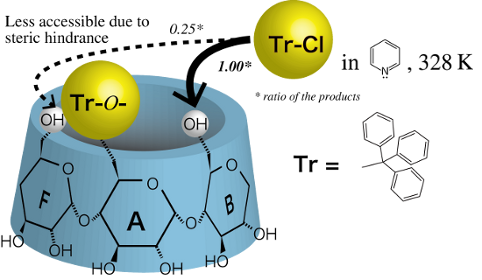
- of α-CD involves three regioisomers, that are, 6A,6B-, 6A,6C-, and 6A,6D-di-O-tritylates (AB-, AC-, and AD-isomers, respectively), as shown in Scheme 1. These regioisomers were well separated and characterized [13]. The tri-6-O-tritylate of α-CD involves four regioisomers, that are 6A,6B,6C-, 6A,6B
- ,6D-, 6A,6B,6E-, and 6A,6C,6E-tri-O-tritylates (ABC-, ABD-, ABE-, and ACE-isomers, respectively, Scheme 1). Among them, only a symmetrical molecule of the ACE-isomer was separated and characterized [9]. The tetratritylate of α-CD involves three regioisomers, among which 6A,6B,6D,6E-tetra-O-tritylate
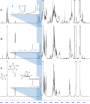
- direction of literature [9], and separated by means of reversed-phase column chromatography. Three regioisomers of di-6-O-trityl-α-CD obtained gave well-separated peaks in UFLC (ultra-fast liquid chromatography) experiment (Figure 1), details of which will be described in the Experimental part. Four



Intermolecular addition reactions of N-alkyl-N-chlorosulfonamides to unsaturated compounds
Beilstein J. Org. Chem. 2015, 11, 1226–1234, doi:10.3762/bjoc.11.136

- HCl after the radical addition due to the high reaction temperature, the formation of regioisomers of 12 and especially the formation of 13 can be explained by a halonium-ion transfer to the alkene. This could produce an chloro-substituted alkene 14, which in a second step would undergo radical


New palladium–oxazoline complexes: Synthesis and evaluation of the optical properties and the catalytic power during the oxidation of textile dyes
Beilstein J. Org. Chem. 2015, 11, 1175–1186, doi:10.3762/bjoc.11.132
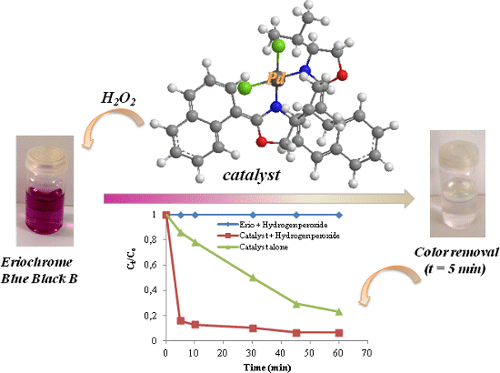
- to separate the later regioisomers by column chromatography or preparative TLC on silica gel were unsuccessful. According to the literature, the PPh3 adducts of cyclopalladated oxazolines have the trans (N,P) geometry [30][31]. In addition, the palladacycles with oxazoline ligands exists in endo and
- exo regioisomers. Results obtained in the present study show that naphthyl-oxazoline has a tendency to form exclusively endo-cyclic complexes with the C=N bond within a palladacycle. Furthermore, NMR data analyses demonstrate that the five-membered palladacycle 5a was preferentially formed upon the


Synthesis of novel N-cyclopentenyl-lactams using the Aubé reaction
Beilstein J. Org. Chem. 2015, 11, 1060–1067, doi:10.3762/bjoc.11.119

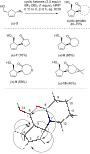
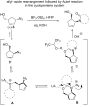
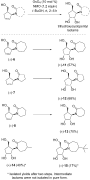
- substituted cyclic ketones to give corresponding lactam products in only moderate yields. Unfortunately, in most cases, the desired lactams could not be isolated in pure form and were contaminated with cleaved secondary amides, diastereomers, regioisomers, etc. Finally, the reaction of the constrained




Synthesis of carbohydrate-scaffolded thymine glycoconjugates to organize multivalency
Beilstein J. Org. Chem. 2015, 11, 668–674, doi:10.3762/bjoc.11.75
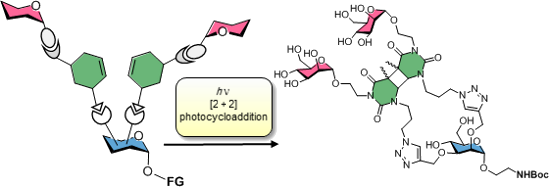
- products (cf. Supporting Information File 1). Both regioisomers can consist of four different stereoisomers, two cis and two trans isomers according to the relative steric orientation of the thymine methyl groups. It can be assumed that the irradiation of 7 in diluted solution favors the syn



Metal-free one-pot synthesis of 2-substituted and 2,3-disubstituted morpholines from aziridines
Beilstein J. Org. Chem. 2015, 11, 524–529, doi:10.3762/bjoc.11.59
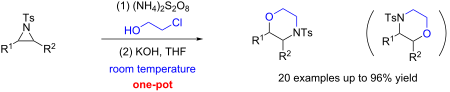
- -disubstituted aziridines (acyclic and/or cyclic ones), separable mixtures of regioisomers 3l,m and 4l,m were obtained arising from isomeric ring opening (Table 2, entries 12 and 13). We speculated that the observed regioselectivity might depend on the combined action of electronic effects and the position of


Eosin Y-catalyzed visible-light-mediated aerobic oxidative cyclization of N,N-dimethylanilines with maleimides
Beilstein J. Org. Chem. 2015, 11, 425–430, doi:10.3762/bjoc.11.48
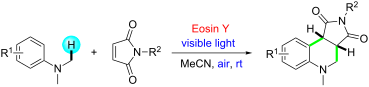
- formation of a mixture of regioisomers 3q1 and 3q2 with 81% combined yield. The major product was the sterically more hindered 3q1 [43][44][45]. On the basis of our observations and literature reported [19][36][38][43][44], a proposed mechanism for the formation of the corresponding tetrahydroquinolines 3



C-5’-Triazolyl-2’-oxa-3’-aza-4’a-carbanucleosides: Synthesis and biological evaluation
Beilstein J. Org. Chem. 2015, 11, 328–334, doi:10.3762/bjoc.11.38

- –alkyne cycloadditions, no traces of 1,5-regioisomers were observed [47][48]. The structure of the obtained compounds was assessed according to 1H NMR, 13C NMR and MS data. In particular, the 1H NMR spectra of 5-methyl-1-[(3RS,5SR)-2-methyl-3-(1H-1,2,3-triazol-1-ylmethyl)isoxazolidin-5-yl]pyrimidine-2,4


Switching the reaction pathways of electrochemically generated β-haloalkoxysulfonium ions – synthesis of halohydrins and epoxides
Beilstein J. Org. Chem. 2015, 11, 242–248, doi:10.3762/bjoc.11.27

- + or I+ and DMSO to unsymmetrically substituted olefins 2c and 2d regioselectively gave bromohydrins as single regioisomers (Table 2, entries 5–10). The regioselectivity of the products can be explained by the stability of carbocations (benzyl > secondary > primary). In the case of terminal alkene 2c


Recent advances in the electrochemical construction of heterocycles
Beilstein J. Org. Chem. 2014, 10, 2858–2873, doi:10.3762/bjoc.10.303
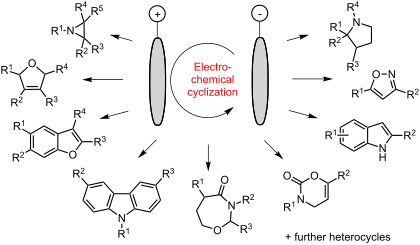
- 24 [72]. In this example, 1,2-benzoquinone derivatives are generated in the presence of ketene N,O-acetals 70. Out of four possible regioisomers, 71a and 71b are exclusively formed (in ratios 71a/71b between 1:1 and 1:2). In a follow-up study, unreacted α-arylated ketene N,O-acetal intermediates (63




Regio- and stereoselective synthesis of new diaminocyclopentanols
Beilstein J. Org. Chem. 2014, 10, 2513–2520, doi:10.3762/bjoc.10.262
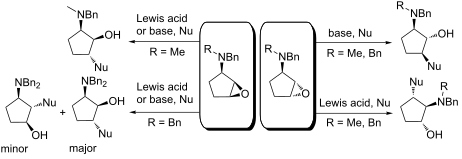
- aminocyclopentanols 8c and 8d (Supporting Information File 1). In every experiment, 1,2-trans-2,3-cis-aminocyclopentanols, arising from opening of epoxide 3a at C1, were the only regioisomers isolated. The stereo- and regiochemistry of 8a and 8d were assigned by 2D NMR (HSQC-DEPT, 1H,1H COSY and NOESY experiments
- displayed poor regioselectivity. In fact, a mixture of the separable regioisomers 9a–d and 10a–d were obtained, where the major products 9a–d were formed due to the attack of the nucleophile at the C1-oxirane carbon atom. In case of aliphatic cyclic amines (morpholine (7a) and N-acetylpiperazine (7c)), the
- nucleophilicity. Moreover, there was not much effect on the outcome of the reactions conducted either under solvent-free conditions or using DMSO as a solvent. The regioisomers 9a–d and 10a–d were isolated through column chromatographic separation and fully characterized in order to avoid ambiguity. The


Facile synthesis of 1H-imidazo[1,2-b]pyrazoles via a sequential one-pot synthetic approach
Beilstein J. Org. Chem. 2014, 10, 2338–2344, doi:10.3762/bjoc.10.243
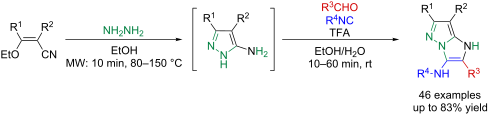
- have predominantly been described as 5H-imidazo[1,2-b]pyrazoles with an endo double bond (and not as 1H-imidazo[1,2-b]pyrazoles), but without 2D NMR-based support. However, the GBB-3CR of functionalized pyrazoles might lead to the formation of two regioisomers [24] and four different tautomeric forms


End group functionalization of poly(ethylene glycol) with phenolphthalein: towards star-shaped polymers based on supramolecular interactions
Beilstein J. Org. Chem. 2014, 10, 2263–2269, doi:10.3762/bjoc.10.235
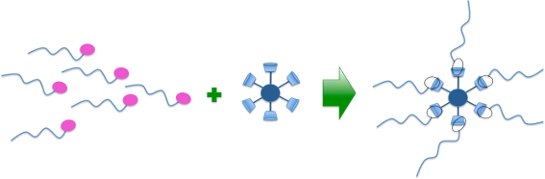
- ) was then reacted with PP-N3 in a 1,3-diploar cycloaddition, which gave the desired phenolphthalein-functionalized mPEG-PP (see Scheme 2). Since the reaction was carried out in absence of copper(I) salts, a mixture of the 1,4- and 1,5-substituted triazole regioisomers was obtained. The host component


Chiral phosphines in nucleophilic organocatalysis
Beilstein J. Org. Chem. 2014, 10, 2089–2121, doi:10.3762/bjoc.10.218
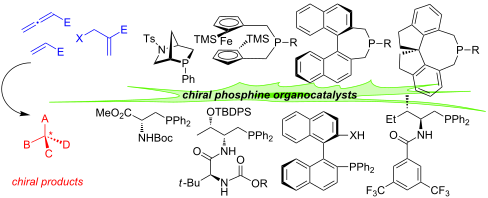
- cyclopentenes as single regioisomers with high enantioselectivities. Interestingly, single amino acid-based phosphines were better than di-, tri-, and tetrapeptide-based catalysts. Of particular note, when they treated γ-substituted racemic allenoates with acyclic enones, unique dynamic kinetic asymmetric


Multicomponent reactions in nucleoside chemistry
Beilstein J. Org. Chem. 2014, 10, 1706–1732, doi:10.3762/bjoc.10.179
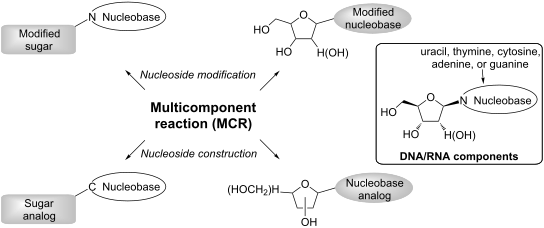
- secondary amines. In some cases, protection of the hydroxy groups in 94a was also necessary. The reactions between 3',5'-di-O-acetyl-5-iodo-2'-deoxyuridine (94b), long-chain 1,ω-dienes (e.g., deca-1,9-diene or tetradeca-1,13-diene) and morpholine afforded products as mixtures of regioisomers resulting from


Synthesis, characterization and DNA interaction studies of new triptycene derivatives
Beilstein J. Org. Chem. 2014, 10, 1290–1298, doi:10.3762/bjoc.10.130
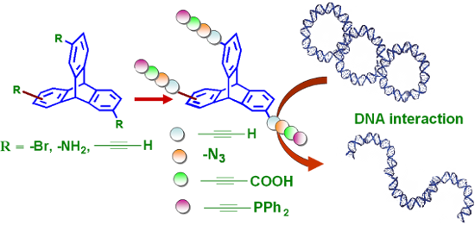
- . Subsequently, derivatization of ethynyl-substituted triptycenes was studied to yield the respective propiolic acid and ethynylphosphine derivatives. Characterization of the newly functionalized triptycene derivatives and their regioisomers were carried out using FTIR and multinuclear NMR spectroscopy, mass
- interactions depends on the functionality of the substituents. However, there is no marked difference in the extent of interaction with DNA between a given pair of regioisomers. Results and Discussion Synthesis and characterization of ethynyl- and azide-substituted triptycenes. Using appropriate


Hindered aryl bromides for regioselective palladium-catalysed direct arylation at less favourable C5-carbon of 3-substituted thiophenes
Beilstein J. Org. Chem. 2014, 10, 1239–1245, doi:10.3762/bjoc.10.123
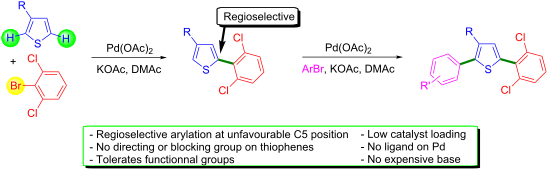
- . However, a complete conversion of 2-bromonitrobenzene was observed. 2-Bromoaniline was found to be unreactive and was recovered. It should be noted that no amination reaction of 2-bromoaniline due to self-coupling was observed. From 2-(trifluoromethyl)bromobenzene, a very similar mixture of regioisomers
- regioisomers a and b were obtained after column chromatography. On the other hand, the use of 2-bromo-1,3-dichlorobenzene allowed to obtain very selectively the desired 5-arylation product 8b. Only traces of the C2-arylated thiophene 8a and a low amount of 2,5-diarylated product 8c were detected by 1H NMR and
- unfavourable C5 position of 3-substituted thiophenes. These less favoured regioisomers can be selectively obtained in moderate to good yields using a range of 3-substituted thiophenes, as chloro, ester, acetyl or ethyl acetate substituents are tolerated. Moreover, the sequential catalytic C5 and C2 arylations


Synthesis of ethoxy dibenzooxaphosphorin oxides through palladium-catalyzed C(sp2)–H activation/C–O formation
Beilstein J. Org. Chem. 2014, 10, 1220–1227, doi:10.3762/bjoc.10.120
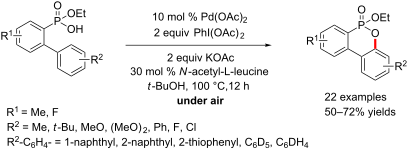
- -dimethoxyphenyl group at 2-position turned out to be compatible with the Pd-catalyzed oxidative cyclization. There are no regioisomers formed due to steric effects. Substrate 3c bearing a chloro group was selectively cyclized to afford 4c in 64% yield. To our delight, the present method worked equally well even


Preparation of phosphines through C–P bond formation
Beilstein J. Org. Chem. 2014, 10, 1064–1096, doi:10.3762/bjoc.10.106
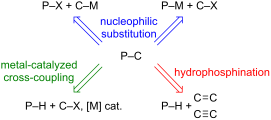
- ] or AIBN radical [77][78][83][235][236]) or transition metal activation. Depending on the regioselectivity of the procedure, the addition of P–H to the triple bond results in the formation of two regioisomers (Scheme 36). The product that results from the Markovnikov addition of P–H corresponds to the


cis–trans Isomerization of silybins A and B
Beilstein J. Org. Chem. 2014, 10, 1047–1063, doi:10.3762/bjoc.10.105
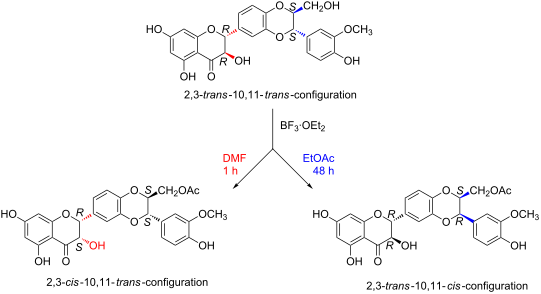
- were shown to be regioisomers of isosilybins A (5) and B (6) [10] (Figure 2). Other authors reported 2,3-cis-isomers of silybin [11][12], the relative configuration of which were corroborated by 1H NMR coupling constants, i.e., J2,3 of ca. 11 Hz in the trans-isomers and 2–3 Hz in the cis-isomers


Visible light mediated intermolecular [3 + 2] annulation of cyclopropylanilines with alkynes
Beilstein J. Org. Chem. 2014, 10, 975–980, doi:10.3762/bjoc.10.96
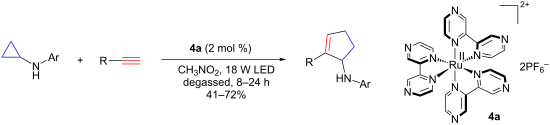
- 21 in 52% yield. The fused indoline motif was formed via an intramolecular Heck reaction under Fu’s conditions [41] to provide a mixture of two olefinic regioisomers 22, which were converted to saturated fused indoline 23 under standard catalytic hydrogenation conditions in a combined yield of 40


Aza-Diels–Alder reaction between N-aryl-1-oxo-1H-isoindolium ions and tert-enamides: Steric effects on reaction outcome
Beilstein J. Org. Chem. 2014, 10, 848–857, doi:10.3762/bjoc.10.81
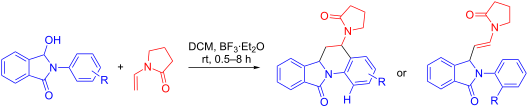
- the dienophile, at least two regioisomers can be visualized for these compounds. Based on our characterization results, only one regioisomer, where the substitution was at position 5 of the isoindoloquinoline ring, was exclusively formed in these reactions. Inverse-electron demand hetero-Diels–Alder
- regioselectivity, Table 1, entries 6 and 14 with 3-chloro-4-fluoroaniline and entries 8 and 15 with 2-naphthylamine as the starting materials were capable of forming additional regioisomers, but the reaction appeared to be regioselective again in these cases, each producing only one regioisomer. These observations


Additive-assisted regioselective 1,3-dipolar cycloaddition of azomethine ylides with benzylideneacetone
Beilstein J. Org. Chem. 2014, 10, 352–360, doi:10.3762/bjoc.10.33
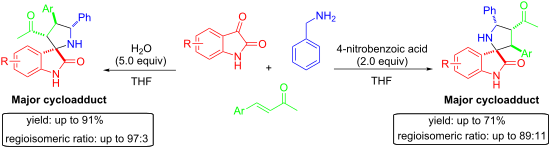
- ethanol at room temperature (Table 1). It smoothly went until completion. Interestingly, the two regioisomers 4a and 5a were obtained with modest yield and poor regioisomeric ratio (Table 1, entry 1), which is quite different from the reaction of chalcone. Generally, only a single regioisomer 4′,5
- electron-deficient β-carbon of benzylideneacetone during the cycloaddition leading to two regioisomers [31]. In the presence of water, transition state A is favored due to the formation of an intermolecular hydrogen bonding between water and two carbonyl groups in the reaction substrates, while transition
- -dipolar cycloaddition to prepare two regioisomers in high yields, we tested two reaction conditions (conditions A: 5.0 equiv H2O as an additive; conditions B: 2.0 equiv 4-NO2PhCOOH as additive) for all substrates. As shown in Table 3, the reactions between benzylideneacetone with the azomethine ylides




Tuning the interactions between electron spins in fullerene-based triad systems
Beilstein J. Org. Chem. 2014, 10, 332–343, doi:10.3762/bjoc.10.31
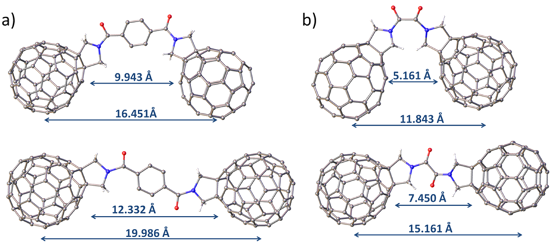
- suggest that this difference alone is too small to explain the position of these features. We note also that 2 and 5 are mixtures of two regioisomers of the pyrrolidine functionalised C70 [19], in a ratio of 6:4 as determined by 1H NMR spectroscopy (see Experimental section). It is possible that these


Boron-substituted 1,3-dienes and heterodienes as key elements in multicomponent processes
Beilstein J. Org. Chem. 2014, 10, 237–250, doi:10.3762/bjoc.10.19

- , substituted by electron-donating or -withdrawing groups and heteroaromatic halides occurred in moderate to good yields (41% to 64% over two steps) with a preference for the para- over meta-regioisomers (2.3:1 to 5.7:1 ratio). Using the same methodology, the preparation and reactivity in tandem Diels–Alder





