


Search results
Search for "ruthenium" in Full Text gives 283 result(s) in Beilstein Journal of Organic Chemistry. Showing first 200.
Iron complexes of tetramine ligands catalyse allylic hydroxyamination via a nitroso–ene mechanism
Beilstein J. Org. Chem. 2015, 11, 2549–2556, doi:10.3762/bjoc.11.275
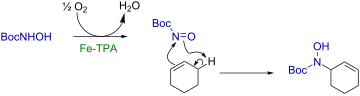
- , only one product was observed in each case. Cenini et al. have reported that both cycloadduct and ene product are formed in the ruthenium-catalysed reaction of nitrobenzene (an alternate route to a nitrosobenzene intermediate) with isoprene [57]. As mentioned above, isoprene produces two different


Diversity-oriented synthesis of analogues of the novel macrocyclic peptide FR-225497 through late stage functionalization
Beilstein J. Org. Chem. 2015, 11, 2487–2492, doi:10.3762/bjoc.11.270
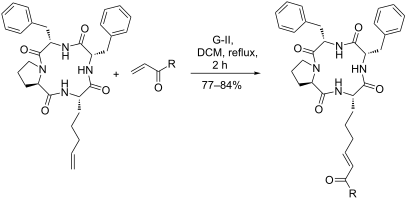
- )(trichlorohexylphosphine)ruthenium, G-II] smoothly effected the desired transformation within a short period of time. Compound 14 was obtained as a single (E)-isomer, as expected. Saturation of the double bond in the latter furnished nor-FR225497 (15) in an overall yield of ≈70% over two steps from template 13. We opted


Efficient synthetic protocols for the preparation of common N-heterocyclic carbene precursors
Beilstein J. Org. Chem. 2015, 11, 2318–2325, doi:10.3762/bjoc.11.252
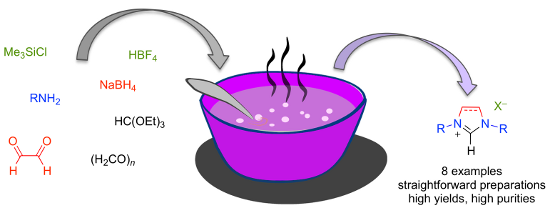
- just a single example, NHC ligands played a crucial role in the development of highly efficient ruthenium initiators for olefin metathesis and related reactions [18][19][20][21]. Lately, these divalent carbon species have also emerged as powerful nucleophilic organocatalysts for polymer chemistry [22


Beyond catalyst deactivation: cross-metathesis involving olefins containing N-heteroaromatics
Beilstein J. Org. Chem. 2015, 11, 2223–2241, doi:10.3762/bjoc.11.241
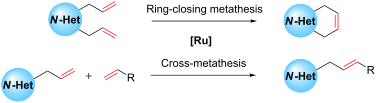
- deactivation caused by amino derivatives will be first presented and discussed. RCM and CM involving alkenes possessing N-heteroaromatics will be then successively examined [38]. Review Mechanistic insights into amine-induced catalyst deactivation Recently, intensive studies dealing with ruthenium catalyst
- deactivation in metathesis have been published, most of them focusing on the GII catalyst [39][40][41][42][43]. In 2007, Grubbs et al. examined the decomposition pathways of various ruthenium methylidenes using NMR spectroscopy [44]. The methylidenes 1 and 2 derived from GI and GII had a half-life of 40 min
- methylidene intermediates 3 and 4 to give CH3PCy3+Cl− and inactive ruthenium complexes. Similar observations were made in the absence or in the presence of ethylene in the reaction medium (Scheme 1). Similar studies concerning the Grubbs–Hoveyda II catalyst were difficult due to the instability of the


Computational study of productive and non-productive cycles in fluoroalkene metathesis
Beilstein J. Org. Chem. 2015, 11, 2150–2157, doi:10.3762/bjoc.11.232
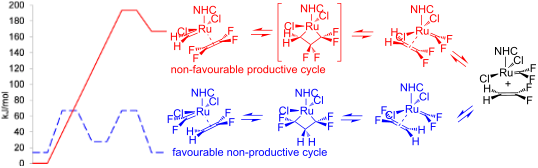
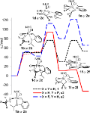
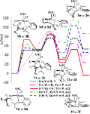
- initiating ruthenium precatalysts [12][13]. A theoretical approach has been also employed in attempts to gain a better insight into the complex structure of intertwined productive and non-productive catalytic cycles of alkene metathesis [14]. In contrast to the older computations, new publications also
- concentrated on the side chain of the vinyl group [24][25][26][27] or applications of 2-fluoroalkenes [28][29][30]. As an exception, the reaction of the Grubbs 2nd generation catalyst with 1,1-difluoroethene gave an isolable difluoromethylene-containing ruthenium complex with very poor catalytic activity [31
- with selected fluoro- and chloroalkenes has been studied and the higher stability of a ruthenium intermediate containing a difluoromethylene ligand has been emphasized [36][37]. A complete mechanism of alkene metathesis including initiation, productive and non-productive cycles represents a highly




Ru complexes of Hoveyda–Grubbs type immobilized on lamellar zeolites: activity in olefin metathesis reactions
Beilstein J. Org. Chem. 2015, 11, 2087–2096, doi:10.3762/bjoc.11.225
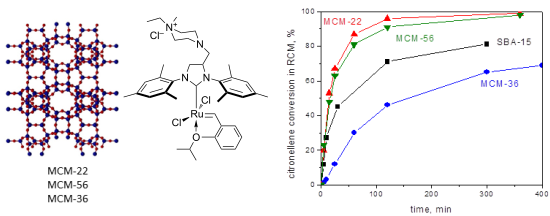
- determination of the ruthenium content was performed by inductively coupled plasma mass spectrometry (ICP–MS) by the Institute of Analytical Chemistry (ICT, Prague, Czech Republic). Catalyst preparation Immobilization of HGIIN+X− complexes was performed by stirring a mixture of complex and support in CH2Cl2 at


Olefin metathesis in air
Beilstein J. Org. Chem. 2015, 11, 2038–2056, doi:10.3762/bjoc.11.221

- been made to render catalysts more stable and yet more functional group tolerant. This review summarizes the major developments concerning catalytic systems directed towards water and air tolerance. Keywords: air stability; catalysis; olefin metathesis; RCM; ROMP; ruthenium; Introduction Transition
- hopefully raise the awareness of the significant tolerance of standard metathesis catalysts to these conditions. Review Well-defined ruthenium catalysts Although well-defined early transition metal-based catalysts formed the basis of early metathesis reactions and can be thought of as the forefathers of
- , late transition metals, which do not exhibit high oxophilicity, appeared as the most promising candidates for reactions performed in air. Indeed in 1988, Grubbs and Novak reported that not only ruthenium was an interesting candidate for olefin metathesis, but also that reactions were successfully


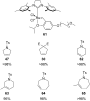


Hexacoordinate Ru-based olefin metathesis catalysts with pH-responsive N-heterocyclic carbene (NHC) and N-donor ligands for ROMP reactions in non-aqueous, aqueous and emulsion conditions
Beilstein J. Org. Chem. 2015, 11, 1960–1972, doi:10.3762/bjoc.11.212
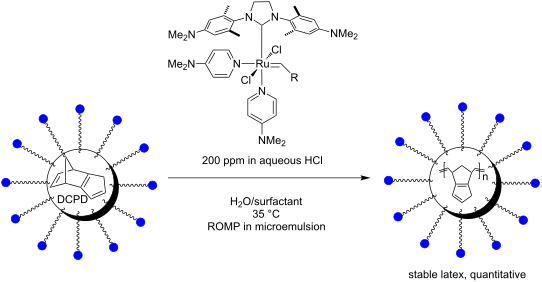
- , OR 97203, USA 10.3762/bjoc.11.212 Abstract Three new ruthenium alkylidene complexes (PCy3)Cl2(H2ITap)Ru=CHSPh (9), (DMAP)2Cl2(H2ITap)Ru=CHPh (11) and (DMAP)2Cl2(H2ITap)Ru=CHSPh (12) have been synthesized bearing the pH-responsive H2ITap ligand (H2ITap = 1,3-bis(2’,6’-dimethyl-4’-dimethylaminophenyl
- the polymerization process. Furthermore, the coagulate content for all experiments stayed <2%. This represents an unprecedented efficiency in emulsion ROMP based on hydrophilic ruthenium alkylidene complexes. Keywords: activation; aqueous catalysis; emulsion; olefin metathesis; polymerization
- ; ruthenium; Introduction The vast application spectrum of Ru-based olefin metathesis has provided a powerful synthetic tool for the organic [1][2][3] and polymer chemist [4][5][6][7][8] alike. The catalysts’ high tolerance towards functional groups, air and moisture makes them attractive to be used in


New aryloxybenzylidene ruthenium chelates – synthesis, reactivity and catalytic performance in ROMP
Beilstein J. Org. Chem. 2015, 11, 1910–1916, doi:10.3762/bjoc.11.206
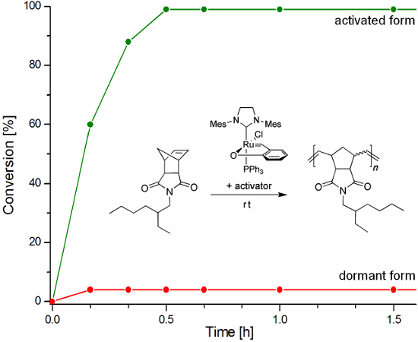
- Patrycja Zak Szymon Rogalski Mariusz Majchrzak Maciej Kubicki Cezary Pietraszuk Adam Mickiewicz University in Poznań, Faculty of Chemistry, Umultowska 89b, 61-614 Poznań, Poland 10.3762/bjoc.11.206 Abstract New phenoxybenzylidene ruthenium chelates were synthesised from the second generation
- ) and a single selected norbornene derivative. Keywords: chemoactivation; latent catalysts; metathesis; ROMP; ruthenium; Introduction Olefin metathesis is nowadays one of the most important methods for the formation of carbon–carbon bonds in organic and polymer chemistry [1][2]. The availability of
- well-defined ruthenium-based catalysts, showing a number of desirable features such as tolerance of functional groups, moisture and air, has significantly expanded the scope and application of this process regardless of dynamic advancement in the development of ruthenium-based metathesis catalysts




Stereochemistry of ring-opening/cross metathesis reactions of exo- and endo-7-oxabicyclo[2.2.1]hept-5-ene-2-carbonitriles with allyl alcohol and allyl acetate
Beilstein J. Org. Chem. 2015, 11, 1893–1901, doi:10.3762/bjoc.11.204

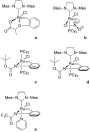
- allyl acetate promoted by different ruthenium alkylidene catalysts were studied. The stereochemical outcome of the reactions was established. The issues concerning chemo- (ROCM vs ROMP), regio- (1-2- vs 1-3-product formation), and stereo- (E/Z isomerism) selectivity of reactions under various conditions
- ROCM reactions of exo- and endo-7-oxabicyclo[2.2.1]hept-5-en-2-carbonitrile (1 and 2, respectively) with allyl acetate (3) or allyl alcohol (4) catalyzed by several commercially available ruthenium catalysts ([Ru]1–6, Figure 1). To the best of our knowledge there is no example of a ROCM reaction of 7
- . Furthermore, less complex mixtures of products were formed and they were easier to separate from the ROMP products. 7-Oxanorbornenes 1 and 2 were treated with olefin 3 or 4 in the presence of ruthenium catalysts [Ru]1–6 (Figure 1) to afford mixtures of tetrahydrofurans 5–12 (Scheme 2). The mixtures were


Profluorescent substrates for the screening of olefin metathesis catalysts
Beilstein J. Org. Chem. 2015, 11, 1886–1892, doi:10.3762/bjoc.11.203
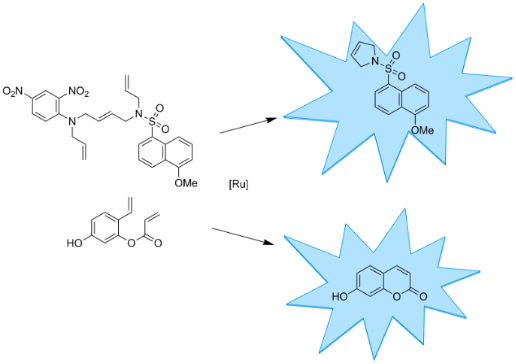
- . To demonstrate the validity of the approach, four commercially available ruthenium-metathesis catalysts were evaluated in six different solvents. The results from the fluorescent assay agree well with HPLC conversions, validating the usefulness of the approach. Keywords: fluorescence; microplate


Cross metathesis of unsaturated epoxides for the synthesis of polyfunctional building blocks
Beilstein J. Org. Chem. 2015, 11, 1876–1880, doi:10.3762/bjoc.11.201
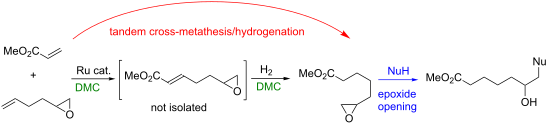
- compounds. The resulting cross metathesis products were hydrogenated in a tandem fashion employing the residual ruthenium from the metathesis step as the hydrogenation catalyst. Interestingly, the epoxide ring remained unreactive toward this hydrogenation method. The saturated compound resulting from the
- cross metathesis of 1 with methyl acrylate was transformed by means of nucleophilic ring-opening of the epoxide to furnish a diol, an alkoxy alcohol and an amino alcohol in high yields. Keywords: cross metathesis; epoxide; ruthenium catalysts; tandem reactions; Introduction Catalytic carbon–carbon
- necessary to ensure high conversion. Reactions were carried out in dimethyl carbonate (DMC), a solvent compatible with ruthenium olefin metathesis catalysts [28] while being much greener than toluene or dichloromethane commonly used in such reactions [29]. Based on our previous results and observations in


Recent applications of ring-rearrangement metathesis in organic synthesis
Beilstein J. Org. Chem. 2015, 11, 1833–1864, doi:10.3762/bjoc.11.199

- % yield [51]. The regioselective formation of 240 may be attributed to the facile formation of a Ru–carbene intermediate where the metal participates on the side opposite to that of the methyl ester and thereby minimizing the steric crowding between ruthenium and carbonyl oxygen of an ester functionality
- RRM process and this activity will continue with more vigour in the future. Ruthenium alkylidene catalysts used in RRM processes. General representation of various RRM processes. A general mechanism for RRM process. RRM of cyclopropene systems. RRM of cyclopropene with catalyst 2. (i) catalyst 2 (2.5




Nitro-Grela-type complexes containing iodides – robust and selective catalysts for olefin metathesis under challenging conditions
Beilstein J. Org. Chem. 2015, 11, 1823–1832, doi:10.3762/bjoc.11.198
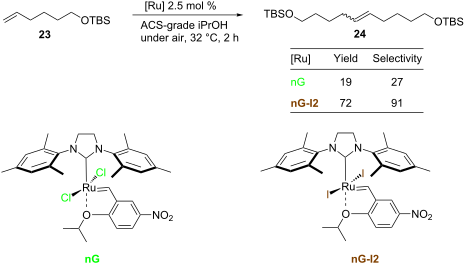
- vicinity of ruthenium related to the presence of iodides ensures enhanced catalyst stability. The benefits are most apparent under challenging conditions, such as very low reaction concentrations, protic solvents or with the occurrence of impurities. Keywords: green solvents; macrocyclization; metathesis
- ; ruthenium; Introduction Olefin metathesis (OM) is a mild and versatile catalytic method which allows the formation of carbon–carbon double bonds [1]. Understanding the key events in ruthenium-catalyzed olefin metathesis [2] and developing efficient and selective catalysts [3] provides opportunities for
- interest. Currently, the second generation Hoveyda-type catalysts, such as HII [4], A [5], B [6], and C [7] are considered to be the most versatile tool for OM (Figure 1). Modifications of ligands permanently bound to the ruthenium center appear to be the most efficient methods for altering the catalyst


Synthesis and structures of ruthenium–NHC complexes and their catalysis in hydrogen transfer reaction
Beilstein J. Org. Chem. 2015, 11, 1786–1795, doi:10.3762/bjoc.11.194
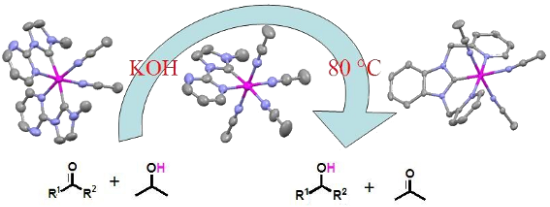
- , China 10.3762/bjoc.11.194 Abstract Ruthenium complexes [Ru(L1)2(CH3CN)2](PF6)2 (1), [RuL1(CH3CN)4](PF6)2 (2) and [RuL2(CH3CN)3](PF6)2 (3) (L1= 3-methyl-1-(pyrimidine-2-yl)imidazolylidene, L2 = 1,3-bis(pyridin-2-ylmethyl)benzimidazolylidene) were obtained through a transmetallation reaction of the
- molecular structures of the complexes 4 and 5 were also studied by X-ray diffraction analysis. These ruthenium complexes have proven to be efficient catalysts for transfer hydrogenation of various ketones. Keywords: N-heterocyclic carbene; ruthenium; transfer hydrogenation; Introduction N-Heterocyclic
- [8][9][10][11][12][13][14][15][16] have been reported. In the family of metal complexes supported by functionalized NHCs, ruthenium complexes have long been a research focus on various applications such as catalysis and photochemistry [17][18][19][20][21][22][23][24][25][26]. However, the majority of


A comprehensive study of olefin metathesis catalyzed by Ru-based catalysts
Beilstein J. Org. Chem. 2015, 11, 1767–1780, doi:10.3762/bjoc.11.192
- species is also discussed, with either pyridine or phosphine ligands to dissociate. Keywords: cis; density functional theory (DFT); N-heterocyclic carbene; olefin metathesis; ruthenium; Introduction Organic synthesis is based on reactions that drive the formation of carbon–carbon bonds [1]. Olefin
- metathesis represents a metal-catalyzed redistribution of carbon–carbon double bonds [2][3][4][5][6] and provides a route to unsaturated molecules that are often challenging or impossible to prepare by any other means. Furthermore, the area of ruthenium-catalyzed olefin metathesis reactions is an outstanding
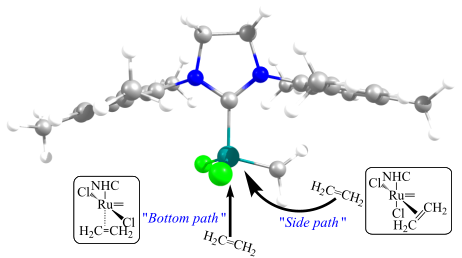
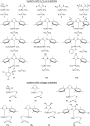
- . Possible side or bottom mechanism of the insertion of the olefin. Ruthenium catalysts, bottom-bound (a) or side-bound (b and c). Studied systems. Binding energy, in kcal/mol, of the first, E1, and of the second, E2, pyridine/PMe3 molecule to the naked 14e species 1–13. Energies (E) in kcal/mol, of the




Grubbs–Hoveyda type catalysts bearing a dicationic N-heterocyclic carbene for biphasic olefin metathesis reactions in ionic liquids
Beilstein J. Org. Chem. 2015, 11, 1632–1638, doi:10.3762/bjoc.11.178
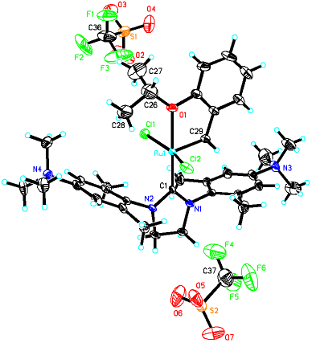
- solvent (toluene) and the ionic liquid (IL) 1-butyl-2,3-dimethylimidazolium tetrafluoroborate [BDMIM+][BF4−]. The structure of Ru-2 was confirmed by single crystal X-ray analysis. Keywords: biphasic catalysis; ionic initiators; recycling; ROMP; ruthenium; Introduction Ionic metathesis catalysts offer
- both the IL and the ionic catalyst effectively block any crossover of catalyst into the second (organic) phase. This offers access to metathesis reactions in which the products have a low ruthenium contamination [11]. Equally important, reactions can be run under biphasic, continuous conditions
- applying supported ionic liquid phase (SILP) technology [11]. We recently reported on different Ru-based ionic metathesis catalysts that can be used for these purposes. In these systems, the charge is either located directly at the ruthenium [11][12] or at the 1-methylpyridinium-4-carboxylate ligands that



Latent ruthenium–indenylidene catalysts bearing a N-heterocyclic carbene and a bidentate picolinate ligand
Beilstein J. Org. Chem. 2015, 11, 1541–1546, doi:10.3762/bjoc.11.169
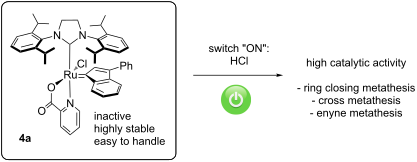
- Cedex, France 10.3762/bjoc.11.169 Abstract A silver-free methodology was developed for the synthesis of unprecedented N-heterocyclic carbene ruthenium indenylidene complexes bearing a bidentate picolinate ligand. The highly stable (SIPr)(picolinate)RuCl(indenylidene) complex 4a (SIPr = 1,3-bis(2-6
- . Keywords: latent catalyst; olefin metathesis; picolinate ligand; ruthenium indenylidene; Introduction Olefin metathesis has witnessed tremendous development in the last decades and has emerged as a powerful tool with dramatic impact on both organic chemistry and materials science [1][2]. Intensive
- research has notably allowed for the design of efficient ruthenium-based catalysts that exhibit improved reactivity [3][4][5][6]. On the other hand, some applications require a precatalyst that can remain inert towards substrates and only initiate in response to a specific stimulus [7]. A common strategy


Ruthenium indenylidene “1st generation” olefin metathesis catalysts containing triisopropyl phosphite
Beilstein J. Org. Chem. 2015, 11, 1520–1527, doi:10.3762/bjoc.11.166
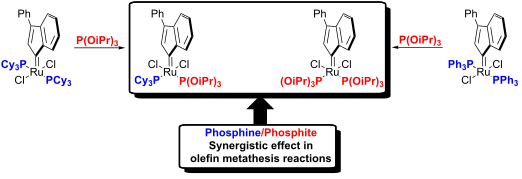
- -type ligands. Keywords: 1st generation; indenylidene; metathesis; phosphite; ruthenium; Introduction The olefin metathesis reaction is a powerful tool for C–C bond formation in the synthesis of highly valuable organic compounds [1][2][3][4]. Protocols involving W-, Mo- and Ru-based pre-catalysts can
- ruthenium complexes used in olefin metathesis reactions. Molecular structure of mixed phosphine/phosphite complex 1. Hydrogen atoms are omitted for clarity. Molecular structure of 2 and the ylide 3. Hydrogen atoms and solvent molecules are omitted for clarity. Selected bond distances (Å) and angles (°) (ESD


Design and synthesis of hybrid cyclophanes containing thiophene and indole units via Grignard reaction, Fischer indolization and ring-closing metathesis as key steps
Beilstein J. Org. Chem. 2015, 11, 1514–1519, doi:10.3762/bjoc.11.165

- of the starting material leading to a complex mixture of products as indicated by thin-layer chromatography (TLC). It is known that sulfur can coordinate with the ruthenium catalyst and deactivate the catalytic cycle [35][36][37]. Therefore, the diolefin did not undergo the RCM sequence. Next, we


The enantioselective synthesis of (S)-(+)-mianserin and (S)-(+)-epinastine
Beilstein J. Org. Chem. 2015, 11, 1509–1513, doi:10.3762/bjoc.11.164
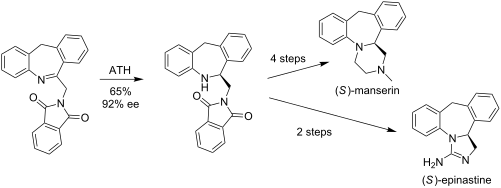
- : chiral diamines; enantioselective reduction; epinastine; mianserin; ruthenium complexes; Introduction Mianserin (1) is a tetracyclic compound widely used as a drug in the treatment of depression. Despite the fact that the (S)-(+)-enantiomer of mianserin is more potent than the (R)-antipode in
- ruthenium complex 11 which contain (1R,2R)- or (1S,2S)-N-tosyl-1,2-cyclohexanediamine as chiral ligand (Figure 2). The reaction was carried out in acetonitrile using an azeotropic mixture of formic acid/triethylamine as hydrogen source with 50:1 substrate to catalyst ratio. Under these conditions the
- regardless of the solvent used, with the exception of acetonitrile (Table 1, entries 8–10). In CH3CN this catalyst is inactive and the product was not formed. The solvent effect on the chemical yield was similar to that observed with catalyst 11 (Table 1). Finally, the ruthenium complex 13 modified with


Tandem cross enyne metathesis (CEYM)–intramolecular Diels–Alder reaction (IMDAR). An easy entry to linear bicyclic scaffolds
Beilstein J. Org. Chem. 2015, 11, 1486–1493, doi:10.3762/bjoc.11.161
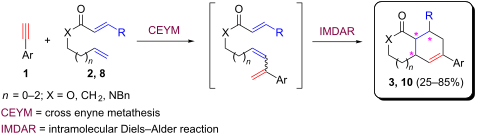
- bearing two different olefin units one being an α,β-unsaturated moiety, the tandem CM–IMDAR protocol would initiate on the electronically neutral olefin. Furthermore, those dienes could undergo an intramolecular cyclization (RCM) promoted by the ruthenium carbene that would compete with the desired
- 5 (method A) or acyl chlorides 6 (method B) under standard conditions (Scheme 3). Since the basic indole nitrogen in substrate 8f could interfere with the ruthenium catalyst, it was N-methylated to render compound 8g. With substrates 8 in hand, they were subjected to the optimized conditions of the


Thermal properties of ruthenium alkylidene-polymerized dicyclopentadiene
Beilstein J. Org. Chem. 2015, 11, 1469–1474, doi:10.3762/bjoc.11.159
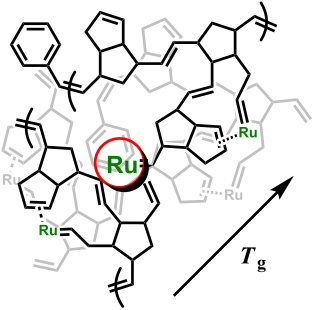
- proportional to the resting period and was accompanied by a constant increase in the glass-transition temperature. We hypothesize that a relaxation mechanism within the cross-linked scaffold, together with a long-lived stable ruthenium alkylidene species are responsible for the observed phenomenon. Keywords
- : glass-transition temperature; polydicyclopentadiene; ring opening metathesis polymerization; ruthenium-catalyzed olefin metathesis; thermoset polymers; Introduction Olefin metathesis [1][2][3][4][5][6] has advanced to become a major synthetic tool in academia [7][8][9][10][11] and industry [12
- ) (Figure 1). The Grubbs-type ruthenium initiators, known for their high activity, stability and functional group tolerance are extensively used to promote this type of olefin metathesis reactions. For example, the Grubbs second generation catalyst 2 [18] (Figure 1), may be used to initiate ROMP reactions


Consequences of the electronic tuning of latent ruthenium-based olefin metathesis catalysts on their reactivity
Beilstein J. Org. Chem. 2015, 11, 1458–1468, doi:10.3762/bjoc.11.158
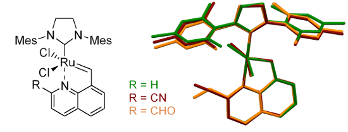
- Arabia 10.3762/bjoc.11.158 Abstract Two ruthenium olefin metathesis initiators featuring electronically modified quinoline-based chelating carbene ligands are introduced. Their reactivity in RCM and ROMP reactions was tested and the results were compared to those obtained with the parent unsubstituted
- reactivity of the complexes. Keywords: DFT calculations; olefin metathesis; ring closing metathesis; ring-opening metathesis polymerisation; ruthenium; Introduction Olefin metathesis is a catalytic process during which C–C double bonds are exchanged [1]. Since the first examples were published in the 1950s
- , many stunning accomplishments have been made in the field resulting in ever increasing interests in the method. Establishment of well-defined molybdenum- and ruthenium-based complexes lead to multitude of applications [2][3][4]. Especially, the latter class of compounds have gained attention due to




Cross-metathesis reaction of α- and β-vinyl C-glycosides with alkenes
Beilstein J. Org. Chem. 2015, 11, 1392–1397, doi:10.3762/bjoc.11.150

- ; catalysis; carbohydrates; cross-metathesis; ruthenium; Introduction Natural and unnatural C-substituted glycosides are important compounds with a plethora of attractive biological properties and they often have been used as artificial DNA components [1]. Among various synthetic procedures providing C





