Search results
Search for "transition states" in Full Text gives 224 result(s) in Beilstein Journal of Organic Chemistry. Showing first 200.
Sequential Diels–Alder/[3,3]-sigmatropic rearrangement reactions of β-nitrostyrene with 3-methyl-1,3-pentadiene
Beilstein J. Org. Chem. 2013, 9, 2137–2146, doi:10.3762/bjoc.9.251

- °C and 20 °C, respectively). Apparently, the developing cis-relationship between the phenyl and nitro groups in transition states leading to both 22b and 19 is unfavorable. On prolonged heating, product 22b is converted to the trans-isomer 23. It was postulated that the zwitterion 24 was an
- tetrasubstituted cycloalkenes 22a and 22b, respectively, whereas 2 and 3 give less stable trisubstituted alkenes 18 and 19 [22] which may explain the rate difference. Significant steric differences between the transition states leading to 22a and 22b versus 18 and19 appear to be absent. Nitronic esters 4–7 lack


Aerobic radical multifunctionalization of alkenes using tert-butyl nitrite and water
Beilstein J. Org. Chem. 2013, 9, 1713–1717, doi:10.3762/bjoc.9.196

- reactions of alkenes 5 and 7 could be rationalized by six-membered transition states 30 and 31 in the 1,5-hydrogen shift. If chair forms were postulated in both cases, more substituents should be arranged at equatorial positions to form more stable transition states. According to this presumption, the


Thermochemistry and photochemistry of spiroketals derived from indan-2-one: Stepwise processes versus coarctate fragmentations
Beilstein J. Org. Chem. 2013, 9, 1668–1676, doi:10.3762/bjoc.9.191
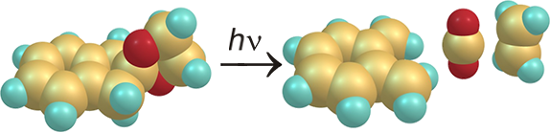
- , involved in the reaction, one bond is made and one bond is broken. However, there are a number of reactions that include a linear system of atoms, or at least one atom, at which two bonds are made and two bonds broken simultaneously. Nevertheless, their transition states exhibit a cyclic overlap of basis
- orbitals. The orbital basis can be derived from the orbital basis of pericyclic transition states by constriction (coarctation, Figure 1). Hence, these reactions have been coined “coarctate” reactions [4][5]. Similar to pericyclic reactions [6], rules were derived to predict their stereochemistry, and
- overlap at each end is bound by terminating groups, e.g. a lone pair, or two atoms to form a three-ring, or four atoms to a five-ring, etc. Similar to pericyclic reactions, thermochemical coarctate reactions proceed via Hückel transition states, if the number of delocalized electrons in the transition


Computational study of the rate constants and free energies of intramolecular radical addition to substituted anilines
Beilstein J. Org. Chem. 2013, 9, 1620–1629, doi:10.3762/bjoc.9.185

- . In accordance with intuition, all transition states are ‘later’ than that of the 5-exo cyclization as indicated by the shorter distances between the radical center and the C-atom attacked for 1–3 (2.15–2.17 Å vs 2.30 in the 5-exo cyclization). Moreover, the trajectory of attack on the arene is very
- . Calculated kinetic and thermodynamic data (on the PW6B95-D3/QZVP//TPSS-D3/def2-TZVP level) and HOMO–SOMO gap ΔEH-S (on the TPSS-D3/TZVP level) of the reactions of 33 and 34 in benzene at 40 °C. Supporting Information Supporting Information File 352: Energies and coordinates of all radicals and transition
- states, tables with data on radicals with Me-substitution on N analogous to Tables 4, 5, and 6. Acknowledgements We thank the DFG (SFB 813, ‘Chemistry at Spin Centers’) and the Jürgen Manchot Stiftung (Fellowship to T. D.) for support.


A reductive coupling strategy towards ripostatin A
Beilstein J. Org. Chem. 2013, 9, 1533–1550, doi:10.3762/bjoc.9.175
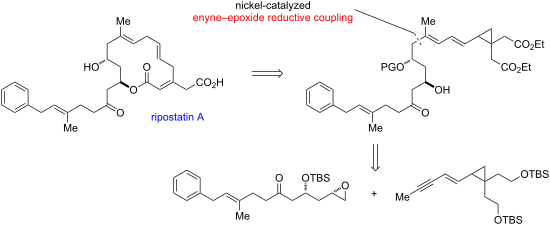
- a β-ketoester. Retrosynthesis utilizing Rychnovsky’s cyanohydrin acetonide methodology. Nickel-catalyzed reductive coupling of alkynes and epoxides. Potential transition states and stereochemical outcomes for a concerted 1,5-hydrogen rearrangement. Rearrangements of vinylcyclopropanes to acylic 1,4


Thiourea-catalyzed Diels–Alder reaction of a naphthoquinone monoketal dienophile
Beilstein J. Org. Chem. 2013, 9, 1414–1418, doi:10.3762/bjoc.9.158
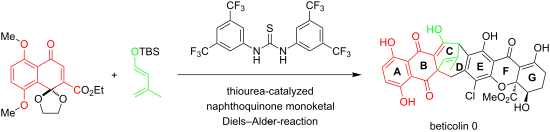
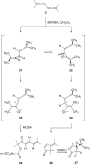
- , 402.1 358.1, 357.1; HRMS–EI (m/z): [M]+ calcd for C28H40O8Si, 532.2491; found, 532.2493. Proposed favored and disfavored transition states during the thiourea catalyzed Diels–Alder reaction of dienophile 2 and diene 3. R = 3,5-bis(trifluoromethyl)phenyl. Retrosynthetic dissection of the ABC-ring system


True and masked three-coordinate T-shaped platinum(II) intermediates
Beilstein J. Org. Chem. 2013, 9, 1352–1382, doi:10.3762/bjoc.9.153
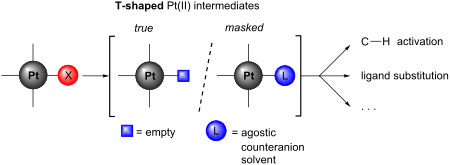
- bending energy profile maintains the same basic features: the T-shaped configurations of the 14-electron species are energy minima, and their cis-like to trans-like interconversion occurs via transition states with Y-shaped configurations [2]. The X-ray structure of the recently reported three-coordinate
- cyclometalated T-shaped structure 27 is obtained, once again stabilized by an agostic interaction. The corresponding transition states for OA and RE processes are isoenergetic with respect to 25. Finally, the agostic coordination mode in 27 is displaced by a DMSO molecule forming the cyclometalated product 28





Host–guest complexes of mixed glycol-bipyridine cryptands: prediction of ion selectivity by quantum chemical calculations, part V
Beilstein J. Org. Chem. 2013, 9, 1252–1268, doi:10.3762/bjoc.9.142
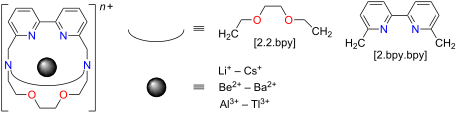
- .bpy]3+ are transition states for the movement of the metal ion inside the cavity of [2.2.bpy], as shown in Figure 5. This motion leads from one glycol molecular bar to the other, bringing the cation closer to the O donor atoms, hence supporting the coordination. The barrier for this movement lies at


![[Graphic 2]](/bjoc/content/inline/1860-5397-9-142-i3.png?max-width=637&scale=0.295455) 2.2.bpy]+.
2.2.bpy]+.


Tandem dinucleophilic cyclization of cyclohexane-1,3-diones with pyridinium salts
Beilstein J. Org. Chem. 2013, 9, 1119–1126, doi:10.3762/bjoc.9.124
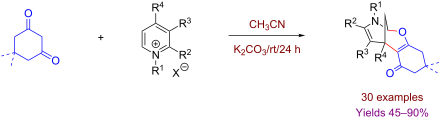
- ). Frequency calculations were performed on all optimized geometries to ensure only positive eigenvalues for minima and one imaginary frequency for transition states. Free energies at 298.15 K and 1 bar pressure were calculated according to the recommendation of Gaussian, Inc. [57][58], and the frequency




Interplay of ortho- with spiro-cyclisation during iminyl radical closures onto arenes and heteroarenes
Beilstein J. Org. Chem. 2013, 9, 1083–1092, doi:10.3762/bjoc.9.120
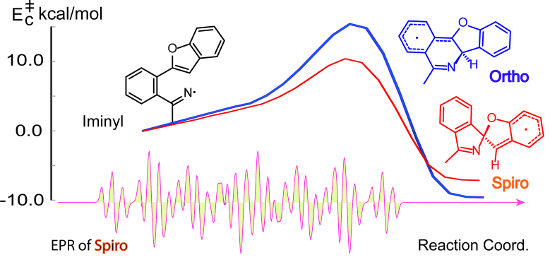
- was in good accordance with the observed exclusive formation of phenanthridines derived from radicals 5a–f for these compounds. The possibility of the rearrangement of spiro- to ortho-species via aziridinyl intermediates (or transition states) (az) which contain benzyl stabilization was examined
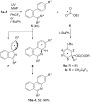
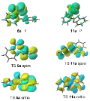
- the ortho mode whereas the benzofuranyl- and benzothiophenyl-iminyls 11 prefer the spiro mode can be obtained by consideration of the structures of the transition states (TS, Figure 4). The top line shows the computed spin density (ρ) maps for the reactant iminyls. In agreement with the EPR spectra
- saddle points by frequency calculations. The experimental kinetic and spectroscopic data was all obtained in the nonpolar hydrocarbon solvents t-BuPh or cyclopropane. Solvent effects, particularly differences in solvation between the neutral reactants and neutral transition states, were therefore




An aniline dication-like transition state in the Bamberger rearrangement
Beilstein J. Org. Chem. 2013, 9, 1073–1082, doi:10.3762/bjoc.9.119
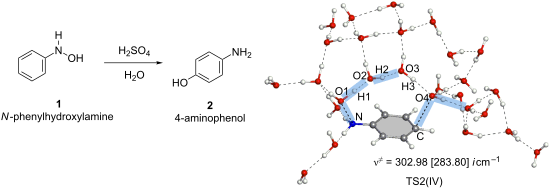
- –N(OH)H + H3O+(H2O)n (n = 4 and 14) was examined. However, the rate-determining transition states involving proton transfers were calculated to have much larger activation energies than the experimental one. Second, a reaction of the diprotonated system, Ph–N(OH)H + (H3O+)2(H2O)13, was traced. An
- activation energy similar to the experimental one was obtained. A new mechanism of the rearrangement including the aniline dication-like transition state was proposed. Keywords: Bamberger rearrangement; DFT calculations; N-phenylhydroxylamine; proton transfer; reactive intermediates; transition states
- the Cl-containing model, 6-31(+)G(d) was used where the diffuse sp function is only the chlorine atom. Transition states (TSs) were sought first by partial optimizations at bond-interchange regions. Second, by the use of Hessian matrices, TS geometries were optimized. They were characterized by


Methylidynetrisphosphonates: Promising C1 building block for the design of phosphate mimetics
Beilstein J. Org. Chem. 2013, 9, 991–1001, doi:10.3762/bjoc.9.114
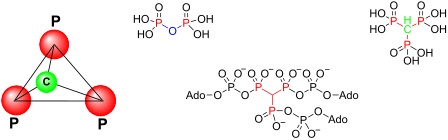
- blocks in the synthesis of the nucleotide analogues with enhanced affinity for receptors and better charge correlation with transition states for selected kinases. Two synthetically useful approaches to the parent trisphosphonic acid HC(PO3H2)3 have been developed. One of the procedures is based on the



Gold-catalyzed oxycyclization of allenic carbamates: expeditious synthesis of 1,3-oxazin-2-ones
Beilstein J. Org. Chem. 2013, 9, 818–826, doi:10.3762/bjoc.9.93
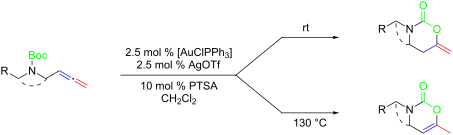
- ). Finally, the protonolysis reaction of the carbon–gold bond by TfOH renders the final products 3M and 4M regenerating the catalyst. This step occurs through the transition states TS2-A and TS2-B, respectively, in an exergonic transformation (ΔGR,298 = −4.5 and −3.0 kcal/mol from INT3-A and INT3-B

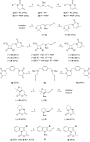


Utilizing the σ-complex stability for quantifying reactivity in nucleophilic substitution of aromatic fluorides
Beilstein J. Org. Chem. 2013, 9, 791–799, doi:10.3762/bjoc.9.90
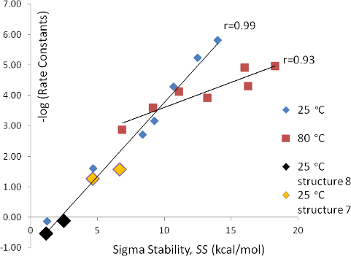
- transition states in chemical reactions, especially for predictive catalysis. It is particularly suitable for stereoselectivity calculations where there is a need to virtually screen large ligand libraries [1]. Another example are the so-called QM/MM methods [2], where part of the structure is treated with
- function of SS in methanol for series C. Optimized geometries, relative energies, and imaginary frequencies for the transition states and the σ-complex (middle structure) formed in the reaction between ammonia and 4. The top and bottom rows show the results from optimizations at the B3LYP/6-31+G(d,p) and


Ring opening of 2-aza-3-borabicyclo[2.2.0]hex-5-ene, the Dewar form of 1,2-dihydro-1,2-azaborine: stepwise versus concerted mechanisms
Beilstein J. Org. Chem. 2013, 9, 761–766, doi:10.3762/bjoc.9.86
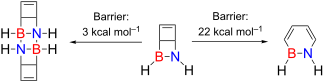
- have performed explorative computations using the CASSCF(6,6)/6-31G* method and could locate transition states for the conrotatory (TS1; nimag = 1, i556 cm−1) and disrotatory (TS2; nimag = 1, i628 cm−1) ring opening of 3. Computation of the intrinsic reaction coordinates confirms that both TS1 and TS2
- connect the Dewar form 3 to 1,2-dihydro-1,2-azaborine. These transition states are similar in geometry to those described earlier for the all-carbon system (see Figure 1 and Figure 2) [14]. The C1–C4 distance is shorter in TS1 (2.247 Å) than it is in TS2 (2.313 Å). The BN unit is a bystander in these two
- mechanisms as it is not involved in the ring-opening process. The energies of these transition states were refined with multireference perturbation theory (MRMP2). In agreement with the results obtained for the all-carbon system [14], the barrier for the orbital-symmetry-allowed conrotatory ring opening is


Asymmetric synthesis of a highly functionalized bicyclo[3.2.2]nonene derivative
Beilstein J. Org. Chem. 2013, 9, 655–663, doi:10.3762/bjoc.9.74
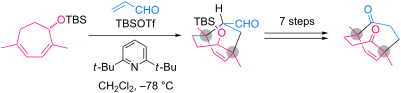
- two quaternary carbons (C1 and 5) and the C12-stereocenter. The selective formation of 8 out of eight possible isomers is rationalized in Scheme 4. The endo-type transition states would be favored over their exo-type counterparts, and acrolein would approach from the bottom face of 7 to avoid steric
- interactions with the axially oriented C2- and C4-hydrogen atoms on the top face [27]. These considerations eliminate six out of the eight stereoisomeric transition states, and leave only TS-A and TS-B, which in fact correspond to the generated adducts 8 and 20, respectively. TS-A would be preferred over TS-B


Enantioselective reduction of ketoimines promoted by easily available (S)-proline derivatives
Beilstein J. Org. Chem. 2013, 9, 633–640, doi:10.3762/bjoc.9.71
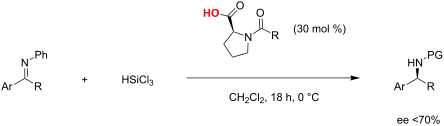
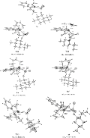
- , and the two lowest energy transition states (TS) leading to the formation of R and S amine were located. In order to simplify the problem, we adopted a stepwise procedure for the location of the TS structures. First of all, a conformational analysis with Monte Carlo techniques was performed with MMFF
- this work. Catalysts synthesized and studied in this work. Calculated transition states for catalyst 6. Stereoselective reduction of ketones. Enantioselective reduction with catalyst 1.a Enantioselective reduction of the N-phenyl imine of acetophenone.a Enantioselective reduction of differently


A computational study of base-catalyzed reactions of cyclic 1,2-diones: cyclobutane-1,2-dione
Beilstein J. Org. Chem. 2013, 9, 594–601, doi:10.3762/bjoc.9.64
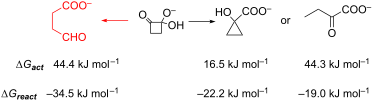
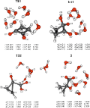
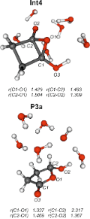
- and Discussion The various transition states, intermediates and products initially considered for the three reaction paths A, B, and C are depicted in Scheme 3. It turned out that not all of the structures shown in Scheme 3 could actually be located as stationary points on the potential-energy surface
- . On the other hand, some other stable as well as highly reactive intermediates and/or transition states were obtained (see below). Generally, in nucleophilic addition reactions to carbonyl compounds in aqueous solution, water not only acts as a solvent but frequently actively participates in the
- transition states, intermediates and products shown in Scheme 3, hydration by six water molecules is implied. Relative Gibbs free energies with respect to the separated reactants 1·(H2O)2 + [OH(H2O)4]– including bulk aqueous solvation energies (SMD solvation model [21]) obtained by various computational





Complete σ* intramolecular aromatic hydroxylation mechanism through O2 activation by a Schiff base macrocyclic dicopper(I) complex
Beilstein J. Org. Chem. 2013, 9, 585–593, doi:10.3762/bjoc.9.63
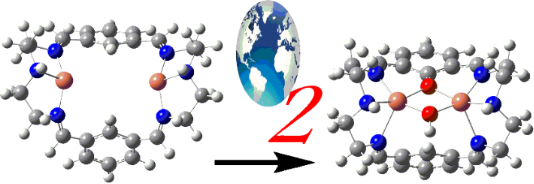
- B3LYP/6-31G(d) level were used to perform single-point energy calculations with a larger basis set, the 6-311G(d,p) basis set [63], and the same functional (B3LYP/6-311G(d,p)//B3LYP/6-31G(d)). Intrinsic reaction pathways were calculated to confirm that the located transition states connected the


A new intermediate in the Prins reaction
Beilstein J. Org. Chem. 2013, 9, 476–485, doi:10.3762/bjoc.9.51
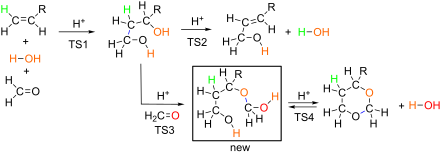
- dispersion correction method (ωB97XD [29]) were applied to the rate-determining step of the propene reaction TS1(Me). The basis sets employed were 6-31G(d) and 6-311+G(d,p). Transition states (TSs) were sought first by partial optimizations at bond interchange regions. Second, by the use of Hessian matrices
- Information File 1). These were found to be similar to diol(Me), ene-ol(Me), ether(Me) and dioxane(Me) in Figure S1, respectively. Thus, those TSs were confirmed to be in the reaction channel. Figure 2 exhibits geometry-dependent energy changes for the transition states depicted in Figure 1 and Figure S1. TS1
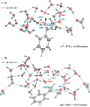
- -diol or to the carbocation X. While the intervention is suggested to depend on the concentration of water, in aqueous media the cation is unlikely owing to the high nucleophilicity of the large water cluster. Geometries of the precursor and the transition states (TSs) of the Prins reaction of propene





Electron and hydrogen self-exchange of free radicals of sterically hindered tertiary aliphatic amines investigated by photo-CIDNP
Beilstein J. Org. Chem. 2013, 9, 437–446, doi:10.3762/bjoc.9.46
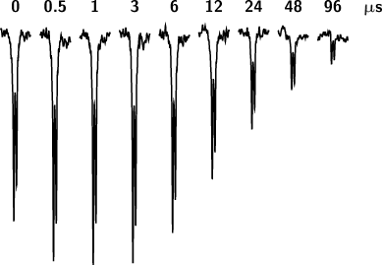
- reversibility of that deprotonation can be discounted. Sterically, that deprotonation is much more demanding than the hydrogen self-exchange, as Newman projections of the expected transition states show. With both reactions, there are four gauche interactions between methyl and a large group (iPr or N(iPr)2


Asymmetric Diels–Alder reaction with >C=P– functionality of the 2-phosphaindolizine-η1-P-aluminium(O-menthoxy) dichloride complex: experimental and theoretical results
Beilstein J. Org. Chem. 2013, 9, 392–400, doi:10.3762/bjoc.9.40
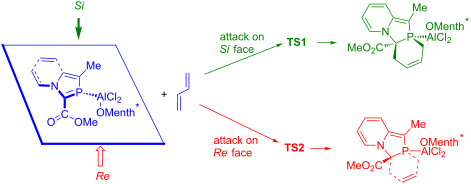
- computational calculations using the hybrid functional of Becke [46] and Lee, Yang and Parr [47]. Geometry optimizations of the reactants, the transition states and the cycloadducts were performed at the B3LYP/6-31+G* level. Stationary points were analysed by frequency calculations at the same level to confirm


Presence or absence of a novel charge-transfer complex in the base-catalyzed hydrolysis of N-ethylbenzamide or ethyl benzoate
Beilstein J. Org. Chem. 2013, 9, 185–196, doi:10.3762/bjoc.9.22
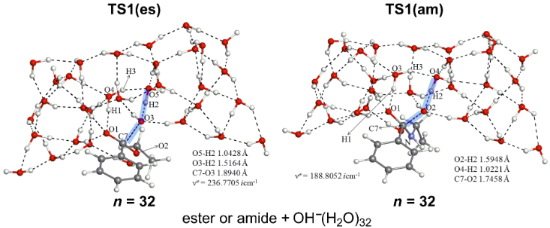
- minimal model of TS1 was proposed and was found to be insensitive to n. Keywords: basic hydrolyses; DFT calculations; ethyl benzoate; N-ethylbenzamide; reactive intermediates; transition states; Introduction Basic hydrolyses of esters and amides have been extensively studied experimentally [1]. Use of
- adopted method or not in relation to the former part of point 3. Transition states (TSs) were sought first by partial optimizations at bond-interchange regions. Second, by the use of Hessian matrices, TS geometries were optimized. They were characterized by vibrational analyses, which checked whether the




Metal-mediated aminocatalysis provides mild conditions: Enantioselective Michael addition mediated by primary amino catalysts and alkali-metal ions
Beilstein J. Org. Chem. 2013, 9, 155–165, doi:10.3762/bjoc.9.18
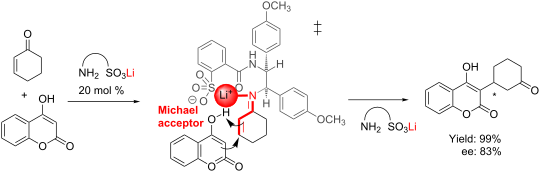
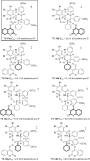
- enantioselectivity, DFT calculations on the enantio-determining transition states were performed by employing the nonempirical TPSS-functional and BP86. Two possible pathways were found computationally (pathway A, B, Scheme 4). The first essential step in the catalytic process is the formation of the imine
- . The addition of 4-hydroxycoumarin to the activated Michael system 12 could now occur along two slightly different mechanistic pathways (A, B, Scheme 4) including the enantio-determining transition states corresponding to TS-13 or TS-14. Both pathways require the formation of a carbon–carbon bond and
- )-enantiomer of 17 should be generated in majority. The experimentally favored enantiomer is indeed (R)-configured with 83% ee (Table 2, entry 7). This value is in good agreement with an energetic differentiation of the enantio-determining transition states of 2.3 kcal/mol although no solvent dependent effects



Polar reactions of acyclic conjugated bisallenes
Beilstein J. Org. Chem. 2013, 9, 36–48, doi:10.3762/bjoc.9.5
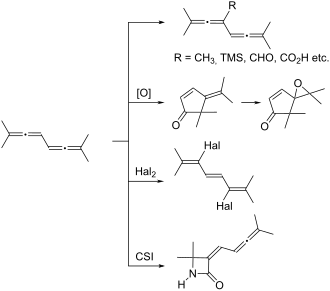
- involving polar intermediates and/or transition states has been investigated on a broad scale for the first time. The reactions studied include lithiation, reaction of the thus formed organolithium salts with various electrophiles (among others, allyl bromide, DMF and acetone), oxidation to cyclopentenones