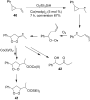
Search for "Negishi cross-coupling" in Full Text gives 29 result(s) in Beilstein Journal of Organic Chemistry.
Beilstein J. Org. Chem. 2025, 21, 2657–2693, doi:10.3762/bjoc.21.206
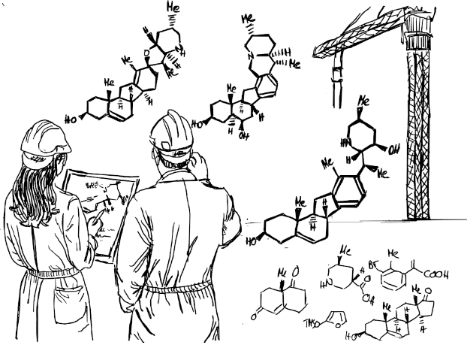
Graphical Abstract
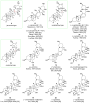
Scheme 1: Representatives of steroid alkaloid classes. Marked in blue is the steroidal cholestane framework, ...
Scheme 2: Subclasses of Veratrum alkaloids: jervanine, veratramine and cevanine-type [8].
Scheme 3: Flow chart presentation of the synthesis of (−)-englerin A developed by the Christmann group [10].
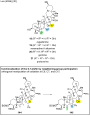
Scheme 4: Structures and year of synthesis of the three types of Veratrum alkaloids reported in the literatur...
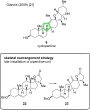
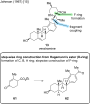
Scheme 5: Key step in the synthesis of cyclopamine (6) by the Giannis group [21].
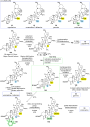
Scheme 6: Overview of the semisynthesis of cyclopamine (6) reported by the Giannis group in 2009 [21].
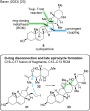
Scheme 7: Key steps in the synthesis of cyclopamine (6) by the Baran group [23].
Scheme 8: Overview of the total synthesis of cyclopamine (6) by the Baran group in 2023 [23].
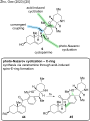
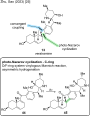
Scheme 9: Key steps in the synthesis of cyclopamine (6) by the Zhu/Gao group [25].
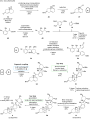
Scheme 10: Overview of the total synthesis of cyclopamine (6) by the group of Zhao/Gao in 2023 [25].
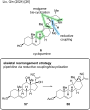
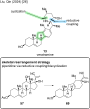
Scheme 11: Key steps in the synthesis of cyclopamine (6) by the Liu/Qin group [26].
Scheme 12: Overview of the semisynthesis of cyclopamine (6) by the Liu/Qin group in 2024 [26].
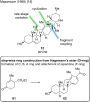
Scheme 13: Key steps in the synthesis of jervine (12) by the Masamune group [14].
Scheme 14: Overview of the total synthesis of jervine (12) by the Masamune group in 1968 [14].
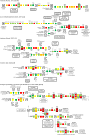
Scheme 15: Color-coded schemes of the presented cyclopamine (6) syntheses by Giannis, Baran, Zhu/Gao, and Liu/...
Scheme 16: Key steps in the total synthesis of veratramine (13) by the Johnson group [15].
Scheme 17: Overview of the total synthesis of veratramine (13) by the Johnson group in 1967 [15].
Scheme 18: Key steps in the synthesis of veratramine (13) by the Zhu/Gao group [25].
Scheme 19: Shortened overview of the total synthesis of veratramine (13) by the Zhu/Gao group in 2023 [25].
Scheme 20: Key steps in the synthesis of veratramine by the Liu/Qin group [26].
Scheme 21: Overview of the semisynthesis of veratramine (13) by the Liu/Qin group in 2024 [26].
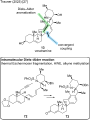
Scheme 22: Key steps in the synthesis of veratramine (13) by the Trauner group [27].
Scheme 23: Overview of the total synthesis of veratramine (13) by the Trauner group in 2025 [27].
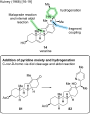
Scheme 24: Key steps in the synthesis of verarine (14) by the Kutney group [16-19].
Scheme 25: Overview of the total synthesis of verarine (14) by the Kutney group reported 1962–1968 [16-19].
Scheme 26: Color-coded schemes of the presented veratramine-type alkaloid synthesis of Zhu/Gao, Liu/Qin and Tr...
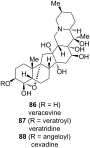
Scheme 27: Structures of veracevine (86), veratridine (87), and cevadine (88).
Scheme 28: Key step in the semisynthesis of verticine (15) by the Kutney group (1977) [20,46].
Scheme 29: Overview of the semisynthesis of verticine (15) by the Kutney group (1977) [20,46].
Scheme 30: Key step of the total synthesis of (±)-4-methylenegermine (17) by the Stork group (2017) [22].
Scheme 31: Overview of the total synthesis of (±)-4-methylenegermine (17) by the Stork group (2017) [22].
Scheme 32: Key step of the total synthesis of heilonine (16) by Cassaidy and Rawal (2021) [24].
Scheme 33: Overview of the total synthesis of heilonine (16) by Cassaidy and Rawal (2021) [24]. FGI: functional gr...
Scheme 34: Key steps of the synthesis of heilonine (16) by Dai and co-workers (2024) [28].
Scheme 35: Overview of the total synthesis of heilonine (16) by Dai and co-workers (2024) [28].
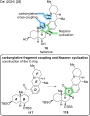
Scheme 36: Key steps of the total synthesis of zygadenine (18) reported by Luo and co-workers [29].
Scheme 37: Overview of the total synthesis of zygadenine (18) by Luo and co-workers (2023) [29].
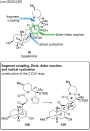
Scheme 38: Key step of the divergent total syntheses of highly oxidized cevanine-type alkaloids by Luo and co-...
Scheme 39: Divergent syntheses of highly oxidized cevanine-type alkaloids by Luo and co-workers (2024) [30].
Scheme 40: Color-coded overview of the presented cevanine-type alkaloid syntheses [10,20,22,24,28-30,46]. LLS: longest linear sequen...
Beilstein J. Org. Chem. 2024, 20, 1922–1932, doi:10.3762/bjoc.20.168
Graphical Abstract
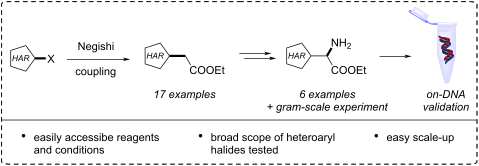
Scheme 1: Known and improved synthetic strategies to access α-(hetero)aryl-amino acids.
Scheme 2: Reformatsky reagent production.
Scheme 3: Scope of ethyl heteroarylacetates. Isolated yields are given. *Dark reactions were carried out for ...
Scheme 4: Telescoped flow synthesis of heteroarylacetates.
Scheme 5: Potential routes for the preparation of oximes.
Scheme 6: Oxime group insertion step.
Scheme 7: Amino ester production: general scheme, scope and gram scale experiment. The numbers in brackets re...
Scheme 8: Reactions scheme and results for the on-DNA experiments. The reported values represent the normaliz...
Beilstein J. Org. Chem. 2024, 20, 32–40, doi:10.3762/bjoc.20.5
Graphical Abstract
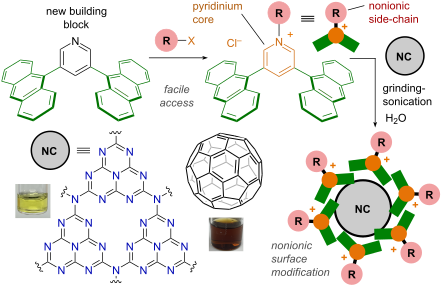
Figure 1: a) Previous methods for the water-solubilization and modification of nanocarbons (NCs). b) Bent aro...
Figure 2: a) Synthetic route toward prePA and PA-CH3, including the optimized structure (DFT) of PA-CH3. b) S...
Figure 3: 1H NMR spectra (500 MHz, rt, 0.5 mM and 1.0 mM based on PA-CH3 and PA-OCH3, respectively, TMS in CD...
Figure 4: a) General protocol for the noncovalent encircling of C60 and s-CNT by PA-R. b) UV–visible spectra ...
Figure 5: 1H NMR spectra (500 MHz, D2O, rt, 0.5 mM based on PA-Im) of (PA-Im)n·(C60)m a) before and b) after ...
Figure 6: a) Protocol for the noncovalent encircling of g-C3N4 by PA-OCH3 and subsequent deposit of g-C3N4 on...
Beilstein J. Org. Chem. 2023, 19, 1895–1911, doi:10.3762/bjoc.19.141
Graphical Abstract
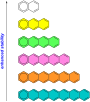
Figure 1: The correlation between stability and Clar's rule in acenes.
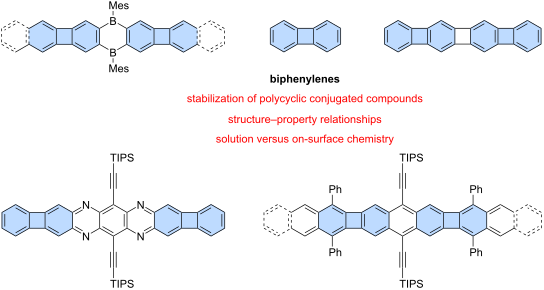
Scheme 1: General synthetic strategies to access the biphenylene core 1.
Figure 2: [N]Phenylenes 7–12 with different topologies.
Scheme 2: Synthesis of POAs 15a and 15b via reactions of BBD 13 and bis(cyanomethyl) compounds 14a and 14b.
Scheme 3: Synthesis of benzo[b]biphenylene (18).
Scheme 4: Synthesis of benzobiphenylene 18 and POA 21.
Scheme 5: Synthesis of symmetric POAs 25a and 25b.
Scheme 6: Synthesis of POA 29 via palladium-catalyzed annulation/aromatization reaction.
Scheme 7: Synthesis of bisphenylene-containing structures 34a–c.
Scheme 8: Synthesis of curved PAH 38 via Pd-catalyzed annulation and Ir-catalyzed cycloaddition reactions.
Scheme 9: Synthesis of [3]naphthylenes.
Scheme 10: Sequential Pd-catalyzed annulation reactions.
Scheme 11: Synthesis of biphenylene-containing unsymmetrical azaacenes 54a–c.
Scheme 12: Synthesis of biphenylene containing symmetrical azaacenes 58a,b.
Scheme 13: Synthesis of azaacene analogues 62–64.
Scheme 14: Synthesis of POA-type structure 69.
Scheme 15: Synthesis of boron-doped POA 73.
Scheme 16: Synthesis of “v”- and “z”-shaped B-POAs 77 and 78.
Scheme 17: Synthesis of boron-doped extended POA 84.
Scheme 18: Ag(111) surface-catalyzed synthesis of POA 87.
Scheme 19: Au(100) and Au(111) surface-catalyzed synthesis of POA 91.
Scheme 20: Au(111) on-surface synthesis of POA 87.
Beilstein J. Org. Chem. 2023, 19, 158–166, doi:10.3762/bjoc.19.15
Scheme 1: Structure of the (8E,10Z)-tetradecadienal (1, sex pheromone of the horse-chestnut leaf miner) and r...
Scheme 2: a) Alkyl–vinyl seminal cross-coupling reaction by Kochi; b) improved procedure described by Cahiez.
Scheme 3: Iron-catalyzed cross-coupling of n-OctMgCl with a 1-butadienyl phosphate.
Scheme 4: Synthesis of several insect sex pheromones (a) red bollworm moth, b) European grapevine moth, c) ho...
Scheme 5: Cross-coupling of alkyl Grignard reagents with a) alkenyl or b) aryl halides involving EtOMgCl as a...
Scheme 6: Total synthesis of codling moth sex pheromone 4 using an iron-mediated cross-coupling between an α,...
Beilstein J. Org. Chem. 2020, 16, 1924–1935, doi:10.3762/bjoc.16.159
Graphical Abstract
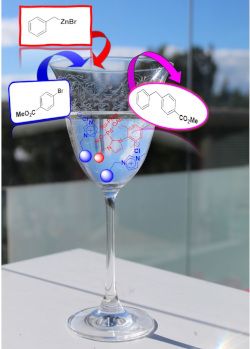
Scheme 1: Synthesis of NHC-supported catalysts.
Scheme 2: Negishi benchmark reaction.
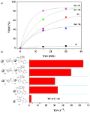
Figure 1: Negishi reaction catalyzed by immobilized NHC–Pd complexes. Conditions: methyl 4-bromobenzoate (0.2...
Scheme 3: Synthesis of immobilized NHC–Pd–RuPhos.
Figure 2: Negishi model reaction between 5 and 6 under flow conditions catalyzed by 4b. V = 0.535 mL, 363 mg ...
Figure 3: Negishi model reaction under flow conditions catalyzed by 8a. V = 2.9 mL, 1.25 g of catalyst, resid...
Figure 4: Negishi reaction between 5 and 6 catalyzed by 8a in the presence of SILLPs. a) Yield (%) vs time fo...
Figure 5: TEM images of the polymers after the Negishi reaction between 5 and 6. a) 8a, bar scale 20 nm, PdNP...
Scheme 4: Pd species immobilized onto SILLPs. i) 1 g SILLP 10, 100 mg PdCl2 in milli-Q® water (100 mL 1% HCl,...
Figure 6: Negishi reaction between 5 and 6 catalyzed by 11. 1 equiv methyl 4-bromobenzoate (6, 0.25 mmol), 2 ...
Figure 7: Negishi reaction between 5 and 6 under flow conditions catalyzed by 8a in the presence of a scaveng...
Figure 8: Effect of the structure of the SILLP scavenger for the Negishi reaction between 5 and 6 under flow ...
Figure 9: TEM images of the polymer after the Negishi reaction between 5 and 6 under flow conditions. a) 8a + ...
Beilstein J. Org. Chem. 2020, 16, 1343–1356, doi:10.3762/bjoc.16.115
Graphical Abstract
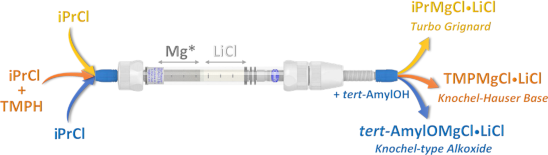
Figure 1: Comparing on-demand coffee and turbo Grignard pod-style machines.
Figure 2: Ranking of the 20 most cited Grignard reagents (SciFinder March 26, 2019).
Figure 3: On-demand prototype. A) Inside view of the pump with a flexible bag containing a yellow liquid layi...
Figure 4: Temperature evolution measured with thermocouples along the column outer surface at three different...
Figure 5: Stratified bicomponent column (Diba Omnifit EZ Solvent Plus) composed of magnesium (chips/powder, 1...
Scheme 1: Continuous flow synthesis of TMPMgCl⋅LiCl with a stratified packed-bed column of activated magnesiu...
Scheme 2: Continuous flow synthesis of TMPMgCl⋅LiBr with a stratified packed-bed column of activated magnesiu...
Scheme 3: Continuous flow synthesis of t-AmylOMgCl⋅LiCl with a stratified packed-bed column of activated magn...
Figure 6: Steady-state concentration stability during the conversion of iPrCl in THF (56 mL, 2.2 M) into iPrM...
Scheme 4: Synthesis of iPrMgCl⋅LiCl on the ODR prototype.
Scheme 5: Synthesis of HMDSMgCl⋅LiCl on the ODR prototype.
Beilstein J. Org. Chem. 2020, 16, 1022–1050, doi:10.3762/bjoc.16.91
Graphical Abstract
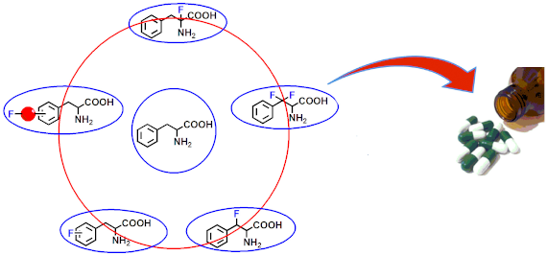
Figure 1: Categories I–V of fluorinated phenylalanines.
Scheme 1: Synthesis of fluorinated phenylalanines via Jackson’s method.
Scheme 2: Synthesis of all-cis-tetrafluorocyclohexylphenylalanines.
Scheme 3: Synthesis of ʟ-4-[sulfono(difluoromethyl)]phenylalanine (nPt: neopentyl, TCE: trichloroethyl).
Scheme 4: Synthesis of ʟ-4-[sulfono(difluoromethyl)]phenylalanine derivatives 17.
Scheme 5: Synthesis of fluorinated Phe analogues from Cbz-protected aminomalonates.
Scheme 6: Synthesis of tetrafluorophenylalanine analogues via the 3-methyl-4-imidazolidinone auxiliary 25.
Scheme 7: Synthesis of tetrafluoro-Phe derivatives via chiral auxiliary 31.
Scheme 8: Synthesis of 2,5-difluoro-Phe and 2,4,5-trifluoro-Phe via Schöllkopf reagent 34.
Scheme 9: Synthesis of 2-fluoro- and 2,6-difluoro Fmoc-Phe derivatives starting from chiral auxiliary 39.
Scheme 10: Synthesis of 2-[18F]FPhe via chiral auxiliary 43.
Scheme 11: Synthesis of FPhe 49a via photooxidative cyanation.
Scheme 12: Synthesis of FPhe derivatives via Erlenmeyer azalactone synthesis.
Scheme 13: Synthesis of (R)- and (S)-2,5-difluoro Phe via the azalactone method.
Scheme 14: Synthesis of 3-bromo-4-fluoro-(S)-Phe (65).
Scheme 15: Synthesis of [18F]FPhe via radiofluorination of phenylalanine with [18F]F2 or [18F]AcOF.
Scheme 16: Synthesis of 4-borono-2-[18F]FPhe.
Scheme 17: Synthesis of protected 4-[18F]FPhe via arylstannane derivatives.
Scheme 18: Synthesis of FPhe derivatives via intermediate imine formation.
Scheme 19: Synthesis of FPhe derivatives via Knoevenagel condensation.
Scheme 20: Synthesis of FPhe derivatives 88a,b from aspartic acid derivatives.
Scheme 21: Synthesis of 2-(2-fluoroethyl)phenylalanine derivatives 93 and 95.
Scheme 22: Synthesis of FPhe derivatives via Zn2+ complexes.
Scheme 23: Synthesis of FPhe derivatives via Ni2+ complexes.
Scheme 24: Synthesis of 3,4,5-trifluorophenylalanine hydrochloride (109).
Scheme 25: Synthesis of FPhe derivatives via phenylalanine aminomutase (PAM).
Scheme 26: Synthesis of (R)-2,5-difluorophenylalanine 115.
Scheme 27: Synthesis of β-fluorophenylalanine via 2-amino-1,3-diol derivatives.
Scheme 28: Synthesis of β-fluorophenylalanine derivatives via the oxazolidinone chiral auxiliary 122.
Scheme 29: Synthesis of β-fluorophenylalanine from pyruvate hemiketal 130.
Scheme 30: Synthesis of β-fluorophenylalanine (136) via fluorination of β-hydroxyphenylalanine (137).
Scheme 31: Synthesis of β-fluorophenylalanine from aziridine derivatives.
Scheme 32: Synthesis of β-fluorophenylalanine 136 via direct fluorination of pyruvate esters.
Scheme 33: Synthesis of β-fluorophenylalanine via fluorination of ethyl 3-phenylpyruvate enol using DAST.
Scheme 34: Synthesis of β-fluorophenylalanine derivatives using photosensitizer TCB.
Scheme 35: Synthesis of β-fluorophenylalanine derivatives using Selectflour and dibenzosuberenone.
Scheme 36: Synthesis of protected β-fluorophenylalanine via aziridinium intermediate 150.
Scheme 37: Synthesis of β-fluorophenylalanine derivatives via fluorination of α-hydroxy-β-aminophenylalanine d...
Scheme 38: Synthesis of β-fluorophenylalanine derivatives from α- or β-hydroxy esters 152a and 155.
Scheme 39: Synthesis of a series of β-fluoro-Phe derivatives via Pd-catalyzed direct fluorination of β-methyle...
Scheme 40: Synthesis of series of β-fluorinated Phe derivatives using quinoline-based ligand 162 in the Pd-cat...
Scheme 41: Synthesis of β,β-difluorophenylalanine derivatives from 2,2-difluoroacetaldehyde derivatives 164a,b....
Scheme 42: Synthesis of β,β-difluorophenylalanine derivatives via an imine chiral auxiliary.
Scheme 43: Synthesis of α-fluorophenylalanine derivatives via direct fluorination of protected Phe 174.
Figure 2: Structures of PET radiotracers of 18FPhe derivatives.
Figure 3: Structures of melfufen (179) and melphalan (180) anticancer drugs.
Figure 4: Structure of gastrazole (JB95008, 181), a CCK2 receptor antagonist.
Figure 5: Dual CCK1/CCK2 antagonist 182.
Figure 6: Structure of sitagliptin (183), an antidiabetic drug.
Figure 7: Structure of retaglpitin (184) and antidiabetic drug.
Figure 8: Structure of evogliptin (185), an antidiabetic drug.
Figure 9: Structure of LY2497282 (186) a DPP-4 inhibitor for the treatment of type II diabetes.
Figure 10: Structure of ulimorelin (187).
Figure 11: Structure of GLP1R (188).
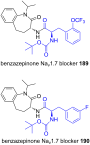
Figure 12: Structures of Nav1.7 blockers 189 and 190.
Beilstein J. Org. Chem. 2020, 16, 190–199, doi:10.3762/bjoc.16.22
Graphical Abstract
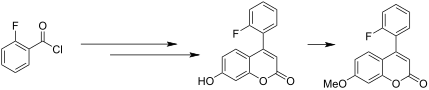
Scheme 1: Synthesis of 4-(2-fluorophenyl)-7-methoxycoumarin (6).
Figure 1: 1H NMR spectra for the “aromatic” region of coumarin 6; comparison of 1H spectrum and 1H-{19F} spec...
Figure 2: 13C NMR spectra for coumarin 5 and 6; showing the splitting of the signal corresponding to C5.
Figure 3: 19F,1H-HOESY NMR spectrum for coumarin 6 illustrating two through-space interactions.
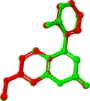
Figure 4: Superposition of single-crystal X-ray structure (red) and DFT-optimized structure (green); RMSD 0.3...
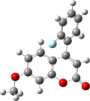
Figure 5: DFT-optimized structure for coumarin (6).
Figure 6: Plots of relative energy (black trace, no units), interatomic distance F–H5 (red trace, Å), interat...
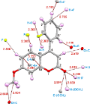
Figure 7: Short contacts within the single-crystal X-ray structure of coumarin 6.
Beilstein J. Org. Chem. 2019, 15, 2304–2310, doi:10.3762/bjoc.15.222
Graphical Abstract
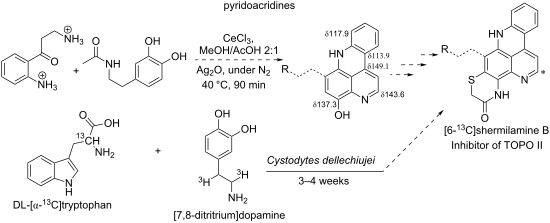
Figure 1: Marine pyridoacridine alkaloids amphimedine (1), ascididemin (2), kuanoniamine A (3), styelsamine D...
Figure 2: A–C): Published methods for the synthesis of 4,5-disubstituted benzo[c][2,7]naphthyridines; D) New ...
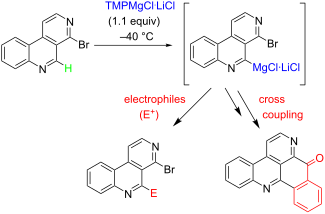
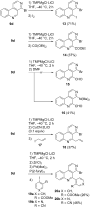
Scheme 1: Regioselective metalation of 4-bromobenzo[c][2,7]naphthyridine (9d) and subsequent conversion into ...
Scheme 2: Outcome of a D2O quenching experiment after metalation of 4-bromobenzo[c][2,7]naphthyridine (9d).
Scheme 3: Synthesis of 5-substituted 4-bromobenzo[c][2,7]naphthyridines via regioselective metalation of 9d u...
Scheme 4: Attempted synthesis of kuanoniamine A (3).
Scheme 5: Synthesis of pyrido[4,3,2-mn]acridone 22 starting from 20a via bromine–magnesium exchange reaction ...
Beilstein J. Org. Chem. 2019, 15, 1416–1424, doi:10.3762/bjoc.15.141
Graphical Abstract
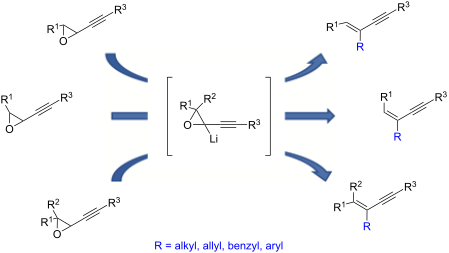
Scheme 1: Stereospecific formation of α-enynes from alkynyloxiranes.
Scheme 2: Trapping experiments of the oxiranyllithium derived from cis or trans-alkynyloxiranes 1b, and their...
Scheme 3: Proposed mechanism for the rearrangement of alkynyloxiranes to α-enynes through metalation and bory...
Beilstein J. Org. Chem. 2019, 15, 577–583, doi:10.3762/bjoc.15.53
Graphical Abstract
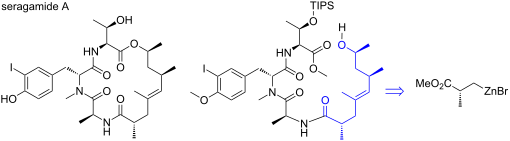
Scheme 1: Actin-binding cyclodepsipeptides, photo amino acids, retrosynthetic cuts of polyketide 7 leading to...
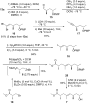
Scheme 2: Synthesis of γ-hydroxy esters 11 and 12, followed by Mitsunobu inversion.
Scheme 3: Synthesis of the polyketide section 7.
Scheme 4: Access to methylated D-iodotyrosine derivatives 22, 23, and 25.
Scheme 5: Synthesis of the doubly protected open chain peptide-polyketide 31.
Beilstein J. Org. Chem. 2019, 15, 371–377, doi:10.3762/bjoc.15.33
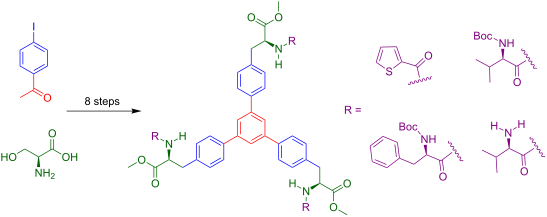
Graphical Abstract
Figure 1: Exemplar C3-symmetric peptide scaffolds reported in the literature.
Scheme 1: Preparation of compound 7 from L-serine (3).
Scheme 2: Preparation of the trimerized product 9.
Scheme 3: Synthesis of compound 11 via Negishi cross-coupling reaction.
Scheme 4: Synthesis of C3-symmetric trimers 12, 13 and 14.
Beilstein J. Org. Chem. 2017, 13, 1596–1660, doi:10.3762/bjoc.13.159
Graphical Abstract
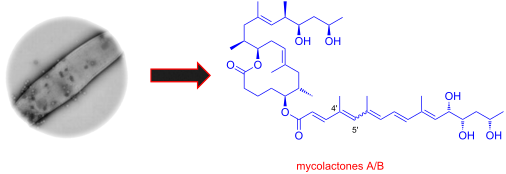
Figure 1: Initial proposal for the core macrolactone structure (left) and the established complete structure ...
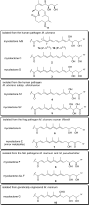
Figure 2: Mycolactone congeners and their origins.
Figure 3: Misassigned mycolactone E structure according to Small et al. [50] (11) and the correct structure (6) f...
Figure 4: Schematic illustration of Kishi’s improved mycolactone TLC detection method exploiting derivatizati...
Figure 5: Fluorescent probes derived from natural mycolactone A/B (1a,b) or its synthetic 8-desmethyl analogs...
Figure 6: Tool compounds used by Pluschke and co-workers for elucidating the molecular targets of mycolactone...
Figure 7: Synthetic strategies towards the extended mycolactone core. A) General strategies. B) Kishi’s appro...
Scheme 1: Kishi’s 1st generation approach towards the extended core structure of mycolactones. Reagents and c...
Scheme 2: Kishi’s 2nd generation approach towards the extended core structure of mycolactones. Reagents and c...
Scheme 3: Kishi’s 3rd generation approach towards the extended core structure of mycolactones. Reagents and c...
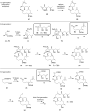
Scheme 4: Negishi’s synthesis of the extended core structure of mycolactones. Reagents and conditions: a) (i) ...
Scheme 5: Burkart’s (incomplete) 1st generation approach towards the extended core structure of mycolactones....
Scheme 6: Burkart’s (incomplete) 1st, 2nd and 3rd generation approach towards the extended mycolactone core s...
Scheme 7: Altmann’s synthesis of alkyl iodide 91. Reagents and conditions: a) (i) PMB-trichloroacetimidate, T...
Scheme 8: Final steps of Altmann’s synthesis of the extended core structure of mycolactones. Reagents and con...
Scheme 9: Basic principles of the Aggarwal lithiation–borylation homologation process [185,186].
Scheme 10: Aggarwal’s synthesis of the C1–C11 fragment of the mycolactone core. Reagents and conditions: a) Cl...
Scheme 11: Aggarwal’s synthesis of the linear C1–C20 fragment of the mycolactone core. Reagents and conditions...
Figure 8: Synthetic strategies towards the mycolactone A/B lower side chain.
Scheme 12: Gurjar and Cherian’s synthesis of the C1’–C8’ fragment of the mycolactone A/B pentaenoate side chai...
Scheme 13: Gurjar and Cherian’s synthesis of the benzyl-protected mycolactone A/B pentaenoate side chain. Reag...
Scheme 14: Kishi’s synthesis of model compounds for elucidating the stereochemistry of the C7’–C16’ fragment o...
Scheme 15: Kishi’s synthesis of the mycolactone A/B pentaenoate side chain. (a) (i) NaH, (EtO)2P(O)CH2CO2Et, T...
Scheme 16: Feringa and Minnaard's incomplete synthesis of mycolactone A/B pentaenoate side chain. Reagents and...
Scheme 17: Altmann’s approach towards the mycolactone A/B pentaenoate side chain. Reagents and conditions: a) ...
Scheme 18: Negishi’s access to the C1’–C7’ fragment of mycolactone A. Reagents and conditions: a) (i) n-BuLi, ...
Scheme 19: Negishi’s approach to the C1’–C7’ fragment of mycolactone B. Reagents and conditions: a) (i) DIBAL-...
Scheme 20: Negishi’s synthesis of the C8’–C16’ fragment of mycolactone A/B. Reagents and conditions: a) 142, BF...
Scheme 21: Negishi’s assembly of the mycolactone A and B pentaenoate side chains. Reagents and conditions: a) ...
Scheme 22: Blanchard’s approach to the mycolactone A/B pentaenoate side chain. a) (i) Ph3P=C(Me)COOEt, CH2Cl2,...
Scheme 23: Kishi’s approach to the mycolactone C pentaenoate side chain exemplified for the 13’R,15’S-isomer 1...
Scheme 24: Altmann’s (unpublished) synthesis of the mycolactone C pentaenoate side chain. Reagents and conditi...
Scheme 25: Blanchard’s synthesis of the mycolactone C pentaenoate side chain. Reagents and conditions: a) (i) ...
Scheme 26: Kishi’s synthesis of the tetraenoate side chain of mycolactone F exemplified by enantiomer 165. Rea...
Scheme 27: Kishi’s synthesis of the mycolactone E tetraenoate side chain. Reagents and conditions: a) (i) CH2=...
Scheme 28: Wang and Dai’s synthesis of the mycolactone E tetraenoate side chain. Reagents and conditions: a) (...
Scheme 29: Kishi’s synthesis of the dithiane-protected tetraenoate side chain of the minor oxo-metabolite of m...
Scheme 30: Kishi’s synthesis of the mycolactone S1 and S2 pentaenoate side chains. Reagents and conditions: a)...
Scheme 31: Kishi’s 1st generation and Altmann’s total synthesis of mycolactone A/B (1a,b) and Negishi’s select...
Scheme 32: Kishi’s 2nd generation total synthesis of mycolactone A/B (1a,b). Reagents and conditions: a) 2,4,6...
Scheme 33: Blanchard’s synthesis of the 8-desmethylmycolactone core. Reagents and conditions: a) (i) TsCl, TEA...
Scheme 34: Altmann’s (partially unpublished) synthesis of the C20-hydroxylated mycolactone core. Reagents and ...
Scheme 35: Altmann’s and Blanchard’s approaches towards the 11-isopropyl-8-desmethylmycolactone core. Reagents...
Scheme 36: Blanchard’s synthesis of the saturated variant of the C11-isopropyl-8-desmethylmycolactone core. Re...
Scheme 37: Structure elucidation of photo-mycolactones generated from tetraenoate 224.
Scheme 38: Kishi’s synthesis of the linear precursor of the photo-mycolactone B1 lower side chain. Reagents an...
Scheme 39: Kishi’s synthesis of the photo-mycolactone B1 lower side chain. Reagents and conditions: a) LiTMP, ...
Scheme 40: Kishi’s synthesis of a stabilized lower mycolactone side chain. Reagents and conditions: a) (i) TBD...
Scheme 41: Blanchard’s variation of the C12’,C13’,C15’ stereocluster. Reagents and conditions: a) (i) DIBAL-H,...
Scheme 42: Blanchard’s synthesis of aromatic mycolactone polyenoate side chain analogs. Reagents and condition...
Scheme 43: Small’s partial synthesis of a BODIPY-labeled mycolactone derivative and Demangel’s partial synthes...
Scheme 44: Blanchard’s synthesis of the BODIPY-labeled 8-desmethylmycolactones. Reagents and conditions: a) (i...
Scheme 45: Altmann’s synthesis of biotinylated mycolactones. Reagents and conditions: a) (i) CDI, THF, rt, 2 d...
Figure 9: Kishi’s elongated n-butyl carbamoyl mycolactone A/B analog.
Beilstein J. Org. Chem. 2017, 13, 1564–1571, doi:10.3762/bjoc.13.156
Graphical Abstract
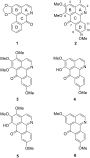
Figure 1: Prominent oxoaporphine and oxoisoaporphine alkaloids: liriodenine (1), menisporphine (2), dauriporp...
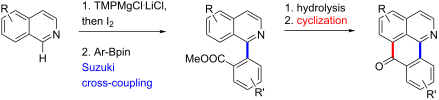
Scheme 1: Previously reported [7,17] and new approach to oxoisoaporphine alkaloids.
Scheme 2: Synthesis of iodinated isoquinolines 8a–c from alkoxy-substituted isoquinolines 7a–c.
Scheme 3: Synthesis of methyl 2-(isoquinolin-1-yl)benzoates 10a–c from 1-iodoisoquinolines 8a–c.
Scheme 4: Synthesis of the alkaloids 6-O-demethylmenisporphine (4), dauriporphinoline (5), and bianfugecine (6...
Scheme 5: Attempted synthesis of bianfugecine (6) via directed remote metalation and subsequent trapping of t...
Scheme 6: Outcome of a D2O quenching experiment after metalation of amide 12.
Scheme 7: Synthesis of 1-arylnaphthalene analogues 15 and 16.
Scheme 8: Outcome of a D2O quenching experiment after metalation of amide 16 with LDA.
Scheme 9: Synthesis of the alkaloids menisporphine (2) and dauriporphine (3) by O-methylation of the alkaloid...
Beilstein J. Org. Chem. 2017, 13, 1407–1412, doi:10.3762/bjoc.13.137
Graphical Abstract
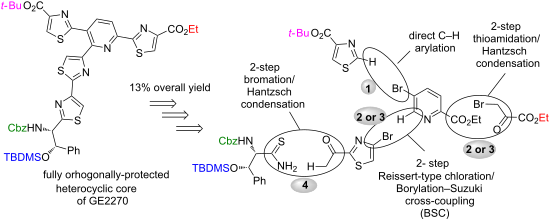
Figure 1: Main synthetic strategies towards heterocyclic cores of D-series GE2270 and our present one.
Scheme 1: Synthesis of trithiazolylpyridine 9. Reaction conditions: a) Pd(OAc)2 (5 mol %), CyJohnPhos (10 mol...
Scheme 2: Synthesis of chiral thioamide 16. Reaction conditions: a) SnCl2∙2H2O, dioxane/H2O (1:3), 0 °C to rt...
Scheme 3: Synthesis of the heterocyclic core of the D-series GE2270. Reaction conditions: a) TBDMSOTf, NEt3, ...
Beilstein J. Org. Chem. 2017, 13, 1064–1070, doi:10.3762/bjoc.13.105
Graphical Abstract
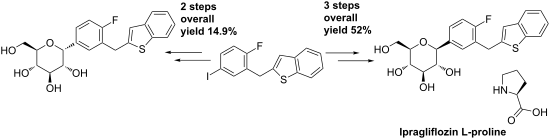
Figure 1: Structure of ipragliflozin L-proline.
Scheme 1: Stereoselective synthesis of C-aryl glycoside by Lemarie.
Scheme 2: Stereoselective synthesis of β-C-arylglucoside 5.
Scheme 3: Synthesis of 1.
Scheme 4: Synthesis of diastereomer 6’ and 5’.
Beilstein J. Org. Chem. 2017, 13, 895–902, doi:10.3762/bjoc.13.90
Graphical Abstract
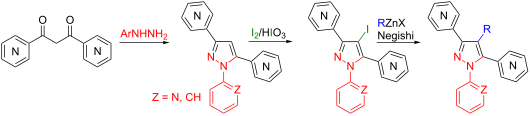
Scheme 1: Envisaged general approach for the synthesis of the title compounds.
Scheme 2: Synthesis of 4-iodopyrazoles of type 3.
Scheme 3: Lithium–halogen exchange and subsequent carboxylation with iodopyrazoles 3a–d.
Scheme 4: Attempted cross-coupling reactions with 4-halopyrazoles 5 and 3a.
Scheme 5: Negishi couplings with 4-iodopyrazoles 3a,b.
Scheme 6: Formation of pyrazoloquinolizin-6-ium iodide 12 upon reaction of 3a with (phenylethynyl)zinc bromid...
Scheme 7: Prototropic tautomerism of compound 1a.
Figure 1: 1H NMR (in italics), 13C NMR and 15N NMR (in bold) chemical shifts of compound 9a (in CDCl3).
Beilstein J. Org. Chem. 2017, 13, 520–542, doi:10.3762/bjoc.13.51
Graphical Abstract
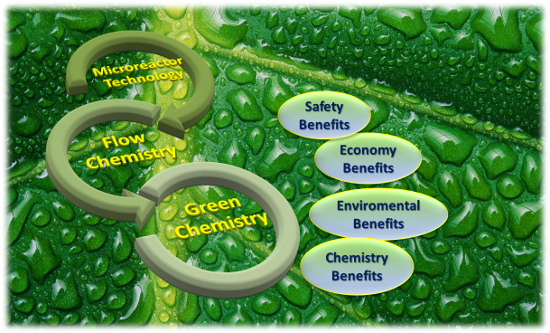
Figure 1: Microreactor technologies and flow chemistry for a sustainable chemistry.
Scheme 1: A flow microreactor system for the generation and trapping of highly unstable carbamoyllithium spec...
Scheme 2: Flow synthesis of functionalized α-ketoamides.
Scheme 3: Reactions of benzyllithiums.
Scheme 4: Trapping of benzyllithiums bearing carbonyl groups enabled by a flow microreactor. (Adapted with pe...
Scheme 5: External trapping of chloromethyllithium in a flow microreactor system.
Scheme 6: Scope for the direct tert-butoxycarbonylation using a flow microreactor system.
Scheme 7: Control of anionic Fries rearrangement reactions by using submillisecond residence time. (Adapted w...
Figure 2: Chip microreactor (CMR) fabricated with six layers of polyimide films. (Reproduced with permission ...
Scheme 8: Flow microreactor system for lithiation, borylation, Suzuki–Miyaura coupling and selected examples ...
Scheme 9: Experimental setup for the flow synthesis of 2-fluorobi(hetero)aryls by directed lithiation, zincat...
Scheme 10: Experimental setup for the coupling of fluoro-substituted pyridines. (Adapted with permission from [53]...
Scheme 11: Continuous flow process setup for the preparation of 11 (Reproduced with permission from [54], copyrigh...
Scheme 12: Continuous-flow photocatalytic oxidation of thiols to disulfides.
Scheme 13: Trifluoromethylation by continuous-flow photoredox catalysis.
Scheme 14: Flow photochemical synthesis of 6(5H)-phenanthridiones from 2-chlorobenzamides.
Scheme 15: Synthesis of biaryls 14a–g under photochemical flow conditions.
Scheme 16: Flow oxidation of hydrazones to diazo compounds.
Scheme 17: Synthetic use of flow-generated diazo compounds.
Scheme 18: Ley’s flow approach for the generation of diazo compounds.
Scheme 19: Iterative strategy for the sequential coupling of diazo compounds.
Scheme 20: Integrated synthesis of Bakuchiol precursor via flow-generated diazo compounds.
Scheme 21: Kappe’s continuous-flow reduction of olefines with diimide.
Scheme 22: Multi-injection setup for the reduction of artemisinic acid.
Scheme 23: Flow reactor system for multistep synthesis of (S)-rolipram. Pumps are labelled a, b, c, d and e; L...
Figure 3: Reconfigurable modules and flowcharts for API synthesis. (Reproduced with permission from [85], copyrig...
Figure 4: Reconfigurable system for continuous production and formulation of APIs. (Reproduced with permissio...
Beilstein J. Org. Chem. 2016, 12, 835–845, doi:10.3762/bjoc.12.82
Graphical Abstract
Figure 1: Types of aryl pyridines and pyrimidines already prepared in our group [23-27].
Scheme 1: Synthesis of diarylpyridines 4–29.
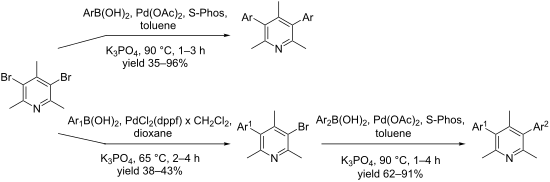
Scheme 2: Synthetic routes leading to unsymmetrically substituted arylpyridines.
Scheme 3: Preparation of unsymmetrical 3,5-diaryl-2,4,6-trimethylpyridines 46–56.
Scheme 4: Preparation of unsymmetrical 3,5-diaryl-4-chloro-2,6-dimethylpyridines 68–71.
Beilstein J. Org. Chem. 2015, 11, 1667–1699, doi:10.3762/bjoc.11.183
Graphical Abstract
Figure 1: Fragments produced by the FAB–MS of dehydrokuanoniamine B (20) [42].
Figure 2: Fragments produced by the EIMS of sagitol (26) [55].
Figure 3: Fragments produced by the EIMS of styelsamine B (4) [45].
Figure 4: Fragments produced by the EIMS of styelsamine D (6) [45].
Figure 5: Fragments produced by the EIMS of subarine (37) [40].
Scheme 1: Synthesis of styelsamine B (4) and cystodytin J (1) [58].
Scheme 2: Synthesis of sebastianine A (38) and its regioisomer 39 [59].
Scheme 3: Synthesis route A of neoamphimedine (12) [61].
Scheme 4: Synthesis route B of neoamphimedine (12) [62].
Scheme 5: Synthesis of arnoamines A (40) and B (41) [63].
Scheme 6: Synthesis of ascididemin (42) [65].
Scheme 7: Synthesis of subarine (37) [66,67].
Scheme 8: Synthesis of demethyldeoxyamphimedine (9) [68].
Scheme 9: Synthesis of pyridoacridine analogues related to ascididemin (42) [70].
Scheme 10: Synthesis of analogues of meridine (56) [71].
Scheme 11: Synthesis of bulky pyridoacridine as eilatin (58) [72].
Scheme 12: Synthesis of AK37 (59), analogue of kuanoniamine A (60) [73].
Figure 6: Biosynthesis pathway I [74].
Figure 7: Reaction illustrating catechol and kynuramine as possible biosynthetic precursors [75].
Figure 8: Biosynthesis pathway B deduced from the feeding experiment A using labelled precursors [76].
Figure 9: Proposed biosynthesis pathway [47].
Figure 10: 4H-Pyrido[2,3,4-kl]acridin-4-one as a cytotoxic pharmacophore.
Figure 11: 7H-Pyrido[2,3,4-kl]acridine as a cytotoxic pharmacophore.
Figure 12: 9H-Quinolino[4,3,2-de][1,10]phenanthrolin-9-one as a cytotoxic pharmacophore.
Figure 13: 8H-Benzo[b]pyrido[4,3,2-de][1,7]phenanthrolin-8-one as a cytotoxic pharmacophore.
Figure 14: Pyrido[4,3,2-mn]pyrrolo[3,2,1-de]acridine as a cytotoxic pharmacophore.
Figure 15: 9H-Pyrido[4,3,2-mn]thiazolo[4,5-b]acridin-9-one and 8H-pyrido[4,3,2-mn]thiazolo[4,5-b]acridine: cyt...
Figure 16: 9H-quinolino[4,3,2-de][1,10]phenanthrolin-9-one as an anti-mycobacterial pharmacophore.
Figure 17: 9H-Quinolino[4,3,2-de][1,10]phenanthrolin-9-one as an antibacterial pharmacophore.
Figure 18: Saturated and less saturated pyridine moieties as aspartyl inhibitor cores.
Figure 19: Iminobenzoquinone and acridone cores as intercalating and TOPO inhibitor motifs found in pyridoacri...
Beilstein J. Org. Chem. 2014, 10, 825–831, doi:10.3762/bjoc.10.78
Graphical Abstract
Figure 1: L-Norleucine, L-isoleucine, and L-leucine.
Figure 2: Concave templates 1 and 2.
Scheme 1: Syntheses of the 2-(9,9’-spirobifluorene-2-yl)trifluoromethansulfonate (7).
Scheme 2: Synthesis of the two receptors 1 and 2.
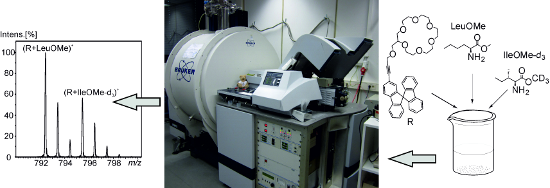
Figure 3: Schematic presentation of the isomer labelled guest method (ILGM).
Figure 4: ESI-mass spectrum (positive mode) of a 1:1:1 mixture of 1, protonated L-leucine methyl ester (LeuOM...
Figure 5: ESI-mass spectrum (positive mode) of a 1:1:1 mixture of 1, protonated L-leucine methyl ester (LeuOM...
Figure 6: Two different motifs for the binding of substrates to the templates.
Beilstein J. Org. Chem. 2014, 10, 814–824, doi:10.3762/bjoc.10.77
Graphical Abstract
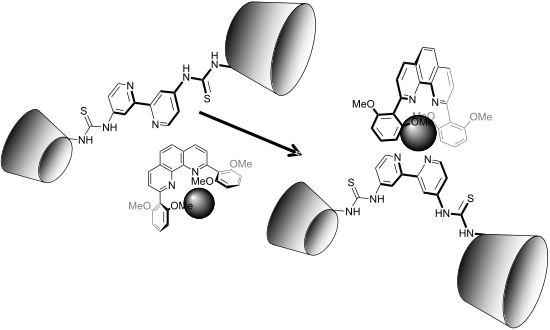
Scheme 1: Off- (open) and on- (closed) states of a ditopic positive allosteric receptor based on a 4,4’-funct...
Scheme 2: Bis(β-cyclodextrin)-functionalised 2,2’-bipyridines 1–3.
Scheme 3: Synthesis of diisothiocyanato-2,2’-bipyridines 14–16.
Scheme 4: Synthesis of peracetylated cyclodextrin 21.
Scheme 5: Synthesis of receptors 1–3.
Figure 1: X-ray crystal structure analysis of [(CO)3Re(14)Cl] (colour code: petrol: rhenium, grey: carbon, re...
Figure 2: MALDI mass spectrum (sample prepared from a 1:1 mixture of CuPF6 and 2 in benzene/acetonitrile (1:1...
Figure 3: Aromatic region of the 1H NMR spectra (400.1 MHz, 293 K, benzene-d6/acetonitrile-d3 1:1) of a) 1 an...
Figure 4: Aromatic region of the 1H NMR spectra (400.1 MHz, 293 K, benzene-d6/acetonitrile-d3 1:1) of a) 2 an...
Scheme 6: Synthesis of ligand 22.
Figure 5: X-ray crystal structure analysis of [Cu(H3CCN)2(22)]BF4 and [Zn(22)2](OTf)2 (counterions are omitte...
Figure 6: Aromatic region of the 1H NMR spectra (400.1 MHz, 293 K, benzene-d6/acetonitrile-d3 1:1) of a) 1, b...
Figure 7: MALDI–TOF mass spectrum (sample prepared from of a 1:1:1 mixture of CuPF6, 22, and 1 in benzene/ace...
Beilstein J. Org. Chem. 2014, 10, 34–114, doi:10.3762/bjoc.10.6
Graphical Abstract
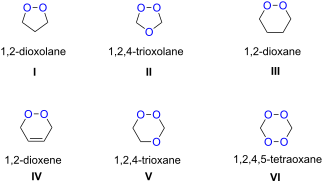
Figure 1: Five and six-membered cyclic peroxides.
Figure 2: Artemisinin and semi-synthetic derivatives.
Scheme 1: Synthesis of 3-hydroxy-1,2-dioxolanes 3a–c.
Scheme 2: Synthesis of dioxolane 6.
Scheme 3: Photooxygenation of oxazolidines 7a–d with formation of spiro-fused oxazolidine-containing dioxolan...
Scheme 4: Oxidation of cyclopropanes 10a–e and 11a–e with preparation of 1,2-dioxolanes 12a–e.
Scheme 5: VO(acac)2-catalyzed oxidation of silylated bicycloalkanols 13a–c.
Scheme 6: Mn(II)-catalyzed oxidation of cyclopropanols 15a–g.
Scheme 7: Oxidation of aminocyclopropanes 20a–c.
Scheme 8: Synthesis of aminodioxolanes 24.
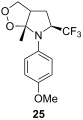
Figure 3: Trifluoromethyl-containing dioxolane 25.
Scheme 9: Synthesis of 1,2-dioxolanes 27a–e by the oxidation of cyclopropanes 26a–e.
Scheme 10: Photoinduced oxidation of methylenecyclopropanes 28.
Scheme 11: Irradiation-mediated oxidation.
Scheme 12: Application of diazene 34 for dioxolane synthesis.
Scheme 13: Mn(OAc)3-catalyzed cooxidation of arylacetylenes 37a–h and acetylacetone with atmospheric oxygen.
Scheme 14: Peroxidation of (2-vinylcyclopropyl)benzene (40).
Scheme 15: Peroxidation of 1,4-dienes 43a,b.
Scheme 16: Peroxidation of 1,5-dienes 46.
Scheme 17: Peroxidation of oxetanes 53a,b.
Scheme 18: Peroxidation of 1,6-diene 56.
Scheme 19: Synthesis of 3-alkoxy-1,2-dioxolanes 62a,b.
Scheme 20: Synthesis of spiro-bis(1,2-dioxolane) 66.
Scheme 21: Synthesis of dispiro-1,2-dioxolanes 68, 70, 71.
Scheme 22: Synthesis of spirohydroperoxydioxolanes 75a,b.
Scheme 23: Synthesis of spirohydroperoxydioxolane 77 and dihydroperoxydioxolane 79.
Scheme 24: Ozonolysis of azepino[4,5-b]indole 80.
Scheme 25: SnCl4-mediated fragmentation of ozonides 84a–l in the presence of allyltrimethylsilane.
Scheme 26: SnCl4-mediated fragmentation of bicyclic ozonide 84m in the presence of allyltrimethylsilane.
Scheme 27: MCl4-mediated fragmentation of alkoxyhydroperoxides 96 in the presence of allyltrimethylsilane.
Scheme 28: SnCl4-catalyzed reaction of monotriethylsilylperoxyacetal 108 with alkene 109.
Scheme 29: SnCl4-catalyzed reaction of triethylsilylperoxyacetals 111 with alkenes.
Scheme 30: Desilylation of tert-butyldimethylsilylperoxy ketones 131a,b followed by cyclization.
Scheme 31: Deprotection of peroxide 133 followed by cyclization.
Scheme 32: Asymmetric peroxidation of methyl vinyl ketones 137a–e.
Scheme 33: Et2NH-catalyzed intramolecular cyclization.
Scheme 34: Synthesis of oxodioxolanes 143a–j.
Scheme 35: Haloperoxidation accompanied by intramolecular ring closure.
Scheme 36: Oxidation of triterpenes 149a–d with Na2Cr2O7/N-hydroxysuccinimide.
Scheme 37: Curtius and Wolff rearrangements to form 1,2-dioxolane ring-retaining products.
Scheme 38: Oxidative desilylation of peroxide 124.
Scheme 39: Synthesis of dioxolane 158, a compound containing the aminoquinoline antimalarial pharmacophore.
Scheme 40: Diastereomers of plakinic acid A, 162a and 162b.
Scheme 41: Ozonolysis of alkenes.
Scheme 42: Cross-ozonolysis of alkenes 166 with carbonyl compounds.
Scheme 43: Ozonolysis of the bicyclic cyclohexenone 168.
Scheme 44: Cross-ozonolysis of enol ethers 172a,b with cyclohexanone.
Scheme 45: Griesbaum co-ozonolysis.
Scheme 46: Reactions of aryloxiranes 177a,b with oxygen.
Scheme 47: Intramolecular formation of 1,2,4-trioxolane 180.
Scheme 48: Formation of 1,2,4-trioxolane 180 by the reaction of 1,5-ketoacetal 181 with H2O2.
Scheme 49: 1,2,4-Trioxolane 186 with tetrazole fragment.
Scheme 50: 1,2,4-Trioxolane 188 with a pyridine fragment.
Scheme 51: 1,2,4-Trioxolane 189 with pyrimidine fragment.
Scheme 52: Synthesis of aminoquinoline-containing 1,2,4-trioxalane 191.
Scheme 53: Synthesis of arterolane.
Scheme 54: Oxidation of diarylheptadienes 197a–c with singlet oxygen.
Scheme 55: Synthesis of hexacyclinol peroxide 200.
Scheme 56: Oxidation of enone 201 and enenitrile 203 with singlet oxygen.
Scheme 57: Synthesis of 1,2-dioxanes 207 by oxidative coupling of carbonyl compounds 206 and alkenes 205.
Scheme 58: 1,2-Dioxanes 209 synthesis by co-oxidation of 1,5-dienes 208 and thiols.
Scheme 59: Synthesis of bicyclic 1,2-dioxanes 212 with aryl substituents.
Scheme 60: Isayama–Mukaiyama peroxysilylation of 1,5-dienes 213 followed by desilylation under acidic conditio...
Scheme 61: Synthesis of bicycle 218 with an 1,2-dioxane ring.
Scheme 62: Intramolecular cyclization with an oxirane-ring opening.
Scheme 63: Inramolecular cyclization with the oxetane-ring opening.
Scheme 64: Intramolecular cyclization with the attack on a keto group.
Scheme 65: Peroxidation of the carbonyl group in unsaturated ketones 228 followed by cyclization of hydroperox...
Scheme 66: CsOH and Et2NH-catalyzed cyclization.
Scheme 67: Preparation of peroxyplakoric acid methyl ethers A and D.
Scheme 68: Hg(OAc)2 in 1,2-dioxane synthesis.
Scheme 69: Reaction of 1,4-diketones 242 with hydrogen peroxide.
Scheme 70: Inramolecular cyclization with oxetane-ring opening.
Scheme 71: Inramolecular cyclization with MsO fragment substitution.
Scheme 72: Synthesis of 1,2-dioxane 255a, a structurally similar compound to natural peroxyplakoric acids.
Scheme 73: Synthesis of 1,2-dioxanes based on the intramolecular cyclization of hydroperoxides containing C=C ...
Scheme 74: Use of BCIH in the intramolecular cyclization.
Scheme 75: Palladium-catalyzed cyclization of δ-unsaturated hydroperoxides 271a–e.
Scheme 76: Intramolecular cyclization of unsaturated peroxyacetals 273a–d.
Scheme 77: Allyltrimethylsilane in the synthesis of 1,2-dioxanes 276a–d.
Scheme 78: Intramolecular cyclization using the electrophilic center of the peroxycarbenium ion 279.
Scheme 79: Synthesis of bicyclic 1,2-dioxanes.
Scheme 80: Preparation of 1,2-dioxane 286.
Scheme 81: Di(tert-butyl)peroxalate-initiated radical cyclization of unsaturated hydroperoxide 287.
Scheme 82: Oxidation of 1,4-betaines 291a–d.
Scheme 83: Synthesis of aminoquinoline-containing 1,2-dioxane 294.
Scheme 84: Synthesis of the sulfonyl-containing 1,2-dioxane.
Scheme 85: Synthesis of the amido-containing 1,2-dioxane 301.
Scheme 86: Reaction of singlet oxygen with the 1,3-diene system 302.
Scheme 87: Synthesis of (+)-premnalane А and 8-epi-premnalane A.
Scheme 88: Synthesis of the diazo group containing 1,2-dioxenes 309a–e.
Figure 4: Plakortolide Е.
Scheme 89: Synthesis of 6-epiplakortolide Е.
Scheme 90: Application of Bu3SnH for the preparation of tetrahydrofuran-containing bicyclic peroxides 318a,b.
Scheme 91: Application of Bu3SnH for the preparation of lactone-containing bicyclic peroxides 320a–f.
Scheme 92: Dihydroxylation of the double bond in the 1,2-dioxene ring 321 with OsO4.
Scheme 93: Epoxidation of 1,2-dioxenes 324.
Scheme 94: Cyclopropanation of the double bond in endoperoxides 327.
Scheme 95: Preparation of pyridazine-containing bicyclic endoperoxides 334a–c.
Scheme 96: Synthesis of 1,2,4-trioxanes 337 by the hydroperoxidation of unsaturated alcohols 335 with 1O2 and ...
Scheme 97: Synthesis of sulfur-containing 1,2,4-trioxanes 339.
Scheme 98: BF3·Et2O-catalyzed synthesis of the 1,2,4-trioxanes 342a–g.
Scheme 99: Photooxidation of enol ethers or vinyl sulfides 343.
Scheme 100: Synthesis of tricyclic peroxide 346.
Scheme 101: Reaction of endoperoxides 348a,b derived from cyclohexadienes 347a,b with 1,4-cyclohexanedione.
Scheme 102: [4 + 2]-Cycloaddition of singlet oxygen to 2Н-pyrans 350.
Scheme 103: Synthesis of 1,2,4-trioxanes 354 using peroxysilylation stage.
Scheme 104: Epoxide-ring opening in 355 with H2O2 followed by the condensation of hydroxy hydroperoxides 356 wi...
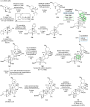
Scheme 105: Peroxidation of unsaturated ketones 358 with the H2O2/CF3COOH/H2SO4 system.
Scheme 106: Synthesis of 1,2,4-trioxanes 362 through Et2NH-catalyzed intramolecular cyclization.
Scheme 107: Reduction of the double bond in tricyclic peroxides 363.
Scheme 108: Horner–Wadsworth–Emmons reaction in the presence of peroxide group.
Scheme 109: Reduction of ester group by LiBH4 in the presence of 1,2,4-trioxane moiety.
Scheme 110: Reductive amination of keto-containing 1,2,4-trioxane 370.
Scheme 111: Reductive amination of keto-containing 1,2,4-trioxane and a Fe-containing moiety.
Scheme 112: Acid-catalyzed reactions of Н2О2 with ketones and aldehydes 374.
Scheme 113: Cyclocondensation of carbonyl compounds 376a–d using Me3SiOOSiMe3/CF3SO3SiMe3.
Scheme 114: Peroxidation of 4-methylcyclohexanone (378).
Scheme 115: Synthesis of symmetrical tetraoxanes 382a,b from aldehydes 381a,b.
Scheme 116: Synthesis of unsymmetrical tetraoxanes using of MeReO3.
Scheme 117: Synthesis of symmetrical tetraoxanes using of MeReO3.
Scheme 118: Synthesis of symmetrical tetraoxanes using of MeReO3.
Scheme 119: MeReO3 in the synthesis of symmetrical tetraoxanes with the use of aldehydes.
Scheme 120: Preparation of unsymmmetrical 1,2,4,5-tetraoxanes with high antimalarial activity.
Scheme 121: Re2O7-Catalyzed synthesis of tetraoxanes 398.
Scheme 122: H2SO4-Catalyzed synthesis of steroidal tetraoxanes 401.
Scheme 123: HBF4-Catalyzed condensation of bishydroperoxide 402 with 1,4-cyclohexanedione.
Scheme 124: BF3·Et2O-Catalyzed reaction of gem-bishydroperoxides 404 with enol ethers 405 and acetals 406.
Scheme 125: HBF4-Catalyzed cyclocondensation of bishydroperoxide 410 with ketones.
Scheme 126: Synthesis of symmetrical and unsymmetrical tetraoxanes 413 from benzaldehydes 412.
Scheme 127: Synthesis of bridged 1,2,4,5-tetraoxanes 415a–l from β-diketones 414a–l and H2O2.
Scheme 128: Dimerization of zwitterions 417.
Scheme 129: Ozonolysis of verbenone 419.
Scheme 130: Ozonolysis of O-methyl oxime 424.
Scheme 131: Peroxidation of 1,1,1-trifluorododecan-2-one 426 with oxone.
Scheme 132: Intramolecular cyclization of dialdehyde 428 with H2O2.
Scheme 133: Tetraoxanes 433–435 as by-products in peroxidation of ketals 430–432.
Scheme 134: Transformation of triperoxide 436 in diperoxide 437.
Scheme 135: Preparation and structural modifications of tetraoxanes.
Scheme 136: Structural modifications of steroidal tetraoxanes.
Scheme 137: Synthesis of 1,2,4,5-tetraoxane 454 containing the fluorescent moiety.
Scheme 138: Synthesis of tetraoxane 458 (RKA182).
Beilstein J. Org. Chem. 2013, 9, 2265–2319, doi:10.3762/bjoc.9.265
Graphical Abstract
Scheme 1: Scaled industrial processes for the synthesis of simple pyridines.
Scheme 2: Synthesis of nicotinic acid from 2-methyl-5-ethylpyridine (1.11).
Scheme 3: Synthesis of 3-picoline and nicotinic acid.
Scheme 4: Synthesis of 3-picoline from 2-methylglutarodinitrile 1.19.
Scheme 5: Picoline-based synthesis of clarinex (no yields reported).
Scheme 6: Mode of action of proton-pump inhibitors and structures of the API’s.
Scheme 7: Hantzsch-like route towards the pyridine rings in common proton pump inhibitors.
Figure 1: Structures of rosiglitazone (1.40) and pioglitazone (1.41).
Scheme 8: Synthesis of rosiglitazone.
Scheme 9: Syntheses of 2-pyridones.
Scheme 10: Synthesis and mechanism of 2-pyrone from malic acid.
Scheme 11: Polymer-assisted synthesis of rosiglitazone.
Scheme 12: Synthesis of pioglitazone.
Scheme 13: Meerwein arylation reaction towards pioglitazone.
Scheme 14: Route towards pioglitazone utilising tyrosine.
Scheme 15: Route towards pioglitazone via Darzens ester formation.
Scheme 16: Syntheses of the thiazolidinedione moiety.
Scheme 17: Synthesis of etoricoxib utilising Negishi and Stille cross-coupling reactions.
Scheme 18: Synthesis of etoricoxib via vinamidinium condensation.
Figure 2: Structures of nalidixic acid, levofloxacin and moxifloxacin.
Scheme 19: Synthesis of moxifloxacin.
Scheme 20: Synthesis of (S,S)-2,8-diazabicyclo[4.3.0]nonane 1.105.
Scheme 21: Synthesis of levofloxacin.
Scheme 22: Alternative approach to the levofloxacin core 1.125.
Figure 3: Structures of nifedipine, amlodipine and clevidipine.
Scheme 23: Mg3N2-mediated synthesis of nifedipine.
Scheme 24: Synthesis of rac-amlodipine as besylate salt.
Scheme 25: Aza Diels–Alder approach towards amlodipine.
Scheme 26: Routes towards clevidipine.
Figure 4: Examples of piperidine containing drugs.
Figure 5: Discovery of tiagabine based on early leads.
Scheme 27: Synthetic sequences to tiagabine.
Figure 6: Structures of solifenacin (2.57) and muscarine (2.58).
Scheme 28: Enantioselective synthesis of solifenacin.
Figure 7: Structures of DPP-4 inhibitors of the gliptin-type.
Scheme 29: Formation of inactive diketopiperazines from cis-rotameric precursors.
Figure 8: Co-crystal structure of carmegliptin bound in the human DPP-4 active site (PDB 3kwf).
Scheme 30: Improved route to carmegliptin.
Figure 9: Structures of lamivudine and zidovudine.
Scheme 31: Typical routes accessing uracil, thymine and cytosine.
Scheme 32: Coupling between pyrimidones and riboses via the Vorbrüggen nucleosidation.
Scheme 33: Synthesis of lamivudine.
Scheme 34: Synthesis of raltegravir.
Scheme 35: Mechanistic studies on the formation of 3.22.
Figure 10: Structures of selected pyrimidine containing drugs.
Scheme 36: General preparation of pyrimidines and dihydropyrimidones.
Scheme 37: Synthesis of imatinib.
Scheme 38: Flow synthesis of imatinib.
Scheme 39: Syntheses of erlotinib.
Scheme 40: Synthesis of erlotinib proceeding via Dimroth rearrangement.
Scheme 41: Synthesis of lapatinib.
Scheme 42: Synthesis of rosuvastatin.
Scheme 43: Alternative preparation of the key aldehyde towards rosuvastatin.
Figure 11: Structure comparison between nicotinic acetylcholine receptor agonists.
Scheme 44: Syntheses of varenicline and its key building block 4.5.
Scheme 45: Synthetic access to eszopiclone and brimonidine via quinoxaline intermediates.
Figure 12: Bortezomib bound in an active site of the yeast 20S proteasome ([114], pdb 2F16).
Scheme 46: Asymmetric synthesis of bortezomib.
Figure 13: Structures of some prominent piperazine containing drugs.
Figure 14: Structural comparison between the core of aplaviroc (4.35) and a type-1 β-turn (4.36).
Scheme 47: Examplary synthesis of an aplaviroc analogue via the Ugi-MCR.
Scheme 48: Syntheses of azelastine (5.1).
Figure 15: Structures of captopril, enalapril and cilazapril.
Scheme 49: Synthesis of cilazapril.
Figure 16: Structures of lamotrigine, ceftriaxone and azapropazone.
Scheme 50: Synthesis of lamotrigine.
Scheme 51: Alternative synthesis of lamotrigine (no yields reported).
Figure 17: Structural comparison between imiquimod and the related adenosine nucleoside.
Scheme 52: Conventional synthesis of imiquimod (no yields reported).
Scheme 53: Synthesis of imiquimod.
Scheme 54: Synthesis of imiquimod via tetrazole formation (not all yields reported).
Figure 18: Structures of various anti HIV-medications.
Scheme 55: Synthesis of abacavir.
Figure 19: Structures of diazepam compared to modern replacements.
Scheme 56: Synthesis of ocinaplon.
Scheme 57: Access to zaleplon and indiplon.
Scheme 58: Different routes towards the required N-methylpyrazole 6.65 of sildenafil.
Scheme 59: Polymer-supported reagents in the synthesis of key aminopyrazole 6.72.
Scheme 60: Early synthetic route to sildenafil.
Scheme 61: Convergent preparations of sildenafil.
Figure 20: Comparison of the structures of sildenafil, tadalafil and vardenafil.
Scheme 62: Short route to imidazotriazinones.
Scheme 63: Alternative route towards vardenafils core imidazotriazinone (6.95).
Scheme 64: Bayer’s approach to the vardenafil core.
Scheme 65: Large scale synthesis of vardenafil.
Scheme 66: Mode of action of temozolomide (6.105) as methylating agent.
Scheme 67: Different routes to temozolomide.
Scheme 68: Safer route towards temozolomide.
Figure 21: Some unreported heterocyclic scaffolds in top market drugs.