


Search results
Search for "ALD" in Full Text gives 74 result(s) in Beilstein Journal of Nanotechnology.
Facile synthesis of carbon nanotube-supported NiO//Fe2O3 for all-solid-state supercapacitors
Beilstein J. Nanotechnol. 2019, 10, 1923–1932, doi:10.3762/bjnano.10.188
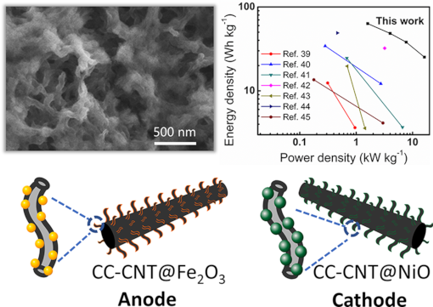
- . deposited iron oxide on CNTs by atomic layer deposition (ALD) and the obtained CNTs@Fe2O3 presented a specific capacitance of 580.6 F·g−1 at 5 A·g−1 [21]. Zhang et al. used magnetron sputtering to prepare sandwich-like CNT@Fe2O3@C structures, and the composite exhibited a specific capacitance of 787.5 F·g−1


Novel hollow titanium dioxide nanospheres with antimicrobial activity against resistant bacteria
Beilstein J. Nanotechnol. 2019, 10, 1716–1725, doi:10.3762/bjnano.10.167
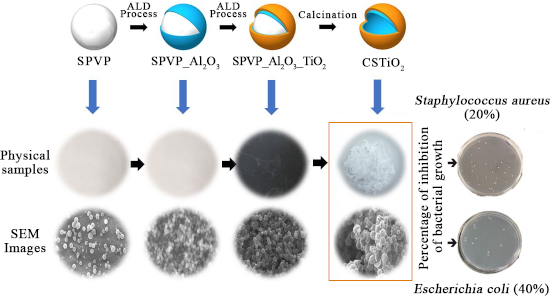
- [10][15]. In this work, the combination of electrospinning and atomic layer deposition (ALD) technologies are presented as an innovative strategy to develop titanium dioxide hollow nanospheres with controlled and homogeneous dimensions. Electrospinning is a technique able to produce different
- solution and the type of polymer. On the other hand, ALD is a novel metal oxide deposition process with excellent thickness control due to its low temperature processing and separated superficial reactions between precursor materials. Precursors are pulsed one by one over a substrate in the chamber and
- likewise purged to eliminate the unreacted substances and the by-product [18][19][20]. This is the first report on the development of metal oxide nanospheres synthesized using both electrospinning and ALD techniques. The resulting nanospheres were fully characterized by measuring the morphological


Growth of lithium hydride thin films from solutions: Towards solution atomic layer deposition of lithiated films
Beilstein J. Nanotechnol. 2019, 10, 1443–1451, doi:10.3762/bjnano.10.142
- deposition (ALD) avoids these issues and is able to deposit conformal films on 3D substrates. However, ALD is limited in the range of chemical reactions, due to the required volatility of the precursors. Moreover, relatively high temperatures are necessary (above 100 °C), which can be detrimental to
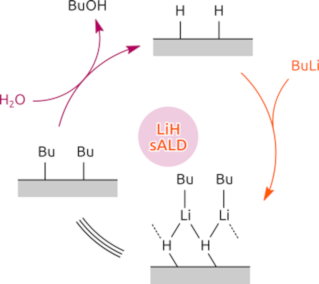
- spectroscopy and Auger spectroscopy analysis show the chemical identity of the decomposing air-sensitive films. Despite the air sensitivity of BuLi and LiH, making many standard measurements difficult, this work establishes the use of sALD to deposit LiH, a material inaccessible to conventional ALD, from
- precursors and at temperatures not suitable for conventional ALD. Keywords: lithiated thin films; lithium hydride; solution atomic layer deposition (sALD); Introduction While the development of electric motors and semiconductor devices is progressing, the pressure on battery development is increasing


On the transformation of “zincone”-like into porous ZnO thin films from sub-saturated plasma enhanced atomic layer deposition
Beilstein J. Nanotechnol. 2019, 10, 746–759, doi:10.3762/bjnano.10.74
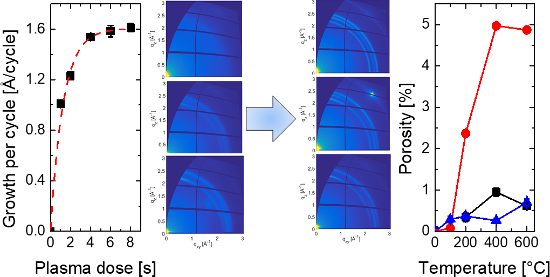
- /bjnano.10.74 Abstract The synthesis of nanoporous ZnO thin films is achieved through annealing of zinc-alkoxide (“zincone”-like) layers obtained by plasma-enhanced atomic layer deposition (PE-ALD). The zincone-like layers are deposited through sub-saturated PE-ALD adopting diethylzinc and O2 plasma with
- crystal growth occurred, giving insights in the manufacturing of nanoporous ZnO from Zn-based hybrid materials. Keywords: calcination; PE-ALD; porosity; thin films; ZnO; Introduction Atomic layer deposition (ALD) and molecular layer deposition (MLD) are sequential self-limiting vapor-phase deposition
- substrates and devices. By combining the metalorganic precursors adopted in ALD with the organic ligands used in MLD, hybrid organic–inorganic materials can be synthesized [2][3][4]. These materials possess properties in between their pure organic and inorganic counterparts, yet differing from the pristine


Biocompatible organic–inorganic hybrid materials based on nucleobases and titanium developed by molecular layer deposition
Beilstein J. Nanotechnol. 2019, 10, 399–411, doi:10.3762/bjnano.10.39
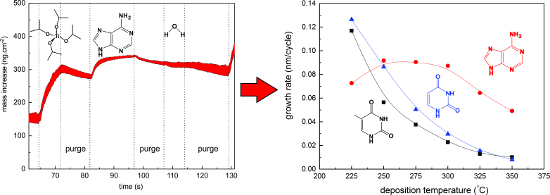
- .; Eidet, J. R. J. Biomed. Mater. Res., Part A 2018, 106, 3090–3098. doi:10.1002/jbm.a.36499]. The growth was followed by in situ quartz crystal microbalance (QCM) measurements and all systems exhibited atomic layer deposition (ALD) type of growth. The adenine system has an ALD temperature window between
- refraction. Keywords: ALD; bioactive materials; hybrid materials; MLD; nucleobases; Introduction There is an ever-increasing interest in organometallic compounds in the field of medicinal chemistry. Organometallic complexes are now being developed as anticancer agents, radiopharmaceuticals for diagnosis
- response [9]. Thus, the tailoring of the surface of materials used in tissue engineering is important for designing bioactive and biocompatible materials. Our choice is the atomic layer deposition/molecular layer deposition (ALD/MLD) technique by which organic–inorganic materials are developed through the




Uniform Sb2S3 optical coatings by chemical spray method
Beilstein J. Nanotechnol. 2019, 10, 198–210, doi:10.3762/bjnano.10.18
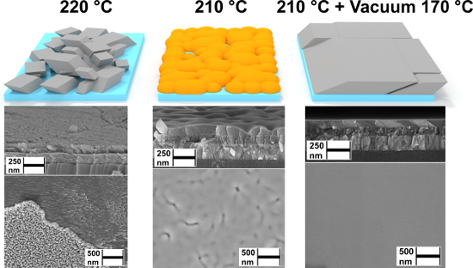
- chemical bath deposition (CBD) [3][4], spin coating [5], atomic layer deposition (ALD) [6] or chemical spray pyrolysis (CSP) [7] method, has been applied in extremely thin absorber (ETA) solar cells due to its excellent absorption coefficient in the visible light spectrum (1.8 × 105 cm−1 at 450 nm) [1][2




Electrostatic force microscopy for the accurate characterization of interphases in nanocomposites
Beilstein J. Nanotechnol. 2018, 9, 2999–3012, doi:10.3762/bjnano.9.279
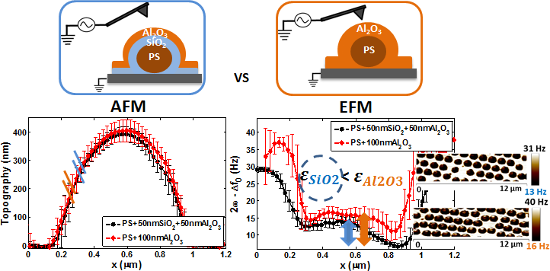
- nm) were deposited or grown over the whole sample surface. Aluminum oxide (Al2O3) shells were prepared using the atomic layer deposition (ALD) method, polyvinyl acetate (PVAc) shells by spin coating, and silicon dioxide (SiO2) shells by plasma sputtering deposition (PSD). The signature of each
- thickness. For this reason, SiO2 was used instead of PVAc because it can be deposited by PSD. This method can precisely and homogeneously spread SiO2 molecules over the whole sample surface, quite similar to ALD, as explained in the Experimental section [40]. In approach 2 (Figure 3), the signal between the
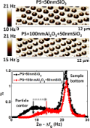
- by ALD (Al2O3) and PSD (SiO2) and the calibration of the SiO2 and Al2O3 layers, stacking layers of SiO2 or Al2O3 over PS for detecting the intermediate material becomes relevant. The second main step aimed for addressing the interphase detection by comparing the EFM response of PS + 50 nm Al2O3 + 50




Controlling surface morphology and sensitivity of granular and porous silver films for surface-enhanced Raman scattering, SERS
Beilstein J. Nanotechnol. 2018, 9, 2813–2831, doi:10.3762/bjnano.9.263
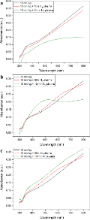
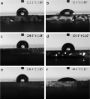
- Scientific UV–vis spectrophotometer (Evolution 600). The water contact angle was measured using a Krüss DSA 30 model drop-shape analysis system. The water contact angle was measured by placing 5 µL water droplets on the silver surface. Atomic layer deposition (ALD) of Al2O3 Silver films on glass substrates
- were inserted into the ALD chamber (Savannah G2, Ultratech/CNT, Cambridge Nanotech) for deposition of a 1 nm thick layer of Al2O3 using trimethylaluminium (98+%, Strem Chemicals, Inc.) and water (HPLC grade, Sigma Aldrich) as precursors at 200 °C. The precursors were vaporized at room temperature and
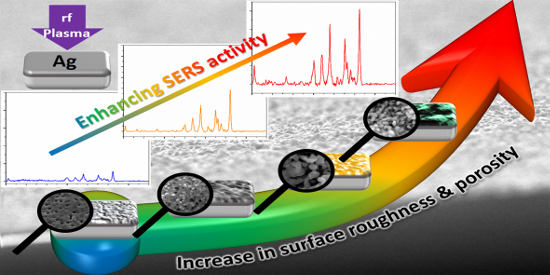
- film by ALD before adding the probe molecule RhB. The influence in SERS activity was compared immediately after deposition and after two weeks. Not unexpectedly, the Al2O3 layer reduces the SERS signal significantly as the analyte molecules are not in direct contact with the silver surface anymore





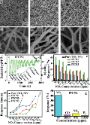
Electrospun one-dimensional nanostructures: a new horizon for gas sensing materials
Beilstein J. Nanotechnol. 2018, 9, 2128–2170, doi:10.3762/bjnano.9.202






Spin-coated planar Sb2S3 hybrid solar cells approaching 5% efficiency
Beilstein J. Nanotechnol. 2018, 9, 2114–2124, doi:10.3762/bjnano.9.200
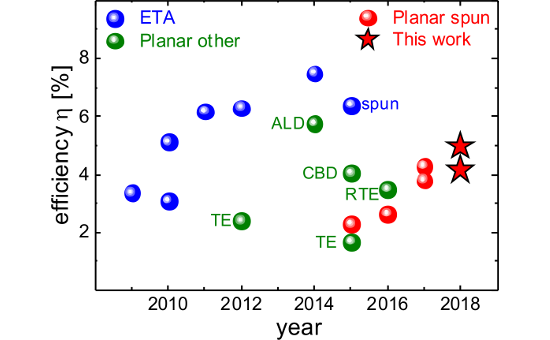
- , spin-coating of different antimony- and sulfur-containing precursors was proposed [29][36][37]. A metal-organic complex is formed in solution which is then spin-coated and afterwards thermally decomposed. Just like for CBD [2][41] or ALD [22][32] the resulting amorphous film needs to be annealed at
- ][5][6][29] reach the highest efficiencies. Planar devices have been produced via various methods such as atomic layer deposition (ALD) [32], chemical bath deposition (CBD) [27] and (rapid) thermal evaporation (R)TE [33][34][35]. As the latest development, spin-coated planar solar cells [31][36][37


Localized photodeposition of catalysts using nanophotonic resonances in silicon photocathodes
Beilstein J. Nanotechnol. 2018, 9, 2097–2105, doi:10.3762/bjnano.9.198
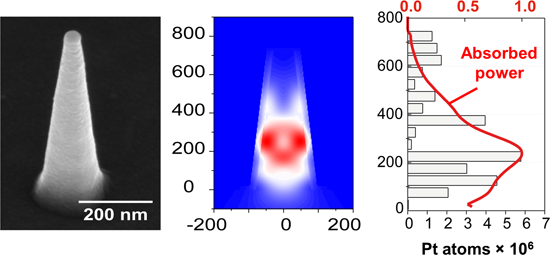
- carriers (Figure 2). An 18 nm amorphous TiO2 layer was conformally deposited on the silicon nanostructures by using atomic layer deposition (ALD). This layer assists with charge separation, stabilizes the silicon surface and helps to passivate trap states, leading to well-known improvements in photo


Magnetic properties of Fe3O4 antidot arrays synthesized by AFIR: atomic layer deposition, focused ion beam and thermal reduction
Beilstein J. Nanotechnol. 2018, 9, 1728–1734, doi:10.3762/bjnano.9.164
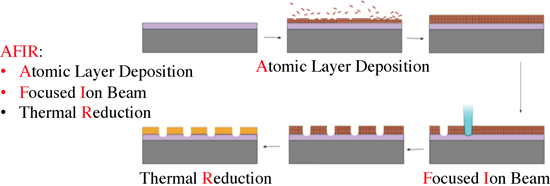
- atomic layer deposition (ALD) [31][32][33]. Due to the self-limited growth of material, ALD allows to control the thickness of the films with high precision [34]. The holes arise because of a dewetting process of the sample [35], which depends on its geometric and magnetic parameters as well as on the
- conditions of synthesis and thermal reduction. Hence, the holes are quite inhomogeneous and appear in disordered form on the sample. Thus, in this article we are interested in introducing a new procedure for obtaining antidot arrays with new properties. The technique is called AFIR (from ALD + FIB
- + reduction), and it consists of the deposition of a thin film by ALD, the generation of holes by means of FIB, and the thermal reduction of the antidot arrays. AFIR opens a new route to manufacture ordered antidot arrays of oxides with variable lattice parameters, arrays that have not been synthesized by




Semi-automatic spray pyrolysis deposition of thin, transparent, titania films as blocking layers for dye-sensitized and perovskite solar cells
Beilstein J. Nanotechnol. 2018, 9, 1135–1145, doi:10.3762/bjnano.9.105
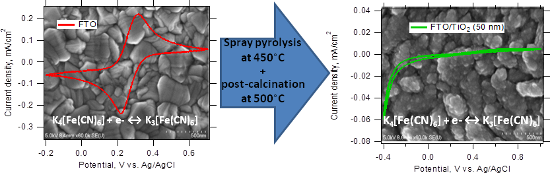
- prevent recombination on this surface [3][4][5]. Blocking layers (BLs) can be fabricated by spray pyrolysis [3][6], magnetron sputtering [7], electrochemical deposition [8] spin coating [9][10], dip coating [11] and atomic layer deposition (ALD) [3]. From the viewpoint of low-cost processing and easy
- prepared by electrodeposition or ALD for example [3][8]. Therefore the central motivation for this work was SPD fabrication of blocking TiO2 films using conventional [6] and novel [13] spray protocols using a semi-automatic spray device, enabling reproducible and uniform thin transparent titania films to
- from this point of view. A tentative interpretation could consider the fact that certain TiO2 films (e.g., those grown by ALD) do show their φFB significantly upshifted (by ≈0.3 V), see e.g. [3]. Our conclusion concerning a significant difference in the properties of the BL resulting from the two


Effect of annealing treatments on CeO2 grown on TiN and Si substrates by atomic layer deposition
Beilstein J. Nanotechnol. 2018, 9, 890–899, doi:10.3762/bjnano.9.83
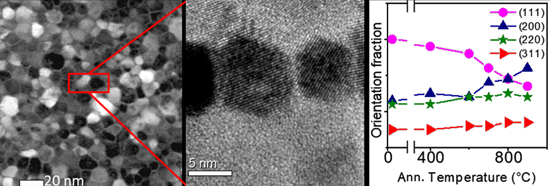
- this work, we investigate the effect of thermal treatment on CeO2 films fabricated by using atomic layer deposition (ALD) on titanium nitride (TiN) or on silicon (Si) substrates. In particular, we report on the structural, chemical and morphological properties of 25 nm thick ceria oxide with particular
- structure with texturing. Further, after annealing at 900 °C an increase of grain dimensions and an enhanced preferential (200) orientation are evidenced. These findings are a strong indication that the texturing is an intrinsic property of the system more than a metastable condition due to the ALD
- sputtering [7], e-beam [16], physical vapor deposition [17], chemical vapor deposition (CVD) [18], and atomic layer deposition (ALD). The latter has been explored by using different precursors, e.g., Ce(thd)4, Ce(iPrCp)3 and Ce(mmp)4) [19][20][21][22][23], obtaining as-deposited film with polycrystalline


Dynamics and fragmentation mechanism of (C5H4CH3)Pt(CH3)3 on SiO2 surfaces
Beilstein J. Nanotechnol. 2018, 9, 711–720, doi:10.3762/bjnano.9.66
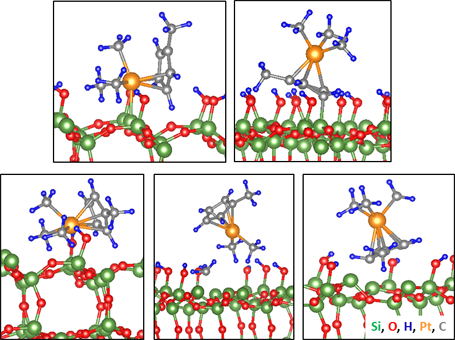
- layer deposition (ALD) conditions are available [12]. The studies in this review fairly agree that (1) the presence of surface hydroxyl groups are the source for protons that help in the evolution of H2, CH4 and H2O during the deposition process, and (2) the molecules dissociate or associate through a
- fragmentation pathways qualitatively. In a recent investigation, thickness-controlled site-selective Pt deposits were obtained by direct atomic layer deposition (ALD) in which ALD was performed on EBID patterned substrates. In this ALD process, an O2 pulse is used to obtain better nucleation, even though the
- , it can be speculated that a design of suitable precursors for electron beam induced deposition might be more efficient than the use of traditional ALD precursors. With our reaction modeling studies, possible pathways by which the precursor molecule can fragment on SiO2 surfaces were also explored



Al2O3/TiO2 inverse opals from electrosprayed self-assembled templates
Beilstein J. Nanotechnol. 2018, 9, 216–223, doi:10.3762/bjnano.9.23
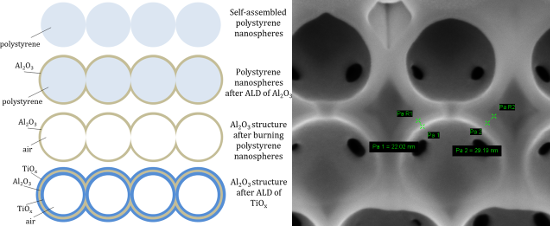
- errors and Al2O3/TiO2 as a structural layer infiltrated through the voids. This is a two-step atomic layer deposition (ALD) process in which the polymeric template is eliminated after the deposition of the alumina layer and before the ALD deposition of the titania layer. Results and Discussion The
- clarity. The electrospray process of a nanofluid containing polystyrene nanospheres is described in the Experimental section below. The second step, shown in Figure 1b, consists of the deposition of a thin, conformal layer of Al2O3 in an ALD reactor at 80 °C. Such a low deposition temperature preserves
- process is the deposition of a conformal ALD layer of TiO2. Titania conformally covers the alumina layer as shown in Figure 1d. At this point, the structure is an inverse opal of a composite Al2O3/TiO2 layer with air voids. The result of the first fabrication step is shown in Figure 2 where up to 50


Atomic layer deposition and properties of ZrO2/Fe2O3 thin films
Beilstein J. Nanotechnol. 2018, 9, 119–128, doi:10.3762/bjnano.9.14
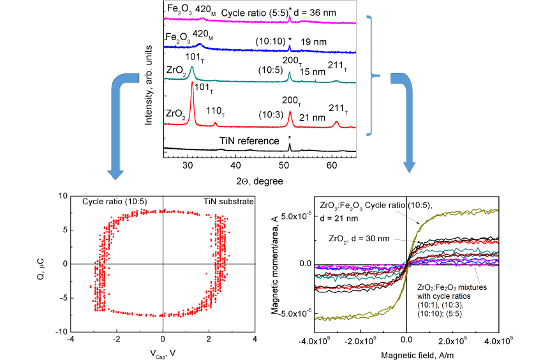
- grown by atomic layer deposition (ALD) at 400 °C. Metastable phases of ZrO2 were stabilized by Fe2O3 doping. The number of alternating ZrO2 and Fe2O3 deposition cycles were varied in order to achieve films with different cation ratios. The influence of annealing on the composition and structure of the
- [11]. Phase diagrams for the ZrO2–FeO system were described [12] and the influence of thermal treatment on the phase development in ZrO2–Fe2O3 and HfO2–Fe2O3 systems was assessed [13]. ALD of ZrO2 from ZrCl4 and O3 has been studied [14]. Reactions between Fe(acac)3 adsorbing on zirconia surfaces [15
- ][16] has been studied as well. Phase stabilization of ZrO2 by Fe doping was investigated by using ALD [17]. Ferromagnetism in ALD-grown Fe3O4/ZrO2/Fe3O4 multilayer nanotubes has been demonstrated [18], while the precursors for distinct solid oxide layers constituting these samples were ferrocene/ozone


Comparative study of post-growth annealing of Cu(hfac)2, Co2(CO)8 and Me2Au(acac) metal precursors deposited by FEBID
Beilstein J. Nanotechnol. 2018, 9, 91–101, doi:10.3762/bjnano.9.11
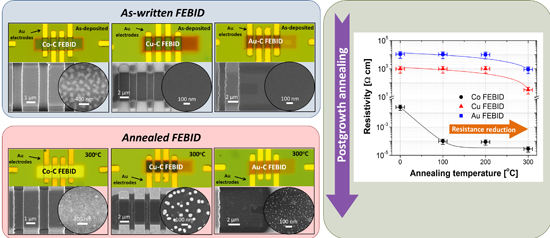
- μm2 were similar for Cu–C and Au–C (ca. 1.7 nm·min−1), while they were slightly lower for Co–C (ca. 1.4 nm·min−1), being comparable to typical atomic layer deposition (ALD) processes. Measurements performed on deposits after annealing at 300 °C indicate shrinkage with respect to the as-deposited


Electron-driven and thermal chemistry during water-assisted purification of platinum nanomaterials generated by electron beam induced deposition
Beilstein J. Nanotechnol. 2018, 9, 77–90, doi:10.3762/bjnano.9.10
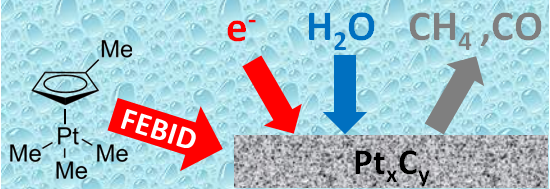
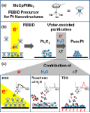
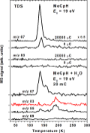
- carbonaceous matrix of nanogranular FEBID materials under humid conditions as relevant, for instance, in applications such as humidity sensing [13]. Results and Discussion Thermal reactions between intact MeCpPtMe3 and H2O In ALD processes for deposition of Pt performed at 100 °C and consisting of alternating



Increasing the stability of DNA nanostructure templates by atomic layer deposition of Al2O3 and its application in imprinting lithography
Beilstein J. Nanotechnol. 2017, 8, 2363–2375, doi:10.3762/bjnano.8.236
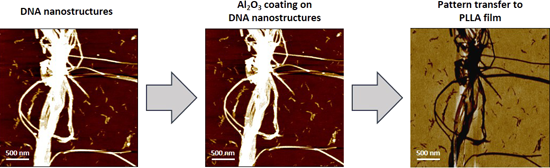
- conformal coating with a nanometer-thin protective inorganic oxide layer created using atomic layer deposition (ALD). DNA nanotubes and origami triangles were coated with ca. 2 nm to ca. 20 nm of Al2O3. Nanoscale features of the DNA nanostructures were preserved after the ALD coating and the patterns are
- resistive to UV/O3 oxidation. The ALD-coated DNA templates were used for a direct pattern transfer to poly(L-lactic acid) films. Keywords: aluminium oxide (Al2O3); atomic layer deposition; DNA nanostructure; nanofabrication; nanoimprint lithography; pattern transfer; polymer stamp; replica molding
- inorganic oxide film grown by atomic layer deposition (ALD). We test the stability of DNA nanotube master templates with an Al2O3 layer against repeated pattern transfer, long-term storage and exposure to UV/O3. The effect of the thickness of the Al2O3 layer on the qualities of pattern transfer and shape



The integration of graphene into microelectronic devices
Beilstein J. Nanotechnol. 2017, 8, 1056–1064, doi:10.3762/bjnano.8.107
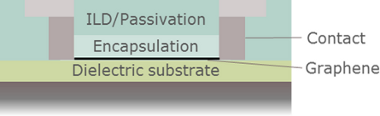
- yields excellent results [4], but this is not a production-relevant approach. A material that is available in mass-production quantities and fulfills both mentioned requirements is aluminum oxide deposited by atomic-layer deposition (ALD). It was demonstrated that graphene encapsulated in Al2O3 could be
- passivated (Figure 4) and was stable for a longer period of time under ambient conditions [50]. The main problem of growing Al2O3 by ALD is to obtain a continuous nucleation layer on graphene to start the deposition. To solve this problem several approaches are proposed. One solution is the deposition of a
- few nanometers thin Al layer on graphene and subsequently oxidizing it in air to generate a thin start layer for a subsequent ALD process depositing several tens of nanometers of Al2O3 [50]. Further there is an adapted nucleation process using water and trimethylaluminium (TMA) as precursors at


High photocatalytic activity of Fe2O3/TiO2 nanocomposites prepared by photodeposition for degradation of 2,4-dichlorophenoxyacetic acid
Beilstein J. Nanotechnol. 2017, 8, 915–926, doi:10.3762/bjnano.8.93
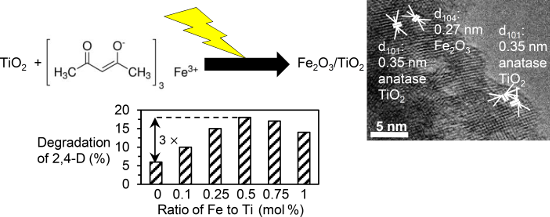
- ], plasma enhanced-chemical vapor deposition (PE-CVD) and radio frequency (RF) sputtering approach [12], and plasma enhanced-chemical vapor deposition and atomic layer deposition (ALD) followed by thermal treatment [13]. Among these preparation methods, impregnation is a commonly used approach for the


Vapor deposition routes to conformal polymer thin films
Beilstein J. Nanotechnol. 2017, 8, 723–735, doi:10.3762/bjnano.8.76
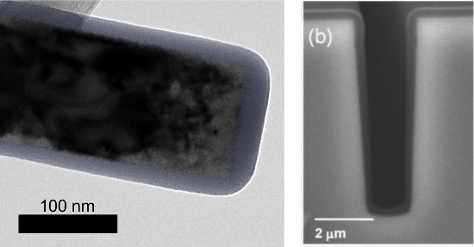
- ]. However, no systematic studies of conformality have been devoted solely to these techniques thus far. Practitioners of MLD can look at existing models for its inorganic analogue, atomic layer deposition (ALD), as a starting point for studying conformal MLD films [12]. This review will focus on two, well


Advances in the fabrication of graphene transistors on flexible substrates
Beilstein J. Nanotechnol. 2017, 8, 467–474, doi:10.3762/bjnano.8.50
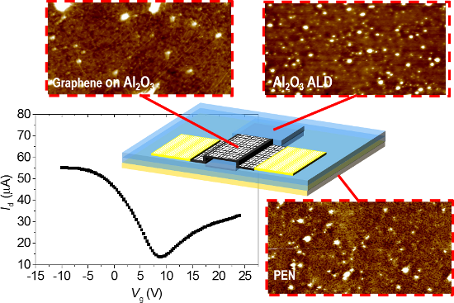
- buried gate contact under a thin Al2O3 insulating film. In order to be compatible with the use of the PEN substrate, optimized deposition conditions of the Al2O3 film by plasma-enhanced atomic layer deposition (PE-ALD) at a low temperature (100 °C) have been developed without any relevant degradation of
- layer deposition (ALD) represents an optimal method to fabricate a good quality Al2O3 dielectric film with a tight control on the deposited thickness and a high level of conformal coverage. While the thickness control allows easy fabrication of a tens of nanometer thick dielectric film (resulting in a
- beneficially high dielectric capacitance), the conformal coverage is essential to contain the potential local degradation of the dielectric performance. Otherwise, this degradation can take over due to the device topography and the high starting roughness of the plastic substrate. ALD is essentially a low



Diffusion of dilute gas in arrays of randomly distributed, vertically aligned, high-aspect-ratio cylinders
Beilstein J. Nanotechnol. 2017, 8, 64–73, doi:10.3762/bjnano.8.7
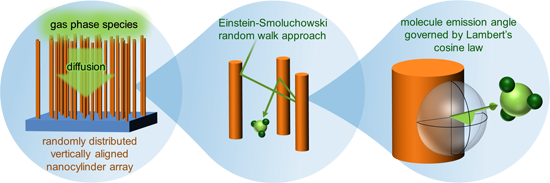
- the coating of nanotubes or nanowires with thin films employing techniques such as chemical vapour deposition (CVD) [11] or atomic layer deposition (ALD) [12][13]. Our recent study constitutes an example of the coating of vertically aligned carbon nanotubes (VACNTs) with monocrystalline anatase using
- ALD [14]. Arrays of nanocylinders are also used in gas sensing systems [15][16]. The increasing interest in surface functionalisation via gas phase techniques as well as gas sensing applications with high-aspect-ratio nanocylinder arrays has raised the need for the fundamental understanding and
- ][19]. The understanding of the gas-transport kinetics within nanocylinder arrays will be also crucial in the design and optimisation of the industrially up-scalable spatial ALD processes [20] carried out on such substrates. Although processes based on gas transport in various types of nanocylinder





