


Search results
Search for "dissipation" in Full Text gives 241 result(s) in Beilstein Journal of Nanotechnology. Showing first 200.
Enhancing mechanical properties of chitosan/PVA electrospun nanofibers: a comprehensive review
Beilstein J. Nanotechnol. 2025, 16, 286–307, doi:10.3762/bjnano.16.22

- smaller distance between molecular chains, which improves energy dissipation. Saeedi et al. [142] conducted DMTA tests and found that storage modulus and loss modulus of chitosan/PVA improved with the addition of graphene oxide. An improvement of loss modulus indicates resistance of polymer chains against


Advanced atomic force microscopy techniques V
Beilstein J. Nanotechnol. 2025, 16, 54–56, doi:10.3762/bjnano.16.6

- Joule dissipation leads to energy dissipation of the cantilever oscillation and a reduction in amplitude for constant excitation. They focus on two-dimensional materials and discuss how the reduction in amplitude resulting from energy dissipation influences the height measurement. In addition to the
Theoretical study of the electronic and optical properties of a composite formed by the zeolite NaA and a magnetite cluster
Beilstein J. Nanotechnol. 2025, 16, 44–53, doi:10.3762/bjnano.16.5
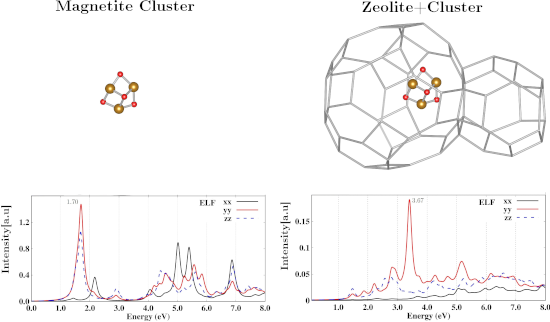
- this range ε1xx = ε1yy = ε1zz then ε1 = 1.5; consequently, the speed with which an electromagnetic wave propagates through this zeolite is v = 0.81c. Of course, the speed of propagation of electromagnetic waves outside this range may not be the same. Given that ε2 quantifies energy dissipation within
- the medium [64], Figure 6a shows that ideally the zeolite exhibits null dissipation within this energy range. Figure 6a indicates that the zeolite exhibits negligible dissipation in this specific energy range. Particularly within the visible spectrum (ranging from 1.63 to 3.26 eV or from 380 to 700 nm
- ), this absence of dissipation shows that the material is transparent, a characteristic commonly associated with distinct aluminosilicates [65][66][67][68][69][70][71][72][73]. Given that the ELF is connected to the relative permittivity as follows [74]: it is anticipated that its behavior below the




Heterogeneous reactions in a HFCVD reactor: simulation using a 2D model
Beilstein J. Nanotechnol. 2024, 15, 1627–1638, doi:10.3762/bjnano.15.128
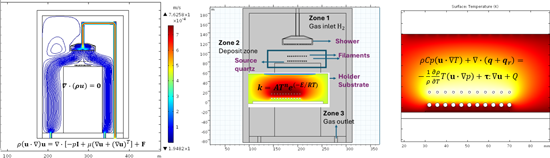
- ), (∇u)T is the transposed velocity gradient tensor, τ is the viscous stress tensor (Pa), μ is the dynamic viscosity (Pa·s), Q includes heat sources other than viscous dissipation (W·m−3), and δij is the Kronecker delta symbol. All equations in this section were taken from [26], except Equation 5, which


A low-kiloelectronvolt focused ion beam strategy for processing low-thermal-conductance materials with nanoampere currents
Beilstein J. Nanotechnol. 2024, 15, 1197–1207, doi:10.3762/bjnano.15.97

- was chosen since no significant heat dissipation from the surface is expected into the vacuum. Ion impacts are generated in equal time intervals as specified by the average time between two ion impacts and are randomly placed with a uniform spatial distribution on a circular beam profile (specified as



Bolometric IR photoresponse based on a 3D micro-nano integrated CNT architecture
Beilstein J. Nanotechnol. 2024, 15, 1030–1040, doi:10.3762/bjnano.15.84
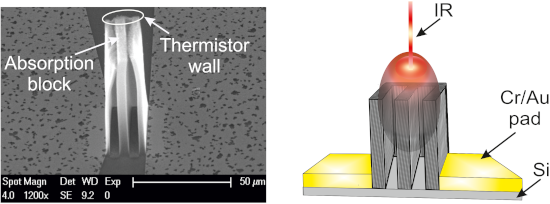
- temperature increase due to the electrical power dissipation in the bolometer Pin was used. The temperature increase ΔT was calculated from the resistance change shown in Figure 5. The equation ΔT = Pin/Gth can be rewritten and used for the calculation of the thermal conductance Gth: where Vbias is the bias
- voltage of 1.5 V, and Rbolometer(Vbias) is the resistance at bias voltage. The temperature change ΔT due to the electrical power dissipation was calculated using Equation 2, and the resistance change in Figure 5 for sample 1 and sample 2 was determined using temperature values of 129.1 and 20.3 °C


Recent progress on field-effect transistor-based biosensors: device perspective
Beilstein J. Nanotechnol. 2024, 15, 977–994, doi:10.3762/bjnano.15.80
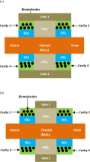
- were investigated. For a dielectric constant equal to 12, the proposed structure provides a power dissipation of 2.8 pW and a maximum current sensitivity of 104%. Moreover, it was demonstrated that the dual-cavity topology offers a higher efficacy than the single cavity in terms of power consumption
- and current sensitivity [96]. Furthermore, the power dissipation is lower and the delay is much larger. Additionally, power dissipation is different for charged and neutral biomolecules. Furthermore, the transient response of the proposed biosensor adds a diverse aspect when analyzing the delay of the




Beyond biomimicry – next generation applications of bioinspired adhesives from microfluidics to composites
Beilstein J. Nanotechnol. 2024, 15, 965–976, doi:10.3762/bjnano.15.79
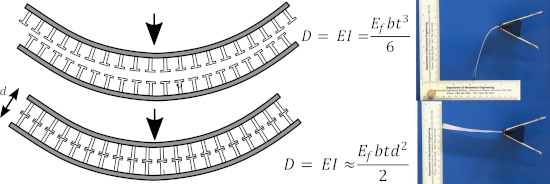
- state for long durations and only need to be reformed occasionally. Energy damping: Depending on the structural layers for the biomimetic adhesives, there could be significant internal energy damping for energy absorption, that is, highly viscoelastic fibers and energy dissipation as heat during


Investigation on drag reduction on rotating blade surfaces with microtextures
Beilstein J. Nanotechnol. 2024, 15, 833–853, doi:10.3762/bjnano.15.70
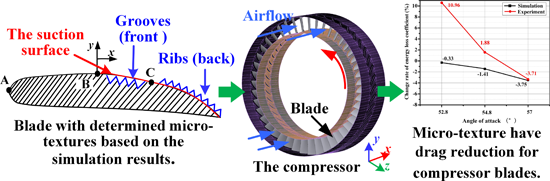
- analysis The effective method to reduce drag in the flow field is to delay boundary layer separation and inhibit turbulence generation [33]. Because turbulence generation leads to energy dissipation, increasing the energy loss. Therefore, the drag reduction of the microtextured blade surface was analyzed


Exploring surface charge dynamics: implications for AFM height measurements in 2D materials
Beilstein J. Nanotechnol. 2024, 15, 767–780, doi:10.3762/bjnano.15.64
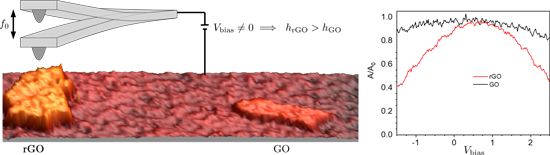
- monolayer flakes of 2D materials is the inaccurate height derived from topography images, often attributed to capillary or electrostatic forces. Here, we show the existence of a Joule dissipative mechanism related to charge dynamics and supplementing the dissipation due to capillary forces. This particular
- of surface charges and their intricate interaction with the tip. Keywords: 2D materials; incorrect height measurements; Joule dissipation; surface conductivity; tip influence; Introduction Two-dimensional (2D) materials have emerged as a promising platform for next-generation electronic devices [1
- differences of the wetting properties [34]. At moderate oscillation amplitudes, intimate tip–sample contact is avoided, and the energy dissipation takes place at the lower turning point of the oscillation cycle because of the formation and rupture of liquid necks [35][36][37]. When operating in this less


Stiffness calibration of qPlus sensors at low temperature through thermal noise measurements
Beilstein J. Nanotechnol. 2024, 15, 580–602, doi:10.3762/bjnano.15.50
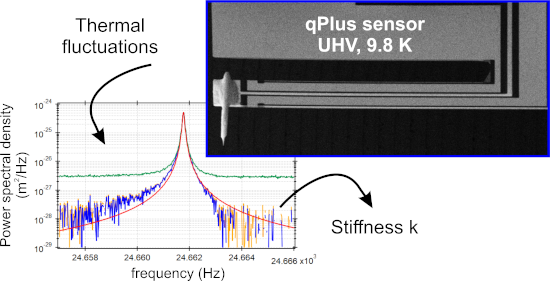
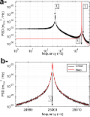
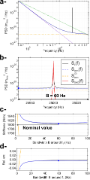
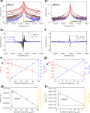
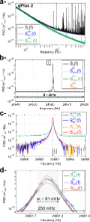
- been formalized by the linear response theory and the fluctuation–dissipation theorem (FDT) [74][75], establishing a connection between fluctuations about equilibrium and the response of a system to external forces upon its susceptibility (or response function). Thermal energy and probe fluctuations

Design, fabrication, and characterization of kinetic-inductive force sensors for scanning probe applications
Beilstein J. Nanotechnol. 2024, 15, 242–255, doi:10.3762/bjnano.15.23
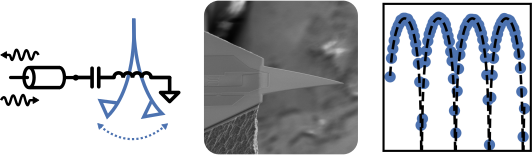
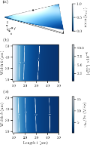
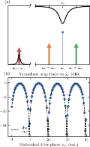
- power spectral density of fluctuations in force (force noise) SFF(ω), which sets a minimum detectable force (signal-to-noise ratio equals one) in a given measurement bandwidth, that is, signal integration time. The fluctuation–dissipation theorem applied to the harmonic oscillator gives where Tm is the



Quantitative wear evaluation of tips based on sharp structures
Beilstein J. Nanotechnol. 2024, 15, 230–241, doi:10.3762/bjnano.15.22
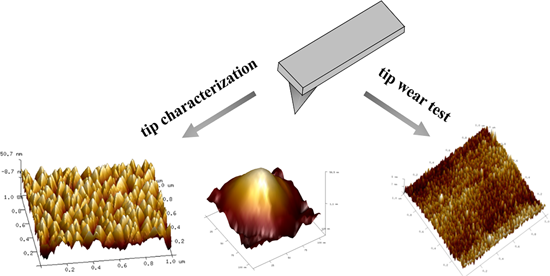
- increase in scanning frequency from 0.2 Hz to 1 Hz. This suggests that a faster scanning frequency can cause more wear. This increased wear may be attributed to low-cycle fatigue resulting from the higher speeds, which generate more heat and energy dissipation, thereby rendering the tip more susceptible to




Modification of graphene oxide and its effect on properties of natural rubber/graphene oxide nanocomposites
Beilstein J. Nanotechnol. 2024, 15, 168–179, doi:10.3762/bjnano.15.16
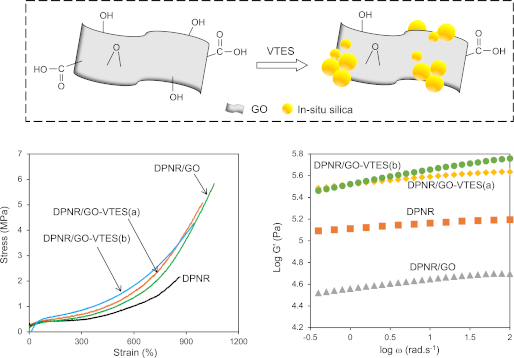
- dissipation while applying force than DPNR/GO-VTES(a) and DPNR. The loss tangent (tan δ) is defined as a G''/G' ratio. The dependence of tan δ with frequency for DPNR/GO samples was quite similar to that of DPNR, in which tan δ decreased as frequency decreased. This phenomenon is appointed to the pure
- in DPNR/GO-VTES(a) and DPNR/GO-VTES(b) may be responsible for a fast energy dissipation. Consequently, DPNR/GO0.5 which uses unmodified GO, shows both entropic and energetic elastic properties, as evidenced by the dependence of loss tangent versus frequency [34]. Conclusion Graphene oxide was






Enhanced feedback performance in off-resonance AFM modes through pulse train sampling
Beilstein J. Nanotechnol. 2024, 15, 134–143, doi:10.3762/bjnano.15.13
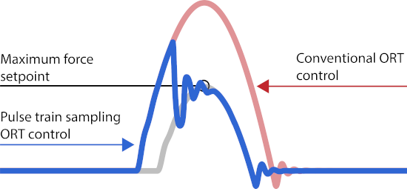
- curves, depends on the applied maximum force. Therefore, the maximum force error affects the measured dissipation values. To get better material contrast, one usually scans slowly to minimize the error. A lower imaging speed decreases the frequency of the disturbances induced by the topography, for which
- mode (ii., iv.). Similarly, panel (C) shows the dissipation channels at 0.5 Hz line rate (i., ii.) and 1 Hz line rate (iii., iv.), for impulse sampling mode (i., iii.) and pulse sampling mode (ii., iv.). In the error images, pixels with values outside of the range of ±25% of the setpoint (270 nN) are
- , calculated ratios are 0.2% and 2.7%, showing the significant improvement in tracking the topography. Moreover, the highlighted pixels in the error image also produce artefacts on the dissipation images (Figure 5C). As predicted, more accurate topography tracking of the pulse sampling mode yields less error


Josephson dynamics and Shapiro steps at high transmissions: current bias regime
Beilstein J. Nanotechnol. 2024, 15, 51–56, doi:10.3762/bjnano.15.5
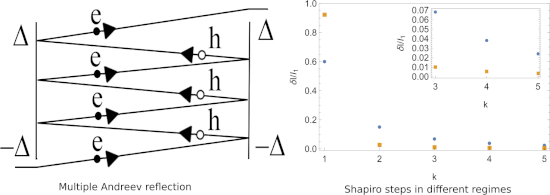
- transparent superconducting nanojunctions at subgap voltages and temperatures. In this limit, intrinsic dissipation in such junctions turns out to be sub-Ohmic, which yields a linear dependence of the average voltage on the bias current I slightly exceeding the critical one Ic. We demonstrate a strong impact
- of intrinsic sub-Ohmic dissipation on integer Shapiro steps appearing on the I–V curve in the presence of external microwave radiation. Keywords: dissipation; Josephson effect; Shapiro steps; superconducting junctions; Introduction The key signature of the ac Josephson effect in superconducting
- modified by replacing V by its time average V→. Dissipation usually plays an important role in the case of current-biased superconducting nanojunctions. One possible way to account for dissipative currents is to employ the so-called resistively shunted junction (RSJ) model [1]. In the case of tunnel


A combined gas-phase dissociative ionization, dissociative electron attachment and deposition study on the potential FEBID precursor [Au(CH3)2Cl]2
Beilstein J. Nanotechnol. 2023, 14, 1178–1199, doi:10.3762/bjnano.14.98
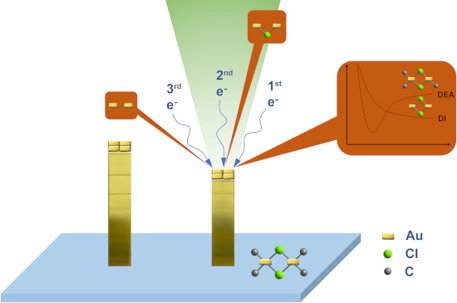
- in the gas phase. Interestingly, a more extensive fragmentation is observed in the FEBID experiment, while by considering only energy dissipation, one would rather expect stabilization (i.e., the opposite effect). In DI, rearrangement reactions are found to be dominant among the fragmentation



A bifunctional superconducting cell as flux qubit and neuron
Beilstein J. Nanotechnol. 2023, 14, 1116–1126, doi:10.3762/bjnano.14.92
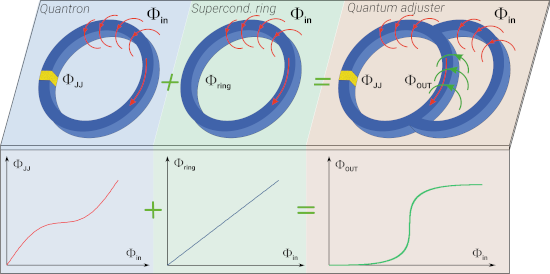
- and annihilation operators for the i-th bosonic mode. Hint is responsible for the interaction between the thermostat and the superconducting parametron. For the case of ohmic dissipation, this relationship is linear and can be written as: where k is a coupling constant. Within the framework of the



ZnO-decorated SiC@C hybrids with strong electromagnetic absorption
Beilstein J. Nanotechnol. 2023, 14, 565–573, doi:10.3762/bjnano.14.47
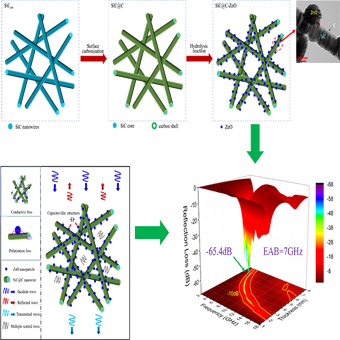
- , indicating that the conductivity loss through the carbon shell plays a dominant role in the EM dissipation. Based on the above analysis, it is considered that multiple loss mechanisms may contribute to the improvement of EM absorption for the as-prepared SiC@C-ZnO hybrids (Figure 7). First, the hybrid


Conjugated photothermal materials and structure design for solar steam generation
Beilstein J. Nanotechnol. 2023, 14, 454–466, doi:10.3762/bjnano.14.36
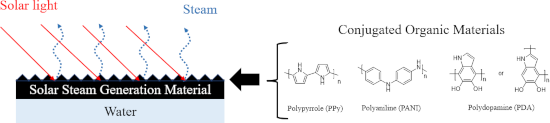
- supplies water to this photothermal film. The film is slightly lifted in order to reduce heat dissipation from the bulk water. This is also beneficial for SSG through the thermal energy generated by the PTM. Porous 3D structures Porous materials, such as sponges [45][49][58][59], foams [31][34][38][49][50


Plasmonic nanotechnology for photothermal applications – an evaluation
Beilstein J. Nanotechnol. 2023, 14, 380–419, doi:10.3762/bjnano.14.33
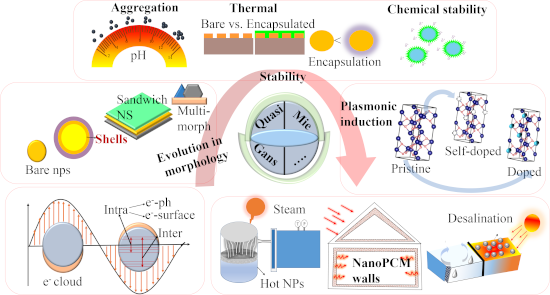
- can be used [92][93]: mi and Ci are, respectively, the mass and the specific heat capacity of the i-th component, T and t are, respectively, temperature and time, and Qin and Qout are, respectively, the rate of input power from the laser and the rate of heat dissipation to the surrounding. Often




Polymer nanoparticles from low-energy nanoemulsions for biomedical applications
Beilstein J. Nanotechnol. 2023, 14, 339–350, doi:10.3762/bjnano.14.29
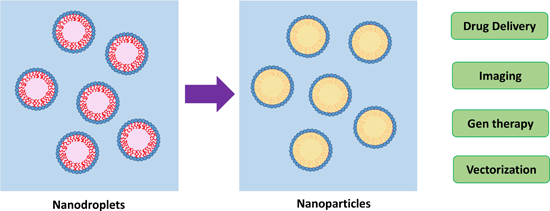
- -called high-energy methods (also called work-based methods [5]), this energy is supplied by external mechanical means, such as in high-pressure homogenizers or from ultrasound devices, with high dissipation (mostly in the form of heat) and, therefore, low energy efficiencies. In contrast, the so-called




Quasi-guided modes resulting from the band folding effect in a photonic crystal slab for enhanced interactions of matters with free-space radiations
Beilstein J. Nanotechnol. 2023, 14, 322–328, doi:10.3762/bjnano.14.27
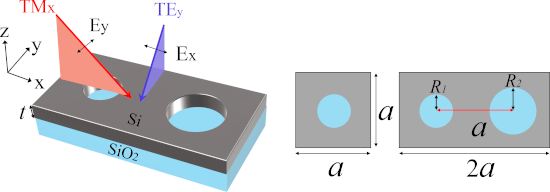
- . Plasmonic nanoantennas [3], although with relatively low Q-factors resulting from material dissipation, still provide a large level of field enhancement due to the deep-subwavelength level of mode confinement. As new alternatives to plasmonic nanostructures, all-dielectric nanostructures supporting Mie


A distributed active patch antenna model of a Josephson oscillator
Beilstein J. Nanotechnol. 2023, 14, 151–164, doi:10.3762/bjnano.14.16
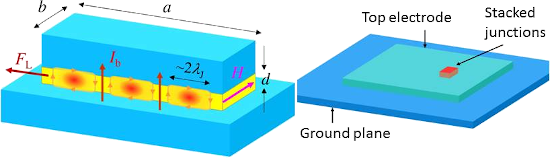
- is only slightly affected by an ill-defined QP resistance and remains practically the same even if we use the upper limit, GQP = 1/Rn. Importantly, ZTL is small because of very small d. Dissipative resistance The effective dissipative resistance is affected by all sources of dissipation, including QP


Frontiers of nanoelectronics: intrinsic Josephson effect and prospects of superconducting spintronics
Beilstein J. Nanotechnol. 2023, 14, 79–82, doi:10.3762/bjnano.14.9
- drastically lower energy dissipation. А logical solution and the most promising candidate for radical reduction in energy consumption is the superconducting digital technology (SDT) based on Josephson junctions. The intrinsic Josephson effect, which was first reported by Reinhold Kleiner, Paul Müller, and co
- -workers (see [4][5] and references therein) has been investigated by many researchers [6][7][8]. The energy consumption of the SDT basic element is of the order of 10−19 J, corresponding to up to seven orders of magnitude less energy dissipation than that for their semiconductor analog, even when the



