


Search results
Search for "dwell time" in Full Text gives 86 result(s) in Beilstein Journal of Nanotechnology.
Electron beam-induced deposition of platinum from Pt(CO)2Cl2 and Pt(CO)2Br2
Beilstein J. Nanotechnol. 2020, 11, 1789–1800, doi:10.3762/bjnano.11.161
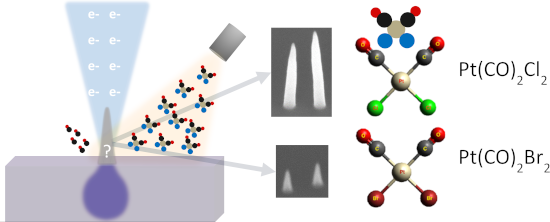
- ultrahigh-resolution (immersion) mode. Specific patterning parameters such as electron beam dwell time and the refresh time between exposure passes will be detailed for each experiment. To characterize FEBID growth, the height and base diameter of pillars were measured using 35° tilt images. Energy
- was used with beam currents of 12, 38, and 140 pA. A writing strategy was employed wherein a 4 × 5 array of locations at a 200 nm pitch was exposed in a serial fashion. At each location, the electron beam remained for a different dwell time, starting with 0.5 ms and increasing by 1 ms at each further
- electrons used to grow a pillar, that is, the beam current multiplied by the total dwell time at the location of exposure, excluding the waiting time. For point exposures, this is a better-defined measure than the dose per unit area. Although the diameters of the pillars from Pt(CO)2Cl2, as judged from


Out-of-plane surface patterning by subsurface processing of polymer substrates with focused ion beams
Beilstein J. Nanotechnol. 2020, 11, 1693–1703, doi:10.3762/bjnano.11.151
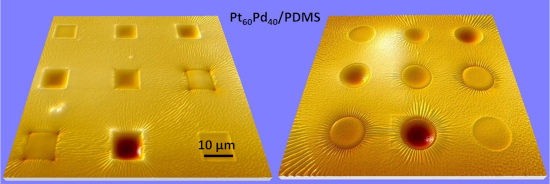
- mode with multiple passes and a beam dwell time of 2 µs. Arrays of 10 × 10 µm2 squares irradiated with different doses were used for measuring the dependence of the surface height on the irradiation dose, as previously described [4]. The distance between the square edges was kept at either 10 or 15 µm


Helium ion microscope – secondary ion mass spectrometry for geological materials
Beilstein J. Nanotechnol. 2020, 11, 1504–1515, doi:10.3762/bjnano.11.133
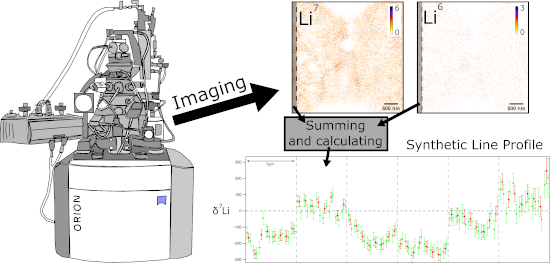
- value of m/z for which no secondary ions were expected, for the measurement of a “background count rate”, with a fixed, low magnetic field of around 100 mT. The primary beam was rastered over the sample to simultaneously map ion counts on each detector with a typical dwell time per pixel of 4 ms



Effect of localized helium ion irradiation on the performance of synthetic monolayer MoS2 field-effect transistors
Beilstein J. Nanotechnol. 2020, 11, 1329–1335, doi:10.3762/bjnano.11.117
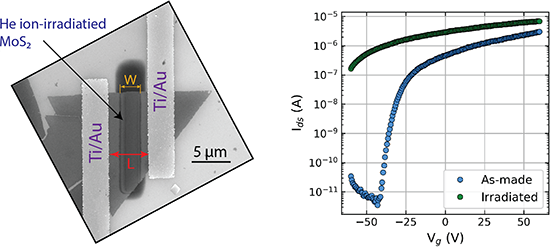
- ]. The average recorded beam current throughout the irradiations was 37.5 ± 0.4 pA, and the probe size was determined at approx. 7 nm [9]. The areal ion dose delivered to each sample was maintained at approx. 1017 ions cm−2, with a step size of 1 nm and a dwell time of 4.3 μs throughout the duration of a


3D superconducting hollow nanowires with tailored diameters grown by focused He+ beam direct writing
Beilstein J. Nanotechnol. 2020, 11, 1198–1206, doi:10.3762/bjnano.11.104
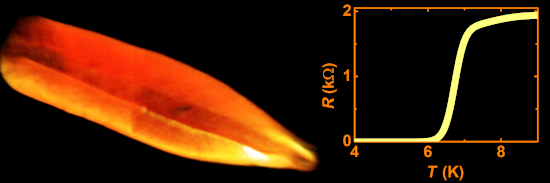
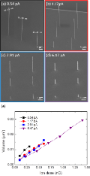
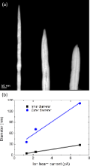
- from the substrate to the top of the pillar [36][37]. This shows the need for future systematic experiments varying the dwell time in pulsed growth or varying the flux of precursor gas. (High-resolution) scanning transmission electron microscopy Dependence of NW inner diameter on the ion beam current



Evaluation of click chemistry microarrays for immunosensing of alpha-fetoprotein (AFP)
Beilstein J. Nanotechnol. 2019, 10, 2505–2515, doi:10.3762/bjnano.10.241
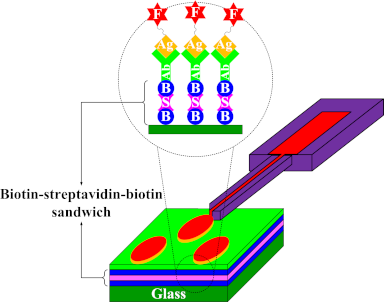
- Nanosciences) [45][46]. Prior to use, the cantilevers were activated by oxygen plasma (10 sccm O2, 0.2 mbar, 100 W, 2 min) and used immediately. The pen reservoir was filled with 0.2 μL of ink solution. For all patterns, a probe dwell time of 0.1 s was applied. Spotting was performed at an optimized relative


Gold-coated plant virus as computed tomography imaging contrast agent
Beilstein J. Nanotechnol. 2019, 10, 1983–1993, doi:10.3762/bjnano.10.195
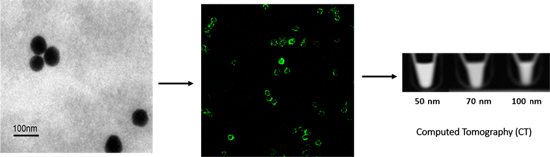
- data was processed by Aztec software from Oxford Instruments. Images were recorded on CCD camera with mapping resolution of 2048 × 1600. The beam was selected with accelerating voltage for imaging, beam current 100 pA at 30 kV and a spot size of 5–6, fast scan rate of dwell time (0.1–0.3 μs), detector




Precise local control of liquid crystal pretilt on polymer layers by focused ion beam nanopatterning
Beilstein J. Nanotechnol. 2019, 10, 1691–1697, doi:10.3762/bjnano.10.164
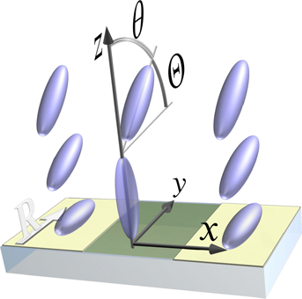
- within a raster consisting of up to 4096 × 3536 pixel2 as well as the time spent by the beam on each pixel (the so-called dwell time). According to our previous comparative study [31], a relatively small dose of Ga+ ions is sufficient for the required polymer transformation and we adopt here the same
- dwell time value of 150 μs. To achieve intermediate LC pretilt, we imprint three periodic patterns of stripes parallel to the PI rubbing direction. The patterns cover square areas of 440–450 μm in size and consist of 440, 294 and 220 stripes imprinted with 1 μm, 1.5 μm and 2 μm periodicity, respectively


Growth of lithium hydride thin films from solutions: Towards solution atomic layer deposition of lithiated films
Beilstein J. Nanotechnol. 2019, 10, 1443–1451, doi:10.3762/bjnano.10.142
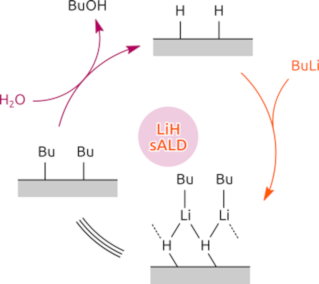
- . Point Auger spectra were collected from different areas on the surface of the sample after 20 s cleaning with 500 eV Ar+ ions. Dwell time during the acquisitions was 100 ms with 1 eV measurement steps with an energy resolution of ΔE/E of 0.5 %. XPS signals were recorded using a Thermo Scientific K-Alpha


Fabrication of phase masks from amorphous carbon thin films for electron-beam shaping
Beilstein J. Nanotechnol. 2019, 10, 1290–1302, doi:10.3762/bjnano.10.128
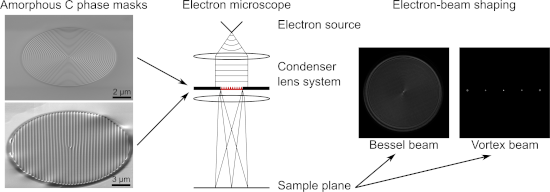
- × 2048 pixels and a dwell time of 50 ns was used which results in a dose of around 0.2 ions/nm2. Phase-mask patterning In the case of BBs the required thickness profile (Equation 3) was milled with custom FIB routines. These are realized in the form of text files in which the spatial coordinates for the
- . Further optimization of the pattern included an increase of the dwell time for the central point by a factor of five to achieve a similar depth as in the rings. Additionally, an offset angle between each repetition was implemented because the beam is not blanked when it moves radially outward between the
- software of the FIB system, which generates the milling pattern by calculating the dwell times based on the pixel values in the bitmap. The maximum dwell time value corresponding to a pixel value of 255 can be specified in the software and the gray values between 0 and 255 are scaled linearly. We used a



Advanced scanning probe lithography using anatase-to-rutile transition to create localized TiO2 nanorods
Beilstein J. Nanotechnol. 2019, 10, 412–418, doi:10.3762/bjnano.10.40
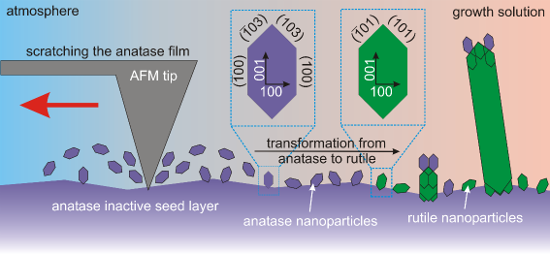
- deposited via resistive evaporation with a deposition rate of 3 Å/s. The Zeiss CrossBeam 1540XB FE SEM was employed for electron-beam exposure using an acceleration voltage of 10 kV, a current of 25 pA, a dose of 200 μAs/cm2, an area step size and dwell time of 1.6 nm and 200 ns, respectively, and an
- . Titanium was turned into the TiO2 seed layer in a rapid thermal processing oven at 850 °C in an oxygen atmosphere (500 sccm) for 2 h using a temperature dwell time of ±1 °C/s. The remaining resist was dissolved in acetone. Results and Discussion We have shown in a previous study that the nanorods produced


Accurate control of the covalent functionalization of single-walled carbon nanotubes for the electro-enzymatically controlled oxidation of biomolecules
Beilstein J. Nanotechnol. 2018, 9, 2750–2762, doi:10.3762/bjnano.9.257
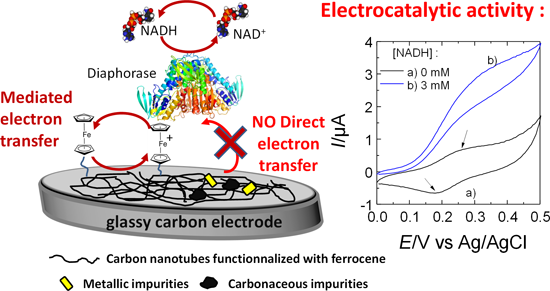
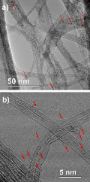
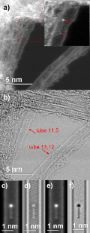
- and 11 mrad for an image resolution of 1024 × 1024 pixels with a dwell-time of 60 µs. STEM-EDS and STEM-EELS experiments were performed with an electron probe of about 0.17 nm and a convergence semi-angle of 24 mrad. The energy resolution was about 0.45 eV. The collection angle of the EELS






Pattern generation for direct-write three-dimensional nanoscale structures via focused electron beam induced deposition
Beilstein J. Nanotechnol. 2018, 9, 2581–2598, doi:10.3762/bjnano.9.240
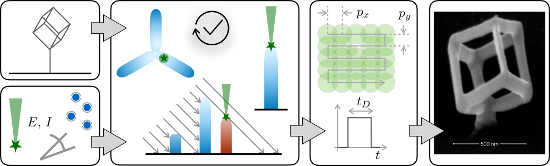
- introduces new vertices, but it also allows for changing, e.g., the distance between two neighboring DE locations (also denoted as pitch Π3D = (Πx, Πy, Πz)) or the duration of a dwell event td, as the pattern file generation progresses from one sub-edge to the next. Within one sub-edge, pitch and dwell time
- a very large jump at some time could then compensate too short jumps between two following DEs later on. In the current work a Gaussian is used with the distance of two consecutive DEs as argument. Its width can be defined in the settings file setf. In general, also the choice of the dwell time td
- auxiliary objects are defined in the geometry files. These will appear as first entries in the pattern files and will thus precede the beginning of the 3D deposition properly. The auxiliary objects comprise (a) four single dots written with a short dwell time at fixed positions defining the edges of a




Phosphorus monolayer doping (MLD) of silicon on insulator (SOI) substrates
Beilstein J. Nanotechnol. 2018, 9, 2106–2113, doi:10.3762/bjnano.9.199
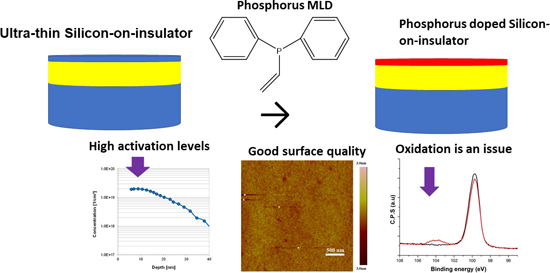
- dwell time of 0.3 s and a pass energy of 50 eV. Core-level scans were acquired at the applicable binding energy range with a step size of 0.1 eV, dwell time of 0.1 s and pass energy of 20 eV averaged over 10 scans. A non-monochromated Al Kα X-ray source at 200 W power was used for all scans. All spectra




High-throughput synthesis of modified Fresnel zone plate arrays via ion beam lithography
Beilstein J. Nanotechnol. 2018, 9, 2049–2056, doi:10.3762/bjnano.9.194
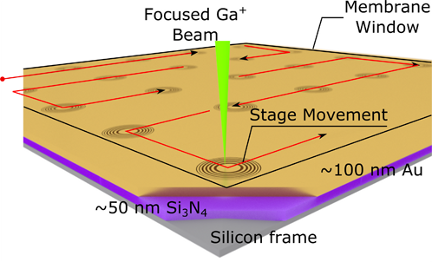
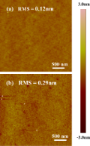
- the beam path), the current and the dwell time need to be precisely adjusted. Following the structuring of the zones, a ca. 3 µm thick beamstop was deposited in the central inactive region via focused ion beam induced deposition (FIBID) of Pt using trimethyl(cyclopentadienyl)platinum(IV), (CH3
- with equally high contrast. The innermost spokes were resolved by a line-by-line scan, using a relatively short pixel dwell time of 0.94 ms. A higher-magnification image of the innermost portion was obtained by a point by point scan shown in Figure 3b. It is seen from this image that the 30 nm features
- ion beam with a nominal beam size of 16 nm was utilized. By using a step size of 8 nm and a dwell time of 0.2133 the linear dosage was 0.8 pC/µm. The array was fabricated by replicating the pattern in a matrix form with 55 µm steps in the x- and y-directions. Dark-field scanning transmission electron


Magnetic properties of Fe3O4 antidot arrays synthesized by AFIR: atomic layer deposition, focused ion beam and thermal reduction
Beilstein J. Nanotechnol. 2018, 9, 1728–1734, doi:10.3762/bjnano.9.164
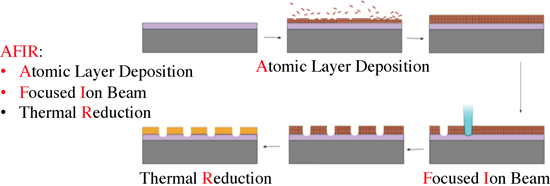
- dose of 30 mC/cm2. The dwell time was chosen to be sure that the ion beam completely perforated the Fe2O3 film and that the hole diameter was quite homogeneous, so at least 20 nm of the substrate were also etched. These antidot arrays are then placed into a furnace GSL-1100X from MTI Corporation, which




Cathodoluminescence as a probe of the optical properties of resonant apertures in a metallic film
Beilstein J. Nanotechnol. 2018, 9, 1491–1500, doi:10.3762/bjnano.9.140
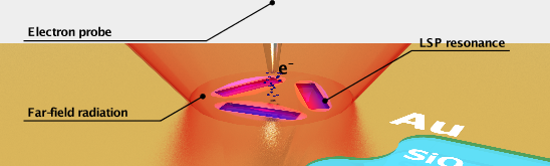
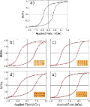
- different transverse parameters were milled using a helium ion microscope (Nanofab Orion, Zeiss) operating at an accelerating voltage of 30 kV and a beam current of 0.1 to 100 pA. A Fibics NPVE pattern generator was used to control the milling parameters such as dose, beam step size and dwell time. Test
- writing was performed on a 100 nm thick Au film on a borosilicate glass substrate. Initial exposures indicated a dose of 15 nC/cm2 as the optimal initial setting for the ion beam with a 1 µs dwell time and 50% beam overlap. The optimised ion beam current selected for milling was 1.5–2.4 pA, producing the


A novel copper precursor for electron beam induced deposition
Beilstein J. Nanotechnol. 2018, 9, 1220–1227, doi:10.3762/bjnano.9.113
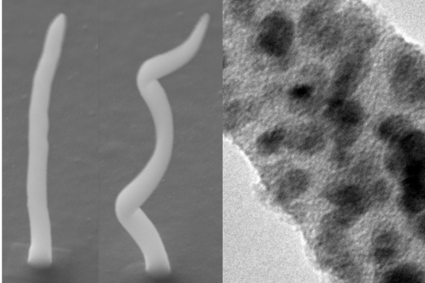
- dwell time, 3 nm point-to-point distance using a serpentine scanning routine. The number of scans increased from 30 to 300. The square pads had an edge length of 10 μm. The AFM image revealed the top edge of the pad being higher than the point in the center, giving an indented shape. This indicates a
- 50 pA beam current and point irradiation times of 60 seconds. The helix was achieved by a circular pattern with a radius of 120 nm, point-to-point distance of 0.5 nm and dwell time of 30 ms using two repetitions for two helix turns. Figure 4 shows scanning electron micrographs of both types of
- of 8 × 8 nanocones with a distance of 400 nm and a base diameter of 80 nm (Figure 5a). It was fabricated using 50 pA beam current and a dwell time of 8 seconds for each cone. The scattering intensity was measured by dark-field reflection spectroscopy and compared to FDTD simulations. Figure 5b shows


Magnetic characterization of cobalt nanowires and square nanorings fabricated by focused electron beam induced deposition
Beilstein J. Nanotechnol. 2018, 9, 1040–1049, doi:10.3762/bjnano.9.97
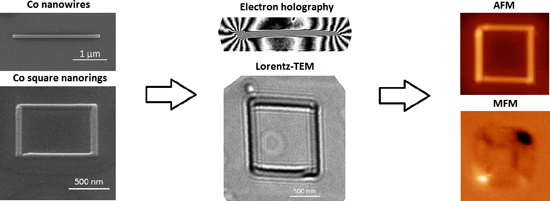
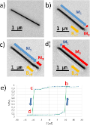
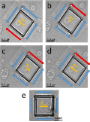
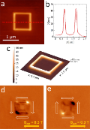
- , revealing different magnetization states and allowing for step-by-step imaging of magnetization reversal processes. Experimental FEBID was performed in a dual-beam system (FEI Strata DB 235M) using the following electron beam parameters: 1 μs dwell time, 90% overlap and 85 and 130 pA beam currents for
Comparative study of antibacterial properties of polystyrene films with TiOx and Cu nanoparticles fabricated using cluster beam technique
Beilstein J. Nanotechnol. 2018, 9, 861–869, doi:10.3762/bjnano.9.80
- of 90° using an Al Kα X-rays source (1486.6 eV, 200 W, Specs). High-resolution Ti 2p spectra are recorded at pass energy of 10 eV with 10 scans (dwell time 100 ms, step 0.05 eV). Prior the analysis, XPS spectra are charge referenced to adventitious carbon peak at 285 eV. Spectral analysis is




Towards the third dimension in direct electron beam writing of silver
Beilstein J. Nanotechnol. 2018, 9, 842–849, doi:10.3762/bjnano.9.78
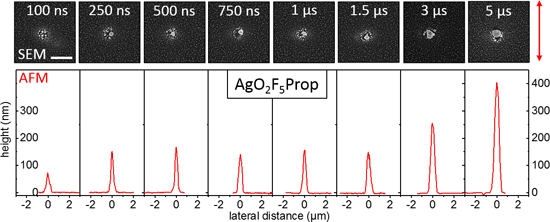
- pentafluoropropionate were investigated with respect to their dwell-time-dependent deposition behavior and growth characteristics. While silver 2,2-dimethylbutyrate showed a strong depletion in the center of the impinging electron beam profile hindering any vertical growth, silver pentafluoropropionate indicated a
- pronounced dependency of the deposit height on the dwell time. Truly three-dimensional silver structures could be realized with silver pentafluoropropionate. The pillars were polycrystalline with silver contents of more than 50 atom % and exhibit strong Raman enhancement. This constitutes a promising route
- . For the dwell time study and the pillar growth beam currents of 50, 150 and 500 pA were used. These correspond to FWHM of the primary electron beam of 100, 200 and 350 nm, respectively, as determined by imaging of lacey carbon edges. The acceleration voltage was kept constant at 15 kV throughout the


Electron interactions with the heteronuclear carbonyl precursor H2FeRu3(CO)13 and comparison with HFeCo3(CO)12: from fundamental gas phase and surface science studies to focused electron beam induced deposition
Beilstein J. Nanotechnol. 2018, 9, 555–579, doi:10.3762/bjnano.9.53


Gas-assisted silver deposition with a focused electron beam
Beilstein J. Nanotechnol. 2018, 9, 224–232, doi:10.3762/bjnano.9.24
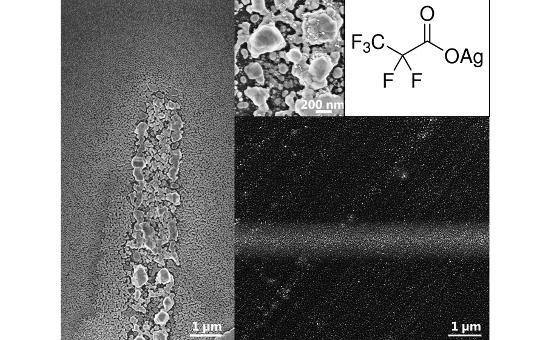
- have a measured full width at half maximum varying from 180 to 400 nm, according to the beam parameters (Table S1, Supporting Information File 1). The electron beam was controlled by a Xenos patterning engine which controls the shape, step size, dwell time and number of passes of the deposit. The line
- deposit lineXENOS was written with this system using 10 µs dwell time, 6 nm step size (corresponds to an effective dwell time of 667 µs per FWHM) and 2000 passes. Each pixel had a refreshment time of 660 ms. The line deposit lineTV was written with a dwell time per FWHM of 171 µs, 75000 passes and a
- refreshment time of 20 ms. The boxTV deposit was written with a dwell time per FWHM of 17.3 µs, 15000 passes and a refreshment time of 40 ms. The boxSLOW deposit was obtained with 4320 µs dwell time per FWHM, 6000 passes and a refreshment time of 10000 ms. For the four latter deposits the line and area scan


Comparative study of post-growth annealing of Cu(hfac)2, Co2(CO)8 and Me2Au(acac) metal precursors deposited by FEBID
Beilstein J. Nanotechnol. 2018, 9, 91–101, doi:10.3762/bjnano.9.11
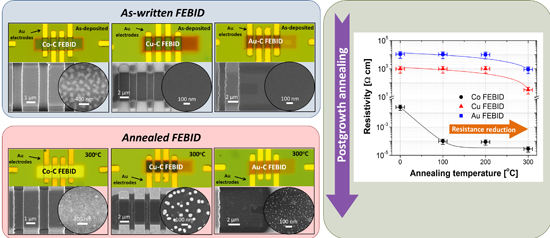
- substrate was kept at room temperature during all depositions, which were performed using a Hitachi S-3600 SEM with a tungsten filament, beam energy of 15 keV, 1.5 nA beam current, electron flux of 2.6 × 10¹⁸ s−1·cm−2, 10 μs dwell time per pixel, 9.6 ms refreshment time, serpentine scan and 10 nm pixel-to


Patterning of supported gold monolayers via chemical lift-off lithography
Beilstein J. Nanotechnol. 2017, 8, 2648–2661, doi:10.3762/bjnano.8.265
- data points were acquired with a 200 ms dwell time. For adequate signal-to-noise, the number of scans was adjusted for different regions of the spectrum to account for different relative sensitivity factors and low amounts of Au, ranging from 20 scans for C 1s to 100 scans for Au 4f. Because PDMS is an





