


Search results
Search for "resistivity" in Full Text gives 248 result(s) in Beilstein Journal of Nanotechnology. Showing first 200.
Microbubbles decorated with dendronized magnetic nanoparticles for biomedical imaging: effective stabilization via fluorous interactions
Beilstein J. Nanotechnol. 2019, 10, 2103–2115, doi:10.3762/bjnano.10.205
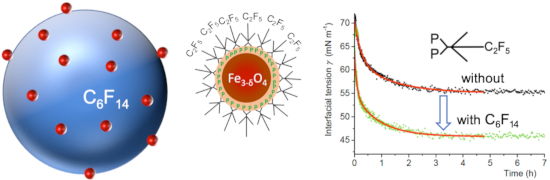
- , resistivity 18.2 MΩ cm). Synthesis of dendrons The approach to the synthesis of the dendrons C2F5OEG8Den and C4F9OEG8Den is described in [47]. From the intermediate D2-2P, the piperazine unit was installed in two steps (Scheme 1): 1) deprotection of the tert-butyl group and 2) amide coupling by using HATU


Porous silver-coated pNIPAM-co-AAc hydrogel nanocapsules
Beilstein J. Nanotechnol. 2019, 10, 1973–1982, doi:10.3762/bjnano.10.194
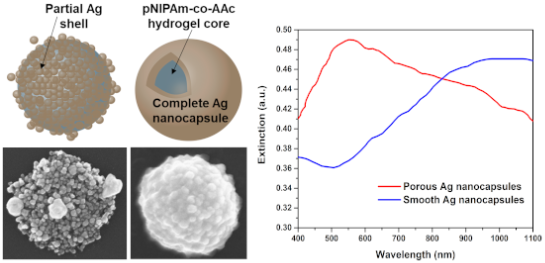
- nitrate (AgNO3, Strem), and ethanol (Aaper). N-Isopropylacrylamide (NIPAM, 99%) and acrylic acid (AAc, 99.5%) were obtained from Acros. Water was purified to a resistivity of 18.2 MΩ cm (Academic Milli-Q Water System; Millipore Corporation) and filtered using a 0.22 μm filter to remove any impurities. All


Nanoarchitectonics meets cell surface engineering: shape recognition of human cells by halloysite-doped silica cell imprints
Beilstein J. Nanotechnol. 2019, 10, 1818–1825, doi:10.3762/bjnano.10.176
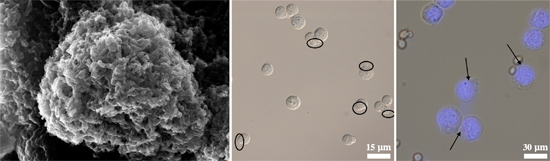
- Tetraethoxysilane (TEOS), poly(acrylamide-co-diallyldimethylammonium chloride) (P(AAm-co-DADMAC), rhodamine B, poly(allylamine hydrochloride) (РАН) were purchased from Sigma-Aldrich. Millipore water (specific resistivity 18 MΩ·cm at 25 °C) was used in all experiments. Halloysite nanotubes (HNTs) of 95–98% purity


Biocatalytic oligomerization-induced self-assembly of crystalline cellulose oligomers into nanoribbon networks assisted by organic solvents
Beilstein J. Nanotechnol. 2019, 10, 1778–1788, doi:10.3762/bjnano.10.173
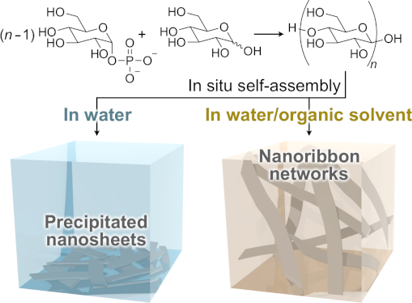
- -dihydroxybenzoic acid, and D2O were purchased from Sigma-Aldrich. Dotite was purchased from Nisshin EM Corporation. All other reagents were purchased from Nacalai Tesque. Ultrapure water with a resistivity greater than 18.2 MΩ cm was supplied by a Milli-Q Advantage A-10 apparatus (Merck Millipore) and used





Layered double hydroxide/sepiolite hybrid nanoarchitectures for the controlled release of herbicides
Beilstein J. Nanotechnol. 2019, 10, 1679–1690, doi:10.3762/bjnano.10.163
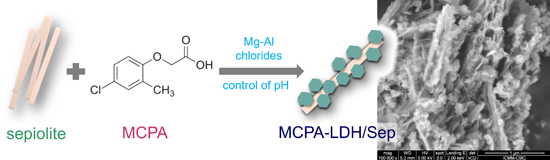
- %, Fluka), MgCl2·6H2O (99%, Carlo Erba), NaOH (≥98%, Fluka), ZnCl2 (>98%, Fluka). Deionized water (resistivity = 18.2 MΩ·cm) was obtained with a Maxima Ultrapure Water from Elga. Preparation of MCPA-LDH/sepiolite nanoarchitectures MgAl-LDH/sepiolite (LDH/Sep) nanoarchitectures were prepared following the


Superconducting switching due to a triplet component in the Pb/Cu/Ni/Cu/Co2Cr1−xFexAly spin-valve structure
Beilstein J. Nanotechnol. 2019, 10, 1458–1463, doi:10.3762/bjnano.10.144
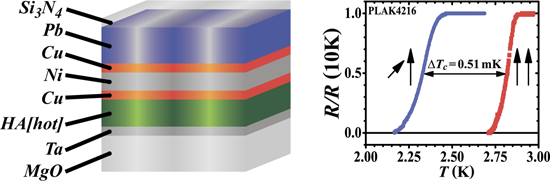
- magnetic field of 3 kOe possibly due to some magnetic inhomogeneity of the HA layer. We note that the magnetic response from the Ni layer cannot be resolved here due to its small value. The electrical resistivity was measured using the standard four-point method. The top insulating layer (Si3N4) was
- mechanically removed from the areas where the golden wires should be attached using a silver paste. The quality of the Pb layer can be judged from the residual resistivity ratio (RRR): Here, R(T) is the measured resistance at a given temperature T, ρph(300 K) is the phonon contribution to the specific
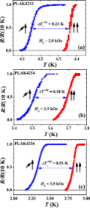
- resistivity at 300 K, and ρ(10 K) is the residual resistivity at 10 K (i.e., above Tc). For our samples this ratio amounted to RRR = 10–12, which corresponds to a SC coherence length of ξS = 41–45 nm (for details see [21]). The critical temperature Tc is defined as the midpoint of the SC transition curve. Its



Kelvin probe force microscopy of the nanoscale electrical surface potential barrier of metal/semiconductor interfaces in ambient atmosphere
Beilstein J. Nanotechnol. 2019, 10, 1401–1411, doi:10.3762/bjnano.10.138
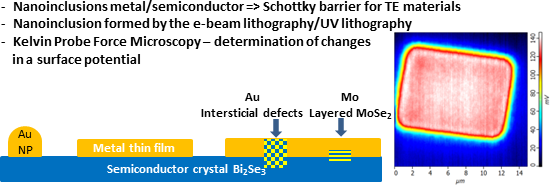
- harm to other transport parameters. The characterization of NIs or NPs in TE materials is realized most frequently by the different modes of atomic force microscopy (AFM): i) by comparing the conductivity/resistivity (CAFM) or I–V curves measurement in the direct-contact of the conductive tip and the


A silver-nanoparticle/cellulose-nanofiber composite as a highly effective substrate for surface-enhanced Raman spectroscopy
Beilstein J. Nanotechnol. 2019, 10, 1270–1279, doi:10.3762/bjnano.10.126
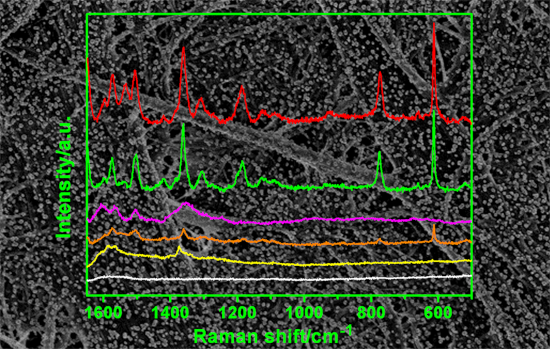
- in all the experiments was purified by using a Milli-Q Advantage A10 system (Millipore, Bedford, MA, USA) with a resistivity higher than 18.2 MΩ·cm. Fabrication of the paper-based Ag-NP/cellulose-NF composites The silver nanoparticles (Ag-NPs) were deposited onto the surface of the cellulose


Synthesis of MnO2–CuO–Fe2O3/CNTs catalysts: low-temperature SCR activity and formation mechanism
Beilstein J. Nanotechnol. 2019, 10, 848–855, doi:10.3762/bjnano.10.85
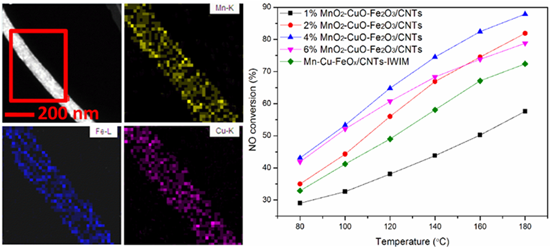
- (NO3)2·3H2O (AR), Fe(NO3)·9H2O (AR) and ethanol (AR) were purchased from Shanghai Chemical Reagent Ltd. All chemical were used without further purification. Deionized water with a resistivity above 18.0 MΩ·cm was obtained from a JL-RO100 Millipore-Q Plus. Modification of CNTs and the synthesis of MnO2




Features and advantages of flexible silicon nanowires for SERS applications
Beilstein J. Nanotechnol. 2019, 10, 725–734, doi:10.3762/bjnano.10.72

- ]. In short, Si wafers (<100> orientation, 5–10 Ω·cm resistivity, p-type) were cleaned following the standard RCA (Radio Corporation of America) cleaning processes [24], followed by Au sputtering in a Polaron E5000 sputter coater at ca. 5·10−4 mbar work pressure. Prior to VLS synthesis, annealing in


Enhancement in thermoelectric properties due to Ag nanoparticles incorporated in Bi2Te3 matrix
Beilstein J. Nanotechnol. 2019, 10, 634–643, doi:10.3762/bjnano.10.63
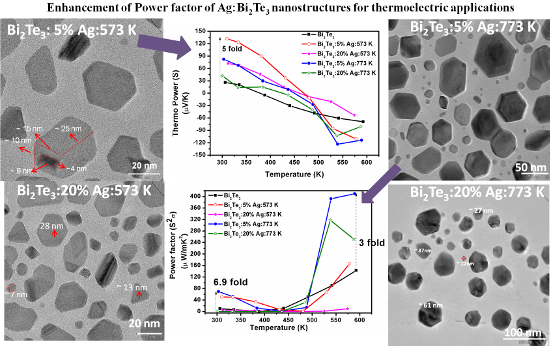
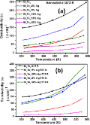
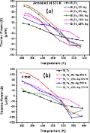
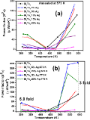
- conductivity with increase in Ag content in Bi2Te3 may be due to the enhanced carrier scattering at the interfaces of metal and semiconductor [20] and due to the presence of oxygen in all samples. An earlier report also suggests that the electrical resistivity of PbTe can increase up to 2–3 orders of magnitude



Effects of post-lithography cleaning on the yield and performance of CVD graphene-based devices
Beilstein J. Nanotechnol. 2019, 10, 349–355, doi:10.3762/bjnano.10.34
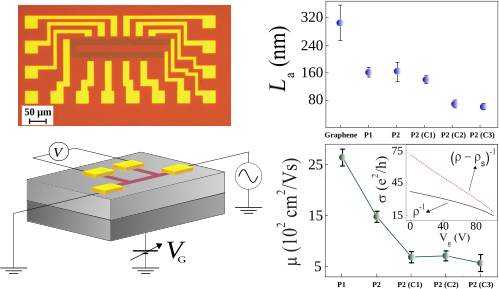
- holes. Figure 5 shows that graphene conductivity, σ, behaves as a sublinear function of the gate voltage, Vg. This sublinear behavior is associated to a weak-point disorder in graphene, which emerges as a carrier density independent residual resistivity, ρs. The strong disorder and the charged-impurity
- disorder are responsible for the resistivity (μne)−1, in which μ is the mobility and n is the carrier density [8][21]. Since n = αVg, where α = 7.2 × 1010 cm−2, we were able to find the resistivity ρs that linearizes the relation where ρ = 1/σ is the measured resistivity of graphene [24]. Then, the


Relation between thickness, crystallite size and magnetoresistance of nanostructured La1−xSrxMnyO3±δ films for magnetic field sensors
Beilstein J. Nanotechnol. 2019, 10, 256–261, doi:10.3762/bjnano.10.24
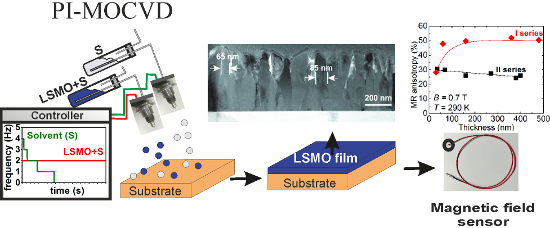
- ]. Transport and magnetoresistive properties In nanostructured manganite materials the difference in dimensions of crystallites and change of the relative amount of grain boundaries (GBs) and film composition significantly change the transport behaviour [17][21]. The decrease of electrical resistivity and the
- resistivity values were observed for the I series films (Figure 3b insert) due to smaller crystallites (Figure 4a,b) and larger number of GBs. The average crystallite diameter of 56 nm and 69 nm was found for the I and II series (Figure 4c), respectively. The technological processing and decrease of the
- resistivity, respectively) with film thickness was observed (Figure 4d,e). The largest MR magnitude (6%, when the field was directed parallel to the film plane B|| = 0.7 T) was obtained for the thickest films (≈400 nm) of the II series. The measured MR values of this II series films at room temperature are


Interaction of Te and Se interlayers with Ag or Au nanofilms in sandwich structures
Beilstein J. Nanotechnol. 2019, 10, 238–246, doi:10.3762/bjnano.10.22
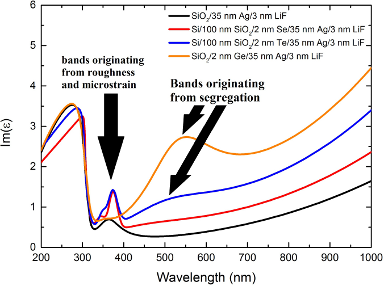
- spectra for samples measured two and four weeks after deposition is that for the latter, the contribution from the Drude term increases significantly, which results in higher values of Im(ε) in the long wavelength range. Since the Drude term is strictly connected to the sample resistivity, it suggests


Bidirectional biomimetic flow sensing with antiparallel and curved artificial hair sensors
Beilstein J. Nanotechnol. 2019, 10, 32–46, doi:10.3762/bjnano.10.4
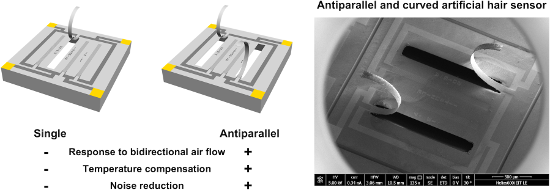
- circuit was excited with Vexc = +3.3 V DC, while its voltage output was connected to a benchtop digital multimeter (Agilent 34405A). Influence of temperature on micro strain gauges As electrical resistivity of metals is temperature-dependent, a drift in the offset voltage may occur while the flow sensor


Zn/F-doped tin oxide nanoparticles synthesized by laser pyrolysis: structural and optical properties
Beilstein J. Nanotechnol. 2019, 10, 9–21, doi:10.3762/bjnano.10.2
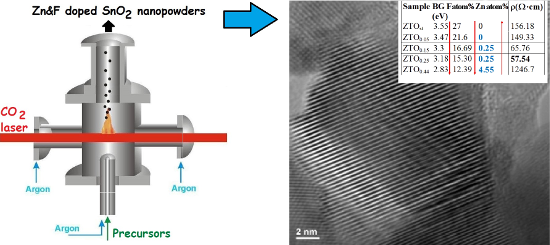
- estimated 4.18 eV bandgap value [24]. Also, the 1 atom % Nd-doped FTO film obtained by spray pyrolysis at 500 °C presented the lowest sheet resistance and resistivity values, which was accompanied by a 4.15 eV bandgap – a value 4.21 eV lower than that of FTO obtained under similar conditions. Also, in this
- resistivity at room temperature is on the order of tens to hundreds of Ω·cm. These electrical values are in agreement with those reported in literature considering that the resulting films have a low particle packing density (SnO2 bulk density is 7.0 g/cm3). Zn-doped SnO2 films have resistivity values
- rutile phase of SnO2. It has been demonstrated that by the increasing the fluorine concentration, the A1g position shift toward lower wavenumbers and the B2g band area grows about 100 times. The optimum resistivity of the co-doped SnO2 films is 57.54 Ω·cm for a ZnEt2 to SnMe4 flow ratio of 0.1. In order



Site-controlled formation of single Si nanocrystals in a buried SiO2 matrix using ion beam mixing
Beilstein J. Nanotechnol. 2018, 9, 2883–2892, doi:10.3762/bjnano.9.267
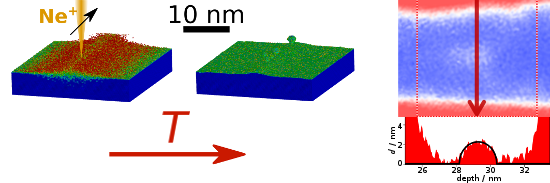
- are based on p-doped Si wafers with a specific resistivity of 10 Ω cm. The buried SiO2 layer was grown via thermal oxidation at 1123 K in dry O2 atmosphere in a furnace followed by RF-sputtering of an amorphous Si layer. The thickness of the oxide layer was measured by spectroscopic ellipsometry in


Contactless photomagnetoelectric investigations of 2D semiconductors
Beilstein J. Nanotechnol. 2018, 9, 2741–2749, doi:10.3762/bjnano.9.256
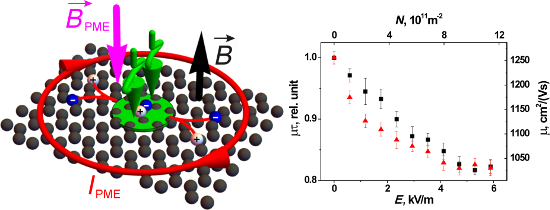
- the Van der Pauw method. For these measurements of resistivity and the Hall coefficient, the samples were equipped with 150 nm thick Au electrodes deposited using a Q150R ES rotary-pumped sputter coater with a film thickness monitor. For the PME-Corbino investigations of graphene with

![[Graphic 1]](/bjnano/content/inline/2190-4286-9-256-i2.svg?max-width=637&scale=1.18182) evoked by the PME circulating current in a point-illuminated 2D...
evoked by the PME circulating current in a point-illuminated 2D...

![[Graphic 7]](/bjnano/content/inline/2190-4286-9-256-i8.svg?max-width=637&scale=1.18182) vs the illumination intensity for differe...
vs the illumination intensity for differe...

![[Graphic 15]](/bjnano/content/inline/2190-4286-9-256-i16.svg?max-width=637&scale=1.18182) vs the carrier lifetime for different values ...
vs the carrier lifetime for different values ...


Optimization of Mo/Cr bilayer back contacts for thin-film solar cells
Beilstein J. Nanotechnol. 2018, 9, 2700–2707, doi:10.3762/bjnano.9.252
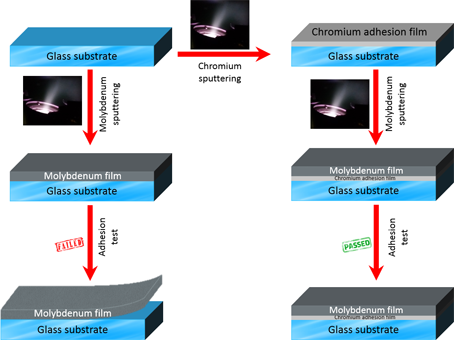
- different deposition powers and working pressures. Good adhesion to the SLG substrate has been achieved by means of an ultra-thin Cr layer under the Mo layer. By optimizing the deposition conditions we achieved low surface roughness, high optical reflectance and low sheet resistivity while we could decrease
- elements, Mo is reported to have a relatively better stability at the elevated temperatures required for the fabrication of CIGS and CZTS, better ohmic contact behavior, lower resistivity and a higher work function than the CIGS and CZTS light-absorbing semiconductor layers. However, the most challenging
- layer [10][11][12][13]. This involves the deposition of a thick Mo layer with low resistivity at low pressure and high sputtering power on a thin Mo layer deposited at high pressure and low power providing the required adhesion to the substrate. However, this method still does not guarantee the adhesion


High-temperature magnetism and microstructure of a semiconducting ferromagnetic (GaSb)1−x(MnSb)x alloy
Beilstein J. Nanotechnol. 2018, 9, 2457–2465, doi:10.3762/bjnano.9.230
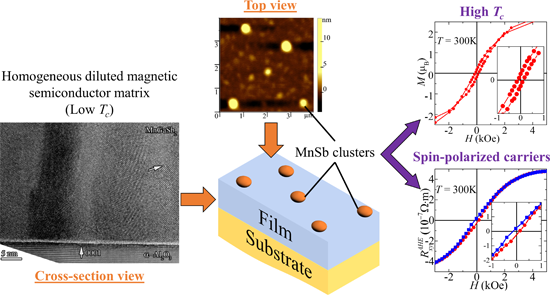
- mobility values have no pronounced dependence on the carrier concentration (see Table 1), i.e., the conductivity of the studied films is affected by various factors. Thus, magnetotransport phenomena can yield additional information about the system. The results of Hall resistivity measurements for the GM3
- sample are shown in Figure 3a and Figure 3b. The Hall resistivity in magnetic systems can be divided into two parts: where RH is the Hall constant, used for the determination of Np and μ (see Table 1), and Rs is the anomalous Hall constant, which is defined by several parameters of the system [22]. Thus
- , the Rxy(H) should reproduce the field dependence of the magnetization. As shown in Figure 3a, Rs·M(H) (the Hall resistivity after subtraction of the linear contribution) demonstrates hysteresis behavior (see inset) with Hc ≈ 140 Oe and a saturation field value of Hsat ≈ 3.8 kOe. This is in a good



Thickness-dependent photoelectrochemical properties of a semitransparent Co3O4 photocathode
Beilstein J. Nanotechnol. 2018, 9, 2432–2442, doi:10.3762/bjnano.9.228
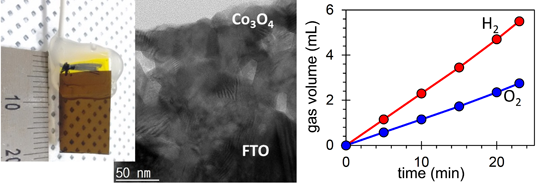
- regarding low-cost and reliable PEC cells [1][2][3][4][5][6][7][8]. For a widespread application of PEC cells, the photoelectrodes need to fulfill the criteria of (i) a low band gap (1.7–2.2 eV), (ii) low resistivity, (iii) low cost, (iv) corrosion stability and (v) a correct alignment of band edges with



Hydrothermal-derived carbon as a stabilizing matrix for improved cycling performance of silicon-based anodes for lithium-ion full cells
Beilstein J. Nanotechnol. 2018, 9, 2381–2395, doi:10.3762/bjnano.9.223
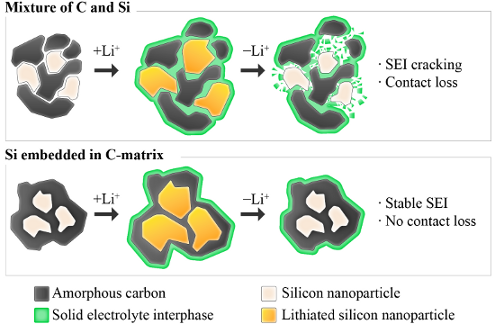
- contribute to a decreasing capacity with each cycle, either due to consumption of active Li, trapping of Li in disconnected Si or a growing resistivity [17][21][22][23][24][25]. With the aim to tackle these problems and to obtain Si anodes with a stable cycling performance at high capacity, several promising


Magnetism and magnetoresistance of single Ni–Cu alloy nanowires
Beilstein J. Nanotechnol. 2018, 9, 2345–2355, doi:10.3762/bjnano.9.219
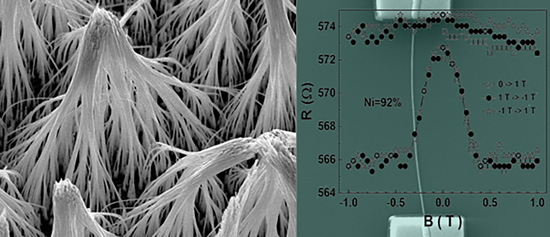
- by McGuire and Potter in 1975 [28]. Accordingly, in a magnetic monodomain system, the resistivity depends on the orientation of the spontaneous magnetization with respect to the current density. If θ is the angle between the magnetization and the current, the resistivity ρ(θ), can be expressed as: It
- is evident that if the field is perpendicular to the direction of the current (cos2 θ = 0), a perpendicular resistivity is measured, , whereas if the field is parallel to the current direction (cos2 θ = 1), a parallel resistivity is measured, , with . In a magnetic monodomain with uniaxial anisotropy
- spontaneous magnetization. When the current flows also along the EA, a sharp reversal of the localized magnetic moments from the current direction (θ = 0°) to the opposite direction (θ = 180°) has no influence on the resistivity (cos2 θ = 1) and hence the parallel resistivity, , should remain constant with


The role of adatoms in chloride-activated colloidal silver nanoparticles for surface-enhanced Raman scattering enhancement
Beilstein J. Nanotechnol. 2018, 9, 2236–2247, doi:10.3762/bjnano.9.208
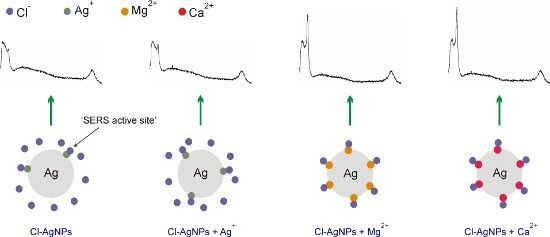
- . Ph. Eur., Merck), 9-aminoacridine hydrochloride monohydrate (for synthesis, Merck) and rhodamine 6G (99%, Sigma-Aldrich) were dissolved in ultrapure water (Direct-Q 3 UV, Millipore, resistivity higher than 18 MΩ). Synthesis of silver colloids The synthesis of all silver colloids used in this study is



Lead-free hybrid perovskites for photovoltaics
Beilstein J. Nanotechnol. 2018, 9, 2209–2235, doi:10.3762/bjnano.9.207
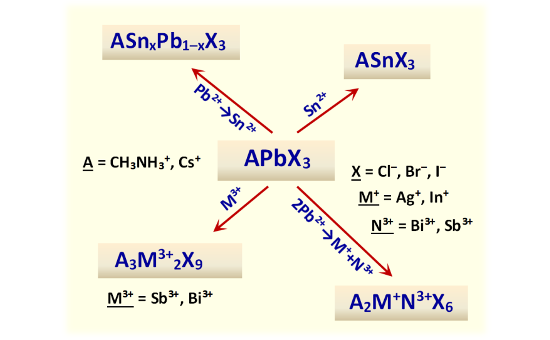
- preferable to sub-micrometer HP domains. Typically, the MABI-based solar cells demonstrate a high resistivity to air oxidation and ambient humidity [85][155][156][157][160][168]. Similar high stability to the degradation under ambient atmosphere was reported for highly luminescent Cs3Bi2X9 (X = Cl, Br, I





