Search results
Search for "polycrystalline" in Full Text gives 259 result(s) in Beilstein Journal of Nanotechnology. Showing first 200.
Controlling surface morphology and sensitivity of granular and porous silver films for surface-enhanced Raman scattering, SERS
Beilstein J. Nanotechnol. 2018, 9, 2813–2831, doi:10.3762/bjnano.9.263
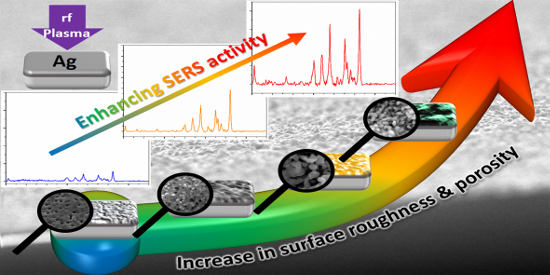
- oxidized silver film was performed with a hydrogen plasma at a power of 200 W and a chamber pressure of 0.38 mbar for 20 min in order to ensure complete reduction of the silver oxide film. Oxidation of sputtered silver films with oxygen plasma yields a polycrystalline silver oxide film with distinct grain



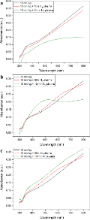



Variation of the photoluminescence spectrum of InAs/GaAs heterostructures grown by ion-beam deposition
Beilstein J. Nanotechnol. 2018, 9, 2794–2801, doi:10.3762/bjnano.9.261
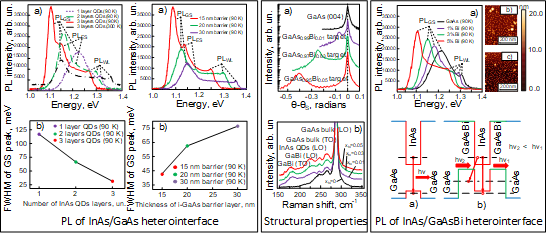
- /cm2. The covering of QDs by the i-GaAs layer was accompanied by an increase of the temperature to 550 °C. InAs/GaAs heterostructures with potential barriers of GaAsBi Growth of GaAs1−xBix layers was carried out using polycrystalline targets, which were made as follows. The batch composition was
- calculated in accordance with the solid phase composition of the finished GaAs1−xBix target. The total mass of the melt was calculated taking into account the ingot volume of the polycrystalline target. After chemical treatment, the components of the batch were placed in a graphite container. Heating of the
- melt. The resulting polycrystalline ingot was cut to 2 mm thick plates. For investigation of the influence of the potential barrier material on the photoluminescence properties of InAs/GaAs heterostructures, experimental samples with GaAs1−xBix potential barriers with bismuth fractions of 1, 3 and 5


Contactless photomagnetoelectric investigations of 2D semiconductors
Beilstein J. Nanotechnol. 2018, 9, 2741–2749, doi:10.3762/bjnano.9.256
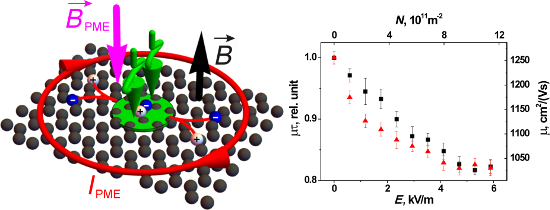
- (). Experimental The investigated graphene samples were supplied by Graphene Supermarket. The single-layer graphene films were grown by CVD processing on a cooper foil and transferred onto a 170 μm thick polyethylene terephthalate (PET) foil. The polycrystalline graphene films covered about 90% of the foil, with

![[Graphic 1]](/bjnano/content/inline/2190-4286-9-256-i2.svg?max-width=637&scale=1.18182) evoked by the PME circulating current in a point-illuminated 2D...
evoked by the PME circulating current in a point-illuminated 2D...

![[Graphic 7]](/bjnano/content/inline/2190-4286-9-256-i8.svg?max-width=637&scale=1.18182) vs the illumination intensity for differe...
vs the illumination intensity for differe...

![[Graphic 15]](/bjnano/content/inline/2190-4286-9-256-i16.svg?max-width=637&scale=1.18182) vs the carrier lifetime for different values ...
vs the carrier lifetime for different values ...


Size-selected Fe3O4–Au hybrid nanoparticles for improved magnetism-based theranostics
Beilstein J. Nanotechnol. 2018, 9, 2684–2699, doi:10.3762/bjnano.9.251
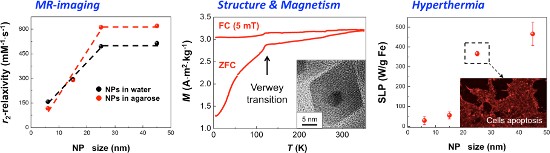
- ]. The XRD results suggest that the structure of sample MNP-25 is bulk-like Fe3O4 and Au in the NPs. The TEM diameter and the XRD crystallite size measurements of Fe3O4 match well, except for the MNP-44 batch, where polycrystalline Fe3O4 is presumed. We conclude that the Fe3O4 crystallite size can be
- ]. For sample MNP-44, TV is indeed shifted by more than 20 K, indicating that the Fe3O4 in this sample is of lower quality than for sample MNP-25. We ascribe this to the polycrystalline nature of the Fe3O4 NPs for this sample, as supported by the XRD results revealing a grain size of 17 nm compared to


Au–Si plasmonic platforms: synthesis, structure and FDTD simulations
Beilstein J. Nanotechnol. 2018, 9, 2599–2608, doi:10.3762/bjnano.9.241
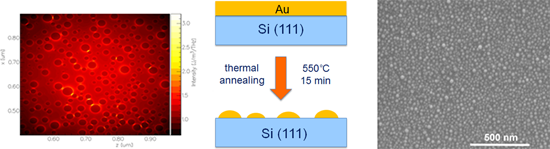
- nanoparticles also increases, but the amount of nanoparticles decreases (Figure 5). This behavior is consistent with the literature, but it can be also found, that during the annealing of polycrystalline films, an increase in grain size takes place until they reach a size approximately equal to twice the



Pattern generation for direct-write three-dimensional nanoscale structures via focused electron beam induced deposition
Beilstein J. Nanotechnol. 2018, 9, 2581–2598, doi:10.3762/bjnano.9.240
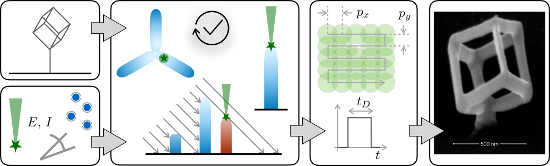
- the chosen process parameters, a wide range of different materials can be obtained. On the one hand, polycrystalline metals can be realized, mainly of ferromagnetic type like Fe, Co or Fe–Co alloys [12][13] or noble metals, such as Pt, Au and Ag [14][15][16]. On the other hand, granular metals [17
- ] but also various oxides and carbides in either amorphous or polycrystalline form [18][19] are accessible. By employing additional postdeposition treatments the metal volume content of some otherwise granular metals can be increased to virtually 100% [20][21][22]. Despite the apparent simplicity of the




Lead-free hybrid perovskites for photovoltaics
Beilstein J. Nanotechnol. 2018, 9, 2209–2235, doi:10.3762/bjnano.9.207
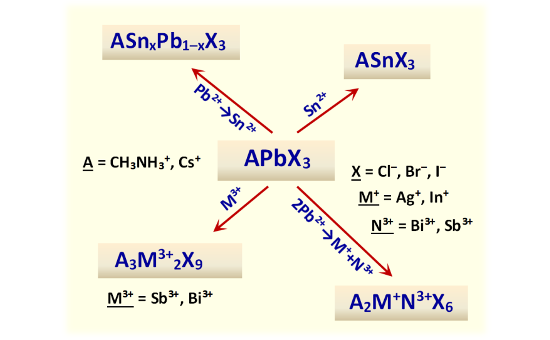
- luminescent Cs3Bi2X9 NCs [159]. A study of single-crystal and polycrystalline MABI showed that both materials have a long exciton lifetime and a high carrier mobility [161][163]. A transient absorption study of MABI crystals showed only a minor change of the exciton dynamics when the crystal size was reduced


Light–Matter interactions on the nanoscale
Beilstein J. Nanotechnol. 2018, 9, 2125–2127, doi:10.3762/bjnano.9.201

- century. Laser processing of thin-film multilayer structures has been one of the initial research directions in photonics [2]. This technique has been employed for many applications, including but not limited to the fabrication of polycrystalline silicon (poly-Si) thin-film transistors or MEMS/NEMS
Synthesis of a MnO2/Fe3O4/diatomite nanocomposite as an efficient heterogeneous Fenton-like catalyst for methylene blue degradation
Beilstein J. Nanotechnol. 2018, 9, 1940–1950, doi:10.3762/bjnano.9.185
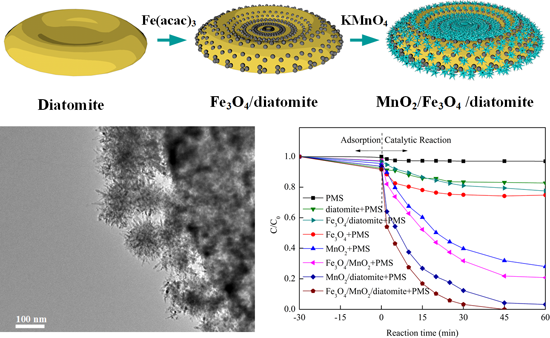
- performed. As shown in Figure 4a, the Fe3O4/diatomite exhibits a morphology similar to that seen in the SEM images, a layer of nanoparticles with diameter of about 10 nm are highly dispersed on the surface of diatomite, which demonstrates a porous polycrystalline structure composed of many interconnected


Synthesis of carbon nanowalls from a single-source metal-organic precursor
Beilstein J. Nanotechnol. 2018, 9, 1895–1905, doi:10.3762/bjnano.9.181
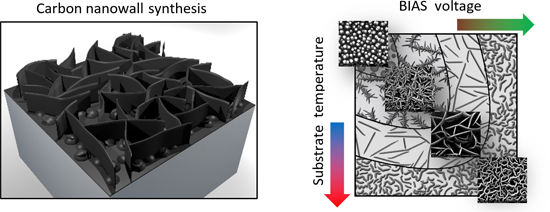
- is based on so-called crowding effects [20]. They suggest that horizontally aligned CNWs first grow until they touch each other and, due to the lack of space, later raise and grow vertically. Zhu et al. used polycrystalline silicon substrates and proposed that after synthesizing an initial graphene


Direct AFM-based nanoscale mapping and tomography of open-circuit voltages for photovoltaics
Beilstein J. Nanotechnol. 2018, 9, 1802–1808, doi:10.3762/bjnano.9.171
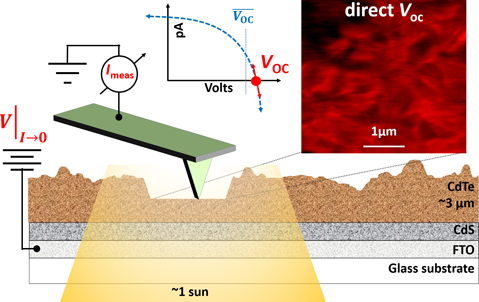
- Katherine Atamanuk Justin Luria Bryan D. Huey University of Connecticut, Dept. of Materials Science and Engineering, Storrs, Connecticut 06269, USA 10.3762/bjnano.9.171 Abstract The nanoscale optoelectronic properties of materials can be especially important for polycrystalline photovoltaics
- interconnects [4][5], and tomographic AFM of photocurrents in polycrystalline solar cells during in situ illumination [6]. Standard photo-conductive AFM (pcAFM) employs a conducting probe, which serves as a positionable top electrode, to map currents upon illumination and/or biasing. With solar cells, the short
- practically removed per image frame, leading to effective 30 nm resolution in the z-direction between consecutive pairs of ISC* and VOC* maps throughout the polycrystalline film thickness. During such progressive imaging some spatial drift is unavoidable, though this is easily accommodated by commercial, free


Multimodal noncontact atomic force microscopy and Kelvin probe force microscopy investigations of organolead tribromide perovskite single crystals
Beilstein J. Nanotechnol. 2018, 9, 1695–1704, doi:10.3762/bjnano.9.161
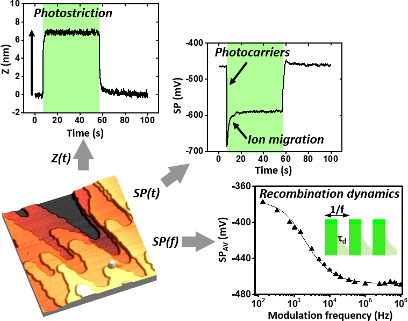
- internal electric field distribution and photocarrier recombination mechanisms in polycrystalline perovskite thin films [6][7]. However, considering the results of earlier works shows that it is sometimes difficult to draw definitive conclusions about the detrimental (or beneficial) impact of the GBs on
- the surface potential probed by KPFM. It is now clear that a complex interplay exists between the charge carrier populations, traps, and mobile ions. Despite all the progress made, interpreting the surface potential (SP) and surface photovoltage (SPV) contrasts recorded by KPFM on polycrystalline lead


Nitrogen-doped carbon nanotubes coated with zinc oxide nanoparticles as sulfur encapsulator for high-performance lithium/sulfur batteries
Beilstein J. Nanotechnol. 2018, 9, 1677–1685, doi:10.3762/bjnano.9.159
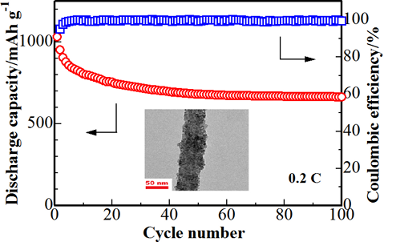
- polycrystalline structure of the as-prepared ZnO@NCNT. Morphology and structure of the ZnO@NCNT before S loading are similar to those in our previous studies, and were discussed in our previous work [13]. After loading with S, the morphology of resulting S/ZnO@NCNT composite was again characterized by SEM and TEM


Sheet-on-belt branched TiO2(B)/rGO powders with enhanced photocatalytic activity
Beilstein J. Nanotechnol. 2018, 9, 1550–1557, doi:10.3762/bjnano.9.146
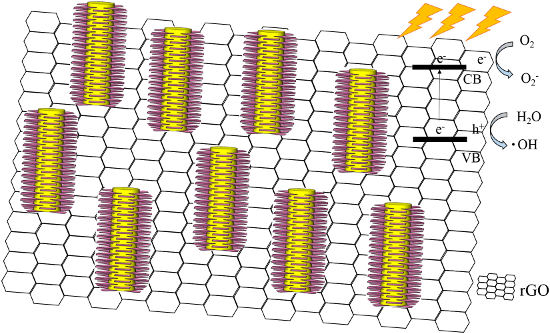
- corresponding to polycrystalline TiO2(B). The high-resolution TEM (HRTEM) image demonstrated in Figure 3c shows parallel fringes with a neighboring distance of ≈0.545 nm, corresponding to the (200) plane of TiO2(B) and distance of ≈0.382 nm, which is attributed to the (110) plane of TiO2(B). The cross-angle of


Atomistic modeling of tribological properties of Pd and Al nanoparticles on a graphene surface
Beilstein J. Nanotechnol. 2018, 9, 1239–1246, doi:10.3762/bjnano.9.115
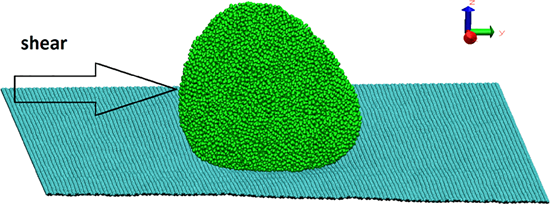
- peaks of radial distribution function are blurred indicating that the nanoparticles are amorphous or polycrystalline. Keywords: aluminum; friction force; graphene; nanoparticle; nanotribology; palladium; Introduction The study of surface or interface phenomena at the atomic level has attracted
- polycrystalline structures of nanoparticles. Figure 10B,D shows the atoms of the Al and Pd nanoparticles at the particle–graphene interface. Note that domains of ordered atoms structures can be observed for both types of particles, but are more clear for the Al particle. Since the internal atom–atom bonding in
- ]. The peaks of RDF are blurred and we can conclude that long-range atomic order is absent and the nanoparticles are amorphous or have a polycrystalline order. We have observed regions of local order of atoms on the particle bottom surface, which may influence the saw-like form of the substrate force as


Heterostuctures of 4-(chloromethyl)phenyltrichlorosilane and 5,10,15,20-tetra(4-pyridyl)-21H,23H-porphine prepared on Si(111) using particle lithography: Nanoscale characterization of the main steps of nanopatterning
Beilstein J. Nanotechnol. 2018, 9, 1211–1219, doi:10.3762/bjnano.9.112
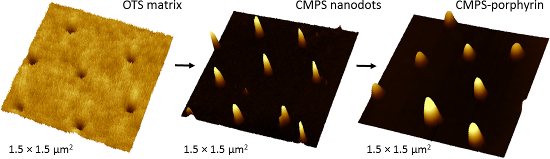
- interfaces has been studied using layer-by-layer assembly that incorporates organosilane or organothiol monolayers to functionalize a surface to form multilayer films [2][3]. Dip-pen nanolithography was applied to pattern porphyrazines onto a polycrystalline gold surface to align horizontally or vertically


Comparative study of sculptured metallic thin films deposited by oblique angle deposition at different temperatures
Beilstein J. Nanotechnol. 2018, 9, 954–962, doi:10.3762/bjnano.9.89
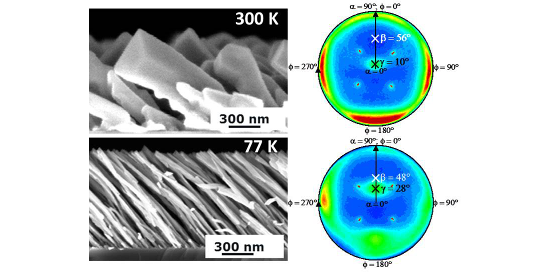
- maxima, revealing a polycrystalline fiber-texture contribution. The four sharp peaks in Figure 2e and 2g, respectively, originate from the Si(100) substrate. The presence of an 800 nm thick oxide layer on the substrate prohibits an epitaxial relationship between the columns and the substrate. In summary
- thin films (θ = 82°), polycrystalline Al thin films are grown with a vertically incoming Al atom flux (θ = 0°). The θ–2θ scans (not shown here) of these vertically deposited films reveal a preferred [111] growth direction for deposition at 77 K, but [111] as well as [100] growth directions for



Effect of annealing treatments on CeO2 grown on TiN and Si substrates by atomic layer deposition
Beilstein J. Nanotechnol. 2018, 9, 890–899, doi:10.3762/bjnano.9.83
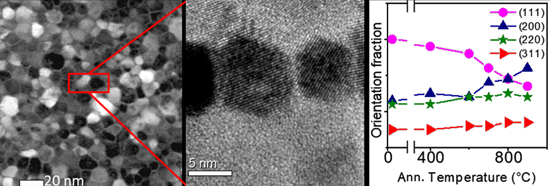
- crystallization. When ceria is deposited on TiN, the temperature has to be limited to 600 °C due to the thermal instability of the underlying TiN substrate with a broadening of the interface, while there are no changes detected inside the CeO2 films. As-deposited CeO2 films show a cubic fluorite polycrystalline
- sputtering [7], e-beam [16], physical vapor deposition [17], chemical vapor deposition (CVD) [18], and atomic layer deposition (ALD). The latter has been explored by using different precursors, e.g., Ce(thd)4, Ce(iPrCp)3 and Ce(mmp)4) [19][20][21][22][23], obtaining as-deposited film with polycrystalline
- use these relative intensities as indication of a preferential orientation by comparing them with the relative intensities of a randomly oriented polycrystalline material (black symbols). In the case of CeO2 deposited on TiN, the prevalence of the (111) orientation and its preservation upon annealing


Facile chemical routes to mesoporous silver substrates for SERS analysis
Beilstein J. Nanotechnol. 2018, 9, 880–889, doi:10.3762/bjnano.9.82
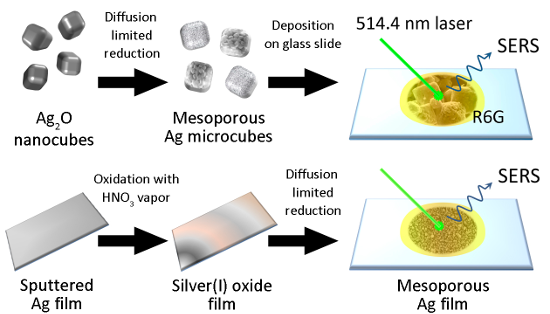
- efficient method for synthesis of silver polygonal structures with amazingly precise shape control using silver(I) oxide as a structural precursor. According to the technique described also elsewhere [27], polycrystalline uniform Ag2O polyhedron-like crystallites could be quantitatively obtained. Such cubic
- silver prepared at a double excess of NaBH4 is of 230 ± 90 nm (Figure 1c) and the related pore size is about 100 nm. A ten-fold excess of NaBH4 led to full conversion of polycrystalline Ag2O to ≈1 μm sponge-like Ag grains (Figure 1d), which also contained numerous mesopores. As it was discussed elsewhere


Towards the third dimension in direct electron beam writing of silver
Beilstein J. Nanotechnol. 2018, 9, 842–849, doi:10.3762/bjnano.9.78
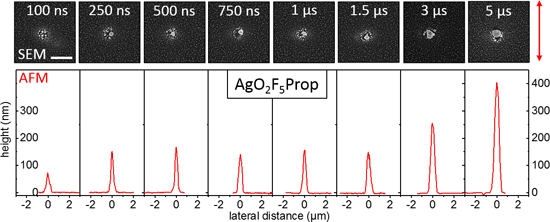
- pronounced dependency of the deposit height on the dwell time. Truly three-dimensional silver structures could be realized with silver pentafluoropropionate. The pillars were polycrystalline with silver contents of more than 50 atom % and exhibit strong Raman enhancement. This constitutes a promising route
- that the forward scattered electrons add to the carbon and oxygen signal, a conservative estimate gives 50 atom % of silver. This lower limit for the silver content for the pillars is contrasted by their polycrystalline nature, their Raman activity in Figure 3e, and the higher silver content measured


Facile synthesis of a ZnO–BiOI p–n nano-heterojunction with excellent visible-light photocatalytic activity
Beilstein J. Nanotechnol. 2018, 9, 789–800, doi:10.3762/bjnano.9.72
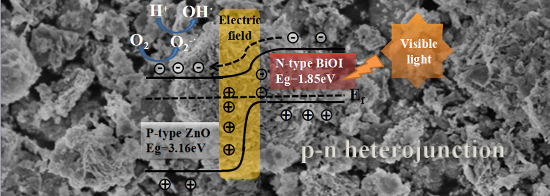
- (Figure S2d, Supporting Information File 1) illustrate the polycrystalline nature of sample B-3 and the coexistence of BiOI and ZnO. Two bright inner rings, which are indexed to BiOI (106) and ZnO (004) facets, indicate the high crystalline degree and echo the previous XRD study to a great extent. The TEM


Review: Electrostatically actuated nanobeam-based nanoelectromechanical switches – materials solutions and operational conditions
Beilstein J. Nanotechnol. 2018, 9, 271–300, doi:10.3762/bjnano.9.29
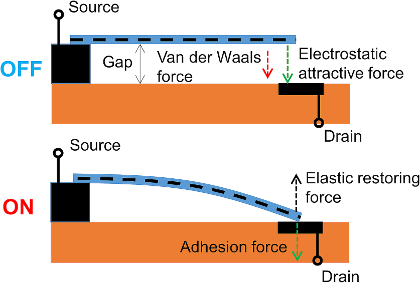
- explained as follows: currently, large area graphene can be prepared by the CVD technique; synthesized by this method, graphene has a polycrystalline nature. Processes occurring at the grain boundaries of polycrystalline graphene as, for example, charge carrier scattering and mechanical stress, result in
- , Si is widely used in top-down fabrication of NEM switches [20][21][22][50][132]. Top-down Si-based NEM devices of different designs (for example, U-shaped dual-beam structure with capacitive paddle (Figure 11a) [20], torsional [133]) are typically fabricated from single- or polycrystalline Si


Co-reductive fabrication of carbon nanodots with high quantum yield for bioimaging of bacteria
Beilstein J. Nanotechnol. 2018, 9, 137–145, doi:10.3762/bjnano.9.16
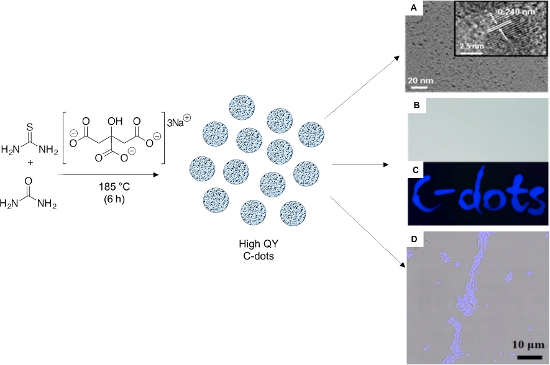
- . This could be ascribed to the fact that the average polycrystalline signal is collected in XRD, while in TEM, only the single crystallite is investigated. The mean crystallite size of the C-dots was estimated by using Scherrer’s equation, D = kλ/βcosθ, where D is the average crystallite size, k is a


Comparative study of post-growth annealing of Cu(hfac)2, Co2(CO)8 and Me2Au(acac) metal precursors deposited by FEBID
Beilstein J. Nanotechnol. 2018, 9, 91–101, doi:10.3762/bjnano.9.11
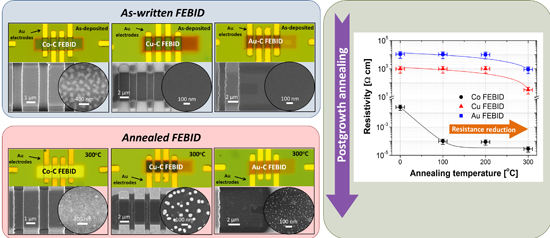
- turns the amorphous carbon into polycrystalline graphite. According to Tuinstra et al. [58], Robertson [59] and Ferrari and co-workers [60], both the G band shift and the integrated intensity ratio allow for the determination of the in-plane correlation length, or of the grain size of graphitic


Growth model and structure evolution of Ag layers deposited on Ge films
Beilstein J. Nanotechnol. 2018, 9, 66–76, doi:10.3762/bjnano.9.9
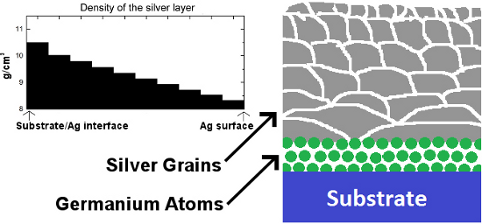
- varying from 2 to 10 nm. This allows to determine the rate of Ge segregation into the Ag polycrystalline structure, but also to assess at which Ag-to-Ge ratio these samples can be treated as silver grains decorated with Ge atoms and when should they be treated as an elemental mixture. To verify whether Ge