Search results
Search for "defects" in Full Text gives 746 result(s) in Beilstein Journal of Nanotechnology. Showing first 200.
Engineered titania nanomaterials in advanced clinical applications
Beilstein J. Nanotechnol. 2022, 13, 201–218, doi:10.3762/bjnano.13.15
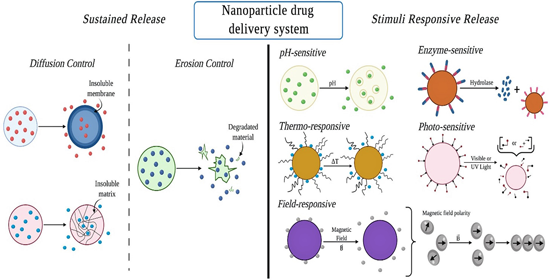
- generated free electrons (e−) react with molecular oxygen to generate superoxide radicals by reduction. Several factors contribute to the photocatalytic performance of TiO2, such as the structural phase (anatase, brookite, or rutile), defects in the lattice, the degree of crystallinity, morphology
- conversion agent. Following ultrasound (US) irradiation, the oxygen-deficient TiO2−x layer with numerous defects facilitates and accelerates the separation of electrons and holes, resulting in a high quantum yield of ROS for tumor eradication. Both in vitro cell-level and systematic in vivo studies of tumor


A photonic crystal material for the online detection of nonpolar hydrocarbon vapors
Beilstein J. Nanotechnol. 2022, 13, 127–136, doi:10.3762/bjnano.13.9
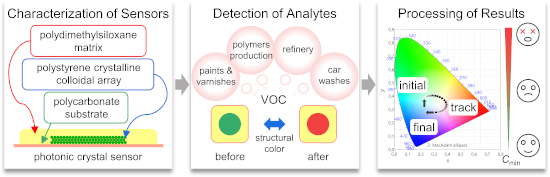
- particles are consistent with the SEM results, and the effective refractive indices are slightly overestimated in comparison with the theoretically calculated values (without PDMS: 1.477, with PDMS: 1.568) [39][40]. This may be due to the presence of surfactants in the interparticle space, defects of the


Tin dioxide nanomaterial-based photocatalysts for nitrogen oxide oxidation: a review
Beilstein J. Nanotechnol. 2022, 13, 96–113, doi:10.3762/bjnano.13.7
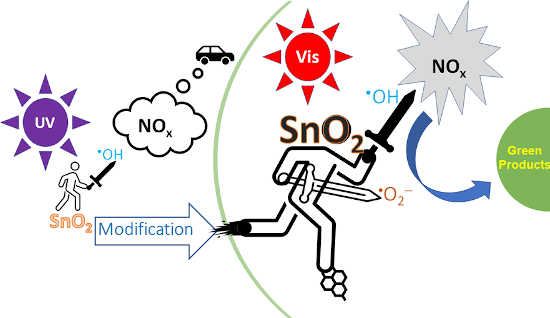
- vacancy defects (OVs) [15][16]. Therefore, SnO2 is considered a potential material in various technological fields such as catalysis, optoelectronic devices, rechargeable lithium batteries, electrocatalysis, photocatalysis, solar energy conversion, and gas sensing [17][18][19][20][21][22][23][24]. In the
- catalytic area, SnO2 is an emerging material for removing contaminants such as organic dyes, phenolic compounds, and volatile organic compounds (VOCs) due to strongly oxidizing properties thanks to flexible energy band structure, rich defects, good chemical, and high thermal stability, and easily controlled
- a SnO2 thin film with a thickness of about 130 nm is 3.597 eV [42]. The reported bandgap of bulk SnO2 is 3.6 eV. Changing the morphology, particle size, or the formation of OVs or defects narrow the bandgap. In the study of Babu et al., a redshift of the absorption edge was observed when SnO2


Topographic signatures and manipulations of Fe atoms, CO molecules and NaCl islands on superconducting Pb(111)
Beilstein J. Nanotechnol. 2022, 13, 1–9, doi:10.3762/bjnano.13.1
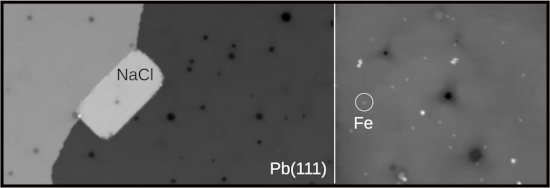
- scanning tunneling spectroscopy (STS) is a zero-bias conductance peak occurring at boundaries and defects. Unfortunately, other structural peculiarities can also mimic such zero-bias anomalies, which eventually leads to severe misinterpretations. Therefore, the latest advances in scanning tunneling
- Cu(111) [62]. Occasionally, even a trilayer phase appears within the NaCl bilayer (Figure 3a and Figure 3b). Note also that dark protrusions originating from trapped Ar atoms are still visible through the NaCl island by STM as well as point defects. We do not exclude that these might be Cl vacancies


Measurement of polarization effects in dual-phase ceria-based oxygen permeation membranes using Kelvin probe force microscopy
Beilstein J. Nanotechnol. 2021, 12, 1380–1391, doi:10.3762/bjnano.12.102
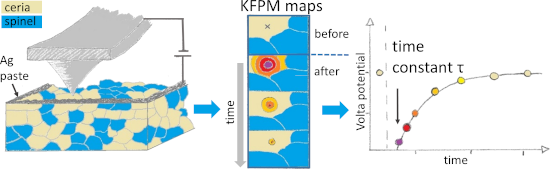
- indicated by the arrow in the upper left side in Figure 1b. The HAADF image in Figure 2a shows a CSO-FC2O interface with the left CSO grain tilted along its [001] direction. A clean surface without any significant structural defects is observed. Corresponding to the square-defined region in Figure 1a


Chemical vapor deposition of germanium-rich CrGex nanowires
Beilstein J. Nanotechnol. 2021, 12, 1365–1371, doi:10.3762/bjnano.12.100
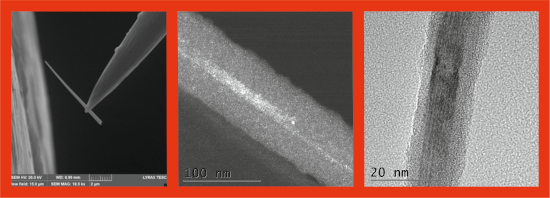
- their magnetic defects and their interactions with charge carriers. Antiferromagnetic clusters in CrGe NWs were investigated using electron spin resonance. Spin–orbit interaction between charge carriers and magnetic defects were studied [9]. Cr/Ge nanotowers as a dilute magnetic semiconductor were



Two dynamic modes to streamline challenging atomic force microscopy measurements
Beilstein J. Nanotechnol. 2021, 12, 1226–1236, doi:10.3762/bjnano.12.90
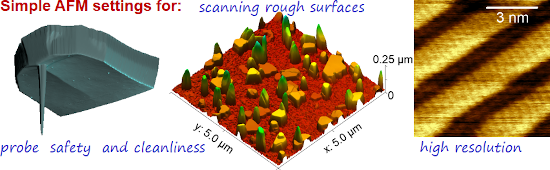
- tip. To select a site, it is optimal to use the vertical mode, since it allows one to maintain sharp probes when scanning rough surfaces. In some cases, when it is necessary to detect the presence of a fine structure against the background of larger defects, it is advisable to use a combination of VM


Irradiation-driven molecular dynamics simulation of the FEBID process for Pt(PF3)4
Beilstein J. Nanotechnol. 2021, 12, 1151–1172, doi:10.3762/bjnano.12.86
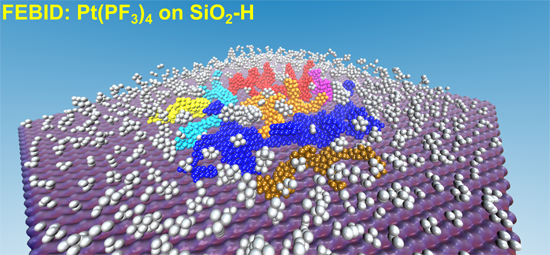
- with the results of [31]. The van der Waals forces between the atoms of the substrate and the adsorbed molecules are described by means of the Lennard-Jones potential: where and . Note that partial hydroxylation, surface defects, and broken O–H bonds may lead to a stronger interaction between Pt and








Self-assembly of amino acids toward functional biomaterials
Beilstein J. Nanotechnol. 2021, 12, 1140–1150, doi:10.3762/bjnano.12.85
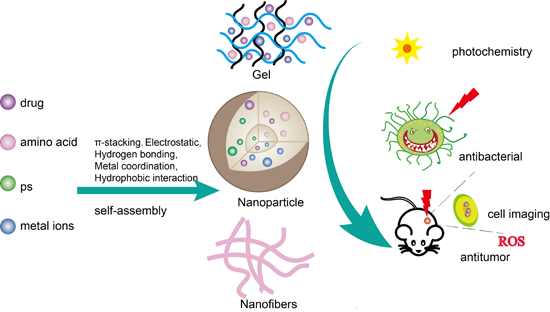
- polymers to enhance, repair, or replace diseased, damaged, or defective tissue [2]. A few examples are tooth repair, peripheral nerve regeneration, nerve tissue engineering, bone and joint replacement and repair, and regeneration of bone defects, biological scaffolds, and wound healing [3][4][5][6][7][8
- product, easy assembly, self-calibration, and no defects [55]. The prepared components may further be used as modular “building blocks” for building higher-order upper structures with increased complexity and functionality [56]. Metal coordination can become a strong interaction due to its near-covalent

Is the Ne operation of the helium ion microscope suitable for electron backscatter diffraction sample preparation?
Beilstein J. Nanotechnol. 2021, 12, 965–983, doi:10.3762/bjnano.12.73
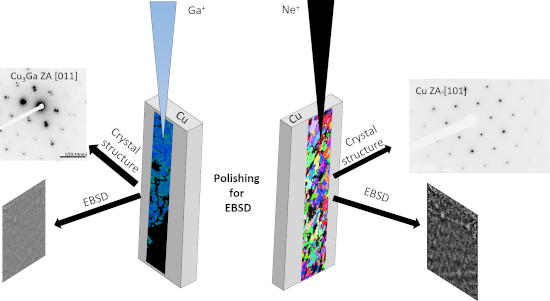
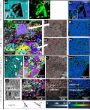
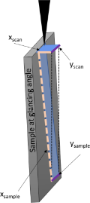
- interaction volume, a steady-state condition of ion impurity concentration and number of induced defects is reached. The EBSD measurements and Monte Carlo simulations indicate that when this steady-state condition is reached more quickly, which can be achieved using high-energy Ne ions at a glancing incidence
- , defects such as interstitials or vacancies can be created [23]. This can induce a significant amount of crystal structure alterations in a sample and thus artefacts. While these artefacts are well recognized for transmission electron microscopy (TEM) lamella preparation, in which the lamella preparation
- of induced defects and number of implanted ions is limited in FIBs that are optimized for patterning applications (such as Ga FIB/SEM or HIM when operated with Ne). The highest concentration of ion implantation and defects is reached once the sample has been milled down to a depth which corresponds



Uniform arrays of gold nanoelectrodes with tuneable recess depth
Beilstein J. Nanotechnol. 2021, 12, 957–964, doi:10.3762/bjnano.12.72
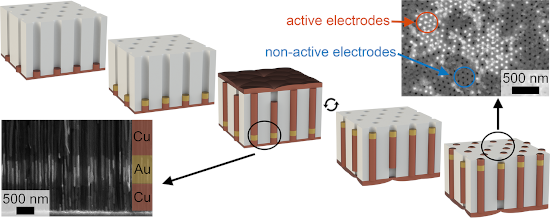
- same time, only a minor part of nanowires is known to grow through the whole thickness of a template when potentiostatic electrodeposition is used [22][23][24][25]. Not only electrodeposition conditions but also thickness and structural defects in the AAO template influence the completeness of the


Molecular assemblies on surfaces: towards physical and electronic decoupling of organic molecules
Beilstein J. Nanotechnol. 2021, 12, 950–956, doi:10.3762/bjnano.12.71

- . To a lesser extent, metal oxides have also been used, for which defects and charging often pose additional challenges [44][45][46]. On electronically insulating surfaces, non-contact atomic force microscopy (AFM) is the method of choice to study molecular assemblies and individual molecules in real
- molecules were pinned to defects on Si and also on the thin CaF2 layer, PTCDA was physically decoupled via the thicker CaF2 films and self-assembled into small islands. For FePc on H-passivated Ge(001), efficient physical decoupling facilitated the growth of large islands with upright oriented molecules
The role of deep eutectic solvents and carrageenan in synthesizing biocompatible anisotropic metal nanoparticles
Beilstein J. Nanotechnol. 2021, 12, 924–938, doi:10.3762/bjnano.12.69
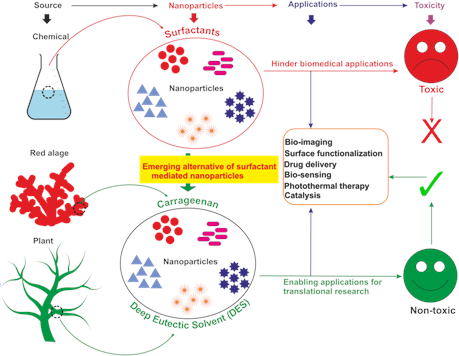
- nanoparticles than for spherical shapes. This is due to greater exposed surface area and more defects during crystal growth of anisotropic nanoparticles. Gold nanoparticles show tremendous potential in biomedical research due to unique optical and physicochemical properties and the inert nanoparticle core. The


In situ transport characterization of magnetic states in Nb/Co superconductor/ferromagnet heterostructures
Beilstein J. Nanotechnol. 2021, 12, 913–923, doi:10.3762/bjnano.12.68
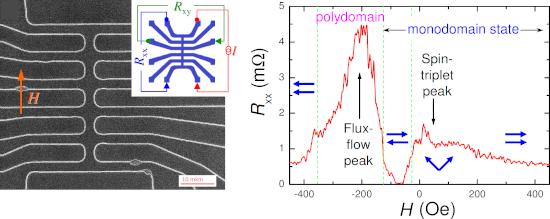
- irreversible behavior of the heterostructure, associated with both the magnetic hysteresis and with a generation of Abrikosov vortices, which are pinned at film defects. As shown previously [23], those two factors may dramatically distort the characteristics of S/F devices. FORC is the key technique that we


The role of convolutional neural networks in scanning probe microscopy: a review
Beilstein J. Nanotechnol. 2021, 12, 878–901, doi:10.3762/bjnano.12.66
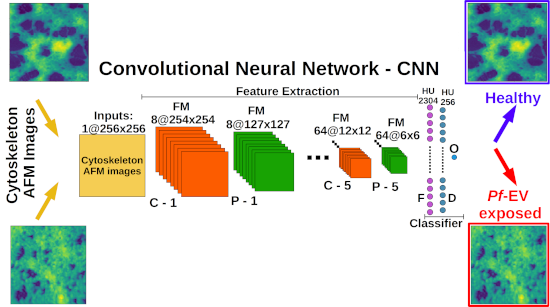
- (STEM) images after nearest neighbor down-sampling. This enabled an increase in image resolution of up to 100-fold, decreasing scanning time and electron dose [120]. Another application of CNNs for STEM was for atomic defect classification [121]. The goal was to characterize defects related to Si
- was trained on simulated STEM images. Then, scanning tunneling microscopy (STM) images of the same sample were used to characterize the defects. STM images, which give the local density of states, measure not only the Si lattice, but also defect areas where this well-ordered lattice disappears. Such
- images were compared with those computed by density functional theory (DFT) based on well-known single and dimer Si defects. The examples given here demonstrate the utility of deep learning in general and CNN in particular in the field of microscopy. In the following section, the emphasis is narrowed







Effects of temperature and repeat layer spacing on mechanical properties of graphene/polycrystalline copper nanolaminated composites under shear loading
Beilstein J. Nanotechnol. 2021, 12, 863–877, doi:10.3762/bjnano.12.65
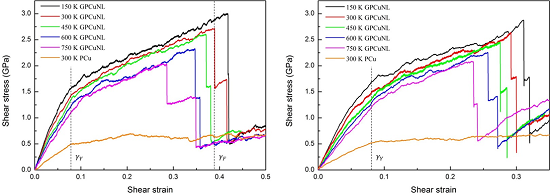
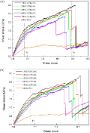
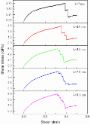
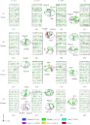
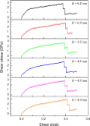
- graphene is maintained but reduced slightly due to the Stone–Wales defects. As shown in Figure 3, the shear stress rises again after failure. Moreover, Figure 9 shows the out-of-plane displacement of graphene at different temperatures. For zigzag and armchair directions, the wrinkle fluctuations of
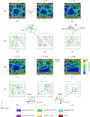
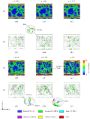
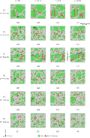
- stacking faults occur in all copper layers. Stacking faults are produced from two adjacent HCP layers. These defects are caused by the release of energy stored in the specimens. The deformation of the polycrystalline structure is mostly affected by the grain boundaries [46][47]. When the dislocations
- affect the wrinkles of graphene. Although changing the grain size does not cause many effects on the shear stress and strain of the composites, it is still an important factor in changing the shear strength and the movement of defects of the composite specimens. Conclusion In this study, shear loading of









Comprehensive review on ultrasound-responsive theranostic nanomaterials: mechanisms, structures and medical applications
Beilstein J. Nanotechnol. 2021, 12, 808–862, doi:10.3762/bjnano.12.64
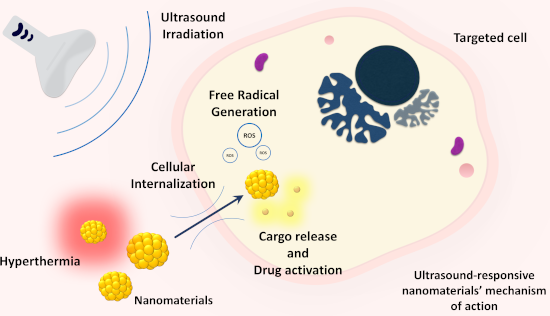
- intensifies the biophysical effects of the US waves [41]. This leads to transient permeabilization of cell membranes through the formation of transient pores and/or defects in the lipid bilayer, and finally, the diffusion of surrounding molecules into the cytosol [74]. Cavitation events triggered by MBs
- encapsulated FITC from PC-PEG-L liposomes, whereas after sonication for 60 s, the release of FITC was increased to 70%. They suggested that the cavitation events during sonication resulted in rupture and pore-like defects occurring in the cell membrane, leading to the release of DOX and FITC from micelles and


Silver nanoparticles nucleated in NaOH-treated halloysite: a potential antimicrobial material
Beilstein J. Nanotechnol. 2021, 12, 798–807, doi:10.3762/bjnano.12.63
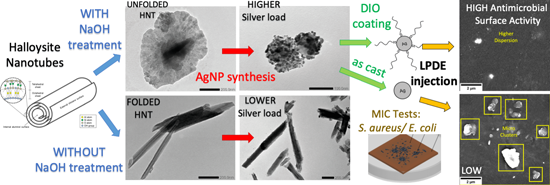
- the external surface of HNT tends to occur in crystalline defects, where aluminol is exposed [23]. Synthesizing Ag-NPs supported by HNT has the advantage of improving stability, thus enhancing the antimicrobial properties of the material [22][23][24][27][28]. In this work we treated the HNT surface
- preferential nucleating spots for silver. These mechanisms are: (1) hydroxylation of the HNT surface, that is, by exposing the clay particles to NaOH, hydroxy groups are grafted on the surface [33][34][35], which will later work as nucleating sites for Ag-NPs; (2) corrosion-induced crystalline defects, that is
- , by exposing the HNT clay particles to NaOH, a corrosion process is triggered that slowly etches the external crystalline phase [31], inducing defects in the crystalline structure, which expose the internal hydroxy layer of HNT to silver nucleation [23]; (3) unfolding of HNT into nanosheets, that is




9.1% efficient zinc oxide/silicon solar cells on a 50 μm thick Si absorber
Beilstein J. Nanotechnol. 2021, 12, 766–774, doi:10.3762/bjnano.12.60
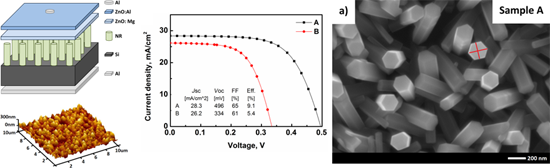
- difference is related to the presence of ZnONR in the structure. Zinc oxide nanorods are monocrystalline and form a better junction with the silicon substrate (with less defects, i.e., less recombination centers). The impact of ZnONR on recombination can be observed considering the Rsh value. If Rsh


Prediction of Co and Ru nanocluster morphology on 2D MoS2 from interaction energies
Beilstein J. Nanotechnol. 2021, 12, 704–724, doi:10.3762/bjnano.12.56
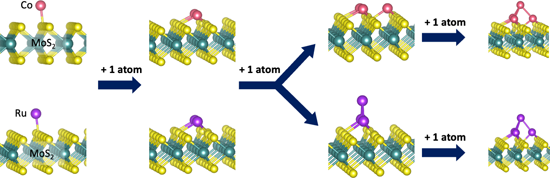
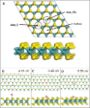
- adsorption. Using the formation of H2S from H2, we computed a vacancy formation energy of −6.16 eV, which confirms that defects are easily formed. Furthermore, our results showed that the presence of an S vacancy (giving a concentration of 2% vacancies per supercell) improved Cu adhesion and promoted the



Electromigration-induced formation of percolating adsorbate islands during condensation from the gaseous phase: a computational study
Beilstein J. Nanotechnol. 2021, 12, 694–703, doi:10.3762/bjnano.12.55
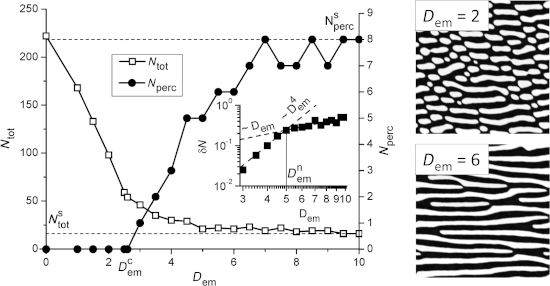
- the formation of nanoscale clusters of point defects in solids exposed to irradiating sources [69][70][71][72][73]. Electromigration effects The main purpose of this work is to study the effect of electromigration on the dynamics of surface growth during deposition, its morphology, and statistical


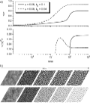


![[Graphic 29]](/bjnano/content/inline/2190-4286-12-55-i36.svg?max-width=637&scale=1.18182) on the adsorption coefficient α ...
on the adsorption coefficient α ...

A review of defect engineering, ion implantation, and nanofabrication using the helium ion microscope
Beilstein J. Nanotechnol. 2021, 12, 633–664, doi:10.3762/bjnano.12.52
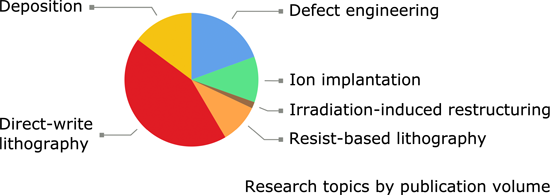
- the introduction of lattice defects has been demonstrated in a variety of nanoengineering applications. The generation of vacancies, preferential sputtering of one atomic species over another, and the introduction of increasing amounts of disorder leading to eventual amorphization of a crystalline
- material are all dials to turn. The properties engineered span electronic, magnetic, optical, chemical, and thermal properties. In the case of 2D and thin-film materials supported on a substrate, defects induced by backscattered ions and sputtered atoms also need to be considered. A recent computational
- . investigated the nature of the ion-induced defects further, and determined that after irradiation, the ion-induced vacancies become saturated with oxygen [20]. The authors of the latter thus proposed that the mechanism behind the irradiation-induced insulating behavior involved oxygen groups acting as charge


Stability and activity of platinum nanoparticles in the oxygen electroreduction reaction: is size or uniformity of primary importance?
Beilstein J. Nanotechnol. 2021, 12, 593–606, doi:10.3762/bjnano.12.49
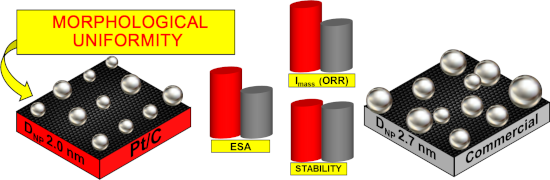
- ]; differences in the principles of calculation, which serve as the basis for the corresponding research methods [41]; a possible contribution of NP structural defects to the broadening of the X-ray diffraction pattern maxima [42], and problems related to the recognition of ultra-small particles in TEM


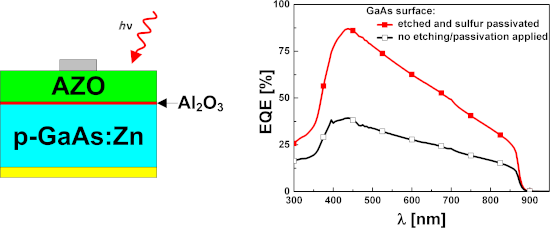
Impact of GaAs(100) surface preparation on EQE of AZO/Al2O3/p-GaAs photovoltaic structures
Beilstein J. Nanotechnol. 2021, 12, 578–592, doi:10.3762/bjnano.12.48
- before to be resulting from complexes of Al3+ ions and VZn [40]. These complexes resulted from the substitution of Zn2+ ions with Al3+ ions. The region above 450 nm is ascribed as the reflection of point defects present in the ZnO structure [41]. One can observe a broad band typically present in undoped
- ZnO [42] with intensity varying depending on the crystallization conditions. Additionally, local maxima may be discriminating the presumable presence of specific defects: 445, 458 (VZn), 480 (Zni+), 516 (VZn−, ZnO), and 560 nm (observed only in the B2 sample, possibly due to AsOx luminescence [43
- ]). The intensities of the defect bands in relation to each other and to the NBE band are associated with the route of AZO growth. The point defects usually observed in ZnO are: oxygen vacancy VO, zinc vacancy VZn, interstitial oxygen Oi, interstitial zinc Zni, and oxygen antisite OZn [44][45]. The




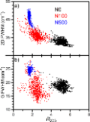
Properties of graphene deposited on GaN nanowires: influence of nanowire roughness, self-induced nanogating and defects
Beilstein J. Nanotechnol. 2021, 12, 566–577, doi:10.3762/bjnano.12.47
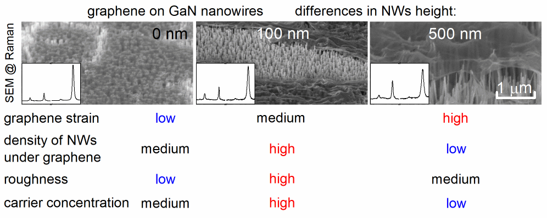
- nanowires impact graphene properties such as roughness, strain, and carrier concentration as well as density and type of induced defects. Tracing the manifestation of those interactions is important for the application of novel heterostructures. A detailed analysis of Raman spectra of graphene deposited on
- contact with graphene. The lowest concentration of defects is observed for graphene deposited on nanowires with the lowest density. The contact between graphene and densely arranged nanowires leads to a large density of vacancies. On the other hand, grain boundaries are the main type of defects in
- graphene on rarely distributed nanowires. Our results also show modification of graphene carrier concentration and strain by different types of defects present in graphene. Therefore, the nanowire substrate is promising not only for strain and carrier concentration engineering but also for defect