Search results
Search for "aggregation" in Full Text gives 351 result(s) in Beilstein Journal of Organic Chemistry. Showing first 200.
Photocatalyzed elaboration of antibody-based bioconjugates
Beilstein J. Org. Chem. 2025, 21, 616–629, doi:10.3762/bjoc.21.49
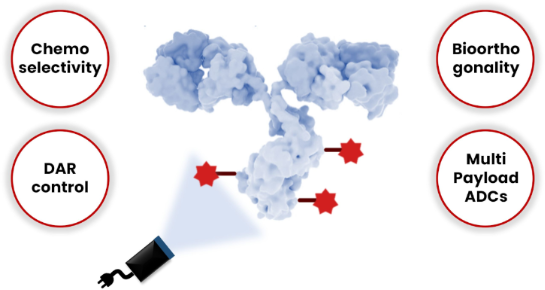
- unconjugated and “overloaded” antibodies. Unconjugated antibodies compete with antibodies containing payloads for binding, which can diminish the effectiveness of the antibody-payload materials. On the other hand, excessive loading of the antibody can lead to antibody aggregation, increased toxicity, decreased
- aggregation during photoconjugation reactions represents a major challenge for the stability and efficacy of conjugated antibodies [60]. Exposure of antibodies to light, particularly UV light, can trigger photoinduced reactions that compromise their structural stability. These phenomena include the oxidation
- disulfide bridges or Cys–Tyr bonds, further increasing the risk of aggregation. Photosensitive payloads, although essential for specific therapeutic or diagnostic applications, are particularly vulnerable to these photochemical reactions. Their light-induced modifications not only exacerbate aggregation but


Synthesis of the aggregation pheromone of Tribolium castaneum
Beilstein J. Org. Chem. 2025, 21, 510–514, doi:10.3762/bjoc.21.38
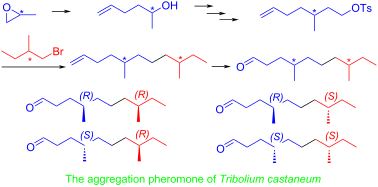
- is a destructive stored product pest. The aggregation pheromone of this pest was prepared via a new and effective strategy. The key steps include the ring-opening reaction of chiral 2-methyloxirane, the stereospecific inversion of chiral secondary tosylate, Li2CuCl4-catalyzed coupling of tosylate
- with Grignard reagent, and oxidation with RuCl3/NaIO4. Keywords: aggregation pheromone; chiral 2-methyloxirane; red flour beetle; total synthesis; Introduction The red flour beetle, Tribolium castaneum Herbst (Coleoptera: Tenebrionidae), is a cosmopolitan, destructive stored product pest [1], which
- for devising a more effective and environmentally friendly strategy to control this pest [9]. Pheromone-based pest management is one of most environment benign, effective, and promising solutions [10][11]. The aggregation pheromone of T. castaneum was first reported by Ryan in 1976, secreted by the


Photomechanochemistry: harnessing mechanical forces to enhance photochemical reactions
Beilstein J. Org. Chem. 2025, 21, 458–472, doi:10.3762/bjoc.21.33

- enables solvent-free conditions for this transformation (Scheme 11B). Here, the aggregation state of the substrate and the reductant proved to be crucial to establish a fully operative protocol. The third reaction tested under mechanophotocatalytic conditions was the well-established decarboxylative




Synthesis and characterizations of highly luminescent 5-isopropoxybenzo[rst]pentaphene
Beilstein J. Org. Chem. 2025, 21, 270–276, doi:10.3762/bjoc.21.19
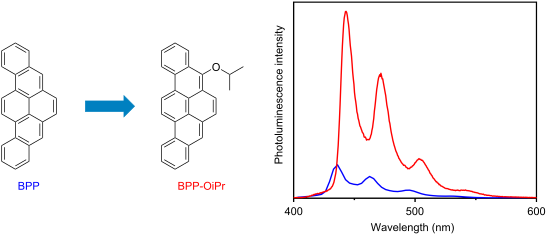
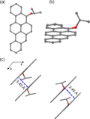
- -butyl-substituted BPP (BPP-t-Bu, PLQY: 0.47) (Figure 2b) [21][22]. Considering that two tert-butyl groups should more effectively hinder the aggregation than one isopropyl group, we tentatively attribute the enhanced PLQY of 3 to the reduced molecular symmetry, which can relax the selection rule and




Efficient synthesis of fluorinated triphenylenes with enhanced arene–perfluoroarene interactions in columnar mesophases
Beilstein J. Org. Chem. 2024, 20, 3263–3273, doi:10.3762/bjoc.20.270
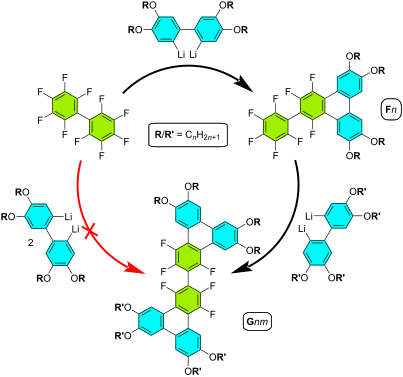
- fluorescence emission spectroscopies reveal green photoluminescence with fluorescence quantum yields of up to 33% for the Fn derivatives. The J-aggregation for the inner fluorine-substituted dimers Gnm is energetically and stereoelectronically more favorable and G66 exhibits thin-film fluorescence with a large
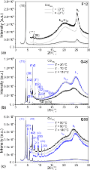
- intermolecular slipped J-type aggregation, supported by S/WAXS and proposed the model of Colrec mesophase [55][56][57]. DFT computation For a deeper understanding of the electronic properties of these fluorine triphenylenes, we performed some DFT computation of F1 and G11 with the shortest methyl chain, and the
- between 410–430 nm. It is noted that G66 shows deeper red-shifted fluorescence than F6, with peaks of 610 nm and 450 nm, respectively. The J-type aggregation for G66 in thin film and liquid crystalline state is energetically favorable for the arene–perfluoroarene overlap stacking and related




Multicomponent reactions driving the discovery and optimization of agents targeting central nervous system pathologies
Beilstein J. Org. Chem. 2024, 20, 3151–3173, doi:10.3762/bjoc.20.261

- approaches Alzheimer’s disease (AD) The pathogenesis of AD is still not clear but is marked as a multifactorial disease [24], including a good deal of hypotheses involving the cholinergic hypothesis, glutamate excitotoxicity, tau aggregation, abnormal extracellular accumulation of Aβ peptides, and oxidative
- AChE, while pyrazole scaffolds possess the ability to reduce the tau and β-amyloid dual aggregation. Benzofuran-pyrazole aldehydes were employed in the Ugi azide reaction to give the desired hybrids. From the screened compounds, 2a, 2b, 2c, 2d, 2e, and 2f demonstrated notable efficacy in regulating the
- were also remarkable, yielding a value 2-fold higher than melatonin (ORAC = 2.45 TE). Natural polyphenols have shown promising potential in inhibiting β-amyloid aggregation and also antioxidant properties, suggesting their effectiveness in preventing AD. To address this, Lambruschini et al. [36


Advances in the use of metal-free tetrapyrrolic macrocycles as catalysts
Beilstein J. Org. Chem. 2024, 20, 3085–3112, doi:10.3762/bjoc.20.257
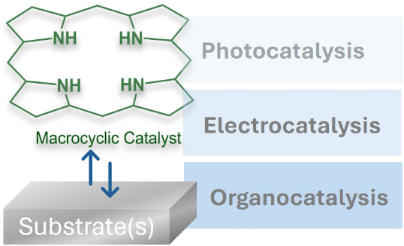
- . Although meso-tetrakis(4-sulfonatophenyl)porphyrin (TPPS4, 54) is an achiral molecule, the respective J-aggregates reveal supramolecular chirality caused by spontaneous mirror symmetry breaking (SMSB) during the aggregation process in an aqueous acidic solution. Using of these aggregates led to
- hypothesis that the reaction would work in acidic environment using catalysts insensitive to pH-induced aggregation. In the same aldol reaction, using of macrocycles 60 and 61 containing chiral secondary amine moieties provided not only good yields, but also good diastereoselectivities; chiral HPLC analysis
- optically active form with 16.7% ee for 63a and 11.8% ee for 63b, respectively (Table 4). The pH-induced aggregation does not only enable to control the catalytic activity, but it also allows a straightforward separation and recovery of the catalyst from the reaction mixture by acidification and


Cyclodextrin-based rotaxanes for polymer materials: challenge on simultaneous realization of inexpensive production and defined structures
Beilstein J. Org. Chem. 2024, 20, 3026–3049, doi:10.3762/bjoc.20.252
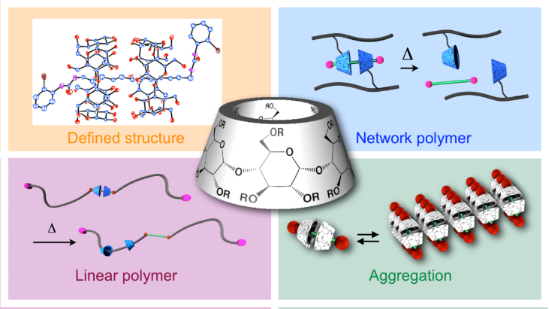
- nature of the rotaxane framework, CD-based polyrotaxane is known to form an aggregation structure by the formation of hydrogen bonds among the CD units [89][90][91][92][93]. Owing to the inclusion structure on the polyrotaxane, it is likely to form a hexagonal packing-type crystalline structure, which is
- different from that of a single CD molecule. Such an aggregation behavior of polyrotaxane induces the increase of the mechanical strength of the material or the construction of a nanosheet, which is beneficial for material application. Meanwhile, CD-based polyrotaxane requires various synthetic demands, as
- discussed in the previous sections, resulting in the limited applicability of this aggregate formation. To solve this issue, we used a CD-based [3]rotaxane unit as an aggregation unit instead of a CD-based polyrotaxane. As described above, the [3]rotaxane unit can be flexibly designed and integrated with






The charge transport properties of dicyanomethylene-functionalised violanthrone derivatives
Beilstein J. Org. Chem. 2024, 20, 2921–2930, doi:10.3762/bjoc.20.244
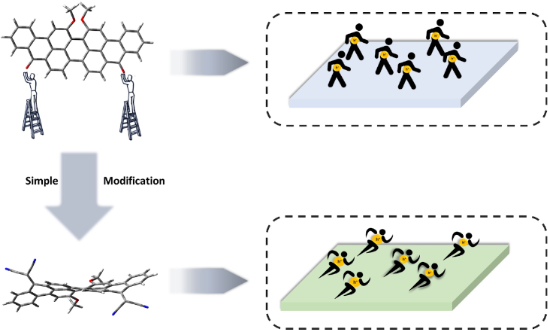
- modification of dihydroxyviolanthrone where the effect of three alkoxy substituents on the 16,17-bis(2-ethylhexyloxy)anthra[9,1,2-cde]benzo[rst]pentaphene-5,10-dione, on aggregation and photovoltaic properties was studied [30]. It was found that derivatives with the shortest linear alkyl chain (n-hexyl


Photoluminescence color-tuning with polymer-dispersed fluorescent films containing two fluorinated diphenylacetylene-type fluorophores
Beilstein J. Org. Chem. 2024, 20, 2682–2690, doi:10.3762/bjoc.20.225
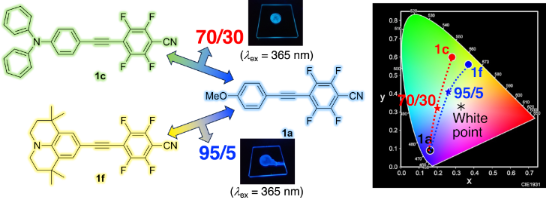
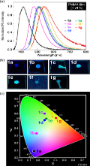
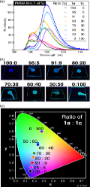
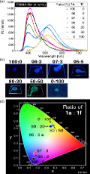
- luminescent materials, particularly after the 2001 discovery of aggregation-induced emission. This study focuses on fluorinated diphenylacetylene-based luminescent molecules, revealing that specific molecular modifications can enhance fluorescence and achieve a wide range of photoluminescence colors. A simple
- has been severely delayed [4][5][6]. However, since Tang et al. first reported the aggregation-induced emission phenomenon in 2001 [7], the development of solid-state light-emitting materials has accelerated significantly [8][9][10]. Many photoluminescent materials that emit blue, green, and yellow


Applications of microscopy and small angle scattering techniques for the characterisation of supramolecular gels
Beilstein J. Org. Chem. 2024, 20, 2608–2634, doi:10.3762/bjoc.20.220

- . This is problematic for gels in particular, as gels are mostly solvent by composition, it is to be expected that the drying procedures required may lead to a change in morphology due to effectively concentrating the sample, leading to more aggregation, any salts present in the solution could also
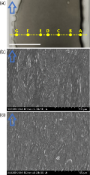
- the mechanism of aggregation is further exemplified by Jones et al. [44]. It was shown that SEM could directly observe structural defects, resulting in the collapse of helically braided structures into their constituent fibrils which can interact with other fibres (Figure 10). The branching density
- [69][70]. We have previously used the power of contrast matching to investigate self-assembly by selectively deuterating 2NapFF to identify the molecular packing structure in D2O solutions (Figure 15) [68]. SANS allowed the surfactant-like aggregation of 2NapFF to be elucidated which provides the


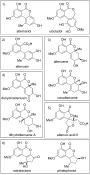
Natural resorcylic lactones derived from alternariol
Beilstein J. Org. Chem. 2024, 20, 2171–2207, doi:10.3762/bjoc.20.187
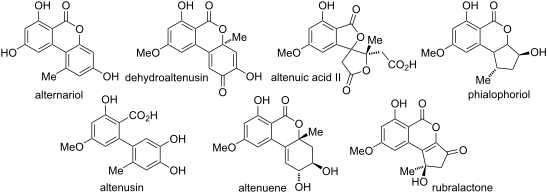
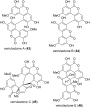
- aggregation, attracting interest for the treatment of Alzheimer’s disease [240], was a selective agonist of the farnesoid X receptor FXR (EC50: 3.2 µM) [241], and displayed remarkable neuroprotective effects against oxidative injuries by acting as potent activator of nuclear factor erythroid-derived 2-like 2

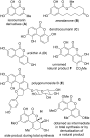


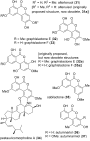



Finding the most potent compounds using active learning on molecular pairs
Beilstein J. Org. Chem. 2024, 20, 2152–2162, doi:10.3762/bjoc.20.185
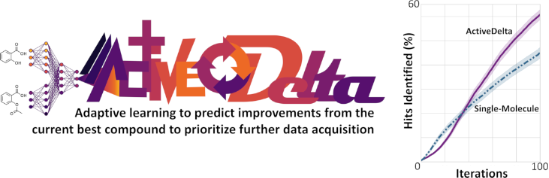
- default parameters and aggregation = ‘sum’ using the PyTorch deep learning framework. For the single-molecule Chemprop implementation, number_of_molecules = 1 while for the ActiveDelta implementation number_of_molecules = 2 to allow for processing of multiple inputs as described previously [29]. We


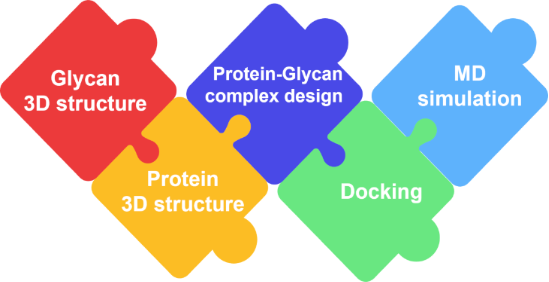
Computational toolbox for the analysis of protein–glycan interactions
Beilstein J. Org. Chem. 2024, 20, 2084–2107, doi:10.3762/bjoc.20.180


Understanding X-ray-induced isomerisation in photoswitchable surfactant assemblies
Beilstein J. Org. Chem. 2024, 20, 2005–2015, doi:10.3762/bjoc.20.176
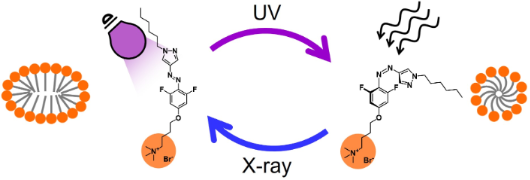
- (version 0.94.11) [34]. The first 50 data points were removed due to aggregation effects in some samples. A linear, horizontal background was set to an appropriate value. The data were fitted to either: ellipsoidal cylindrical core-shell, ellipsoidal core-shell or spherical core-shell structures, with a
- (black lines) indicate that a spherical-to-ellipsoidal transition occurs in H2O but not in D2O. Note that the grey circles indicate the native, E-isomer state, and the slope of −3 at low Q values (b) indicates the presence of larger-scale aggregation. The dimensional changes to the ellipsoidal and



Supramolecular assemblies of amphiphilic donor–acceptor Stenhouse adducts as macroscopic soft scaffolds
Beilstein J. Org. Chem. 2024, 20, 1590–1603, doi:10.3762/bjoc.20.142
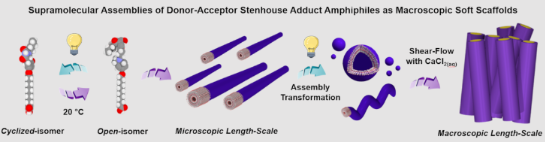
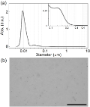
- , was further diluted to prepare various aliquots with a concentration ranging from 1.0 × 10⁻⁴–0.1 mM in order to estimate the critical aggregation concentration (CAC) by using static light scattering (SLS). An aqueous solution of DA11 was estimated to have a CAC of <6.0 μM (Figure S5, Supporting




Structure–property relationships in dicyanopyrazinoquinoxalines and their hydrogen-bonding-capable dihydropyrazinoquinoxalinedione derivatives
Beilstein J. Org. Chem. 2024, 20, 1037–1052, doi:10.3762/bjoc.20.92
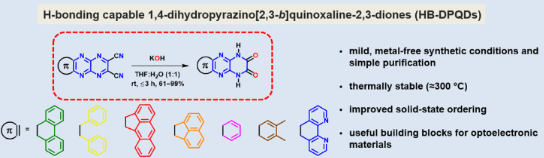
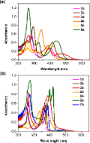
- illustrated in Figures S37–S41 (Supporting Information File 1). This serves as good evidence that the synthesized compounds exhibit no signs of aggregation in DMSO within the assessed concentration range (i.e., 2.5–45 μM). Electronic structure calculations Gas-phase computational investigations were conducted




Synthesis and characterization of water-soluble C60–peptide conjugates
Beilstein J. Org. Chem. 2024, 20, 777–786, doi:10.3762/bjoc.20.71
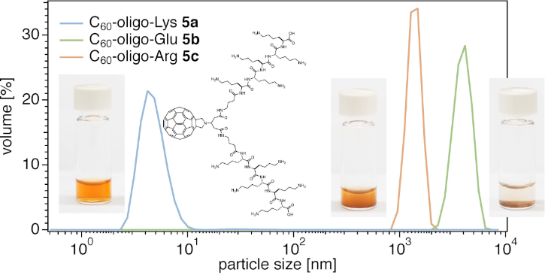
- aggregations in aqueous solution, as observed by dynamic light scattering (DLS), cryoTEM, and concentration-dependent surface tension measurements [40]. Despite the small size (≈10 nm in hydrodynamic diameter), the aggregation of these fullerene moieties was not ideal for biological applications as
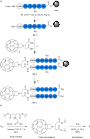
- the approach of bulk water molecules to the fullerene core and hamper water exchange – an important factor for enhancement in MRI. Well-dispersed water-soluble C60 derivatives exhibiting less aggregation are in high demand. To address the challenge mentioned above, we developed highly water-soluble
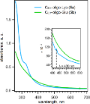
- ) showed much smaller aggregation (dotted green line, ≈12 nm), providing a transparent solution, while C60–oligo-Arg (5c) remained insoluble over the tested pH value range (4.0–9.2). This was presumably due to the strong cation–π interactions between the cationic Arg moieties and the aromatic C60, which is




Research progress on the pharmacological activity, biosynthetic pathways, and biosynthesis of crocins
Beilstein J. Org. Chem. 2024, 20, 741–752, doi:10.3762/bjoc.20.68
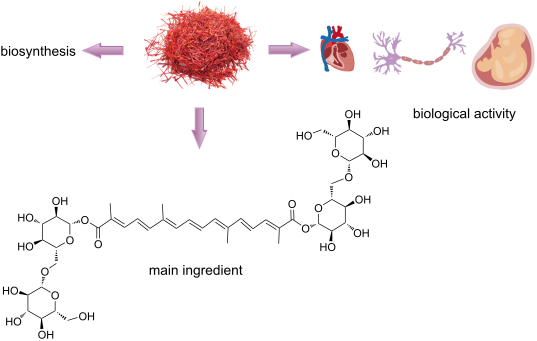
- (ROSs) [28]. Crocins can inhibit the activity of acetylcholinesterase and increase the acetylcholine concentration, thus improving the learning and memory ability of the brain [29]. Moreover, crocins prevent the abnormal aggregation of amyloid β-protein (Aβ), microtubule-associated protein tau, and α


Ligand effects, solvent cooperation, and large kinetic solvent deuterium isotope effects in gold(I)-catalyzed intramolecular alkene hydroamination
Beilstein J. Org. Chem. 2024, 20, 479–496, doi:10.3762/bjoc.20.43
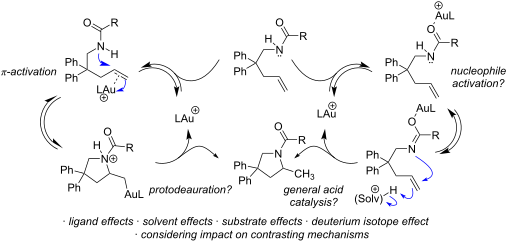
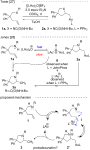
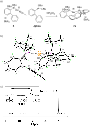
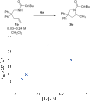
- ]. Protic additives are widely accepted to “facilitate proton transfer,” but they can also influence the aggregation of charged intermediates. Most mechanistic discussions incorporate protodeauration of alkylgold intermediates and consider a continuum from rate or enantio-determining nucleophilic attack







Green and sustainable approaches for the Friedel–Crafts reaction between aldehydes and indoles
Beilstein J. Org. Chem. 2024, 20, 379–426, doi:10.3762/bjoc.20.36
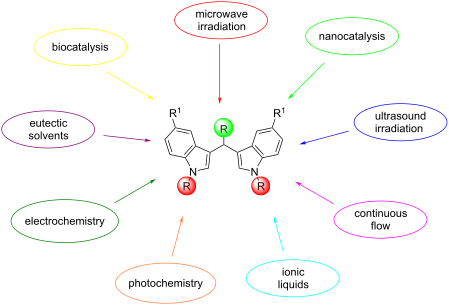
- facile recyclability, with the silica layer preventing the Fe3O4 from aggregation. The LPMNPs managed to provide impressive yields, while employing an amount of 2.5 mol % in water, with the help of conventional heating at 50 °C, which facilitated the organocatalytic process that required 1 to 1.5 hours
- -proline on the surface of the magnetic nanoparticle via iminium formation as seen in Scheme 18, allowing the indole to attack the formed double bond and initiate the Michael-type mechanism [107]. In an effort to replace the widespread use of nano-iron oxides, which present issues, such as aggregation, and




Substitution reactions in the acenaphthene analog of quino[7,8-h]quinoline and an unusual synthesis of the corresponding acenaphthylenes by tele-elimination
Beilstein J. Org. Chem. 2024, 20, 243–253, doi:10.3762/bjoc.20.24
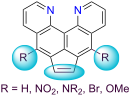
- effect of functional groups on the further chemistry and basicity of the newly synthesized derivatives is also considered. Results and Discussion Amination, dehydrogenation, and supramolecular aggregation Direct amination of quinoquinoline 5 could potentially lead to 2(11)-substituted amines 6 (Figure 1
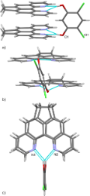
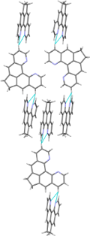
- -stacking of almost planar diazaarene fragments, leading to pronounced supramolecular aggregation. Although dipyridoacenaphthene does not undergo nucleophilic amination and dehydrogenation under a wide range of conditions, its 5(8)-nitro derivatives can be transformed under mild conditions into the




Synthesis of the 3’-O-sulfated TF antigen with a TEG-N3 linker for glycodendrimersomes preparation to study lectin binding
Beilstein J. Org. Chem. 2024, 20, 173–180, doi:10.3762/bjoc.20.17
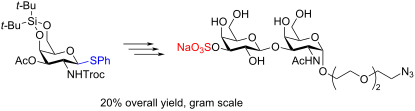
- galectins 1 and 3 leads to tumour cell aggregation and promotes cancer metastasis [3][4][5]. The 3’-O-sulfated analogue is known to bind to siglecs 1, 4, and 8 [6] as well as galectin 4 [7][8], but its biological role is not that well investigated. Compound 2 is a new compound but two syntheses of compound


Perspectives on push–pull chromophores derived from click-type [2 + 2] cycloaddition–retroelectrocyclization reactions of electron-rich alkynes and electron-deficient alkenes
Beilstein J. Org. Chem. 2024, 20, 125–154, doi:10.3762/bjoc.20.13
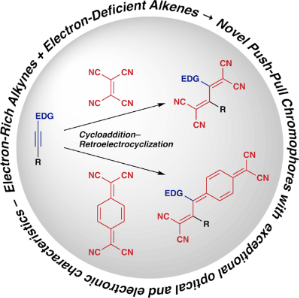
- chain in dimethyl sulfoxide. Furthermore, the solvent-driven shuttling motion of the macrocycle was observed to exert a discernible effect on the aggregation of the amphiphilic molecular system. In particular, changing the solvent led to the generation of interlaced nanofibers, perforated capsules, and
- solution as well as contradictory propensity to form luminescent nanostructure suspensions in hexane (Figure 5) [137]. It was posited that 65 features hollow vesicles, with vesicle fusion releasing curvature energy, leading to a thermodynamically more stable tubular structure. Such aggregation-induced


Preparing a liquid crystalline dispersion of carbon nanotubes with high aspect ratio
Beilstein J. Org. Chem. 2024, 20, 52–58, doi:10.3762/bjoc.20.7
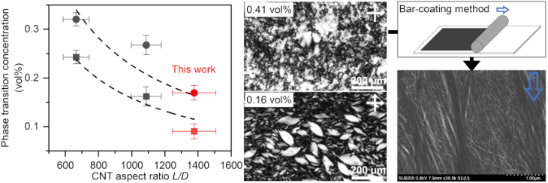
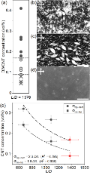
- only SC and water molecules. The DWCNT dispersion was repeatedly subjected to centrifugation at 1,000g for 5 minutes (KOKUSAN H-36) and stirred with a pipette to prevent DWCNT re-aggregation, resulting in the production of the condensed DWCNT dispersion. The dispersions' concentrations were adjusted by