


Search results
Search for "agonist" in Full Text gives 83 result(s) in Beilstein Journal of Organic Chemistry.
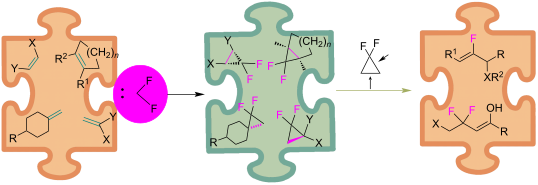
The preparation and properties of 1,1-difluorocyclopropane derivatives
Beilstein J. Org. Chem. 2021, 17, 245–272, doi:10.3762/bjoc.17.25




Synthesis of aryl 2-bromo-2-chloro-1,1-difluoroethyl ethers through the base-mediated reaction between phenols and halothane
Beilstein J. Org. Chem. 2021, 17, 89–96, doi:10.3762/bjoc.17.9

- as monofluorinated and trifluoromethylated arenes or aliphatics [1][2][3][4]. Recent progress in difluoromethylene chemistry successfully led to the finding of bioactive compounds such as pantoprazole, a proton pump inhibitor [5], and AFP-07, a prostaglandin I2 receptor-selective agonist [6][7][8


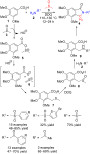
Synthesis of esters of diaminotruxillic bis-amino acids by Pd-mediated photocycloaddition of analogs of the Kaede protein chromophore
Beilstein J. Org. Chem. 2020, 16, 1111–1123, doi:10.3762/bjoc.16.98
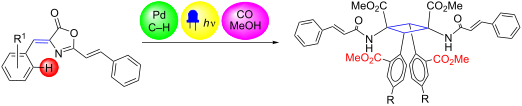
- activity, not only as antinociceptive drugs but also in the treatment of type 2 diabetes mellitus. In fact, recent results have shown that these compounds are the only non-peptidic agonists of the GLP-1R (glucagon-like peptide 1 receptor) and they have a higher stability than any other agonist prepared to


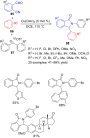
Palladium-catalyzed regio- and stereoselective synthesis of aryl and 3-indolyl-substituted 4-methylene-3,4-dihydroisoquinolin-1(2H)-ones
Beilstein J. Org. Chem. 2020, 16, 1084–1091, doi:10.3762/bjoc.16.95
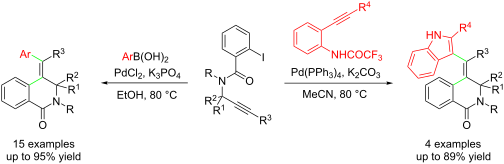
- active small molecules that exhibit antihypertensive activity [7][8]. Moreover, these heterocycles can be used as 5-HT3 antagonists [9], rho kinase inhibitors [10], thymidylate synthetase inhibitors [11], PARP-1 inhibitors [12], melatonin MT1 and MT2 receptor agonist [13], and fascin-targeted


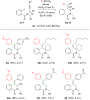

Fluorinated phenylalanines: synthesis and pharmaceutical applications
Beilstein J. Org. Chem. 2020, 16, 1022–1050, doi:10.3762/bjoc.16.91
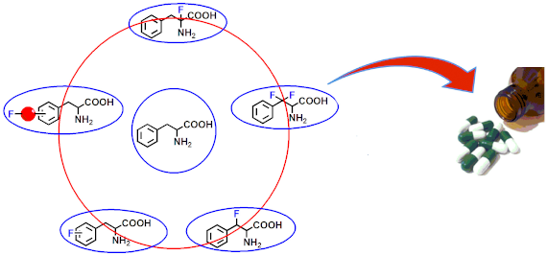
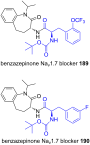
- emerged as a promising approach for treatment. (R)-2,5-Difluorophenylalanine is a required building block for the synthesis of LY2497282 [50][124] (Figure 9). 5.2.5. Ulimorelin: Ulimorelin (187) is a small cyclic peptide containing ᴅ-4-FPhe. Ulimorelin acts as a selective agonist of the ghrelin/growth


Two antibacterial and PPARα/γ-agonistic unsaturated keto fatty acids from a coral-associated actinomycete of the genus Micrococcus
Beilstein J. Org. Chem. 2020, 16, 297–304, doi:10.3762/bjoc.16.29
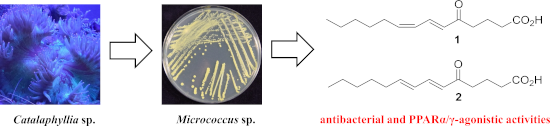
- cytotoxicity against murine leukemia P388 cells at 100 µM. Additionally, compounds 1 and 2 were evaluated for agonist activity to peroxisome proliferator-activated receptors (PPARs) because similar oxo fatty acids are known to act as PPAR agonists [42]. PPARs are ligand-activated transcription factors playing
- physiological functions in energy metabolism, PPARs are the molecular targets of metabolic disorders [48]. To assess the PPAR isoform specificity of 1 and 2, three reporter cell lines expressing luciferase genes in response to PPARα, PPARβ/δ, and PPARγ agonists were used [49]. The agonist activity was
- β/δ agonist activities were observed for 1 at the lower concentration of 6.25 μM, but the activity at 6.25 μM was almost equivalent to the activity level of the vehicle DMSO. We thus considered that 1 had no significant activity at 6.25 μM. Overall, 1 was lesser potent than 2, indicating that the


Chemical tuning of photoswitchable azobenzenes: a photopharmacological case study using nicotinic transmission
Beilstein J. Org. Chem. 2019, 15, 2812–2821, doi:10.3762/bjoc.15.274
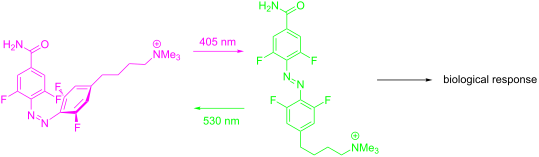
- biologically inert, irradiation with violet light effectively "uncaged" agonist activity, but in a photoreversible manner. Since the neurotransmitter acetylcholine has fully saturated heteroatom valences, our photoswitchable 4FABTA probe could be useful for physiological studies of this neurotransmitter
- )AChR. The structural difference between the native acetylcholine and nicotine are striking, and their diversity reflects the complexity of structure–activity relationships of ligands for nicotinic acetylcholine receptors. For example, the drug homocholine phenyl ether (HoChPE) is an agonist of the
- and health of cells. Next we examined if 1 could serve as a photoswitchable antagonist of nicotinic acetylcholine receptors having α4β2E61C mutant as predicted from previous results [16]. After labeling HEK293 cells as described above, we recorded the currents evoked by puffing the agonist carbachol




A toolbox of molecular photoswitches to modulate the CXCR3 chemokine receptor with light
Beilstein J. Org. Chem. 2019, 15, 2509–2523, doi:10.3762/bjoc.15.244
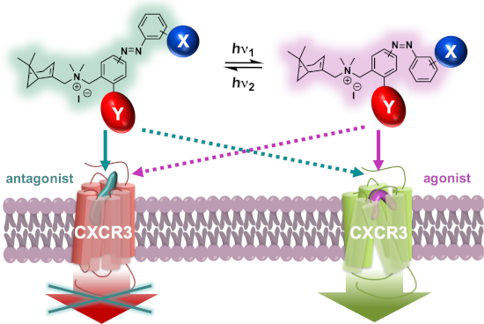
- , exemplified by partial agonist 1c and equal full agonists 1d and 1e (VUF11418, Figure 2A). A tentative explanation for this efficacy switch includes a variation of the dihedral angle of the biaryl moiety, an increase of the electron density in the biaryl unit and/or a postulated halogen bond of the halogen
- alignment between trans-2a and the agonist 1e (Figure 2B), since the planar azobenzene is partially overlapping with the biaryl moiety. However, the two aromatic rings of both compounds can evidently not be in exactly the same plane because the azobenzene moiety is planar while the tilting of the dihedral
- angle of the biaryl moiety of 1e was speculated to be associated with its agonist activity (vide supra) [24]. The alignment of the cis-isomer of 2a with agonist 1e is very different. The outer aromatic ring of cis-2a goes out of plane and is now occupying the space that is also occupied by the iodine



Design, synthesis and biological evaluation of immunostimulating mannosylated desmuramyl peptides
Beilstein J. Org. Chem. 2019, 15, 1805–1814, doi:10.3762/bjoc.15.174
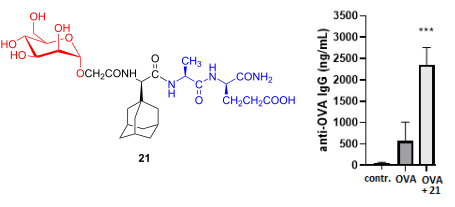
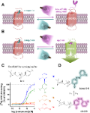
- antigens and regulate the immune reaction by specific binding to CLRs. Therefore, compounds with expressed CRL agonist or antagonist properties could also be considered as potential agents for cancer immunotherapy [49][50]. Mannosylated liposomes with incorporated MDP have proved to be effective carriers


N-(1-Phenylethyl)aziridine-2-carboxylate esters in the synthesis of biologically relevant compounds
Beilstein J. Org. Chem. 2019, 15, 1722–1757, doi:10.3762/bjoc.15.168

- agonist of S1P receptors while DS-SG-45 was found inactive. Dihydrosphingosines, e.g., safingol and sphinganine itself or as components of dihydroceramides are of interest as enzyme inhibitors [74][75]. Their common vicinal aminohydroxy fragment was efficiently synthesized from the aziridine ketone (2S,1


Synthesis of non-racemic 4-nitro-2-sulfonylbutan-1-ones via Ni(II)-catalyzed asymmetric Michael reaction of β-ketosulfones
Beilstein J. Org. Chem. 2019, 15, 1289–1297, doi:10.3762/bjoc.15.127
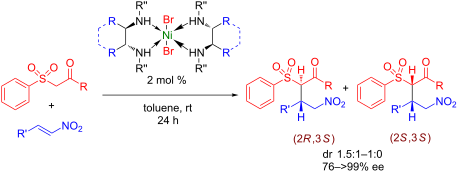
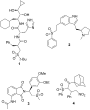
- 5-HT1 receptor agonist for the treatment of migraine) [7], and apremilast (3, Otezla®, inhibitor of the PDE4 for the treatment of certain types of psoriasis and psoriatic arthritis) [8] (Figure 1). Recently we have shown that racemic sulfone 4 exhibits high antiviral activity against BVDV with low



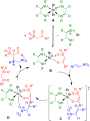

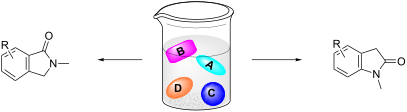
Multicomponent reactions (MCRs): a useful access to the synthesis of benzo-fused γ-lactams
Beilstein J. Org. Chem. 2019, 15, 1065–1085, doi:10.3762/bjoc.15.104
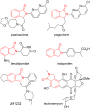
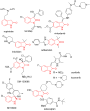
- , nintedanib is employed against pulmonary fibrosis [32], tenidap [33] is a nonsteroidal anti-inflammatory drug (NSAID), while indolidan [34] and adibendan [35] are potent long-acting cardiotonic agents and SM-130686 is a GHSR agonist [36] (Figure 5). Other kinase inhibitors such as sunitinib [37] and






Synthesis of nonracemic hydroxyglutamic acids
Beilstein J. Org. Chem. 2019, 15, 236–255, doi:10.3762/bjoc.15.22
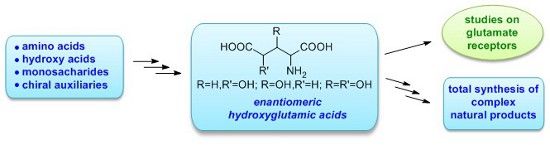
- )-3 showed similar potency at mGlu1aR and mGlu8aR as L-glutamic acid [16] while its affinity for AMPA and NMDA receptors was low [17]. On the other hand, (2S,4R)-3 demonstrated significant preference for the NMDA receptor [17]. Furthermore, it was found that (2S,3S,4S)-4 acts as a selective agonist of


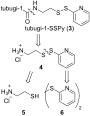
Synthesis of a tubugi-1-toxin conjugate by a modulizable disulfide linker system with a neuropeptide Y analogue showing selectivity for hY1R-overexpressing tumor cells
Beilstein J. Org. Chem. 2019, 15, 96–105, doi:10.3762/bjoc.15.11
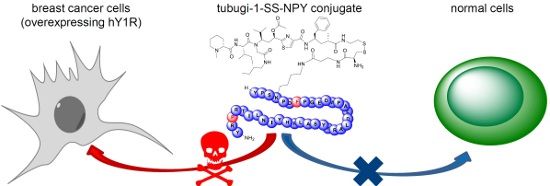
- been identified as fast and efficiently internalizing GPCR in those cells upon agonist binding [29][30]. The NPY Y1 receptor subtype for these reasons is a very promising molecular target to be addressed by selective peptide–drug conjugates (PDCs), notably for cancer treatment or diagnosis. However




Non-native autoinducer analogs capable of modulating the SdiA quorum sensing receptor in Salmonella enterica serovar Typhimurium
Beilstein J. Org. Chem. 2018, 14, 2651–2664, doi:10.3762/bjoc.14.243
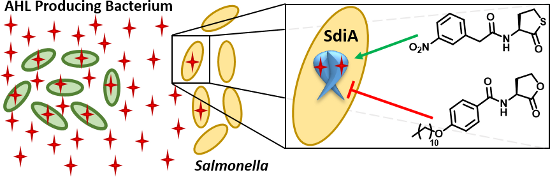
- receptor activation (or inactivation). Most LuxR-type proteins are highly unstable in vitro in the absence of an agonist ligand, and this instability is typically heightened in the presence of an antagonist [38]. As such, the observed stability of EHEC SdiA in vitro, both in the absence and presence of
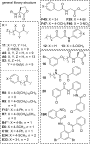
- Figure 2. For agonism at 100 μM, 119 compounds (79% of the library), and at 1 μM, 71 compounds (47% of the library), activated SdiA by at least 50% (above the negative control). This level of promiscuity in terms of agonist ligands is high for a LuxR-type receptor. For comparison, RhlR and QscR were
- heightened stringency of testing against an agonist (here, L-OOHL) at its EC90 value. For reference, 24% and 12% of a comparable in-house library were found to inhibit QscR [57] (at 5 μM) and RhlR [56] (100 μM) by greater than 65%, respectively. Lowering our cut-off, we found 23 compounds that could inhibit



Targeting the Pseudomonas quinolone signal quorum sensing system for the discovery of novel anti-infective pathoblockers
Beilstein J. Org. Chem. 2018, 14, 2627–2645, doi:10.3762/bjoc.14.241
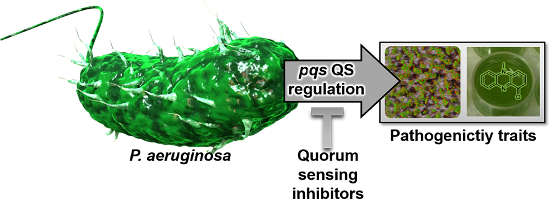
- -position of the quinolone core through action of the P. aeruginosa enzyme PqsH (Figure 14), turning the inverse agonist 33 into a strong agonist 34 (EC50 = 2.8 nM). This phenomenon was overcome by blocking the metabolic susceptible 3-position with various functional groups resulting in 35 which showed good
- , the chlorine is able to occupy a vacant sub pocket. A hydrogen bond is found between the backbone oxygen of L207 and the 3-NH2 hydrogen atoms. Interestingly, adding the chlorine substituent in 7-position of PQS leads to a 135 times more potent agonist, indicating the importance of the vacant sub
- production at a concentration of 10 µM. Various analogues were synthesized resulting in compound 42 (M64), where similar as in the quinolones described by Lu et al., introduction of the electron-withdrawing nitro function led to very potent inverse agonist (Figure 18) [72]. M64 (42) proved a very potent


Comparative cell biological study of in vitro antitumor and antimetastatic activity on melanoma cells of GnRH-III-containing conjugates modified with short-chain fatty acids
Beilstein J. Org. Chem. 2018, 14, 2495–2509, doi:10.3762/bjoc.14.226
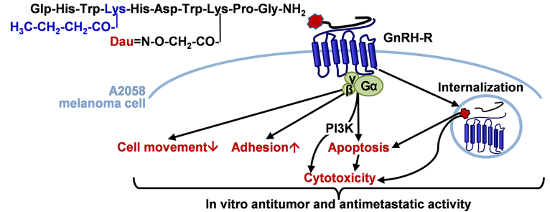
- depending on the cellular milieu or function, the GnRH analogs could elicit different – even opposite – actions [6][40]. For example, Aguilar-Rojas and his co-workers reported a similar combination of actions (invasion inhibitory and adhesion increasing effects) of a GnRH agonist in a breast cancer cell


Recyclable hypervalent-iodine-mediated solid-phase peptide synthesis and cyclic peptide synthesis
Beilstein J. Org. Chem. 2018, 14, 1112–1119, doi:10.3762/bjoc.14.97
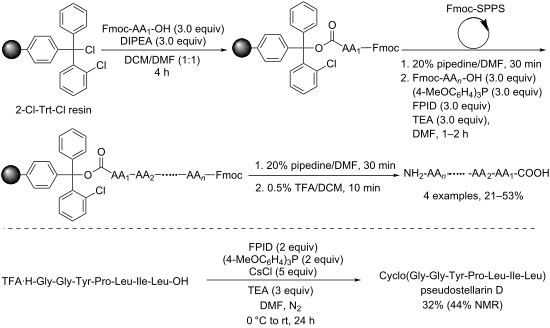
- reversed-phase HPLC (RP-HPLC). For the target peptides, we aimed at peptides with specific biological activities. Leu-enkephalin, which is isolated from pig brains, acts as an endogenous mediator at central morphine receptor sites and thus possesses potent opiate agonist activity [34][35][36]. Leu


On the design principles of peptide–drug conjugates for targeted drug delivery to the malignant tumor site
Beilstein J. Org. Chem. 2018, 14, 930–954, doi:10.3762/bjoc.14.80
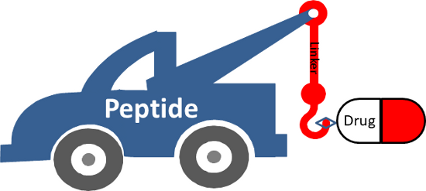


Synthesis and in vitro biochemical evaluation of oxime bond-linked daunorubicin–GnRH-III conjugates developed for targeted drug delivery
Beilstein J. Org. Chem. 2018, 14, 756–771, doi:10.3762/bjoc.14.64
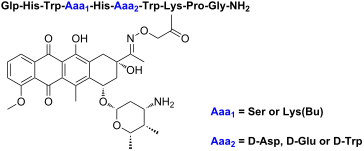
- studies have been prepared as previously described [29][51][52][55]. Radioiodinated GnRH-I agonist triptorelin was prepared by chloramines-T method and purified by RP-HPLC [29][51][52][56]. This radioligand has been well-characterized and shows high-affinity binding to human and rat pituitaries as well as



Diastereoselective auxiliary- and catalyst-controlled intramolecular aza-Michael reaction for the elaboration of enantioenriched 3-substituted isoindolinones. Application to the synthesis of a new pazinaclone analogue
Beilstein J. Org. Chem. 2018, 14, 593–602, doi:10.3762/bjoc.14.46
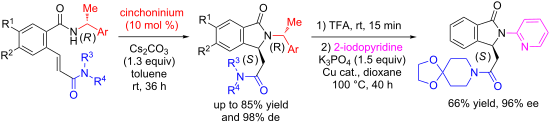
- agonist at GABAA (γ-aminobutyric acid type A) benzodiazepine receptors [17]. In order to circumvent any hydrolysis of the ketal group during the preparation of the starting benzamide (see Supporting Information File 1), the synthesis of intermediate 24 was performed according another pathway depicted in


Aminosugar-based immunomodulator lipid A: synthetic approaches
Beilstein J. Org. Chem. 2018, 14, 25–53, doi:10.3762/bjoc.14.3
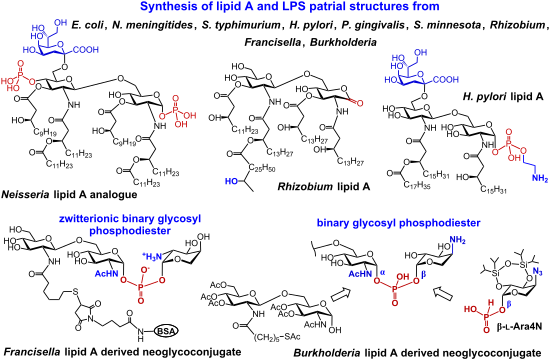
- vaccine adjuvants [59][60][61]. X-ray structural analyses of the MD-2∙TLR4 complexes with bound variably acylated lipid A uncovered markedly different modes of interaction of agonist and antagonist TLR4 ligands. Commonly, the binding of hexaacylated bisphosphorylated lipid A (such as lipid A from E. coli
- addition to labeled E. coli type lipid A 25, the labeled tetraacylated lipid IVa was also prepared. Importantly, the bioactivity of labeled compounds was fully preserved (the labeled E. coli type lipid A 25 performed as strong TLR4 agonist and the labeled tetraacylated lipid IVa acted, as expected, as TLR4




Microfluidic radiosynthesis of [18F]FEMPT, a high affinity PET radiotracer for imaging serotonin receptors
Beilstein J. Org. Chem. 2017, 13, 2922–2927, doi:10.3762/bjoc.13.285
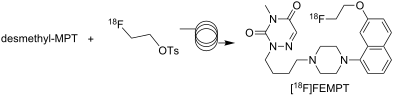
- the reduction in reaction times and consumption of reagents that often result in increased radiochemical yields and rapid optimization of reaction parameters for 18F-labeling. In this paper, we report on the two-step microfluidic radiosynthesis of the high affinity partial agonist of the serotonin 1A
- receptor, [18F]FEMPT (pKi = 9. 79; Ki = 0.16 nM) by microfluidic radiochemistry. [18F]FEMPT was obtained in ≈7% isolated radiochemical yield and in >98% radiochemical and chemical purity. The molar activity of the final product was determined to be >148 GBq/µmol (>4 Ci/µmol). Keywords: agonist; fluorine
- -18; 5-HT1A; microfluidics; PET; Introduction The development of serotonin 1A receptor (5-HT1AR) agonist radiotracers for applications in molecular imaging with positron emission tomography (PET) has been avidly sought over the past two decades, albeit with limited success. The current status of


The chemistry and biology of mycolactones
Beilstein J. Org. Chem. 2017, 13, 1596–1660, doi:10.3762/bjoc.13.159
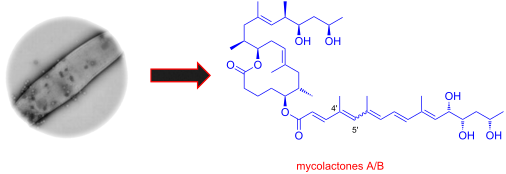
- 8000 host genes identified the angiotensin type II receptor (AT2R) as the molecular target of mycolactone, which was confirmed by genetic knockout in vitro and in vivo and by chemical inhibition. In a competition binding assay mycolactone was able to displace the potent radiolabeled agonist [125I









G-Protein coupled receptors: answers from simulations
Beilstein J. Org. Chem. 2017, 13, 1071–1078, doi:10.3762/bjoc.13.106
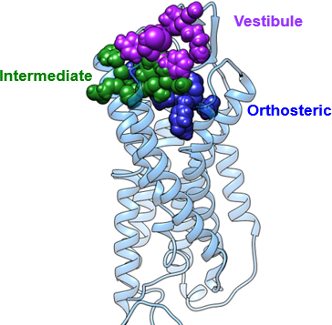
- , no agonist ligand is bound. The G-protein is bound to the intracellular side of the receptor. In this state, the GPCR exhibits its basal activity, which can range from completely inactive to significantly active. Figure 3b shows the fully activated complex, which requires both an agonist ligand and
- experimental findings [29] suggest that both an agonist ligand and a bound G-protein are necessary in order to activate GPCRs. It is therefore significant that the first molecular dynamics (MD) simulations of a ternary GPCR complex were reported only four years ago [30]. Such simulations are now commonplace
- bound. The α-subunit of the G-protein is shown in green, β in yellow and γ in magenta. In this state, the GPCR exhibits basal activity. This figure assumes pre-association of the G-protein to the receptor. (b) Fully activated GPCR. Both an agonist ligand and the G-protein are required for full





