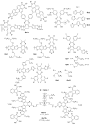
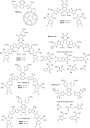
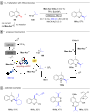
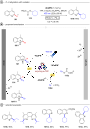
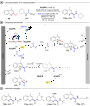
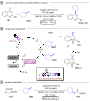
Search for "dyes" in Full Text gives 279 result(s) in Beilstein Journal of Organic Chemistry. Showing first 200.
Beilstein J. Org. Chem. 2024, 20, 1111–1166, doi:10.3762/bjoc.20.98
Graphical Abstract
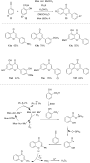
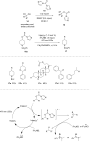
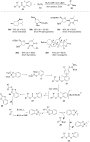
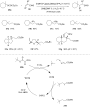
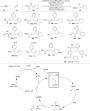
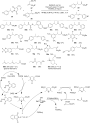
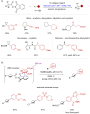
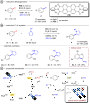
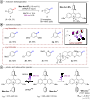
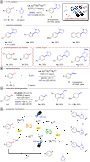
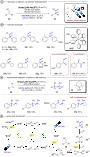
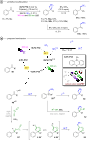
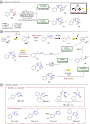
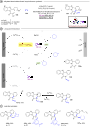
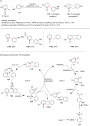
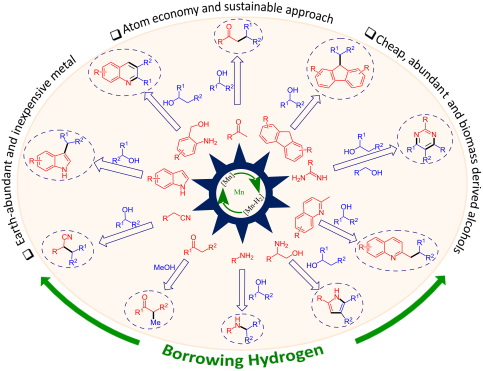
Scheme 1: General scheme of the borrowing hydrogen (BH) or hydrogen auto-transfer (HA) methodology.
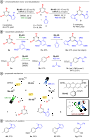
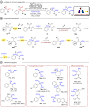
Scheme 2: General scheme for C–N bond formation. A) Traditional cross-couplings with alkyl or aryl halides. B...
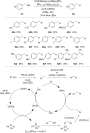
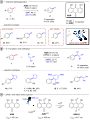
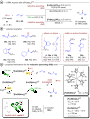
Figure 1: Manganese pre-catalysts used for the N-alkylation of amines with alcohols.
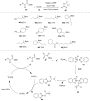
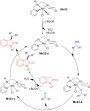
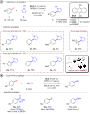
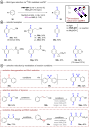
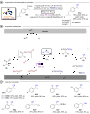
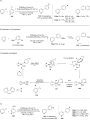
Scheme 3: Manganese(I)-pincer complex Mn1 used for the N-alkylation of amines with alcohols and methanol.
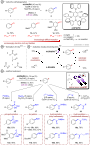
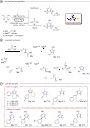
Scheme 4: N-Methylation of amines with methanol using Mn2.
Scheme 5: C–N-Bond formation with amines and methanol using PN3P-Mn complex Mn3 reported by Sortais et al. [36]. a...
Scheme 6: Base-assisted synthesis of amines and imines with Mn4. Reaction assisted by A) t-BuOK and B) t-BuON...
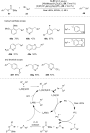
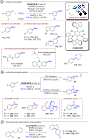
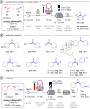
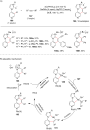
Scheme 7: Coupling of alcohols and hydrazine via the HB approach reported by Milstein et al. [38]. aReaction time...
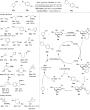
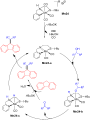
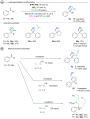
Scheme 8: Proposed mechanism for the coupling of alcohols and hydrazine catalyzed by Mn5.
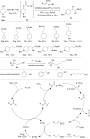
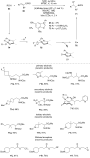
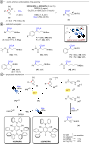
Scheme 9: Phosphine-free manganese catalyst for N-alkylation of amines with alcohols reported by Balaraman an...
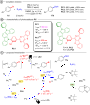
Scheme 10: N-Alkylation of sulfonamides with alcohols.
Scheme 11: Mn–NHC catalyst Mn6 applied for the N-alkylation of amines with alcohols. a3 mol % of Mn6 were used....
Scheme 12: N-Alkylation of amines with primary and secondary alcohols. a80 °C, b100 °C.
Scheme 13: Manganese(III)-porphyrin catalyst for synthesis of tertiary amines.
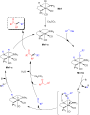
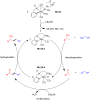
Scheme 14: Proposed mechanism for the alcohol dehydrogenation with Mn(III)-porphyrin complex Mn7.
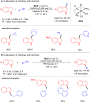
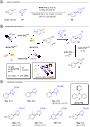
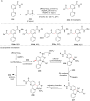
Scheme 15: N-Methylation of nitroarenes with methanol using catalyst Mn3.
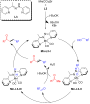
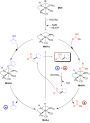
Scheme 16: Mechanism of manganese-catalyzed methylation of nitroarenes using Mn3 as the catalyst.
Scheme 17: Bidentate manganese complex Mn8 applied for the N-alkylation of primary anilines with alcohols. aOn...
Scheme 18: N-Alkylation of amines with alcohols in the presence of manganese salts and triphenylphosphine as t...
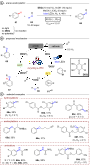
Scheme 19: N-Alkylation of diazo compounds with alcohols using catalyst Mn9.
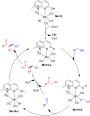
Scheme 20: Proposed mechanism for the amination of alcohols with diazo compounds catalyzed by catalyst Mn9.
Scheme 21: Mn1 complex-catalyzed synthesis of polyethyleneimine from ethylene glycol and ethylenediamine.
Scheme 22: Bis-triazolylidene-manganese complex Mn10 for the N-alkylation of amines with alcohols.
Figure 2: Manganese complexes applied for C-alkylation reactions of ketones with alcohols.
Scheme 23: General scheme for the C–C bond formation with alcohols and ketones.
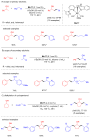
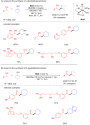
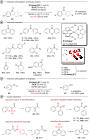
Scheme 24: Mn1 complex-catalyzed α-alkylation of ketones with primary alcohols.
Scheme 25: Mechanism for the Mn1-catalyzed alkylation of ketones with alcohols.
Scheme 26: Phosphine-free in situ-generated manganese catalyst for the α-alkylation of ketones with primary al...
Scheme 27: Plausible mechanism for the Mn-catalyzed α-alkylation of ketones with alcohols.
Scheme 28: α-Alkylation of esters, ketones, and amides using alcohols catalyzed by Mn11.
Scheme 29: Mono- and dialkylation of methylene ketones with primary alcohols using the Mn(acac)2/1,10-phenanth...
Scheme 30: Methylation of ketones with methanol and deuterated methanol.
Scheme 31: Methylation of ketones and esters with methanol. a50 mol % of t-BuOK were used, bCD3OD was used ins...
Scheme 32: Alkylation of ketones and secondary alcohols with primary alcohols using Mn4.
Scheme 33: Bidentate manganese-NHC complex Mn6 applied for the synthesis of alkylated ketones using alcohols.
Scheme 34: Mn1-catalyzed synthesis of substituted cycloalkanes by coupling diols and secondary alcohols or ket...
Scheme 35: Proposed mechanism for the synthesis of cycloalkanes via BH method.
Scheme 36: Synthesis of various cycloalkanes from methyl ketones and diols catalyze by Mn13. aReaction time wa...
Scheme 37: N,N-Amine–manganese complex (Mn13)-catalyzed alkylation of ketones with alcohols.
Scheme 38: Naphthyridine‑N‑oxide manganese complex Mn14 applied for the alkylation of ketones with alcohols. a...
Scheme 39: Proposed mechanism of the naphthyridine‑N‑oxide manganese complex (Mn14)-catalyzed alkylation of ke...
Scheme 40: α-Methylation of ketones and indoles with methanol using Mn15.
Scheme 41: α-Alkylation of ketones with primary alcohols using Mn16. aNMR yield.
Figure 3: Manganese complexes used for coupling of secondary and primary alcohols.
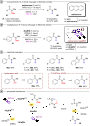
Scheme 42: Alkylation of secondary alcohols with primary alcohols catalyzed by phosphine-free catalyst Mn17. a...
Scheme 43: PNN-Manganese complex Mn18 for the alkylation of secondary alcohols with primary alcohols.
Scheme 44: Mechanism for the Mn-pincer catalyzed C-alkylation of secondary alcohols with primary alcohols.
Scheme 45: Upgrading of ethanol with methanol for isobutanol production.
Scheme 46: Mn-Pincer catalyst Mn19 applied for the β-methylation of alcohols with methanol. a2.0 mol % of Mn19...
Scheme 47: Functionalized ketones from primary and secondary alcohols catalyzed by Mn20. aMn20 (5 mol %), NaOH...
Scheme 48: Synthesis of γ-disubstituted alcohols and β-disubstituted ketones through Mn9-catalyzed coupling of...
Scheme 49: Proposed mechanism for the Mn9-catalyzed synthesis of γ-disubstituted alcohols and β-disubstituted ...
Scheme 50: Dehydrogenative coupling of ethylene glycol and primary alcohols catalyzed by Mn4.
Scheme 51: Mn18-cataylzed C-alkylation of unactivated esters and amides with alcohols.
Scheme 52: Alkylation of amides and esters using Mn21.
Scheme 53: α-Alkylation of nitriles with primary alcohols using in situ-generated manganese catalyst.
Scheme 54: Proposed mechanism for the α-alkylation of nitriles with primary alcohols.
Scheme 55: Mn9-catalyzed α-alkylation of nitriles with primary alcohols. a1,4-Dioxane was used as solvent, 24 ...
Figure 4: Manganese complexes used for alkylation of heterocyclic compounds.
Scheme 56: Aminomethylation of aromatic compounds with secondary amines and methanol catalyzed by Mn22.
Scheme 57: Regioselective alkylation of indolines with alcohols catalyzed by Mn9. aMn9 (4 mol %), 48 h.
Scheme 58: Proposed mechanism for the C- and N-alkylation of indolines with alcohols.
Scheme 59: C-Alkylation of methyl N-heteroarenes with primary alcohols catalyzed by Mn1. aTime was 60 h.
Scheme 60: C-Alkylation of oxindoles with secondary alcohols.
Scheme 61: Plausible mechanism for the Mn23-catalyzed C-alkylation of oxindoles with secondary alcohols.
Scheme 62: Synthesis of C-3-alkylated products by coupling alcohols with indoles and aminoalcohols.
Scheme 63: C3-Alkylation of indoles using Mn1.
Scheme 64: C-Methylation of indoles with Mn15 and methanol.
Scheme 65: α-Alkylation of 2-oxindoles with primary and secondary alcohols catalyzed by Mn25. aReaction carrie...
Scheme 66: Dehydrogenative alkylation of indolines with Mn1. aMn1 (5.0 mol %) was used.
Scheme 67: Synthesis of bis(indolyl)methane derivatives from indoles and alcohols catalyzed by Mn26. aMn26 (5....
Scheme 68: One-pot synthesis of pyrimidines via BH.
Scheme 69: Synthesis of pyrroles from alcohols and aminoalcohols using Mn4.
Scheme 70: Synthesis of pyrroles via multicomponent reaction catalyzed by Mn12.
Scheme 71: Friedländer quinoline synthesis using an in situ-generated phosphine-free manganese catalyst.
Scheme 72: Quinoline synthesis using bis-N-heterocyclic carbene-manganese catalyst Mn6.
Scheme 73: Quinoline synthesis using manganese(III)-porphyrin catalyst Mn7.
Scheme 74: Manganese-catalyzed tetrahydroquinoline synthesis via borrowing BH.
Scheme 75: Proposed mechanism for the manganese-catalyzed tetrahydroquinoline synthesis.
Scheme 76: Synthesis of C3-alkylated indoles using Mn24.
Scheme 77: Synthesis of C-3-alkylated indoles using Mn1.
Scheme 78: C–C Bond formation by coupling of alcohols and ylides.
Scheme 79: C-Alkylation of fluorene with alcohols catalyzed by Mn24.
Scheme 80: Proposed mechanism for the C-alkylation of fluorene with alcohols catalyzed by Mn24.
Scheme 81: α-Alkylation of sulfones using Mn-PNN catalyst Mn28.
Beilstein J. Org. Chem. 2024, 20, 1037–1052, doi:10.3762/bjoc.20.92
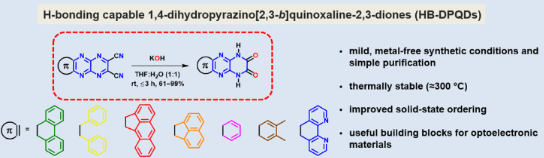
Graphical Abstract
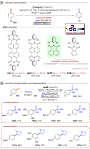
Figure 1: Chemical structures of H-bonding N-heteroacenes synthesized by Miao et al. and Bunz et al. (a) [22,23]. Pr...
Scheme 1: Synthesis of dicyanopyrazinoquinoxaline derivatives 1a–7a.
Scheme 2: Synthesis of bis-alkoxy-substituted π-conjugated phenanthrolines 16a, 16b, 16c, and 16d.
Scheme 3: An alternative synthetic route to access 7a.
Scheme 4: Synthesis of DPQDs 1b–7b from their corresponding DCPQs 1a–7a. *THF/H2O/1,4-dioxane (4:5:1). **in s...
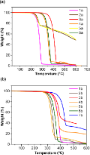
Figure 2: TGA of 1a–6a (a) and 1b–7b (b) obtained at 10 °C/min under nitrogen.
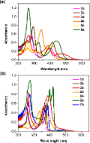
Figure 3: Absorption spectra (20 μM) for a) DCPQs 1a–6a and b) DPQDs 1b–7b in dimethyl sulfoxide.
Figure 4: Calculated HOMO (below) and LUMO (above) energies by DFT analysis (B3LYP/6-31+G* level of theory), ...
Figure 5: Calculated HOMO (below) and LUMO (above) energies by DFT analysis (B3LYP/6-31+G* level of theory), ...
Figure 6: Asymmetric unit of DPQD 2b with important bond lengths highlighted (a). Torsion angles of 4.33° and...
Beilstein J. Org. Chem. 2024, 20, 973–1000, doi:10.3762/bjoc.20.87
Graphical Abstract
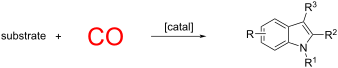
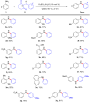
Scheme 1: Pd(0)-catalyzed domino C,N-coupling/carbonylation/Suzuki coupling reaction for the synthesis of 2-a...
Scheme 2: Pd(0)-catalyzed single isonitrile insertion: synthesis of 1-(3-amino)-1H-indol-2-yl)-1-ketones.
Scheme 3: Pd(0)-catalyzed gas-free carbonylation of 2-alkynylanilines to 1-(1H-indol-1-yl)-2-arylethan-1-ones....
Scheme 4: Pd(II)-catalyzed heterocyclization/alkoxycarbonylation of 2-alkynylaniline imines.
Scheme 5: Pd(II)-catalyzed heterocyclization/alkoxycarbonylation of 2-alkynylanilines to N-substituted indole...
Scheme 6: Synthesis of indol-2-acetic esters by Pd(II)-catalyzed carbonylation of 1-(2-aminoaryl)-2-yn-1-ols.
Scheme 7: Pd(II)-catalyzed carbonylative double cyclization of suitably functionalized 2-alkynylanilines to 3...
Scheme 8: Indole synthesis by deoxygenation reactions of nitro compounds reported by Cenini et al. [21].
Scheme 9: Indole synthesis by reduction of nitro compounds: approach reported by Watanabe et al. [22].
Scheme 10: Indole synthesis from o-nitrostyrene compounds as reported by Söderberg and co-workers [23].
Scheme 11: Synthesis of fused indoles (top) and natural indoles present in two species of European Basidiomyce...
Scheme 12: Synthesis of 1,2-dihydro-4(3H)-carbazolones through N-heteroannulation of functionalized 2-nitrosty...
Scheme 13: Synthesis of indoles from o-nitrostyrenes by using Pd(OAc)2 and Pd(tfa)2 in conjunction with bident...
Scheme 14: Synthesis of substituted 3-alkoxyindoles via palladium-catalyzed reductive N-heteroannulation.
Scheme 15: Synthesis of 3-arylindoles by palladium-catalyzed C–H bond amination via reduction of nitroalkenes.
Scheme 16: Synthesis of 2,2′-bi-1H-indoles, 2,3′-bi-1H-indoles, 3,3′-bi-1H-indoles, indolo[3,2-b]indoles, indo...
Scheme 17: Pd-catalyzed reductive cyclization of 1,2-bis(2-nitrophenyl)ethene and 1,1-bis(2-nitrophenyl)ethene...
Scheme 18: Flow synthesis of 2-substituted indoles by reductive carbonylation.
Scheme 19: Pd-catalyzed synthesis of variously substituted 3H-indoles from nitrostyrenes by using Mo(CO)6 as C...
Scheme 20: Synthesis of indoles from substituted 2-nitrostyrenes (top) and ω-nitrostyrenes (bottom) via reduct...
Scheme 21: Synthesis of indoles from substituted 2-nitrostyrenes with formic acid as CO source.
Scheme 22: Ni-catalyzed carbonylative cyclization of 2-nitroalkynes and aryl iodides (top) and the Ni-catalyze...
Scheme 23: Mechanism of the Ni-catalyzed carbonylative cyclization of 2-nitroalkynes and aryl iodides (top) an...
Scheme 24: Route to indole derivatives through Rh-catalyzed benzannulation of heteroaryl propargylic esters fa...
Scheme 25: Pd-catalyzed cyclization of 2-(2-haloaryl)indoles reported by Yoo and co-workers [54], Guo and co-worke...
Scheme 26: Approach for the synthesis of 6H-isoindolo[2,1-a]indol-6-ones reported by Huang and co-workers [57].
Scheme 27: Zhou group’s method for the synthesis of 6H-isoindolo[2,1-a]indol-6-ones.
Scheme 28: Synthesis of 6H-isoindolo[2,1-a]indol-6-ones from o-1,2-dibromobenzene and indole derivatives by us...
Scheme 29: Pd(OAc)2-catalyzed Heck cyclization of 2-(2-bromophenyl)-1-alkyl-1H-indoles reported by Guo et al. [55]....
Scheme 30: Synthesis of indolo[1,2-a]quinoxalinone derivatives through Pd/Cu co-catalyzed carbonylative cycliz...
Scheme 31: Pd-catalyzed carbonylative cyclization of o-indolylarylamines and N-monosubstituted o-indolylarylam...
Scheme 32: Pd-catalyzed diasteroselective carbonylative cyclodearomatization of N-(2-bromobenzoyl)indoles with...
Scheme 33: Pd(0)-catalyzed synthesis of CO-linked heterocyclic scaffolds from alkene-indole derivatives and 2-...
Scheme 34: Proposed mechanism for the Pd(0)-catalyzed synthesis of CO-linked heterocyclic scaffolds.
Scheme 35: Pd-catalyzed C–H and N–H alkoxycarbonylation of indole derivatives to indole-3-carboxylates and ind...
Scheme 36: Rh-catalyzed C–H alcoxycarbonylation of indole derivatives to indole-3-carboxylates reported by Li ...
Scheme 37: Pd-catalyzed C–H alkoxycarbonylation of indole derivatives with alcohols and phenols to indole-3-ca...
Scheme 38: Synthesis of N-methylindole-3-carboxylates from N-methylindoles and phenols through metal-catalyst-...
Scheme 39: Synthesis of indol-3-α-ketoamides (top) and indol-3-amides (bottom) via direct double- and monoamin...
Scheme 40: The direct Sonogashira carbonylation coupling reaction of indoles and alkynes via Pd/CuI catalysis ...
Scheme 41: Synthesis of indole-3-yl aryl ketones reported by Zhao and co-workers [73] (path a) and Zhang and co-wo...
Scheme 42: Pd-catalyzed carbonylative synthesis of BIMs from aryl iodides and N-substituted and NH-free indole...
Scheme 43: Cu-catalyzed direct double-carbonylation and monocarbonylation of indoles and alcohols with hexaket...
Scheme 44: Rh-catalyzed direct C–H alkoxycarbonylation of indoles to indole-2-carboxylates [79] (top) and Co-catal...
Scheme 45: Pd-catalyzed carbonylation of NH free-haloindoles.
Beilstein J. Org. Chem. 2024, 20, 701–713, doi:10.3762/bjoc.20.64
Graphical Abstract
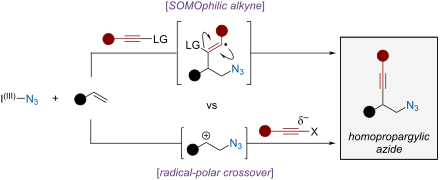
Scheme 1: Overview of homopropargylic azides importance and strategies for azido-alkynylation.
Scheme 2: Screening of nucleophilic alkynes and investigation of the photocatalyst solubility. n.o = not obse...
Scheme 3: Selected scope entries of the azido-alkynylation. The data were already published in ref. [45].
Scheme 4: Unsuccessful examples. The conditions used are the same as in Scheme 3. The yields reported were determined...
Scheme 5: Proposed mechanism.
Beilstein J. Org. Chem. 2024, 20, 552–560, doi:10.3762/bjoc.20.47
Graphical Abstract
Scheme 1: Synthesis of compound 1 and N-acylated compounds 2a–c.
Figure 1: Absorption (1), fluorescence (2, λex = 410 nm) and fluorescence excitation (3, λfl = 465 nm) spectr...
Figure 2: Electronic absorption spectra of compound 2b in acetonitrile before (1) and after 15 s (2), 35 s (3...
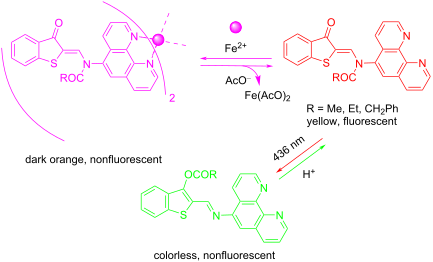
Scheme 2: Photoisomerization of N-acylated ketoenamines 2a–c.
Figure 3: Molecular structure of O-acylated isomer 3b. Thermal ellipsoids are drawn at the 50% probability le...
Figure 4: Fragment of the molecular packing of compound 3b, showing π–π interactions in the crystalline state...
Figure 5: Absorption spectra of compound 2a in acetonitrile before (1) and after (2) the addition of Fe2+ (c2a...
Figure 6: Changes in the absorption intensity of compound 2a in acetonitrile at 520 nm after the addition of ...
Scheme 3: Sequential interaction of compounds 2a–c with Fe2+ and AcO−.
Figure 7: Job’s plot at the wavelength 429 nm, reflecting the interaction of compound 2a with Fe2+ in acetoni...
Figure 8: Fluorescence intensity of compound 2a upon alternate addition of Fe2+ and AcO−.
Beilstein J. Org. Chem. 2024, 20, 346–378, doi:10.3762/bjoc.20.35
Graphical Abstract
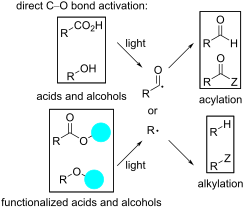
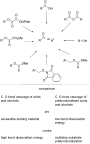
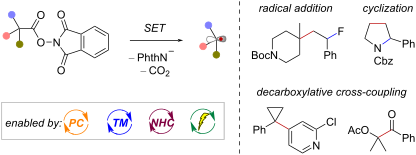
Scheme 1: Comparison between Barton and NHPI ester radical precursors.
Scheme 2: Overview of the mechanisms and activation modes involved in radical generation from RAEs.
Scheme 3: Common mechanisms in photocatalysis.
Scheme 4: A) Giese-type radical addition of NHPI esters mediated by a reductive quenching photocatalytic cycl...
Scheme 5: A) Minisci-type radical addition of NHPI esters. B) Reaction mechanism involving an “off-cycle” red...
Scheme 6: Activation of NHPI esters through hydrogen-bonding in an oxidative quenching photocatalytic cycle.
Scheme 7: SET activation of RAE facilitated by a Lewis acid catalyst.
Scheme 8: PCET activation of NHPI esters in the context of a radical-redox annulation.
Scheme 9: Activation enabled by a strong excited-state reductant catalyst and its application in the dearomat...
Scheme 10: Proposed formation of an intramolecular charge-transfer complex in the synthesis of (spiro)anellate...
Scheme 11: Formation of a charge-transfer complex between enamides and NHPI esters enabled by a chiral phospha...
Scheme 12: Activation of NHPI ester through the formation of photoactive EDA-complexes.
Scheme 13: A) EDA complex-mediated radical hydroalkylation reactions of NHPI esters. B) Proposed mechanism for...
Scheme 14: Proposed radical chain mechanism initiated by EDA-complex formation.
Scheme 15: A) Photoinduced decarboxylative borylation. B) Proposed radical chain mechanism.
Scheme 16: A) Activation of NHPI esters mediated by PPh3/NaI. B) Proposed catalytic cycle involving EDA-comple...
Scheme 17: A) Radical generation facilitated by EDA complex formation between PTH1 catalyst and NHPI esters. B...
Scheme 18: Proposed catalytic cycle for the difunctionalization of styrenes.
Scheme 19: Formation of a charge-transfer complex between NHPI esters and Cs2CO3 enables decarboxylative amina...
Scheme 20: 3-Acetoxyquinuclidine as catalytic donor in the activation of TCNHPI esters.
Scheme 21: A) Photoinduced Cu-catalyzed decarboxylative amination. B) Proposed catalytic cycle. C) Radical clo...
Scheme 22: A) Photoinduced Pd-catalyzed aminoalkylation of 1,4-dienes. B) Proposed catalytic cycle.
Scheme 23: A) TM-catalyzed decarboxylative coupling of NHPI esters and organometallic reagents. B) Representat...
Scheme 24: Synthetic applications of the TM-catalyzed decarboxylative coupling of NHPI esters and organometall...
Scheme 25: A) Ni-catalyzed cross-electrophile coupling of NHPI esters. B) Representative catalytic cycle.
Scheme 26: A) Synthetic applications of decarboxylative cross-electrophile couplings. B) Decarboxylative aryla...
Scheme 27: A) Activation of tetrachlorophthalimide redox-active esters enabled by a low-valency Bi complex. B)...
Scheme 28: Activation of NHPI esters mediated by Zn0 applied in a Z-selective alkenylation reaction.
Scheme 29: A) Activation of NHPI esters enabled by a pyridine-boryl radical species applied to the decarboxyla...
Scheme 30: A) Decarboxylative coupling of RAE and aldehydes enabled by NHC-catalyzed radical relay. B) Propose...
Scheme 31: A) Decarboxylative C(sp3)–heteroatom coupling reaction of NHPI esters under NHC catalysis B) The NH...
Scheme 32: A) Electrochemical Giese-type radical addition of NHPI esters. B) Reaction mechanism.
Scheme 33: Electrochemical Minisci-type radical addition of NHPI-esters.
Scheme 34: Ni-electrocatalytic cross-electrophile coupling of NHPI esters with aryl iodides.
Scheme 35: A) Decarboxylative arylation of NHPI esters under Ag-Ni electrocatalysis B) Formation of AgNP on th...
Scheme 36: Synthetic applications of decarboxylative couplings of NHPI esters under Ni-electrocatalysis.
Scheme 37: Examples of natural product syntheses in which RAEs were used in key C–C bond forming reactions.
Beilstein J. Org. Chem. 2024, 20, 243–253, doi:10.3762/bjoc.20.24
Graphical Abstract
Scheme 1: Comparison of basicity (in water scale) and synthetic availability of quinoline-type azaarenes and ...
Figure 1: Suggested amination products 6 and two resonance forms of dianion 7.
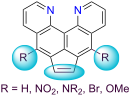
Figure 2: Targeted dipyridoacenaphthylene 8.
Scheme 2: Formation of complex 9 and its slow hydrolytic degradation into protic salt 5·HCl.
Figure 3: Molecular and crystal structure of salt 5·HCl·2H2O is strongly dominated by severe H-bonding (blue ...
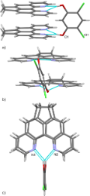
Figure 4: Selected images of the supramolecular organization of two molecules of base 5 held by 4,6-dichloror...
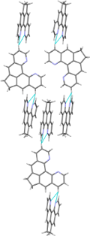
Figure 5: Fragment of the crystal packing of neutral dipyridoacenaphthene 5 showing self-association via mult...
Scheme 3: Dinitration of compound 5 and the initially assumed admixture 11.
Scheme 4: Mononitration of compound 5.
Figure 6: Structure of dinitroacenaphthylene 12.
Scheme 5: Dehydrogenation of compounds 10 and 11.
Scheme 6: Nucleophilic methoxylation of compounds 10(12).
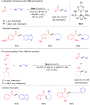
Figure 7: Basicity of key compounds in acetonitrile.
Scheme 7: Electrophilic bromination of compound 5.
Scheme 8: tele-Elimination upon interaction of dibromide 15 with pyrrolidine.
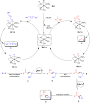
Scheme 9: Interaction of dibromide 15 with anionic bases.
Beilstein J. Org. Chem. 2024, 20, 228–242, doi:10.3762/bjoc.20.23
Graphical Abstract
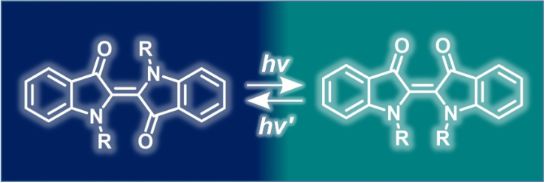
Figure 1: Precursors used in the synthesis of indigo [4].
Figure 2: a) Intramolecular (a = 2.26 Å) and intermolecular (b = 2.11 Å) hydrogen bonds in indigo, b) crystal...
Figure 3: Bond length in the indigo molecule obtained from the single crystal X-ray analysis [12], the typical bo...
Figure 4: The structure of the indigo chromophore (H-chromophore, highlighted in blue), asterisk indicates th...
Figure 5: Influence of substituents in the benzene rings on the color of indigo derivatives.
Figure 6: a) E–Z photoisomerization of indigo and b) photoinduced proton transfer in the excited state, aster...
Figure 7: Structures of indigo derivatives discussed in this review.
Figure 8: Photoswitching of N,N'-diacetylindigo (9a) in CCl4 (c = 17.1 µM; cell length = 5.0 cm) irradiated w...
Figure 9: Photoisomerization of compound 18c upon irradiation with red light and schematic representation of ...
Figure 10: Schematic representation of indigo-type (left) and amide-type (right) resonances in N,N'-acetylindi...
Figure 11: Suggested intermediates for the double bond cleavage for the thermal relaxation of N,N'-diacylindig...
Figure 12: Zwitterionic resonance structures of Z-indigo.
Figure 13: Photos of crystalline N,N'-di(Boc)indigo 17a its solutions in 1) DMSO, 2) DMF, 3) N-methyl-2-pyrrol...
Figure 14: Structural isomers of indigo.
Figure 15: Photochromism of indirubin derivatives and supramolecular complexation of the E-isomers with Schrei...
Figure 16: Photoisomerization of the protonated isoindigo.
Beilstein J. Org. Chem. 2024, 20, 118–124, doi:10.3762/bjoc.20.12
Graphical Abstract
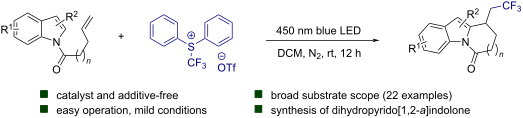
Figure 1: Representative dihydropyrido[1,2-a]indolone derivatives.
Scheme 1: Selected works for the construction of dihydropyrido[1,2-a]indolones and current methodology.
Scheme 2: Substrate scope of the cascade reaction.
Scheme 3: Radical trapping experiment.
Figure 2: UV–vis spectra of substrates; [1a] 0.33 M, [2a] 0.11 M.
Scheme 4: Plausible reaction mechanism.
Beilstein J. Org. Chem. 2023, 19, 1867–1880, doi:10.3762/bjoc.19.139
Graphical Abstract
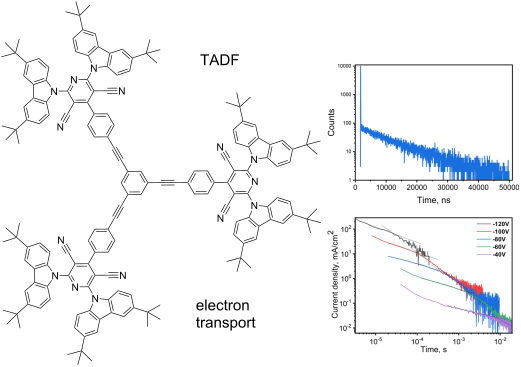
Figure 1: Chemical structures of pyridine-3,5-dicarbonitrile-based TADF emitters.
Scheme 1: Synthesis of dicyanocarbazole 6. Reaction conditions: a) cyanoacetamide, piperidine, methanol, 40 °...
Scheme 2: Synthesis of dicyanocarbazoles 7–9. Reaction conditions: a) corresponding ethynyl arene, Pd(Ph3P)4 ...
Figure 2: Absorption (a, b) and PL (c, d) spectra of dilute toluene, THF, and chloroform solutions (10−5 M) a...
Figure 3: PL spectra (a) and PL decay curves (b) of air-equilibrated (as prepared) and deoxygenated toluene s...
Figure 4: Non-normalized (a) and normalized (b) PL spectra and PL decay curves (c) of the film of a 10 wt % m...
Figure 5: TGA (a) and DSC 2nd heating (b) curves of compounds 6–9.
Figure 6: CV curves of compounds 6–9.
Figure 7: Photoelectron emission spectra of the vacuum-deposited films of compounds 6–9 on glass substrates c...
Figure 8: The current transients (a) for electrons recorded at the different voltages for the vacuum-deposite...
Beilstein J. Org. Chem. 2023, 19, 1832–1840, doi:10.3762/bjoc.19.135
Graphical Abstract
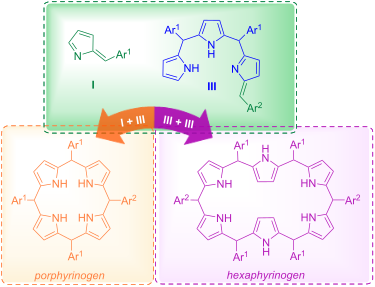
Scheme 1: Retrosynthetic method for A4B2-hexaphyrin and A3B-porphyrin synthesis.
Figure 1: Mass spectrum of the reaction mixture of 1 and 2d at 30 min at 0 °C with assigned intermediates (po...
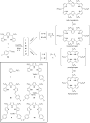
Scheme 2: A suggested reaction pathway for the formation of A4B2-hexaphyrins and A3B-porphyrins.
Figure 2: Intermediates in the reaction mixture of 5 and 2h at 30 min at 0 °C.
Beilstein J. Org. Chem. 2023, 19, 1785–1803, doi:10.3762/bjoc.19.131
Graphical Abstract
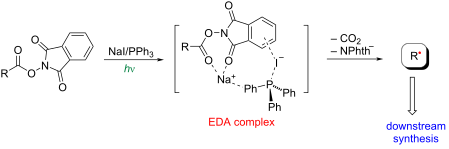
Scheme 1: Photocatalytic decarboxylative transformations mediated by the NaI/PPh3 catalyst system.
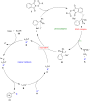
Scheme 2: Proposed catalytic cycle of NaI/PPh3 photoredox catalysis.
Scheme 3: Decarboxylative alkenylation of redox-active esters by NaI/PPh3 catalysis.
Scheme 4: Decarboxylative alkenylation mediated by NaI/PPh3 catalysis.
Scheme 5: NaI-mediated photoinduced α-alkenylation of Katritzky salts 7.
Scheme 6: n-Bu4NI-mediated photoinduced decarboxylative olefination.
Scheme 7: Proposed mechanism of the n-Bu4NI-mediated photoinduced decarboxylative olefination.
Scheme 8: Photodecarboxylative alkylation of redox-active esters with diazirines.
Scheme 9: Photoinduced iodine-anion-catalyzed decarboxylative/deaminative C–H alkylation of enamides.
Scheme 10: Photocatalytic C–H alkylation of coumarins mediated by NaI/PPh3 catalysis.
Scheme 11: Photoredox alkylation of aldimines by NaI/PPh3 catalysis.
Scheme 12: Photoredox C–H alkylation employing ammonium iodide.
Scheme 13: NaI/PPh3/CuBr cooperative catalysis for photocatalytic C(sp3)–O/N cross-coupling reactions.
Scheme 14: Proposed mechanism of NaI/PPh3/CuBr cooperative catalysis for photocatalytic C(sp3)–O/N cross-coupl...
Scheme 15: Photocatalytic decarboxylative [3 + 2]/[4 + 2] annulation between enynals and γ,σ-unsaturated N-(ac...
Scheme 16: Proposed mechanism for the decarboxylative [3 + 2]/[4 + 2] annulation.
Scheme 17: Decarboxylative cascade annulation of alkenes/1,6-enynes with N-hydroxyphthalimide esters.
Scheme 18: Decarboxylative radical cascade cyclization of N-arylacrylamides.
Scheme 19: NaI/PPh3-driven photocatalytic decarboxylative radical cascade alkylarylation.
Scheme 20: Proposed mechanism of the NaI/PPh3-driven photocatalytic decarboxylative radical cascade cyclizatio...
Scheme 21: Visible-light-promoted decarboxylative cyclization of vinylcycloalkanes.
Scheme 22: NaI/PPh3-mediated photochemical reduction and amination of nitroarenes.
Scheme 23: PPh3-catalyzed alkylative iododecarboxylation with LiI.
Scheme 24: Visible-light-triggered iodination facilitated by N-heterocyclic carbenes.
Scheme 25: Visible-light-induced photolysis of phosphonium iodide salts for monofluoromethylation.
Beilstein J. Org. Chem. 2023, 19, 1741–1754, doi:10.3762/bjoc.19.127
Graphical Abstract
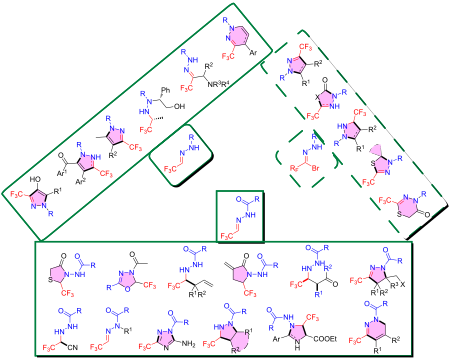
Scheme 1: Synthesis of trifluoromethylpyrazoles from trifluoroacetaldehyde hydrazones.
Scheme 2: Synthesis of polysubstituted pyrazolidines and pyrazolines.
Scheme 3: Asymmetric synthesis of 3-trifluoromethyl-1,4-dihydropyridazines reported by Rueping et al. [39].
Scheme 4: Synthesis of 3-trifluoromethyl-1,4-dihydropyridazine with Brønsted acid-assisted Lewis base catalys...
Scheme 5: Synthesis of CF3-pyrazoles and CF3-1,6-dihydropyridazines.
Scheme 6: Asymmetric reactions of trifluoromethylimines with organometallic reagents.
Scheme 7: Mannich-type reaction of trifluoroacetaldehyde hydrazones.
Scheme 8: Synthesis of trifluoromethylated hydrazonoyl halides.
Scheme 9: Early work of trifluoromethylated hydrazonoyl halides.
Scheme 10: [3 + 2]/[3 + 3] Cycloadditions of trifluoromethylated hydrazonoyl halides.
Scheme 11: Substrate scope for [3 + 2] cycloadditions with trifluoroacetonitrile imines reported by Jasiński’s...
Scheme 12: Synthesis of trifluoromethylated 1,2,4-triazole and 1,2,4-triazine derivatives.
Scheme 13: [3 + 2] Cycloadditions of difluoromethylated hydrazonoyl halides.
Scheme 14: Preparation and early applications of trifluoromethylated acylhydrazones.
Scheme 15: 1,2-Nucleophilic addition reactions of trifluoromethylated acylhydrazones.
Scheme 16: Cascade oxidation/cyclization reactions of trifluoromethylated homoallylic acylhydrazines.
Scheme 17: Synthesis of trifluoromethylated cyanohydrazines and 3-trifluoromethyl-1,2,4-triazolines.
Scheme 18: N-Arylation and N-alkylation of trifluoromethyl acylhydrazones.
Scheme 19: [3 + 2]-Cycladditions of trifluoromethyl acylhydrazones.
Beilstein J. Org. Chem. 2023, 19, 1694–1712, doi:10.3762/bjoc.19.124
Graphical Abstract
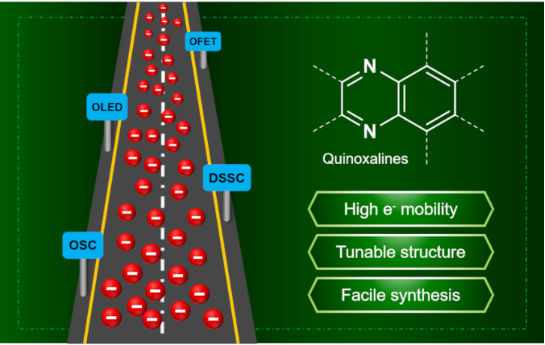
Figure 1: Structures of some of the most versatile Qx scaffolds; dashed lines indicate the substitution sites...
Figure 2: Qx-derived polymer acceptors.
Figure 3: Qx-derived small molecule NFAs.
Figure 4: Qx-derived small molecule NFAs.
Figure 5: Dyes and sensitizers based on Qx auxiliary acceptors or bridging units.
Figure 6: Qx-derived n-type transistor materials.
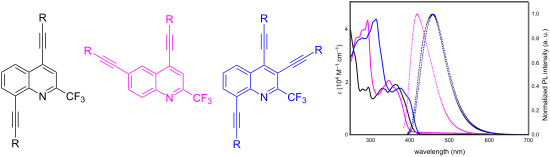
Figure 7: Qx-derived ETM and TADF emitters.
Figure 8: Qx-derived chromophores.
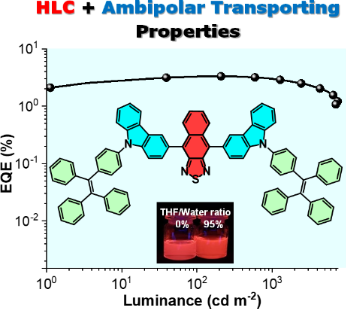
Beilstein J. Org. Chem. 2023, 19, 1664–1676, doi:10.3762/bjoc.19.122
Graphical Abstract
Scheme 1: Synthesis of D–A–D chromophore TPECNz.
Figure 1: a) The optimized structure and HOMO/LUMO distributions calculated by B3LYP/6-31G(d,p) method. b) Th...
Figure 2: UV–vis absorption and PL spectra in a) toluene solution (≈1 × 10⁻⁵ M) and b) thin film spin-coated ...
Figure 3: a) Normalized UV–vis absorption/PL spectra in different solvents. b) Lippert–Mataga plot of Stokes ...
Figure 4: a) PL spectra in THF/water mixtures (5 μM) with different water fractions (fw). b) Plot of relative...
Figure 5: a) DSC and TGA thermograms measured at a heating rate of 10 °C min−1 under N2 flow. b) Cyclic volta...
Figure 6: a) Schematic structure of the hole-only and electron-only MIS devices. b) Electric-field dependence ...
Figure 7: a) Schematic energy diagram of OLED and organic materials used in the device. b) EL spectra at vari...
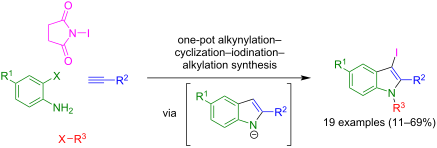
Beilstein J. Org. Chem. 2023, 19, 1379–1385, doi:10.3762/bjoc.19.99
Graphical Abstract
Scheme 1: Consecutive alkynylation–cyclization–alkylation three-component synthesis and conception of a conse...
Scheme 2: Consecutive alkynylation–cyclization–iodination–alkylation four-component synthesis of trisubstitut...
Scheme 3: Consecutive double alkynylation–cyclization–iodination–alkylation pseudo-five-component synthesis o...
Scheme 4: Suzuki coupling of 3-iodoindole 5a with arylboronic acids 7 to give 1,2,3-trisubstituted indoles 8.
Figure 1: A: Absorption and emission spectra of 1-methyl-2-phenyl-3-(p-tolyl)-1H-indole (8b), recorded in dic...
Beilstein J. Org. Chem. 2023, 19, 1198–1215, doi:10.3762/bjoc.19.88
Graphical Abstract
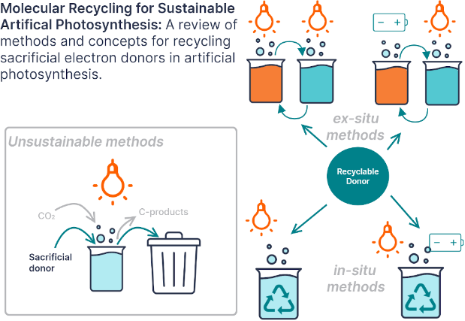
Figure 1: Diagram comparing the two reaction pathways for sacrificial electron donors (SD) in photocatalyzed ...
Figure 2: Diagram showing water-splitting systems developed by Girault, Scanlon, and co-workers that employ i...
Figure 3: Diagram illustrating the transfer of electrons in a photocatalytic particulate suspensions Z-scheme...
Figure 4: A. Structures of the molecules represented in part B. The numbers in brackets correspond to the com...
Figure 5: A. Structures of the molecules represented in part B. The numbers in brackets correspond to the com...
Beilstein J. Org. Chem. 2023, 19, 1055–1145, doi:10.3762/bjoc.19.81
Graphical Abstract
Figure 1: Oxidative and reductive activations of organic compounds harvesting photoredox catalysis.
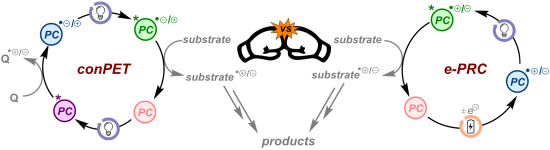
Figure 2: General catalytic cycles of radical ion conPET (left) and radical ion e-PRC (right).
Figure 3: “Beginner’s guide”: comparison between advantages, capacities, and prospectives of conPET and PEC.
Figure 4: A) conPET reductive dehalogenation of aryl halides with PDI. B) Reductive C–H arylation with pyrrol...
Figure 5: A) Chromoselective mono- and disubstitution or polybrominated pyrimidines with pyrroles. B) Sequent...
Figure 6: A) Synthesis of pyrrolo[1,2-a]quinolines. B) Synthesis of ullazines.
Figure 7: A) Reductive phosphorylation of aryl halides via conPET. B) Selected examples from the substrate sc...
Figure 8: A) Reductive dehalogenation of aryl halides via conPET and selected examples from the substrate sco...
Figure 9: A) Reductive C–H arylation of aryl halides via conPET (top) and selected examples from the substrat...
Figure 10: A) Reductive hydrodehalogenation of aryl halides with Mes-Acr-BF4. B) Selected examples from the su...
Figure 11: A) Reductive hydrodechlorination of aryl chlorides with 4-DPAIPN. B) Proposed formation of CO2•−. C...
Figure 12: A) Reductive conPET borylation with 3CzEPAIPN (top) and selected examples from the substrate scope ...
Figure 13: Scale-up of conPET phosphorylation with 3CzEPAIPN.
Figure 14: A) Borylation of 1d. B) Characteristics and structure of PC1 with green and red parts showing the l...
Figure 15: A) Reductive C–H arylation scope with polysulfide conPET (top) and selected examples from the subst...
Figure 16: Scale-up of A) C–H arylation and B) dehaloborylation with polysulfide photocatalysis in continuous-...
Figure 17: A) Formation of [Ir1]0 and [Ir2]0 upon PET between [Ir1]+ and Et3N. B) Mechanism of multi-photon ta...
Figure 18: A) Reductive hydrodehalogenation of aryl halides via multi-photon tandem photocatalysis. B) Selecte...
Figure 19: A) Carbonylative amidation of aryl halides in continuous flow. B) Selected examples from the substr...
Figure 20: A) General scheme for reductive (RQ) and oxidative quenching (OQ) protocols using [FeIII(btz)3](PF6)...
Figure 21: A) Carbonylative amidation of alkyl iodides with [IrIII(ppy)2(dtbbpy)]PF6. B) Selected examples fro...
Figure 22: A) Carboxylative C–N bond cleavage in cyclic amines. B) Selected examples from the substrate scope....
Figure 23: A) Formal reduction of alkenes to alkanes via transfer hydrogenation. B) Selected examples from the...
Figure 24: A) Birch-type reduction of benzenes with PMP-BPI. B) Selected examples from the substrate scope (sc...
Figure 25: Proposed mechanism of the OH− mediated conPET Birch-type reduction of benzene via generation of sol...
Figure 26: Reductive detosylation of N-tosylated amides with Mes-Acr-BF4. B) Selected examples from the substr...
Figure 27: A) Reductive detosylation of N-tosyl amides by dual PRC. B) Selected examples from the substrate sc...
Figure 28: A) Mechanism of the dual PRC based on PET between [Cu(dap)2]+ and DCA. B) Mechanism of the dual PRC...
Figure 29: A) N–O bond cleavage in Weinreb amides with anthracene. B) N–O bond cleavage in Weinreb amides rely...
Figure 30: A) Pentafluorosulfanylation and fluoride elimination. B) Mechanism of the pentafluorosulfanylation ...
Figure 31: A) α-Alkoxypentafluorosulfanylation (top) and selected examples from the substrate scope (bottom). ...
Figure 32: A) Oxidative amination of arenes with azoles catalyzed by N-Ph PTZ. B) Selected examples from the s...
Figure 33: A) C(sp3)–H bond activation by HAT via chloride oxidation by *N-Ph PTZ•+. B) Proposed mechanism for...
Figure 34: A) Recycling e-PRC C–H azolation of electron-rich arenes with pyrazoles using Mes-Acr+ as a photoca...
Figure 35: A) Radical ion e-PRC direct oxidation of unactivated arenes using TAC+ as an electro-activated phot...
Figure 36: A) Radical ion e-PRC direct oxidation of unactivated arenes using TPA as an electro-activated photo...
Figure 37: Proposed mechanism (top) and mode of preassembly (bottom).
Figure 38: A) Possible preassemblies of reactive (left) vs unreactive (right) arenes. B) Calculated spin densi...
Figure 39: A) Recycling e-PRC C(sp2 )–H acetoxylation of arenes using DDQ as a photocatalyst. B) Proposed cata...
Figure 40: Gram scale hydroxylation of benzene in a recirculated flow setup.
Figure 41: A) Radical ion e-PRC vicinal diamination of alkylarenes using TAC+ as an electro-activated photocat...
Figure 42: A) Sequential oxygenation of multiple adjacent C–H bonds under radical ion e-PRC using TAC+ as an e...
Figure 43: A) Enantioselective recycling e-PRC cyanation of benzylic C–H bonds using ADQS as photocatalyst. B)...
Figure 44: Proposed tandem mechanism by Xu and co-workers.
Figure 45: A) Enantioselective recycling e-PRC decarboxylative cyanation using Cu(acac)2, Ce(OTf)3 and a box l...
Figure 46: A) Enantioselective recycling e-PRC benzylic cyanation using Cu(MeCN)4BF4, box ligand and anthraqui...
Figure 47: A) Radical ion e-PRC acetoxyhydroxylation of aryl olefins using TAC+ as an electro-activated photoc...
Figure 48: Selected examples from the substrate scope.
Figure 49: Photoelectrochemical acetoxyhydroxylation in a recirculated flow setup.
Figure 50: A) Radical ion e-PRC aminooxygenation of aryl olefins using TAC+ as an electro-activated photocatal...
Figure 51: A) Recycling e-PRC C–H alkylation of heteroarenes with organic trifluoroborates using Mes-Acr+ as p...
Figure 52: A) Recycling e-PRC decarboxylative C–H alkylation of heteroarenes using CeCl3·7H2O as catalyst. B) ...
Figure 53: A) Recycling e-PRC decarboxylative C–H alkylation of heteroarenes using Fe(NH4)2(SO4)2·6H2O as cata...
Figure 54: A) Recycling e-PRC C–H alkylation of heteroarenes with alkyl oxalates and 4CzIPN as photocatalyst. ...
Figure 55: A) Recycling e-PRC decarboxylative C–H carbamoylation of heteroarenes using 4CzIPN as photocatalyst...
Figure 56: A) Photoelectrochemical HAT-mediated hydrocarbon activation via the chlorine radical. B) Proposed m...
Figure 57: A) Selected examples from the substrate scope. B) Gram and decagram scale semi-continuous flow PEC ...
Figure 58: A) Photoelectrochemical HAT-mediated dehydrogenative coupling of benzothiazoles with aliphatic C–H ...
Figure 59: A) Photoelectrochemical HAT activation of ethers using electro-activated TAC+ as photocatalyst. B) ...
Figure 60: Selected examples from the substrate scope.
Figure 61: A) Photoelectrochemical HAT-mediated synthesis of alkylated benzimidazo-fused isoquinolinones using...
Figure 62: A) Decoupled photoelectrochemical cerium-catalyzed oxydichlorination of alkynes using CeCl3 as cata...
Figure 63: Proposed decoupled photoelectrochemical mechanism.
Figure 64: A) Decoupled photoelectrochemical ring-opening bromination of tertiary cycloalkanols using MgBr2 as...
Figure 65: A) Recycling e-PRC ring-opening functionalization of cycloalkanols using CeCl3 as catalyst. B) Prop...
Figure 66: Selected examples from the substrate scope of the PEC ring-opening functionalization.
Figure 67: A) Radical ion e-PRC reduction of chloro- and bromoarenes using DCA as catalyst and various accepto...
Figure 68: A) Screening of different phthalimide derivatives as catalyst for the e-PRC reduction of aryl halid...
Figure 69: Screening of different organic catalysts for the e-PRC reduction of trialkylanilium salts.
Figure 70: A) e-PRC reduction of phosphonated phenols and anilinium salts. B) Selected examples from the subst...
Figure 71: A) ConPET and e-PRC reduction of 4-bromobenzonitrile using a naphthalene diimide (NDI) precatalyst ...
Figure 72: A) Radical ion e-PRC reduction of phosphinated aliphatic alcohols with n-BuO-NpMI as catalyst. B) C...
Figure 73: Selected examples from the substrate scope.
Figure 74: A) Recycling e-PRC reductive dimerization of benzylic chlorides using a [Cu2] catalyst. B) Proposed...
Figure 75: A) Decoupled photoelectrochemical C–H alkylation of heteroarenes through deamination of Katritzky s...
Figure 76: Proposed mechanism by Chen and co-workers.
Beilstein J. Org. Chem. 2023, 19, 1008–1014, doi:10.3762/bjoc.19.76
Graphical Abstract
Figure 1: Representative examples of N-arylamines.
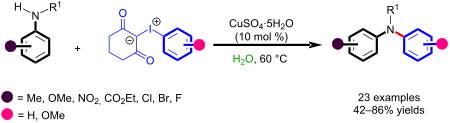
Scheme 1: N-Arylation of amines with hypervalent iodine reagents.
Scheme 2: N-Arylation of primary amines with iodonium ylide. Reaction conditions: 0.2 mmol aniline 1, 0.24 mm...
Scheme 3: N-Arylation of secondary amines with iodonium ylide.
Beilstein J. Org. Chem. 2023, 19, 820–863, doi:10.3762/bjoc.19.62
Graphical Abstract
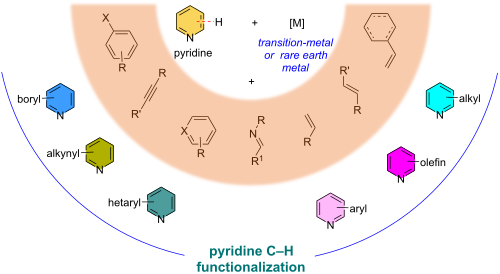
Figure 1: Representative examples of bioactive natural products and FDA-approved drugs containing a pyridine ...
Scheme 1: Classical and traditional methods for the synthesis of functionalized pyridines.
Scheme 2: Rare earth metal (Ln)-catalyzed pyridine C–H alkylation.
Scheme 3: Pd-catalyzed C–H alkylation of pyridine N-oxide.
Scheme 4: CuI-catalyzed C–H alkylation of N-iminopyridinium ylides with tosylhydrazones (A) and a plausible r...
Scheme 5: Zirconium complex-catalyzed pyridine C–H alkylation.
Scheme 6: Rare earth metal-catalyzed pyridine C–H alkylation with nonpolar unsaturated substrates.
Scheme 7: Heterobimetallic Rh–Al complex-catalyzed ortho-C–H monoalkylation of pyridines.
Scheme 8: Mono(phosphinoamido)-rare earth complex-catalyzed pyridine C–H alkylation.
Scheme 9: Rhodium-catalyzed pyridine C–H alkylation with acrylates and acrylamides.
Scheme 10: Ni–Al bimetallic system-catalyzed pyridine C–H alkylation.
Scheme 11: Iridium-catalyzed pyridine C–H alkylation.
Scheme 12: para-C(sp2)–H Alkylation of pyridines with alkenes.
Scheme 13: Enantioselective pyridine C–H alkylation.
Scheme 14: Pd-catalyzed C2-olefination of pyridines.
Scheme 15: Ru-catalyzed C-6 (C-2)-propenylation of 2-arylated pyridines.
Scheme 16: C–H addition of allenes to pyridines catalyzed by half-sandwich Sc metal complex.
Scheme 17: Pd-catalyzed stereodivergent synthesis of alkenylated pyridines.
Scheme 18: Pd-catalyzed ligand-promoted selective C3-olefination of pyridines.
Scheme 19: Mono-N-protected amino acids in Pd-catalyzed C3-alkenylation of pyridines.
Scheme 20: Amide-directed and rhodium-catalyzed C3-alkenylation of pyridines.
Scheme 21: Bimetallic Ni–Al-catalyzed para-selective alkenylation of pyridine.
Scheme 22: Arylboronic ester-assisted pyridine direct C–H arylation.
Scheme 23: Pd-catalyzed C–H arylation/benzylation with toluene.
Scheme 24: Pd-catalyzed pyridine C–H arylation with potassium aryl- and heteroaryltrifluoroborates.
Scheme 25: Transient activator strategy in pyridine C–H biarylation.
Scheme 26: Ligand-promoted C3-arylation of pyridine.
Scheme 27: Pd-catalyzed arylation of nicotinic and isonicotinic acids.
Scheme 28: Iron-catalyzed and imine-directed C–H arylation of pyridines.
Scheme 29: Pd–(bipy-6-OH) cooperative system-mediated direct pyridine C3-arylation.
Scheme 30: Pd-catalyzed pyridine N-oxide C–H arylation with heteroarylcarboxylic acids.
Scheme 31: Pd-catalyzed C–H cross-coupling of pyridine N-oxides with five-membered heterocycles.
Scheme 32: Cu-catalyzed dehydrative biaryl coupling of azine(pyridine) N-oxides and oxazoles.
Scheme 33: Rh(III)-catalyzed cross dehydrogenative C3-heteroarylation of pyridines.
Scheme 34: Pd-catalyzed C3-selective arylation of pyridines.
Scheme 35: Rhodium-catalyzed oxidative C–H annulation of pyridines to quinolines.
Scheme 36: Rhodium-catalyzed and NHC-directed C–H annulation of pyridine.
Scheme 37: Ni/NHC-catalyzed regio- and enantioselective C–H cyclization of pyridines.
Scheme 38: Rare earth metal-catalyzed intramolecular C–H cyclization of pyridine to azaindolines.
Scheme 39: Rh-catalyzed alkenylation of bipyridine with terminal silylacetylenes.
Scheme 40: Rollover cyclometallation in Rh-catalyzed pyridine C–H functionalization.
Scheme 41: Rollover pathway in Rh-catalyzed C–H functionalization of N,N,N-tridentate chelating compounds.
Scheme 42: Pd-catalyzed rollover pathway in bipyridine-6-carboxamides C–H arylation.
Scheme 43: Rh-catalyzed C3-acylmethylation of bipyridine-6-carboxamides with sulfoxonium ylides.
Scheme 44: Rh-catalyzed C–H functionalization of bipyridines with alkynes.
Scheme 45: Rh-catalyzed C–H acylmethylation and annulation of bipyridine with sulfoxonium ylides.
Scheme 46: Iridium-catalyzed C4-borylation of pyridines.
Scheme 47: C3-Borylation of pyridines.
Scheme 48: Pd-catalyzed regioselective synthesis of silylated dihydropyridines.
Beilstein J. Org. Chem. 2023, 19, 700–718, doi:10.3762/bjoc.19.51
Graphical Abstract
Figure 1: Dibenzo[b,f]azepine (1a), -oxepine (1b) and -thiepine (1c) as examples of dibenzo[b,f]heteropines (1...
Figure 2: Selected pharmaceuticals with the dibenzo[b,f]azepine skeleton.
Figure 3: Examples of 10,11-dihydrodibenzo[b,f]azepine-based ligands.
Figure 4: The dibenzo[b,f]azepine moiety in dyes with properties suitable for the use in organic light emitti...
Figure 5: Selective bioactive natural products (13–18) containing the dibenzo[b,f]oxepine scaffold and Novart...
Scheme 1: Retrosynthetic approach to 5H-dibenzo[b,f]azepine (1a) from nitrotoluene (22).
Scheme 2: Oxidative coupling of o-nitrotoluene (22) and reduction of 2,2'-dinitrobibenzyl (21) to form 2,2'-d...
Scheme 3: Synthesis of 10,11-dihydro-5H-dibenzo[b,f]azepine (2a) via amine condensation.
Scheme 4: Catalytic reduction of 10,11-dihydro-5H-dibenzo[b,f]azepine (2a).
Scheme 5: The Wagner–Meerwein rearrangement of acridin-9-ylmethanol (23) into 5H-dibenzo[b,f]azepine (1a).
Scheme 6: Oxidative ring expansion of 2-(9-xanthenyl)malonates 24.
Scheme 7: Ring expansion via C–H functionalisation.
Scheme 8: The synthesis of fluorinated 5H-dibenzo[b,f]azepine 38 from isatin (32).
Scheme 9: The synthesis of substituted dibenzo[b,f]azepines 43 from indoles 39.
Scheme 10: Retrosynthetic pathways to dibenzo[b,f]azepines via Buchwald–Hartwig amination.
Scheme 11: Synthesis of dibenzo[b,f]oxepine 54 and -azepine 55 derivatives via (i) Heck reaction and (ii) Buch...
Scheme 12: Double Buchwald–Hartwig amination and thioetherification in the synthesis of tricyclic azepines 60 ...
Scheme 13: Double Buchwald–Hartwig amination towards substituted dibenzoazepines 62.
Scheme 14: Double Buchwald–Hartwig amination towards 10,11-dihydro-5H-dibenzo[b,f]azepine derivatives 71.
Scheme 15: One-pot Suzuki coupling–Buchwald–Hartwig amination.
Scheme 16: One-pot Rh/Pd-catalysed synthesis of dihydropyridobenzazepines.
Scheme 17: A retrosynthetic pathway to dibenzo[b,f]azepines via Mizoroki–Heck reaction.
Scheme 18: One-pot domino Pd-catalyzed Mizoroki–Heck–Buchwald–Hartwig synthesis of dibenzo[b,f]azepines.
Scheme 19: Dibenzo[b,f]thiapine and -oxepine synthesis via SNAr (thio)etherification, Wittig methylenation and...
Scheme 20: A retrosynthetic pathway to dibenzo[b,f]oxepines via Ullmann coupling.
Scheme 21: Ullmann-type coupling in dibenzo[b,f]oxepine synthesis.
Scheme 22: Wittig reaction and Ullmann coupling as key steps in dihydrobenz[b,f]oxepine synthesis.
Scheme 23: Pd-catalysed dibenzo[b,f]azepine synthesis via norbornene azepine intermediate 109.
Scheme 24: A simple representation of olefin metathesis resulting in transalkylidenation.
Scheme 25: Ring-closing metathesis as key step in the synthesis of dibenzo[b,f]heteropines.
Scheme 26: Alkyne–aldehyde metathesis in the synthesis of dibenzo[b,f]heteropines.
Scheme 27: Hydroarylation of 9-(2-alkynylphenyl)-9H-carbazole derivatives.
Scheme 28: Oxidative coupling of bisphonium ylide intermediate to give pacharin (13).
Scheme 29: Preparation of 10,11-dihydrodibenzo[b,f]heteropines via intramolecular Wurtz reaction.
Scheme 30: Phenol deprotonation and intramolecular etherification in the synthesis of bauhinoxepine J.
Figure 6: Functionalisation of dibenzo[b,f]azepine.
Scheme 31: Palladium-catalysed N-arylation of dibenzo[b,f]azepine.
Scheme 32: Cu- and Ni-catalysed N-arylation.
Scheme 33: N-Alkylation of dibenzo[b,f]azepine (1a) and dihydrodibenzo[b,f]azepine (2a).
Scheme 34: Preparation of methoxyiminosilbene.
Scheme 35: Synthesis of oxcarbazepine (153) from methoxy iminostilbene 151.
Scheme 36: Ring functionalisation of dihydrodibenzo[b,f]azepine.
Beilstein J. Org. Chem. 2023, 19, 635–645, doi:10.3762/bjoc.19.45
Graphical Abstract
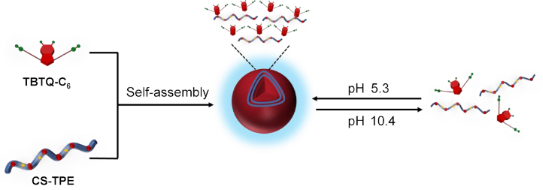
Scheme 1: (a) Synthesis route to CS-TPE. (b) Structure of TBTQ-C6. (c) Construction of TBTQ-C6/CS-TPE supramo...
Figure 1: Partial 1H NMR spectra (400 MHz, CD3COOD/D2O, 25 °C) of (a) CS, (b) CS-TPE-2%, (c) CS-TPE-10%, and ...
Figure 2: (a) Optical images of CS-TPE under daylight (top) and 365 nm UV light (bottom) in the solid state; ...
Figure 3: TEM images of (a) CS-TPE-2%, (b) CS-TPE-10%, and (c) CS-TPE-20% assemblies at pH 5.3; TEM images of...
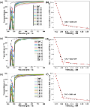
Figure 4: (a, c, e) Optical transmittance and (b, d, f) transmittance as a function of [TBTQ-C6] at 293 nm of...
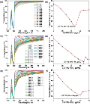
Figure 5: (a, c, e) Optical transmittance and (b, d, f) CS-TPE concentration-dependent optical transmittance ...
Figure 6: TEM images of (a) TBTQ-C6/CS-TPE-10% in aqueous solution at pH 5.3, (b) after adjustment of the sol...
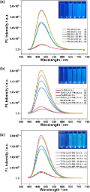
Figure 7: (a) Fluorescence spectra of CS-TPE with different Rf in aqueous solutions at pH 5.3 and 10.4; (b) f...
Beilstein J. Org. Chem. 2023, 19, 550–565, doi:10.3762/bjoc.19.40
Graphical Abstract
Scheme 1: Novel pyrene–phenanthridine conjugates Phen-Py-1 (longer, flexible linker) and Phen-Py-2 (shorter, ...
Scheme 2: Synthesis of Phen-Py-1 and Phen-Py-2 by amide formation; Reagents and conditions: 1. TFA–H2O mixtur...
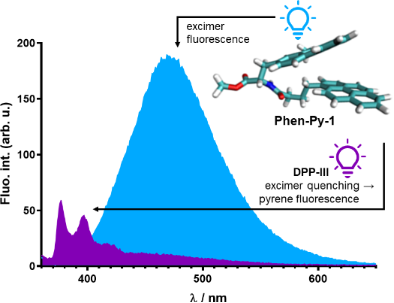
Figure 1: 2D (left) and 3D (right) representation of fluorescence emission spectra of Phen-Py-1 (c = 2 × 10⁻⁶...
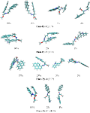
Figure 2: Most representative structures of the conjugates Phen-Py-1 and Phen-Py-2 at different pH conditions...
Figure 3: UV–vis titration of Phen-Py-1 with ct-DNA,; changes in the UV–vis spectra of Phen-Py-1 at λ = 350 n...
Figure 4: . Experimental (■) and calculated (–) (by Scatchard equation Table 2) fluorescence intensities of compound ...
Figure 5: Comparison of spectra of DNA-dye complex (r = 0.5, black) and sum of DNA and dye spectra (red) of a...
Figure 6: Fluorimetric titration of Phen-Py-1, λexc = 352 nm, c = 1 × 10⁻⁶ mol dm−3 with dipeptidyl peptidase...
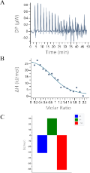
Figure 7: A: ITC titration: raw titration data from the experimental injections of human DPP III enzyme mutan...
Beilstein J. Org. Chem. 2023, 19, 349–379, doi:10.3762/bjoc.19.29
Graphical Abstract
Figure 1: Alkyne–azide "click reaction".
Figure 2: β- and meso-triazole-linked porphyrin.
Scheme 1: Synthesis of β-triazole-linked porphyrins 3a–c.
Scheme 2: Synthesis of β-triazole-bridged porphyrin-coumarin conjugates 11–20.
Scheme 3: Synthesis of β-triazole-bridged porphyrin-xanthone conjugates 23–27 and xanthone-bridged β-triazolo...
Scheme 4: Synthesis of meso-triazoloporphyrins 32a–c and triazole-bridged diporphyrins 34.
Scheme 5: Synthesis of meso-triazole-linked porphyrin-ferrocene conjugates 37a–d.
Scheme 6: Synthesis of meso-triazole-linked porphyrin conjugates 40a,b and 41a,b.
Scheme 7: Synthesis of meso-triazole-linked glycoporphyrins 43a–c.
Scheme 8: Synthesis of meso-triazole-linked porphyrin-coumarin conjugates 44–48.
Scheme 9: Synthesis of meso-triazole-bridged porphyrin-DNA conjugate 50.
Scheme 10: Synthesis of meso-linked porphyrin-triazole conjugates 53 and 57.
Scheme 11: Synthesis of meso-triazole-linked porphyrin-corrole conjugate 60.
Scheme 12: Synthesis of porphyrin conjugates 64a,b and 67a,b. Reaction conditions: (i) CuSO4, sodium ascorbate...
Scheme 13: Synthesis of meso-triazole-bridged porphyrin-quinolone conjugates 70a–e.
Scheme 14: Synthesis of meso-triazole-linked porphyrin-fluorescein dyad 73.
Scheme 15: Synthesis of meso-triazole-linked porphyrin-carborane conjugates 76a,b.
Scheme 16: Synthesis of meso-triazole-bridged porphyrin-BODIPY conjugates 78 and 80.
Scheme 17: Synthesis of meso-triazole-linked cationic porphyrin conjugates 85 and 87. Reaction conditions: (i)...
Scheme 18: Synthesis of meso-triazole-cobalt-porphyrin diimine-dioxime conjugate 91. Reactions conditions: (i)...
Scheme 19: Synthesis of triazole-linked porphyrin-bearing N-doped graphene hybrid 96.
Scheme 20: Synthesis of meso-triazole-linked porphyrin-fullerene dyads 100a–d and 104a,b.
Scheme 21: Synthesis of meso-triazole-bridged diporphyrin conjugates 107 and 108.
Scheme 22: Synthesis of porphyrin-ruthenium (II) conjugates 112a,b and 116a,b. Reaction conditions: (i) Zn(OAc)...
Scheme 23: Synthesis of meso-triazole-linked porphyrin dyad 119 and triad 121.
Scheme 24: Synthesis of di-triazole-bridged porphyrin-β-CD conjugate 126.
Scheme 25: Synthesis of meso-triazole-bridged porphyrin star trimer 129.
Scheme 26: Synthesis of 1,2,3-triazole-linked porphyrin-β-CD conjugates 131a,b.
Scheme 27: Synthesis of tritriazole-bridged porphyrin-lantern-DNA sequence 134.
Scheme 28: Synthesis of meso-triazole-linked porphyrin-polymer conjugates 137 and 139.
Scheme 29: Synthesis of triazole-linked capped porphyrin 142; Reaction conditions: method A: 10% H2O in THF, C...
Scheme 30: Synthesis of meso-tetratriazole-linked porphyrin-maleimine conjugates 145a–c.
Scheme 31: Synthesis of meso-tetratriazole-linked porphyrin-cholic acid complex 148a,b.
Scheme 32: Synthesis of meso-tetratriazole-linked porphyrin conjugates 151–153.
Scheme 33: Synthesis of meso-tetratrizole-porphyrin-carborane conjugates 155, 156 and 158a–c.
Scheme 34: Synthesis of meso-tetratriazole-porphyrin-cardanol conjugates 160 and 162.
Scheme 35: Synthesis of meso-tetratriazole-linked porphyrin-BODIPY conjugate 164.
Scheme 36: Synthesis of meso-tetratriazole-linked porphyrin-β-CD conjugates 166a,b.
Scheme 37: Synthesis of tetratriazole-bridged meso-arylporphyrins 171a–c and 172a–c.
Scheme 38: Synthesis of octatriazole-bridged porphyrin-β-CD conjugate 174 and porphyrin-adamantane conjugates ...
Beilstein J. Org. Chem. 2022, 18, 1596–1606, doi:10.3762/bjoc.18.170
Graphical Abstract
Scheme 1: The synthesis of 6A-azido-6A-deoxy-per-6-O-tert-butyldimethylsilyl-β-cyclodextrin.
Scheme 2: The synthesis of β-cyclodextrin dimers with permethylated secondary rims.
Scheme 3: The synthesis of β-cyclodextrin dimers with permethylated primary rims.
Figure 1: The fragments of 1H NOESY NMR spectra of 4 (a), 10 (b), and 9 (c) indicating the interaction betwee...
Figure 2: The fragment of the 1H NMR spectrum of compounds 9 (green); 10 (red); 12 (blue) representing the si...
Figure 3: Other cyclodextrins that were used in the solubilization experiments with tetracene.
Figure 4: The tetracene UV absorbance dependence on concentration at 476 nm.
Figure 5: The relative concentrations of tetracene in DMSO solutions with hosts 4, 5, 10, 12, 13–18 referred ...
Figure 6: "Tail-to-tail" (a) and "head-to-head" (b) orientation of two cyclodextrin moieties and primary-rim ...
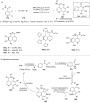
Figure 7: Isotherms of the titration of tetracene with "dimeric" CD solutions in DMSO at 298 K (circles – 10;...
Figure 8: Isotherms of the titration of tetracene with "monomeric" CD solutions in DMSO at 298 K (circles – 16...