


Search results
Search for "ethylenediamine" in Full Text gives 73 result(s) in Beilstein Journal of Organic Chemistry.
Synthesis of pyrrolidine-based hamamelitannin analogues as quorum sensing inhibitors in Staphylococcus aureus
Beilstein J. Org. Chem. 2018, 14, 2822–2828, doi:10.3762/bjoc.14.260
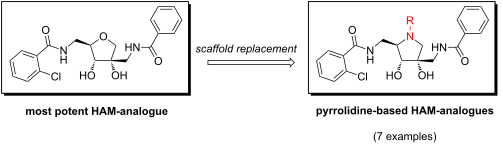
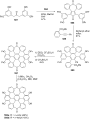
- -chlorobenzamide 13. Removal of the Boc-group with TFA resulted in 14. Next, the phthalimide was removed via refluxing with ethylenediamine and the resulting amine protected as para-nitrobenzenesulfonamide to obtain the desired fragment 9. The synthesis of 10 starts from commercially available 2-methylene-1,3
- the target analogues. Synthesis of fragment 9. Reagents and conditions: a) phthalimide, Pd2(allyl)2Cl2, ligand 15, Na2CO3, CH2Cl2, rt; b) i) 13, DEAD, PPh3, toluene, 0 °C to rt; ii) TFA, CH2Cl2, H2O, rt; c) i) ethylenediamine, EtOH/THF 7:3, reflux; ii) p-Ns-Cl, Et3N, THF, 0 °C. Synthesis of fragment


Synthesis of functionalised β-keto amides by aminoacylation/domino fragmentation of β-enamino amides
Beilstein J. Org. Chem. 2018, 14, 2602–2606, doi:10.3762/bjoc.14.238
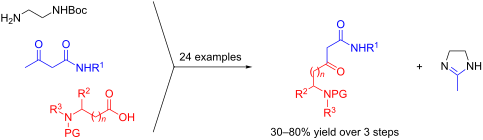
- Pavel Yanev Plamen Angelov Department of Organic Chemistry, University of Plovdiv Paisii Hilendarski, 24 Tsar Asen Str., 4000 Plovdiv, Bulgaria 10.3762/bjoc.14.238 Abstract Ethylenediamine-derived β-enamino amides are used as equivalents of amide enolate synthons in C-acylation reactions with N
- scope [21]. A contribution of ours in this area is the application of ethylenediamine-derived β-enamino amides as synthetic equivalents of primary and secondary amide enolate synthons in reactions with acid chlorides [22]. To extend the scope of the methodology, we now have explored the acylation of
- active substances [5][6][7][8][9][11][23][24][25][26][27][28][29][30][31][32][33]. Results and Discussion For the purposes of this study we used two β-enamino amides 1 (R1 = H, Ph), that are easily prepared in quantitative yields by condensation of Boc-monoprotected ethylenediamine with commercially


Synthesis of new p-tert-butylcalix[4]arene-based polyammonium triazolyl amphiphiles and their binding with nucleoside phosphates
Beilstein J. Org. Chem. 2018, 14, 1980–1993, doi:10.3762/bjoc.14.173
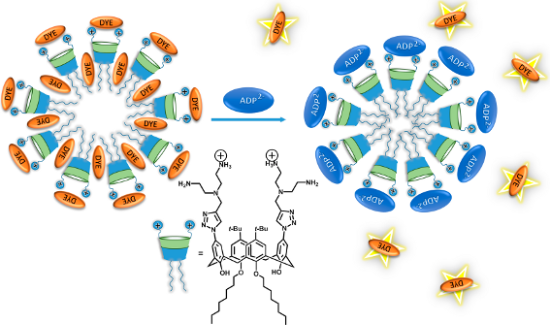
- amino groups in the ethylenediamine fragment (pK2 = 9.08 and pK3 = 9.97 for the diethylenetriamine conjugated acid [48]). Thus, stabilization of the monocationic form prevents the formation of a dicationic species. The premicellar aggregates of the lipophilic dicationic macrocycle 10b demonstrate a


A hemicryptophane with a triple-stranded helical structure
Beilstein J. Org. Chem. 2018, 14, 1885–1889, doi:10.3762/bjoc.14.162
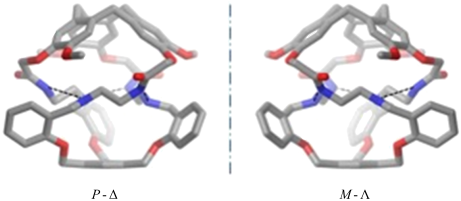
- HCl and then a catalytic amount of para-toluenesulfonic acid in methanol to compound 2. Then, compound 3 was reacted with ethylenediamine, providing 4 in 48% yield. The reaction between 1,3,5-tris(bromomethyl)benzene and 2-hydroxybenzaldehyde provided the precursor of the south unit 5 in 78% yield


One hundred years of benzotropone chemistry
Beilstein J. Org. Chem. 2018, 14, 1120–1180, doi:10.3762/bjoc.14.98
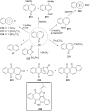
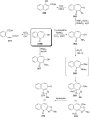
- variety of areas in organic chemistry [56][57]. Recently, Shaabani’s group synthesized and characterized palladium nanoparticles supported on ethylenediamine-functionalized cellulose (PdNPs@EDACs) as a novel bio-supported catalyst for Heck and Sonogashira couplings in water [58]. Shaabani’s group reported
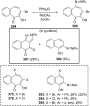
- -hydroxy-4,5-benzotropone (238): Some quinoxaline and pyrazine derivatives 254–256 were synthesized from 1,2-phenylenediamine (251), 1,2-diaminocyclohexane (252), and ethylenediamine (253) with 4,5-benzotropolone 238 (Figure 11) [162]. Compound 256 can be converted to methylated 257. Tarbell’s group also








Phosphodiester models for cleavage of nucleic acids
Beilstein J. Org. Chem. 2018, 14, 803–837, doi:10.3762/bjoc.14.68
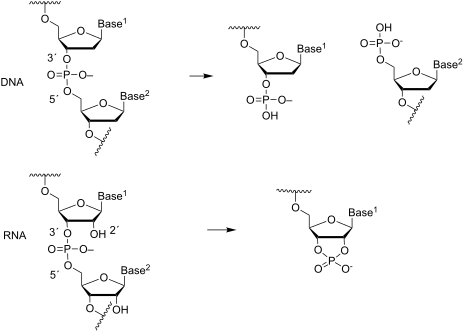
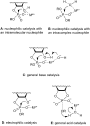
- second-order rate constant for the ethylenediamine-catalyzed cleavage of ApA has been reported to be 1.2∙10−6 L mol−1 s−1 at pH 8 and 50 °C [83]. Cyclic polyamines are somewhat better catalysts (Figure 9). The tetracation of 1,4,16,19-tetraoxa-7,10,13,22,25,28-hexaazacyclotriacontane (9) cleaves ApA
- almost 20 times as fast as ethylenediamine, the second-order rate constant being 2∙10−5 L mol−1 s−1 at 50 °C [84]. The reason for this enhanced activity remains obscure. One may tentatively assume that the multiple positive charges play a role by stabilizing electrostatically the phosphorane intermediate



Aminosugar-based immunomodulator lipid A: synthetic approaches
Beilstein J. Org. Chem. 2018, 14, 25–53, doi:10.3762/bjoc.14.3


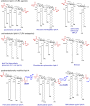


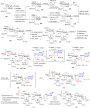
Total synthesis of TMG-chitotriomycin based on an automated electrochemical assembly of a disaccharide building block
Beilstein J. Org. Chem. 2017, 13, 919–924, doi:10.3762/bjoc.13.93
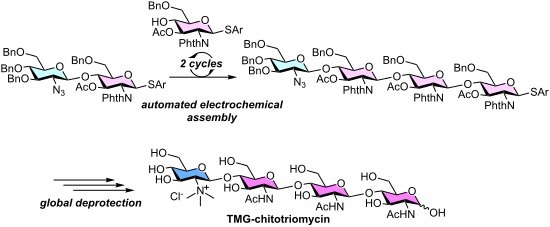
- were achieved by following the procedure reported by Yu and co-workers (Figure 4) [8]. Phthaloyl groups and acetyl groups of 7 are removed by the reaction with ethylenediamine followed by applying the conventional acetylation protocol with acetic anhydride (Ac2O) in the presence of N,N


Fluorescent carbon dots from mono- and polysaccharides: synthesis, properties and applications
Beilstein J. Org. Chem. 2017, 13, 675–693, doi:10.3762/bjoc.13.67
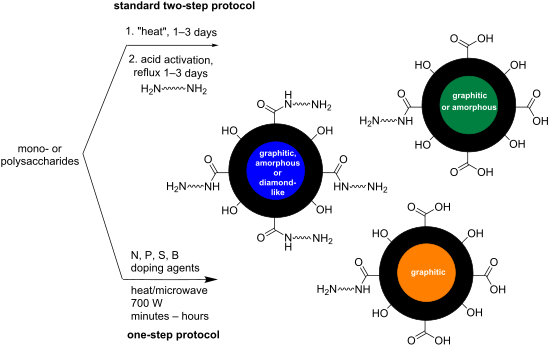
- concurrently their results, in the use of both N and P as dopants in their CD syntheses. For instance, Dong et al. described the development of dual-doped hollow CDs using a wet-chemical method from glucose in the presence of 1,2-ethylenediamine (EDA) and conc. H3PO4 (Scheme 9) [40]. During the exothermic


Regiochemistry of cyclocondensation reactions in the synthesis of polyazaheterocycles
Beilstein J. Org. Chem. 2017, 13, 257–266, doi:10.3762/bjoc.13.29
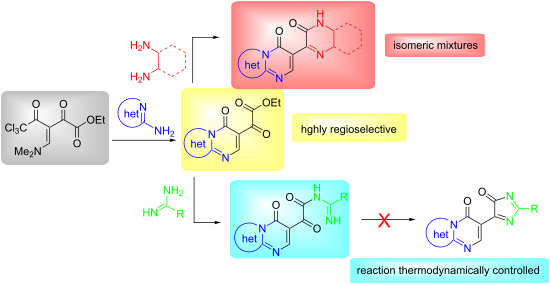
- ] and aromatic amidines resulted in glyoxalate-substituted pyrido[1,2-a]pyrimidinone, thiazolo[3,2-a]pyrimidinone and pyrimido[1,2-a]benzimidazole. Pyrazinones and quinoxalinones were obtained through the reaction of these glyoxalates with ethylenediamine and 1,2-phenylenediamine derivatives. On the
- involved the cyclocondensation of 1,2-dicarbonyl compounds with ethylenediamine and 1,2-phenylenediamine and they obtained polyazaheterocycles with pyrazinone and quinoxalinone cores. Although there is a wide range of papers reporting on cyclocondensation reactions, only few authors have discussed the
- the loss of heterocyclic aromaticity. However, aiming at the synthesis of new heterocycles, we next investigated the reaction of compounds 5–7 with different 1,2-diamines. Initially, the reaction between compound 5 and ethylenediamine (8a) was tested. Due to precipitation of the product during the


Construction of bis-, tris- and tetrahydrazones by addition of azoalkenes to amines and ammonia
Beilstein J. Org. Chem. 2016, 12, 2471–2477, doi:10.3762/bjoc.12.241
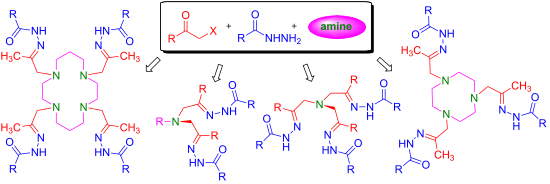
- 1a was used to ensure complete alkylation). Macrocyclic polynitrogen ligands with several hydrazone arms may be of interest for the design of sensors [52] and contrast agents [53]. Unfortunately, alkylation of ethylenediamine with 4 equivalents of 1a led to an indecipherable mixture of products. In




Three-component synthesis of highly functionalized aziridines containing a peptide side chain and their one-step transformation into β-functionalized α-ketoamides
Beilstein J. Org. Chem. 2016, 12, 1772–1777, doi:10.3762/bjoc.12.166
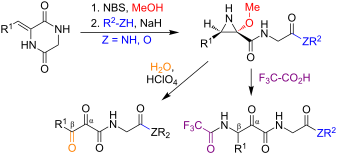
- corresponding compounds 11, which were then transformed into pyrazines 12 and quinoxalines 13 via straightforward cyclocondensation reactions with ethylenediamine and o-phenylenediamine, respectively (Scheme 6 and Table 3). The transformation of 2 into 11 can be explained by the mechanism summarized in Scheme 7




Multicomponent reactions: A simple and efficient route to heterocyclic phosphonates
Beilstein J. Org. Chem. 2016, 12, 1269–1301, doi:10.3762/bjoc.12.121
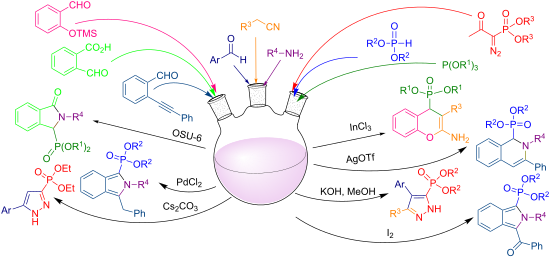
- three-component reaction of 1,4-bi-nucleophiles such as ethanolamine (88), ethylenediamine (89), 2-aminophenol (92) and 1,2-phenylenediamine (93), with 6-methyl-3-formylchromone (75) and diethyl phosphonate afforded the phosphonate derivatives of 1,4-oxazepine 90, 1,4-diazepine 91, 1,5-benzoxazepine 94


Supported bifunctional thioureas as recoverable and reusable catalysts for enantioselective nitro-Michael reactions
Beilstein J. Org. Chem. 2016, 12, 628–635, doi:10.3762/bjoc.12.61
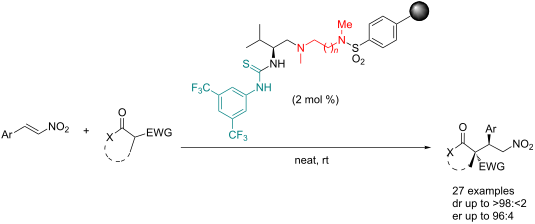
- of nucleophile and 10 mol % of catalysts (entries 1–4 and 9–11 in Table 1). As a general trend, the reactions were faster, and much more stereoselective for ketoester 3a than for diethyl malonate 2a, and that the difference was specially remarkable when supported ethylenediamine-derived thioureas II


New synthetic strategies for xanthene-dye-appended cyclodextrins
Beilstein J. Org. Chem. 2016, 12, 537–548, doi:10.3762/bjoc.12.53
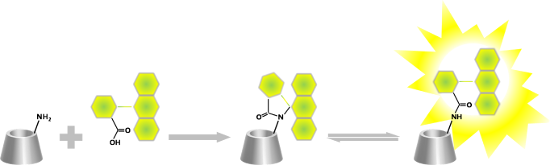
- three-step procedure: rhodamine B was modified into a spirolactam rhodamine ethylenediamine, 6-monotosyl-β-CD was reacted with ethylenediamine in order to obtain the equivalent monosubstituted derivative, and finally, the coupling between the two molecules was performed. The coupling with the 6-mono(2


Mycothiol synthesis by an anomerization reaction through endocyclic cleavage
Beilstein J. Org. Chem. 2016, 12, 328–333, doi:10.3762/bjoc.12.35
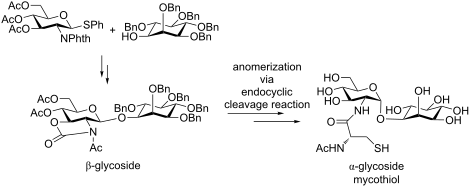
- -disaccharide 2 in 90% yield (Scheme 4). After removing the phthaloyl and acetyl groups by using ethylenediamine in dimethylformamide (DMF), a carbamate group was introduced using triphosgene in the presence of NaHCO3. Acetylation of both the hydroxy and carbamate groups was carried out using acetic anhydride


Highly stable and reusable immobilized formate dehydrogenases: Promising biocatalysts for in situ regeneration of NADH
Beilstein J. Org. Chem. 2016, 12, 271–277, doi:10.3762/bjoc.12.29
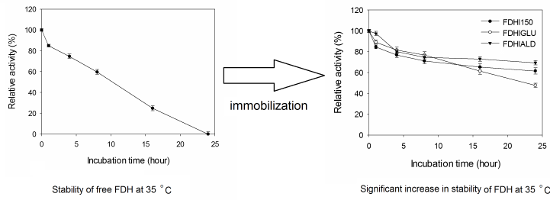
- modified with ethylenediamine and then activated with glutaraldehyde (FDHIGLU), and Immobead 150 support functionalized with aldehyde groups (FDHIALD). The highest immobilization yield and activity yield were obtained as 90% and 132%, respectively when Immobead 150 functionalized with aldehyde groups was
- ethylenediamine and then activated with glutaraldehyde, and Immobead 150 support functionalized with aldehyde groups. The optimum conditions of free and immobilized FDH preparations were determined for formate oxidation. The thermal stability of free and immobilized FDH preparations was tested at 35 and 50 °C
- group of glutaraldehyde and the amino functional groups of the enzyme [29]. In this study, Immobead 150 support was modified with ethylenediamine and then activated with glutaraldehyde for the covalent immobilization of C. methylica FDH (Figure 1b). The amount of bound protein was determined as 75% of


Supramolecular structures based on regioisomers of cinnamyl-α-cyclodextrins – new media for capillary separation techniques
Beilstein J. Org. Chem. 2016, 12, 97–109, doi:10.3762/bjoc.12.11
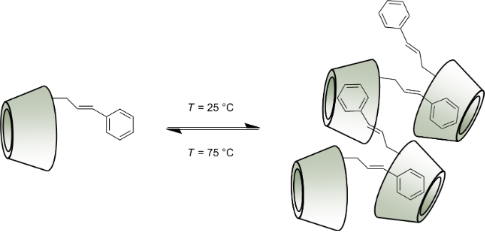
- -phenylalanine, N-(1-naphthyl)ethylenediamine, 4-nitroaniline, p-aminoacetophenone, tyramine) and nine in the form of anions (N-acetyl-DL-phenylalanine, N-acetyl-DL-tryptophan, N-benzoyl-DL-phenylalanine, N-boc-DL-tryptophan, N-FMOC-DL-valine, N-FMOC-DL-alanine, N-FMOC-DL-leucine, DL-3-phenyllactic acid, (R
- evidence for the important role of the nitro substituent in the structure of 4-nitroaniline in the interaction with the Cin-α-CD cavity (Figure 14). N-(1-naphthyl)ethylenediamine significantly interacted with 5 mM 2-O-Cin-α-CD, however, the increase of the Cin-α-CD concentrations in BGE up to 25 mM caused
- stronger interactions with 3-O-Cin-α-CD in comparison with 2-O-Cin-α-CD. This fact indicates a specific interaction between N-(1-naphthyl)ethylenediamine and the 3-O-Cin-α-CD cavity. Effective electrophoretic mobilities of all tested anions (listed above) did not decrease significantly in BGE with 5 mM Cin


New metathesis catalyst bearing chromanyl moieties at the N-heterocyclic carbene ligand
Beilstein J. Org. Chem. 2015, 11, 2795–2804, doi:10.3762/bjoc.11.300
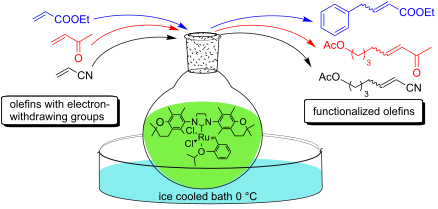
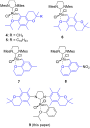
- subjected to reaction with 2,3-dihydroxy-1,4-dioxane (glyoxal equivalent) followed by reduction of the intermediate diimines by NaBH3CN to give ethylenediamine 13 in 90% yield. Usage of the more convenient sodium borohydride led to a prolonged reaction time (up to 20 h) and a lower reaction yield
- . Imidazolinium salt 14 was obtained by treatment of 13 with trimethyl orthoformate in 73% yield. It is worth noting that ethylenediamine 13 and imidazolinium salt 14 were sufficiently pure after precipitation, thus chromatographic purification was not necessary. Some specific effects are observed in the NMR
- ), 14.4, 13.5, 12.1 (C-5a, 7a, 8b) ppm. HRMS (ESI): [M + H]+ calcd for C30H45N2O2: 465.3476, found: 465.3465. 1,3-Bis(2,2,5,7,8-pentamethylchroman-6-yl)-4,5-dihydro-1H-imidazol-3-ium chloride (14) To a solution of ethylenediamine 13 (200 mg, 0.43 mmol) in trimethyl orthoformate (5 mL), ammonium chloride




Effective ascorbate-free and photolatent click reactions in water using a photoreducible copper(II)-ethylenediamine precatalyst
Beilstein J. Org. Chem. 2015, 11, 1950–1959, doi:10.3762/bjoc.11.211
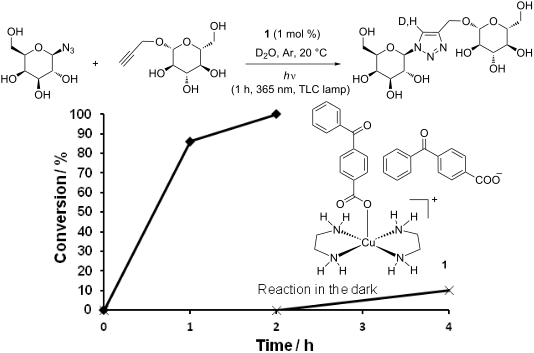
- water in the absence of sodium ascorbate is an active area of current research with strong potential for applications in bioconjugation. The water-soluble and photoreducible copper(II)–EDA (EDA = ethylenediamine) complex 1, which has two 4-benzoylbenzoates acting as both counterion and photosensitizer
- synthesis and characterization of 1, its photoreduction properties in various solvents and illumination conditions, and its catalytic properties which reveal that 1, when illuminated, is an effective photolatent click catalyst in aqueous medium. Results and Discussion The EDA (EDA = ethylenediamine) ligand


Tuning the size of a redox-active tetrathiafulvalene-based self-assembled ring
Beilstein J. Org. Chem. 2015, 11, 966–971, doi:10.3762/bjoc.11.108
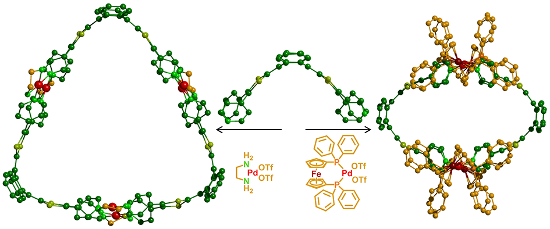
- adjusted to tune the macrocycle size and shape. Complexation of ligand L1 with precursor Pd(en)(OTf)2 (en = 1,2-ethylenediamine) was carried out in DMSO at 40 °C and monitored by 1H NMR. In 30 min, the reaction converged into a unique symmetrical discrete species that could be isolated in more than 90
- -ylidene heterocycles. Because of the lower steric demand with the 1,2-ethylenediamine co-ligand, the vicinal pyridyl units are free to rotate around the C-pyridine axis in M6L3, resulting in dihedral angles of 40° and 52° in the crystal (Figure 4b). These values are in the same range as those observed in


N-Alkyl derivatives of diosgenyl 2-amino-2-deoxy-β-D-glucopyranoside; synthesis and antimicrobial activity
Beilstein J. Org. Chem. 2015, 11, 869–874, doi:10.3762/bjoc.11.97
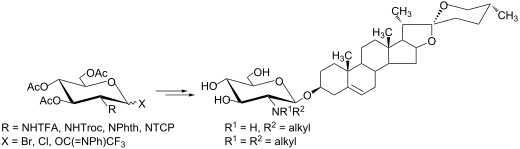
- Higashi et al., but in a slightly different manner [47]. Bromide 2c (α + β) was synthesized analogously to 2b. Synthesis of (N-phenyl)trifluoroacetimidates 5a–d demands removal of the acetyl groups from the anomeric hydroxy groups in 1a–d. It was done with ethylenediamine in a mixture with acetic acid in


Properties of cationic monosubstituted tetraalkylammonium cyclodextrin derivatives – their stability, complexation ability in solution or when deposited on solid anionic surface
Beilstein J. Org. Chem. 2015, 11, 192–199, doi:10.3762/bjoc.11.20
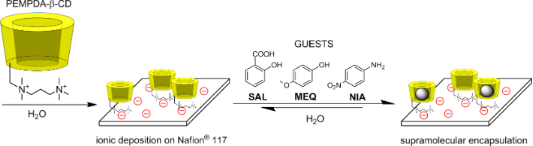
- (PErMethylated EthyleneDiAmine substituted). Its binding ability toward selected aromatic guests is compared to the native β-CD at different pH. Deposition of PEMPDA-β-CD on the surface of an anionic Nafion® 117 membrane via ionic self-assembly was also studied along with the determination of sorption kinetics


Release of β-galactosidase from poloxamine/α-cyclodextrin hydrogels
Beilstein J. Org. Chem. 2014, 10, 3127–3135, doi:10.3762/bjoc.10.330
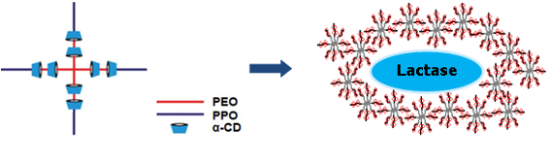
- diblock PEO–PPO copolymer chains attached to a central ethylenediamine group [8]. Their sensitivity to pH due to the central group offers interesting features as compared with the micelles of non-ionic block copolymers (such as Pluronics). Namely, with respect to the development of pharmaceutical


Oligomerization of optically active N-(4-hydroxyphenyl)mandelamide in the presence of β-cyclodextrin and the minor role of chirality
Beilstein J. Org. Chem. 2014, 10, 2361–2366, doi:10.3762/bjoc.10.246
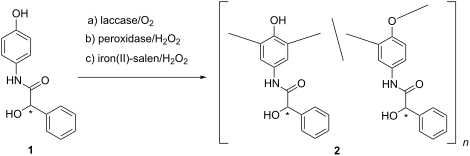
- .10.246 Abstract The oxidative oligomerization of a chiral mandelamide derivative (N-(4-hydroxyphenyl)mandelamide, 1) was performed in the presence of horseradish peroxidase, laccase and N,N'-bis(salicylidene)ethylenediamine-iron(II) to obtain chiral oligophenols 2. The low enantioselectivity of the
- the oligomerization of substituted electron-rich phenols in the presence of oxidizing agents [3][4]. In addition to that, N,N'-bis(salicylidene)ethylenediamine-iron(II) (iron(II)-salen) represents an alternative catalyst for oxidative coupling reactions of phenol derivatives [5]. The use of β
- . Oxidative oligomerization with N,N'-bis(salicylidene)ethylenediamine-iron(II): 15.6 mg (48,4 µmol) N, N´-bis(salicylidene)ethylenediamine-iron(II) was dissolved in 50 mL acetonitrile and then 1,22 g (5 mmol) N-(4-hydroxyphenyl)mandelamide (1) added. Subsequently 510 µL (5 mmol) of hydrogen peroxide (30





