Search results
Search for "oxazolidinone" in Full Text gives 68 result(s) in Beilstein Journal of Organic Chemistry.
Aldehydes as powerful initiators for photochemical transformations
Beilstein J. Org. Chem. 2020, 16, 833–857, doi:10.3762/bjoc.16.76
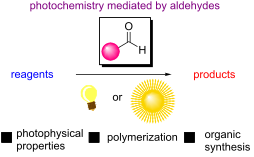
- homolytic cleavage of the C–S bond, providing the sulfonyl radical 186. The sulfonyl radical 186 can then approach anti to the oxazolidinone moiety in 180, generating a β-sulfonyl radical 187, which, once trapped by another sulfonyl cyanide molecule 181, affords the desired product 182, and the sulfonyl






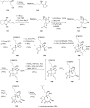
SnCl4-catalyzed solvent-free acetolysis of 2,7-anhydrosialic acid derivatives
Beilstein J. Org. Chem. 2019, 15, 2990–2999, doi:10.3762/bjoc.15.295
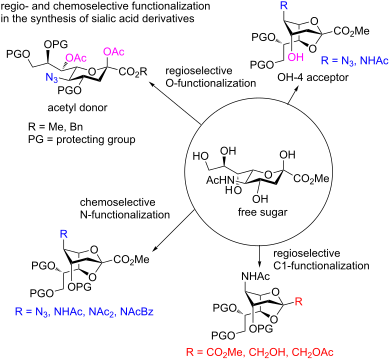
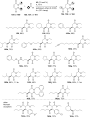
- disappointment, an attempted acetolysis upon changing the fucose-containing disaccharides 29 and 33 with substrate 37 did not provide the desired ring-opening product 38 albeit it bore a robust N-5/O-4-oxazolidinone-based sialyl group (Scheme 5). Furthermore, 8,9-di-O-acetylated disaccharide 39 was subjected to




α-Photooxygenation of chiral aldehydes with singlet oxygen
Beilstein J. Org. Chem. 2019, 15, 2076–2084, doi:10.3762/bjoc.15.205
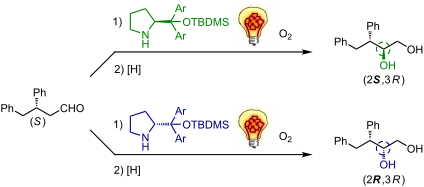
- ) or a chiral auxiliary (i.e., oxazolidinone) into the substrate structure is required for highly stereoselective reactions [20][21][22]. ‘One-pot’ photochemical α,β-functionalization of cinnamaldehyde Over the last few years, photochemical methods for asymmetric functionalisation of carbonyl compounds



Synthesis of the polyketide section of seragamide A and related cyclodepsipeptides via Negishi cross coupling
Beilstein J. Org. Chem. 2019, 15, 577–583, doi:10.3762/bjoc.15.53
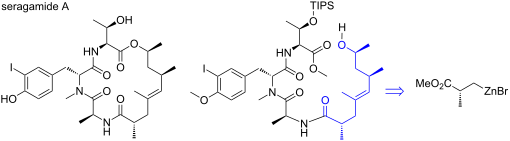
- -methylated product via oxazolidinone 24 was hampered by low yield on reaction with paraformaldehyde [47][48]. Although subsequent reduction of 24 with Et3SiH/TFA and reprotection of the free N-methyl amino acid with Boc2O proceeded smoothly and delivered iodotyrosine 25, the overall yield via 24 was not




Synthesis of nonracemic hydroxyglutamic acids
Beilstein J. Org. Chem. 2019, 15, 236–255, doi:10.3762/bjoc.15.22
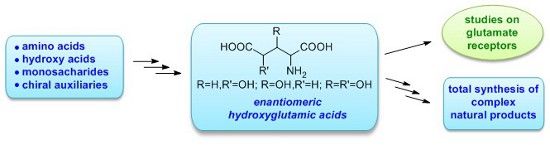
- of a chiral auxiliary with lithium dibutylcuprate. Next, titanium tetrachloride-catalyzed cyanation secured another carboxy group and after a few transformations an oxazolidinone (4S,5R)-39 was obtained as a major (7:1) product readily purified chromatographically. To complete the synthesis of (2S,3R
- acid Cleavage of the 5-membered ring in the protected epoxide 88 obtained from (S)-pyroglutamic acid [93][94][95] gave the methyl ester 89 which, when adsorbed on silica gel, smoothly underwent stereospecific epoxide ring opening to give the oxazolidinone 90 (Scheme 23) [96]. Before installation of the
- compound underwent another intramolecular cyclization in the 5-exo mode to form the oxazolidinone 118. To complete the synthesis of (2S,3S,4S)-4 the secondary hydroxy group was protected as a pivalate, the hydroxymethyl fragment was oxidized after hydrolysis of the silyl ether and finally all protecting


Mechanistic studies of an L-proline-catalyzed pyridazine formation involving a Diels–Alder reaction with inverse electron demand
Beilstein J. Org. Chem. 2019, 15, 30–43, doi:10.3762/bjoc.15.3
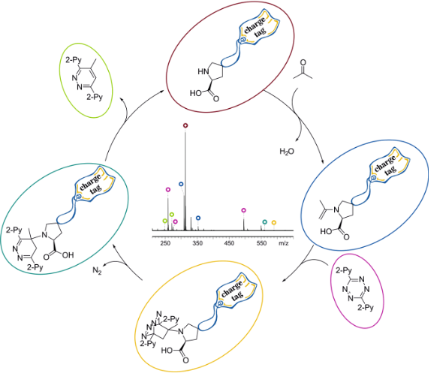
- at δ = 4.4 ppm (Figure S3, Supporting Information File 1), characteristic for an oxazolidinone (Scheme 4). In agreement with the findings from List [58] and Gschwind [46], the equilibrium concentration of the isomeric enamine is too low to be detected although this species is required as dienophile
- before, now L-proline (1 equiv) and acetone (95 equiv) were mixed first. The formation of intermediate enamine I1 and/or the isomeric oxazolidinone was validated by the detection of a signal at m/z 156 for the protonated species in ESIMS spectra, and only then the tetrazine substrate 2 (1 equiv) was
- added. By this way, it was possible to detect not only substrate 2 (m/z 237, m/z 259), product 3 (m/z 249, m/z 271, m/z 287) and the proline catalyst (m/z 116, m/z 138), but also the intermediate I1 and/or its oxazolidinone isomer (m/z 156) and the dihydropyridazine intermediate III1 (m/z 386, Figure 4




Stereodivergent approach in the protected glycal synthesis of L-vancosamine, L-saccharosamine, L-daunosamine and L-ristosamine involving a ring-closing metathesis step
Beilstein J. Org. Chem. 2018, 14, 2949–2955, doi:10.3762/bjoc.14.274
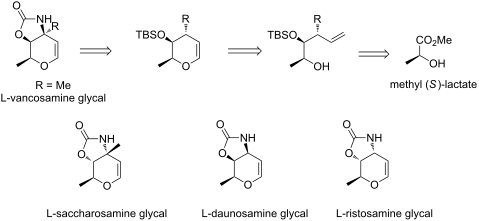
- obtained for the desired products due to the formation of substantial amounts of ring-opened byproducts 10 resulting from the hydride addition to the carbonyl group of the oxazolidinone ring [33][34]. The alcohols 9 were then subjected to a Swern oxidation followed by a Wittig reaction to generate the


A novel and practical asymmetric synthesis of eptazocine hydrobromide
Beilstein J. Org. Chem. 2018, 14, 2340–2347, doi:10.3762/bjoc.14.209
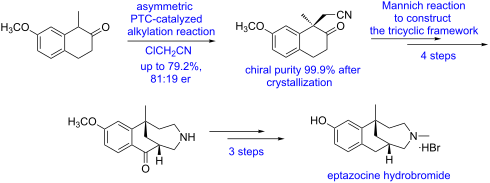
- the unwanted isomer [3][4][5][6]. Other asymmetric syntheses of 1 have been reported in the literature. These relied either on organometallic catalysis [7], asymmetric tandem addition to chiral tetrahydronaphthalenes [8], bioenzymatic steps [9] or diastereoselective Evans alkylation from oxazolidinone


A stereoselective and flexible synthesis to access both enantiomers of N-acetylgalactosamine and peracetylated N-acetylidosamine
Beilstein J. Org. Chem. 2018, 14, 856–860, doi:10.3762/bjoc.14.71
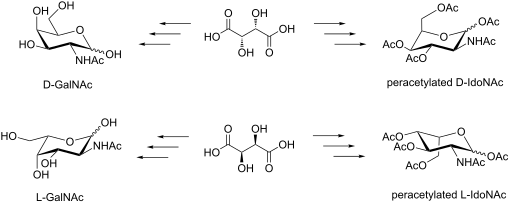
- as starting material reduces the flexibility of this approach. Another strategy introduces the nitrogen at C-2 [11] via the 2-iodoxybenzoic acid-mediated generation of an oxazolidinone ring, selectively leading to C2–C3 syn-products [12]. A third approach features E-selective Julia olefination of (R


Recent developments in the asymmetric Reformatsky-type reaction
Beilstein J. Org. Chem. 2018, 14, 325–344, doi:10.3762/bjoc.14.21
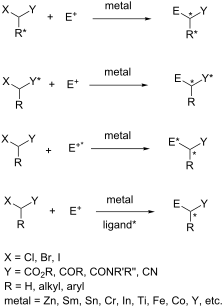
- Reformatsky reaction between L-cysteine-derived thiazolidinic aldehyde 14 and (R)-α-chloroacetyl-2-oxazolidinone 15, leading to the corresponding β-hydroxy amide 16 in both remarkable yield (95%) and diastereoselectivity (>98% de), as shown in Scheme 6. The latter was subsequently converted into the expected
- Isobe et al. for a diastereoselective SmI2-mediated Reformatsky reaction constituting the key step of a highly economical total synthesis of prostaglandin E2 methyl ester [23]. As shown in Scheme 7, the reaction occurred between achiral aldehyde 17 and chiral oxazolidinone 18 in the presence of SmI2 in
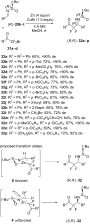
- mediate Reformatsky reactions. As an example, chiral oxazolidinone 20 reacted with achiral aldehyde 21 in the presence of SnCl2 to afford the corresponding chiral Reformatsky product 22 as a single diastereomer (>96% de) in moderate yield (56%), as shown in Scheme 8 [24]. The latter was used to synthesize











Recent progress in the racemic and enantioselective synthesis of monofluoroalkene-based dipeptide isosteres
Beilstein J. Org. Chem. 2017, 13, 2637–2658, doi:10.3762/bjoc.13.262
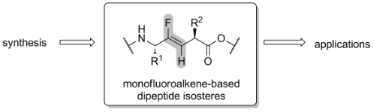
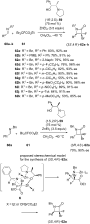
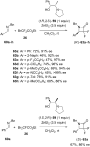
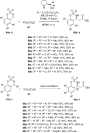
- be achieved using an olefination reaction, a metathesis reaction or a copper-mediated reduction of 3,3-difluoropropenes. Pannecoucke’s group employed a chiral auxiliary, the Evans oxazolidinone, to prepare the non-racemic dipeptide isostere 35 (Scheme 7) [34]. Stereoselective alkoxymethylation on the
- oxazolidinone derivative 31 was first achieved with an excellent yield (88%) and diastereoselectivity (de > 95%). The chiral auxiliary was then removed and the free alcohol was oxidized to the corresponding aldehyde 32. Alkene 33 was then obtained after olefination of 32 with low selectivity ((Z):(E) = 64:36


Diastereoselective Mannich reactions of pseudo-C2-symmetric glutarimide with activated imines
Beilstein J. Org. Chem. 2017, 13, 2473–2477, doi:10.3762/bjoc.13.244
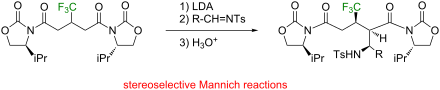
- , Nakanarusawa 4-12-1, Hitachi 316-8511, Japan 10.3762/bjoc.13.244 Abstract As an extension of the boron enolate-based aldol reactions, the oxazolidinone-installed bisimide 1a from 3-(trifluoromethyl)glutaric acid was employed for Mannich reactions with tosylated imines 2 as electrophiles to successfully obtain
- couple of routes to get successful access to such target molecules with a variety of substituents at the 2-position [1][2][3]. Previously, the oxazolidinone-installed bisimide 1a was employed for the crossed aldol reactions by the way of boron enolate which allowed the isolation of optically active
- , entry 7). Because the employment of the phenylalanine-based oxazolidinone as the chiral auxiliary under the same conditions gave similar results as the one obtained from valine (Table 1, entries 8 vs 7), we decided the conditions in entry 7 (Table 1) as the best of all tested and investigated the


Total syntheses of the archazolids: an emerging class of novel anticancer drugs
Beilstein J. Org. Chem. 2017, 13, 1085–1098, doi:10.3762/bjoc.13.108
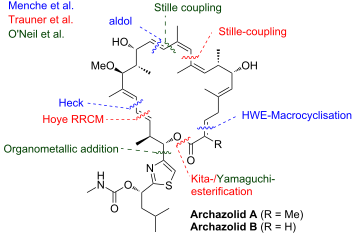
- . Synthesis of the north-western fragment As shown in Scheme 10, the synthesis of stannane 39 started with aldehyde 48 which was derived from propargyl alcohol in five steps [82]. After DMP oxidation the generated aldehyde 48 underwent a syn-selective Evans aldol addition with oxazolidinone 47 to obtain the


Continuous N-alkylation reactions of amino alcohols using γ-Al2O3 and supercritical CO2: unexpected formation of cyclic ureas and urethanes by reaction with CO2
Beilstein J. Org. Chem. 2017, 13, 329–337, doi:10.3762/bjoc.13.36
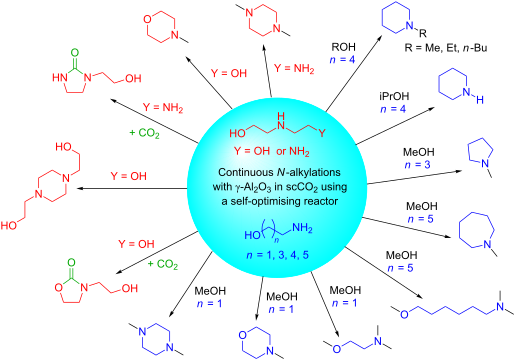
- became apparent that the reactivity of 12 was more complicated. Running the reaction at 380 °C and 0.3 mL min−1 resulted in 46% of 9 being obtained but, at lower temperatures, different products were obtained. For example, when the reaction was run at 250 °C (Table 4, entry 1), oxazolidinone 13 was
- apparent that the dimer 14 could be formed from oxazolidinone 13 as increasing the residence time led to an increase in selectivity of 14 over 13 (Table 4, entry 2). Indeed, when 13 was used as the starting material, the major product that was isolated was 14; and this reactivity of 13 has been reported
- previously in batch reactions [49]. Increasing the residence time further (Table 4, entry 3) resulted in the oxazolidinone 13 not being detected and 14 was the major product together with a small quantity of mono O-ethylated 14. Reducing the temperature gave a better selectivity to the oxazolidinone 13


Versatile synthesis of the signaling peptide glorin
Beilstein J. Org. Chem. 2017, 13, 247–250, doi:10.3762/bjoc.13.27
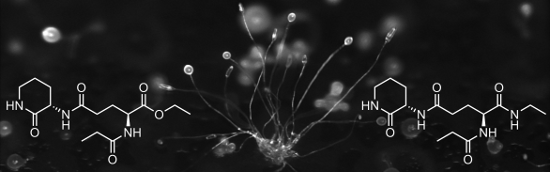
- challenge in the syntheses of glorin and analogs is the differentiation between the α- and the γ-carboxylic acid groups of L-glutamic acid for selective esterification or amidation. α-Selective functionalization was achieved via synthesis of oxazolidinone 6 from Cbz-L-glutamic acid (5) with paraformaldehyde
- and p-toluenesulfonic acid under dehydrating conditions [18]. Opening of the oxazolidinone with sodium ethoxide as nucleophile thus yielded ester 7a, while addition of ethylamine yielded amide 7b. Subsequent amide bond formation with lactam 4 using isobutyl chloroformate or HBTU as coupling reagents


Ionic liquids as transesterification catalysts: applications for the synthesis of linear and cyclic organic carbonates
Beilstein J. Org. Chem. 2016, 12, 1911–1924, doi:10.3762/bjoc.12.181
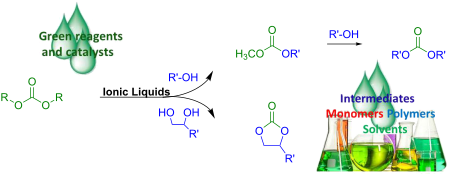
- with respect to traditional homogenous systems in terms of milder reaction conditions and easier separation and recycle workups. Two representative examples of ionic liquids employed for the synthesis of FAMEs are the pyridinium and oxazolidinone-based compounds shown in Figure 2 [52][53]. It should be


Total synthesis of leopolic acid A, a natural 2,3-pyrrolidinedione with antimicrobial activity
Beilstein J. Org. Chem. 2016, 12, 1624–1628, doi:10.3762/bjoc.12.159
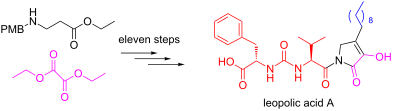
- carried out. Crucial steps for the strategy include a Dieckmann cyclization to obtain the 2,3-pyrrolidinedione ring and a Wittig olefination to install the polymethylene chain. An oxazolidinone-containing leopolic acid A analogue was also synthesized. The antibacterial activity showed by both compounds
- the literature [1] (see Supporting Information File 2 for NMR spectra). Interestingly, while searching the best conditions to obtain compound 10, we treated 9 with oxalyl chloride and DMSO, following the Swern protocol [19]. This treatment led to the formation of the oxazolidinone 14 (Scheme 2). We
- assume that the reaction occurred via inversion of the configuration at the hydroxylated carbon, based on an intramolecular SN2 cyclocarbamation by the Boc group [20][21]. The small coupling constant (J = 2.6 Hz) between the two hydrogens on the oxazolidinone ring confirmed that the compound was the anti


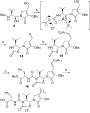
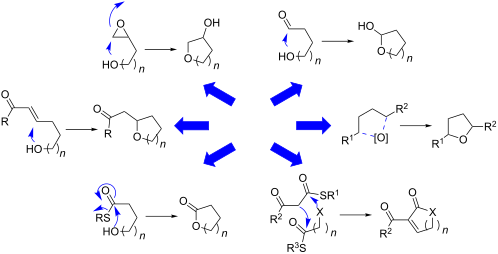
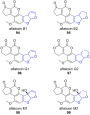
Biosynthesis of oxygen and nitrogen-containing heterocycles in polyketides
Beilstein J. Org. Chem. 2016, 12, 1512–1550, doi:10.3762/bjoc.12.148
- elements, like a pyrrolidine, a furan-2-one, an oxazolidinone and particularly a 3,4-furylidene moiety in the polyketide part. An analysis of the gene cluster as well as feeding experiments with isotope-labelled precursors led to a proposal for the formation of the furan ring [69][70]. The anticipated




Correction: Effective in silico prediction of new oxazolidinone antibiotics: force field simulations of the antibiotic–ribosome complex supervised by experiment and electronic structure methods
Beilstein J. Org. Chem. 2016, 12, 608–610, doi:10.3762/bjoc.12.59
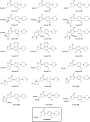
Effective in silico prediction of new oxazolidinone antibiotics: force field simulations of the antibiotic–ribosome complex supervised by experiment and electronic structure methods
Beilstein J. Org. Chem. 2016, 12, 415–428, doi:10.3762/bjoc.12.45
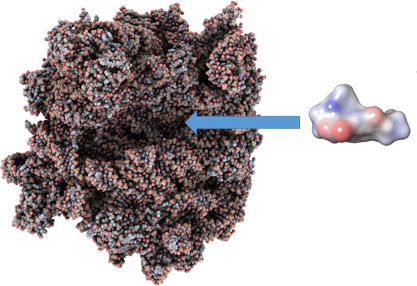
- space in terms of a) the isolated and b) the ribosomal bound state. In a first step, an all-atom model of the bacterial ribosome consisting of nearly 1600 atoms was constructed and evaluated. The conformational space of 30 different ribosomal/oxazolidinone complexes was scanned by stochastic methods
- (PRSP) [16]. Nevertheless, though oxazolidinones represent one of the few new chemical classes of antibiotics disclosed in the past 40 years, cases of oxazolidinone-resistant strains have been already reported [17][18][19], underscoring again the urgent demand for new linezolid analogues to overcome the
- pocket for the oxazolidinone ring is characterized by universally conserved 23S-rRNA nucleotides, leading to very similar ligand-bound conformations in different bacterial ribosomes [23]. From a theoretical point of view, the simulation of recognition processes employing nucleotide-based receptors is


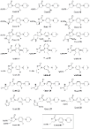
Copper-catalyzed intermolecular oxyamination of olefins using carboxylic acids and O-benzoylhydroxylamines
Beilstein J. Org. Chem. 2016, 12, 22–28, doi:10.3762/bjoc.12.4
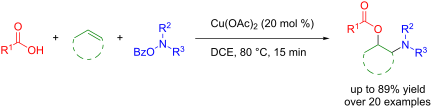
- -oxazolidinone motifs (Scheme 1D) [16]. Metal-free intermolecular oxyamination reactions have also been accomplished; examples were reported by the Zhu lab with the use of peroxides [17] and by the Studer lab with the use of hypervalent iodo-azide reagents [18]. Furthermore, the intramolecular oxyamination of


Synthesis of Xenia diterpenoids and related metabolites isolated from marine organisms
Beilstein J. Org. Chem. 2015, 11, 2521–2539, doi:10.3762/bjoc.11.273
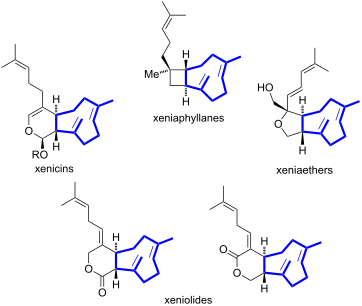
- construction of the cyclononene unit [49]. The synthesis started with a diastereoselective Evans syn-aldol reaction between substituted propanal 86 and E-crotonyl-oxazolidinone 85 (Scheme 9). The resulting secondary alcohol was silylated and the chiral auxiliary was cleaved with lithium borohydride. Acylation







Automated solid-phase synthesis of oligosaccharides containing sialic acids
Beilstein J. Org. Chem. 2015, 11, 617–621, doi:10.3762/bjoc.11.69
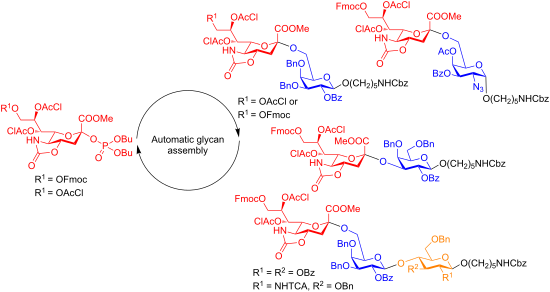
- electron-withdrawing group at the quaternary anomeric center decreases the reactivity. In addition, no participating group on C-3 can be used to direct the stereochemistry at the anomeric carbon (C-2) [2]. Efficient chemical sialylation reactions utilize the cyclic 4O,5N-oxazolidinone protecting group [12


Diastereoselective and enantioselective conjugate addition reactions utilizing α,β-unsaturated amides and lactams
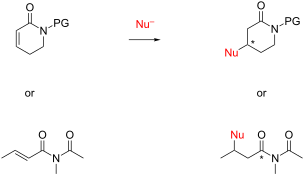
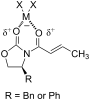
Beilstein J. Org. Chem. 2015, 11, 530–562, doi:10.3762/bjoc.11.60




(2R,1'S,2'R)- and (2S,1'S,2'R)-3-[2-Mono(di,tri)fluoromethylcyclopropyl]alanines and their incorporation into hormaomycin analogues
Beilstein J. Org. Chem. 2014, 10, 2844–2857, doi:10.3762/bjoc.10.302
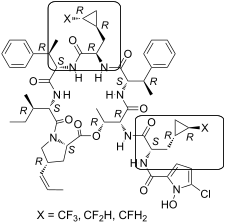
- the chiral auxiliary approaches to β-branched arylalanines, including all four stereoisomers of β-methylphenylalanine, the one employing the "Evans amide" method with a 4-benzyl- or 4-phenyl-2-oxazolidinone moiety, has been used most frequently. Along this route, which requires eight procedural steps