


Search results
Search for "[4 2]-cycloaddition" in Full Text gives 103 result(s) in Beilstein Journal of Organic Chemistry.
Design and synthesis of novel bis-annulated caged polycycles via ring-closing metathesis: pushpakenediol
Beilstein J. Org. Chem. 2014, 10, 2664–2670, doi:10.3762/bjoc.10.280
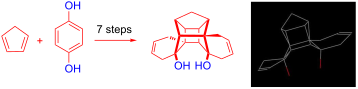
- the corresponding 2,5-diallyl-1,4-benzoquinone (18) was obtained in good yield (67%). Since the quinone 18 is prone to polymerization (it gave a long streak on TLC when exposed to air at rt), it was immediately subjected to the [4 + 2] cycloaddition reaction with freshly prepared 1,3-cyclopentadiene


Site-selective covalent functionalization at interior carbon atoms and on the rim of circumtrindene, a C36H12 open geodesic polyarene
Beilstein J. Org. Chem. 2014, 10, 956–968, doi:10.3762/bjoc.10.94
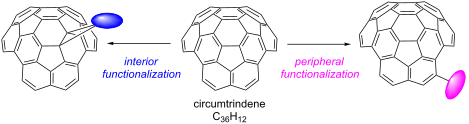
- unit. Representative synthetic reactions of fullerene C60 (2) include cyclopropanation [29][30], [3 + 2] cycloaddition [31][32], [4 + 2] cycloaddition [33], nucleophilic addition [34], and radical addition reactions [35]. Two of the earliest and most widely used reactions, the Bingel–Hirsch reaction




Thermodynamically stable [4 + 2] cycloadducts of lanthanum-encapsulated endohedral metallofullerenes
Beilstein J. Org. Chem. 2014, 10, 714–721, doi:10.3762/bjoc.10.65
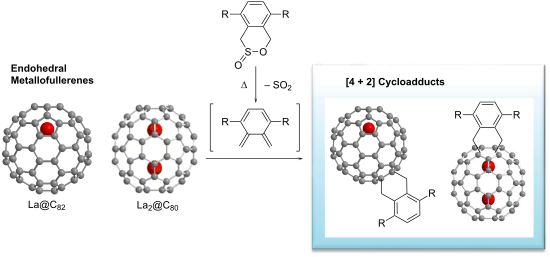
- and Die & Mould Technology, School of Materials Science and Technology, Huazhong University of Science and Technology, Wuhan 430074, China and Department of Chemistry, Tokyo Gakugei University, Tokyo 184-8501, Japan 10.3762/bjoc.10.65 Abstract The [4 + 2] cycloaddition of o-quinodimethanes, generated
- to remarkable differences in chemical and electronic properties between these two classes of EMFs. Chemical functionalization of fullerenes enhances molecular properties and possible applications of fullerenes [1][4]. The [4 + 2] cycloaddition reaction is a useful chemical modification method because
- it enables to introduce a variety of addends and/or the combination of different functionalities on the fullerene [7]. Regarding the [4 + 2] cycloaddition of EMFs, however, no report is available for endohedral di-metallofullerenes, with the exception of azafullerene [8]. A limited number of reports






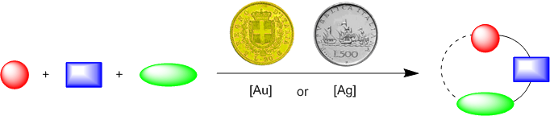
Silver and gold-catalyzed multicomponent reactions
Beilstein J. Org. Chem. 2014, 10, 481–513, doi:10.3762/bjoc.10.46


Boron-substituted 1,3-dienes and heterodienes as key elements in multicomponent processes
Beilstein J. Org. Chem. 2014, 10, 237–250, doi:10.3762/bjoc.10.19

- . In the case of methyl acrylate or acrylonitrile, a mixture of cis diastereomers was obtained regioselectively at higher temperature, in a 1:1.6 to 1:1.8 ratio. By contrast, the [4 + 2]-cycloaddition proved to be completely regioselective when performed on the catechol derivative in the absence of
- based on a first Diels–Alder cycloaddition, as shown above. However, a recent report of Norsikian, Beau and co-workers described a novel sequence of tandem transformations which combined the Petasis reaction, intramolecular [4 + 2]-cycloaddition, cross metathesis and Michael reaction. This process gave
- product showed traces of the boron cycloadduct, highlighting that this mechanism proceeds, first with a Lewis-acid catalysed [4 + 2]-cycloaddition, and then by Lewis acid-assisted C–B bond protonation. In a different approach which exploited another aspect of the reactivity of boron-substituted dienes


Synthesis of five- and six-membered cyclic organic peroxides: Key transformations into peroxide ring-retaining products
Beilstein J. Org. Chem. 2014, 10, 34–114, doi:10.3762/bjoc.10.6
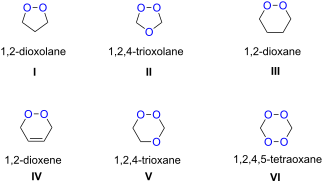
- peroxides are based on three key reagents: oxygen, ozone, and hydrogen peroxide. These reagents and their derivatives are used in the main methods for the introduction of the peroxide group, such as the singlet-oxygen ene reaction with alkenes, the [4 + 2]-cycloaddition of singlet oxygen to dienes, the






Gold(I)-catalyzed enantioselective cycloaddition reactions
Beilstein J. Org. Chem. 2013, 9, 2250–2264, doi:10.3762/bjoc.9.264
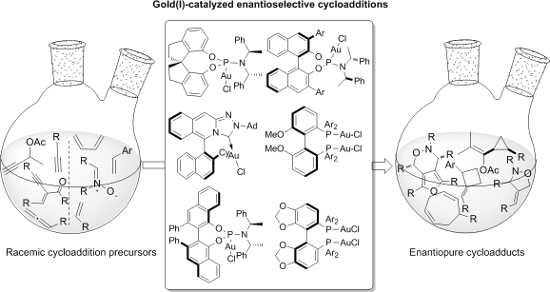
- allyl cation to the diene. Curiously, by using a gold(I) catalyst bearing a π-acceptor phosphite ligand, such as Au10/AgSbF6, allenedienes disubstituted at the distal position of the allene lead to products formally arising from a [4 + 2] cycloaddition process (Scheme 8, b) [59][60]. Several
- [4 + 2] cycloaddition (Scheme 9, R1, R2 = alkyl groups). This turned out to be the case and, gratifyingly, we showed that it is possible to perform highly enantioselective allenediene [4 + 2] cycloadditions by using gold complexes derived from a bulky phosphoramidite equipped with anthracenyl
- into a enantioselective version by using a novel chiral gold complex Au14, featuring a triazole unit embedded in a rigid axially chiral cyclic frame (Scheme 11) [72]. The catalyst generated from Au14 and AgNTf2 was able to promote the [4 + 2] cycloaddition between allenamides 16 and conjugated dienes


Gold(I)-catalyzed 6-endo hydroxycyclization of 7-substituted-1,6-enynes
Beilstein J. Org. Chem. 2013, 9, 2242–2249, doi:10.3762/bjoc.9.263
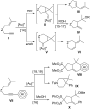
- also observed in particular cases affording methylenecyclohexene derivatives like VI [14]. On the other hand, 1,6-enynes VII, bearing an aryl substituent at the alkyne, undergo a formal intramolecular [4 + 2] cycloaddition through an initial 5-exo cyclization followed by a Friedel–Crafts-type reaction
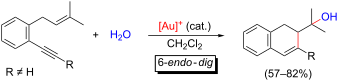
- acetylene moiety would take place through an initial 5-exo cyclization that in the case of aryl-substituted enynes (R = Ar) would give rise to a formal [4 + 2] cycloaddition product XIV [18][19], or alternatively, through a relatively less common 6-endo-dig pathway via gold species XV, which could be
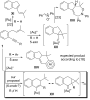
- and 4a’, is generated in preference to 3a which would be the expected product derived from a formal [4 + 2] cycloaddition initiated by a 5-exo cyclization followed by a Friedel–Crafts-type process in intermediate 5a or 5a’, as described by Echavarren and co-workers [18][19]. Prompted by this result



Flexible synthesis of anthracycline aglycone mimics via domino carbopalladation reactions
Beilstein J. Org. Chem. 2013, 9, 2194–2201, doi:10.3762/bjoc.9.258
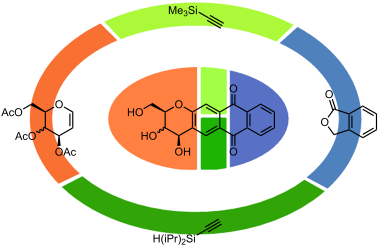
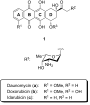
- for the aspired synthesis [10][11][12][13]. A classical synthesis was published in 1988 by Hansen where a silyl-substituted diene 3 was used for the [4 + 2]-cycloaddition (Scheme 1) [14]. Starting from bisquinone 4 the annulated ring system 5 is obtained in a 1:1 mixture of cis-endo regioisomers



Sequential Diels–Alder/[3,3]-sigmatropic rearrangement reactions of β-nitrostyrene with 3-methyl-1,3-pentadiene
Beilstein J. Org. Chem. 2013, 9, 2137–2146, doi:10.3762/bjoc.9.251

- been the subject of several theoretical investigations [7][8][9][10]. The necessary nitronic ester precursors are readily preparable by Lewis acid-promoted [4 + 2]-cycloaddition reactions of nitroalkenes with appropriate dienes, a general reaction first reported by Denmark and coworkers (Denmark Diels


The chemistry of isoindole natural products
Beilstein J. Org. Chem. 2013, 9, 2048–2078, doi:10.3762/bjoc.9.243
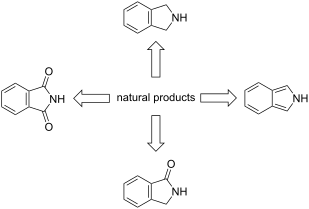
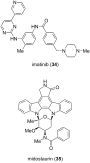
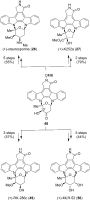
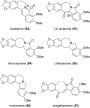
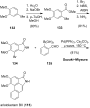
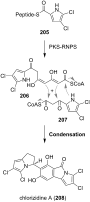
- ) units. The remaining methyl groups are believed to be installed by S-adenosyl methionine (SAM). An intramolecular Aldol condensation generates the pyrrolinone 62, which reacts via an [4 + 2]-cycloaddition to prochaetoglobosin I (63) [56]. Recently, gene disruption studies of Chaetomium globosum revealed












Gold-catalyzed intermolecular coupling of sulfonylacetylene with allyl ethers: [3,3]- and [1,3]-rearrangements
Beilstein J. Org. Chem. 2013, 9, 1724–1729, doi:10.3762/bjoc.9.198

- = di-t-butyl-o-biphenylphosphine, JohnPhos) formed in situ was used as catalyst, the reaction was more efficient in chlorinated solvents rather than polar aprotic or aromatic hydrocarbon solvents (Table 1, entries 1–7). Contrary to the previous [4 + 2] cycloaddition, formal enyne cross metathesis or [2


Substituent effect on the energy barrier for σ-bond formation from π-single-bonded species, singlet 2,2-dialkoxycyclopentane-1,3-diyls
Beilstein J. Org. Chem. 2013, 9, 925–933, doi:10.3762/bjoc.9.106
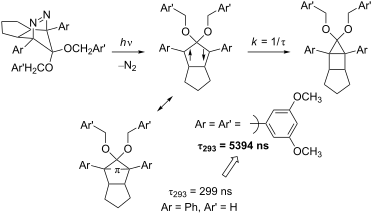
- method of Tiecco [32]. Pyrazole 3g was then synthesized by the reaction with hydrazine hydrate. AZg was obtained by the Diels–Alder [4 + 2]-cycloaddition with cyclopentadiene and hydrogenation using PtO2 as a catalyst. The endo-configured structure of azoalkanes AZc–g was determined by X-ray


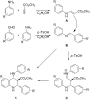
Facile synthesis of functionalized tetrahydroquinolines via domino Povarov reactions of arylamines, methyl propiolate and aromatic aldehydes
Beilstein J. Org. Chem. 2012, 8, 1839–1843, doi:10.3762/bjoc.8.211
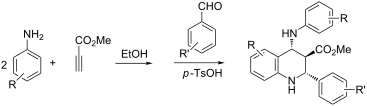
- developed as the most powerful synthetic routes to construct oxygen or nitrogen-containing six-membered heterocycles [4][5][6][7][8]. In recent years, the imine Diels–Alder reaction (also known as Povarov reaction) and the [4 + 2] cycloaddition reaction of imines (obtained from the corresponding aromatic


Asymmetric Brønsted acid-catalyzed aza-Diels–Alder reaction of cyclic C-acylimines with cyclopentadiene
Beilstein J. Org. Chem. 2012, 8, 1819–1824, doi:10.3762/bjoc.8.208
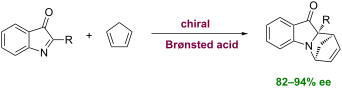
- optically active aza-tetracycles in good yields with high diastereo- and enantioselectivities under mild reaction conditions. Keywords: BINOL phosphate; [4 + 2] cycloaddition; Diels–Alder reaction; organocatalysis; Introduction The enantioselective aza-Diels–Alder reaction is an important method for the


Iridium-catalyzed intramolecular [4 + 2] cycloadditions of alkynyl halides
Beilstein J. Org. Chem. 2012, 8, 1765–1770, doi:10.3762/bjoc.8.201
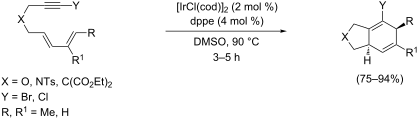
- solvent resulted in incomplete reaction after 3 h, so the most efficient reaction conditions for the intramolecular [4 + 2] cycloaddition of diene-tethered alkynyl bromide 1a were found to be [IrCl(COD)]2 (2 mol %), dppe (4 mol %) in DMSO at 90 ºC. In order to illustrate the general applicability of this
- the starting material was recovered. Changing the reaction conditions to the original system of Vaska’s complex in toluene (conditions B, Scheme 5) did not change this result. The previous Ir-catalyzed [4 + 2] cycloaddition work by Shibata and co-workers did not include any examples of similar
- found to undergo [4 + 2] cycloaddition under the reported conditions. The Ir-catalyzed reactions provided the cycloadducts in similar yields to the previous Rh-catalyzed reactions of alkynyl halides; however, the Ir-catalyzed reactions required higher reaction temperatures (90 versus 25 °C). Literature


Highly enantioselective access to cannabinoid-type tricyles by organocatalytic Diels–Alder reactions
Beilstein J. Org. Chem. 2012, 8, 1385–1392, doi:10.3762/bjoc.8.160
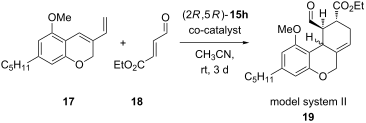
- used method [3][4][5][6][7]. Some examples are shown in Figure 1. The first application was the total synthesis of the steroid Cortisone (1) in 1952 by Woodward et al. [8]. Another example, indicating the importance of the well-known [4 + 2] cycloaddition in natural-product synthesis, is the first
- published total synthesis of Taxol (2) by Nicolaou. Two different [4 + 2]-cycloaddition reactions were applied to set up each of the two six-membered rings of the target molecule [9][10]. As a final example, Dynemicin A (3) should be mentioned, which is an enediyne consisting of a complex heterocyclic
- skeleton and a network of sensitive functional groups, exhibiting antitumor and antibiotic activity [11]. Three independent research groups (Schreiber, Myers and Danishefsky) successfully applied [4 + 2]-cycloaddition reactions in elegant and divergent strategies to reach the target molecule [12][13][14


Synthesis of a novel chemotype via sequential metal-catalyzed cycloisomerizations
Beilstein J. Org. Chem. 2012, 8, 1338–1343, doi:10.3762/bjoc.8.153

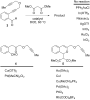
- ] utilizing both Cu(I) and Pt(II) [19] catalysts afforded the desired cyclopropane 6 in moderate yield (40%) along with ketone 7 (45%), derived from [4 + 2] cycloaddition of the benzopyrylium intermediate with the pendent alkyne [20] (Scheme 2b). However, better yields were observed when the initial




Triple-channel microreactor for biphasic gas–liquid reactions: Photosensitized oxygenations
Beilstein J. Org. Chem. 2011, 7, 1158–1163, doi:10.3762/bjoc.7.134
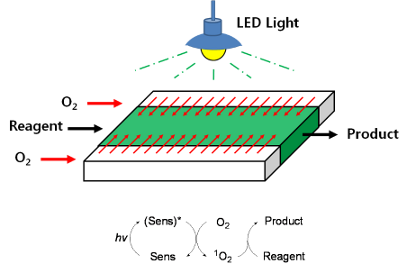
- sensitizer. The results from the triple-channel microreactor and the batch reaction presented in Table 3 clearly indicate the efficiency of the former. Photosensitized oxygenation of α-terpinene The photosensitized oxygenation of α-terpinene is a Diels–Alder type [4 + 2] cycloaddition reaction. The product


A practical microreactor for electrochemistry in flow
Beilstein J. Org. Chem. 2011, 7, 1108–1114, doi:10.3762/bjoc.7.127

- the product selectivity. Cycloadditions using the N-acyliminium ions as heterodienes with a variety of dienophiles, such as alkenes and alkynes, give the corresponding [4 + 2] cycloaddition products in high yields [10]. The same authors also reported a successful polymer synthesis using the same


Recent developments in gold-catalyzed cycloaddition reactions
Beilstein J. Org. Chem. 2011, 7, 1075–1094, doi:10.3762/bjoc.7.124
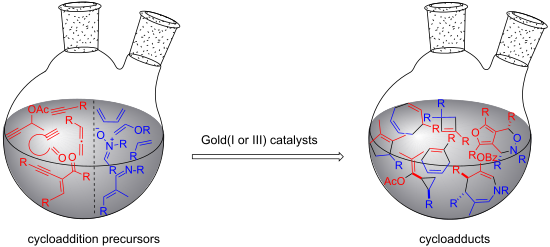
- type 1 and alkynes (Scheme 1) [24][25]. The mechanism proposed by the authors involves an initial 5-endo nucleophilic attack of the carbonyl moiety on the metal–alkyne complex to generate a carbonyl ylide intermediate I, which undergoes a regioselective (4 + 2) cycloaddition with the external alkyne. A
- aforementioned mechanistic pathway [26]. According to the theoretical data, the formal (4 + 2) cycloaddition would indeed comprise a two-step process consisting of a dipolar (3 + 2) cycloaddition of the carbonyl ylide I to afford a carbene species III [27][28], followed by a 1,2-alkyl migration to yield the
- highly stereoselective (4 + 2) cycloaddition with the vinyl ether to yield, after the elimination of the gold catalyst, highly substituted oxacyclic systems 7 in good yields and with notable diastereoselectivities. Importantly, this reaction tolerates a wide range of vinyl ethers, and different


Recent advances in the gold-catalyzed additions to C–C multiple bonds
Beilstein J. Org. Chem. 2011, 7, 897–936, doi:10.3762/bjoc.7.103
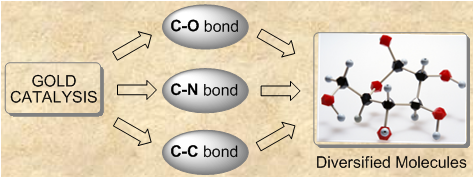
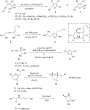
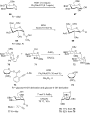
- a highly enantioselective three-component (393–395) cascade reaction which involved an enantioselective [4 + 2] cycloaddition reaction catalyzed by a chiral phosphoric acid and a subsequent catalytic intramolecular hydroamination by a gold(I) complex (Scheme 64) [180]. Further studies revealed that
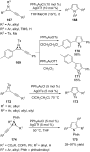
- + 2] cycloaddition product in very good yield (Scheme 41). Enynes [110][111][112][113][114][115][116], diynes [117][118][119][120], allenynes [121][122][123][124][125][126][127][128], and dienes [129][130][131] are common substrates for intramolecular cycloaddition reactions. Porcel et al. found that
- the [4 + 3] and [4 + 2] cycloadducts (225 and 226) [101]. The selectivity was improved to 96:4 in favor of the [4 + 3] cycloadduct when di-tert-butylbiphenylphosphinegold(I) was employed as the catalyst. On the other hand, the use of arylphosphitegold(I) complexes exclusively produced the formal [4








Construction of cyclic enones via gold-catalyzed oxygen transfer reactions
Beilstein J. Org. Chem. 2011, 7, 606–614, doi:10.3762/bjoc.7.71
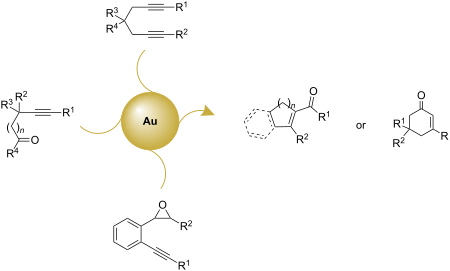
- transfer of 2-alkynyl-1,5-diketones. The discovery of a [4 + 2] cycloaddition of a furanium intermediate to a carbonyl group was further verified by quantum chemical calculations. The competing [2 + 2] and [4 + 2] reaction coordinates were computed for the simplified substrate 11a, shown in Scheme 10. In




Synthesis of cross-conjugated trienes by rhodium-catalyzed dimerization of monosubstituted allenes
Beilstein J. Org. Chem. 2011, 7, 578–581, doi:10.3762/bjoc.7.67

- used for consecutive double [4 + 2] cycloaddition reactions [2][3][4] to provide a rapid access to polycyclic carbon frameworks. Thus, a number of methods for the preparation of the parent 3-methylenepenta-1,4-diene [5] and its substituted derivatives [6][7][8][9][10][11][12][13][14][15][16][17] has
- dimerization reaction, in contrast to the nickel-catalyzed reaction [18][19]. Next, we examined the consecutive double [4 + 2] cycloaddition reaction of the cross-conjugated trienes obtained in the present study. Triene 3a was treated with 4-phenyl-1,2,4-triazoline-3,5-dione (4, PTAD), a highly reactive
- tetracyanoethylene (6, TCNE), which was a less reactive dienophile than 4, was used, [4 + 2] cycloaddition also occurred preferentially at site β, but only once on heating at 60 °C for 24 h. Conclusion In summary, we have developed a new dimerization reaction of monosubstituted allenes catalyzed by a rhodium(I)/dppe


The arene–alkene photocycloaddition
Beilstein J. Org. Chem. 2011, 7, 525–542, doi:10.3762/bjoc.7.61
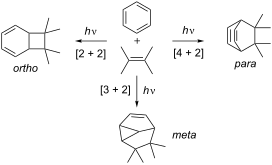
- + 2] cycloaddition (Diels–Alder reaction) is only very rarely observed photochemically (vide infra). Photocycloadditions are not limited to simple alkenes, and even the thermally very stable benzene core has been shown to become quite reactive upon excitation with photons. It can be converted into
- known representatives are undoubtedly the [2 + 2] photocycloaddition, forming either cyclobutanes or four-membered heterocycles (as in the Paternò–Büchi reaction), whilst excited-state [4 + 4] cycloadditions can also occur to afford cyclooctadiene compounds. On the other hand, the well-known thermal [4





