Search results
Search for "activation energy" in Full Text gives 125 result(s) in Beilstein Journal of Organic Chemistry.
Enantioselective carbenoid insertion into C(sp3)–H bonds
Beilstein J. Org. Chem. 2016, 12, 882–902, doi:10.3762/bjoc.12.87
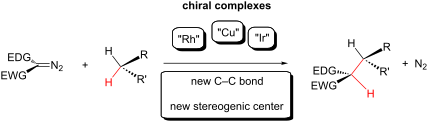
- attributed to the stabilization of the partial positive charge on the divalent carbon of the transition state TS-40 provided by the phenyl donor group. The second reason concerns the large difference between the activation energy of these reactions which relies on the development of steric strain through the


Recent advances in C(sp3)–H bond functionalization via metal–carbene insertions
Beilstein J. Org. Chem. 2016, 12, 796–804, doi:10.3762/bjoc.12.78

- metal center to the ligand and to carbon dioxide was supported by experimental data and DFT studies. Such interaction increases the electrophilicity of the carbene moiety and thus lowers the activation energy for C–H bond insertion. Other ligands have also been explored for the metal–carbene C(sp3)–H


Strecker degradation of amino acids promoted by a camphor-derived sulfonamide
Beilstein J. Org. Chem. 2016, 12, 732–744, doi:10.3762/bjoc.12.73
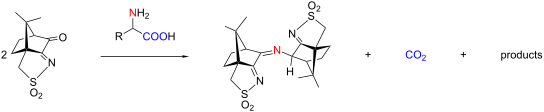
- cycloreversion for the model compound obtained from glycine and glyoxal (see Supporting Information File 3) showed that this reaction has a moderate activation energy but is endothermic and therefore not probable to occur in our reaction conditions. Since the barrier towards the Strecker degradation of the
- mechanisms should have an appreciable barrier (activation energy) and therefore give an indication for the viability of different reaction paths. For the ninhydrin reaction with amino acids, a concerted mechanism with simultaneous elimination of CO2 and H2O from an intermediate aminal (carbinolamine) has
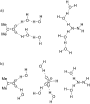
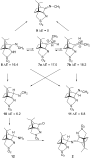
- zwitterions. Intramolecular reactions of non-zwitterionic ground state 6g to 11 (top) or 8 (bottom). The activation energy ΔEa denotes the calculated energy difference (in kcal/mol) between the TS and the optimized ground state 6g. A similar activation barrier was found for the conversion 6g → 10 (50.3 kcal


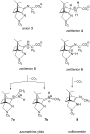



cis–trans-Amide isomerism of the 3,4-dehydroproline residue, the ‘unpuckered’ proline
Beilstein J. Org. Chem. 2016, 12, 589–593, doi:10.3762/bjoc.12.57
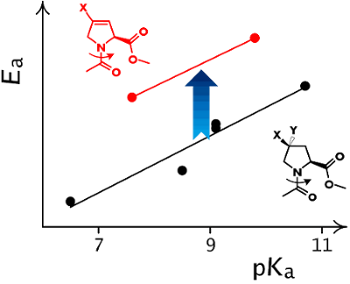
- energies with the pKa of the ammonium groups in the corresponding free amino acids (Scheme 2). The resulting correlation indicates a remarkable offset in the activation energy in the 3,4-double bond containing residues (Figure 3). This effect was not only observed in water, but also persisted in organic


Interactions between 4-thiothymidine and water-soluble cyclodextrins: Evidence for supramolecular structures in aqueous solutions
Beilstein J. Org. Chem. 2016, 12, 549–563, doi:10.3762/bjoc.12.54
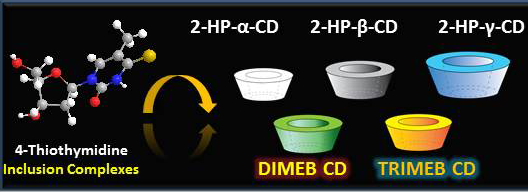
- of the cathodic peak potential is reasonable because a higher activation energy would be expected under such conditions. As described in [39], this observed increased difficulty is due to the inclusion of the pyrimidine ring inside the cavity of the CDs hindering the interaction with the electrode
- the reduction of the involved groups in the inclusion complex need less activation energy. On the other hand, when TRIMEB CD was considered, while the cathodic peak potential can be considered constant, the current intensity decreases after the first CD addition then it remains constant (Figure 3E



Amino-functionalized (meth)acryl polymers by use of a solvent-polarity sensitive protecting group (Br-t-BOC)
Beilstein J. Org. Chem. 2016, 12, 245–252, doi:10.3762/bjoc.12.26
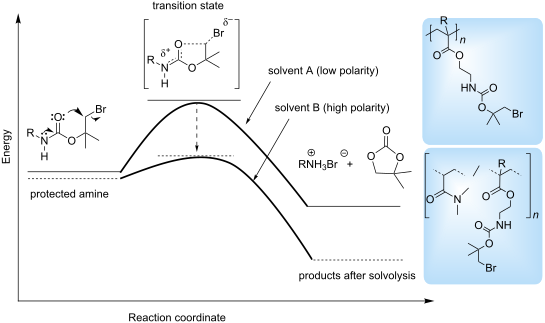
- this in mind, the bromo-tert-butyloxycarbonyl (Br-t-BOC) group represents the first known solvent-polarity sensitive amino-protecting group. As shown in Figure 1, this group is stable in nonpolar solvents because of high activation energy and easily decomposes in a more polar environment because of
- reduced activation energy. This effect is a result of an increased polarity of the transition state in comparison to the starting molecule (Figure 1). In contrast to the classical t-BOC protecting group, the Br-t-BOC group can be easily removed without pH adjustments. Since the published papers from L. A
- (s, νC-H (R-CH3)); DSC: Tg = 125.9 °C; GPC (THF): = 8900 g/mol, = 6000 g/mol, D = 1.48. Schematic representation of a deprotection taking the relatively high polarity of the transition state and the solvent polarity into account: high activation energy in nonpolar solvents and low activation energy


Solving the puzzling competition of the thermal C2–C6 vs Myers–Saito cyclization of enyne-carbodiimides
Beilstein J. Org. Chem. 2016, 12, 43–49, doi:10.3762/bjoc.12.6
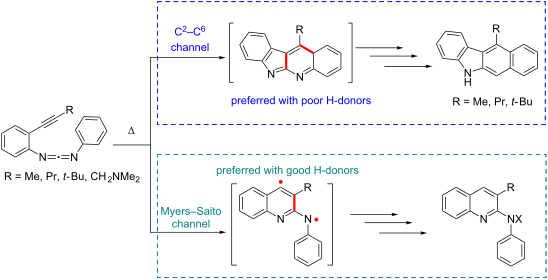
- and the decision between the two reaction channels for 7 is not necessarily guided by the free activation energy of the two initial steps, but by the inability of the Myers–Saito diradical to compete in follow-up reactions, either inter- or intramolecular, with the C2–C6 (Schmittel) channel. Results
- over formation of 13DA, suggesting that in the thermolysis the Myers–Saito product 12 should prevail. Due to the low free activation energy for the strongly exergonic intramolecular hydrogen abstraction 11_INTMS → 11_INTγHT of only 1.5 kcal mol−1, the diradical cyclization step is now rate determining


2-Hetaryl-1,3-tropolones based on five-membered nitrogen heterocycles: synthesis, structure and properties
Beilstein J. Org. Chem. 2015, 11, 2179–2188, doi:10.3762/bjoc.11.236
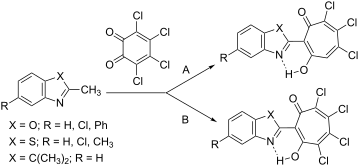
- activation energy barrier of the limiting step of the formation of 1,3-tropolone derivatives in the reaction of methylene-active five-membered heterocycles with o-chloranil in acetic acid solution strongly depends on the properties of the fragment X in the heterocyclic compounds. The larger the


![[Graphic 3]](/bjoc/content/inline/1860-5397-11-236-i8.png?max-width=637&scale=1.18182) N···H–O equilibrium in solutions of 2-hetaryl-5,6,7-trichloro- and 4,...
N···H–O equilibrium in solutions of 2-hetaryl-5,6,7-trichloro- and 4,...


Computational study of productive and non-productive cycles in fluoroalkene metathesis
Beilstein J. Org. Chem. 2015, 11, 2150–2157, doi:10.3762/bjoc.11.232
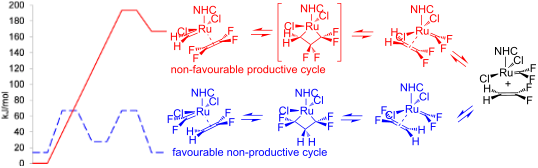
- -difluoromethyleneruthenium complex 2AC, leading to symmetrical metallacyclobutane 2NA with activation energy around 65 kJ/mol and through the same transition state back to complex 2AC and 1,1-difluoroethene (2). However, for the productive anti-coordination of 1,1-difluoroethene (2), no stable metallacyclobutane structure




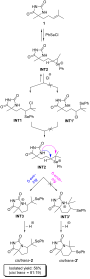
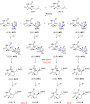
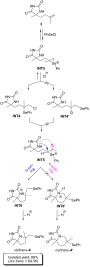
Mechanism, kinetics and selectivity of selenocyclization of 5-alkenylhydantoins: an experimental and computational study
Beilstein J. Org. Chem. 2015, 11, 1865–1875, doi:10.3762/bjoc.11.200
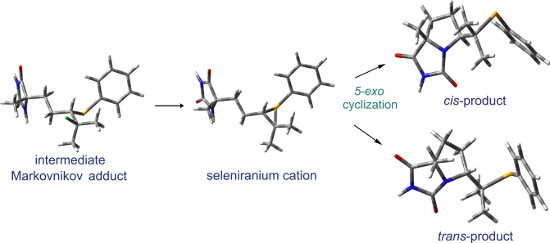
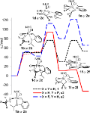
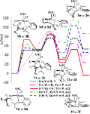
- energies were calculated at T = 298 K. Rate constants were calculated using Transition state theory as implemented in TheRate program [48] and 1 M standard state as: where kB, h and R stand for the Boltzman, Planck, and the gas constant, and ΔG≠ is the free activation energy, which is calculated as the G





Synthesis of racemic and chiral BEDT-TTF derivatives possessing hydroxy groups and their achiral and chiral charge transfer complexes
Beilstein J. Org. Chem. 2015, 11, 1561–1569, doi:10.3762/bjoc.11.172
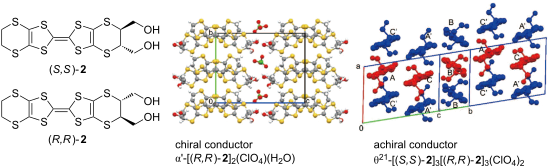
- and 0.6 ohm cm for θ21-[(S,S)-2]3[(R,R)-2]3(ClO4)2 and α'-[(R,R)-2]2ClO4(H2O), respectively. Both salts show semiconducting behaviour and the activation energy of θ21-[(S,S)-2]3[(R,R)-2]3(ClO4)2 is Ea = 86 meV which is lower than that of α'-[(R,R)-2]2ClO4(H2O) which has Ea = 140 meV. Conclusion In


Synthesis of a tricyclic lactam via Beckmann rearrangement and ring-rearrangement metathesis as key steps
Beilstein J. Org. Chem. 2015, 11, 1503–1508, doi:10.3762/bjoc.11.163
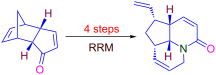
- -caprolactam from cyclohexanone oxime involving the BR. The activation energy for the BR is almost the same as that of the nucleophilic substitution at sp2 nitrogen. To synthesize various aza-arenes and cyclic imines, such as quinolines, aza-spiro compounds and dihydropyrroles, the intramolecular SN2-type


Surprisingly facile CO2 insertion into cobalt alkoxide bonds: A theoretical investigation
Beilstein J. Org. Chem. 2015, 11, 1340–1351, doi:10.3762/bjoc.11.144
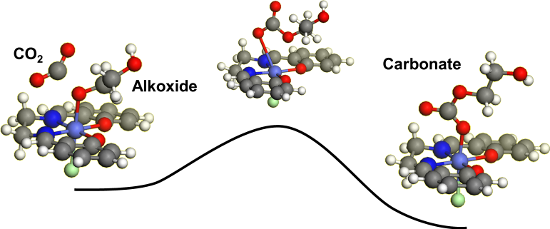
- , a linear Brønsted–Evans–Polanyi relationship was found between the activation energy and the reaction energy. Keywords: activation; alkoxide; carbon dioxide; cobalt; insertion; salen; Introduction Carbon dioxide (CO2) has been known to be an attractive carbon source for decades [1][2][3][4][5][6
- , the insertion step into an Al(III)-alkoxide bond is a simple intramolecular process with a small activation energy (∆E# = 9.12 kcal/mol) [30][51]. Nevertheless, a bimetallic aluminium complex is considered in the mechanism. Since it is a bimolecular reaction, the Gibbs energies will be higher. Carbon
- that the activation energy decreases with increasing exothermicity of the CO2 insertion. Thereby, a linear relationship between the activation energy and the reaction energy – a so-called Brønsted–Evans–Polanyi relationship – was found. This relationship enables one to predict the activation barrier


New palladium–oxazoline complexes: Synthesis and evaluation of the optical properties and the catalytic power during the oxidation of textile dyes
Beilstein J. Org. Chem. 2015, 11, 1175–1186, doi:10.3762/bjoc.11.132
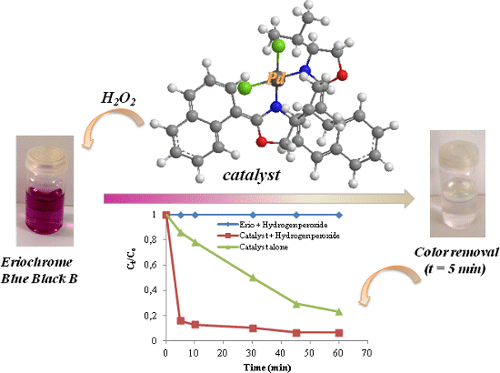
- . Thermodynamic parameters To better understand the degradation process, the pseudo first-order kinetic equation was used to determine the kinetic parameters. The Arrhenius law was used to calculate the activation energy (Ea). The determination of the entropy and the enthalpy of activations (ΔS* and ΔH*) were
- performed using the Eyring equation [37]. The results are summarized in Table 3. The activation energy (Ea) has been found to be low (16.669 kJ mol−1) confirming that the complex 9 was very efficient for the degradation of azo dyes using H2O2. Reuse of the catalysts In this section, the reusability of the


Mechanical stability of bivalent transition metal complexes analyzed by single-molecule force spectroscopy
Beilstein J. Org. Chem. 2015, 11, 817–827, doi:10.3762/bjoc.11.91
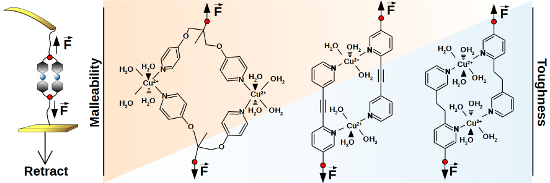
- to a hypothetical potential energy diagram (PED) along the rupture coordinate z (Figure 3). Starting from a bound state 0, a certain activation energy EA is needed to escape over transition state I. Under an applied force, f, the whole PED is tilted by ∆E = −f ∆z, where ∆z is the distance from state
- deforms the potential energy along the rupture coordinate z according to ∆E, thereby reducing activation energy EA and increasing force-driven rupture koff(f). Most probable rupture forces plotted over their corresponding loading rate. Each point denotes for one series of measurements at a certain pulling




On the strong difference in reactivity of acyclic and cyclic diazodiketones with thioketones: experimental results and quantum-chemical interpretation
Beilstein J. Org. Chem. 2015, 11, 504–513, doi:10.3762/bjoc.11.57
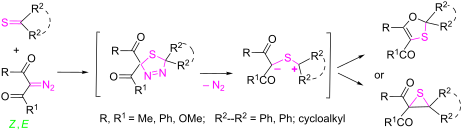
- intermediate thiocarbonyl ylides of type 7 from 1a–d and 2a is thermodynamically favorable. The activation energy of the 1,3-dipolar cycloaddition of diazo compounds 1 to thiobenzophenone (2a, ΔG1#) is significantly larger than the decomposition energy of 1,3,4-thiadiazolines 6 (ΔG2#). In line with these data
- equation: ΔG1–7’ = ΔG1 + ΔG2. The lower relative energy of the 1,3,4-thiadiazoline 6' decomposition products, as well as the smaller activation energy of the second step of the process (ΔG2# < ΔG1#), result in the formation of thiocarbonyl ylide 7'. Since the activation energy of the cycloaddition step is
- with 2b also proceed via a concerted pathway. The calculated activation energy of DDC 1a–f cycloadditions with thioketone 2b correlate well with the experimental results, where the lowest values of ΔG1# (30.7–31.2 kcal·mol−1; Table 2) are related to the most reactive of acyclic diazoadicarbonyl


IR and electrochemical synthesis and characterization of thin films of PEDOT grown on platinum single crystal electrodes in [EMMIM]Tf2N ionic liquid
Beilstein J. Org. Chem. 2015, 11, 348–357, doi:10.3762/bjoc.11.40
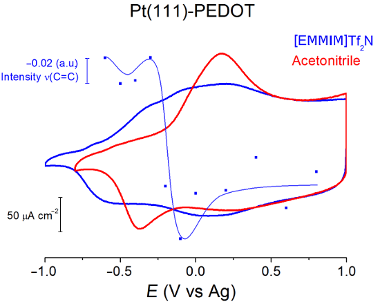
- possible to establish a relation between the current and the temperature using the “initial rate” approximation and the Arrhenius Equation. Since the logarithm of the current density vs the inverse of the temperature plot showed a linear dependence, Figure 4b, the apparent activation energy were calculated
- (Table 1). The values of the activation energy for the oxidation and reduction processes are very similar and very close to the one reported for polythiophene (16 kJ mol−1) [24], which means that the oxidation and reduction of PEDOT (and the corresponding counterion exchange) occurs easily in spite of
- the fact that the viscosity of the ionic liquid is quite high [16]. It is important to state that the activation energy of the nucleation kinetics related to the ion exchange depends on the overpotential used. Even so, the results shown in Table 1, Figure 3a and Figure 4 show that the kinetics of the

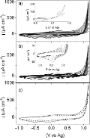

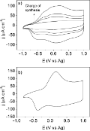


Molecular ordering at electrified interfaces: Template and potential effects
Beilstein J. Org. Chem. 2014, 10, 2243–2254, doi:10.3762/bjoc.10.233
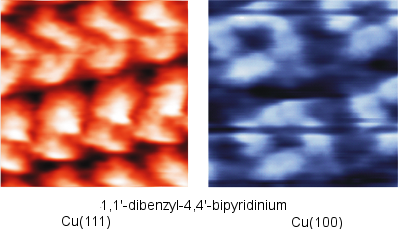
- , provided a sufficient surface mobility allows the adsorbed molecules to reach their equilibrium positions, i.e., minima in the corrugation function. In this case the substrate surface acts as a “template”. Under UHV conditions the activation energy for structural equilibration is usually provided by
- the 120° step edge serves as a positional marker. The phase-transition process starts preferentially at point defects and domain boundaries (as marked by the white arrows in Figure 6b) because this requires a relatively low activation energy. Finally, the new stripe pattern is completed right after


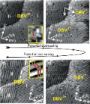


Proton transfers in the Strecker reaction revealed by DFT calculations
Beilstein J. Org. Chem. 2014, 10, 1765–1774, doi:10.3762/bjoc.10.184
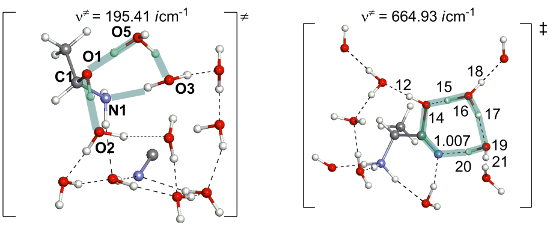
- alanine was studied by DFT calculations for the first time, which involves two reaction stages. In the first reaction stage, the aminonitrile was formed. The rate-determining step is the deprotonation of the NH3+ group in MeCH(OH)-NH3+ to form 1-aminoethanol, which occurs with an activation energy barrier
- + and CN−]. This step is exothermic by 5.5 kcal/mol with a small activation energy barrier (ΔE≠) of 1.4 kcal/mol. Starting from 4, a proton of the NH3+ group migrates to one water molecule to form 5 [Me(H)C(OH)-NH2(H3O+) and CN−] via a transition state TS4/5. After that, the proton migrates from H3O+ to
- addition model of TS1/2 was examined by the use of the amine in Scheme 2. The activation energy of the less crowded TS1/2–A is 1.8 kcal/mol smaller than the more crowded TS1/2–B; see Figure 3. This calculation result is consistent with Harada's work that a chiral product [4] was obtained in the Strecker


Theoretical studies on the intramolecular cyclization of 2,4,6-t-Bu3C6H2P=C: and effects of conjugation between the P=C and aromatic moieties
Beilstein J. Org. Chem. 2014, 10, 1032–1036, doi:10.3762/bjoc.10.103
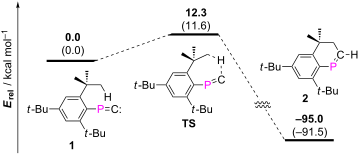
- alternative Fritsch–Buttenberg–Wiechell-type rearrangement requires almost no activation energy, the intramolecular cyclization needs an activation energy of 12.3 kcal/mol at the MP2(full)/6-31G(d) condition. DFT calculations supported that the optimized structure of the cyclization product of Mes*P=C
- activation energy (ΔEa) was 12.3 kcal/mol, and the Gibbs free energy ΔG was estimated as 11.6 kcal/mol. Such energy profile indicates a sharp contrast to the modeled FBW rearrangement of phosphanylidenecarbene requiring no activation energy [20], and would be partially explicable for the experimental result
- conclusion, the chemistry of the intramolecular C–H insertion of phosphanylidenecarbene 1 affording 2 was studied by ab initio and DFT calculations. The intramolecular cyclization requires an activation energy, whereas the phosphorus version of the FBW rearrangement proceeded without an energetic barrier


On the mechanism of photocatalytic reactions with eosin Y
Beilstein J. Org. Chem. 2014, 10, 981–989, doi:10.3762/bjoc.10.97
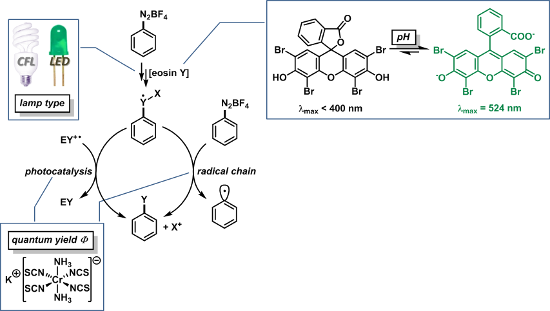
- -colored LEDs (see Supporting Information File 1 for spectrum). The activation energy of thermal heterolysis of arenediazonium ions is approx. 115 kJ/mol (1.19 eV) [29]. The energy of a photon at the edge of the visible spectrum (400 nm) is 3.1 eV so that such photons carry sufficient energy to heterolyze


Site-selective covalent functionalization at interior carbon atoms and on the rim of circumtrindene, a C36H12 open geodesic polyarene
Beilstein J. Org. Chem. 2014, 10, 956–968, doi:10.3762/bjoc.10.94
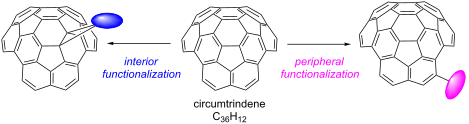
- in a cold trap [10][11][12]. The high temperatures used in FVP (often up to 1100 °C) provide sufficient thermal energy to enable molecules to overcome high activation energy barriers. The FVP approach takes advantage of the fact that the normal out-of-plane deformations of simple planar polyarenes




Dimerisation, rhodium complex formation and rearrangements of N-heterocyclic carbenes of indazoles
Beilstein J. Org. Chem. 2014, 10, 832–840, doi:10.3762/bjoc.10.79
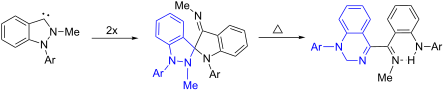
- frequencies on Z→E isomerisation. The following scheme presents diagnostic peak assignments of the 1H and 13C NMR spectra, taken at 400 and 100 MHz in CDCl3, respectively. According to DFT calculations the conversion of 13a to 14a requires an activation energy of ΔG# = +79 kJ/mol (ΔE = +89 kJ/mol) while the




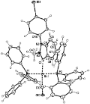


Chromatographically separable rotamers of an unhindered amide
Beilstein J. Org. Chem. 2014, 10, 701–706, doi:10.3762/bjoc.10.63
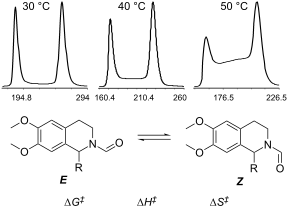
- pure form by crystallization. While Rice and Brossi focused on the optical and crystallographic properties of these compounds, Szántay et al. gave a first estimate of the activation energy of the interconversion of these two rotamers based on dynamic NMR spectroscopy at variable temperature. They
- ‡ (293 K) = 93.2 ± 0.1 kJ/mol (E to Z) respectively (Figure 1, Figure 2). Dynamic HPLC studies Like the DNMR data, the simple kinetic analysis only permits the determination of the free activation energy while the separation of entropic and enthalpic contributions requires a variation of the temperature
- implemented the unified equation. For the evaluation of activation parameters of the interconversion process experiments between 30 °C and 55 °C were considered, because at lower temperatures the plateau height was too low to be determined with high precision. The Gibbs free activation energy ΔG‡ (T) was


![[Graphic 2]](/bjoc/content/inline/1860-5397-10-63-i3.png?max-width=637&scale=1.18182) ) in 4 (BP-D3/def2-SVP).
) in 4 (BP-D3/def2-SVP).

Substrate dependent reaction channels of the Wolff–Kishner reduction reaction: A theoretical study
Beilstein J. Org. Chem. 2014, 10, 259–270, doi:10.3762/bjoc.10.21
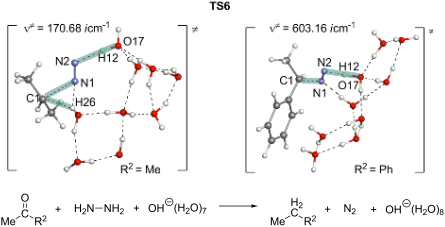
- , the ethylbenzene product was obtained and this is shown in XVIIIPh of Figure 6. Figure 7 shows energy changes of the acetophenone reaction. The rate-determining step was found to be TS5 with the activation energy, +18.04 kcal/mol. The protonation of the anion Ph–C(−)Me–N–N–H in XPh is difficult
- , because the anion character is delocalized in the phenyl ring by canonical resonance structures. The activation energy relative to the hydrazone is +26.34 (= + 18.04 − (−8.30)) kcal/mol, which is somewhat larger yet comparable to the experimental one, +22.9 kcal/mol in the solvent butyl carbitol, n-C4H9
- obtained, it was found to be unlikely because of the very large activation energy at the N2 extrusion step TS5, (xi). Second, elementary steps of OH− containing two reactions were traced, where ketones are acetone and acetophenone. These results are summarized in Scheme 7. From the ketone to the hydrazone