


Search results
Search for "interconversion" in Full Text gives 151 result(s) in Beilstein Journal of Organic Chemistry.
Phosphodiester models for cleavage of nucleic acids
Beilstein J. Org. Chem. 2018, 14, 803–837, doi:10.3762/bjoc.14.68
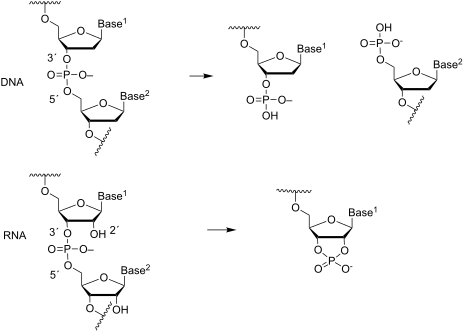
- fission of the intermediate to a 2´,3´-cyclic phosphate, leading to pH-independent cleavage, is much slower (Scheme 1). The rate of this reaction (black line in Figure 6) is only 2% of the interconversion rate of 2´,5´- and 3´,5´-diesters [44]. Studies with various uridine 3´-alkylphosphates have, however



Nucleophilic dearomatization of 4-aza-6-nitrobenzofuroxan by CH acids in the synthesis of pharmacology-oriented compounds
Beilstein J. Org. Chem. 2017, 13, 2854–2861, doi:10.3762/bjoc.13.277
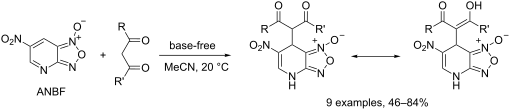
- doublets at 4.71 and 5.15 ppm (J = 2.4 Hz) corresponding to H1’ and H7 atoms were observed. Another set of signals was referred to tautomers 6b. Due to fast interconversion of these tautomers the signals of their methyl groups represent broad singlets at 2.06 and 2.40 ppm. The reaction of ANBF with 1
- that may be attributed to dioxo- and enolic forms. However, analysis of their 1H and 13C NMR spectra was quite complicated due to the broadening of the signals as a result of interconversion of tautomers. On the contrary, 1H NMR spectra in acetone-d6 are much simpler: in each case the single set of


Fluorination of some highly functionalized cycloalkanes: chemoselectivity and substrate dependence
Beilstein J. Org. Chem. 2017, 13, 2364–2371, doi:10.3762/bjoc.13.233
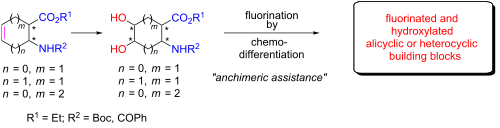
- fluorination based on hydroxy–fluorine interconversion seems to be an eloquent, simple and efficient procedure for the creation of a certain fluorinated organic molecule, regio- and stereoselectivity, stereocontrol and substrate influence remain a challenge in the case of highly functionalized frameworks


Base-promoted isomerization of CF3-containing allylic alcohols to the corresponding saturated ketones under metal-free conditions
Beilstein J. Org. Chem. 2017, 13, 1507–1512, doi:10.3762/bjoc.13.149

- by way of the latter intermediate would be occurred at the CF3-attached carbon atom to produce the corresponding allenyl type intermediate. Furthermore, its keto–enol interconversion would result in construction of the isomerized α,β-unsaturated ketones (E)-5 [4][5][6]. For a better comprehension of


Cycloheximide congeners produced by Streptomyces sp. SC0581 and photoinduced interconversion between (E)- and (Z)-2,3-dehydroanhydrocycloheximides
Beilstein J. Org. Chem. 2017, 13, 1039–1049, doi:10.3762/bjoc.13.103
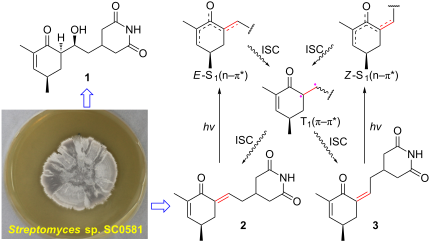
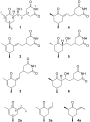
- , anhydroisoheximide (4), cycloheximide (5), and isocycloheximide (6), were obtained from the cultures of Streptomyces sp. SC0581. Their structures were elucidated by extensive spectroscopic analysis in combination with theoretical conformational analysis and ECD computations. The photoinduced interconversion between
- , anhydroisoheximide (4) [6], together with cycloheximide (5) and isocycloheximide (6) [10]. Their structures were elucidated by spectroscopic analysis, theoretical conformational analysis, and ECD/TDDFT calculations. The photoinduced interconversion between 2 and 3 was observed and verified, and the possible reaction
- path and mechanism were proposed by theoretical computations. All the isolated compounds were evaluated for antifungal activity and cancer cell toxicity. Herein are reported the isolation, structural elucidation, and biological activities of these compounds and the interconversion between 2 and 3




3D printed fluidics with embedded analytic functionality for automated reaction optimisation
Beilstein J. Org. Chem. 2017, 13, 111–119, doi:10.3762/bjoc.13.14
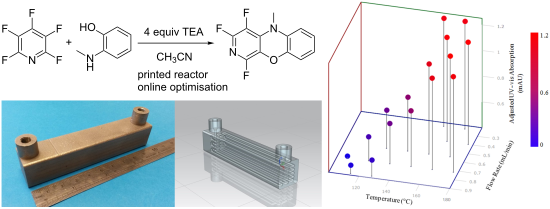
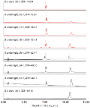
- equipment, allowing automated online and inline optimisation of the reaction medium. This set-up allowed the optimisation of two reactions, a ketone functional group interconversion and a fused polycyclic heterocycle formation, via spectroscopic and chromatographic analysis. Keywords: 3D printing; inline
- wavelengths of around 260 nm. RD1 was therefore tested using the carvone functional group interconversion previously outlined (Scheme 1) and would be fully automated, using the spectroscopic data generated from the inline flow cell as the controlling output that would run the Chemstation control macros and




Synthesis, dynamic NMR characterization and XRD studies of novel N,N’-substituted piperazines for bioorthogonal labeling
Beilstein J. Org. Chem. 2016, 12, 2478–2489, doi:10.3762/bjoc.12.242
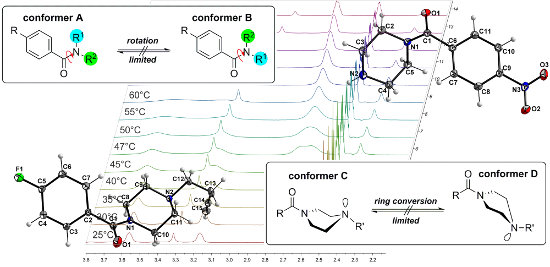
- , 49.0 ppm) are found when analyzing the 13C NMR spectra. Two effects are responsible for this behavior. The first arises from the presence of two different conformers (rotamers); this is caused by the limited interconversion by rotation about the C–N amide bond resulting from the partial double bond
- , interconversion of the amine is also reduced at room temperature. Normally, such formation of conformers is found for piperazines [21][22] and morpholines [21][23] only at lower temperatures (below −10 °C). Additionally, only the protons of 4-nitrobenzoylamides 3a, 4a and 5a exhibit this behavior at room




Mechanistic investigations on six bacterial terpene cyclases
Beilstein J. Org. Chem. 2016, 12, 1839–1850, doi:10.3762/bjoc.12.173
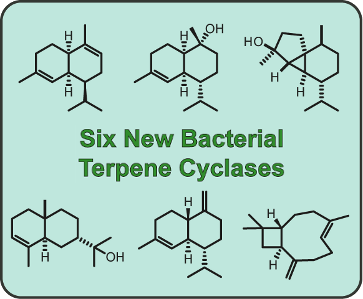
- ]. Their interconversion could be a non-enzymatic process catalysed by weak acids, e.g., during work-up, but the acid-catalysed conversion of 4a is known to give a mixture of α-, β-, and γ-eudesmol [57], but not 7-epi-α-eudesmol, which demonstrates the participation of the enzyme to fix 4a in the correct


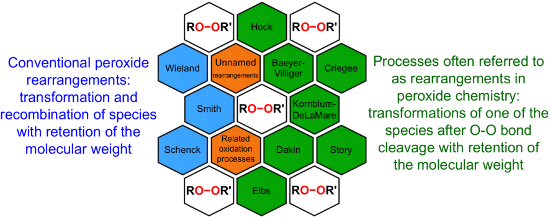
Rearrangements of organic peroxides and related processes
Beilstein J. Org. Chem. 2016, 12, 1647–1748, doi:10.3762/bjoc.12.162



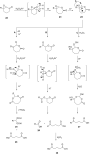


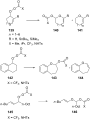


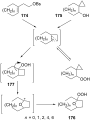


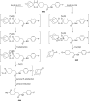


Experimental and theoretical insights in the alkene–arene intramolecular π-stacking interaction
Beilstein J. Org. Chem. 2016, 12, 1616–1623, doi:10.3762/bjoc.12.158
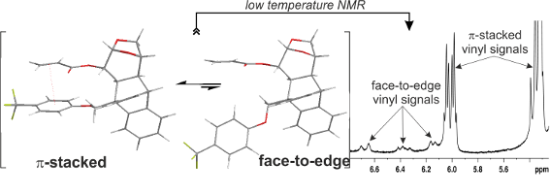
- , the energy barriers computed for the s-cis/s-trans conversion of 6a–c are low (6.3–7.5 kcal/mol), suggesting a fast equilibration even at low temperatures. On the other hand, the barriers calculated for the anti/gauche interconversion are considerably higher (14.7–16.2 kcal/mol). This slow




Biosynthesis of oxygen and nitrogen-containing heterocycles in polyketides
Beilstein J. Org. Chem. 2016, 12, 1512–1550, doi:10.3762/bjoc.12.148
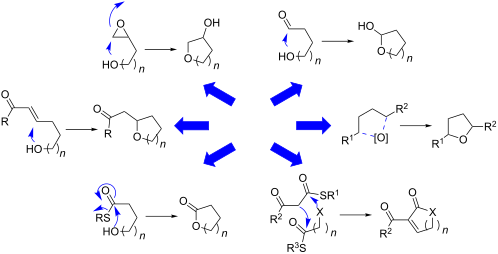
- ]. Altering of synthase specificity and thus interconversion into each other has been demonstrated [173]. 2.1.2 Michael addition–lactamisation: Glutarimides. The biosynthesis of the glutarimides proceeds similar to δ-lactone biosynthesis and has been described in chapter 1.6. 2.1.3 Dieckmann condensation




Stereodynamic tetrahydrobiisoindole “NU-BIPHEP(O)”s: functionalization, rotational barriers and non-covalent interactions
Beilstein J. Org. Chem. 2016, 12, 1453–1458, doi:10.3762/bjoc.12.141
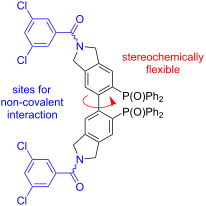
- enantiomerization as well as the half-life of isolated enantiomers. The latter are of particular importance if chiral co-ligands are cleaved off prior to catalysis and if the remaining stereochemically aligned BIPHEP complex fragment serves as the active species. Therefore, detailed knowledge of the interconversion
- crucial. In contrast to 1a and 1b, three coexisting isomeric species were observed with NMR spectroscopy in CDCl3 for tetrahydrobiisoindole “NU-BIPHEP(O)” 1c. This behaviour originates from an increased interconversion barrier between the E/Z isomers of the carbamate N–C(O) unit that is derived from a
- the corresponding author upon request. A rotational barrier of = 99.5 ± 0.1 kJ mol−1 was determined for the interconversion of 3. This is a significant increase compared to unsubstituted BIPHEP(O) ( = 88.6 kJ mol−1). Eyring plot analysis allowed the determination of the activation parameters ΔH


On the mechanism of imine elimination from Fischer tungsten carbene complexes
Beilstein J. Org. Chem. 2016, 12, 1322–1333, doi:10.3762/bjoc.12.125
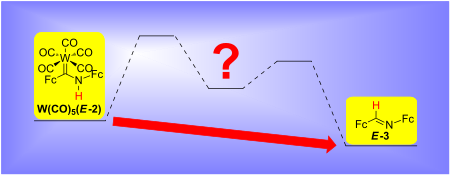
- , the 1,2-H shift in the free carbenes has been calculated as well (Scheme 3). The carbene E-2 is 23 kJ mol−1 more stable than the Z-2 isomer (Supporting Information File 1, Figure S17). The interconversion between these isomers E-2 → Z-2 (ΔG‡ = 130 kJ mol−1) proceeds via a bending vibration of the Cp–C




A modular approach to neutral P,N-ligands: synthesis and coordination chemistry
Beilstein J. Org. Chem. 2016, 12, 846–853, doi:10.3762/bjoc.12.83
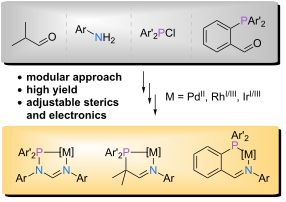
- temperature, indicating that a relatively fast interconversion of the different conformers occurs at ambient conditions. However, with increasing steric bulk of the aromatic nitrogen substituents, a substantial line broadening is observed, indicating the rise of the isomerization barrier through steric


A convenient route to symmetrically and unsymmetrically substituted 3,5-diaryl-2,4,6-trimethylpyridines via Suzuki–Miyaura cross-coupling reaction
Beilstein J. Org. Chem. 2016, 12, 835–845, doi:10.3762/bjoc.12.82
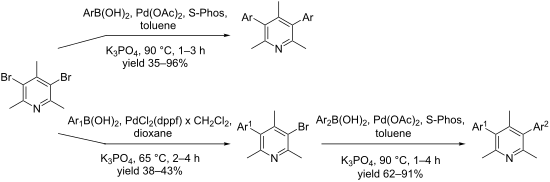
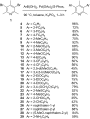
- the phenyl rings (or naphthalene ring for 26) with three methyl groups of the pyridine ring. Consequently, the inhibited rotation of the phenyl rings led to the formation of stable diastereomeric atropisomers which could be detected in NMR spectroscopy. The interconversion barrier is probably




Muraymycin nucleoside-peptide antibiotics: uridine-derived natural products as lead structures for the development of novel antibacterial agents
Beilstein J. Org. Chem. 2016, 12, 769–795, doi:10.3762/bjoc.12.77
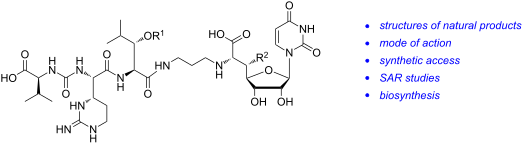
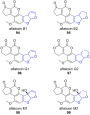
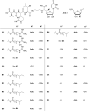
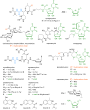
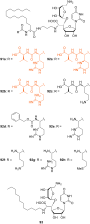
- . This strategy resulted in the bioactive analogues 95–98 (Figure 12). Analogue 95 with an interconversion of the lipid side chain and the guanidine group had a slightly reduced activity compared to lipidated analogue 92g. Analogue 96 showed an increased antibacterial activity towards some of the tested









Strecker degradation of amino acids promoted by a camphor-derived sulfonamide
Beilstein J. Org. Chem. 2016, 12, 732–744, doi:10.3762/bjoc.12.73
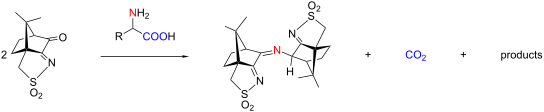
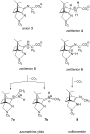
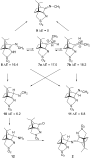
- ). We therefore expected that kinetic effects during the tautomerizations might be responsible for the observed selectivity and checked the interconversion pathways between the tautomers 7–11 which differ only in the position of one proton. Such a proton migration must of course be catalyzed, and water
- ) for possible reactions. Thus we can draw the following conclusions from the results: 1. A direct interconversion of 7a and 7b (the azomethine ylides) by rotation around the bond which connects the bicyclic ring system with the nitrogen atom appears possible (barrier of medium height). No interference
- from 7b to 8 directly, but only via isomer 7a which is formed according to 1). 3. Barriers of medium height are observed for the tautomerizations 7b → 9 + 10 + 11 and 8 → 9 + 10 + 11. No direct reaction to these products is possible from 7a, but only after interconversion to 7b according to 1. From 8





(Thio)urea-mediated synthesis of functionalized six-membered rings with multiple chiral centers
Beilstein J. Org. Chem. 2016, 12, 462–495, doi:10.3762/bjoc.12.48
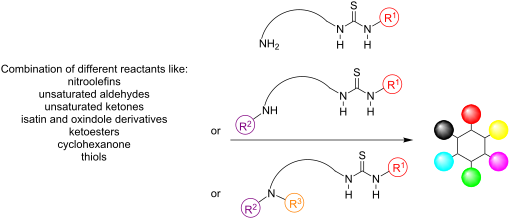
- resulted in three diastereoisomers (Scheme 62) [83]. With this in hand, they envisioned the interconversion of the kinetic products to the most stable product. In order to achieve that, they designed an one-pot two-step process, where upon completion of the tandem Henry–Michael reaction, TMG catalyzed the


Dynamic behavior of rearranging carbocations – implications for terpene biosynthesis
Beilstein J. Org. Chem. 2016, 12, 377–390, doi:10.3762/bjoc.12.41
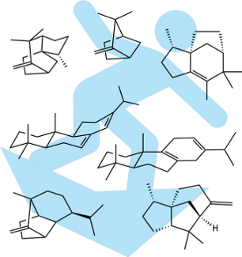
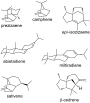
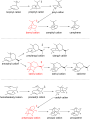
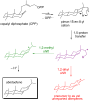
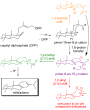
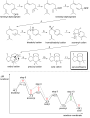
- in the pimar-15-en-8-yl cation can lead to a PTSB – one branch of which leads to the carbocation precursor to abietadiene (Figure 9, green), but the other branch of which leads to a rearranged skeleton, not yet reported for any diterpenes/diterpenoids from Nature (Figure 9, red). Interconversion of



Tandem processes promoted by a hydrogen shift in 6-arylfulvenes bearing acetalic units at ortho position: a combined experimental and computational study
Beilstein J. Org. Chem. 2016, 12, 260–270, doi:10.3762/bjoc.12.28
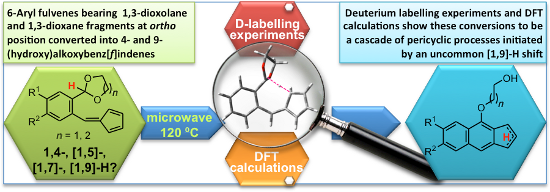
- being lower than that of 10a into 12a (13.9 and 17.0 kcal·mol−1, respectively). 4) The overall processes 3a → 5a and 3a → 6a are exothermic by 31.3 and 30.7 kcal·mol−1, respectively. The interconversion between 5a and 6a is predicted to take place via two consecutive [1,5]-H shifts at the pentagonal
- . The interconversion between the isomeric benzindenes 5a and 6a could also occur by means of two consecutive [1,5]-H shifts through an unstable benzisoindene intermediate. Conclusion The ability of benzofulvenes bearing 1,3-dioxolane or -dioxane units in ortho position for undergoing cascade processes


Versatile deprotonated NHC: C,N-bridged dinuclear iridium and rhodium complexes
Beilstein J. Org. Chem. 2016, 12, 117–124, doi:10.3762/bjoc.12.13
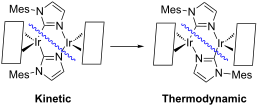
- 3H-H and 3H-T (where H-H = head-to-head and H-T = head-to-tail). By DFT calculations here we contribute in the understanding of the thermodynamics of the subsequent C,N-bridged dinuclear iridium and rhodium complexes [59], and the facility for the interconversion between these latter dimeric species
- NHC here have been studied in detail by DFT calculations. This is a contribution in the understanding of the thermodynamics of the subsequent C,N-bridged dinuclear iridium and rhodium complexes defined by Braunstein et al. [59] and the facility for the interconversion between these latter dimeric


Recent highlights in biosynthesis research using stable isotopes
Beilstein J. Org. Chem. 2015, 11, 2493–2508, doi:10.3762/bjoc.11.271
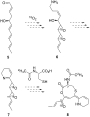
- agreement with the detection of (ring-2H5)benzoic acid in culture extracts from labeling experiments with (ring-2H5)Phe. This interconversion of two proteinogenic amino acids in the biosynthesis of an NRPS compound from secondary metabolism is unprecedented and its discovery was strongly supported by the











Biocatalysis for the application of CO2 as a chemical feedstock
Beilstein J. Org. Chem. 2015, 11, 2370–2387, doi:10.3762/bjoc.11.259
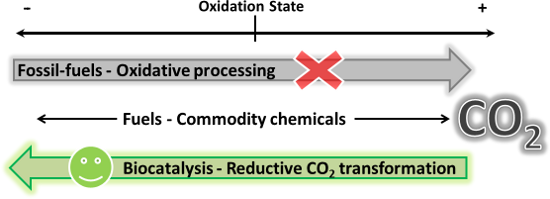
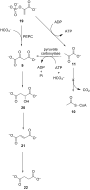
- Pyrococcus furiosus does not interfere. Decarboxylases A number of enzymes are capable of catalysing the reversible interconversion of lipophilic aromatics and the more polar respective carboxylates [12]. It is thought these reactions may proceed in the carboxylation direction as a detoxification mechanism
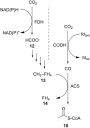
- formate and CO2 interconversion is broadly distributed in nature, irrespective of metabolic directionality, however, catalytic properties vary greatly depending on the source organism. As expected, the enzymes that naturally catalyse CO2 reduction and highly homologous FDHs from formate oxidation pathways






Structure and conformational analysis of spiroketals from 6-O-methyl-9(E)-hydroxyiminoerythronolide A
Beilstein J. Org. Chem. 2015, 11, 1447–1457, doi:10.3762/bjoc.11.157
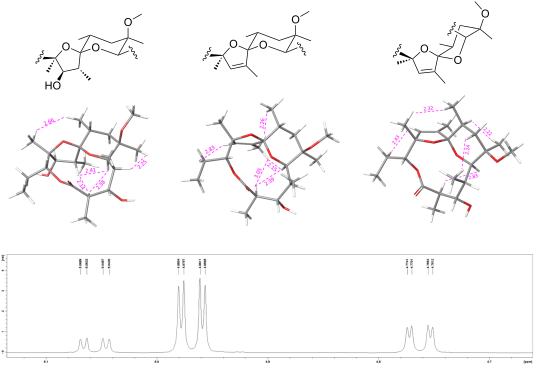
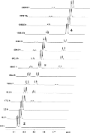
- the initial addition of 10 μL of 1 M HCl. Interconversion kinetics of compounds 2 (blue), 3 (orange) and 4 (grey). Modelling-derived structure of 3 showing key nOe interactions (calculated distances in Å). Modelling-derived structure of compound 4 showing key nOe interactions (calculated distances in




Why base-catalyzed isomerization of N-propargyl amides yields mostly allenamides rather than ynamides
Beilstein J. Org. Chem. 2015, 11, 1441–1446, doi:10.3762/bjoc.11.156
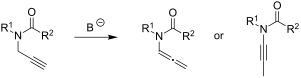
- due to thermodynamic rather than kinetic reasons, and it is not necessarily the case that ynamides are more stable than the parent allenamides. Here it is hypothesized that N-propargylamide ↔ allenamide ↔ ynamide interconversion takes place reversibly and the outcome of the reaction is related to the





