


Search results
Search for "racemization" in Full Text gives 123 result(s) in Beilstein Journal of Organic Chemistry.
Efficient and selective chemical transformations under flow conditions: The combination of supported catalysts and supercritical fluids
Beilstein J. Org. Chem. 2011, 7, 1347–1359, doi:10.3762/bjoc.7.159
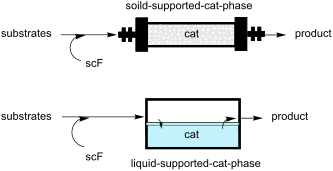
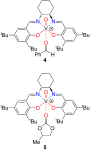
- mixture of zeolite CP811E-150 as the acid catalyst for the racemization and CALB supported on a SILLP based on bead-type PS-DVB resins [106]. Good results were obtained when the zeolite catalyst was coated with a small amount of an IL. This follows the same trend observed in the case of SILPs


Synthesis of enantiomerically enriched (R)-13C-labelled 2-aminoisobutyric acid (Aib) by conformational memory in the alkylation of a derivative of L-alanine
Beilstein J. Org. Chem. 2011, 7, 1304–1309, doi:10.3762/bjoc.7.152
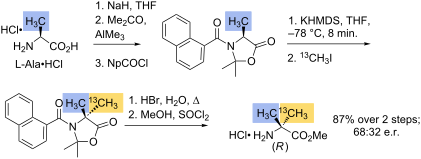
- e.r. of the products 5 and 6*) was strongly dependent on the conditions of the reaction and in particular on the time allowed between deprotonation of 3 and the addition of 13CH3I. Presumably, shorter reaction times minimise the extent of racemization of the intermediate enolate 4 [36]. Addition of


A novel high-yield synthesis of aminoacyl p-nitroanilines and aminoacyl 7-amino-4-methylcoumarins: Important synthons for the synthesis of chromogenic/fluorogenic protease substrates
Beilstein J. Org. Chem. 2011, 7, 1030–1035, doi:10.3762/bjoc.7.117
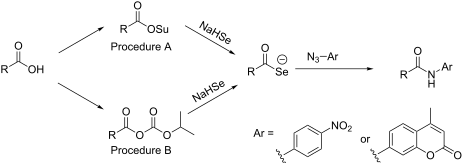
- groups such as Cbz and Pht. The use of phosphorus pentaoxide for peptide synthesis was also reported, but racemization could occur under these reaction conditions [10][11]. Phosphorus oxychloride was another condensing agent used to synthesize various N-protected aminoacyl-pNAs in yields between 70% and
- 90% [12]. The proposed mechanism implies in situ activation of carboxylic acid by formation of the active mixed anhydride with phosphorodichloridic acid. Although the authors demonstrated that the synthesis was simple and free of racemization, this method required unfavorable anhydrous pyridine as a
- racemization, it does not result in satisfactory yields. Because of these limitations of the existing methods, there is still a need to develop a generally applicable method for the synthesis of aminoacyl-pNAs. Conjugation of Nα-protected amino acids with fluorogenic 7-amino-4-methylcoumarin (AMC) is similarly

A practical two-step procedure for the preparation of enantiopure pyridines: Multicomponent reactions of alkoxyallenes, nitriles and carboxylic acids followed by a cyclocondensation reaction
Beilstein J. Org. Chem. 2011, 7, 962–975, doi:10.3762/bjoc.7.108

- form, but in methanol-d4 the equilibrium shifts completely to the pyridinol tautomer. Subsequent transformations of the prepared pyridine derivatives To prove the enantiopurity of the pyridines derived from carboxylic acids and nitriles, which are prone to racemization, i.e., substrates with tertiary
- diastereomeric compounds obtained from racemic starting materials unambiguously shows that the sequence proceeds without noticeable racemization, since 49, 50 and 51 were obtained in diastereomeric pure form (Table 2) as judged by 1H NMR analysis (estimated error 3–5%). For instance, the signal of the methoxy


Recent advances in the gold-catalyzed additions to C–C multiple bonds
Beilstein J. Org. Chem. 2011, 7, 897–936, doi:10.3762/bjoc.7.103
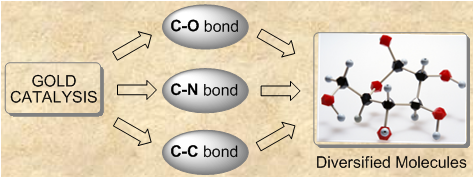
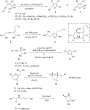
- enriched secondary propargyl alcohols led to the chiral oxetan-3-one with no apparent racemization (Scheme 20). 3 Gold-catalyzed C–N bond formations Many organic compounds containing nitrogen exhibit important biological and pharmaceutical properties. As with gold-catalyzed C–O bond formation, the directly








Metathesis access to monocyclic iminocyclitol-based therapeutic agents
Beilstein J. Org. Chem. 2011, 7, 699–716, doi:10.3762/bjoc.7.81

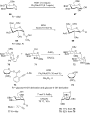
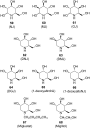
- or stereoselective epoxidation followed by regioselective epoxide opening) produced the racemic iminocyclitols (18–20) in good overall yields (Scheme 3). In addition, Blechert showed that this method was more adaptable as it could also yield enantiopure 18–20, provided that racemization was avoided
- 69 provides an attractive starting point since it reacts with organometallic reagents with a high degree of diastereoselectivity and minimal racemization. N-allylation (allyl iodide/NaH; 95% yield) of an intermediate derived from 70 gave the diolefin product 71, which was then subjected to RCM





Stereogenic boron in 2-amino-1,1-diphenylethanol-based boronate–imine and amine complexes
Beilstein J. Org. Chem. 2011, 7, 615–621, doi:10.3762/bjoc.7.72
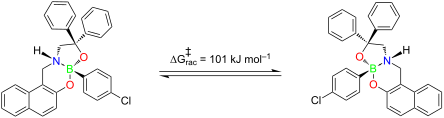
- complex 10 was established by separation of the enantiomers. Racemization barriers were found to be in the same range for both amine and imine complexes (100–110 kJ/mol). Keywords: boron; chirality; coordination chemistry; crystal structure; stereochemistry; Introduction Enantiomerism of main group
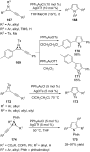
- have been able to obtain boronate–imine complexes 4 with boron as a stable stereogenic center (Scheme 1). Their racemization barrier was measured and the absolute configuration of the isolated enantiomers was determined by a comparison of the measured and calculated CD spectra [18]. In this article, we
- boronate–amine complex 10 on the other hand, the racemization barrier of the latter was determined. For this purpose, a sample of the enantiomerically pure complex 10 was heated in n-decane at 60 °C, and the decay of the optical purity was followed by chiral HPLC. Thus, the racemization rate at 325.4 K was


Complete transfer of chirality in an intramolecular, thermal [2 + 2] cycloaddition of allene-ynes to form non-racemic spirooxindoles
Beilstein J. Org. Chem. 2011, 7, 601–605, doi:10.3762/bjoc.7.70
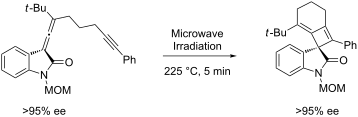
- biradical intermediate, but the tert-butyl group hinders rotation around the carbon–carbon bond as shown in Figure 4, thus slowing racemization of the resulting radical containing carbon. This hypothesis is supported by a report by Pasto, where transfer of chiral information was incomplete in a thermal




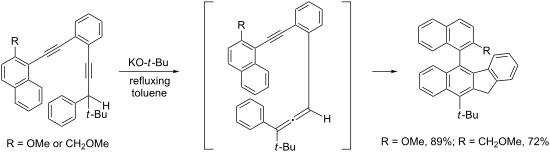
Synthesis of 5-(2-methoxy-1-naphthyl)- and 5-[2-(methoxymethyl)-1-naphthyl]-11H-benzo[b]fluorene as 2,2'-disubstituted 1,1'-binaphthyls via benzannulated enyne–allenes
Beilstein J. Org. Chem. 2011, 7, 496–502, doi:10.3762/bjoc.7.58
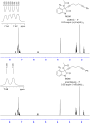
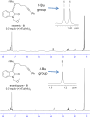
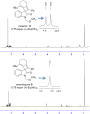
- determined to be 23.5 kcal/mol at 50 °C, corresponding to a half-life of 14.5 minutes for racemization [27][28]. Because the structure of 20a could be regarded as a 2,3,4-trisubstituted 1,1'-binaphthyl, the rate of rotation can be expected to be even slower. Again, in C6D6 recorded on a 600 MHz NMR
- , corresponding to a half-life of 4.5 hours for racemization [28]. The high stability of the configuration even at such an elevated temperature allows BINOL to be used in a variety of synthetic applications. The configurational stability of 20b and 20c, which could be regarded as 2,2'-disubstituted 1,1


Palladium- and copper-mediated N-aryl bond formation reactions for the synthesis of biological active compounds
Beilstein J. Org. Chem. 2011, 7, 59–74, doi:10.3762/bjoc.7.10
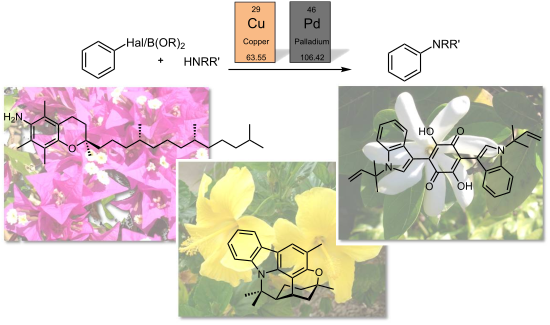
- , published at the same time, was synthesized by the coupling of L-aspartic acid (83) to aryl bromide 82 in 55% yield and 90% ee (Scheme 20). Under these reaction conditions, CuI was found to be the copper source that caused the least amount of racemization [72]. Chan–Lam arylation in the synthesis of




Thermal rearrangement of tert-butylsulfinamide
Beilstein J. Org. Chem. 2011, 7, 9–12, doi:10.3762/bjoc.7.2

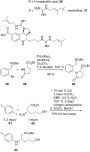
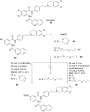
- (entry 23) or with microwave irradiation (entry 25), complete consumption of starting material was observed. In other cases (entries 4, 5, 11 and 12), 10 to 30% of the starting material was recovered without racemization. Conclusion We found that both (R and S) tert-butanesulfinamides are unstable above


Kinetics and mechanism of vanadium catalysed asymmetric cyanohydrin synthesis in propylene carbonate
Beilstein J. Org. Chem. 2010, 6, 1043–1055, doi:10.3762/bjoc.6.119
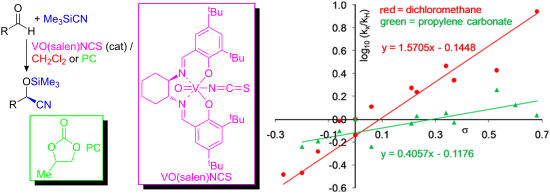
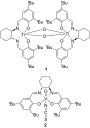
- gives unprotected cyanohydrins which are prone to racemization. Pre-eminent amongst the synthetic catalysts are metal(salen) complexes, especially those based on titanium (1) and vanadium (2) [1] (Figure 1). Titanium complex 1 will catalyse the asymmetric addition of TMSCN to aromatic aldehydes with 80
- concentration of 0.56 M. In each case, the enantiomeric excess of the cyanohydrin product was determined by chiral GC after conversion of the trimethylsilyl ether into the corresponding acetate by the method of Kagan [80], a process which is known to cause no racemization (Scheme 3). The results of this study
- hours followed by crystallization from ether/hexane. That no racemization occurred during this process was demonstrated by conversion of the mandelic acid into methyl mandelate followed analysis by chiral HPLC (data presented in Supporting Information File 1), which gave an enantiomeric excess of 81






Towards racemizable chiral organogelators
Beilstein J. Org. Chem. 2010, 6, 960–965, doi:10.3762/bjoc.6.107
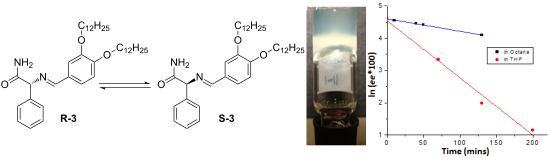
- ; organogels; racemization; self-assembly; Introduction Gelation represents a macroscopic manifestation of self-assembled molecules. Impressive supramolecular architectures have been reported in which the self-assembled molecules immobilize solvent to produce a gel phase. Carefully designed self complementary
- that these hydrogen-bonded dimers or tetramers subsequently stack via π-π interaction and via van der Waals interactions into bundled fibers. Racemization The racemization of R-3 was investigated by chiral HPLC. After adding 1 equivalent of DBU to a solution of R-3 in octane at room temperature
- , samples were collected over time and the enantiomeric purity was measured. Racemization was not observed in the gel state (5 mM) after 18 hours, whilst after heating and cooling precipitation was observed. At a concentration of 1 mM, where self-assembled fibers are present, the ee of the solution


Development of dynamic kinetic resolution on large scale for (±)-1-phenylethylamine
Beilstein J. Org. Chem. 2010, 6, 823–829, doi:10.3762/bjoc.6.97
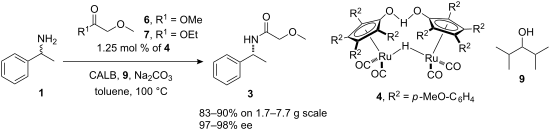
- Lisa K. Thalen Jan-E. Backvall Stockholm University, Department of Organic Chemistry, Arrhenius Laboratory SE-106 91, Stockholm, Sweden 10.3762/bjoc.6.97 Abstract Candida antarctica lipase B (CALB) and racemization catalyst 4 were combined in the dynamic kinetic resolution (DKR) of (±)-1
- donor. Keywords: dynamic kinetic resolution; kinetic resolution; racemization; Shvo; Candida antartica lipase B; Introduction Chiral amines are important building blocks in the synthesis of many pharmaceuticals, fragrances, and agricultural products, and it is therefore important to develop methods
- (CALB) as the enzyme and 4 as the racemization catalyst (See Scheme 1 for an example of the previously developed protocol with isopropyl acetate as the acyl donor providing 2 as the amide product) [12][13]. The Jacobs–De Vos group showed that palladium on an alkaline earth support in combination with an


Recent advances in carbocupration of α-heterosubstituted alkynes
Beilstein J. Org. Chem. 2010, 6, No. 77, doi:10.3762/bjoc.6.77

- pure sulfoxide was used as starting material, no racemization was detected [40]. 1-Alkynyl sulfones 38 are prone to addition of organocopper reagents. However, the stereochemistry of the resulting vinyl sulfones 39 appear to be dependent on the relative amounts of copper(I) bromide as well as the


RAFT polymers for protein recognition
Beilstein J. Org. Chem. 2010, 6, No. 66, doi:10.3762/bjoc.6.66
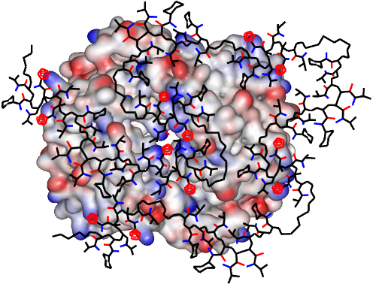
- polymer backbones. They also pose fewer racemization problems which often accompany proteinogenic amino acids in peptidic environments. In recent years, our group has developed water-soluble linear polymeric protein binders which contained one or more different binding monomers and displayed micromolar




Shelf-stable electrophilic trifluoromethylating reagents: A brief historical perspective
Beilstein J. Org. Chem. 2010, 6, No. 65, doi:10.3762/bjoc.6.65
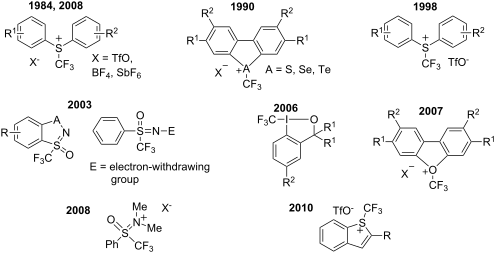
- stereoretentive CF3 transfer. High enantioselectivities in the range 93–97% were measured for the corresponding alcohols because of post-reaction racemization of aldehydes. Although the scope of this asymmetric reaction is limited to aldehydes, the level of enantioselectivity is superior to that obtained in the


Ring strain and total syntheses of modified macrocycles of the isoplagiochin type
Beilstein J. Org. Chem. 2009, 5, No. 71, doi:10.3762/bjoc.5.71
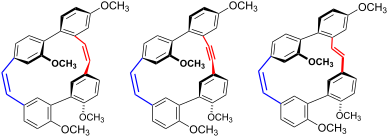
- and quantum chemical CD (circular dichroism) investigations, the absolute configuration of the first natural compound of this type, isoplagiochin C from P. deflexa, was established as (PA)-1 and the energy of racemization was calculated and measured to be 102 kJ/mol, approximately [13]. The
- stereochemical correlation between isoplagiochin C (1) and isoplagiochin D (2) was also confirmed experimentally by hydrogenolysis of enantiopure samples of (PA)-1 to give and (PA)-2 (Scheme 1), and of (MA)-1 to give and (MA)-2, respectively, without any racemization [14]. The natural compounds isoplagiochin D




The first preparative solution phase synthesis of melanotan II
Beilstein J. Org. Chem. 2008, 4, No. 39, doi:10.3762/bjoc.4.39
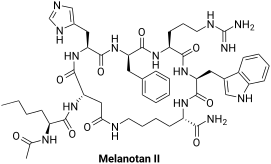
- 8-fold excess of DCC as the coupling agent and 1-hydroxybenzotriazole (HOBt) as a racemization suppressant. The yield of the cyclized product 12 was 31%, very close to the reported 30% yield for solution-phase cyclization of a related linear heptapeptide obtained by solid phase peptide synthesis [18


Synthesis of new triazole- based trifluoromethyl scaffolds
Beilstein J. Org. Chem. 2008, 4, No. 19, doi:10.3762/bjoc.4.19

- single isomer without any racemization. This compound can easily afford the free amino ester which is a promising trifluoromethyl building block for the synthesis of new triazole-based trifluoromethyl oligomers. Conclusion In summary, this paper describes the synthesis of new trifluoromethyl triazole


DBFOX- Ph/metal complexes: Evaluation as catalysts for enantioselective fluorination of 3-(2-arylacetyl)-2-thiazolidinones
Beilstein J. Org. Chem. 2008, 4, No. 16, doi:10.3762/bjoc.4.16
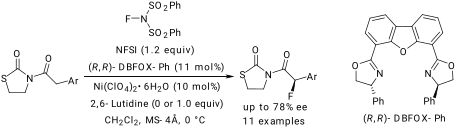
- that of Sodeoka's report [57]; this is presumably due to the low activity of our catalyst system which requires higher reaction temperature conditions (0 °C vs. −20 °C [57]). Racemization of the products 2 during the fluorination reaction was ruled out since no racemization was observed when 2a was


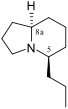
Synthesis of (–)-Indolizidine 167B based on domino hydroformylation/cyclization reactions
Beilstein J. Org. Chem. 2008, 4, No. 2, doi:10.1186/1860-5397-4-2
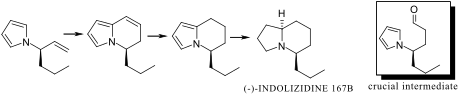
- conversions, practically the same ee, that is, the starting ee value (92%). A similar behaviour occurred for dihydroindolizine 3, its ee value remaining the same as that of the corresponding olefin 1 (ee 92%) at all reaction times. The isomerization of b into l and the absence of racemization of starting



Large- scale ruthenium- and enzyme- catalyzed dynamic kinetic resolution of (rac)-1-phenylethanol
Beilstein J. Org. Chem. 2007, 3, No. 50, doi:10.1186/1860-5397-3-50
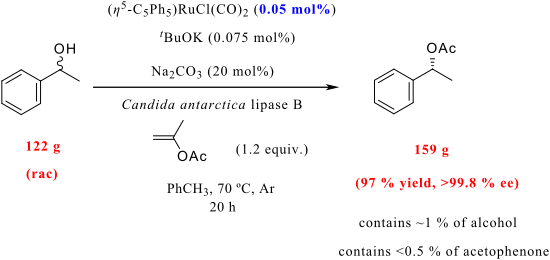
- racemization of 1-phenylethanol (2) in the presence of the immobilized enzyme, and could be used in 0.05 mol% with high efficiency. Commercially available isopropenyl acetate was employed as acylating agent in the lipase-catalyzed transesterifications, which makes the purification of the product very easy. In
- ][28] and recently this approach has been extended to dynamic kinetic resolution (DKR) by combining the enzymatic resolution with a metal-catalyzed racemization. [29][30][31][32][33][34][35][36][37] Today, many stable lipases are commercially available and they are frequently used in synthetic organic
- "in situ" racemization of the substrate using a ruthenium(II) racemization catalyst (1) at ambient temperature (Figure 1).[32][34] Many 1-arylethanols are used as intermediates for the synthesis of pharmaceuticals and agrochemicals,[40][41] and they are therefore needed in enantiomerically pure form





