


Search results
Search for "stereoisomer" in Full Text gives 174 result(s) in Beilstein Journal of Organic Chemistry.
Polyketide stereocontrol: a study in chemical biology
Beilstein J. Org. Chem. 2017, 13, 348–371, doi:10.3762/bjoc.13.39
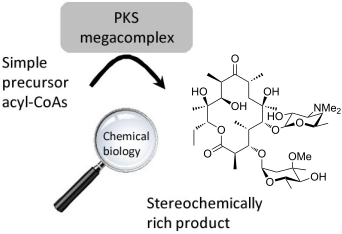
- so in principle, 1024 (210) different stereoisomers are possible. Yet, nature reliably assembles only one stereoisomer (at least at detectable levels), at once revealing the strict stereocontrol underpinning the pathway and the importance of synthesizing this particular version. Indeed, the crystal
- resulting enantiomeric materials, it was then shown by autoradiography that acylation of all six DEBS proteins is highly specific for the (2S)-isomer (7) [26], implying that the six AT domains present in the multienzymes select exclusively this stereoisomer (Figure 5). Subsequent studies in vitro with a
- . Analysis of results obtained with KRs from the DEBS [68], tylosin (Tyl) [68][72] and amphotericin [58][61] PKSs (Figure 12), showed that when the KRs selected the correct stereoisomer at the C-2 methyl position, reduction occurred almost exclusively in the native direction; the same result was obtained for


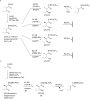


Diastereoselective anodic hetero- and homo-coupling of menthol-, 8-methylmenthol- and 8-phenylmenthol-2-alkylmalonates
Beilstein J. Org. Chem. 2017, 13, 33–42, doi:10.3762/bjoc.13.5
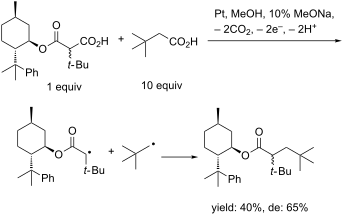
- compound 23b (Figure 2) and converting the sp3 hybridized carbon atoms C2’ and C3’ into sp2 hybrids shows that the minor stereoisomer is formed by the shielding of the re-face through the tert-butyl group. Hence the major diastereomer 23a is formed by an attack via the less shielded si-face. The same




Biomimetic synthesis and HPLC–ECD analysis of the isomers of dracocephins A and B
Beilstein J. Org. Chem. 2016, 12, 2523–2534, doi:10.3762/bjoc.12.247
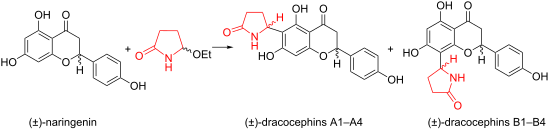
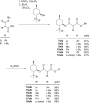
- racemates (2a, 2c/2b, 2d; 3a, 3c/3b, 3d) by HPLC–ECD analysis (Figure 1). The planar structure and absolute configuration of the first-eluted stereoisomer of dracocephins A (±)-2a–d was determined by single-crystal X-ray diffraction analysis as (2R,5”S)-2a [2]. The biosynthesis of these flavonoid
- /TZVP and CAM-B3LYP/TZVP ECD spectra of (2R,5’’R)-2d showed a better agreement with the ECD of 2a (second-eluted stereoisomer) on the basis of the agreement with the 202 nm positive CE but the negative 330 nm n–π* transition was missing from the computed ECDs. The negative 330 nm n–π* transition could
- /TZVP ECD spectra of (2R,5’’S)-2a gave a perfect agreement with the HPLC–ECD of (2R,5’’R)-2d (fourth eluted stereoisomer). All these calculation results would favor the configurational assignment (2R,5’’S)-2d (fourth eluted stereoisomer) and (2R,5’’R)-2a (second eluted stereoisomer), which, however


β-Amino functionalization of cinnamic Weinreb amides in ionic liquid
Beilstein J. Org. Chem. 2016, 12, 2372–2377, doi:10.3762/bjoc.12.231

- aziridines derived from compounds 6a-A and 6a-B, the vicinal proton coupling constants were 7.5 Hz and 4.5 Hz, respectively. Therefore, compound 6a-A was assigned as syn-stereoisomer, and compound 6a-B was assigned as anti-stereoisomer. In the 1H NMR spectra of the isolated diastereomers, an obvious and


A new and expeditious synthesis of all enantiomerically pure stereoisomers of rosaprostol, an antiulcer drug
Beilstein J. Org. Chem. 2016, 12, 2234–2239, doi:10.3762/bjoc.12.215
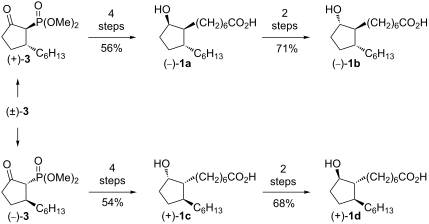
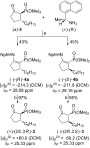
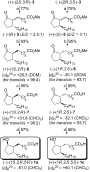
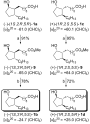
- rosaprostol (1), an antiulcer drug, were efficiently synthesized from the enantiomers of 2-(dimethoxyphosphoryl)-3-hexylcyclopentanone (3) as chiral substrates. The latter were obtained by resolution of racemic 3 with (+)-(R)-1-(1-naphthyl)ethylamine. The conversion of (+)-3 into rosaprostol stereoisomer
- (−)-1a was accomplished in four steps in 56% overall yield. According to the same protocol, the second stereoisomer (+)-1c was obtained from (−)-3 in 55% overall yield. A slightly improved procedure of the last two steps of the transformation of (+)-3 into (−)-1a allowed an increase in the overall yield
- atom and step economy. Since a detailed evaluation of the biological activity and preclinical studies requires gram quantities of each stereoisomer of 1, we sought a shorter and more efficient approach to our targets. Herein we disclose a new total synthesis of all enantiomerically pure rosaprostol



The direct oxidative diene cyclization and related reactions in natural product synthesis
Beilstein J. Org. Chem. 2016, 12, 2104–2123, doi:10.3762/bjoc.12.200
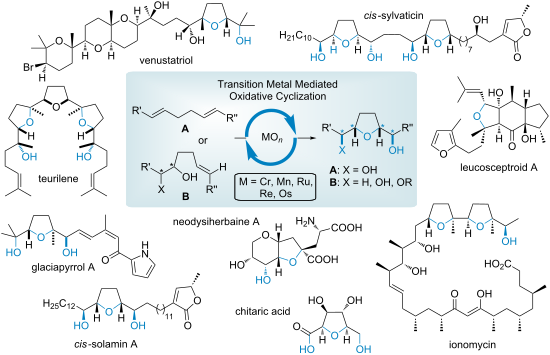
- already exist or followed [32][33][34][35][36][37][38][39]. Starting from the readily available C2-symmetric 1,5-diene 4 the 2,3,4,5-tetra-substituted THF diol 5 was obtained as a single stereoisomer with a yield of 84%, following the type A cyclization. Deprotection led to natural (+)-anhydro-D-glucitol
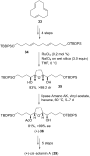
- prepared from commercially available neryl acetate (15). The auxiliary-controlled, permanganate-promoted oxidation of diene 16 proceeded selectively at low temperatures, affording the corresponding diastereomeric THF diols as an inseparable mixture (dr 7:1, major stereoisomer shown in Scheme 6). Compound
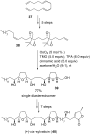
- of dienyne 57 proceeded rapidly and selectively at low temperatures, affording the corresponding diastereomeric THF diols as a separable mixture (dr 6:1, major stereoisomer shown in Scheme 13). Semi hydrogenation of the triple bond using the Lindlar catalyst gave the bis-homoallylic alcohol 58a






Chiral ammonium betaine-catalyzed asymmetric Mannich-type reaction of oxindoles
Beilstein J. Org. Chem. 2016, 12, 2099–2103, doi:10.3762/bjoc.12.199
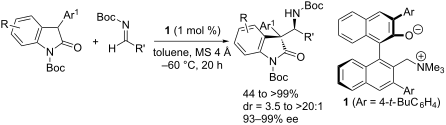
- reduced diastereoselectivity (Table 2, entries 1–4). Sterically demanding 2-tolualdehyde-derived imine 3f served as a good electrophile and the corresponding Mannich adduct 4af was isolated as virtually a single stereoisomer (Table 2, entry 5). 3-Thiophenyl aldimine 3g was also well tolerated, but a


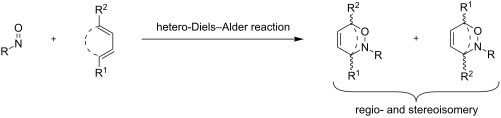
Stereo- and regioselectivity of the hetero-Diels–Alder reaction of nitroso derivatives with conjugated dienes
Beilstein J. Org. Chem. 2016, 12, 1949–1980, doi:10.3762/bjoc.12.184


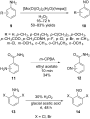


Conjugate addition–enantioselective protonation reactions
Beilstein J. Org. Chem. 2016, 12, 1203–1228, doi:10.3762/bjoc.12.116
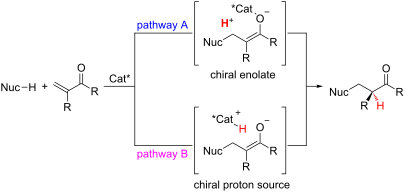
- , Frost reported that using the same catalyst system, phenyltrimethoxysilane (49a) could be added to dimethyl itaconate (50) with modest enantioselectivity and without defining the absolute configuration of the major stereoisomer (Scheme 11b) [32]. Darses and Genet reported the highly enantioselective Rh


One-pot synthesis of enantiomerically pure N-protected allylic amines from N-protected α-amino esters
Beilstein J. Org. Chem. 2016, 12, 957–962, doi:10.3762/bjoc.12.94
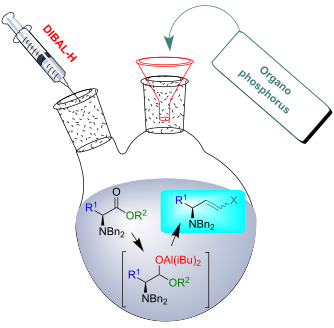
- [6] but this is the first time it is described the synthesis of its (dia)stereoisomer (Z)-2b. The olefination with the non-stabilized ylide of pentadecyltriphenylphosphonium bromide led exclusively to (Z)-2c. Likewise, the results obtained for (E)-2a, the use of stabilized ylides (Table 2, entries 3


Enantioselective carbenoid insertion into C(sp3)–H bonds
Beilstein J. Org. Chem. 2016, 12, 882–902, doi:10.3762/bjoc.12.87
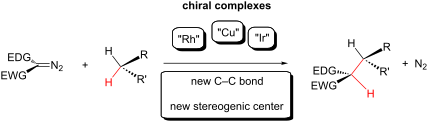
- of 5 mol % of copper chloride salt, 6 mol % of ligand 1c and 6 mol % of sodium tetrakis[(3,5-tri-fluoromethyl)phenyl]borate (NaBARF). The cyclic sulfones 52 were obtained in good yields and excellent enantiomeric excesses (85–98%) favoring the cis-1,2-di-substituted stereoisomer (Table 5). The
- authors also performed the copper carbenoid insertion reaction to yield five-membered cyclic sulfones 54, under similar experimental conditions, in moderate yields and enantiomeric excesses of the trans stereoisomer (Table 6). Independent to the size of the product, the authors emphasize the low


Muraymycin nucleoside-peptide antibiotics: uridine-derived natural products as lead structures for the development of novel antibacterial agents
Beilstein J. Org. Chem. 2016, 12, 769–795, doi:10.3762/bjoc.12.77
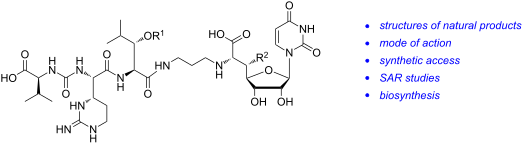
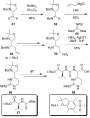
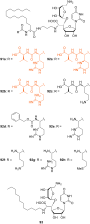
- be proven that (5'S,6'S)-GlyU 101 is the stereoisomer furnished in this reaction, so that no epimerisation at a later stage of the biosynthetic route is required for the formation of the A-90289 nucleoside antibiotics. Based on the elucidation of the LipK-mediated reaction, Van Lanen et al. then









Interactions of cyclodextrins and their derivatives with toxic organophosphorus compounds
Beilstein J. Org. Chem. 2016, 12, 204–228, doi:10.3762/bjoc.12.23
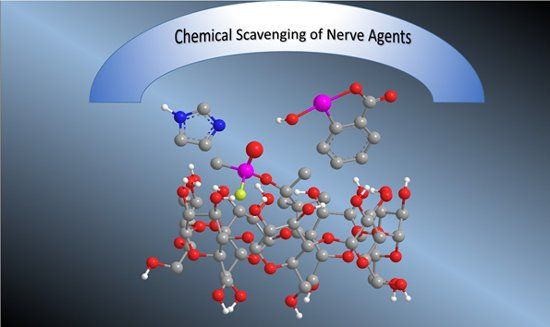
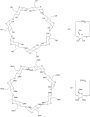
- phosphonate group for the three methylfluorophosphonates do not result in fundamental changes of the dissociation constants. However, the rather slow hydrolysis rate of P(R)-sarin can be explained by the space arrangement of this stereoisomer into the β-CD cavity. Sarin is the smallest of the three
- β-CD cavity could therefore be at the origin of the rather low reaction rate observed for this stereoisomer. Thus, in all the studies of Cabal, the P(R)-stereoisomers of soman, sarin and cyclosarin are faster hydrolyzed than the P(S)-stereoisomers in presence of CDs. Nevertheless, due to the






Organocatalytic and enantioselective Michael reaction between α-nitroesters and nitroalkenes. Syn/anti-selectivity control using catalysts with the same absolute backbone chirality
Beilstein J. Org. Chem. 2015, 11, 2577–2583, doi:10.3762/bjoc.11.277
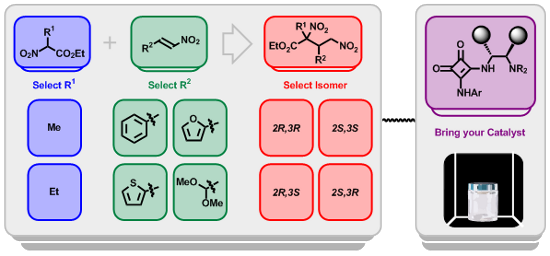
- therefore access to any stereoisomer at will from the same set of starting materials with full absolute and relative stereocontrol is not trivial. Previous reports show that the diastereoselection can be directed by different approaches that include the modification of reaction conditions [7][8][9], the


Lewis acid-promoted hydrofluorination of alkynyl sulfides to generate α-fluorovinyl thioethers
Beilstein J. Org. Chem. 2015, 11, 1902–1909, doi:10.3762/bjoc.11.205
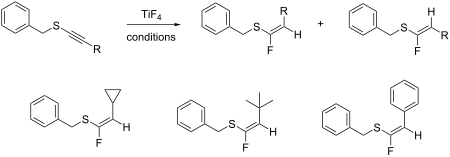
- , giving the Z-stereoisomer 2c in 45% and 57% yields, respectively. We then maintained the phenyl moiety on the alkyne side of the sulfide, and replaced the benzyl group with a cyclohexyl fragment directly connected to the sulfur atom (compound 1d). This material allowed too for a stereoselective reaction
- , giving rise to the Z-stereoisomer of 2d in 47% and 68% yields, respectively. At this stage we decided to explore two simple variations of the groups directly connected to the ethynyl moiety, that are, a cyclopropyl group and the bulky tert-butyl group. Thus, we reacted cyclopropylethynyl(phenyl)sulfane
- completely stereoselective, furnished the Z-stereoisomer 2f in 40% and 62% yields, respectively, along with a 2% of difluorinated compound 4f. The formation of this byproduct could not be avoided; in fact lower temperatures or shorter reaction times did not change the outcome, and the contaminant 4f could


Stereochemistry of ring-opening/cross metathesis reactions of exo- and endo-7-oxabicyclo[2.2.1]hept-5-ene-2-carbonitriles with allyl alcohol and allyl acetate
Beilstein J. Org. Chem. 2015, 11, 1893–1901, doi:10.3762/bjoc.11.204

- allyl alcohol (4). The plausible mechanism of the formation of ROCM and ROMP products from exo- or endo-7-oxabicyclo[2.2.1]hept-5-ene-2-carbonitriles 1 or 2. For simplicity of the scheme, the reaction of only exo-stereoisomer 1 as a substrate is presented. Results of ROCM reactions of nitriles 1 and 2


Electrochemical oxidation of cholesterol
Beilstein J. Org. Chem. 2015, 11, 392–402, doi:10.3762/bjoc.11.45
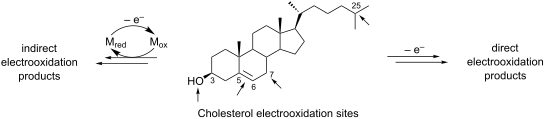
- obtained in 32, 31, and 7% yields, respectively (Scheme 4). It is noteworthy that the reaction afforded a single stereoisomer of 11 or 12. Several important observations provided in the paper can give an idea on a plausible mechanism of cholesterol oxidation. First, in the absence of HMP and O2 only


Total synthesis of the proposed structure of astakolactin
Beilstein J. Org. Chem. 2014, 10, 2421–2427, doi:10.3762/bjoc.10.252
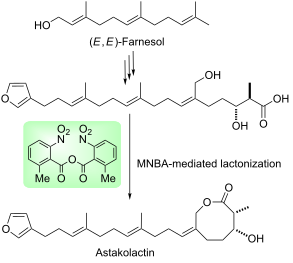
- stereoisomer (1’), with a Johnson–Claisen rearrangement, an asymmetric Mukaiyama aldol reaction, and our MNBA-mediated lactonization as key steps. It was found that the 1H and 13C NMR data of synthesized 1 and 1’ are not identical with those of the natural compound. Further studies to elucidate the complete




Photochemical approach to functionalized benzobicyclo[3.2.1]octene structures via fused oxazoline derivatives from 4- and 5-(o-vinylstyryl)oxazoles
Beilstein J. Org. Chem. 2014, 10, 2222–2229, doi:10.3762/bjoc.10.230
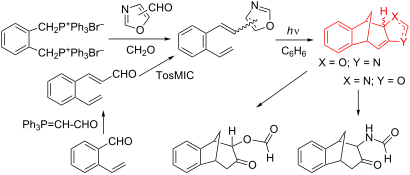
- spectrum there are 5 signals in the region from 108 to 40 ppm. The doublet at 108 ppm indicates the structure with sp2-hybridized carbon (CH(A)) and the triplet at 44 ppm indicates the existence of one geminal carbon atom. The tetracyclic oxazoline stereoisomer rel-(2S)-10 undergoes spontaneously oxazoline


Synthesis and bioactivity of analogues of the marine antibiotic tropodithietic acid
Beilstein J. Org. Chem. 2014, 10, 1796–1801, doi:10.3762/bjoc.10.188
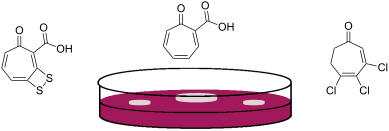
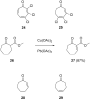
- product was sufficiently pure for its direct usage in a Diels–Alder reaction with tetrachlorocyclopropene, resulting in the adduct 19 as a single stereoisomer. The formation of only one stereoisomer is explainable by an E/Z isomerisation of 18 and a Diels–Alder reaction that only proceeds from (Z)-18, but


Streptopyridines, volatile pyridine alkaloids produced by Streptomyces sp. FORM5
Beilstein J. Org. Chem. 2014, 10, 1421–1432, doi:10.3762/bjoc.10.146
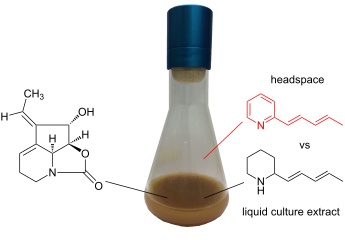
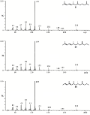
- the diastereomeric mixture of Wittig salts. Conclusively, 10 must be the last possible 1Z,3Z-stereoisomer. Both compounds 10 and 11 could not be isolated in pure form, but their mass spectra and retention times were identical to those of the natural products. The mass spectrum of compound 8 indicated


Synthesis of a sucrose dimer with enone tether; a study on its functionalization
Beilstein J. Org. Chem. 2014, 10, 1246–1254, doi:10.3762/bjoc.10.124
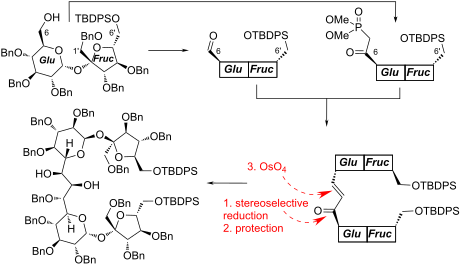
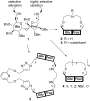
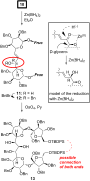
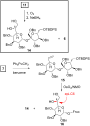
- of 10. Indeed, treatment of enone 10 with Zn(BH4)2 under the standard conditions afforded allylic alcohol 11 as single stereoisomer in 65% yield. Based on our model, the R-configuration might be safely assigned to the new stereogenic center. This assignment was further verified independently by
- circular dichroism spectroscopy (CD) using the in situ dimolybdenum methodology (see next chapter). Next steps of the synthesis consisted of the protection of the C6–OH as benzyl ether (to 12) and osmylation of the double bond. The cis-dihydroxylation provided, as single stereoisomer, a diol to which




Allenylphosphine oxides as simple scaffolds for phosphinoylindoles and phosphinoylisocoumarins
Beilstein J. Org. Chem. 2014, 10, 996–1005, doi:10.3762/bjoc.10.99
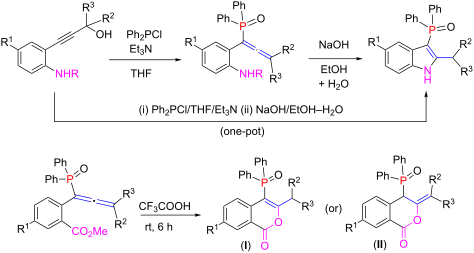
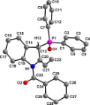
- compound 7 was further confirmed by X-ray crystallography (Figure 2). The C=CHMe distance of 1.317(2) Å clearly indicates a double bond between these two carbon atoms. The other stereoisomer in which the methyl group is trans to the nitrogen was not observed. Interestingly though, the removal of the acyl




Structure elucidation of female-specific volatiles released by the parasitoid wasp Trichogramma turkestanica (Hymenoptera: Trichogrammatidae)
Beilstein J. Org. Chem. 2014, 10, 767–773, doi:10.3762/bjoc.10.72
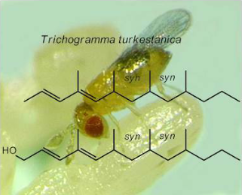
- -butyldimethylsilyl)]-β-cyclodextrin (50% in OV1701) as the stationary GC phase, operated at 100 °C. Under these conditions, the (2S,4S,6S)-enantiomer [30] is the later eluting stereoisomer, giving an α-value of (tr2:tr1) = 1.019 (see Supporting Information File 1, Figure S4). As a result of our investigations we



Synthesis of complex intermediates for the study of a dehydratase from borrelidin biosynthesis
Beilstein J. Org. Chem. 2014, 10, 634–640, doi:10.3762/bjoc.10.55
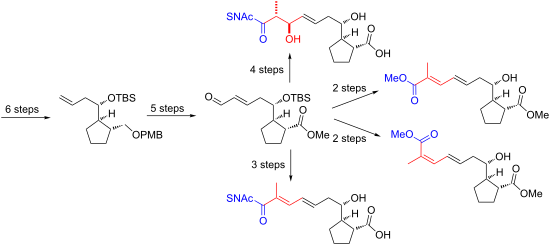
- -unsaturated aldehyde 11 in a pure form. Synthesis of DH substrate surrogate For the synthesis of the DH substrate surrogate 5a we aimed at an anti-selective aldol reaction, which permits efficient access to the desired 2D,3D-stereoisomer followed by a smooth transformation into the SNAc thioester in the





