


Search results
Search for "terminal alkyne" in Full Text gives 155 result(s) in Beilstein Journal of Organic Chemistry.
Articulated rods – a novel class of molecular rods based on oligospiroketals (OSK)
Beilstein J. Org. Chem. 2015, 11, 74–84, doi:10.3762/bjoc.11.11

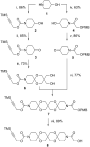
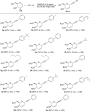
- defined a 1,2,3-triazole containing linkage between two piperidine rings as the flexible joint F, which should be easily accessible by copper-catalyzed cycloaddition between an azide G and a terminal alkyne H (CuAAC, “Click” reaction) [16]. Primary alcohols I serve as “protected” azides accessible by
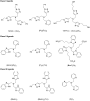
- , the PMB group was cleaved by DDQ to give the orthogonally protected trispiro rod 8 (Scheme 1). To demonstrate the capability of the approach outlined in Figure 3 we selectively activated both sides of building block 8 either by introduction of an azide group (9) or liberation of the terminal alkyne by




Synthesis of antibacterial 1,3-diyne-linked peptoids from an Ugi-4CR/Glaser coupling approach
Beilstein J. Org. Chem. 2015, 11, 25–30, doi:10.3762/bjoc.11.4
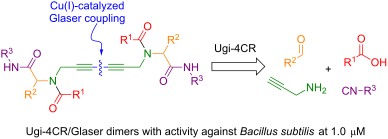
- were obtained in good yields. The next step was the copper-catalysed homocoupling (Glaser reaction) of the terminal alkyne functions. Albeit several protocols are reported for this reaction, the CuCl-catalyzed method recently described by Jia and co-workers was utilised to access the C2-symmetric 1,3


Sequential decarboxylative azide–alkyne cycloaddition and dehydrogenative coupling reactions: one-pot synthesis of polycyclic fused triazoles
Beilstein J. Org. Chem. 2014, 10, 3031–3037, doi:10.3762/bjoc.10.321
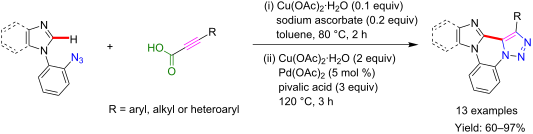
- cycloaddition, CuAAC) between an organic azide and a terminal alkyne is a well-established strategy for the construction of 1,4-disubstituted 1,2,3-triazoles [1][2][3][4]. In a recent development, this decarboxylative coupling reaction was well documented for the generation of C–C bonds [5]. This method has


A general metal-free approach for the stereoselective synthesis of C-glycals from unactivated alkynes
Beilstein J. Org. Chem. 2014, 10, 2649–2653, doi:10.3762/bjoc.10.277
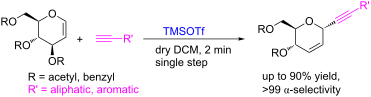
- challenge. We reasoned that the development of a strategy which in situ activates the terminal alkyne and further catalyzes the reaction without the aid of other Lewis acids might be a solution to this problem. Thus, in continuation of our efforts [36][37][38], we describe a highly stereoselective TMSOTf



A small azide-modified thiazole-based reporter molecule for fluorescence and mass spectrometric detection
Beilstein J. Org. Chem. 2014, 10, 2470–2479, doi:10.3762/bjoc.10.258
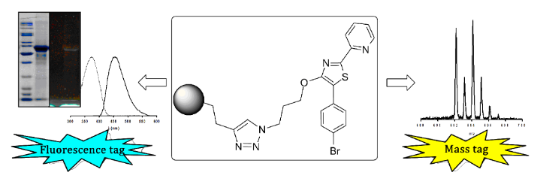
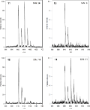
- , fluorescent and MS techniques. Conclusion We introduce the azide-modified thiazole-based reporter molecule BPT (1) with superior properties for fluorescence, UV and MS detection compared to other common reporters. BPT (1) can be easily synthesized and attached to terminal alkyne-modified molecules via CuAAC



Synthesis and solvodynamic diameter measurements of closely related mannodendrimers for the study of multivalent carbohydrate–protein interactions
Beilstein J. Org. Chem. 2014, 10, 1524–1535, doi:10.3762/bjoc.10.157
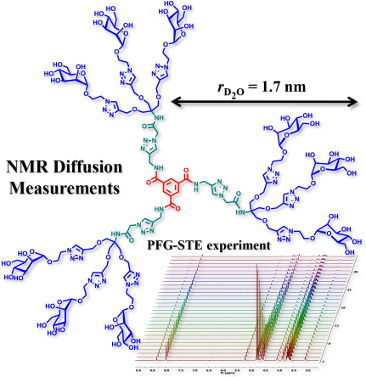
- (18H), and the terminal alkyne protons (9H) at δ 4.16, 3.87, and 2.48 ppm, respectively. Toward the last and further extended 9-mer 21, a convergent strategy was rather adopted (Scheme 4). This strategy has the clear advantages of providing an easier purification process from partially substituted end


An economical and safe procedure to synthesize 2-hydroxy-4-pentynoic acid: A precursor towards ‘clickable’ biodegradable polylactide
Beilstein J. Org. Chem. 2014, 10, 1365–1371, doi:10.3762/bjoc.10.139
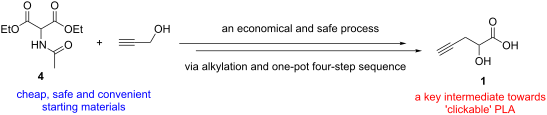
- with low cost. Malonate has a low pKa of ~13 and can be easily deprotonated and alkylated by mild bases such as sodium/potassium alkoxides without deprotonating a terminal alkyne. Conveniently, both malonate and propargyl alcohol are commercially available in bulk quantities. Herein, we report one


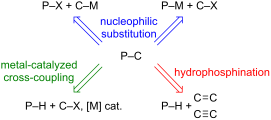
Preparation of phosphines through C–P bond formation
Beilstein J. Org. Chem. 2014, 10, 1064–1096, doi:10.3762/bjoc.10.106


Isocyanide-based multicomponent reactions towards cyclic constrained peptidomimetics
Beilstein J. Org. Chem. 2014, 10, 544–598, doi:10.3762/bjoc.10.50



Practical synthesis of aryl-2-methyl-3-butyn-2-ols from aryl bromides via conventional and decarboxylative copper-free Sonogashira coupling reactions
Beilstein J. Org. Chem. 2014, 10, 384–393, doi:10.3762/bjoc.10.36
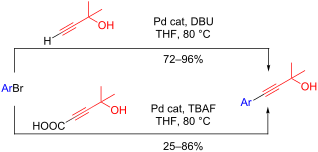
- acetylene after reductive elimination. The activated acetylide species for the coupling process is generated from the reaction of a terminal alkyne with copper in the presence of a base and is transferred on the palladium site via transmetallation. In order to improve the efficacy of the reaction, several
- derived from the starting aryl bromides in a 2–5% yield range. Likely, the acetone protecting group is cleaved from protected terminal alkyne even under such mild conditions and therefore, the terminal alkyne generated in situ couples with another molecule of the starting aryl bromide to provide the


Synthesis of 3,4-dihydro-1,8-naphthyridin-2(1H)-ones via microwave-activated inverse electron-demand Diels–Alder reactions
Beilstein J. Org. Chem. 2014, 10, 282–286, doi:10.3762/bjoc.10.24
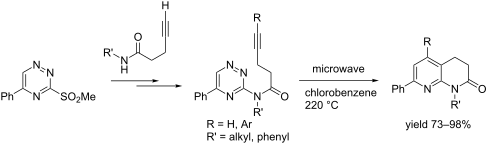
- electron-demand Diels–Alder reaction from 1,2,4-triazines bearing an acylamino group with a terminal alkyne side chain. Alkynes were first subjected to the Sonogashira cross-coupling reaction with aryl halides, the product of which then underwent an intramolecular inverse electron-demand Diels–Alder


Synthesis and biological activity of N-substituted-tetrahydro-γ-carbolines containing peptide residues
Beilstein J. Org. Chem. 2014, 10, 155–162, doi:10.3762/bjoc.10.13
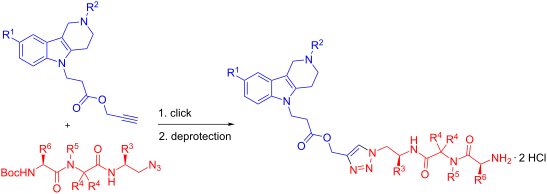
- of mitochondria but possessed some inhibitory effect on the mitochondria permeability transition. The original N-substituted-tetrahydro-γ-carbolines containing an terminal alkyne group demonstrated a high prooxidant activity, whereas their conjugates with peptide fragments slightly inhibited both
- membrane potential, mitochondrial permeability transition and lipid peroxidation. Results and Discussion The starting N-substituted tetrahydro-γ-carbolines 3a–d containing a terminal alkyne group were prepared in good yields by heating compounds 1a–d [12][13] with propargyl acrylate (2) in the presence of
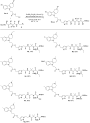
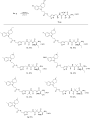
- described the conjugation of N-substituted tetrahydro-γ-carbolines containing a terminal alkyne group 3a–d with various azidopeptides 5 (prepared by Ugi multicomponent reaction) through the Cu(I)-catalyzed Huisgen 1,3-dipolar cycloaddition. The activity of the obtained compounds on rat liver mitochondria


Triphenylene discotic liquid crystal trimers synthesized by Co2(CO)8-catalyzed terminal alkyne [2 + 2 + 2] cycloaddition
Beilstein J. Org. Chem. 2013, 9, 2852–2861, doi:10.3762/bjoc.9.321
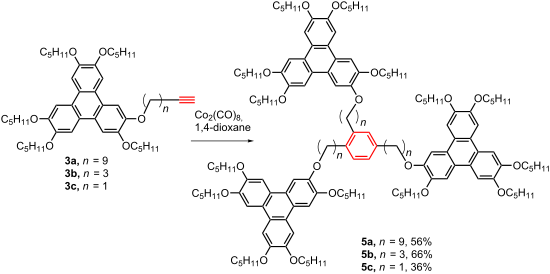
- trimers using Co2(CO)8-catalyzed terminal alkyne [2 + 2 + 2] cycloaddition reaction is reported. The trimers consist of three triphenylene discotic units linked to a central 1,2,4-trisubstituted benzene ring via flexible spacers. The trimers were synthesized in the yields up to 70% by mixing the monomers
- and stabilization of the discotic columnar mesophase. Conclusion The synthesis and mesomorphism of two new mono-functionalized triphenylene discotic monomers and four discotic trimers is reported. The trimers have been successfully synthesized for the first time by using a Co2(CO)8-catalyzed terminal
- alkyne [2 + 2 + 2] cycloaddition reaction in moderate yields. Three of the four 1,2,4-trisubstituted benzene-cored discotic trimers have shown stable Colho and Colro mesophases and wide mesophase ranges including room temperature. The connecting linker group to the triphenylene and the spacer length to


Total synthesis of the endogenous inflammation resolving lipid resolvin D2 using a common lynchpin
Beilstein J. Org. Chem. 2013, 9, 2762–2766, doi:10.3762/bjoc.9.310
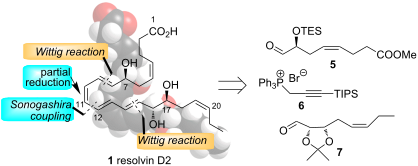
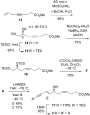
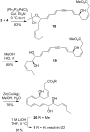
- stereoisomer analogues of RvD2 (1). Removal of the TIPS group with TBAF gave terminal alkyne 12. Alkyne 12 then underwent smooth hydrozirconation utilizing the procedure reported by Negishi [24] were ZrCp2HCl is generated in situ by reduction of ZrCp2Cl2 with DIBALH in THF. Iodinolysis of the zirconium species


Advancements in the mechanistic understanding of the copper-catalyzed azide–alkyne cycloaddition
Beilstein J. Org. Chem. 2013, 9, 2715–2750, doi:10.3762/bjoc.9.308
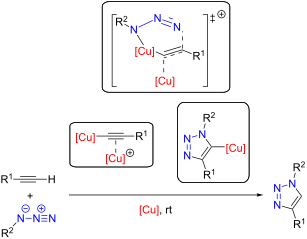
- Huisgen’s azide–alkyne cycloaddition (CuAAC reaction). In fact, the catalytic effect of copper ions had first been mentioned by L’Abbé in 1984 [7], but had henceforth been overlooked until Meldal presented a copper(I)-catalyzed solid-phase synthesis of 1,2,3-triazoles. In this procedure, the terminal alkyne




Ambient gold-catalyzed O-vinylation of cyclic 1,3-diketone: A vinyl ether synthesis
Beilstein J. Org. Chem. 2013, 9, 2537–2543, doi:10.3762/bjoc.9.288
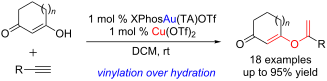
- [22]. The internal alkyne (1-phenyl-1-propyne), which was usually much less reactive than the terminal alkyne, was also tested. As expected, no reaction occurred at room temperature under the optimal conditions. To our delight, the desired products 8 were obtained while refluxing at 60 °C for 48 h


Gold(I)-catalyzed enantioselective cycloaddition reactions
Beilstein J. Org. Chem. 2013, 9, 2250–2264, doi:10.3762/bjoc.9.264
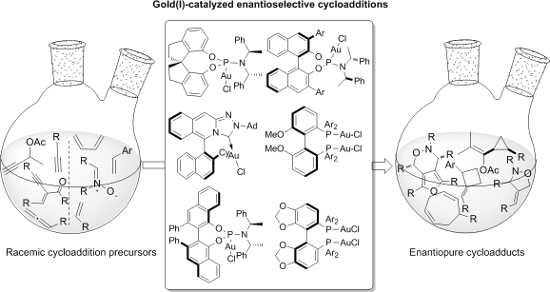
- a nucleophilic intramolecular attack of the carboxy moiety on the activated alkyne. 1,2-Migration of the ester affording a gold–carbene of type A is usually preferred when a terminal alkyne is used [38][39][40]. Based on this concept, several groups have shown that the resulting carbenoid


Gold(I)-catalyzed 6-endo hydroxycyclization of 7-substituted-1,6-enynes
Beilstein J. Org. Chem. 2013, 9, 2242–2249, doi:10.3762/bjoc.9.263
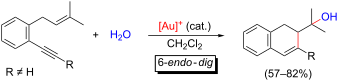
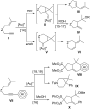
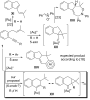
- and co-workers, as substrates in the identification of new reactivities catalyzed by gold and other transition metal complexes [5][6][7][8][9][10][11][12][13]. Cyclopropyl metal carbenes II are usually formed by exo-dig processes from enynes I bearing a terminal alkyne, which in the absence of



Gold-catalyzed glycosidation for the synthesis of trisaccharides by applying the armed–disarmed strategy
Beilstein J. Org. Chem. 2013, 9, 2147–2155, doi:10.3762/bjoc.9.252
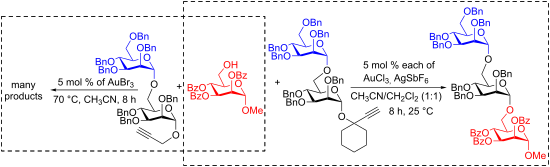
- glycosidation at ambient temperature. Accordingly, a panel of alkynylated glycosyl donors (15a–j) was synthesized and subjected to the glycosidation with three widely available gold salts, namely AuBr3, AuCl3 and HAuCl4, at 25 °C for 12 h in acetonitirile (Table 1). Substitutions at the terminal alkyne carbon


Post-Ugi gold-catalyzed diastereoselective domino cyclization for the synthesis of diversely substituted spiroindolines
Beilstein J. Org. Chem. 2013, 9, 2097–2102, doi:10.3762/bjoc.9.246
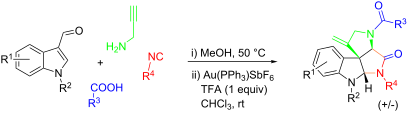
- only the R-isomer of the Ugi-adduct 5a to simplify the discussion. The cationic gold coordinates with the terminal alkyne which becomes activated for a nucleophilic attack. This can occur from both sides of the indole core. When the attack occurs from the back side of the indole core, spiro


Gold-catalyzed reaction of oxabicyclic alkenes with electron-deficient terminal alkynes to produce acrylate derivatives
Beilstein J. Org. Chem. 2013, 9, 1969–1976, doi:10.3762/bjoc.9.233
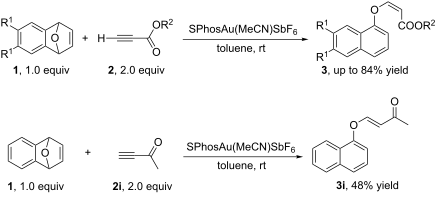
- terminal alkyne 2a, we first used PPh3AuCl as a catalyst, AgSbF6 as an additive, and toluene as a solvent to examine the reaction outcome. Acrylate derivative 3a was formed with (Z)-configuration in 11% yield (Table 1, entry 1). In this reaction, naphthalen-1-ol was also obtained with 44% yield as the
- impaired the reaction outcome (Table 3, entries 1 and 7). Increasing the steric hindrance of the ester group improved the yields of 3 (Table 3, entries 4 and 5). The usage of but-3-yne-2-one (terminal alkyne ketone) 2i as a substrate gave the corresponding 3i with (E)-configuration in 48% yield (Scheme 2
- electron-deficient terminal alkynes. The reaction with terminal alkyne 2i as a substrate. The reaction with naphthalen-1-ol (5) as a substrate. The proposed mechanism for Au(I)-catalyzed reaction. Initial screening of the reaction conditions. Further screening of the reaction conditions. Substrate scope of


Gold-catalyzed regioselective oxidation of propargylic carboxylates: a reliable access to α-carboxy-α,β-unsaturated ketones/aldehydes
Beilstein J. Org. Chem. 2013, 9, 1925–1930, doi:10.3762/bjoc.9.227
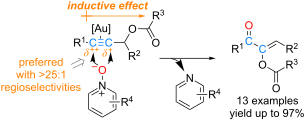
- rationalized in the next paragraph. In the case of pivalate 3c with a terminal alkyne (entry 2), the use of this bulky acyl group instead of acetyl is to curtail the hydrolytic formation of the corresponding α-ketoaldehyde. In many cases the ratios of 5-OAc and 5-H were high with IPrAuNTf2 as the catalyst; for


The application of a monolithic triphenylphosphine reagent for conducting Ramirez gem-dibromoolefination reactions in flow
Beilstein J. Org. Chem. 2013, 9, 1781–1790, doi:10.3762/bjoc.9.207
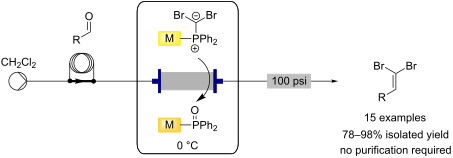
- -dibromovinyl)benzene (3) in 84% yield. Triphenylphosphine oxide (4) was also isolated from the reaction as a byproduct. These gem-dibromoolefin products are particularly important intermediates in the one carbon homologation of an aldehyde into the corresponding terminal alkyne, known as the Corey–Fuchs


A reductive coupling strategy towards ripostatin A
Beilstein J. Org. Chem. 2013, 9, 1533–1550, doi:10.3762/bjoc.9.175
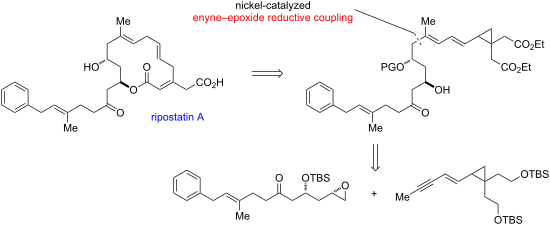
- ethylenediamine complex of lithium acetylide in a 1:1 THF/DMSO solvent mixture at 0 °C allowed the terminal alkyne to be accessed in 84% yield without rearrangement to the internal alkyne. Silyl protection afforded alkyne 50, which was prone to decomposition upon extended storage, even at −20 °C. Hydrozirconation


Preparation of optically active bicyclodihydrosiloles by a radical cascade reaction
Beilstein J. Org. Chem. 2013, 9, 1326–1332, doi:10.3762/bjoc.9.149
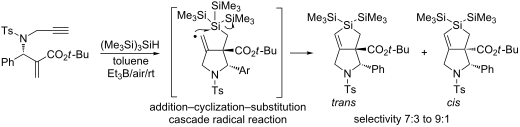
- -carbonyl radical that underwent radical cyclization to a terminal alkyne unit. The resulting vinyl radical attacked the silicon atom in an SHi manner to give dihydrosilole. The reaction preferentially formed trans isomers of bicyclosiloles with an approximately 7:3 to 9:1 selectivity. Keywords





