Search results
Search for "DMSO" in Full Text gives 1094 result(s) in Beilstein Journal of Organic Chemistry. Showing first 200.
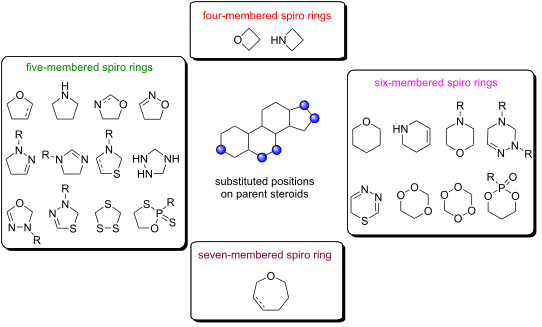
Syntheses and medicinal chemistry of spiro heterocyclic steroids
Beilstein J. Org. Chem. 2024, 20, 1713–1745, doi:10.3762/bjoc.20.152


Polymer degrading marine Microbulbifer bacteria: an un(der)utilized source of chemical and biocatalytic novelty
Beilstein J. Org. Chem. 2024, 20, 1635–1651, doi:10.3762/bjoc.20.146
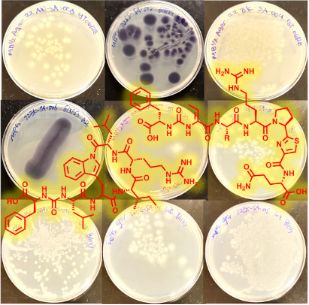
- reclassified as Saccharophagus degradans 2-40 [118]. Two additional GH18 chitinases, MtCh509 [50] and rChi1602 [79] were characterized from Microbulbifer thermotolerans DAU221 and Microbulbifer sp. BN3, respectively. MtCh509 was expressed in E. coli. Some organic solvents (benzene, DMSO, hexane, isoamyl




pKalculator: A pKa predictor for C–H bonds
Beilstein J. Org. Chem. 2024, 20, 1614–1622, doi:10.3762/bjoc.20.144
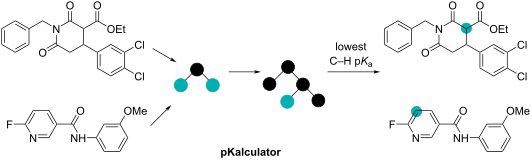
- benchmarked against 695 experimentally determined C–H pKa values in DMSO. The ML model is trained on a diverse dataset of 775 molecules with 3910 C–H sites. Our ML model predicts C–H pKa values with a mean absolute error (MAE) and a root mean squared error (RMSE) of 1.24 and 2.15 pKa units, respectively
- (DMSO) using a graph convolutional neural network (GCNN) [3]. Using a mix of experimental and computed pKa data, they achieved a mean absolute error (MAE) of 2.1 pKa units. Lee and co-workers also addressed this problem by creating a general machine learning (ML) model using either a neural network or
- and achieved a MAE of 1.5 pKa units for the solvent DMSO using XGBoost [4][5]. Unfortunately, neither the Grzybowski group nor the Lee group have made their models generally available to other users. Inspired by the efforts of the Grzybowski group and the Lee group, we have developed pKalculator, a


![[Graphic 9]](/bjoc/content/inline/1860-5397-20-144-i12.svg?max-width=637&scale=1.3000021)


Regio- and stereochemical stability induced by anomeric and gauche effects in difluorinated pyrrolidines
Beilstein J. Org. Chem. 2024, 20, 1572–1579, doi:10.3762/bjoc.20.140
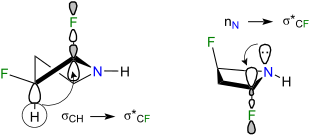
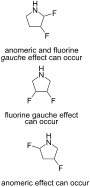
- differences did not impact the selection of the best levels based on geometry criteria. Regarding the conformational energy, 3-fluoropyrrolidine exhibited four conformers in the gas phase, although this was reduced to three in implicit DMSO experiments (Table 1). In both cases, a cis-twist ring with an axial
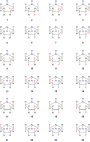
- . Consequently, a total of 10 different structures was identified in the gas phase, with two additional structures observed in implicit DMSO (using solvation model density, SMD), bringing the total to 12. Since the atomic composition of the compounds in Figure 4 was the same, the relative energy may be compared
- , and a stability landscape covering all optimized structures may be obtained from this analysis. Among these structures, only six were found to be significantly stable (<3 kcal⋅mol−1) in either the gas phase or DMSO. Remarkably, structure 19 was the most stable, followed by structure 17, as shown in





Photoswitchable glycoligands targeting Pseudomonas aeruginosa LecA
Beilstein J. Org. Chem. 2024, 20, 1486–1496, doi:10.3762/bjoc.20.132
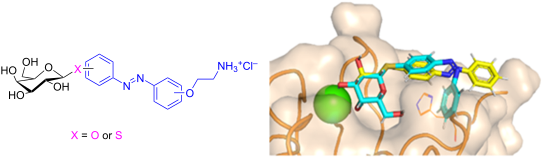
- respectively 71%, 41%, and 37% total yields (Scheme 1). Photophysical characterization The photoswitching properties of galactosyl azobenzenes 1–5 were realized in water or in Tris buffer containing 5 to 10% DMSO, in accordance with the biophysical evaluation conditions by using ITC. All these compounds
- Z/E ratios during irradiation, showing an excellent photoconversion yield of Z/E = 99:1 at PSS370, and E/Z = 87:13 at PSS485 in D2O/5% DMSO (Figure 3). As the Z-isomer is metastable, its half-life has been determined to be 44.4 h in water at room temperature (Figure S9 in Supporting Information File
- ITC200 isothermal titration calorimeter (Microcal-Malvern Panalytical, Grenoble, France). The lyophilized LecA protein was dissolved in a buffer composed of 20 mM Tris.HCl (pH 7.5), 100 mM NaCl and 100 μM CaCl2 with 5% or 10% DMSO final. All compounds were first dissolved in DMSO then in same buffer for


Synthesis of substituted triazole–pyrazole hybrids using triazenylpyrazole precursors
Beilstein J. Org. Chem. 2024, 20, 1396–1404, doi:10.3762/bjoc.20.121
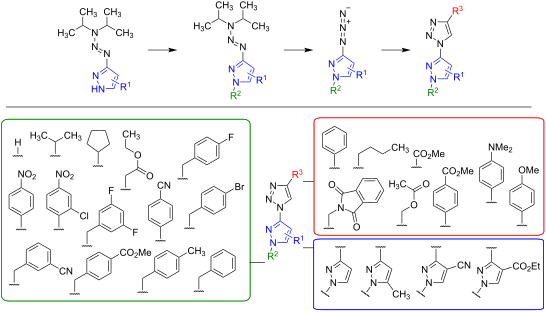
- , THF/pyridine (9:1), −20 °C to 21 °C, 12 h, b) Cs2CO3, DMSO, 120 °C, 2–3 d, c) TFA, TMS-N3, DCM, 25 °C, 12 h, d) 1. TFA, TMS-N3, DCM, 0–50 °C, 12 h; 2. alkyne, THF/H2O, CuSO4, sodium ascorbate, 16 h, 50 °C. Synthesis of triazenylpyrazoles 15a–d and functionalization to N-substituted triazenylpyrazoles




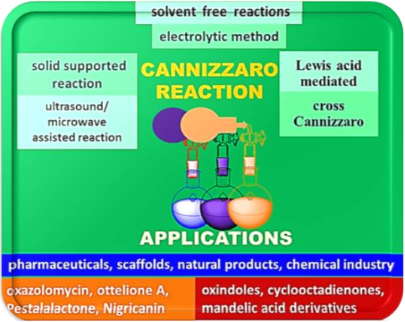
Synthetic applications of the Cannizzaro reaction
Beilstein J. Org. Chem. 2024, 20, 1376–1395, doi:10.3762/bjoc.20.120
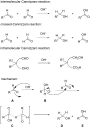
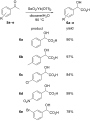
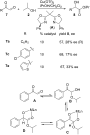
- phthalides 100, as evidenced by the per-O-methylated derivative of pestalone, a marine natural substance. Either in a Cannizarro–Tishchenko-type reaction with nucleophile catalysis (NaCN) or under photochemical conditions (DMSO, 350 nm), the transformation often proceeds without any problems in DMSO (Scheme








Sustainable tandem acylation/Diels–Alder reaction toward versatile tricyclic epoxyisoindole-7-carboxylic acids in renewable green solvents
Beilstein J. Org. Chem. 2024, 20, 1308–1319, doi:10.3762/bjoc.20.114
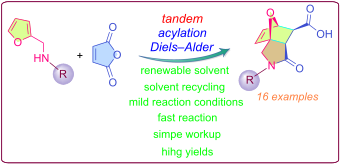
- yields and the desired stereoselectivity [59][60][61]. The viscous nature of the aminofuranes usually requires the use of toxic solvents such as toluene, and in some studies, solvents such as DMSO, which are difficult to remove from the reaction medium [62][63][64]. Although solvent effects are of little
- reaction, the acylation is followed by an intramolecular Diels–Alder reaction and the amide intermediate (a sample compound has been previously isolated and fully characterized as a result of detailed studies) is in equilibrium with the final product at room temperature in polar solvents such as DMSO
- chloroform-d (CDCl3) or hexadeuterodimethyl sulfoxide (DMSO-d6) as a solvent. Chemical shifts (δ) are reported in ppm and J values in Hertz. The elemental analyses were performed using an LECO CHNS-932 elemental analyzer (Saint Joseph, MI, USA). Representative procedure for the IMDAF reaction to afford 2a In


Competing electrophilic substitution and oxidative polymerization of arylamines with selenium dioxide
Beilstein J. Org. Chem. 2024, 20, 1221–1235, doi:10.3762/bjoc.20.105
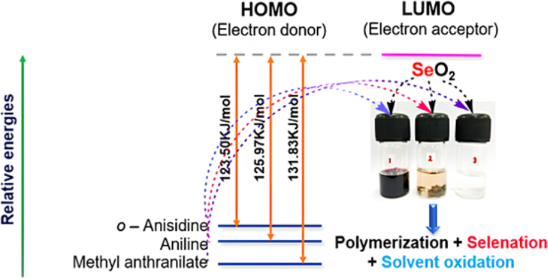
- repeated several times to obtain a sufficient amount of the mixture for 77Se NMR spectroscopy. Indeed, two major resonance signals at 371 and 296 ppm were observed in the 77Se NMR spectrum of the mixture recorded in DMSO-d6 (Figure S5, Supporting Information File 1), which could be assigned to diaryl
- )selanyl)aniline (2): Black solid (28.2 mg); 77Se NMR (95 MHz, DMSO-d6, δ) 371.2, 296.1; HRESIMS (m/z): [M + H]+ calcd for C12H13N2Se (ortho/para), 265.0238; found, 265.0229, [M + H − PhNH2]+ calcd for C6H6NSe (ortho/para), 172.0238; found, 171.9667; FTIR (KBr) ν̃max: 3436, 3354, 3220, 3026, 1595, 1490


Structure–property relationships in dicyanopyrazinoquinoxalines and their hydrogen-bonding-capable dihydropyrazinoquinoxalinedione derivatives
Beilstein J. Org. Chem. 2024, 20, 1037–1052, doi:10.3762/bjoc.20.92
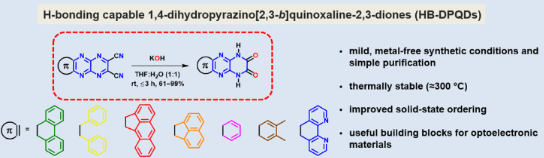
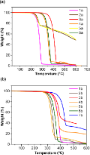
- equiv of 1,2-aceanthrylenedione, the reaction provided pure 3a product in moderate yield (41%). Subsequent recrystallization with boiling DMSO provided pristine red-brown crystals of 3a. The synthesis of DCPQ 4a was simple and proceeded with the condensation of a 1:1 mixture of acenaphthenequinone and
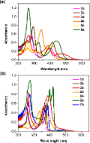
- and its high thermal stability. Optical properties The electronic properties of the DCPQs 1a–6a and DPQDs 1b–7b were explored by UV–vis absorption spectroscopy in dimethyl sulfoxide (DMSO) at 25 °C (Figure 3). The electronic absorption spectra of DCPQs exhibited structureless bands with λmax values
- this investigation [32]. Also, DPQDs displayed higher molar extinction coefficients (ε) than the corresponding DCPQs by a factor of approximately 1.4 to 5.3 in DMSO (Table 1). Furthermore, in all cases, the compounds from both families adhere to the Beer–Lambert law at the observed concentrations, as




Carbonylative synthesis and functionalization of indoles
Beilstein J. Org. Chem. 2024, 20, 973–1000, doi:10.3762/bjoc.20.87
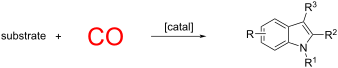
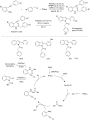
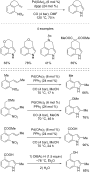
- indole derivatives were obtained by catalyzing the reaction with 5 mol % of Pd(tfa)2 (palladium(II) trifluoroacetate) and 1.5 equivalents of p-benzoquinone as oxidant in a 1:5 DMSO/MeOH solvent mixture at a temperature between 0 °C and 15 °C and, for a time between 48 and 120 hours depending on the
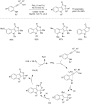
- mixture in DMSO and the reaction was carried out at 120 °C for 12 hours under a low pressure of CO (1 bar) [55]. Another version was reported by Han and co-workers, who synthesized the desired products starting from 2-(2-iodophenyl)-1H-indoles, catalyzing the reaction with Pd(OAc)2, PPh3, and K2CO3. The
- processes took place in a Schlenk tube loaded with 2.5 mol % of Pd(PPh3)2Cl2 as catalyst, 10 mol % of Cu(OAc)2 as co-catalyst, 5 mol % of PPh3 as ligand under a mixture of CO/air 7:1 in toluene/DMSO as solvent at 100 °C for 36 h. The desired products were isolated in yields up to 98% (Scheme 35). Unlike








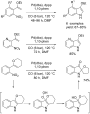


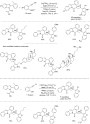


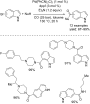
Enantioselective synthesis of β-aryl-γ-lactam derivatives via Heck–Matsuda desymmetrization of N-protected 2,5-dihydro-1H-pyrroles
Beilstein J. Org. Chem. 2024, 20, 940–949, doi:10.3762/bjoc.20.84
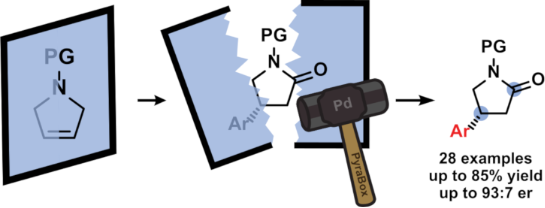
- purified compounds. Synthesis of (R)-baclofen hydrochloride (6) from 4dd and (R)-rolipram (5b) from 4de. Reaction conditions: a) 4dd (0.20 mmol, 1.0 equiv), PhSH (0.30 mmol, 1.5 equiv), K2CO3 (0.40 mmol, 2 equiv), MeCN (2 mL), DMSO (0.75 mL), 25 °C, 2 h, then 6 N HCl (0.5 mL), 100 °C, 10 h. Reaction
- conditions: b) 4de (0.105 mmol, 1.0 equiv), PhSH (0.16 mmol, 1.5 equiv), K2CO3 (0.21 mmol, 2 equiv), MeCN (1 mL), DMSO (0.4 mL), 25 °C, 2 h. Enantiomeric ratio (er) determined by high-performance liquid chromatography (HPLC) analysis of the purified compounds. A rationale for the catalytic cycle for the Heck




Synthesis and properties of 6-alkynyl-5-aryluracils
Beilstein J. Org. Chem. 2024, 20, 898–911, doi:10.3762/bjoc.20.80
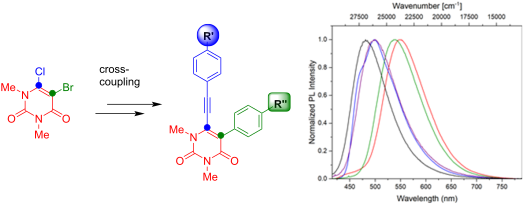
- using Pd(PPh3)Cl2 (5 mol %), CuI (5 mol %), NEt3 (10 equiv), DMSO, at 25 °C for 6 h as reaction conditions with excellent yield and selectivity. With the optimized conditions in hand, the next step was to investigate the scope and afford 3a–j. The corresponding results are depicted in Scheme 2. The
- precipitate was then filtered and dried. Representative procedure A for the synthesis of 3a–j. A mixture of 2 (1.99 mmol; 0.504 mg), Pd(PPh3)Cl2 (5 mol %; 98.3 µmol; 6.9 mg), CuI (5 mol %; 98.7 µmol; 18.8 mg) was dissolved in DMSO (5 mL) and stirred for 5 min under an argon atmosphere. NEt3 (11 equiv; 21.5
- 5. Conditions: i) Br2 (1.0 equiv), Ac2O (1.5 equiv), AcOH, 25 °C, 1 h [62]; ii) Pd(PPh3)Cl2 (5 mol %), CuI (5 mol %), NEt3 (10 equiv), DMSO, 25 °C, 6 h; iii) Pd(CH3CN)2Cl2 (5 mol %), CuI (5 mol %), NEt3 (10 equiv), 1,4-dioxane, 100 °C, 6 h; iv) Pd(PPh3)4 (10 mol %), NaOH (3 equiv), 1,4-dioxane/water




Ortho-ester-substituted diaryliodonium salts enabled regioselective arylocyclization of naphthols toward 3,4-benzocoumarins
Beilstein J. Org. Chem. 2024, 20, 841–851, doi:10.3762/bjoc.20.76
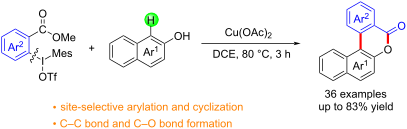
- solvents including dimethyl sulfoxide (DMSO), N,N-dimethylformamide (DMF), toluene, acetic acid (AcOH) and water (Table 1, entries 9–13) were carried out. However, polar solvents such as AcOH and H2O were proved to be unsuitable for this reaction. For catalysts, we found that Cu(OAc)2 gave the best results


Synthesis and characterization of water-soluble C60–peptide conjugates
Beilstein J. Org. Chem. 2024, 20, 777–786, doi:10.3762/bjoc.20.71
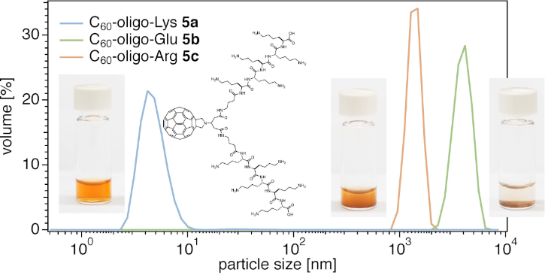
- . In addition, 5a was not highly soluble in most nonpolar solvents, including toluene and CH2Cl2, but slightly soluble in other polar solvents, including MeOH and DMSO. The solubility of C60–peptide conjugates 5a–c was in line with DLS data of the aqueous solutions or dispersions. While 5a (blue line




Synthesis of new representatives of A3B-type carboranylporphyrins based on meso-tetra(pentafluorophenyl)porphyrin transformations
Beilstein J. Org. Chem. 2024, 20, 767–776, doi:10.3762/bjoc.20.70
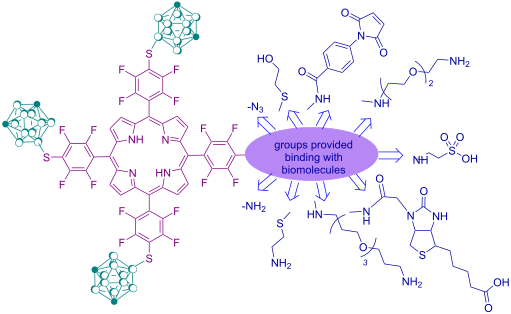
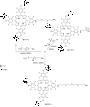
- carboranethiol was observed which is consistent with literature data [40][41]. To optimize the reaction conditions for the preparation of boronated porphyrin 5 we then performed the reaction of porphyrin 1 with mercaptocarborane 4 (molar ratio 1:4) in DMSO in the presence of anhydrous NaOAc for 1 h at ambient
- temperature under argon. Under these reaction conditions, the tris(carboranyl)-substituted porphyrin 6 was obtained in 39% yield after purification by column chromatography on SiO2 using CHCl3/hexane 1:1 as eluent (Scheme 3). It should be noted that the reaction of porphyrin 6 with NaN3 in DMSO at 20 °C for
- DMSO at room temperature for 10 min using anhydrous NaOAc as a base to afford the corresponding boronated porphyrin conjugates 18–20 in 80–87% yields. Exploring the reactivity of the p-fluorine atom similar nucleophilic substitution reactions of porphyrin 6 were carried out with 1,8-diamino-3,6


SOMOphilic alkyne vs radical-polar crossover approaches: The full story of the azido-alkynylation of alkenes
Beilstein J. Org. Chem. 2024, 20, 701–713, doi:10.3762/bjoc.20.64
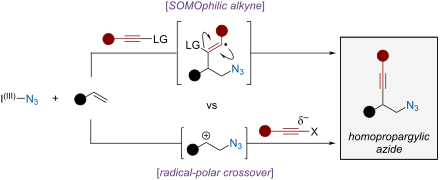
- transformation before [41][42][44], in our case only 9% of the desired product was obtained (Table 3, entry 2). A large quantity of product resulting from a Ritter-type reaction between acetonitrile and the carbocation intermediate could be observed by NMR [55]. Other highly polar solvents such as DMF and DMSO


New variochelins from soil-isolated Variovorax sp. H002
Beilstein J. Org. Chem. 2024, 20, 692–700, doi:10.3762/bjoc.20.63
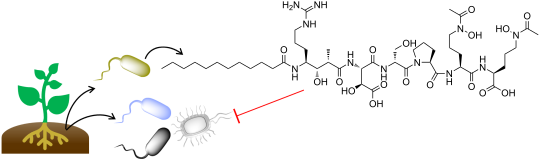
- hydrolysates were dissolved in water (160 µL), and treated with saturated NaHCO3 (200 µL) and 1% ʟ-FDLA in acetone (160 µL). The mixtures were heated at 40 °C for 30 minutes, quenched with 1 M HCl (200 µL), and concentrated in vacuo. The residue was dissolved in DMSO (400 µL) and passed through a membrane


Regioselective quinazoline C2 modifications through the azide–tetrazole tautomeric equilibrium
Beilstein J. Org. Chem. 2024, 20, 675–683, doi:10.3762/bjoc.20.61
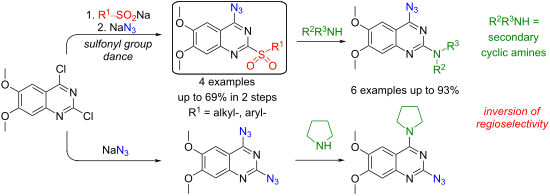
- -pot reaction was performed by adding sodium 4-methylphenylsulfinate in the first step which was followed by NaN3. As the result, the formation of hydrolysis product 5a and 2,4-diazidoquinazoline (6a) was observed. Next, the reaction 1a → 4a in DMSO yielded diazidoquinazoline 6a as a major product and
- reactivity in the SNAr reactions in comparison to polar solvents such as DMSO and DMF. This is explained by solvent hydrogen bond acidity and basicity descriptors α and β, for example, α(DMSO) = 0, β(DMSO) = 0.88, α(MeOH) = 0.43, β(MeOH) = 0.47. The rate constant of the SNAr process escalates with an
- preparation of 2-chloro-4-sulfonylquinazolines 8 (Scheme 3). The starting material 7 underwent SNAr reactions with sodium sulfinates and the C4-substituted products 8a,b were isolated [24]. The complete conversion was achieved in DMF or DMSO. In the case of sodium dodecylsulfinate, the reaction stopped at 70


Isolation and structure determination of a new analog of polycavernosides from marine Okeania sp. cyanobacterium
Beilstein J. Org. Chem. 2024, 20, 645–652, doi:10.3762/bjoc.20.57
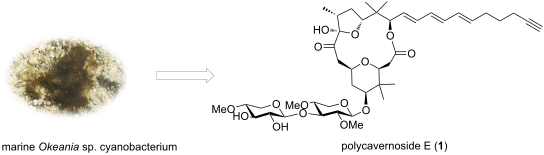
- antitrypansomal assay The bloodstream form of Trypanosoma brucei rhodesiense strain IL-1501 was cultured at 37 °C under a humidified 5% CO2 atmosphere in HMI-9 medium supplemented with 10% heat-inactivated fetal bovine serum (FBS) [8][9]. For in vitro studies, compounds were dissolved in DMSO and diluted in
- culture medium prior to being assayed. The maximum DMSO concentration in the in vitro assays was 1%. The compounds were tested in an AlamarBlue serial drug dilution assay to determine the 50% inhibitory concentrations (IC50) [10]. Serial drug dilutions were prepared in 96-well microtiter plates


Chemical and biosynthetic potential of Penicillium shentong XL-F41
Beilstein J. Org. Chem. 2024, 20, 597–606, doi:10.3762/bjoc.20.52
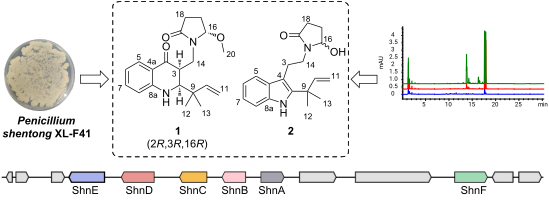
- −1; for 1H NMR (CDCl3, 600 MHz) and 13C NMR (CDCl3, 125 MHz) spectral data, see Table 1; LC–MS (m/z): [M − H]− calcd for 283.2; found, 283.2. Antimicrobial activity evaluation All isolated compounds were dissolved in 1% DMSO and introduced to pathogenic bacteria or fungi in LB or PDB media. The 96
- -well plates were incubated at 37 °C for 18 hours, with 1% DMSO serving as the negative control. After incubation, the OD600 of the bacterial cultures was measured using a Microplate Reader. HPLC analysis of small-scale fermentation with different media. More details of media, XISR I and XISR III can be




Synthesis of photo- and ionochromic N-acylated 2-(aminomethylene)benzo[b]thiophene-3(2Н)-ones with a terminal phenanthroline group
Beilstein J. Org. Chem. 2024, 20, 552–560, doi:10.3762/bjoc.20.47
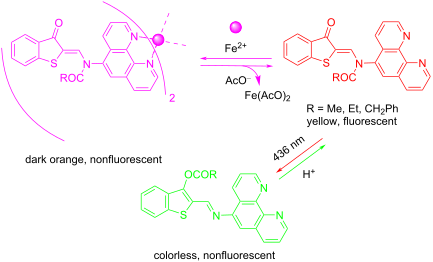
- a terminal phenanthroline receptor substituent was synthesized. Upon irradiation in acetonitrile or DMSO with light of 436 nm, they underwent Z–E isomerization of the C=C bond, followed by very fast N→O migration of the acyl group and the formation of nonemissive O-acylated isomers. These isomers
- absorption and fluorescence spectra of 2a–c were studied by the action of d-metal perchlorates (Zn2+, Hg2+, Cu2+, Cd2+, Ni2+, Co2+ and Fe2+) in acetonitrile (2a and 2b) and DMSO (2c). Exclusively Fe2+ caused an appearance of new broad long-wavelength absorption bands at 480–530 nm with a contrast naked-eye
- effect: a visually distinguishable color change of the solutions from yellow to dark orange (Figure 5). Other cations did not demonstrate a measurable effect (Figure 6). Complexes 2a–c with Fe2+ in acetonitrile and DMSO were nonfluorescent. According to spectrophotometric titration data and the isomolar


Switchable molecular tweezers: design and applications
Beilstein J. Org. Chem. 2024, 20, 504–539, doi:10.3762/bjoc.20.45




A new analog of dihydroxybenzoic acid from Saccharopolyspora sp. KR21-0001
Beilstein J. Org. Chem. 2024, 20, 497–503, doi:10.3762/bjoc.20.44
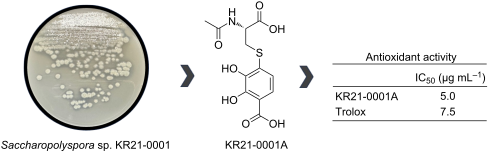
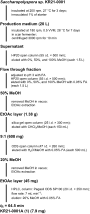
- preparative HPLC of the crude extract, 7.9 mg of 1 was obtained (Scheme 1). Table S1 (Supporting Information File 1) shows the physicochemical properties of 1, which is a yellow oil soluble in MeOH and DMSO. The UV absorption maximum of 1 was at 286 nm (ε = 10238 M−1·cm−1). The molecular formula of 1 was



Ligand effects, solvent cooperation, and large kinetic solvent deuterium isotope effects in gold(I)-catalyzed intramolecular alkene hydroamination
Beilstein J. Org. Chem. 2024, 20, 479–496, doi:10.3762/bjoc.20.43
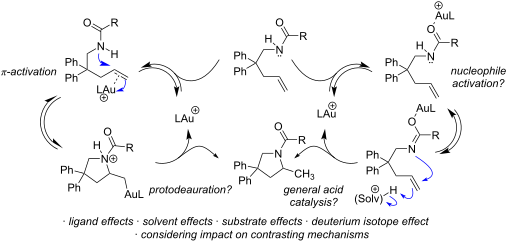
- faster the reaction. With a more strongly Bronsted acidic additive (acetic acid), rates are diminished with increasing additive. With a more polar non-protic additive (DMSO) the rate initially increases, then decreases with possible catalyst decomposition observed. Ether additives THF and dioxane have a