


Search results
Search for "chemical reactions" in Full Text gives 157 result(s) in Beilstein Journal of Organic Chemistry.
Synthesis of nucleotide–amino acid conjugates designed for photo-CIDNP experiments by a phosphotriester approach
Beilstein J. Org. Chem. 2013, 9, 2898–2909, doi:10.3762/bjoc.9.326
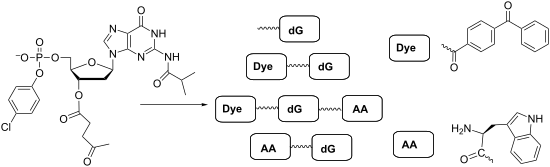
- spin hyperpolarization, which occurs in transient radical pairs on a microsecond time scale. Nuclear spin hyperpolarization is preserved in diamagnetic products of chemical reactions for several seconds allowing for NMR detection. This approach is based on the phenomenon of Chemically Induced Dynamic


Flow microreactor synthesis in organo-fluorine chemistry
Beilstein J. Org. Chem. 2013, 9, 2793–2802, doi:10.3762/bjoc.9.314
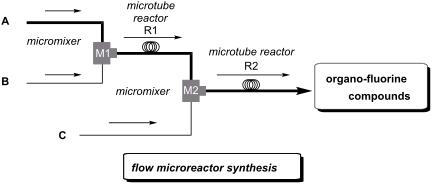
- faced with problems such as the difficulties in handling of fluorinating reagents and in controlling of chemical reactions. Recently, flow microreactor synthesis has emerged as a new methodology for producing chemical substances with high efficiency. This review outlines the successful examples of
- on the market contain fluorine atoms [6][9][10]. Despite increased demands in wide fields of science, synthesis of fluoro-organic compounds is still often faced with problems such as the difficulty in handling of fluorinating reagents and in controlling of chemical reactions. Furthermore, low
- increasingly popular method in organic chemistry [14][15][16][17]. Flow microreactor systems serve as an effective method for precise control of chemical reactions. Not only operational safety, but also extremely fast mixing, efficient heat transfer, and precise residence time control by virtue of the


A combined continuous microflow photochemistry and asymmetric organocatalysis approach for the enantioselective synthesis of tetrahydroquinolines
Beilstein J. Org. Chem. 2013, 9, 2457–2462, doi:10.3762/bjoc.9.284
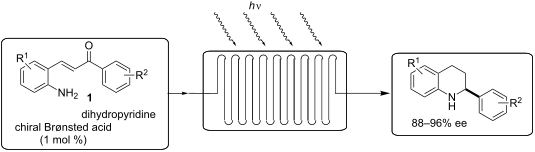
- ][11][12][13][14][15][16][17]. In the past years, continuous-flow chemistry has received considerable attention and microstructured continuous-flow devices have emerged as useful devices for different chemical reactions [18][19][20][21][22]. Microreactor technology offers numerous practical advantages


One-pot sequential synthesis of isocyanates and urea derivatives via a microwave-assisted Staudinger–aza-Wittig reaction
Beilstein J. Org. Chem. 2013, 9, 2378–2386, doi:10.3762/bjoc.9.274
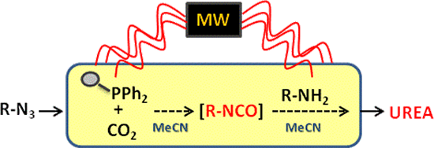
- heat and mass transfer provided by dielectric heating and sonochemical conditions [24][25]. In general, MW in organic synthesis is a valid response to problems regarding long reaction times and a high reagent excess. The use of dielectric heating to promote chemical reactions has become well


The rapid generation of isothiocyanates in flow
Beilstein J. Org. Chem. 2013, 9, 1613–1619, doi:10.3762/bjoc.9.184
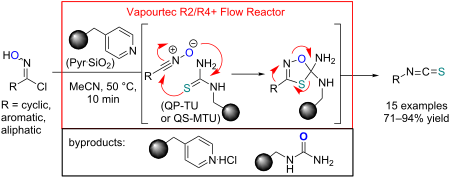
- Marcus Baumann Ian R. Baxendale Department of Chemistry, University of Durham, South Road, Durham DH1 3LE, United Kingdom 10.3762/bjoc.9.184 Abstract Isothiocyanates are versatile starting materials for a wide range of chemical reactions. However, their high nucleophilic susceptibility means they


Efficient continuous-flow synthesis of novel 1,2,3-triazole-substituted β-aminocyclohexanecarboxylic acid derivatives with gram-scale production
Beilstein J. Org. Chem. 2013, 9, 1508–1516, doi:10.3762/bjoc.9.172
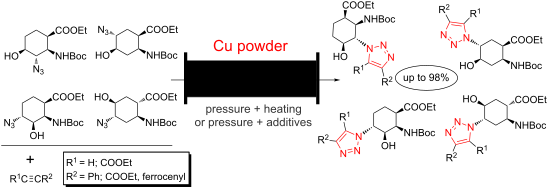
- ] and conventional batch experiments [76]. In conventional batch-based chemistry, the scale-up of chemical reactions can be a challenge because the output depends on the batch size. The situation becomes even more complicated when unstable reactants such as azides are handled on a large scale. However



Hypervalent iodine/TEMPO-mediated oxidation in flow systems: a fast and efficient protocol for alcohol oxidation
Beilstein J. Org. Chem. 2013, 9, 1437–1442, doi:10.3762/bjoc.9.162
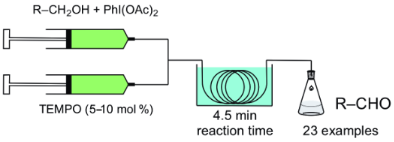
- platforms to perform reactions under continuous flow rather than in batch mode has led to improvements regarding safety and sustainability. Microreactor technology can be beneficial over classical approaches in a variety of chemical reactions. Many reactions can benefit from the properties of microreactors


Copper-catalyzed aerobic aliphatic C–H oxygenation with hydroperoxides
Beilstein J. Org. Chem. 2013, 9, 1217–1225, doi:10.3762/bjoc.9.138

- radical; 1,5-H radical shift; hydroperoxides; molecular oxygen; Introduction Aliphatic sp3 C–H bonds are ubiquitous components in organic molecules but rather inert towards most of the chemical reactions. It thus remains as one of the most challenging topics in organic synthesis to develop catalytic


Camera-enabled techniques for organic synthesis
Beilstein J. Org. Chem. 2013, 9, 1051–1072, doi:10.3762/bjoc.9.118
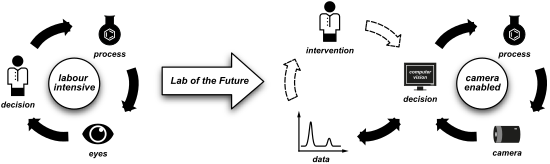
- plurality of chemical reactions in an array format (Figure 17). This system is specifically targeted at oligonucleotide synthesis where multiple reactions may frequently be performed in parallel, and so this invention included the development of optical analysis software to process the vast amount of data


Utilizing the σ-complex stability for quantifying reactivity in nucleophilic substitution of aromatic fluorides
Beilstein J. Org. Chem. 2013, 9, 791–799, doi:10.3762/bjoc.9.90
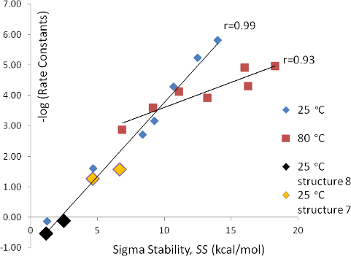
- transition states in chemical reactions, especially for predictive catalysis. It is particularly suitable for stereoselectivity calculations where there is a need to virtually screen large ligand libraries [1]. Another example are the so-called QM/MM methods [2], where part of the structure is treated with


Towards a biocompatible artificial lung: Covalent functionalization of poly(4-methylpent-1-ene) (TPX) with cRGD pentapeptide
Beilstein J. Org. Chem. 2013, 9, 270–277, doi:10.3762/bjoc.9.33
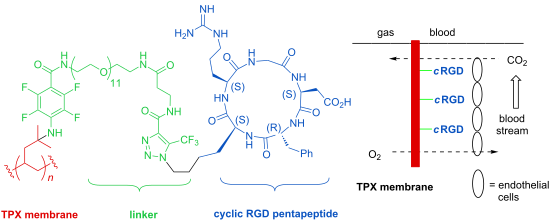
- pentapeptide 1b the cycloaddition product 8a was formed in the absence of any additives (Scheme 2). Prior to chemical reactions carried out with modified TPX materials, all reactions were first probed in solution (see Supporting Information File 1, section 2D). In order to analyze the outcome of 1,3-dipolar


A chemist and biologist talk to each other about caged neurotransmitters
Beilstein J. Org. Chem. 2013, 9, 64–73, doi:10.3762/bjoc.9.8
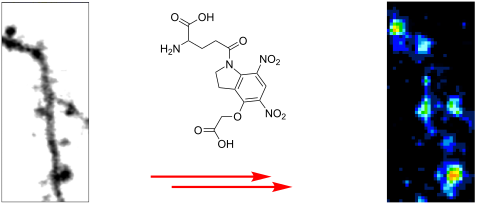
- called a rate. The former is simply a way of measuring the quantum yield by determining the half-time (hence “rate”) of photolysis under some set of defined irradiation conditions. However, even with the former measurement care must be taken. The chemical reactions of release can be quite complex, so the


Cyclodextrin-based nanosponges as drug carriers
Beilstein J. Org. Chem. 2012, 8, 2091–2099, doi:10.3762/bjoc.8.235
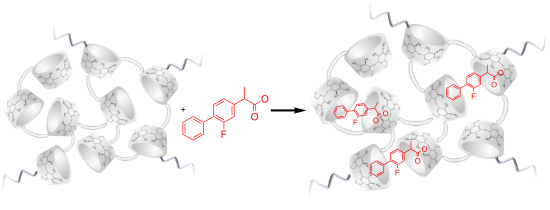
- and makes it possible to obtain an efficaciously supported catalyst to promote chemical reactions and aid the destruction of chemical pollutants (detergents, POPs abatement) as well as biosensors. Nanosponges can also be used in agriculture and have shown the interesting characteristic of


Impact of cyclodextrins on the behavior of amphiphilic ligands in aqueous organometallic catalysis
Beilstein J. Org. Chem. 2012, 8, 1479–1484, doi:10.3762/bjoc.8.167
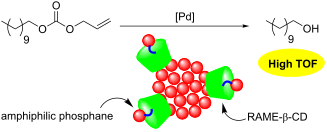
- and water especially appeared to be an effective solution to limit the environmental impact of chemical reactions [1][2][3]. Although these media all display eco-friendly characteristics such as non-flammability and chemical stability, water has an additional advantage of being cheap, nontoxic and


The use of glycoinformatics in glycochemistry
Beilstein J. Org. Chem. 2012, 8, 915–929, doi:10.3762/bjoc.8.104
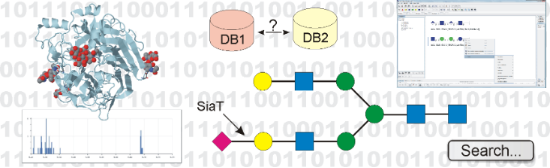
- analysis of carbohydrates and other glyco-related experiments. The protocols include step-by-step instructions, references, and features to rate the protocols or to post related questions. Another resource with a special focus on glycochemistry is GlycoNavi, which is a database of chemical reactions that

Recent developments in chemical diversity
Beilstein J. Org. Chem. 2012, 8, 827–828, doi:10.3762/bjoc.8.92
- participating contributions in the Thematic Series, involves the development of novel reaction methodologies as a means to access or discover new “chemotypes”. In this way, organic chemists are empowered by the paradigm of “chemical diversity as a function of novel chemical reactions”. “Recent developments in
On the mechanism of action of gated molecular baskets: The synchronicity of the revolving motion of gates and in/out trafficking of guests
Beilstein J. Org. Chem. 2012, 8, 90–99, doi:10.3762/bjoc.8.9
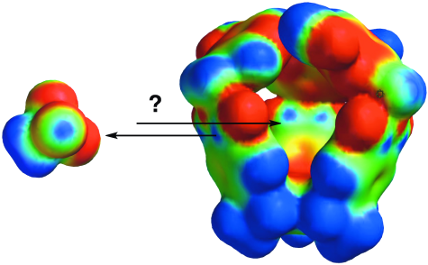
- gated basket. The greater the affinity, the less effective the gates are in “sweeping” the guest as the gates undergo their revolving motion. This result is important for exploring the utility of gating for controlling the outcome of chemical reactions occurring in confined space but also for the


Unusual behavior in the reactivity of 5-substituted-1H-tetrazoles in a resistively heated microreactor
Beilstein J. Org. Chem. 2011, 7, 503–517, doi:10.3762/bjoc.7.59
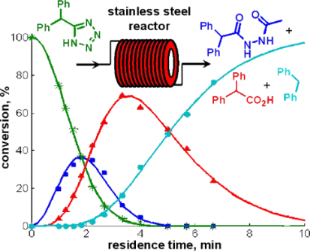
- decomposition described earlier, reaction pressure apparently had no significant influence, there are some transformations that can potentially be influenced by reaction pressure under these flow conditions. In general, the rate and equilibrium of many chemical reactions can be influenced when pressures in the


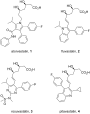
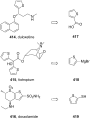
An overview of the key routes to the best selling 5-membered ring heterocyclic pharmaceuticals
Beilstein J. Org. Chem. 2011, 7, 442–495, doi:10.3762/bjoc.7.57





Formation of epoxide-amine oligo-adducts as OH-functionalized initiators for the ring-opening polymerization of ε-caprolactone
Beilstein J. Org. Chem. 2010, 6, 938–944, doi:10.3762/bjoc.6.105
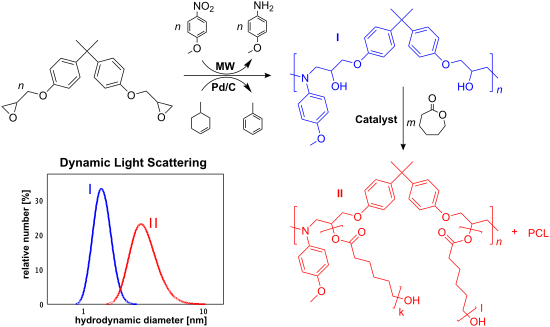
- ) irradiation in organic, pharmaceutical and polymer chemistry has become a well-established technique to promote chemical reactions. In many cases, the main advantages of this physical heating method over traditional heating in an oil bath are increases in reaction speed, product yields and purity [1][2][3][4


Chromo- and fluorophoric water-soluble polymers and silica particles by nucleophilic substitution reaction of poly(vinyl amine)
Beilstein J. Org. Chem. 2010, 6, No. 79, doi:10.3762/bjoc.6.79
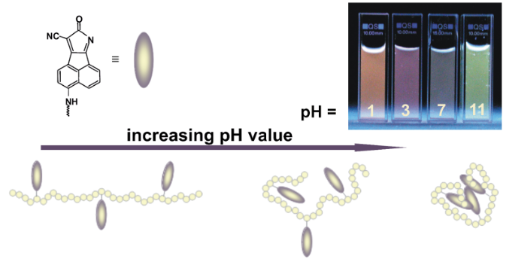
- has been found to be suitable because of its higher solubility in water compared to β-cyclodextrin (800.5 g L−1 vs. 18.5 g L−1) [27][28][29]. Chemical reactions between two incompatible reactants can also be achieved under heterogeneous reaction conditions (the reaction is localized at the interphase




Synthesis in the glycosciences
Beilstein J. Org. Chem. 2010, 6, No. 16, doi:10.3762/bjoc.6.16
- presented in this series. Furthermore, carbohydrate chemistry is presented in the context of chemical biology together with organic chemistry making use of known chemical reactions as well as the stereochemical advantages of saccharides to construct novel molecules with unique properties. It has been a joy
Flow through reactors for organic chemistry: directly electrically heated tubular mini reactors as an enabling technology for organic synthesis
Beilstein J. Org. Chem. 2009, 5, No. 70, doi:10.3762/bjoc.5.70
- ]. In many cases shorter reaction times have been reported compared to the traditional heating methods. The question of a specific microwave effect is under current discussion, but for many chemical reactions it is evident that microwave heating is just another way transferring heat into the reaction
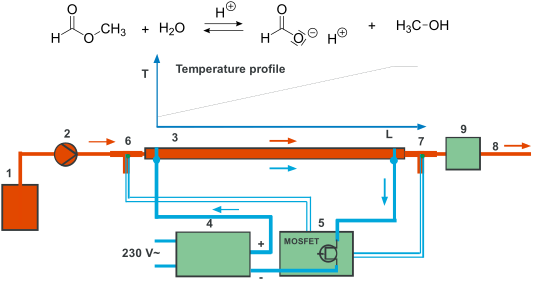
- operated mini reactor for chemical reactions using readily available laboratory equipment. In this sense it is an enabling technology allowing the use of continuous reactors at low cost, enlarging the portfolio of enabling technologies for organic synthesis [27]. Performing a simple organic reaction
- determined. The system gives the opportunity to adjust accurately high heating rates with traditional resistive electric heating. This feature makes the device a tool well suited to compare the influence of heating rates on chemical reactions. Further studies will focus on the comparison of heating within


Hydroxyapatite supported caesium carbonate as a new recyclable solid base catalyst for the Knoevenagel condensation in water
Beilstein J. Org. Chem. 2009, 5, No. 68, doi:10.3762/bjoc.5.68

- . Thus, the use of aqueous solvents in chemical reactions has proved a cleaner and safer alternative to organic solvents [2]. Heterogeneous catalysis, which has the immediate advantage of easy recoverability and recyclability of the catalyst – sometimes with the further advantage of increased selectivity


Can we measure catalyst efficiency in asymmetric chemical reactions? A theoretical approach
Beilstein J. Org. Chem. 2009, 5, No. 67, doi:10.3762/bjoc.5.67
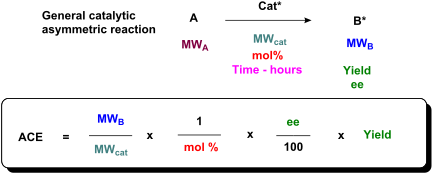
- such a comparison. We propose that a catalyst is more efficient if fewer atoms are utilised to give a product in a required enantiomeric excess. We illustrate this concept by analysing several well-known asymmetric catalytic chemical reactions carried out in academic laboratories, and compare small





